Cruise Ships Are Improving Environmental Management Says SGS
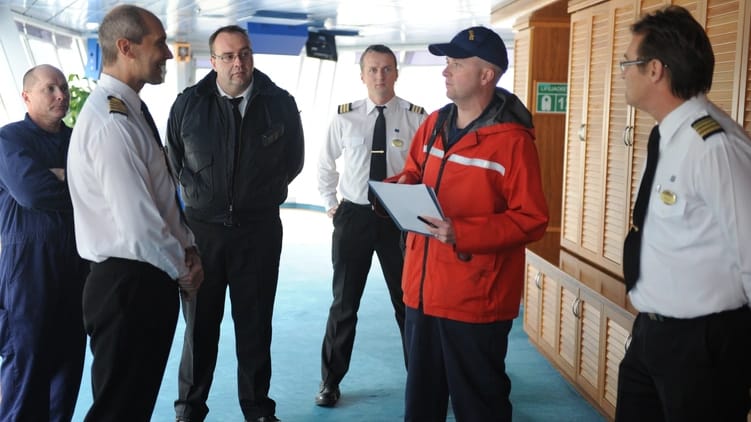
The growth of the cruise industry in the post-COVID-19 pandemic era has created increased awareness of maintaining a healthy environment for travelers. The trade group Cruise Lines International Association (CLIA) predicts that close to 40 million people will take a cruise in 2027. Keeping those folks safe from environmental health issues while onboard has emerged as a major business opportunity for SGS Marine Services.
SGS (General Society of Surveillance), founded in 1878 by Henri Goldstuck, is a global company based in Geneva, Switzerland. It offers a multitude of testing, inspection, and certification services for industries such as agriculture, forestry, building infrastructure, consumer products and retail, cosmetics, cybersecurity, and technology. Marine services for the rapidly growing cruise industry are one of its newest additions.
Robert Goldring, SGS’s Manager of Global Sales, said he started the company’s move into the cruise sector in 2000 when more industry regulations started coming into effect. SGS now works with approximately 85 percent of the world’s cruise lines.
“It is a huge program,” said Goldring. “It started with one cruise line, Norwegian Cruise Line, in 2000. They had an inkling that regulations were coming, and they did, so we started with one company, and I brought it into the SGS world, and we call it SGS Marine Services.
“The things we focus on are regulations from the general vessel permit, which is a set of regulations that came from the Environmental Protection Agency (EPA) specifically for large ships to control their discharges, and that includes ballast water testing and water treatment plants on board the ship. We also do public health testing such as Legionella testing. Actually, Legionnaires' disease (a serious lung infection) propelled it (testing), and a lot of the cruise lines are doing it now.”
Goldring said SGS has expanded its program for Legionella testing “because we now have our labs on a global scale. They are certified by the CDC (Centers for Disease Control),” for an elite testing program.
Legionella is a particular bacterium that grows within water systems, especially closed systems, such as in air conditioning units. What happens is that it can become airborne in water vapor. It can also be in showerheads and in whirlpools.
Goldring believes the regulations for the safety of ships’ passengers and crew are constantly improving for a cruise industry that is showing rapid growth.
“It is growing like crazy, so I would say that between the U.S. Coast Guard, which is now in the process of taking over these regulations from the EPA under what is called VIDA (Vessel Incident Discharge Act), the EPA, and the IMO (International Maritime Organization), they are doing a pretty good job keeping up with environmental protections for the oceans from large vessels. We do trade vessels as well,” he adds.
Overall, Goldring feels the public is safe from various environmental aspects SGS has to deal with, but there are always things some cruise lines need to address better. He says some cruise lines are better than others.
“I would say in general, the environmental protection of the passengers is very good. Sometimes they run into situations, for example, where they may be painting a section of the ship with varnish, which is very toxic, and fumes get inside the “skin” of the ship, as we call it. People get sick from this, so that is a problem,” but he believes a lot of the cruise lines and trade vessels as well are addressing this issue.
SGS Marine Services also has a program called “crew wellbeing,” where it goes on the ship and takes a survey on how well the crew and passengers are being protected. Goldring says they have done it for two clients now, and that it is what they are involved with now.
“A good example was when I went up to the Lido deck of a ship where they have their buffet and everything. They had just recently painted in the eating area, and it was not dry. They had signs that said, ‘Do Not Touch. Wet Paint.’ The fumes from the paint, however, would go into the food, and we call that cross-contamination, and that is a very big thing. People probably shrug it off and say, ‘How can that hurt me?’ but you have volatile fumes in the air that land on the food and then go into your body. This is one example of how these companies and cruise lines have to be aware,” said Goldring.
When SGS technicians do their work on a ship, they look at approximately 20 things. “We are doing temperatures, crew wellbeing, and actually talking to crew, noise evaluations, and how many decibels the crew and passengers are exposed to. We will go into crew and passenger cabins and test to see how much mold is in the air. We test the showers and showerheads and water faucets for Legionella,” he said.
In addition to the larger ships, cruise lines have their own private islands, and SGS sends technicians to test the water around these locations. “You have people swimming in water close to shore, and it has to be free of bacteria, fecal coliform, etc., plus they also have sewage treatment systems on the islands, and they have to discharge somewhere. So the water they are discharging is tested as well,” said Goldring.
With the size of cruise ships constantly growing, SGS Marine often sends two or even three field technicians to do the testing.
In general, the SGS spokesman feels cruise lines are “doing a very good job, some do more than others,” adding that SGS Marine Services also carries out “ballast water testing, which is important for the oceans. If their (ballast) system is not working well, they are discharging things that are killing fish.”
Construction is Underway on More Giants for Cruising
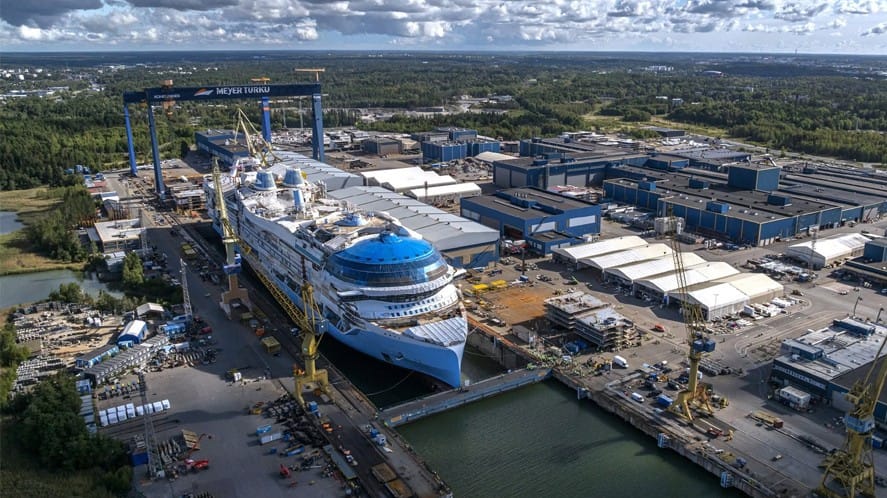
The pace of construction on the next generation of ultra-large cruise ships is gaining momentum. The ships are being floated out of their assembly docks and going on sea trials, while steel cutting and block assembly are already underway for even more of the giants.
For years, Royal Caribbean International’s two Oasis-class ships at 225,000 gross tons were the outliers, with none of the large, contemporary segment cruise lines willing to jump the 200,000 gross ton milestone. Imaginative concepts were presented, such as Kloster’s World City (proposed at 250,000 GT), but the lines continued to build ships in the 150,000 to 180,000 gross ton range.
Changing economics and the need to make space for even more amenities, however, are changing that. Currently, there are a dozen ships exceeding the 200,000 GT milestone, as MSC Cruises surpassed the mark and now Disney Cruise Line, which acquired and completed Genting Hong Kong’s partially built Global Dream. Collectively, these ships represent approximately 68,000 berths (roughly 3.8 million passengers annually), a relatively small fraction of the total industry, which the trade group Cruise Lines International Association (CLIA) projects is nearing 40 million passengers per year.
Fully a quarter of the new ships in the orderbooks, however, are set to exceed 200,000 gross tons, a total of 19 ships due to enter service in the next decade between November 2026 and 2037. Collectively, they represent more than 40 percent (4.3 million GT) of the total gross tonnage on order in the cruise industry, and more than 105,000 berths, or nearly half the capacity on order.
Yet, while the ships are coming in classes, Royal’s Oasis and Icon, MSC’s World, Carnival’s Ace, and Norwegian's so far unnamed class, the lines are working to differentiate the ships. They are learning from the designs and continuing to add new amenities, giving the giants individual personalities.
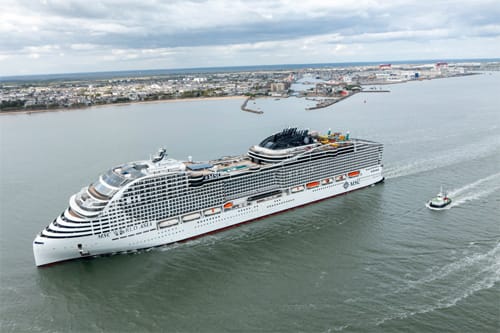
MSC's third World Class, MSC World Asia, departing the shipyard for trials (Chantiers de l’Atlantique and Askopia)
MSC’s World Class
First in the schedule is MSC’s third World Class cruise ship, MSC World Asia. She will be the 24th cruise ship for the brand and the third in the World Class, but they are promising some unique elements. MSC World Asia completed her second series of sea trials in mid-September after having gone to sea for the first time in July. Being built in France at Chantiers de l’Atlantique, they report the ship’s engines, maneuverability, fuel efficiency, safety systems, speed, and stopping distances were all tested.
Delivery of MSC World Asia is scheduled for November 25, and her first revenue cruise is December 4. The ship, which is approximately 216,638 GT, will accommodate over 6,700 passengers and 2,100 crew and feature more than 40 bars, lounges, and restaurants. Unique attractions will include the longest dry slide at sea, décor with flair from Asia including a 29-foot-wide dragon suspended 32 feet above the World Promenade, new dining experiences, expanded wellness and spa offerings, new shopping venues, and even the largest Venchi chocolate experience at sea.
MSC Cruises is not stopping there. MSC World Atlantic is already well into its assembly and due to enter service in late 2027. She was floated from the building dock on September 26. The company already had two more giants on order, and in November 2025 announced a further €3.5 billion investment, confirming orders for numbers seven and eight of the World Class due in 2030 and 2031.
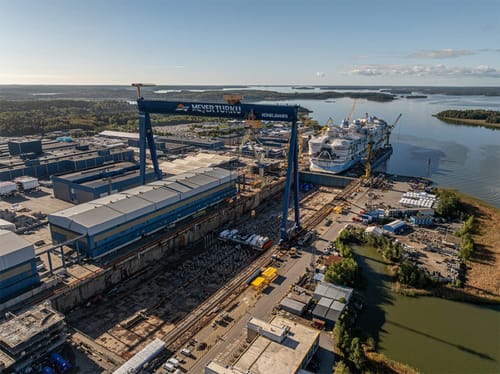
Blocks for the fifth Icon class ship are in the assembly dock (Meyer Turku)
Royal Caribbean’s Icon Class
In Finland, Meyer Turku also marked milestones in its construction program for Royal Caribbean International’s giants. The fourth ship of the class, Hero of the Seas, was floated and moved forward from the assembly dock on September 4. Meyer Turku highlights that it took 90 million gallons of water to fill the dry dock and move the 248,663 gross ton ship. Already visible in the background were the first blocks for Icon #5, and Meyer Turku reported on September 14 that the first steel block was now in place in the dry dock and assembly was underway on the ship due to delivery in 2028.
Royal Caribbean boasts of the changes for Hero of the Seas, including eight neighborhoods with the most pools at sea (nine distinct pools), a record-breaking 28 dining venues and cooking classes, new family raft slides, new accommodations for multigenerational families, and more. Like MSC, Royal Caribbean is not stopping there, for in addition to Icon #5, it has Icon #6 (due in 2029) and Icon #7 (due in 2030) on the books and Oasis #7, which is due in 2028.
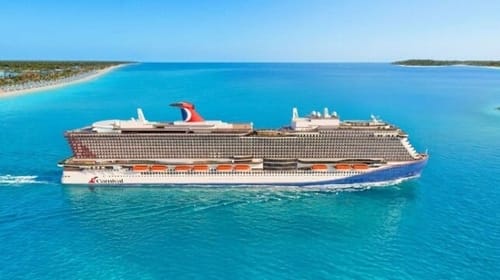
Rendering of Carnival Destiny, for which steel cutting began in July (Carnival Cruise Line)
Carnival’s Ace Class
A few weeks earlier, in July, Fincantieri in Italy started cutting steel for the first of Carnival Cruise Line’s first 200,000-plus gross ton ultra-large cruise ships. Known as Project Ace, steel cutting started on July 10 in Monfalcone, Italy, for the first ship, which is aptly named Carnival Destiny, celebrating the first cruise ship to exceed 100,000 gross tons. The new Carnival Destiny will exceed 220,000 tons and accommodate 6,160 passengers (over 8,000 passengers at full capacity). She is scheduled for delivery in the summer of 2029, followed by sister ships in 2031 and 2033.
Details are scarce right now, but Carnival Cruise Line calls her a “bold evolution in how guests engage on board.” More than 70 percent of its venues and attractions will be new concepts for Carnival, ranging from dining to bars and lounges, immersive entertainment, and outdoor spaces. Carnival Destiny, they said, will become the most outward-facing megaship, with an unprecedented number of balcony cabins and more than 4.5 acres of glass.
Rounding out the ultra-large cruise ships on the books are Norwegian Cruise Line’s orders for five ships simply referred to currently as “New Class,” also being built at Fincantieri. The ships are expected to be approximately 227,000 gross tons with accommodations for 5,000 passengers. The first is scheduled for 2030, then every other year until 2036, and the last in 2037.
For now, that’s the plan for the ultra-large generation of cruise ships. Earlier reports had indicated that MSC Cruises was discussing the possibility with Meyer Turku of approximately 260,000 to 270,000 gross ton ships that would be nearly 1,200 feet (365 meters) in length. While that project has not advanced, it seems certain that more ultra-large cruise ships will emerge in the future.
Classic Liner Turned Cruise Ship Faces Uncertain Future
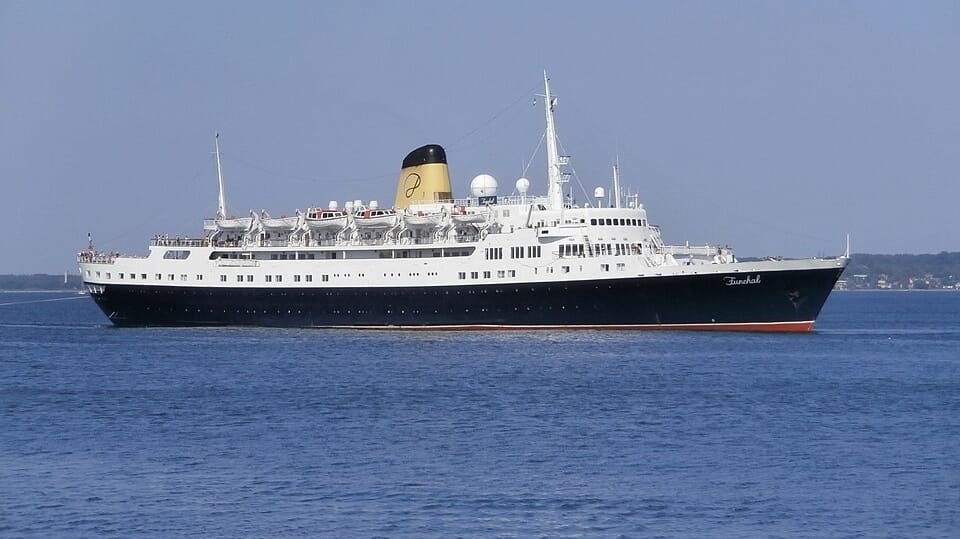
Another one of the few remaining classic passenger ships is facing an uncertain future as Funchal is currently being auctioned as part of the insolvency of her owner. Built in the days when passenger ships conducted liner service, the now 65-year-old ship retains her classic silhouette and her original name even though she was converted to cruising and has changed ownership multiple times.
Shipping aficionados and members of the Portuguese community are rallying with last-minute hope to save the classic ship even though her age and condition likely mean her prospects are limited. The Madeira Judicial Court has ordered Funchal (IMO 5124162) to be sold in a sealed-bid auction as part of the liquidation of a company called Teamson, her last owners, which the media links to Brock Pierce. A child actor who appeared in Disney movies, Pierce is an American cryptocurrency entrepreneur who acquired the ship in 2021 for a reported price of approximately 1.6 million euros.
The court and insolvency administrator opened the Funchal on September 18 for inspection by potential bidders. Interested parties have until September 30 to submit sealed bids. They will be opened on October 9, with the administrator highlighting that the buyer gets the ship free of debts and encumbrances but takes over the expenses immediately. Minimum bids are set at 802,354 euros ($921,000), putting Funchal in the scrap market.
It is not the first time Funchal has faced the auction block in her long career. Emblematic of the long-ago Portuguese passenger fleet, people argue she deserves to be saved yet one more time. The insolvency administrator highlights that before the current owners stopped work, the interiors had been stripped and are free of asbestos and other hazardous products. They also obtained a license for her to operate as a hotel on Portugal’s Tagus River.
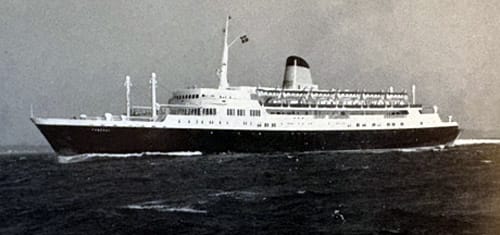
Built in 1961, she is one of the last classic liners
Funchal was conceived in the late 1950s as a replacement for another ship built in 1907 that was operating carrying passengers, cargo, and mail from Portugal to Madeira, the Azores, and the Canary Islands. Funchal was ordered by the privately-owned Empresa Insulana de Navegacao, a Portuguese shipping company with a long heritage of sailing both to the islands and South America.
The ship was built at the Elsinore shipyard and, despite only being 9,842 gross tons and 501 feet (155 meters) in length, was at the time the largest ship built in Denmark. She was launched in February 1961 and entered service in November of the same year with accommodations for 80 First Class and a total of 320 Tourist Class passengers.
Funchal was recognized as a stylish workhorse, maintaining the service to the islands as airplanes were taking over many of the traditional liner services. She had been designed to offer an occasional cruise, but at her heart was a steam-driven liner.
She also had her moments of fame. Portugal’s authoritarian president, naval officer Américo de Deus Rodrigues Tomás, used the vessel as a presidential yacht. In 1972, Funchal also carried the remains of Dom Pedro I (1798–1834), known as Brazil’s liberator and first emperor, back to Brazil on the 150th anniversary of its liberation.
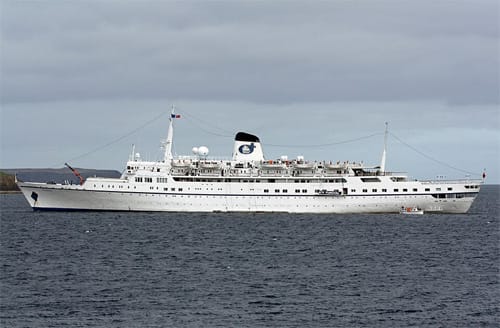
Funchal became a full-time cruise ship by the mid-1970s, seen here in white livery in 2010 (Donald Macleod photo - CC BY 2.0)
By the early 1970s, however, she was no longer needed for the route to the islands. In 1972, she had broken down and underwent what became a life-saving overhaul. She was fitted with new diesel motors, and her passenger spaces were rebuilt for cruising with 400 passengers and the addition of an outdoor pool. Her Portuguese owners started using her for cruising, and then Greek businessman Georgios Potamianos took the ship on charter, running her as a cruise ship. In the 1990s, he built up a small cruise line called Classic International, headed by Funchal, and added several other historic ships.
The next challenge to her life came with the SOLAS 2010 regulations, which put many older ships out of service. Funchal was sent for an overhaul to make her compliant and ready for another decade of service. However, work stopped, and Classic International folded after the death of Potamianos, leaving Funchal with an uncertain future.
Portuguese entrepreneur Rui Alegre stepped in in 2013, buying Funchal and several other classic cruise ships to launch a firm called Portuscale Cruises. Funchal seemed to cheat fate and returned to service in the fall of 2013, but it was short-lived. Portuscale Cruises ceased operation by the end of 2015. Funchal was laid up in Lisbon and has never sailed again.
She was sold in 2018 to a UK-based firm called Signature Living. They said she would be rebuilt as a party ship for the Ibiza crowd. When that failed, they said she would become a floating hotel in Liverpool. When that failed, Teamson acquired her. First, it said she would sail again, and then it said she would become a hotel in Lisbon. After a small fire in 2021, work stopped, and she continues to wait for her future.
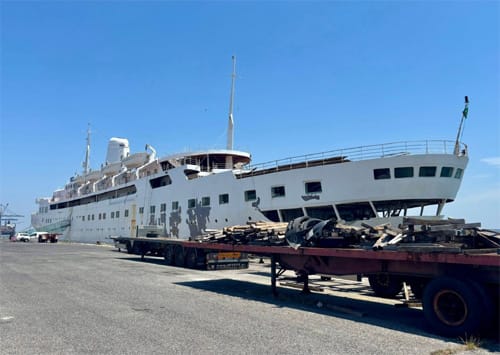
Funchal in June 2026 - photo courtesy of Rich Turnwald
People who got aboard earlier this year reported she was stripped bare on the interior down to her steel. Furniture was stacked and strewn about. Her decks were bare. The exterior has patchy paint and is rust-streaked. Media reports indicate there is a caretaker crew of 10, but they have not been paid in 25 months.
Observers note the minimum bid is a very fair price for the little ship, and she comes without the problems of asbestos or debt. It remains to be seen, though, if the emblematic little ship of the bygone liner days and glory of Portugal’s merchant marine can yet one more time survive an auction and find a future, avoiding the recyclers.
Top photo of Funchal in 2014 by Pjotr Mahhonin - CC BY-SA 4.0
Costa Prepares to Leave Asia After Accommodating Athletes at Asian Games
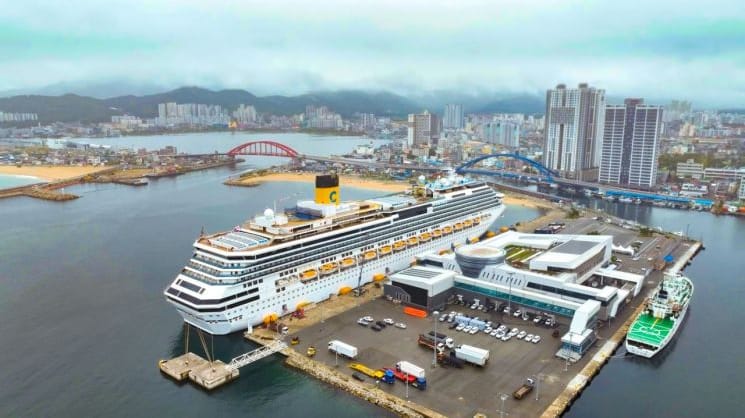
After 20 years and being a pioneer in Asia and the Chinese cruise market, Costa Cruises has operated its final Asian cruise as it prepares to reposition its last ship in Asia back to the western markets. For her finale, Costa Serena is operating an unusual charter as the first cruise ship used to accommodate athletes at the Asian Games.
The charter, which had been planned by the organizers of the Aichi-Nagoya Asian Games Organizing Committee as far back as 2024, however, drew attention during the final rush to the games. Organizers had anticipated around 11,000 participants, but in the final rush, it turned out that more than 17,000 were registered, raising concerns about whether they would have sufficient housing. The cruise ship is housing about 4,000 athletes and officials from up to 43 nations.
She is moored at the Kinjo Pier at the Port of Nagoya, operating as a floating hotel and residential facility. Media reports indicate that the charter deal worth approximately $30 million was negotiated by JTB’s Nagoya Business Division and was signed in September last year. She will remain in Nagoya until October 6.
Costa highlights that it made special preparations for the event. The fitness areas were expanded and re-equipped, and the pools, thermal areas, and quiet zones were repurposed as recovery spaces. The onboard medical center is coordinating with the games’ medical services. Operations aboard were also adjusted, such as the dining hours, and menus were adapted to meet the athletes’ needs.
Costa Serena was built in 2007 by Fincantieri as one of five ships in the class that included the ill-fated Costa Concordia. The 114,000 gross ton cruise ship, which is 289.5 meters (950 feet) in length, is now the oldest member of the Costa fleet.
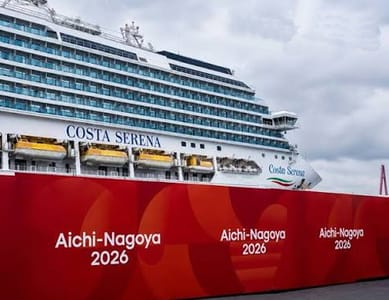
Her role as a floating accommodation facility continues through the end of the games, with the ship scheduled to leave Tokyo on October 18 for a 65-night voyage to Buenos Aires, Argentina. It is the end of Costa’s Asian deployments, which included becoming, in 2006, the first international cruise line to homeport a cruise ship, Costa Allegra (28,430 gross tons), in mainland China.
Costa developed the Asian market and moved a series of successively larger cruise ships to China, including the sister ships Costa Classica, which arrived in China in 2009, and the following year, Costa Romantica. Costa Victoria also moved to China for a time and was followed by Costa Atlantica. Costa Serena was homeported in China for the first time in 2015 and has remained in Asia for the past 11 years.
After a decade in China, Costa boasted in 2016 that it had carried two million passengers, with reports that it had more than a third of the Asian market. It sent Costa Fortuna to China in 2016 and Costa neoRomantica in 2018, while it also joined the Chinese joint venture with China State Shipbuilding Corp. (CSSC), including selling Costa Atlantica and Costa Mediterranea to what has become China’s Adora Cruises. Carnival Corporation also announced the construction of two 135,500 gross ton Costa cruise ships, each with a capacity for over 5,200 passengers, as its first custom-built cruise ships for the Chinese market. The first of the ships, Costa Venezia, made it to Asia in the summer of 2019, while her sister, Costa Firenze, was not delivered until after the COVID-19 pandemic paused cruising.
With China and much of Asia remaining closed to cruising for years, Carnival Corporation made a strategic decision to reposition the Costa operation. Older ships were retired or sold, while Costa Serena remained idle in Asia. Costa Cruises never returned the Costa Magica to service after the pandemic and sold the ship. In 2025, Costa reported it had also sold her sister ship, Costa Fortuna, which was delivered in September 2026 to her new owners. Costa is now down to eight cruise ships, after having transferred three to Carnival Cruise Line and retired four older ships, all since the pandemic.
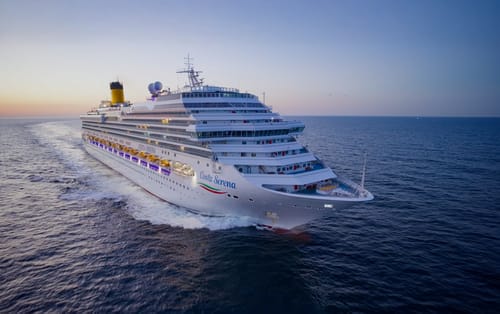
Costa Serena departs in October, heading to Brazil and then Europe, closing Costa's 20 years in Asia and the Chinese market (Costa Cruises)
Costa Serena finally returned to service in the summer of 2023 and became the first cruise ship to restart outbound, international cruises from South Korea and Taiwan. But it would not be until the summer of 2025 before Costa Serena returned to mainland China.
The decision to leave the Asian market was announced in May 2025. With the sale of Costa Fortuna, the line said Costa Serena would undergo an overhaul in November 2025. They updated her decor, renovated her suites, redesigned her pools and bars, modernized the restaurants, and added a new food court, in preparation for her new deployments.
Costa decided to first send Costa Serena to Brazil for the seasonal cruise market. Then in the spring of 2027 she will return for the first time to Europe, sailing in the Mediterranean. So far, Carnival Corporation has not announced any plans for new ships to rebuild Costa’s capacity.
Costa has not commented on the decision to leave Asia, but it follows many other major cruise lines that have not restored operations in China and Asia after the pandemic, citing challenges in the market. Only MSC Cruises and Royal Caribbean International restored their Chinese cruises, while Adora Cruises emerged after the pandemic.
Cruising on the Great Lakes Offers New Experiences
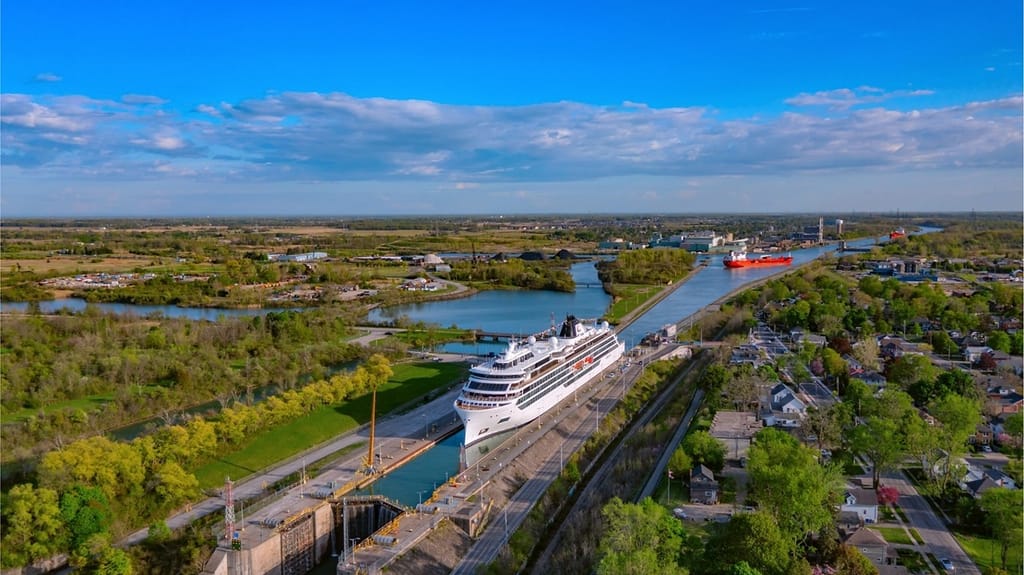
The Great Lakes, North America’s “Inland Oceans,” are gaining stronger attention from cruise enthusiasts. This year, it was projected that the cruise program would attract an estimated 175,000 passenger visits, an increase of 15 percent over 2025.
Unlike the massive vessels that sail the oceans, Great Lakes cruise ships have a maximum capacity of less than 400 passengers but offer some international flair.
The fleet of cruise lines is comprised of Ponant Cruises from France, Hapag-Lloyd of Germany, Viking, with Norwegian roots based in Switzerland, and U.S. companies, Victory Cruise Lines and Pearl Seas Cruises.
“We have a real strong mix of international cruise lines that provide an interesting balance, an interesting mix of product, and an interesting mix of clients,” says Stephen Burnett, Executive Director, Great Lakes Cruise Association (GLCA).
“We crossed a very important line when Viking came to the Great Lakes because where Viking goes, the rest of the world goes,” Burnett said.
The fleet mix has also brought change to the association’s profile. Years ago everything was done in English, said Burnett, but the language mix now includes German, French, Italian, Japanese, and Cantonese.
The association has approximately 30 ports that are “cruise ready,” and on an average cruise a ship will visit six or seven ports, but those ports get rotated as cruise lines develop new itineraries.
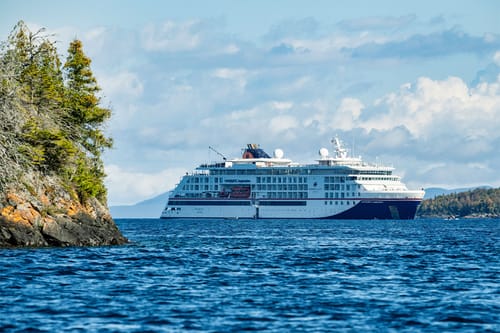
Hanseatic Inspiration offers programs tied to the nature experiences in the Great Lakes (Hapag-Lloyd)
Burnett says the association tracks the cruise season in two ways.
“We view it in terms of the business that arrives in the Great Lakes, but also in terms of customer satisfaction. It is very important that we understand how people feel about the Great Lakes. We have 28 to 30 member ports, and they feed information to me. It is an extraordinary amount of interesting intelligence that comes from Thunder Bay at the top of Lake Superior, Kingston, and down towards Cornwall, Ontario.”
From the information gleaned, Burnett says, “We understand our guests are two things, very happy in what they see, and there is a great amount of surprise in what they see. Many of the guests that come from afar don’t realize how big the lakes are, and the biggest surprise is they are walking around the deck, and they don’t see land. So it is vast inland oceans.”
Burnett explains that those “oceans” offer a number of surprises, not only from the geography but also when clients find places like Toronto, where, believe it or not, they discover 90 languages are spoken daily. “It is an incredible amount of polyglot communities who have immigrated here, and they are quite fascinated by the multicultural aspect of how Toronto really works. They are amazed at the incredible nature-based geography of the north shore of Lake Superior. They didn’t imagine how incredibly wild and virgin the territory is.”
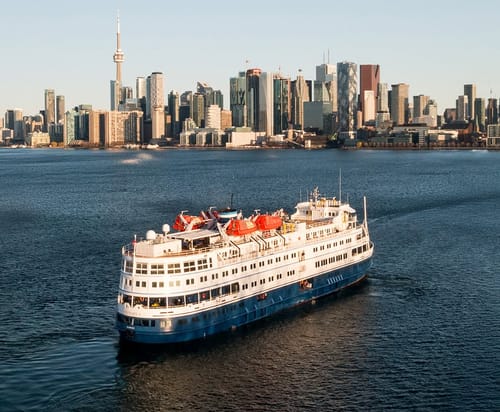
Victory I arriving in the cosmopolitan city of Toronto (Victory Cruise Lines)
While the Great Lakes may not sound as sexy as the Caribbean or the Mediterranean, the reasons cruisers venture to the region vary.
“Some people have traveled everywhere else in the world, and they want to cruise in their own backyard, so that would be North Americans. So cruising in your own backyard, in a way, is a huge attraction, and for many it’s an opportunity to travel in a region that is very different to some of the international destinations. You can travel for seven days in the Canadian sector of the Great Lakes and be in the same country. Then you can flip across the border and then be in the U.S.”
He explained that, “We also have clients who are extremely interested in First Nations and Aboriginal history, so we have a strong relationship with Aboriginal communities where we can embrace them in the product development side. We get Europeans who are fascinated with that culture.”
The Great Lakes cruise experience is also attractive in the programs provided on the vessel.
Burnett noted that there is a lecture series, for example, given by a retired lawyer.
“He is a political advisor to the federal (Canadian) government, and his hobby is history. So he does on average about 10 lectures on a voyage, and the problem he has is that when he finishes a lecture, people won’t leave him alone. They want him to expand on his many topics,” he said.
One topic of great interest is the story of how German U-boats (submarines) were able to bypass underwater security netting to get up the St. Lawrence River and attack small Quebec villages during the Second World War.
Burnett says, “This poor guy has 30 people waiting in line who want to talk about this story (after the lecture). So the stories of the Great Lakes really attract people as well.”
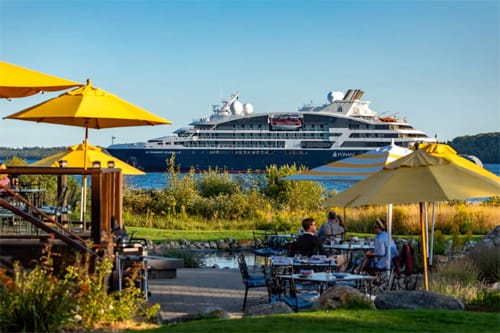
Ponant cruise ship anchored off Mackinac Island, a popular tourist destination in Michigan (Mackinac Island Tourism Bureau)
On a more serious note, he said, “The world is in a bit of a dangerous place at the moment with a lot of conflict, and some of that conflict is in cruise regions. There is nowhere in the world as safe as the Great Lakes.”
In 2027, the Great Lakes Cruise Association will add a new event to launch its season called Great Lakes Cruising Sail Away, to be held May 4 in Toronto at the port’s cruise terminal. Victory Cruise Lines will have a ship at the terminal during the event. It will be an annual event and will move to different ports each year.
The association is also looking to add Cornwall, located in eastern Ontario, Canada, to its ports’ list.
“Cornwall has an extraordinary amount of attractions, including strong Aboriginal First Nations culture,” said Burnett.
He also noted the association has a focus on Lake Superior’s north shore, “which we call Lake Superior North Shore Inside Passage. There is a group of islands there that make like an archipelago, so you can cruise inside those islands where there are five small communities that have wonderful things to see and do. So we are very much trying to expand our product.”
No comments:
Post a Comment