It’s possible that I shall make an ass of myself. But in that case one can always get out of it with a little dialectic. I have, of course, so worded my proposition as to be right either way (K.Marx, Letter to F.Engels on the Indian Mutiny)
Sunday, October 04, 2026
Iran Keeps Up Pace of Strikes With Attack on Brand New LR2 Tanker
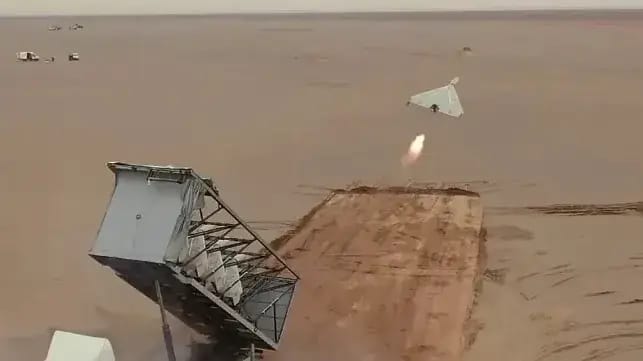
Iran's low-cost attack drones have played a prominent role in its campaign to restrict Hormuz traffic (IRGC file image)
On Sunday, Iran hit another tanker in the Strait of Hormuz, extending a fast-paced run of attacks on the "shuttle" shipping trade between Gulf oil producers and the STS transfer zone in the Gulf of Oman.
Vanguard Tech has identified the latest tanker hit as the Lipsi, a brand new LR2 linked to a Greek operator and a Chinese owner. Industry media sources have reported that the vessel sustained engine room damage.
Over the past week, the pace of successful Iranian strikes has approached a rate of nearly one tanker per day, following weeks of relative security. The attacks put pressure on the steady flow of tanker traffic through the waterway, which had recently rebounded to more than 12 million barrels per day - enough to restore total Gulf export volume to nearly prewar levels.
There may be technical factors behind the increased hit rate. Iran's ship-targeting capability appears to be getting better, one U.S. official told the Wall Street Journal.
An absence of deterrence may also be allowing Iran greater latitude to strike shipping. After initially pursuing a "head-for-an-eye" strategy of damaging or sinking multiple Iranian tankers every time Iran hit a GCC-linked tanker, the U.S. has ceased all (publicized) counterattacks on the Iran-linked merchant fleet.
So far, a substantial volume of tanker traffic through the U.S.-protected southern waterway continues despite Iran's push to increase the pace of attacks, satellite imaging shows. Naval analyst Tom Bike has identified three disabled tankers in the vicinity of the Musandam Peninsula and at least four additional tankers making a daylight transit through the channel.
Two More Tankers in Hormuz Report Strikes, Bringing Total to Six in a Week
Cape Dao struck on September 23 marked the beginning of the new offensive which has seen at least six tankers struck in a week
Multiple sources are confirming that two more tankers reported strikes, bringing the total to six ships in one week and 110 incidents directly related to the US-Iran conflict, says UK Maritime Trade Operations. The latest wave comes as analysts report Iran’s oil industry appears to have been effectively choked off and oil income is running dry.
The first of the two reports used third-party data to UKMTO but has also been widely reported by security consultants. The Kuwait Oil Tanker Co. crude oil tanker Kazimah III (317,250 dwt) was struck while transiting the Strait of Hormuz on Thursday, October 1. The Iranian news agency Fars reported the incident, saying it was about five miles off the coast of Oman. It did not name the tanker but said it was burning.
Late on Friday, UKMTO received information from the master of an unnamed tanker that was struck while outbound. A fire was extinguished, but there were also reports of a blackout onboard. Security consultancy Ambrey reported it was a Panama-flagged crude oil tanker located about 5.3 nautical miles off the coast of Oman. It said plumes of smoke were coming from the rear of the vessel.
Location of the vessel strikes on September 28-29 (UKMTO)
Iran’s so-called Persian Gulf Strait Authority told Iranian media that the ships being targeted included those on its non-compliant list. The reports noted that at least three of the tankers were controlled by the UAE, Al Ruwais, Sinbad, and Mersin Prosperity, and that they had made several unauthorized transits in the past two months. As of Friday, the list stands at 82 vessels.
Iran, however, also targeted at least two tankers controlled by Kuwait this week that are not on the non-compliant list. All the tankers, however, appeared to be in the southern channel of the Strait near the coast of Oman. The Al Ruwais was a small LR2 product tanker.
The attacks escalated as mediators reported no progress on the talks between the United States and Iran that took place around the United Nations General Assembly.
At the same time, sources in the U.S. confirmed that a third carrier strike group and as many as 9,000 or 10,000 troops are on their way to the region. While some of it may be a troop rotation after long deployments, it will also provide the U.S. the opportunity to renew its offensive if Donald Trump chooses.
Analysts believe the pressure is growing on Iran as its oil income is dwindling. Kpler analysts said that Iran was cutting back its production and has stopped loading floating storage. It appears that none of their large tankers have escaped the Gulf since the U.S. reinstated the blockade, while Iran was also storing crude outside the Gulf in the Far East. Reports. However, the analysts indicate that most of that inventory has been depleted, reducing the income from oil sales.
U.S. Central Command said that, as of September 30, a total of 125 vessels have been redirected during enforcement of the blockade. It also emphasized that forces are strictly enforcing the blockade.


No comments:
Post a Comment