SAUDI IMPERIALISM
Mr. President, Don’t Strike Yemen
The fight between Saudi Arabia and Yemen is escalating at a rapid pace.
On October 11, the Houthis carried out a major attack on the airport in Saudi Arabia’s capital city, Riyadh. The strikes killed 12 and injured over 300, in what was the deadliest Houthi attack Saudi Arabia had experienced in more than a decade. This is just the latest in a string of disasters for the Saudis, who’ve been sandwiched between Houthi forces in the south and Shiite militias from Iraq in the north – which struck Saudi Arabia’s crucial East-West pipeline in September.
The pain hasn’t been contained to Saudi Arabia’s oil industry, however.
Saudi’s economic calamity
In the furtherance of their domestic development mission, “Saudi Vision 2030,” the Saudis have sought to diversify their economic portfolio. This program has involved investing in the tourism and financial sectors of the economy in order to lessen their reliance on oil revenue. In doing this, they have marketed themselves as a friendly environment for international business.
Much like the rude awakening experienced by nations in the Persian Gulf earlier this year, Saudi Arabia’s image as a safe haven for global capital has been seriously degraded by intense warfare. The ease with which Houthi missiles and drones have struck major population hubs is causing business interests to rethink their investments. The Saudi military’s performance has also been anything but confidence-inspiring. They have failed to properly defend their nation, and have been unable to mount a serious counter-offensive.
Part of this is by design. The inherent weakness of the Saudi armed forces comes from the foundational, intentional fragmentation of military institutions. The House of Saud – Saudi Arabia’s royal family – wanted to protect itself from a potential military coup. In crafting their armed forces, the Saudi royals sought to create division within the ranks. They figured that by building up many small units – as opposed to one unified military – no one segment would be powerful enough on its own to overthrow the Kingdom from within.
By prioritizing the acquisition of modern weaponry as opposed to the buildup of a capable fighting force, the Saudis have walked their nation into a catastrophe.
Who is helping MBS?
In his moment of peril, Crown Prince Mohammed bin Salman is seeking assistance. Pakistan has pledged to militarily support the Saudis, citing the Mecca Joint Defense Agreement. France has also committed assets to Saudi Arabia, with President Emmanuel Macron saying that “Soldiers, radars, defense systems” will be used to defend Saudi energy infrastructure. Egypt’s National Defense Council – led by President Abdel-Fattah el-Sissi – has announced that they plan to use “all possible forms of support” to help the Saudis.
According to Axios’ Barak Ravid, Syrian President Ahmed al-Sharaa is said to be in discussions about potentially sending 10,000-20,000 troops to Yemen. Syria’s military under al-Sharaa includes many Islamists who fought in the Syrian civil war. The 84th Division, one of the units being considered for deployment to Yemen, consists of thousands of former Hayat Tahrir al-Sham (HTS) rebels.
HTS was originally formed under the name Jabhat al-Nusra, also known as al-Nusra Front. Abu Bakr al-Baghdadi – the late former leader of the Islamic State in Iraq – assisted al-Sharaa, who at the time was known as Abu Mohammed al-Jolani, in creating the group in August 2011 as the Syrian affiliate of al-Qaeda.
According to Ravid, the U.S. “doesn’t oppose” the idea of sending these troops into combat, saying that the effort could strengthen ties between Syria and Saudi Arabia.
MBS has also been relentless in his push for direct U.S. military involvement. In September, he called President Donald Trump multiple times to request that he assist the Saudis, specifically that he order the U.S. military to engage in direct strikes against Houthi forces.
Debate has commenced within the Trump administration and at the Pentagon. Originally, it was reported that Trump declined MBS’ request, telling him that the U.S. would not militarily intervene in Yemen. But with the situation worsening in Saudi Arabia and given the context of the recent Houthi attacks on the airport in Riyadh, U.S. strikes are once again being seriously considered.
When asked on October 11 if the U.S. planned to strike the Houthis, Trump responded, “We may. We’re going to look at it.”
“We just found out about the recent attack. So, we’ll make a decision. We move very quickly,” Trump said.
A clash at the Pentagon has begun. The Washington Post reported on October 5 that a “tense” meeting occurred with top U.S. officials. According to The Post, Gen. Michael Kurilla – a hawkish voice urging strikes on Yemen – and Joint Chiefs chairman Gen. Charles Brown Jr. – a skeptic of the utility of such attacks – argued over the assessments being given to Trump. Brown Jr. suggested new assessments be prepared, ones that outline the potential results of military action.
Brown Jr. was met with a harsh response from Kurilla, who reportedly said: “The time for assessments is over.” People familiar with the matter told The Post that Secretary of Defense Pete Hegseth sided with Kurilla in the exchange.
Military action against the Houthis is becoming a more accepted idea amongst the top brass of defense policymakers, who now await a decision from Trump. It seems that the hawks have once again fought their way to Trump’s desk, silencing dissenting voices before the president can even hear them out.
An unwinnable war
Despite the bluster coming from those advocating for intervention, a move to engage in strikes on Yemen would be a dreadful mistake.
For starters, nearly eight months of fighting against Iran has seriously damaged America’s regional infrastructure. Bases across the Middle East, which have already been battered from Iranian attacks, could be targeted by Houthi missiles and drones if the U.S. strikes Yemen. The bases are particularly vulnerable right now due to the U.S. military’s shortage of both Patriot and THAAD missile defense systems.
Similarly, the Houthis could attempt to strike American naval ships in the Arabian Sea. Ship-launched SM-3 and SM-6 missile interceptors – systems which have been used during the Iran war – would be needed to defend against Houthi retaliation. While they weren’t depleted to the same level as the ground-launched interceptors, stockpiles of the naval systems aren’t estimated to return to pre-war status until 2029 due to the lengthy production process. This creates a dangerous situation, and the Houthis wouldn’t need to sink an American ship in order to create a crisis that sends a message to the world.
The war’s core objectives were also not achieved. The Iranian regime remains in power, the Strait of Hormuz has continued to be a risky route for transit, and the nuclear file – which we were told was the primary dispute over which this war was launched – has not been addressed.
Before we dive haphazardly into another war, we also ought to consider what it is we seek to achieve, and the likely costs associated with such a goal. If the objective of a U.S. intervention is to eliminate or substantially degrade the Houthis, the history of our and Saudi Arabia’s record on this front might be of interest.
In the spring of 2025, Trump authorized Operation Rough Rider, a weeks-long campaign to degrade the Houthis’ ability to restrict shipping in the Red Sea. From March to May, bombs dropped in and around Yemen’s capital, Sanaa. The clash ended with an Omani-brokered ceasefire, and the Houthis’ missile and drone stockpiles, along with many of their launchers, remained intact.
Due to a lack of on-the-ground intelligence in Yemen, tracking the whereabouts of the Houthi forces – and their leadership, in particular – was very difficult. As a result, the war was “expensive but inconclusive,” as The New York Times put it. U.S. officials told The Times that over $200 million worth of munitions were used in just the first three weeks of fighting. In the first month, the war’s total cost was $1 billion.
And in the end, nothing of substance was achieved.
Saudi Arabia also failed to defeat the Houthis from 2015 to 2022 when they – with U.S. support – fought a war that resulted in one of the deadliest humanitarian crises on the globe.
Starting under President Barack Obama, the U.S. worked alongside Saudi Arabia to wage war on Yemen. The U.S. supplied them with arms, gave them intelligence, and refueled their aircraft, all while the Saudis targeted civilian infrastructure. Farms, food sites, shopping centers, and a school bus filled with 40 children were all bombed in Saudi Arabia’s years-long campaign. As the war went on, starvation became more prevalent amongst the civilian population.
The New York Times had the following to say when explaining Obama’s rationale for assisting Saudi Arabia in this war:
“Among other reasons, the White House needed to placate the Saudis as the administration completed a nuclear deal with Iran, Saudi Arabia’s archenemy. That fact alone eclipsed concerns among many of the president’s advisers that the Saudi-led offensive would be long, bloody and indecisive.”
While hundreds of thousands of people died in the war, the Houthis have grown into a much larger and much stronger fighting force. The war, while incredibly brutal, was a strategic failure for the Saudis.
Don’t do it
The previous bouts against the Houthis were incredibly costly, resulted in unimaginable bloodshed, and ended in defeat for the Saudis and Americans. What is it about the current circumstances that makes U.S. officials believe this time will be any different? On a similar note, knowing the inhumane manner in which Saudi Arabia has conducted itself in Yemen, why should Americans look to attach themselves to yet another immoral war? Whose interests would that serve?
An entanglement in Yemen is the last thing the American people need right now. This administration remains lost in a world of uncertainty regarding both Iran and the Strait of Hormuz, and it would be incredibly unwise to launch yet another war of choice at this moment of transparent weakness. There is no plausible justification for engaging in a new military operation on Saudi Arabia’s behalf.
Mr. President, don’t strike Yemen.
Nolan Denaro is a political analyst, writer, and host of “The Quest For Clarity” podcast, available on YouTube and Spotify. He is a columnist at Antiwar.com, and his work has been published by Responsible Statecraft, the Libertarian Institute, The Daily Caller, and the Ludwig von Mises Institute. He writes on U.S. foreign policy, economics, and current events, with a particular focus on war and imperialism. He maintains a personal Substack blog, and you can follow him on X @nolandenaro. Nolan can be reached for correspondence at nolansdenaro@icloud.com
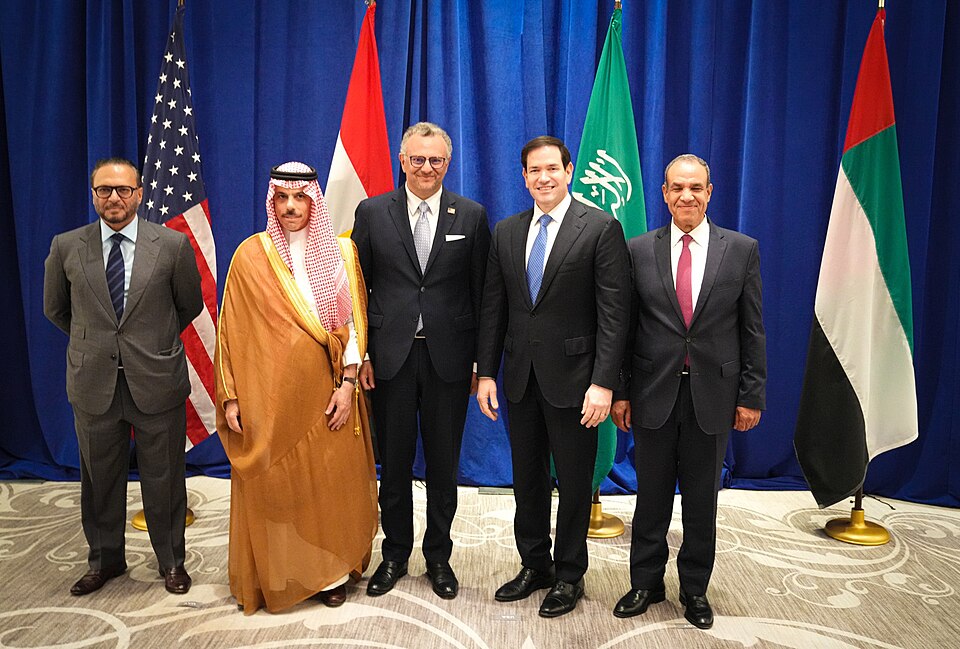
For decades, Arab governments, particularly those of the Gulf, have spent enormous sums purchasing some of the world’s most sophisticated weapons. They have hosted American military bases, cultivated close relationships with Washington, and built their security around the promise of American protection. Their economic ambitions have rested on the same expectation. Oil production, aviation, tourism, and international finance all depend on stability.
Yet a movement emerging from one of the poorest and most devastated countries in the Arab world has exposed the limits of that arrangement. The Houthis have survived years of bombardment, disrupted international shipping, threatened Saudi infrastructure, challenged Israel, and endured American attacks without disappearing.
The Houthis did not create the crisis of Arab governments. They have exposed contradictions that decades of military spending, dependence on American protection, and diplomatic accommodation with Israel have failed to resolve.
Qatar hosts Al Udeid Air Base, Bahrain hosts the American Fifth Fleet, and several other Gulf countries maintain extensive military relationships with Washington. These arrangements provide considerable protection, but they cannot guarantee security. Indeed, hosting American forces can also make these countries targets.
The wider confrontation involving the United States, Israel, and Iran has demonstrated this vulnerability. Energy facilities have been damaged and trade disrupted. Reuters reported that damage to Qatar’s Ras Laffan complex had removed roughly 17 percent of its LNG export capacity. For governments whose prosperity depends on attracting international investment, the consequences extend far beyond the immediate destruction.
American power can deter attacks and supply advanced weapons. It cannot make airports, pipelines, oil terminals, and cities invulnerable. Protection is not the same as security.
The Houthis understand this imbalance. They do not need an air force comparable to Saudi Arabia’s or an economy capable of competing with the Gulf monarchies. Their missiles, drones, difficult terrain, and ability to survive sustained attacks allow them to impose costs on much wealthier adversaries. Saudi Arabia, meanwhile, has refineries, airports, financial centers, and enormous investments in tourism and infrastructure. Wealth creates power, but it also creates targets.
The vulnerability is particularly troubling for Saudi Arabia’s Vision 2030. Investors do not need to see entire cities destroyed before reconsidering their commitments. Repeated threats to airports, energy facilities, and transportation routes can undermine confidence in the stability on which the kingdom’s economic transformation depends.
But military technology alone cannot explain the Houthis’ resilience.
As I argued in “To Understand the Houthis, Begin With Yemen,” the movement’s history did not begin when Tehran decided to challenge Saudi Arabia. It emerged from Yemen’s own political and religious struggles, particularly the Zaydi revival in the northern region of Saada. The Houthis survived six wars against the Yemeni government between 2004 and 2010, developing their leadership and military experience before Iranian assistance became substantial. Iran subsequently supplied weapons and technology that expanded their capabilities. But supplying a movement is not the same as creating it.
In “The Geography of Asymmetric War,” I compared the Houthis with Hezbollah. Hezbollah depended heavily on Syria as a strategic rear, a relationship disrupted by the fall of Bashar al-Assad. The Houthis operate under different conditions. Yemen’s northern mountains provide concealment, defensive depth, and opportunities to disperse and regroup. Yemen itself provides much of their strategic rear.
History matters as much as geography. Hundreds of thousands of Yemeni workers were expelled from Saudi Arabia during the Gulf crisis of 1990–91, followed by another wave of mass deportations in 2013 and 2014. These experiences contributed to longstanding grievances. Many Yemenis who resent Saudi policies also oppose Houthi rule, but those grievances existed long before Iran became deeply involved.
Reducing the Houthis to Iranian proxies allows Arab governments to avoid examining Yemen’s history and the consequences of their own interventions. It also obscures a more important question: why have governments possessing overwhelming military superiority repeatedly failed to achieve their political objectives?
Palestine and the limits of Arab power
For generations, Palestine occupied a central place in Arab political life. Governments often failed to match their declarations of solidarity with meaningful action, but Palestinian political rights remained an important principle of official diplomacy.
The 2002 Arab Peace Initiative made normalization with Israel conditional on a comprehensive settlement, including Palestinian statehood. The Abraham Accords reversed that sequence. The UAE, Bahrain, Morocco, and Sudan moved toward normalization without resolving the Palestinian question. Economic opportunities and closer relations with Washington increasingly took precedence over Palestinian sovereignty.
Then came Gaza.
The devastation exposed the distance between official declarations and the limited willingness of Arab governments to confront Israel or Washington. Governments possessing enormous wealth, sophisticated weapons, and considerable diplomatic influence watched as Palestinians endured catastrophic destruction and displacement.
The Houthis presented a striking contrast. They attacked shipping and launched missiles toward Israel while explicitly linking their actions to Gaza. Their campaign did not end Palestinian suffering, and it imposed serious costs on international commerce. Nevertheless, their willingness to act gave them political visibility far beyond their military strength.
One does not have to admire the Houthis to understand this appeal. Their rule has been authoritarian, and Yemenis have suffered under their policies. But recognizing these realities does not erase the political significance that some Arabs attach to their confrontation with Israel.
Arab Barometer research has documented declining public support for normalization with Israel following the war in Gaza. Opposition to normalization does not necessarily mean support for the Houthis or Iran. It does demonstrate that Palestine remains deeply important to Arab populations, regardless of their governments’ diplomatic priorities.
An even more disturbing development has been the discussion of relocating Palestinians outside their homeland. The Associated Press documented approaches involving Sudan, Somalia, and Somaliland. Sudan rejected the idea, while Somali and Somaliland officials denied agreeing to such arrangements.
The proposals themselves are revealing. Instead of asking how Palestinians might exercise sovereignty in their homeland, powerful actors have discussed where Palestinians might be moved.
Edward Said understood this danger. For him, Palestine was never simply a territorial dispute. It was a struggle over dispossession, exile, memory, and the right of a people to remain connected to their homeland. Military power could be accompanied by the power to rewrite history and transform people displaced from their homes into a humanitarian problem rather than a people with political rights.
Words such as resettlement, reconstruction, and voluntary migration may sound humanitarian. But Palestinians remember 1948 and 1967, when families driven from their homes discovered that supposedly temporary displacement could become permanent.
Can a people disappear because another state wants them to disappear?
Not simply by decree. But a people can be made politically invisible when their homeland is treated as available for redesign without their consent.
Arab Barometer’s research on Palestinian attitudes reminds us that Palestinians have political judgments and aspirations of their own. They are not simply beneficiaries of Houthi solidarity, victims of Israeli military power, or subjects of Arab diplomacy. Their future belongs to them.
The historical progression is troubling. The Arab Peace Initiative envisioned normalization after Palestinian statehood. The Abraham Accords pursued normalization without it. Proposals for relocation raise the possibility of a regional order accommodating Israel while Palestinians are increasingly separated from their homeland.
The Houthis did not create this contradiction. Their confrontation with Israel has made it harder for Arab governments to conceal.
The Red Sea has two sides
The Red Sea is often discussed as though its politics were determined exclusively by the Arabian Peninsula. Yet across the water lie Eritrea, Djibouti, Sudan, and Somalia. These countries are not simply coastlines or ports available to outside powers. They have their own histories, interests, and sovereign rights.
Eritrea’s experience illustrates the contradictions particularly well.
In 2015, Eritrea allowed the UAE to use Assab as a military staging ground for the Saudi-led intervention against the Houthis. The Emiratis developed facilities there and used the port and airfield to support operations in Yemen. That partnership eventually unraveled. Today, Eritrea’s foreign minister condemns what he calls Emirati “port imperialism” and insists that there is no military solution to Yemen’s conflict.
The reversal is remarkable. The UAE, once operating militarily from Eritrean territory, has become one of Ethiopian Prime Minister Abiy Ahmed’s most important international partners. And Abiy has repeatedly advanced ambitions toward the Red Sea that Eritrea regards as a threat to its sovereignty.
The UAE’s role goes considerably further than commercial investment or diplomatic friendship. It supported Abiy’s government during the devastating Tigray war, including through military assistance. Its close relationship with Addis Ababa has since acquired another dangerous dimension in Sudan.
In February 2026, Reuters documented a secret training camp in Ethiopia’s Benishangul-Gumuz region for fighters associated with Sudan’s Rapid Support Forces. Sources, including an Ethiopian official, attributed financing, training, and logistical support to the UAE. Reuters examined satellite imagery and diplomatic and security documents supporting its investigation, although it could not independently establish every aspect of Emirati involvement. Abu Dhabi denies supporting the RSF, and Addis Ababa denies backing the force.
The implications are enormous. Sudan’s war has already devastated communities, displaced millions, and created one of the world’s worst humanitarian crises. If Ethiopian territory is being used to sustain the RSF with Emirati assistance, then Abiy’s government is not simply dealing with instability across its western border. It is implicated in a regional military relationship that risks prolonging Sudan’s destruction.
The same partnership has consequences for Eritrea. The UAE has supported Abiy’s government militarily and cultivated maritime relationships in Somaliland and Puntland that could advance Ethiopia’s ambitions toward the Red Sea. These are not isolated developments. They reveal how Emirati influence can connect the war in Sudan, Ethiopia’s internal conflicts, and the confrontation over Eritrea’s coastline.
This does not establish that Abu Dhabi has ordered Abiy to attack Eritrea. But the combination of Emirati military support, Ethiopian territorial ambitions, and deteriorating relations with Asmara creates a dangerous convergence of interests. Eritrea has good reason to examine the consequences of that relationship for its own security.
For Eritrea, the question is not whether Ethiopia should enjoy commercial access to international trade. Ethiopia enjoyed access to Eritrean ports following independence, and peaceful commercial arrangements remain possible. The issue is the use of maritime ambitions to challenge another country’s sovereignty. Assab and Massawa belong to Eritrea. Their political status is not negotiable.
Eritrea’s relationships with Egypt and Saudi Arabia make the situation even more complicated. Egypt has become an important diplomatic partner in defending Red Sea sovereignty, while Saudi Arabia has cultivated closer relations with Asmara. Yet both have their own interests in Yemen, and neither relationship guarantees Eritrea’s security.
Egypt’s position is especially revealing. President Abdel Fattah el-Sisi has moved quickly toward authorizing possible military assistance to Saudi Arabia in response to Houthi attacks. Egypt has legitimate concerns about the Suez Canal, and Saudi Arabia has every right to protect its population. But the contrast with Cairo’s response to Ethiopian threats against Eritrea is difficult to ignore.
Egypt has repeatedly affirmed Eritrea’s sovereignty, including through cooperation with Eritrea, Sudan, and Somalia. Yet diplomatic declarations are different from a public offer of military assistance. Why is Egypt prepared to contemplate military involvement in defense of Saudi Arabia while remaining more restrained in its response to threats against Eritrea? If the security of the Red Sea is truly indivisible, a war over Eritrea’s sovereign coastline should concern Cairo as much as instability across the water.
History makes Egypt’s possible involvement in Yemen particularly troubling. In 1962, Gamal Abdel Nasser sent Egyptian forces to support the republican revolution against North Yemen’s Zaydi monarchy. Saudi Arabia supported the royalists. Both governments were predominantly Sunni, yet they fought on opposite sides of a conflict shaped by political rivalry rather than ancient religious divisions.
More than six decades later, Saudi Arabia confronts another movement emerging from Yemen’s Zaydi north, while Egypt considers assisting Riyadh. Nasser’s intervention became a costly entanglement. Saudi Arabia’s intervention beginning in 2015 likewise failed to eliminate the Houthis despite overwhelming conventional military superiority. Another round of intervention risks repeating a familiar tragedy.
Meanwhile, Ethiopia’s ambitions toward the Red Sea have become more dangerous as its relations with Eritrea deteriorate. A wider confrontation involving Egypt, Saudi Arabia, and the Houthis could distract regional governments and create opportunities for Abiy to advance his maritime agenda. That danger is compounded by the UAE’s support for his government and its expanding interests along the African shore.
Israel’s recognition of Somaliland and its growing security relationship there add another complication. The UAE maintains an important presence at Berbera, while Israel has an obvious strategic interest in the Gulf of Aden opposite Yemen. The precise extent of Israeli military facilities remains contested, but its involvement brings another powerful actor into an already crowded region.
It would be a mistake to imagine that all these governments follow a single coordinated plan. Egypt, Saudi Arabia, the UAE, Ethiopia, and Israel have interests that overlap in some places and diverge in others. That is precisely what makes the situation so dangerous. A decision taken in Yemen can change calculations in Sudan, Ethiopia, Eritrea, or Somaliland.
For Eritrea, the lesson of Assab is particularly important. Strategic geography can provide diplomatic leverage, but it can also expose a country to the wars of others. Eritrea has already sacrificed generations of its people in wars involving Ethiopia, including its tragic participation in the 2020–2022 Tigray conflict. Its people should not have to make further sacrifices because powerful governments see their coastline as a prize.
Nor should the people of Yemen continue to pay for the inability of outside powers to find a political settlement. The Houthis’ military resilience does not make their rule just or their actions beyond criticism. But their survival has demonstrated the limits of military superiority and the dangers of mistaking destruction for political success.
The crisis is therefore larger than the Houthis. It concerns Arab governments that have invested enormous resources in weapons without securing lasting peace, pursued economic transformation while remaining vulnerable to regional conflict, and normalized relations with Israel without resolving the Palestinian question. It also concerns the growing involvement of Gulf powers in African conflicts, where local populations bear the consequences of rivalries extending far beyond their borders.
Palestinians continue to struggle against dispossession. Sudanese civilians endure a devastating war. Yemenis have suffered through years of intervention and internal repression. Eritreans face the possibility of another war over territory whose sovereignty should never have been in question.
The Houthis have not resolved these crises. They have made the failures of regional power harder to conceal.
After decades of military spending, American bases, normalization, and promises of stability, what exactly has all that power delivered?
No comments:
Post a Comment