Reviewing Sven Beckert's Capitalism: A Global History: merchants, commodity frontiers and the question the book leaves open
Alberto Garzón
Sep 22, 2026
Ecosocialist Notebook
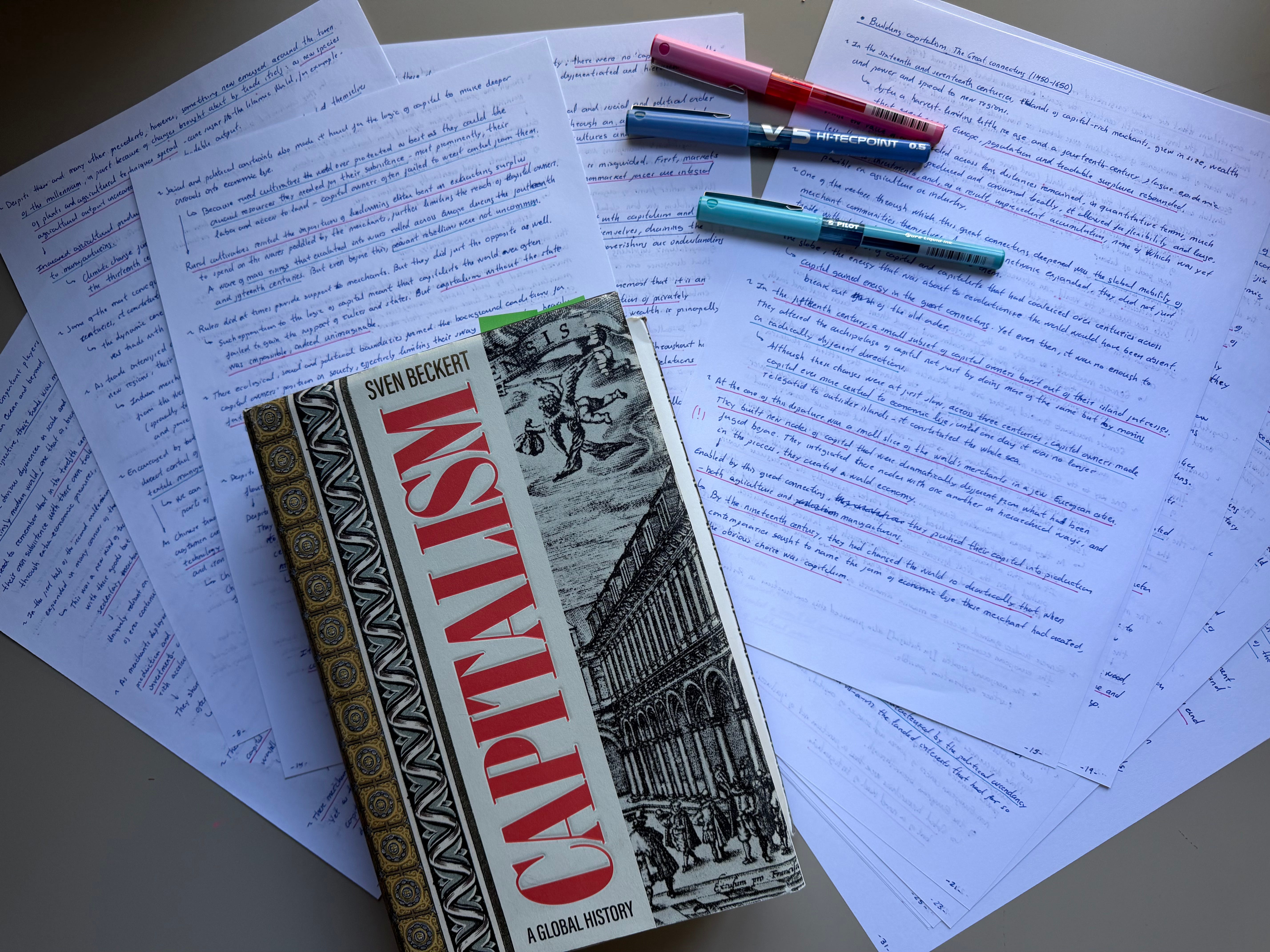
This week sees the Spanish publication of Sven Beckert’s monumental Capitalism: A Global History (Crítica). It runs to more than a thousand pages of exhaustive description of capitalism’s historical trajectory, plus more than three hundred pages of bibliography and notes. Works this well documented are rare, and rarer still are those that are also enjoyable to read. It strikes the ideal balance between the scholar's deep knowledge and the popularising impulse that leaves the ivory towers of the university to reach a wide audience. The book was published in English at the end of last year and received an enthusiastic reception that acknowledged, above all, Beckert’s capacity to synthesise the vast body of knowledge accumulated on the history of capitalism.
That said, it has also been criticised for its overall approach, for how it handles various issues, and for certain absences or shortcomings. But of course, when someone sets out to write nothing less than the history of capitalism, reaching back to processes that took place a thousand years ago, I suppose we take it for granted that pleasing everyone is impossible. There is not, and cannot be, such a thing as a perfect work. One thing is clear, though: Capitalism is already an indispensable reference for anyone who wants to know where we come from and who also wants tools to better understand where we are heading.
The engine of transformation
In Capitalism, we should think of capital as a kind of virus, first documented in the twelfth century in Aden, in present-day Yemen. There, we have documented evidence of profit-maximising practices among a notable group of merchants, that is, people who made money by trading goods. Although this was a fundamentally agrarian and tributary society, governed by social norms and customs, these merchants followed an entirely different logic. That logic is what justifies treating Aden as an “island of capital,” a seed of what was to come.
Beckert stresses that Aden was not the cradle of capitalism, but it was proof that capitalists already existed in bygone times. And not only there: the same was true of other places on the planet where capitalists were marginal elements within non-capitalist societies. From this perspective, capitalism took shape gradually through the interconnections between these islands of capital, spreading its logic to other parts of the world and eventually infecting the entire planet. If today almost everything around us is a commodity, and consequently has a price (including ourselves, as labour power), it all began on those islands of capital.
Thus, in Capitalism the founding actors of the modern economic system were merchants. Although we traditionally associate merchants with mere commercial intermediation, Beckert shows that many of them took direct and indirect control over production. Merchants, industrialists and financiers are abstract figures who in practice have been far more intermingled than their conceptual separation suggests. The agrarian plantation complex built by European colonial capital in the New World is a good illustration not only of this mixed control (over production, over the trade in what was produced, and over investment) but also of new ways of organising labour and nature, with the slave plantation as the forerunner of the modern factory, with its controlled rhythms, supervised labour and emphasis on productivity. Those merchants embodied the practices we now call capitalist, which gradually spread not only to other regions of the planet but also into other spheres of economic and social life. As merchants linked up with one another through long-distance trade, archipelagos of capital took shape and their positions grew stronger. In a continuous process of unfolding and expansion, they colonised human life while provoking resistance among ordinary people and among traditional elites jealous of the merchants’ growing wealth. That resistance, and other obstacles, could be overcome by forging alliances with and within the state, which most of the time meant force and war. In Capitalism, indeed, the state is a central actor without which neither the origin nor the triumph of the logic of capital and its usual agents, such as private firms, can be understood.
Besides political resistance, Capitalism also features ecological limits that merchants seek to overcome. These arise from the relative scarcity of natural resources and account for what Beckert calls “commodity frontiers”: a way of naming the process whereby the exhaustion of a resource (a forest, a soil, a population to enslave) drives activity elsewhere, to a place where new resources can be exploited. The movement of capital is thus characterised by landing in a territory, commodifying the resources capital needs to reproduce itself, exploiting and depleting them and, once they are finally exhausted, moving on to another place to repeat the process. Capitalism is full of historical cases documenting this process of successive exploitation and plunder, which shows, following Jason Moore, that capital puts “cheap nature” to work for it in a seemingly endless unfolding. This logic reaches into the present: the competitive scramble for, and unbridled extraction of, critical minerals, for example, make up what Thea Riofrancos calls “the frontiers of green capitalism.” In this sense, frontiers are not national borders but the outermost layer of capital's logic. With these levers, merchants and commodity frontiers, Beckert’s capitalism unfolds across his stimulating pages.
A global analysis
One virtue of Capitalism is that it lets us grasp the logic of capital at its proper scale: global. Accustomed as we are to thinking in national terms, Beckert’s approach forces us to think globally. It is not simply a matter of adding other national or regional histories to the traditional Eurocentric narrative on which millions of people in the West (myself included) were raised. Rather, it is a matter of understanding that the logic of capital operates everywhere at once, so to understand capitalism we must analyse everything at the same time. For instance, some say capitalism is in terminal crisis because Western economies show clear signs of decline. But can we be sure that what is actually happening is not a redefinition of the international division of labour, with the economic centre shifting towards Asia? There is no doubt that the gloomy horizons tormenting the Western middle and working classes, who are watching the welfare states won through decades of struggle come under siege, are not shared by an emerging international working class that has recently escaped absolute poverty and is only now beginning to form the middle strata of its countries and regions. What is, for us, largely a step backwards (towards precarity, vulnerability, instability and fear) is, for them, also broadly speaking, a dream world that none of their previous generations could even have imagined.
This global approach, in which the world economy is the central unit, places Beckert in the tradition of Marx, Bukharin and Wallerstein. This is a sensitive matter among historians of capitalism. The historical tradition that has studied the capitalist economic system most thoroughly, the Marxist one, is deeply divided over its origin. Broadly speaking, one of the main fault lines in the debate has pitted those who believe capitalism originated globally in the sixteenth century, with the expansion of trade networks across the planet following the European conquest of the New World, against those who believe capitalism was born later, as a result of new property relations in the English countryside. The former are usually called Wallersteinians (after Immanuel Wallerstein) and the latter Brennerians (after Robert Brenner). While the former emphasise the world-economy, that is, capitalism as a logic that can only be understood at a world scale, the latter believe they have found a kind of patient zero in the transformations that took place in a single country, England. This theoretically unbridgeable divergence dates back to the postwar period and the work of Maurice Dobb and Paul Sweezy, grew fierce in the so-called Brenner debate of the 1970s, and resurfaces every so often in the same or similar terms. For me, the best recent review is Henry Heller’s The Birth of Capitalism (Pluto Press), though in Spanish there is also Ellen Meiksins Wood’s now-classic survey, The Origin of Capitalism: A Longer View (Siglo XXI).
It is impossible not to ask where Sven Beckert stands in this debate and, after months of reading him closely, I would say it is impossible to give a definitive answer. On the one hand, the global history of capitalism that Beckert tells, as commercial activity unfolding progressively and inexorably, clearly bears Wallerstein’s stamp. On the other hand, Beckert concedes almost everything to Brenner in the chapters reviewing transformations in the rural world. My somewhat trivial conclusion, then, is that Beckert has remained deliberately ambiguous on this point because his real aim is not to explain why capitalism emerged but how the processes we now call capitalist have spread historically and geographically. This is not a flaw but a virtue, because Capitalism provides indispensable raw material for any research programme. What matters is that the rest of us, readers and researchers, are the ones who must ask the questions.
The limits of capitalism
Both interpretations I have described above share a blind spot that is also present, though to a lesser degree, in Beckert’s book: the question of limits. When the 2025 Nobel Prize was awarded, I had the opportunity to discuss this in these pages, but it is worth insisting. If, for most Marxists, the origin of capitalism lies in the history of trade and/or in transformations of property relations, mainstream economists usually locate it in the emergence of institutions such as technological innovation, democracy, or the monetary system. But none of them tends to give sufficient weight to energy and the role of natural resources.
Today’s dominant common sense holds that capitalism faces no real limits but, at most, obstacles that human action can overcome. So we assume that economic growth could continue indefinitely if the right decisions are made; the usual debate is about what those decisions are (should we expand or shrink the space of the self-regulating market? reduce inequality of income and wealth? recover monetary sovereignty? invest much more in research and development?). Since the 1970s, however, what we now know as ecological economics has challenged that belief and raised the possibility that capitalism faces limits that are independent of human decisions: biophysical limits, that is, limits that can be acted upon but not repealed. Even so, most economists ignore these warnings, either downplaying the problem (even when one expression is climate change, which tends to be acknowledged) or trusting that human creativity will solve the problems with more technology.
The irony is that the classical economists, such as David Ricardo and Thomas Malthus, and later William Stanley Jevons, considered infinite economic growth impossible. For them, limits linked to land and/or natural resources were obvious. Marx was reluctant to accept the idea of absolute limits valid for every economic system, although the matter is still debated; he accepted that capitalism had internal limits, but not that future socialism would face the same deficit. And although this path was closed off in the formation of most economists’ common sense, it remained a subject of research and theorising.
From this other research programme, inspired by the work of E. A. Wrigley, Kenneth Pomeranz, Georgescu-Roegen and Paolo Malanima, industrial capitalism was only possible because it drew on fossil fuels (first as a source of heat, which freed up land, and then as a source of mechanical energy, which raised productivity). This necessary but not sufficient condition allowed economies to break free of the limits that land had imposed on every society since the dawn of humanity, but at the cost of consuming a non-renewable stock that we are squandering like a reckless heir. The availability of an extraordinary source of fossilised energy allowed the societies that managed to harness it to make a giant leap in productive capacity and, when political struggle pushed for it, in the living conditions of the population as a whole. The consequences of this fact are not mere externalities, as climate change and other ecological impacts are usually presented, but are intrinsic to economic dynamics. This means that the future of capitalism is also necessarily bound up with the fate of fossil fuels and with humanity’s capacity to replace them with alternative energy sources that provide the same physical services (among them power, the key to the systematic rise in productivity over the last two hundred years).
Beckert touches on this point only superficially. On the one hand, he accepts that the growth of preindustrial societies was constrained by the fixed availability of land, but assumes that technological advances overcame these limitations and that, consequently, Malthusian fears were not borne out. This reading is too conventional, because the classical economists’ concern was not cancelled but suspended, insofar as the leap rested on drawing down a finite stock. What will remain when that stock runs out? On the other hand, in the epilogue Beckert also concedes that the creativity capitalism stimulates has managed to decouple economic growth from fossil fuel consumption. This concession is too hasty, because the observed decoupling is between economic growth and greenhouse gas emissions, and it holds only for the most developed economies; absolute levels of fossil fuel consumption, for example, reached a new all-time high in 2025. Moreover, we still depend on fossil fuels not only for transport but also for most of the goods and food we consume. In fact, immediately after making that concession, Beckert openly asks whether capitalism can coexist with a natural world that will always be finite. And the truth is that, so far, no combination of energy sources has managed both things that would be needed at once: to provide the world economy with the physical services that fossil fuels provide today, and to do so in time.
The world to come
While Capitalism says little about energy, it is generous on land: exhausted soils, felled forests, shifting frontiers. The same is true of the social conflicts capitalism generates. These are described in marvellous depth and, particularly for recent decades, organised by political regime. The sections on the taming of capitalism, that is, on what we have called the “golden age of capitalism” (for its high rates of economic growth, today a pipe dream in the West), are brilliant. They also allow an apt contrast with the features of social conflict under neoliberalism, yielding a picture of the profound structural weakness of workers’ organisations in their capacity to influence economic decisions.
According to a well-known anecdote, Margaret Thatcher once said that one of her greatest achievements was New Labour and its leader, Tony Blair. She was not wrong, because that Third Way was both a renunciation of reformism (which, for all its limits, still pursued a socialist society) and the expression of ideological defeat at the hands of those who promoted ideas such as “popular capitalism.” For decades, the Western political left has been so defensive that the new and modest proposals of authors such as Thomas Piketty, Gabriel Zucman, or, more recently, Daron Acemoglu seem revolutionary. Perhaps that is why neoliberalism’s self-inflicted defeat after the 2008 financial crisis did not give way to a progressive and socialist wave (which is what even someone like Nicolas Sarkozy expected when he rushed to call for a swift refounding of capitalism) but to a genuine and dangerous reactionary tsunami across the West. A new division of labour that downgrades the place of the economies that have formed the world’s centre since the sixteenth century, growing inequality produced by neoliberal inertia, and ecological and labour anxieties: together they make the perfect cocktail.
Indeed, Beckert reminds us that union density is in decline, and that this is not just a question of will but of structural problems. His argument raises a further question. When the logic of capital has advanced to the point of contaminating almost every aspect of our lives, turning human beings into isolated individuals stretched to the limit by market competition, cooperative behaviour becomes much harder to sustain. In a world economy in which billions of workers compete for the best-paid segments of the labour market, capital runs a race to the bottom on wages. And in that structural context, in which workers in Cambodia or Kenya occupy the bottom rung of the global ladder of exploitation, workers in Morocco or Thailand the next one up, and those in Spain or the United Kingdom the higher rungs, it is not hard to understand (though never to justify) why fear drives workers to turn against one another, demanding protectionist and/or anti-immigration policies to ease that anxiety.
This brings me to the last point I would like to raise in this review: geopolitical tensions. Although English liberalism, born of the Napoleonic Wars and especially after 1846, rested on direct and indirect imperialism over other regions of the world, it still proclaimed that capitalism was associated with peace and a better future. Even a considerable share of the left-wing thinkers of the time, many of them followers of Richard Cobden, accepted this thesis, which many still defend today when they equate trade with peace. Chapter 13 of Capitalism, however, takes us back to the late nineteenth and early twentieth centuries, when competition between countries intensified and helped create the conditions that led to the two world wars. The central question is: why did this happen? Beckert suggests that the defensive reactions of countries such as France and Germany were driven by fear of a rising power, the United States.
It is worth remembering that both Germany and the United States were accelerating industrialisation through mercantilist policies of tariff protection and support for infant industries, and both knew they needed raw materials. Beckert cites, for example, Friedrich Naumann, a German liberal politician who argued for expanding the colonies in order to secure the supply of natural resources German industry required. This was a widespread view, and it had an immediate historical precedent: it was exactly what the United States had done in expanding westward, killing and isolating Native Americans (whom the dominant ideology considered inferior) and seizing their lands and resources. Late nineteenth-century colonialism also reflected a zero-sum conception of the world.
Perhaps it is no coincidence that today we are witnessing a return of the same mercantilist proposals in the West, justified largely by similar arguments. Western militarisation is advancing by leaps and bounds while industries retreat to their home territories, where the shelter of the state guarantees them solid defences against threats in the international market. The state is coming back, but not to broaden the rights of the working class; rather, to direct an industrial policy aimed at “securing” supply chains. Elsewhere, I have argued that a pendulum swings between free trade and protectionism, and between conceptions of wealth as a positive-sum or a zero-sum game. Today, in the midst of the eco-social crisis, and when not even billionaires trust in the future, eager as they are to leave for Mars or build underground bunkers, it seems more urgent than ever to reorganise resistance to capitalism. Because our lives depend on it.
Ecosocialist Notebook - Alberto Garzón is a reader-supported publication. To receive new posts and support my work, consider becoming a free or paid subscriber.
No comments:
Post a Comment