Hundreds of schools to shut Monday as France braces for more student protests
France's education minister said lessons would be "totally or partly suspended" at up to 500 high schools on Monday after several days of sometimes violent protests against teacher shortages, dilapidated school buildings and overcrowding in classrooms. The minister said 24 schools had been "burned or ransacked" since the start of the protest movement.
Issued on: 04/10/2026 -
By: FRANCE 24

Up to 500 schools across France will be totally or partly closed on Monday due to the protests by teenage pupils that have shaken the country, the education minister said.
Lessons will be "totally or partly suspended" in some "400-500" high schools as the security conditions "have not been fulfilled", said Education Minister Edouard Geffray on Sunday, adding that 24 schools had been "burned or ransacked" since the start of the movement.
The teens at French high schools, known as lycées, say that their studies are being ruined by high teacher absences, overlong school days and dilapidated facilities, as well as other grievances
Geffray said the number of schools affected on Monday would be comparable to the figure from Friday but vowed there would be a "partial, progressive return to lessons".
More than a third of the 468 schools in the wider Ile-de-France region surrounding the capital will be shut on Monday as a result of the protests, Valerie Pecresse, the right-wing president of the region, told broadcaster Franceinfo.

The movement began at a Paris school on September 17 but grew last week into nationwide protests marked in places by outbursts of violence involving teenagers and security forces, which sometimes used tear gas and batons to disperse the children.
'Deliberately targeted'
At Saint-Denis, just north of Paris, students took turns expressing their grievances at an open-air meeting Sunday.
When you are a student from one of the deprived districts, said one student, "The violence is unleashed."
She referred in particular to one student who had lost his teeth to a police rubber bullet and another who had been hit in the eye.
One 16-year-old boy, Campion, held a placard that read: "They say they are listening to us but prefer to gas us".
"I don't understand why the government deploys so much force against a case that is valid: our education, our future," he told AFP.

Geffray, in his statement, spoke of far-left infiltrators who had "hijacked' the movement "and engaged in extreme violence".
"Clearly, this poses a risk to both our staff and our students," he alleged, adding that 78 education staff members had been wounded – "something we have never seen before".
"They were deliberately targeted because they were employees of the national education system," Geffray claimed.
Organisers have called for the protests to continue on Tuesday, citing a lack of "concrete measures" from the government.
In a bid to address the protesters' concerns, Prime Minister Sébastien Lecornu set out a timetable on Sunday urging local authorities to prioritise filling gaps left by long-term absences and unfilled posts.
He also called a meeting for Tuesday with regional presidents to discuss overhauling the country's often-dilapidated school buildings.
Violent incidents
More than 5,000 people, 85 percent of them minors, have been arrested since the start of the movement.
A 16-year-old was detained on Sunday over the assault of a teacher in the southern town of La Ciotat. The teacher, 59, was struck and doused with gasoline on the sidelines of a high school student protest on Friday.
A group of youths were last week filmed beating and kicking a policeman on the ground in Belfort in eastern France in images that caused an outcry among officials.
Two youths, Bulgarian nationals aged 15 and 17, have been arrested and investigated for suspected aggravated violence, the prosecutor said.
One of the youths, whom the policeman had tried to arrest before being beaten, has now filed his own attempted murder complaint, his lawyer said.

04:55
The France branch of Amnesty last week slammed "disproportionate police violence" in tackling the demonstrations and said students must be allowed to express their grievances.
"Authorities must allow young people to exercise these rights without fear of being hit by tear gas grenades or batons, or being arbitrarily taken into police custody," said Amnesty France president Anne Savinel-Barras.
But Interior Minister Laurent Nunez stated that security forces "are not cracking down on young people" but rather "protecting" school and university students wishing to "peacefully voice their demands".
(FRANCE 24 with AFP)
As students call for 'act three', can France's school protests keep momentum?
Student protests that began in and around Paris last week have since reached secondary schools across France. Talks with the education minister haven't satisfied pupils' demands to tackle teacher shortages, neglected facilities and overcrowded classrooms. As student unions call for a fresh round of protests next week, whether the movement spreads to universities could prove decisive.
Issued on: 03/10/2026 - RFI

"We're quite disappointed," said Marius Mesnil, co-secretary-general of the High School Student Union, after talks at the Education Ministry on Friday.
He and representatives of other student unions, parents' associations and teachers unions met Education Minister Édouard Geffray as hundreds of schools remained closed or blockaded amid protests that have become increasingly violent.
Some 170 students have been injured since the start of the movement, Geffray said on Friday evening, while more than 100 secondary schools have suffered "severe damage".
At least 65 staff members – including 40 head teachers – have also been injured. Police have arrested more than 5,000 people since protests began, most of them minors.
While Geffray said the student movement was being "held hostage" by violent instigators, the minister assured pupils he was listening to their demands. He announced a new platform to allow them to share their grievances with policy-makers, and promised to follow up on calls for absent teachers to be replaced, school buildings to be renovated and timetables reviewed.
"Dear high schoolers, I can assure you that you are being listened to, you are being heard and you are being taken seriously," Geffray said.
Mesnil acknowledged the minister had listened, but said he hadn't committed to concrete measures to ease the protests.
"We're pleased we were finally received, after protesting for 10 days and getting no response," he told RFI. "However, we received very few answers."
Student unions are urging pupils across France to turn out on Tuesday for what they have dubbed "act three" of the movement.
"The government is promising things, but we need to be sure that they're actually implemented and that they aren't just empty promises designed to silence the movement and let it run out of steam," said Mesnil. "So we’re keeping up the pressure on 6 October – everyone out on the streets."
Student solidarity
Whether the high school movement will maintain momentum depends largely on whether it finds common ground with the higher education sector, according to Stéphane Sirot, a historian specialising in strikes and trade unionism.
"Will the movement take off significantly in universities? If they come together, it would mean trade unions would inevitably have to take a stance, even offer some form of support," he told RFI.
Sirot pointed to the example of 2006, when hundreds of thousands of young people took part in protests against government proposals to make it easier to fire employees under 26 in a bid to encourage hiring.
The movement, which began in high schools before being joined by university students and trade unions, eventually forced the government to scrap the reform.
The current protests could follow a similar trajectory, Sirot suggested, "although there is one major difference: this time there is a multitude of demands, and some of them could contribute to the search for a compromise".
'We share the same demands'
While protests have taken place at some French universities, for now the movement remains strongest in high schools.
On Thursday, the biggest day of action so far, some 30 university campuses were blockaded compared to 222 secondary schools. Another 800 schools reported disruptions.
Eloïse Lefebvre Milon, one of the leaders of the Student Union which represents people in higher education, told RFI her group was calling on university students to stand with high schoolers.
"We share the same demands, namely a bigger budget for young people, because today they represent the future of the country and we cannot leave them in such a state of underfunding," she said.
"Young people at secondary school and university are the ones who will be working tomorrow, the ones who will have to tackle the climate crisis and the social crisis... We have to give them an education that is equal to these challenges."
Several university student unions, as well as France's largest federation of parents' associations for public schools and at least six trade unions in the education sector, say they will join the demonstrations on 6 October.
Mesnil said students were seeking to join forces with teachers to draw attention to chronic underfunding for public education.
"We're trying to bring about this convergence of struggles between teachers and secondary school pupils because, ultimately, we face the same issues: namely, we don't have enough resources and the government treats us with contempt... We are trying to unite our fights as much as possible to make our position even stronger."
Student protests in France: 400–500 schools fully or partially closed Monday
Another day of mobilisation is planned for Tuesday. By then, 400 to 500 secondary schools are expected to remain fully or partially closed, including 24 that have been “burned or vandalised”. The ministry also reports that 78 education staff have been injured since the movement began.
Up to 500 secondary schools in France are expected to be fully or partially closed on Monday as a new day of mobilisation by pupils gets under way, following several days of protests marked by clashes with police, damage to schools and street violence.
The demonstrations, which have spread across several major cities, have seen rubbish bins and other objects set on fire, projectiles thrown at security forces and damage to school buildings and street furniture.
The Ministry of Education said on Sunday that classes would be "totally or partially" suspended in 400 to 500 secondary schools where security conditions "are not met".
There were "between 400 and 500 suspended classes" on Friday, and "there will probably be just as many on Monday, but with a gradual, partial resumption of classes", Education Minister Édouard Geffray said in interviews with TV channel France 2 and radio station France Inter.
Twenty-four of the 735 schools affected by the protests have been "set on fire or ransacked", the minister said. Geffray also said that "78 staff members" from the Ministry of Education have been injured "since the start of the events".
Interior Minister denies any disproportionate intervention
The Interior Ministry said that the unrest has led to nearly 5,000 arrests since Monday.
Rubbish bins and other objects have been set on fire, while projectiles have been thrown at security forces. Police have intervened to disperse some demonstrators, using tear gas, rubber bullets and defensive ball launchers (LBDs), as well as batons
On Sunday morning, Interior Minister Laurent Nuñez defended the actions of the security forces, rejecting claims that the response was "disproportionate".
Nuñez insisted that "the police do not repress young people", but "protect" pupils and students who wish to "advance their demands peacefully". He nonetheless warned that they intervene "firmly and without delay" to put an end to "damage, violence [and] abuses" committed by troublemakers.
He also denied that the security forces are specifically targeting "racialised young people from working-class neighbourhoods", condemning what he called a "blaming narrative totally disconnected from the real world".
Unsafe buildings, overcrowded classes and absent teachers
The movement began two weeks ago at the Saint-Exupéry secondary school in Créteil, in the Paris suburbs, in support of striking teachers who were denouncing a lack of staff and resources.
It then gathered pace and gradually spread across the country over the past week.
Pupils are denouncing, among other things, unsafe and insanitary buildings, overcrowded classes, timetables they say are impossible to cope with and a shortage of staff, with teacher absences that are not systematically covered. Some are also challenging the ban on mobile phones in schools.
On Friday morning, the Minister of Education, Édouard Geffray, met representatives of the pupils. After the meeting, they said they had not obtained any "concrete measures" and called for the movement to continue next week.
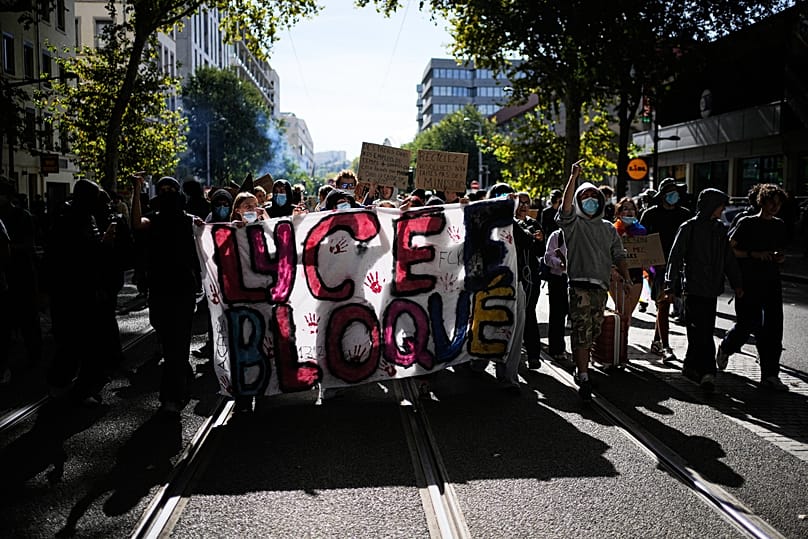
An "act III" planned for Tuesday
After two nationwide days of mobilisation, on 29 September and 1 October, an "act III" is planned for Tuesday.
All the teachers' unions said on Sunday that they would join the pupils' protest. "Their demands are legitimate, and we support them all the more because they are at the heart of our own mobilisations denouncing the lack of resources for several years now," they stated in a press release.
The unions also criticise a government response to the mobilisation that they say has been limited to the intervention of the security forces. "Reports from pupils who have been injured, assaulted and threatened are increasing by the day. This is unacceptable," they argue.
A mobilisation marked by several serious incidents
Several serious incidents have also been recorded on the fringes of the mobilisation.
In Tours, in central France, a young man who was injured lost sight in his right eye after clashes between pupils and police on Wednesday, according to the local prosecutor.
In La Ciotat, in Provence, a 59-year-old teacher was doused in petrol and beaten during a pupils' demonstration. A 16-year-old boy, suspected of carrying out the attack, was arrested in Marseille on Sunday morning and taken into police custody.
Police officers have also been targeted. In Belfort, in the east of the country, one officer was chased, beaten and repeatedly kicked by a group of young people. Two people were taken into custody following this attack.
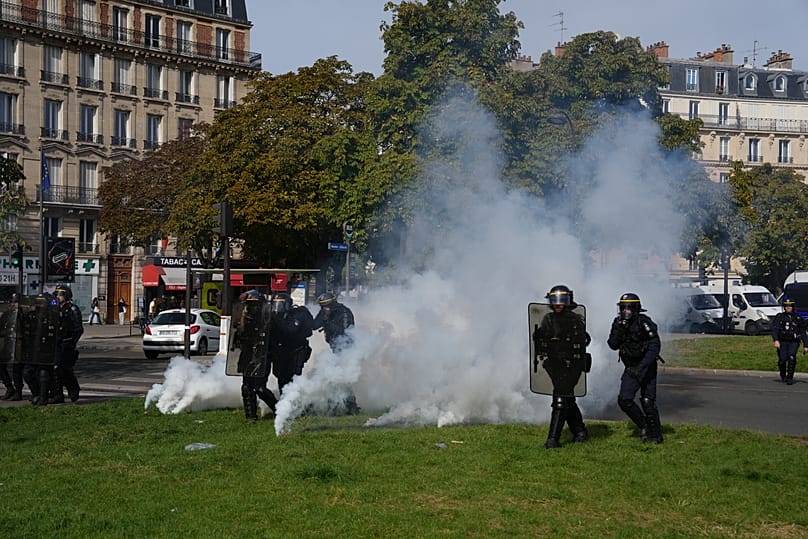
According to information from Le Parisien, faced with the widespread damage around schools and in public spaces, the government intends to bring forward the timetable for the "casseurs-payeurs" bill. The aim is to make people who take part in violent gatherings contribute to the cost of repairs, even when they are not directly responsible for the damage.
The Senate is due to examine the bill at the end of October
No comments:
Post a Comment