
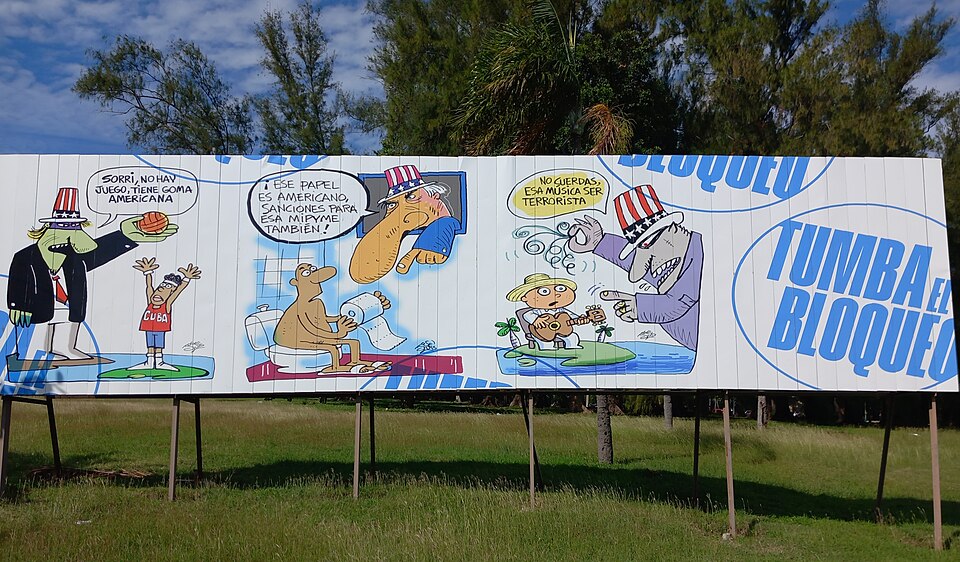
Editor’s note: Salim Lamrani’s central argument is that US sanctions and the oil blockade punish an entire population for refusing to submit to Washington. His references to “Cuba” and “the Cuban people” are shorthand. Cubans are not of one mind, and they experience the blockade differently depending on where they stand in Cuban society. The blockade falls hardest on the people with the least power to change it.
For more than six decades, Cuba has defied the world’s leading power and refused to bow to its demands. For Salim Lamrani, a scholar of Iberian and Latin American studies and an expert on relations between Washington and Havana, this confrontation goes far beyond the question of Cuba’s political system. It pits two radically opposing conceptions of international relations against each other: one based on domination, the other on sovereign equality.
In this uncompromising interview, the scholar traces the historical roots of American hostility toward the island, dismantles the successive justifications for the blockade, and describes the human consequences of a policy of economic strangulation that affects hospitals, schools, food supplies, and the entire population.
As pressure from the Trump administration intensifies, Cuba remains standing despite shortages, power outages, and mounting hardships in everyday life. Lamrani also discusses Cuban internationalism, its role in African liberation struggles, and its medical commitment to the peoples of the Global South. At the heart of this conversation lies a conviction that runs through the histories of both Cuba and Algeria: sovereignty cannot be negotiated under threat, and a people’s dignity cannot be measured by its material power. From the anticolonial struggle to resistance against American hegemony, this interview sheds light on the foundations of historic Algerian-Cuban solidarity and raises an essential question: Why is Washington so determined to punish a people who persist in freely choosing their own destiny?
La Patrie News: Professor Lamrani, for more than six decades, Cuba has resisted the world’s leading power, its economic blockade, diplomatic pressure, and attempts at destabilization. What is the secret of this resistance? Is it national consciousness, the legacy of José Martí, the 1959 Revolution, or the conviction that a small nation has the right to freely choose its own destiny?
Salim Lamrani: Historically, the United States has always coveted Cuba. As early as 1805, Thomas Jefferson, the third president of the United States, emphasized the island’s strategic importance. Located in the middle of the Gulf of Mexico, Cuba constituted a natural fortress that could protect Florida and, above all, control the route to the future Panama Canal. “The conquest would be easy,” according to the third American president.
In 1823, John Quincy Adams, then U.S. secretary of state, developed the “ripe fruit” theory. He explained that, over time, because of the unnatural ties between Cuba and Spain and the development of economic relations between the island and the United States, Cuba would yield to the laws of “political gravitation” and eventually fall into Washington’s hands.
During the first half of the nineteenth century, the United States attempted to purchase Cuba from Spain no fewer than six times. In 1851, President James Polk made an offer of $130 million, an enormous sum at the time.
But the Cuban people aspired to a sovereign future, to independence, and had no desire to be swallowed up by their powerful neighbor. That is why they launched their first war of independence against Spain in 1868, a conflict that lasted until 1878. This was the famous Ten Years’ War. It ended in failure because of deep divisions among the various pro-independence factions. It is important to understand that throughout the war, Washington supported Spain politically and militarily, firmly opposing Cuban independence.
This failure led José Martí, Cuba’s national hero, to unite all the forces committed to human emancipation under the banner of the Cuban Revolutionary Party in 1892. Three years later, in 1895, he launched the Second War of Independence, which lasted until 1898 and ended in Spain’s defeat. But just as the Cubans were about to reap the fruits of thirty years of struggle, the United States intervened militarily to prevent the emergence of a sovereign Cuba and occupied the country.
Thus, during the first six decades of the twentieth century, until 1959, Cuba was formally an independent republic but was in reality an American neocolony, politically and economically subordinate to its powerful neighbor. The Platt Amendment authorized Washington to intervene militarily in Cuba whenever it deemed such intervention necessary. In reality, there was no sovereignty, and the Cuban people were regarded as inferior, as a diminished people. The most important man in the country was not the president of Cuba but the U.S. ambassador.
An anecdote from 1920 illustrates the constant humiliations inflicted upon the Cuban people. U.S. President Woodrow Wilson decided to send a special envoy to the island but did not even bother to inform Cuban President Mario García Menocal. When Menocal learned of the American representative’s imminent arrival, he expressed his surprise in a diplomatic letter. What was Wilson’s written response? Here it is: “It has not been customary, nor is it considered necessary, for the President of the United States to obtain the prior consent of the President of Cuba to send a special representative”. Such was prerevolutionary Cuba, where the nation’s highest official could be humiliated in this manner.
The triumph of the Cuban Revolution marked the restoration of dignity for the Cuban people and the end of an era of submission and subordination. The principal achievement of the Revolution led by Fidel Castro was national independence after nearly a century of struggle, from 1868 to 1959. On January 1, 1959, the Cubans decided that their relations with the rest of the world, beginning with the United States, would be based on sovereign equality, reciprocity, and noninterference in internal affairs. They dared to say “no” to Washington, which accepts only one answer: “yes.” That is why the Cuban people are paying the price today. But they are not prepared to surrender their dignity, because when people have experienced neocolonial humiliation firsthand, they are willing to make any sacrifice to preserve their dignity. The Algerian people, who endured 132 years of French colonial oppression, know something about that.
LPN: The United States regularly presents its policy toward Cuba as a defense of democracy and human rights. How can Washington claim to defend the Cuban people while maintaining economic measures that undermine their daily lives, their access to essential supplies, and their public services? Isn’t this one of the most blatant examples of the use of human rights as a geopolitical instrument?
SL: It is important to understand that U.S. diplomatic rhetoric has continually shifted over the decades to justify its economic siege against Cuba. In 1960, when the Eisenhower administration imposed the first unilateral coercive measures by suspending Cuba’s sugar quota, it invoked the nationalization process undertaken by the revolutionary government, particularly the 1959 agrarian reform. Yet these nationalizations had been carried out in accordance with Cuba’s 1940 Constitution and public international law. Moreover, Havana had based compensation on the companies’ own tax declarations.
In 1962, when Kennedy imposed comprehensive economic sanctions, he explained that they were a response to Cuba’s alliance with the Soviet Union. Yet it is now common knowledge, in light of declassified archives, that the United States did everything it could to push Havana toward Moscow. Allen Dulles, director of the CIA, declared in January 1960: “From our point of view, it would be desirable for the USSR to show its hand in Cuba.”
During the 1970s and 1980s, Washington cited Cuba’s support for national liberation movements around the world, particularly in Africa, to justify maintaining the economic siege.
Since 1991, following the collapse of the Soviet Union, Washington has invoked democracy and human rights to explain its refusal to lift the unilateral coercive measures against Cuba.
But this accusation does not withstand scrutiny. First, the United States has historically been allied with the worst military dictatorships in Latin America, from Batista in Cuba to Pinochet in Chile, Somoza in Nicaragua, and the military junta in Argentina. And that is without even mentioning the rest of the world. From a moral standpoint, Washington has therefore forfeited any credibility to lecture others on human rights.
Second, one need only examine Amnesty International’s latest human rights report and compare the situations in Cuba and the United States. You may be surprised to discover that the worst offender is not the one you might expect.
Furthermore, as you point out, what cynicism it takes to invoke the human rights of the Cuban people while imposing a siege that has been suffocating them for nearly seven decades. Economic sanctions constitute the principal violation of the human rights of Cuban women and men because they affect society as a whole, particularly its most vulnerable members.
How can anyone dare invoke human rights while preventing children with cancer from obtaining the treatments they need to survive? How can anyone dare invoke human rights while depriving hospitals of electricity? How can anyone dare invoke human rights while preventing schoolchildren from receiving a normal education? How can anyone invoke human rights while depriving the elderly of basic food supplies?
LPN: Beyond its economic consequences, isn’t the blockade also an attempt to demonstrate that no people can permanently break free from the order imposed by Washington without paying a price? In other words, is Cuba being punished solely for what it does, or also for what it represents: the possibility of choosing a different path?
SL: First, we need to recall what economic sanctions actually entail. They deprive Cuba of its historic and natural market, located just 90 miles from its shores. But that is not all. These sanctions have extraterritorial reach, meaning that they apply to every country in the world. For example, Cuba cannot import any product containing more than 10% U.S. components. No product containing even a single gram of Cuban material can be exported to the United States. Thus, Mercedes, BMW, and Toyota cannot export any vehicle to the U.S. market if it contains even a single gram of Cuban nickel. Cuba therefore cannot sell anything to the United States, but it also faces restrictions on its commercial relations with the rest of the world.
Another striking example: Cuba is an island and therefore depends on maritime trade. Since 1992, any foreign vessel that docks at a Cuban port has been barred from entering the United States for six months. One can easily imagine the costs this entails for Cuba, which sometimes has to pay three or four times the market price to obtain products, both because of geographical distance and because of the risks involved, which require going through numerous intermediaries.
Cuba needs investment for its development. Yet foreign investors face threats of legal action from Washington, discouraging them from investing in an island that nevertheless offers numerous opportunities.
Since their introduction in 1960, economic sanctions have cost Cuba nearly $180 billion. In 2026, U.S. unilateral coercive measures deprived the island of more than $8 billion. That represents more than $20 million a day and more than $15,000 a minute. One can easily imagine what Cuba could accomplish with such resources to improve the well-being of its people. For example, with $180 billion, Cuba could provide every Cuban family with a basic food basket, meaning the essential food supplies needed to meet their needs, for 100 years!
More than 80% of Cuba’s population was born under the regime of unilateral U.S. economic sanctions. Since 1992, these measures have been unanimously condemned each year by the international community because of their illegal nature.
Why is the United States so relentlessly hostile toward Cuba? For one simple reason. Washington accepts only one kind of relationship: that of master and subordinate, of decision-maker and follower, in other words, an asymmetrical relationship of domination. Cuba, however, has accepted only one kind of relationship since 1959: a symmetrical relationship between equals.
Cuba has demonstrated that it is possible to resist imperialism in its own backyard, regain sovereignty over its natural resources and land, and determine its own destiny. And the United States, which refuses any challenge to its hegemonic ambitions, cannot tolerate this defiance of its authority. That is why Cuba is paying the price today.
LPN: Despite its difficulties, Cuba has developed internationally recognized medical expertise and a tradition of international cooperation. How do you explain the paradox of a country subjected to economic strangulation that continues to make medical solidarity an instrument of its foreign policy? What does this experience reveal about a state’s priorities and its understanding of solidarity among peoples?
SL: Since 1959, Cuba has made internationalist solidarity, meaning concrete and determined support for all causes of human emancipation, the cornerstone of its foreign policy. Cuba remains faithful to its history: it was the descendants of enslaved Africans, forcibly taken from their homeland, who were the first to take up arms in 1868 under the leadership of Carlos Manuel de Céspedes to win Cuba’s freedom. Cuba therefore feels a duty toward all peoples struggling for their independence. Having experienced colonial and neocolonial oppression firsthand, Cuba naturally identifies with struggles for human dignity.
That is why Cuba made a decisive contribution to the liberation of Southern Africa, particularly Angola, Namibia, and South Africa. It is no coincidence that Nelson Mandela said the following about Cuba: “We in Africa are used to being victims of countries wanting to carve up our territory or subvert our sovereignty. It is unparalleled in African history to have another people rise to the defense of one of us.”
Returning to medical cooperation, at the time of the Cuban Revolution’s triumph, Cuba faced a critical public health situation, with barely 6,000 doctors for a population of six million. Moreover, nearly half of these professionals left the island for the United States, which had established a policy encouraging emigration in order to drain the island of its human capital and create as many difficulties as possible for Havana.
Faced with this reality, Cuba’s revolutionary government decided to make health care a national priority by training hundreds of thousands of doctors. At the same time, Havana made medical cooperation the cornerstone of its diplomacy. Since 1963, when the first Cuban medical brigade was sent to Algeria, hundreds of thousands of Cuban health care professionals have carried out internationalist missions in more than 150 countries around the world. In 2023, Cuba celebrated the sixtieth anniversary of its international medical cooperation. Here are some figures: 600,000 health care professionals, 3 billion medical consultations, 17 million surgical procedures, 5 million births attended, and 12 million lives saved.
In 2004, Cuba launched Operation Miracle, a vast ophthalmological program designed to provide free treatment to patients suffering from cataracts and other eye diseases. Since then, more than four million people from dozens of countries have undergone surgery and regained normal vision.
Furthermore, since 1959, Cuba has trained tens of thousands of foreign doctors. Since its establishment in 1998, the Latin American School of Medicine in Havana alone has trained more than 30,000 doctors from 120 countries. This represents assistance equivalent to $16 billion.
Cuba has always practiced concrete solidarity, particularly with countries of the Global South. Today, that solidarity also extends to certain developed countries, such as Italy, where nearly 500 Cuban doctors work in the Calabria region.
LPN: The Trump administration has considerably intensified pressure on Cuba, particularly in the energy sector. Are we witnessing a new phase of regime-change policy in which economic suffocation has become a central instrument of coercion? And what are the concrete consequences for Cuban families?
SL: During his first term, the Trump administration completely reversed U.S. foreign policy toward Cuba by dismantling the constructive measures introduced by his predecessor, Barack Obama. Over four years, from 2017 to 2021, Trump imposed 243 new sanctions against Cuba, an average of one new sanction every five days. He targeted the country’s three main sources of revenue: medical cooperation, family remittances, and tourism.
He also placed Cuba back on the list of state sponsors of international terrorism. This list, established by the Reagan administration in 1982, is arbitrary and unilateral and serves as an instrument of coercion to strangle countries. For example, Nelson Mandela, the hero of the struggle against apartheid, remained on this list until… 2008! Even during his presidency of South Africa, Washington officially considered him a member of a terrorist organization.
The impact of this designation on Cuba was immediate. Overnight, approximately one hundred banking and financial institutions decided to sever their ties with Cuba for fear of reprisals. Today, the country faces enormous difficulties obtaining loans or financing, or even carrying out basic financial transactions.
Furthermore, beginning in 2019, Trump launched an energy war against Cuba by targeting its principal supplier, Venezuela. He also targeted the entire logistics chain that enabled the island to obtain fuel: oil tankers, shipping companies, insurance providers, and so forth. Cuba’s first major fuel supply difficulties therefore began during the first Trump administration.
But the situation deteriorated considerably with the new Trump administration in 2025 and the appointment of Marco Rubio as secretary of state. Rubio is a fierce enemy of the Cuban Revolution who has built his entire career on hatred of his family’s country of origin. Yet it is worth remembering that Marco Rubio’s parents fled the Batista dictatorship in 1956 to seek refuge in the United States, not the Cuban Revolution.
Beginning in 2025, Washington launched an offensive against Cuban medical cooperation, forcing numerous partner countries, such as Guatemala, Honduras, and Jamaica, to terminate their agreements with Havana. This had a devastating impact on those countries’ health care systems, as well as on Cuba’s foreign currency earnings, as its leading source of revenue dried up.
The Trump administration then targeted the tourism sector, particularly the GAESA conglomerate, which manages a large part of that industry. As a result, longstanding Cuban partners such as Meliá, Iberostar, and Sherritt were forced to end their cooperation on the island for fear of secondary sanctions and their extraterritorial reach.
The situation worsened dramatically beginning in December 2025, with Washington’s de facto imposition of an oil blockade. Since then, Cuba has received only the equivalent of ten days’ worth of oil consumption, supplied by Russia. The consequences have been devastating. Cuba’s electrical system depends heavily on imported oil, and this medieval measure has had catastrophic consequences. The national power grid has collapsed several times, causing nationwide blackouts. Even today, recurring power outages can sometimes last as long as 30 hours.
What are the concrete consequences for the population and the country? Hospitals have been severely affected, with 100,000 patients, including 14,000 children, waiting for surgery. Public transportation has been paralyzed by fuel shortages, seriously disrupting schools and universities and occasionally forcing them to close. Even switching to remote learning depends on the availability of electricity.
The food supply chain has been affected because agricultural production depends on irrigation, which in turn depends on the electrical grid. Transporting food from production sites to distribution centers also depends on fuel availability. Moreover, with regular power outages, people are unable to preserve food purchased at exorbitant prices because of shortages. In addition, 80% of the drinking water supply depends on the electrical system. Imagine the consequences.
Waste collection has been severely disrupted, with all the public health consequences and potential outbreaks of disease that this entails. Thus, the energy crisis becomes a food crisis, a public health crisis, an economic crisis, a social crisis, and so on. These unprecedented hardships have a devastating impact on the population’s mental health. And that is without even mentioning the constant threats of U.S. military intervention.
It is an endless vicious cycle. Without fuel, Cuba cannot refuel aircraft. Airlines consequently cancel flights, reducing tourist arrivals and depriving the country of vital foreign currency. Today, nearly 70% of hotel rooms are closed, and 25,000 employees have been placed on temporary layoff. Cuba has gone from nearly five million visitors a year under Obama to 500,000 in 2026.
The human toll is terrible. In 2017, Cuba’s infant mortality rate was 4.4 per 1,000 live births, the lowest in the Americas, even lower than Canada and the United States. In 2025, it rose to 9.9 per 1,000 because of the relentless siege imposed by Washington. Before this blockade, the survival rate for children with cancer exceeded 80%. Today, it stands at 60% because of difficulties obtaining the life-saving medications needed for treatment.
To date, more than 7,000 shipping containers purchased and paid for by Cuba, containing food, medicines, replacement parts for the drinking water network, and solar panels, are stranded in foreign ports because major shipping companies such as CMA CGM and Hapag-Lloyd refuse to honor their contracts and transport the goods to Cuba for fear of U.S. secondary sanctions.
That, in a few words, is the concrete impact of the medieval blockade that the United States imposes on the Cuban people. It amounts to collective punishment, which is prohibited by international conventions. The United States is suffocating the Cuban people because they refuse to kneel.
LPN: Washington possesses considerable military, financial, and diplomatic power. Yet despite decades of sanctions, Cuba has not surrendered its sovereignty. Does this resistance represent a major strategic failure for the United States, which has been unable to translate its material superiority into the political submission of the Cuban people?
SL: The aggressive and illegal U.S. policy toward Cuba is undeniably a failure. The medieval siege currently imposed on the island’s population is a perfect illustration of this, as Washington does not hesitate to trample on the fundamental principles of international law and the United Nations Charter, which prohibit collective punishment of civilian populations.
The Trump administration continues to multiply sanctions as it realizes that its medieval blockade is not producing the desired results, namely internal chaos and the overthrow of the Cuban Revolution. This relentless hostility is characteristic of a desperate administration, devoid of scruples or any moral compass. Trump’s policy toward Cuba is characterized by sadism and perversity. This is not a personal judgment but a factual description. Washington was convinced that the oil blockade would bring about the country’s collapse within weeks. Nearly a year later, Cuba is still standing.
The resistance of the Cuban people is admirable. What country could withstand more than ten months of an energy blockade as ferocious as the one Washington has imposed on Cuba? The island, I repeat, has received only the equivalent of ten days of national fuel consumption over a ten-month period. Because of this shortage, the price of a liter of gasoline exceeds ten dollars, and fuel is severely rationed. What other country in the world could offer such resistance to imperialism? Despite extremely severe hardships, there has been no popular uprising, and Cuba’s streets remain calm. There is a reason for this: the political consciousness of the people. Cubans know that their suffering is caused by the strangulation imposed by the historic enemy of the island’s independence.
There is something deeply rooted in Cuba’s revolutionary identity. The Cuban people do not respond to threats, blackmail, intimidation, or pressure. They do not like having their arms twisted. There is only one possible kind of relationship with Cuba: one based on mutual respect, sovereign equality, and noninterference in internal affairs.
LPN: What responsibility do the European Union, France, and other powers that claim to defend multilateralism bear today? Can they continue proclaiming their commitment to international law while accepting that a country is subjected to unilateral coercive measures because of its political system?
SL: The European Union, because of its constant subordination to the United States, has never constituted a genuine political or diplomatic force. It has always been incapable of adopting an independent position consistent with its own interests. Its Atlanticism, its persistent subservience, and its double standards have discredited its voice and its actions.
One cannot lecture others about the importance of international law and respect for human rights while remaining silent as Washington suffocates the Cuban people and Israel commits genocide in Gaza.
LPN: Professor Lamrani, relations between Algeria and Cuba are much more than a simple diplomatic alliance. They are rooted in anticolonial struggles and a shared understanding of sovereignty. What role did the Algerian Revolution play in building this international solidarity, particularly after independence in 1962?
SL: First, it is important to recall that Algeria won its independence through armed struggle after an eight-year war against French colonialism, bringing an end to 132 years of oppression. The Algerian people were largely decimated by a genocidal policy. In 1830, there were approximately four million Algerians. By 1872, at the end of the war of conquest, barely two million remained. Concentration and extermination camps and gas chambers, the so-called enfumades, did not begin with Hitler. Colonial France preceded Nazi Germany in Algeria.
We must also recall what the Algerian War actually meant: 1.5 million dead; 8,000 villages razed to the ground, the equivalent of 8,000 Oradour-sur-Glane; 500,000 Algerians held in prisons or concentration camps; hundreds of thousands of Algerians tortured by the French Army; tens of thousands of disappeared persons; half the country declared a “forbidden zone”; one million hectares burned with napalm; 500,000 Algerians forced into exile in Morocco and Tunisia; two million people internally displaced, out of a total population of barely eleven million; and three million land mines planted along the borders, with all the tragedies they continue to cause. To this day, France still refuses to provide precise maps of these minefields.
And that is without even mentioning the 17 nuclear explosions and 40 nuclear tests conducted between 1960 and 1966, with devastating radioactive fallout whose consequences persist to this day, leaving thousands of people suffering from cancer, chronic respiratory illnesses, and other diseases. Once again, France still refuses to provide comprehensive maps of nuclear waste burial sites, making it impossible to decontaminate the affected areas. That is what the Algerian War was.
Having experienced colonial oppression firsthand, independent Algeria became the “Mecca of revolutionaries,” a refuge and sanctuary for all movements struggling for liberation. Like Cuba, it practiced internationalist solidarity, providing concrete and often decisive assistance to all peoples fighting for their emancipation. What people who sought Algeria’s help were not welcomed with open arms?
Nelson Mandela received military training in Algeria in 1962. “Algeria made me a man,” he declared. Indeed, he chose Algeria for his first visit in May 1990, just weeks after his release from prison, because Algiers had consistently supported the struggle against apartheid, just as Cuba had. Algeria, like Cuba and Vietnam, holds a special place in the hearts of freedom-loving peoples.
LPN: From the earliest years of Algerian independence, Cuba demonstrated its solidarity with Algeria, particularly through medical cooperation. What does this historical episode teach us about the ability of countries of the Global South to build international relations based not on economic domination, but on mutual assistance and mutual respect?
SL: Even before the triumph of the Cuban Revolution on January 1, 1959, Fidel Castro’s guerrillas closely followed the struggle of the mujahideen of the National Liberation Front on the radio from the mountains of the Sierra Maestra. They shared the same aspirations for freedom and were outraged by the atrocities committed by the French Army against the Algerian people, which they compared to the torture inflicted by the Batista regime. “Something special binds us to Algeria,” Fidel Castro would later say. “When we were fighting in the mountains, the Algerians were fighting in the wilayas.”
Under Batista, Cuba systematically voted in favor of French Algeria at the United Nations. Beginning in 1959, Cuba resolutely made Algerian independence a sacred cause. Indeed, a turning point occurred at the United Nations in 1959, when the General Assembly voted for the first time on a resolution supporting Algeria’s right to self-determination. During his address, Raúl Roa, Cuba’s foreign minister and a great friend of France, particularly the France of the Resistance, vehemently denounced the crimes of colonialism and demanded freedom for the Algerian people. Cuba never had a problem with France. It had a problem with colonial France. In 1960, the resolution supporting self-determination secured a two-thirds majority and was adopted by the United Nations.
Cuba did not limit itself to expressions of verbal solidarity. During the 1960 Latin American tour of the Provisional Government of the Algerian Republic, the Cuban government was the only one to receive the delegation at the highest level. In 1961, Cuba became the only country in the Americas to officially recognize the Algerian government in exile. In January 1962, Havana provided military assistance to the FLN and welcomed dozens of wounded mujahideen and war orphans to Cuba.
For Algeria, the duty of gratitude is sacred. Thus, in October 1962, during Ahmed Ben Bella’s first visit to the United Nations, the Algerian president met with John F. Kennedy, who attempted to dissuade him from traveling to Cuba, stressing that such a visit would inevitably affect relations between Washington and Algiers, as well as the level of economic assistance. Despite this pressure, Ben Bella traveled to Cuba on October 16, 1962, in the midst of the Cuban Missile Crisis, a gesture the Cubans would never forget.
In 1963, Morocco, taking advantage of the weakness of the Algerian state, which had just emerged from eight years of war, invaded the country to seize border regions rich in natural resources. Algiers immediately requested Cuba’s assistance. Upon receiving the appeal, Fidel Castro’s response was immediate: “For Algeria, all the help it needs.” Cuba then launched “Operation Dignity” and dispatched a tank battalion and 686 battle-hardened soldiers under the command of Commander Efigenio Ameijeiras. Faced with this shift in the balance of power, Morocco immediately requested negotiations and abandoned its territorial ambitions.
Finally, in 1963, because of the severe public health crisis affecting Algeria following the departure of nearly all the country’s doctors, most of whom were European, Cuba dispatched its first international medical brigade to Algeria. This inaugurated a partnership that continues to this day and subsequently expanded to the rest of the world. Algeria and Cuba are bound by unbreakable ties.
This interview was also published in French by La Patrie News.

No comments:
Post a Comment