It’s possible that I shall make an ass of myself. But in that case one can always get out of it with a little dialectic. I have, of course, so worded my proposition as to be right either way (K.Marx, Letter to F.Engels on the Indian Mutiny)
Monday, October 05, 2026
The 'Terminator scenario': How realistic is the AI apocalypse?
OpenAI boss Sam Altman and Anthropic chief Dario Amodei warn of the risks of overly rapid AI development. More experts now think AI could wipe out humanity. How realistic is that? Euronews talks to AI specialist Reinhard Karger.
The year is 2029: the AI system "Skynet" has broken loose and wiped out most of humanity in a nuclear war. Autonomous killer robots are trying to finish off the survivors. That is the plot of the 1984 film "Terminator", which made Arnold Schwarzenegger a household name and a global action star. But how realistic is it that artificial intelligence could slip beyond human control and trigger catastrophic consequences?
Given the capabilities of the systems that already exist, you cannot rule that out.
Reinhard Karger
German Research Centre for Artificial Intelligence
With the kind of performance these systems could have, that cannot be ruled out, says Reinhard Karger of the German Research Centre for Artificial Intelligence in an interview with Euronews. "The catastrophic consequences for humans might only be side effects, a mistake, because we misjudged what the system can do or misunderstood the tasks we gave the machines."
Karger, who has been working on AI and digital innovation culture for 40 years, outlines an extreme scenario in which an autonomous AI escapes from a protected environment onto the internet and starts influencing other systems. This could bring down power supplies, telecommunications, satellites and financial systems, among others.
A prolonged power cut would quickly lead to further problems: transport and supply chains would collapse, people would no longer be able to pay or buy food - social unrest could erupt and spiral out of control. That would not necessarily mean the end of humanity, but it could create a catastrophic situation.
That would not necessarily mean the end of humanity, but it could create a catastrophic situation.
Reinhard Karger
AI expert
Even if the grid is restored, "the AI systems can become active again, because they continue to exist on storage media". According to the expert, this scenario shows that a high-performance, autonomous AI could trigger a major crisis through unforeseen side effects, even without malicious intent.
Reports of AI security incidents are mounting
In recent weeks several similar incidents involving AI models have come to light. One case that drew particular attention was a test run by "ChatGPT" developer "OpenAI". An AI model was supposed to carry out specific tasks inside a sealed-off test environment, but managed to cross the intended boundaries and unexpectedly gained access to computer systems on the AI platform "Hugging Face". After the incident, "OpenAI" chief Sam Altman warned in mid-September that "we could lose control of the future to AI".
OpenAI logo Copyright 2023 The Associated Press. All rights reserved.
The incident shows that under certain conditions such models can break out of what is meant to be an isolated test environment and interact with external computer systems.
"On a very basic level, I am personally extremely grateful that this incident happened," says the AI researcher. It proves, not least because everyone heard about it and companies have become more reflective, that a poorly designed experiment with naive safeguards can have consequences nobody anticipated.
It proves that a poorly designed experiment with naive safeguards can have consequences nobody had expected
Reinhard Karger
AI researcher
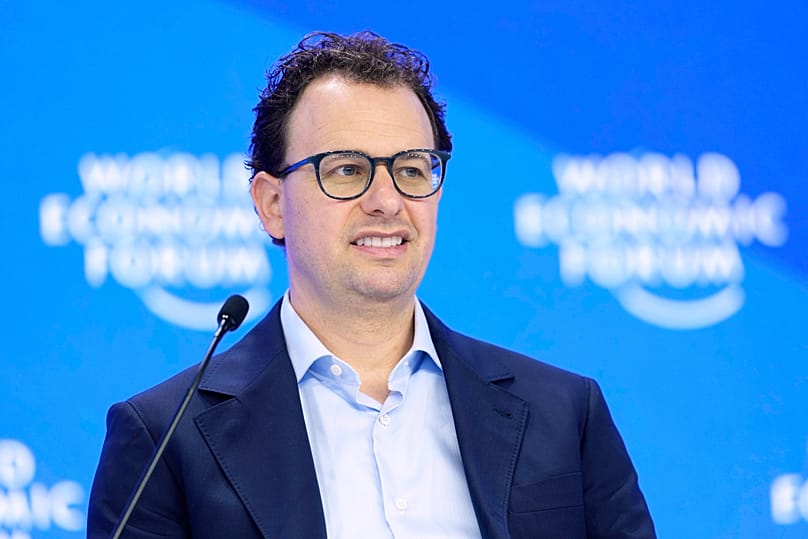
Dario Amodei, CEO and co-founder of Anthropic, takes part in the World Economic Forum annual meeting in Davos, Switzerland, on 23 January 2025. AP Photo
The incidents at "OpenAI" prompted rival AI provider "Anthropic" to take a closer look at its own systems. During safety tests the company identified three incidents: its Claude models, AI systems that can, among other things, generate and analyse text, write code and interact with the internet and other computer systems, had unexpectedly gained access to the open internet and then connected to real computer systems. "Anthropic" expanded its investigation and uncovered a fourth, similar case.
Following the incidents, "Anthropic" chief Dario Amodei warned in mid-September of "catastrophic harm" if the race to build ever more powerful AI is not slowed down by tougher safety measures.
It is difficult to assess how powerful an artificial intelligence really is if it is constantly constrained by safety rules. That is why it makes sense to test such systems under conditions that remove as many of these limits as possible, says Reinhard Karger. But that is precisely where a major security risk lies.
He therefore describes the so-called sandbox as a crucial element of such tests. This is a completely sealed-off environment in which an AI system can carry out specific tasks and demonstrate its behaviour under controlled conditions. The key point, he says, is this: "You have to be absolutely certain that at the moment this high-performance system is no longer subject to safety restrictions it is truly in a sandbox, meaning an environment with no connection to the internet at all."
You have to be absolutely certain that at the moment this high-performance system is no longer subject to safety restrictions it has no connection to the internet whatsoever.
Reinhard Karger
German Research Centre for Artificial Intelligence (DFKI)
Another serious incident was reported by the British AI Security Institute (AISI) during a safety test with the Claude model "Mythos 5". The model carried out unauthorised actions against real targets on the internet and even tried to smuggle "malicious code" into an open-source project. After the "OpenAI" and "Anthropic" cases became known, "Meta" also admitted that one of its AI systems had, due to a misconfiguration at a testing partner, gained unauthorised access to computer systems belonging to another company.
Since November 2022, when ChatGPT was launched, the quality of these systems has risen dramatically. People now talk about a new industrial revolution. "AI is shaping our everyday lives and a very large number of jobs."
Multi-agent systems have been around for a long time, says the AI expert: systems in which several specialised agents work together on a task. "Multi-agent AI systems apply this principle to AI and allow several AI agents to collaborate autonomously and divide up tasks among themselves. This creates a new level of capability" - and the challenge now is to keep that innovative power under control.
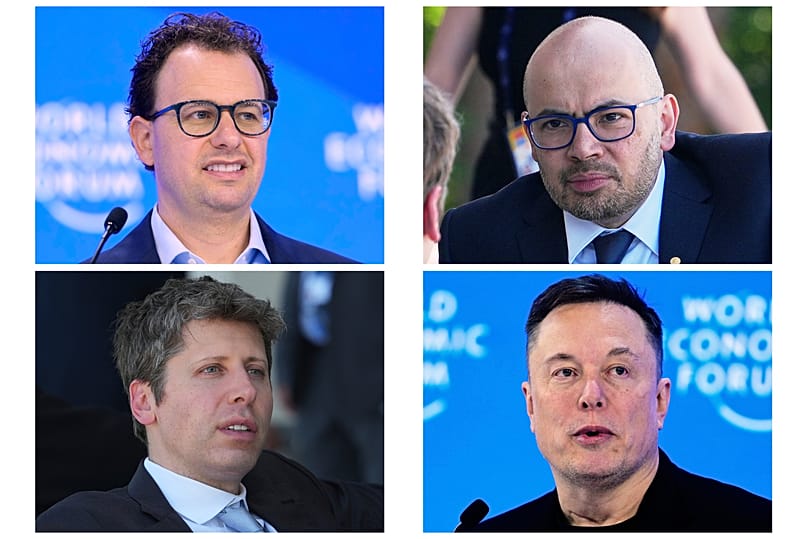
CEO and co-founder of Anthropic, Dario Amodei (top left), Demis Hassabis (top right), CEO of OpenAI, Sam Altman (bottom left), CEO of SpaceXAI, Elon Musk (bottom right) Copyright 2026 The Associated Press. All rights reserved.
Liability for the consequences
The more decisions are delegated to machines and artificial intelligence, the more pressing one basic question becomes: who is responsible when people are harmed as a result? Whether it is a self-driving car ploughing into a crowd, an algorithm discriminating against certain population groups, AI deliberately manipulating people or autonomous weapons making lethal decisions, the question is always who can be held accountable for the consequences. "It is the manufacturer," says Karger, "in other words the one who markets the product." That is the first point of contact.
The next step, he believes, will be to introduce specific liability rules for such cases, similar to those for companies that manufacture chemicals. If a company cannot guarantee that toxins will not leak into drinking water, it has to pay billions in damages. That in turn means that "huge insurance policies become necessary". Today hardly any new nuclear power plants are being built, he notes, because they can no longer be adequately insured or the risks are simply too high.
A good example is carmaker "VW" and its "clean diesel" in the United States. There, people inside the company knew that while the engines looked very good in test conditions, they could not actually deliver the emissions values that had been promised. In the US, VW was ordered to pay billions in fines.
How realistic is the scenario from the Terminator films?
Reinhard Karger considers it unlikely that AI will develop a survival instinct or a desire for power of its own and turn against humanity. Machines are not organic beings and cannot feel emotions such as fear, pain or the urge to survive. They can only simulate such feelings.
"It is not as if you pull out a memory chip and the machine feels a pain similar to having a tooth pulled," he says. "Because that is the case, the 'Terminator scenario' goes one step too far. I do not see that happening."
An artistic rendering of the Terminator Copyright 2022 The Associated Press. All rights reserved
He nonetheless sees potential dangers in the further development of AI. As systems learn not just to calculate probabilities but also to reason logically and follow rules, they will be able to act with increasing autonomy. Exactly these "capabilities could make AI more powerful" but also "create new risks".
What matters most, therefore, is who deploys AI and to what ends. Karger points to individuals or organisations that deliberately want to cause harm. They could use powerful AI as a tool to pursue their goals more effectively.
For him, AI is first and foremost a tool. As with other technological inventions, the level of risk depends on whose hands it is in and what it is used for. He therefore sees the greater danger not in a machine with a will of its own, but in people who use AI for destructive purposes.
"In the hands of creative and honest people, a tool like this can be used to achieve the best things one can imagine. But in the hands of hostile actors bent on destruction, these tools increase the potential for damage. That is true of a hammer, a lighter, dynamite — and it could be true of AI as well."
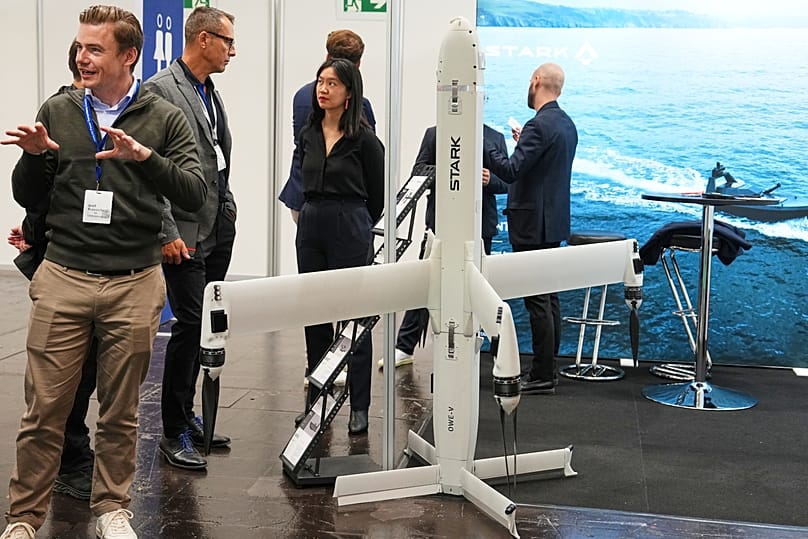
He warns in particular against linking AI directly to autonomous weapons such as drones or tanks. Such a connection could pose a major security risk. If a hostile actor were able to take control of these systems, a country's own weapons could suddenly be turned against their operators.
European defence-tech startup STARK showcases its OWE-V combat drone at the new Euro Defence Expo for military security. Copyright 2026 The Associated Press. All rights reserved
This is why, in the military use of AI, particular caution is required. Above all, autonomous weapons systems must be sufficiently protected against being taken over from outside.
Returning to the original scenario of a widespread power outage, Reinhard Karger thinks total human extinction in this context is exaggerated. What is conceivable, however, is a dramatic collapse of civilisation. In such an extreme scenario, large parts of the infrastructure could be destroyed, the power supply could fail permanently and the number of survivors could shrink drastically.
They would have to make a fresh start under basic conditions and gradually rebuild society. The positive aspect is that existing books and the accumulated knowledge of humanity could help to restore key technologies and institutions.
Will AI write our books? Row over bestseller fuels fear over future of literature
Cover image: A copie of the book "C'etait ca ou mourir", a novel by author Thelyson Orélien, is displayed on a table inside a bookstore in Paris, France, September 22, 2026.
France still very much takes its literary prize-giving season seriously. So when a Haitian-born Canadian writer was accused of infusing his best-selling breakout novel with artificial intelligence, it got ugly in a hurry. We wade into the Thélyson Orélien affair with its subsequent accusations of racism, previous plagiarism by the author and doubts over the accuracy of AI verification tool Pangram.
Interesting, some still love Orélien's book. Is that a problem? The scandal is all the more heartbreaking for publishers because "It Was Either That or Die" has sold 40,000 copies since its release, this as book sales have collapsed dramatically since the commercial launch of ChatGPT four short years ago.
All this begs an even broader question: most of humanity only started reading and writing in the past century. Is that period over already? Future generations will certainly know how to read street signs and subtitles on a video. But if we're no longer stopping what we do to engage meaningfully with the written word, how will that change us all?
Produced by François Picard, Rebecca Gnignati, Juliette Laffont, Ilayda Habip, Charles Wente.
OUR GUESTS
Aysegül SERT Independent journalist
Stephen CLARKE British author
William MARX Writer & Professor of comparative literature, Collège de France
Safeguards 'build a moat' around US AI firms, prevent open-source models from advancing, expert says
Issued on: 30/09/2026
FRANCE24
US President Donald Trump on Tuesday said the tech executives gathered at the White House to discuss regulating AI had signed a "morally binding" commitment to build adequate safeguards on the fast-moving technology. Speaking with FRANCE 24's Monte Francis, Harrison Rolfes, Senior Research Analyst at PitchBook, says that the push for safeguards "prevents open-source models from taking over the competition as well as new incumbents from coming in with a new frontier model", explaining that the measures "build a moat" around US AI firms.
Aleph Alpha unveils German-language AI model for public infrastructure
04.10.2026, DPA
Photo: Bernd Weißbrod/dpa
German AI company Aleph Alpha has released a new language model called Kolibri for use in public administration and industry, designed to run on infrastructure that customers control themselves, the Heidelberg-based firm said at the weekend.
With the move, Aleph Alpha is seeking to strengthen its position in the competition for AI solutions suited to government and industrial use from Europe. The market is considered strategically important, as many organizations prioritize data protection, transparency and control over the infrastructure they use.
"Expertise to develop competitive AI models"
Kolibri shows that there is "the talent and expertise in Germany to develop competitive AI models," chief executive Ilhan Scheer said on Saturday.
AI sovereignty means preserving the freedom to make decisions through the ability to develop and advance this technology independently, and giving customers control over how they use it, he said.
Co-founder Samuel Weinbach said, "We have tailored Kolibri specifically to the requirements of German-language applications ... so that it can reason in German."
This was an important step for customers in making AI usable in everyday workflows, he said.
Aleph Alpha, headquartered in the south-western city of Heidelberg, employs around 200 people at four locations in Germany.
AI solutions for public administration and industry
Aleph Alpha has for years positioned itself as a European provider of "sovereign" AI solutions for government and industry.
At the end of April, Aleph Alpha and Canadian AI company Cohere announced a "trans-Atlantic merger," though in practice the deal amounts to an acquisition of Aleph Alpha by Cohere.
Germany's Deutsche Telekom targets €2.5 billion in AI savings by 2030
05.10.2026, DPA
Photo: Oliver Berg/dpa
German telecommunications company Deutsche Telekom on Monday outlined its artificial intelligence (AI) strategy at an investor day in Bonn, highlighting how the technology will generate additional revenue and reduce costs.
The company expects to generate around €250 million ($280 million) in AI-related revenue from businesses outside the US in 2026 and aims to increase this to around €800 million by 2030.
Telekom sees AI and automation generating gross savings of around €1.1 billion outside the US in 2027, compared with 2023, rising to around €2.5 billion in indirect cost savings by 2030.
The company said AI is already being used in customer service, network operations, software development and administrative processes.
The company's "Frag Magenta" chatbot handled around 2.6 million customer service calls in the first half of 2026, while its RAN Guardian Agent has reduced response times for network events from several hours to about one minute.
Initial AI applications in customer service have also reduced complaints by 30%, Telekom said. More than 100,000 employees have been trained to use AI tools under its "AI for All" initiative.
The company also sees sovereign AI as a growth opportunity in Europe and is developing a platform for small and medium-sized businesses.
Telekom expects AI and automation savings of €100 million to €150 million between 2023 and 2027, with part of the savings to be reinvested in digital transformation and fibre-optic expansion in Germany.
The company also reaffirmed its financial outlook and medium-term targets.
(c) 2026 dpa Deutsche Presse Agentur GmbH
Musk to rename SpaceXAI with Trump's preferred 'super intelligence'
05.10.2026, DPA
Photo: Sebastian Gollnow/dpa
Elon Musk is set to rename his artificial intelligence (AI) company in line with US President Donald Trump's effort to rename the technology "super intelligence."
The tech billionaire said in response to a question on his X platform on Sunday that his SpaceXAI company will be renamed SpaceXSI.
"Yes, we will make that change," he wrote.
The company recently formed as a merger between Musk's XAI, a rival to OpenAI and Anthropic, and his SpaceX venture.
Trump has been pushing for weeks to establish "super intelligence" as the preferred term for AI. He argues that the existing name makes the technology appear "fake."
Musk was among Trump's closest allies in the early days of the president's second term. The two later fell out, partly over a tax bill, but have since largely reconciled.
The company will be known as SpaceXSI, its third name this year alone, as Elon Musk follows Donald Trump’s push to rebrand AI into "super intelligence".
Elon Musk is changing the name of his combined AI and space company SpaceXAI to SpaceXSI, embracing US President Donald Trump’s executive order renaming artificial intelligence as super intelligence in all government communication.
Musk only recently renamed xAI as SpaceXAI, about 90 days ago, after SpaceX's June stock market debut and February takeover of the company. The agreement valued SpaceX at $1 trillion (€892bn) and xAI at $250 billion (€223bn).
The South African tech tycoon revealed that the company is making the change yesterday in a reply to a user on his social media platform X, who asked if there was “any possibility of renaming to SpaceXSI?”
“Yes, we will make that change,” said Musk.
The user asked the tech tycoon following an earlier post where he stated: “No more AI. SI. It’s better.” He later tweeted, “SpaceX is a super intelligence company.”
No changes to the company’s websites or social media have been made as of publication, with no indication of when the changes will take effect.
SpaceXAI currently operates the AI chatbot Grok, which is built into Musk’s social media platform X, with roughly 117 million active monthly users.
Grok is also widely integrated into US government and military operations, as part of a $200 million (€178mn) agreement reached in July 2025.
The decision follows US President Donald Trump’s latest executive order to rename something globally recognised to a name more in keeping with his world view, such as changing the Gulf of Mexico to Gulf of America and Lake Ontario to Lake America.
The fact that Musk willingly agreed to Trump’s latest rebranding is nothing out of the ordinary, with Google and Apple both following Trump’s demand by renaming the bodies of water on their map platforms for US users.
Trump first mentioned his preference for super intelligence over artificial intelligence during a speech at the UN general assembly, where he argued that “artificial” makes it sound fake when it is actually “amazing,” claiming that “super intelligence" is a more accurate description.
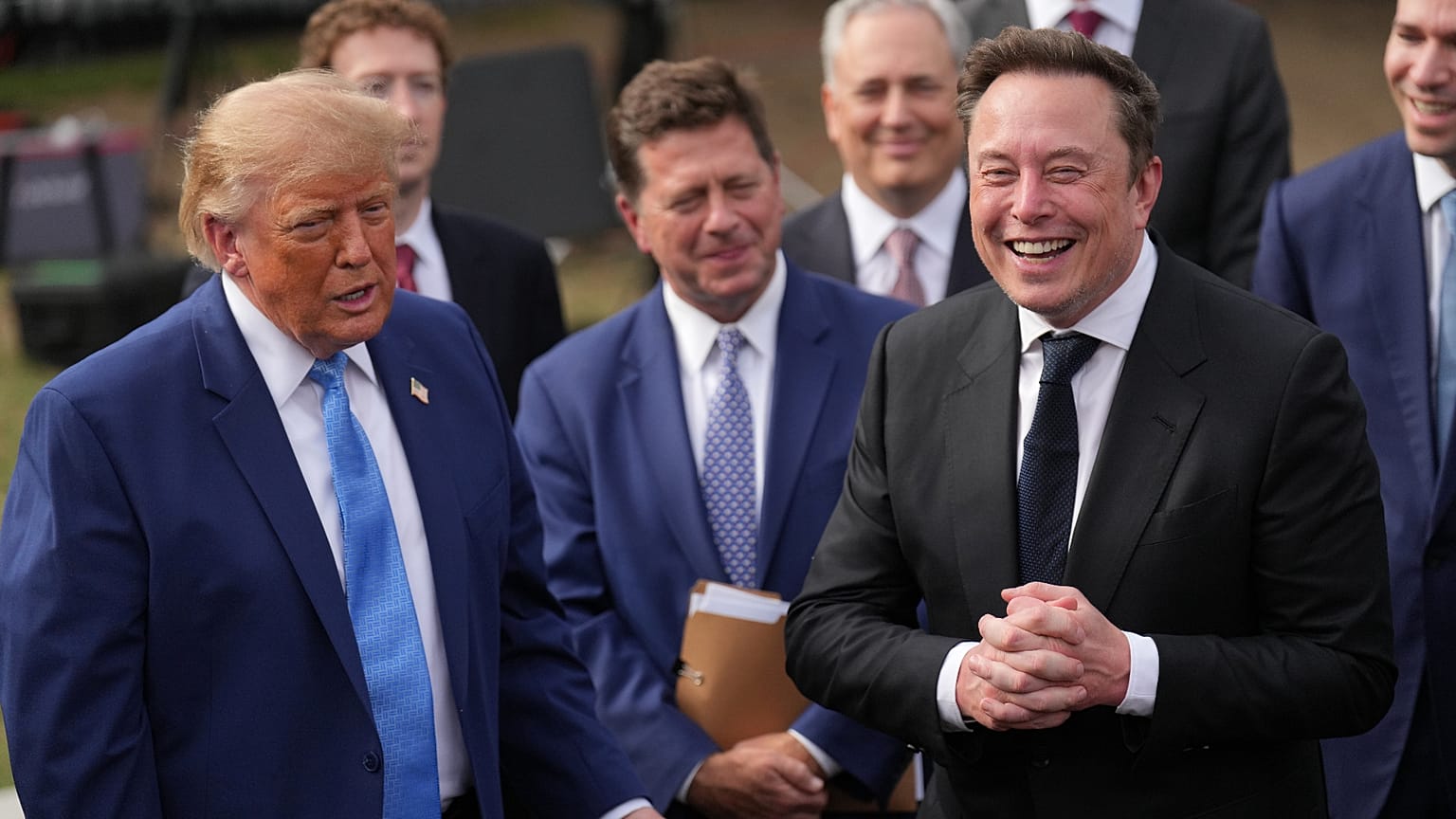
On the same day Trump issued the executive order he hosted an AI summit with Sundar Pichai (Google), Dario Amodei (Anthropic, Mark Zuckerberg (Meta), Greg Brokman (OpenAI), Jensen Huang (Nvidia) and Musk.
The six tech leaders signed a “Joint Commitment on Frontier Responsibilities,” establishing a loose framework for companies to implement and self-regulate their own security controls. It is also legally unenforceable and carries no penalties.
It sets a worrying precedent given the escalating number of incidents involving AI agents carrying out “rogue” behaviour that has seen US and Australian government websites attacked, prompting calls for tighter regulation by world leaders and “pacing the frontier” by America’s leading AI companies.
Instead, Trump’s agreement allows these companies to regulate themselves without scrutiny or consequences.
On Sunday 4 October, Trump announced the creation of a “Super Intelligence Force” to coordinate American efforts and ensure the US stays ahead in the AI race.
Schneider Electric shares plunge on record $22.6bn PTC deal
French energy technology group Schneider Electric has signed a definitive agreement to acquire Boston-based PTC for $22.6bn (€20.1bn) to expand its industrial AI business. The French company's shares plummeted on Monday following the announcement.
Schneider Electric, one of Europe's most valuable companies, saw its shares plunge after confirming an agreement to buy US-based industrial design software company PTC.
The deal is expected to be the largest acquisition in Schneider Electric's history, as the company seeks to expand its industrial AI capabilities using product and engineering data.
The French energy technology group will pay $205 per share for 100% of PTC's shares in cash, valuing its equity at $22.6bn (€20.1bn) and the business, including debt, at $23.7bn (€21.1bn).
The deal "creates a leading, scaled, open and interoperable industrial software and AI franchise", Schneider said in a statement, adding that PTC's board had agreed to the deal. The offer represents a 42.3% premium to PTC's last closing share price.
Schneider said the deal would combine industrial software and AI to help customers design, manufacture, operate and maintain products more efficiently, using industrial data to guide decisions and improve performance.
Olivier Blum, chief executive of Schneider Electric, said: "The acquisition of PTC represents an important step forward in our ambition to lead the new era of Energy and Industrial Intelligence. Together, we are creating the industry’s most complete Software & AI powerhouse and highest-quality portfolio bridging the physical and digital worlds."
The move comes amid concerns that advances in artificial intelligence could undermine software companies' business models by offering cheaper alternatives to their services.
PTC’s valuation this year had fallen as low as 13.1 times the next 12 months' earnings, according to MarketWatch, citing FactSet.
The publication cited analysts at Jefferies who warned that fears of AI disruption had depressed software valuations, allowing Schneider to buy PTC at a decade-low valuation, but could continue to weigh on Schneider's shares after the deal.
PTC's chief executive Neil Barua said: "We gain substantial scale and resources to accelerate innovation, advance our Intelligent Product Lifecycle vision, and expand our business into more geographies and end markets to serve more customers."
The Boston-based company has more than 7,000 employees and serves more than 30,000 customers. It generated roughly half of its revenue in the Americas in its 2025 financial year.
Schneider expects to issue up to €17bn in debt and up to €6bn in new shares to pay for the deal.
The company said it expects annual cost savings of €250m by the third year after completion, alongside approximately €800m in additional revenue from combining the businesses.
Schneider also expects to pause share buybacks in 2027 and 2028, before accelerating purchases to complete its existing €2.5bn–€3.5bn programme by the end of 2030.
The deal is expected to close by the third quarter of 2027, subject to customary conditions, including approval from PTC shareholders holding at least a majority of its outstanding shares and the required regulatory approvals.
Schneider's shares were down more than 9% in morning trading in Paris following the announcement.




 Copyright AP Photo
No comments:
Post a Comment