Saturday, January 17, 2026

Marco Rubio, Tony Blair, Jared Kushner named to Trump’s ‘Board of Peace’ for Gaza


US President Donald Trump on Friday unveiled the members of a “Board of Peace" tasked with overseeing the temporary governance of post-war Gaza. Trump will chair the board himself and will be joined by former British prime minister Tony Blair, US Secretary of State Marco Rubio, US special envoy Steve Witkoff and the president’s son-in-law, Jared Kushner.


Issued on: 17/01/2026 
By: FRANCE 24
Video by: FRANCE 24
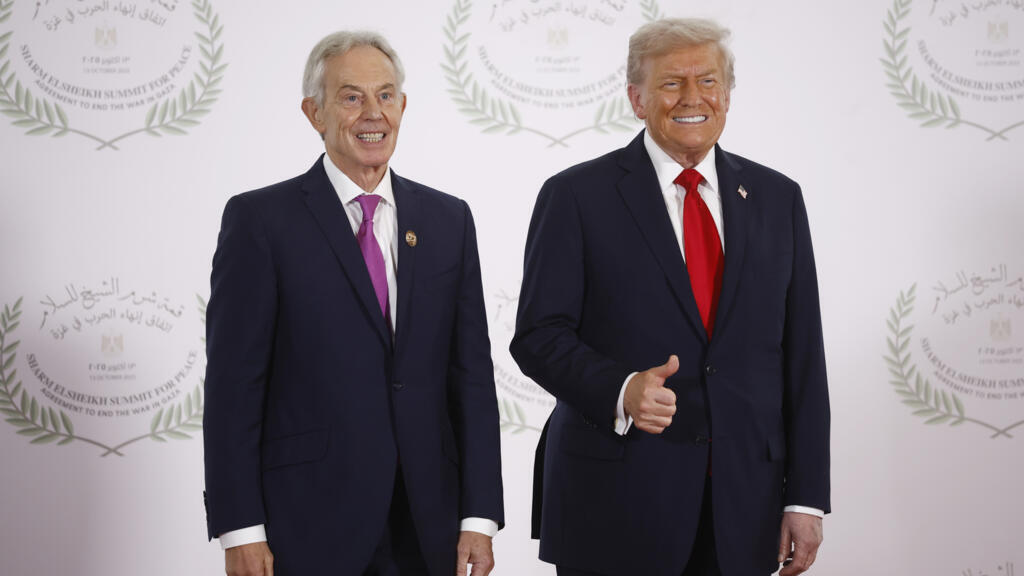

US President Donald Trump and British former prime minister Tony Blair pose at the Gaza Peace Summit in Sharm el-Sheikh, Egypt, on October 13 2025. © Yoan Valat, AP file photo
01:41


US President Donald Trump on Friday gave a key role in post-war Gaza to former British prime minister Tony Blair and appointed a US officer to lead a nascent security force.

Trump named members of a board to help supervise Gaza that was dominated by Americans, as he promotes a controversial vision of economic development in a territory that lies in rubble after two-plus years of relentless Israeli bombardment.

The leaders of Egypt, Turkey, Argentina and Canada were also asked to join the so-called Board of Peace.

The step came after a Palestinian committee of technocrats meant to govern Gaza held its first meeting in Cairo which was attended by Jared Kushner, Trump's son-in-law who plays a key role on the Middle East.

Trump has already declared himself the board's chair and on Friday announced its full membership that will include Blair as well as senior Americans – Kushner, Secretary of State Marco Rubio and Steve Witkoff, Trump's business partner turned globe-trotting negotiator.

In Canada, a senior aide to Prime Minister Mark Carney said he intended to accept Trump's invitation, while in Turkey, a spokesman for President Recep Tayyip Erdogan said he had been asked to become a "founding member" of the board.

Egypt's Foreign Minister Badr Abdelatty said Cairo was "studying" a request for President Abdel Fattah al-Sisi to join.

Sharing an image of the invitation letter, Argentine President Javier Milei wrote on X that it would be "an honour" to participate in the initiative.


In a statement sent to AFP, Blair said: "I thank President Trump for his leadership in establishing the Board of Peace and am honoured to be appointed to its Executive Board."

Blair is a controversial figure in the Middle East because of his role in the 2003 invasion of Iraq. Trump himself said last year that he wanted to make sure Blair was an "acceptable choice to everybody".

Blair spent years focused on the Israeli-Palestinian issue as representative of the "Middle East Quartet" – the United Nations, European Union, United States and Russia – after leaving Downing Street in 2007.

The White House said the Board of Peace will take on issues such as "governance capacity-building, regional relations, reconstruction, investment attraction, large-scale funding and capital mobilisation".

Trump, a real-estate developer, has previously mused about turning devastated Gaza into a Riviera-style area of resorts, although he has backed away from calls to forcibly displace the population.

The other members of the board are World Bank President Ajay Banga, an Indian-born American businessman; billionaire US financier Marc Rowan; and Robert Gabriel, a loyal Trump aide who serves on the National Security Council.

Palestinian militant group Islamic Jihad criticised the composition of the Board of Peace, saying it served Israel's interests.

The board "came in accordance with Israeli criteria and to serve the interests of the occupation", the group said in a statement.


Israel strikes

Israel's military said Friday it had again hit the Gaza Strip in response to a "blatant violation" of the ceasefire declared in October.

The strikes come despite Washington announcing that the Gaza plan had gone on to a second phrase – from implementing the ceasefire to disarming Hamas, whose October, 2023 attack on Israel prompted the massive Israeli offensive.

Trump on Friday named US Major General Jasper Jeffers to head the International Stabilization Force, which will be tasked with providing security in Gaza and training a new police force to succeed Hamas.

Jeffers, from special operations in US Central Command, in late 2024 was put in charge of monitoring a ceasefire between Lebanon and Israel, which has continued periodic strikes aimed at Hezbollah militants.

The United States has been searching the world for countries to contribute to the force, with Indonesia an early volunteer.

But diplomats expect challenges in seeing countries send troops so long as Hamas does not agree to disarm fully.

Committee begins work

Gaza native and former Palestinian Authority deputy minister Ali Shaath was earlier tapped to head the governing committee.
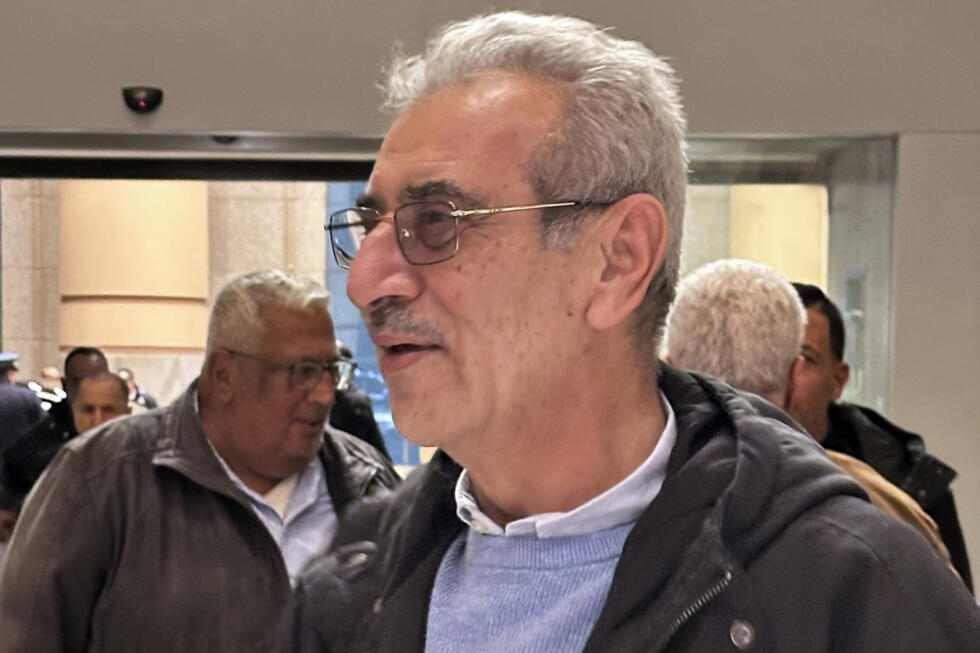
Ali Shaath, head of the Palestinian technocratic committee for managing the Gaza Strip, arrives at a hotel in Cairo. © Mohammed Abed, AFP


The committee's meeting in Cairo also included Bulgarian diplomat Nickolay Mladenov, who was given a role of high representative liaising between the new governing body and Trump's Board of Peace.

Committee members are scheduled to meet again Saturday, one of them told AFP on condition of anonymity.

"We hope to go to Gaza next week or the week after; our work is there, and we need to be there," he said.

Trump also named a second "executive board" that appears designed to have a more advisory role.

Blair, Witkoff and Mladenov will serve on it as well as Turkish Foreign Minister Hakan Fidan.

Israel said on Saturday it objected to the board's line-up.

"The announcement regarding the composition of the Gaza Executive Board, which is subordinate to the Board of Peace, was not coordinated with Israel and runs contrary to its policy," the office of Israeli Prime Minister Benjamin Netanyahu said.

"The Prime Minister has instructed the Foreign Affairs Minister to contact the US Secretary of State on this matter."

Israel has refused a Turkish role in the security force, owing to President Recep Tayyip Erdogan's fiery denunciations of Israel's actions in Gaza.

The board will also include senior figures from mediators Egypt and Qatar, and the United Arab Emirates, which normalised ties with Israel in 2020.

Trump also named to the board Sigrid Kaag, the UN humanitarian coordinator for Gaza, despite his administration's efforts to sideline the world body.

(FRANCE 24 with AFP)


Israel objects to US lineup of 'Gaza executive board'

Netanyahu's office said the lineup runs contrary to Israeli policy. The Trump administration had announced panel members who will oversee the transitional government in the war-ravaged Palestinian territory.


Earlier this week, the Trump administration announced the start of the second phase of the US president's Gaza peace plan
Image: Omar Ashtawy/APAimages/IMAGO

Israel objected on Saturday to the US announcement of members of a so-called "Board of Peace" executive board appointed to lead post-war Gaza, according to a US-brokered ceasefire agreement that came into force in October.

US President Donald Trump on Friday announced the names of some of the people who are going to sit on the body that will oversee the transitional government in the war-ravaged Palestinian territory.

Among those on the seven-member "founding executive board" are US Secretary of State Marco Rubio, Trump's special envoy Steve ​Witkoff, ​former British Prime Minister Tony Blair, Trump's son-in-law Jared Kushner and World Bank President Ajay Banga.

Trump himself will chair the "founding executive board."

Turkish, Qatari officials to sit on 'Gaza executive board'

In addition, there will be a "Gaza executive board" that, according to a statement from the White House,"will help support effective governance and the delivery of best-in-class services that advance peace, stability, and prosperity for the people of Gaza."

Witkoff, Kushner and Blair will also sit on the Gaza executive board, along with Turkish Foreign Minister Hakan Fidan, Qatari diplomat Ali Al-Thawadi and other officials. Both Turkey and Qatar have been critical of Israel's military operations in Gaza since the October 7, 2023, attacks on Israel.

What did Israel say about the US appointments?

The office of Prime Minister Benjamin Netanyahu said he has instructed Foreign Minister Gideon Saar to discuss the Israeli reservations with Rubio.

"The announcement regarding the composition of the Gaza Executive Board, which is subordinate to the Board of Peace, was not coordinated with Israel and runs contrary to its policy," the statement read, without going into specifics about stating the prime minister's exact objections.

The Palestinian militant group Islamic Jihad, which is considered a terrorist group by some countries, also criticized the makeup of the board, arguing it "came in accordance with Israeli criteria and to serve the interests of the occupation, in a clear indicator of preexisting bad intentions over the implementation of the terms of the [ceasefire] agreement.

Earlier this week, the Trump administration announced the start of the second phase of the US president's Gaza peace plan.

The first phase called for a ceasefire that came into effect on October 10. Since then, both sides have accused the other of violating the deal.

Israel has continued to restrict aid into the Gaza Strip and conduct attacks.

And Hamas — which is designated as a terrorist organization by Germany, the EU, the US and some Arab states — has so far refused to disarm, a non-negotiable demand from Israel.

rmt/sms (AFP, AP, Reuters)


Thousands oppose US plans in 'Hands off Greenland' protests

DW with AFP, AP
17/01/2026 
 
Organizers have called on Danish and Greenlandic residents to join marches and rallies against US President Donald Trump's push to acquire Greenland.


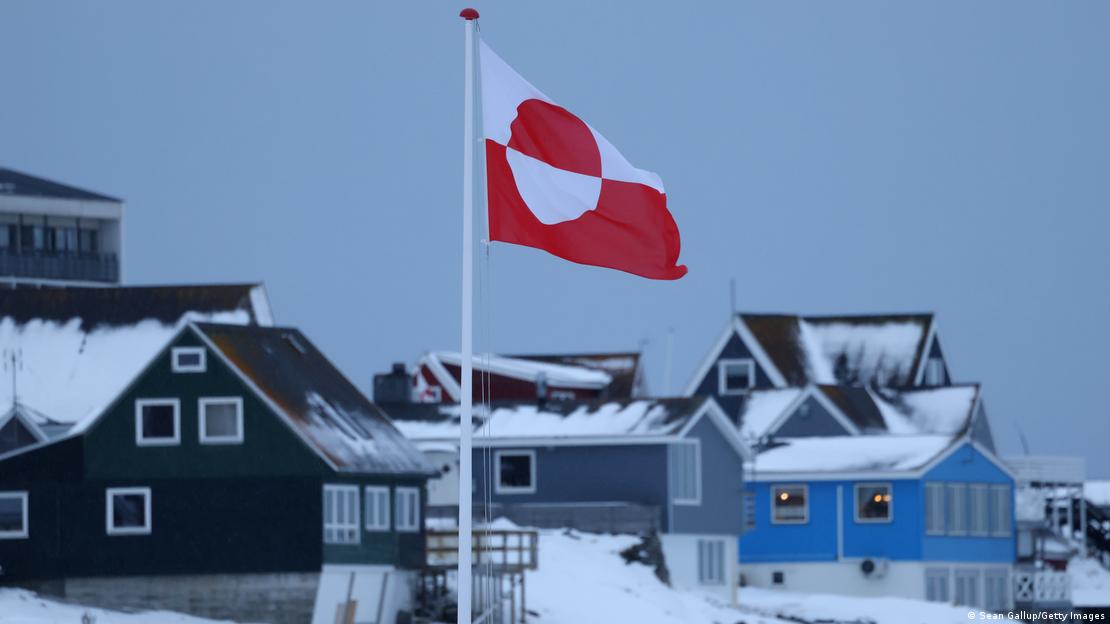
Thousands gathered in Nuuk to protest President Donald Trump's intent to acquire Greenland
Image: Sean Gallup/Getty Images


Massive demonstrations organized by Greenlandic associations have been taking place across Denmark and Greenland on Saturday to protest US President Donald Trump's ambitions to take over the Arctic island.

The aim of the protests is "to send a clear and unified message of respect for Greenland's democracy and fundamental human rights," said Uagut, an association of Greenlanders in Denmark, on its website.
Thousands assemble in big Danish cities

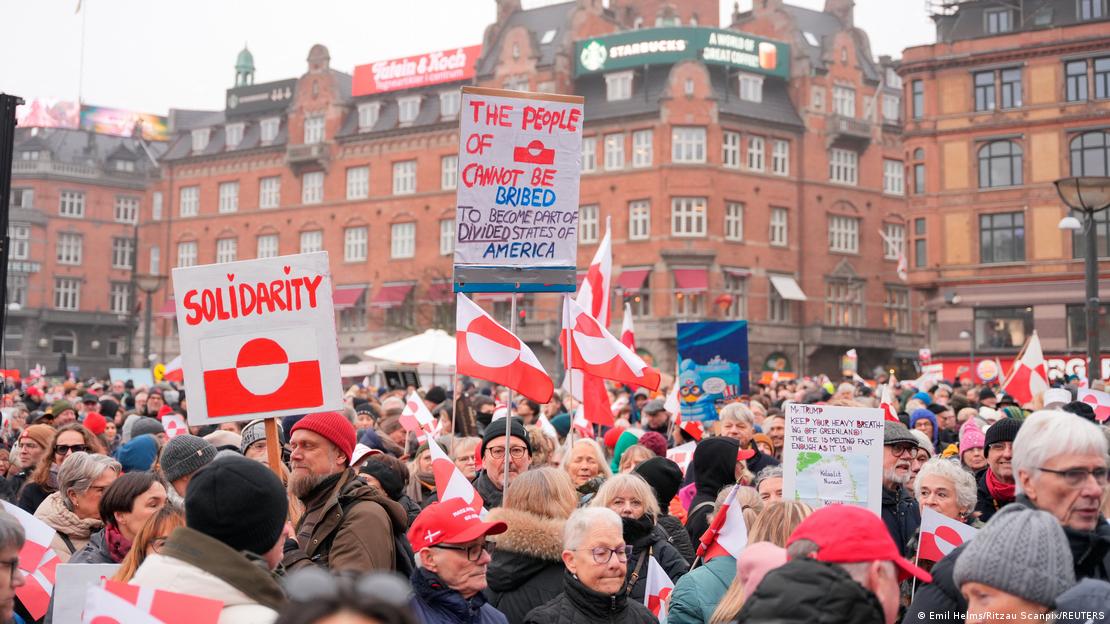
Thousands of demonstrators assembled in Copenhagen's City Hall Square at 12:00 p.m. local time (11:00 GMT), chanting "Greenland is not for sale" and holding banners with slogans such as "Hands off Greenland." They then marched towards the US embassy.


Thousands marched through the streets of Copenhagen to voice their opposition against US control over the Danish territory
Image: Emil Helms/Ritzau Scanpix/REUTERS

"I am very grateful for the ‌huge support ⁠we as Greenlanders receive... We are also sending a message to the world that you all must wake up," Julie Rademacher, chair of Uagut, told the protesters.

"Greenland and the Greenlanders have involuntarily ‍become the front in the fight for democracy and human rights," she added.

Protests were also ongoing in the Danish cities of Aarhus, Aalborg, and Odense.

Protesters gather in Nuuk

The demonstration in Greenland's capital, Nuuk, began 4:00 p.m. local time (1500 GMT), according to the organizers, who say it is "against the United States' illegal plans to take control of Greenland."

The Greenland flag is called Erfalasorput, which means "our flag" in the Greenlandic languageImage: Sean Gallup/Getty Images

Several thousand protesters, including the territory's prime minister, Jens-Frederik Nielsen, who was seen waving a Greenlandic flag, chanted slogans and sang traditional Inuit songs in the light rain.

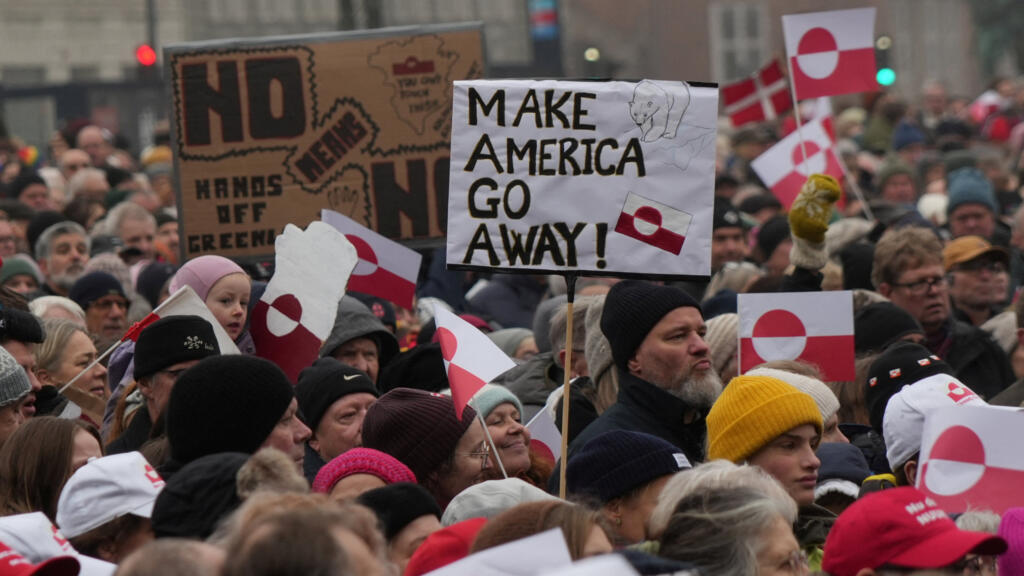
Many of them wore caps bearing the slogan "Make America Go Away," an AFP reporter noted, referencing Trump's "Make America Great Again" brand.

Demonstrators marched to the US consulate carrying Greenlandic flags. The territory's total population is about 57,000.

Dispute over Greenland intensifies

Tensions around Greenland have risen this month amid repeated insistence by US President Donald Trump that he wants the US to take control of Greenland.

On Saturday, Trump announced a 10% tariff on 8 European nations, including Germany, that oppose his plans to take over the semiautonomous territory of the Kingdom of Denmark.

Protests coincide with visit of US delegation to Denmark

The protests also coincide with the visit of a bipartisan delegation of US lawmakers, a group mostly made up of Democrats, to Denmark.

US lawmakers said they were visiting Copenhagen in a bid to "lower the temperature" as tensions remain between EU and US ambitions over the future of Greenland.

Europeans have also shown support for Denmark by deploying small numbers of troops to Greenland in the face of US threats to acquire the Danish territory.

Edited by: Roshni Majumdar, Jenipher Camino Gonzalez
Dmytro Hubenko Dmytro covers stories in DW's newsroom from around the world with a particular focus on Ukraine.

'Hands off Greenland': Thousands protest in Denmark against Trump's land grab

Thousands of people began demonstrating across Denmark and Greenland on Saturday against US President Donald Trump’s threats to take over the Arctic island. The protests follow a new Trump warning on Friday that he may levy tariffs on countries that oppose his plans to acquire the semi-autonomous Danish territory.


Issued on: 17/01/2026 
By:  FRANCE 24
Video by: FRANCE 24


Protesters take part in a demonstration to show support for Greenland in Copenhagen on January 17, 2026. © Tom Little, Reuters
01:47


Thousands of people took to the streets of Denmark's capital on Saturday to protest at US President Donald Trump's push to take over Greenland, an autonomous Danish territory. Thousands more marched and sang traditional Inuit songs in a sister demonstration in Greenland's capital Nuuk.

The protests followed Trump's warning on Friday that he "may put a tariff" on countries that oppose his plans to take over mineral-rich Greenland, which is an autonomous territory of Denmark.

They also coincided with a visit to Copenhagen by a bipartisan delegation from the US Congress that has made clear the opposition of many Americans to the Trump administration's sabre-rattling.

Waving the flags of Denmark and Greenland, the protesters formed a sea of red and white outside Copenhagen city hall, chanting "Kalaallit Nunaat!" – the vast Arctic island's name in Greenlandic.

Thousands of people had said on social media they would to take part in marches and rallies organised by Greenlandic associations in Copenhagen, and in Aarhus, Aalborg, Odense and the Greenlandic capital Nuuk.

‘Playing straight into Russia’s hands’: Expert warns Trump’s Greenland push strains NATO
© FRANCE 24
07:15

"The aim is to send a clear and unified message of respect for Greenland's democracy and fundamental human rights," Uagut, an association of Greenlanders in Denmark, said on its website.

Several thousand people also demonstrated in the capital of Greenland on Saturday.

The protesters – including the territory's prime minister, Jens-Frederik Nielsen, waving a Greenlandic flag – chanted slogans and traditional Inuit songs under light rain.

Many of them wore caps with the slogan "Make America Go Away" – a riff on Trump's MAGA brand – an AFP reporter saw.

The Copenhagen rally, which began at 12pm (1100 GMT), was due to make a stop outside the US embassy in the Danish capital.
'Demand respect'

"Recent events have put Greenland and Greenlanders in both Greenland and Denmark under pressure," Uagut chairwoman Julie Rademacher said in a statement to AFP, calling for "unity".

"When tensions rise and people go into a state of alarm, we risk creating more problems than solutions for ourselves and for each other. We appeal to Greenlanders in both Greenland and Denmark to stand together," she said.

The demonstration in Greenland was "to show that we are taking action, that we stand together and that we support our politicians, diplomats and partners", Kristian Johansen, one of the organisers, said in a statement.

"We demand respect for our country's right to self-determination and for us as a people," added Avijaja Rosing-Olsen, another organiser.

"We demand respect for international law and international legal principles. This is not only our struggle, it is a struggle that concerns the entire world."

According to the latest poll published in January 2025, 85 percent of Greenlanders oppose the territory joining the United States. Only six percent were in favour.
'No security threat'

Speaking in Copenhagen, where the Congressional delegation met top Danish and Greenlandic politicians and business leaders, US Democratic Senator Chris Coons insisted there was no security threat to Greenland to justify the Trump administration's stance.

He was responding after Trump advisor Stephen Miller claimed on Fox News that Denmark was too small to defend its sovereign Arctic territory.

"There are no pressing security threats to Greenland, but we share real concern about Arctic security going forward, as the climate changes, as the sea ice retreats, as shipping routes change," Coons told the press.

"There are legitimate reasons for us to explore ways to invest better in Arctic security broadly, both in the American Arctic and in our NATO partners and allies," said Coons, who is leading the US delegation.

Trump has repeatedly criticised Denmark – a NATO ally – for, in his view, not doing enough to ensure Greenland's security.

The US president has pursued that argument, despite strategically located Greenland – as part of Denmark – being covered by NATO's security umbrella.

European NATO members are deploying troops in Greenland for a military exercise designed to show the world, including the United States, that they will "defend (their) sovereignty", French armed forces minister Alice Rufo said this week.

Britain, Finland, France, Germany, the Netherlands, Norway and Sweden have announced they are sending small numbers of military personnel to prepare for future exercises in the Arctic.

The United States has been invited to participate in the excercise, Denmark said on Friday.

(FRANCE 24 with AFP)

Thousands take part in 'Hands off Greenland' protests in Denmark

By Euronews with AFP
Published on 17/01/2026 


Large crowds of demonstrators marched through Copenhagen and other Danish cities on Saturday in support of Greenland's sovereignty amid tensions with the US.

Thousands of people took to the streets of Denmark's capital on Saturday to protest at US President Donald Trump's push to take over Greenland.

The protest followed Trump's warning on Friday that he "may put a tariff" on countries that oppose his plans to take over mineral-rich Greenland, which is an autonomous territory of Denmark.

They also coincided with a visit to Copenhagen by a bipartisan delegation from the US Congress that has made clear the opposition of many Americans to the Trump administration's sabre-rattling.

Waving the flags of Denmark and Greenland, the protesters formed a sea of red and white outside Copenhagen city hall, chanting "Kalaallit Nunaat!" -- the vast Arctic island's name in Greenlandic.

Thousands of people had said on social media they would to take part in marches and rallies organised by Greenlandic associations in Copenhagen, and in Aarhus, Aalborg, Odense and the Greenlandic capital Nuuk.

"The aim is to send a clear and unified message of respect for Greenland's democracy and fundamental human rights," Uagut, an association of Greenlanders in Denmark, said on its website.

A sister demonstration was scheduled to happen in Nuuk, the capital of Greenland, to protest the US' "illegal plans to take control of Greenland", organisers said.

Demonstrators would march to the US consulate carrying Greenlandic flags.

The Copenhagen rally made a stop outside the US embassy in the Danish capital.
Demand respect

"Recent events have put Greenland and Greenlanders in both Greenland and Denmark under pressure," Uagut chairwoman Julie Rademacher said in a statement to AFP, calling for "unity".

"When tensions rise and people go into a state of alarm, we risk creating more problems than solutions for ourselves and for each other. We appeal to Greenlanders in both Greenland and Denmark to stand together," she said.

The demonstration in Greenland was "to show that we are taking action, that we stand together and that we support our politicians, diplomats and partners," Kristian Johansen, one of the organisers, said in a statement.

"We demand respect for our country's right to self-determination and for us as a people," added Avijaja Rosing-Olsen, another organiser.

"We demand respect for international law and international legal principles. This is not only our struggle, it is a struggle that concerns the entire world."

According to the latest poll published in January 2025, 85 percent of Greenlanders oppose the territory joining the United States. Only six percent were in favour.
No security threat

Speaking in Copenhagen, where the Congressional delegation met top Danish and Greenlandic politicians and business leaders, US Democratic Senator Chris Coons insisted there was no security threat to Greenland to justify the Trump administration's stance.


He was responding after Trump advisor Stephen Miller claimed on Fox News that Denmark was too small to defend its sovereign Arctic territory.

"There are no pressing security threats to Greenland, but we share real concern about Arctic security going forward, as the climate changes, as the sea ice retreats, as shipping routes change," Coons told the press.

"There are legitimate reasons for us to explore ways to invest better in Arctic security broadly, both in the American Arctic and in our NATO partners and allies," said Coons, who is leading the US delegation. Trump has repeatedly criticised Denmark -- a NATO ally -- for, in his view, not doing enough to ensure Greenland's security.

The US president has pursued that argument, despite strategically located Greenland -- as part of Denmark -- being covered by NATO's security umbrella.

European NATO members are deploying troops in Greenland for a military exercise designed to show the world, including the United States, that they will "defend (their) sovereignty",

French armed forces minister Alice Rufo said this week.

Britain, Finland, France, Germany, the Netherlands, Norway and Sweden have announced they are sending small numbers of military personnel to prepare for future exercises in the Arctic.

The United States has been invited to participate in the exercise, Denmark said on Friday.

NATO Mulls ‘Arctic Sentry’ To Ease US-Denmark Tensions Over Greenland – Analysis

January 17, 2026
RFE RL
By Rikard Jozwiak

One potential way to diffuse the current political tension between Denmark and the United States regarding the future status of Greenland could be a NATO-led Arctic Sentry mission.

The idea was aired when the ambassadors of the military alliance met in Brussels on January 8 to discuss the White House’s recent expression of interest in potentially taking over the autonomous Danish territory — with Washington not ruling out a military intervention to achieve this goal.

It follows two similar NATO missions launched in 2025, first the Baltic Sentryoperation, responding to numerous undersea sabotages in northern Europe, and then Eastern Sentry, which was launched shortly after a big Russian drone incursion into Poland.

Both “sentries” are still ongoing. They are also considered big successes, according to NATO officials RFE/RL has been in touch with on condition of anonymity.

But can something similar be repeated around, and possibly in, Greenland?

Belgian Defense Minister Theo Francken has publicly endorsed the idea and London and Berlin are also warming to it.

At the meeting in Brussels, everyone agreed that NATO needs to step up in the Arctic region.

“Canada has been screaming about the need to up the game in the High North for years, so Washington is hardly the first one to bring this up,” is how one European diplomat put it.

Seven of the eight so-called Arctic countries are NATO members, with Russia being the glaring exception. And while the waters around Greenland aren’t full of Russian and Chinese ships right now, that could change as Arctic ice melts and new sea lanes open up.

The NATO supreme allied commander (SACEUR) and the top US general in Europe, Alexus Grynkewich, recently noted at a military conference in Sweden that Russian and Chinese vessels “are not studying the seals and the polar bears,” adding they are “out there doing bathymetric surveys and trying to figure out how they can counter NATO capabilities on and under the sea. So that’s something that could grow very quickly, and we need to be mindful of it and ready.”

At the same time Grynkewich added that any concrete NATO mission right now is “premature.”

Speaking in Berlin earlier this week about a potential Arctic Sentry operation, German Defense Minister Boris Pistorius also noted that such an undertaking is still months away.

Yet, NATO Secretary-General Mark Rutte is busy discussing with Washington how the alliance can step up — one way or another.

European diplomats have told RFE/RL that an Arctic Sentry initiative would potentially neutralize the argument that the United States needs to have Greenland and prove that Europe can handle two flanks at the same time: Russia in the east and potentially Russia and China in the Arctic.

“In many ways it’s about burden-sharing here, as well,” one of them said, adding one potential scenario could involve Europeans handling air and sea surveillance while the United States increases its troop presence in Greenland.

The United States has some 200 officers there on one base looking after ballistic missile early warnings and space surveillance. During the Cold War, however, there were up to US 10,000 troops on the island spread out across 17 bases.

A ‘Loaded Pistol’


This was based on a 1951 deal between Copenhagen and Washington that allows the United States to have military assets, including bases, as long as NATO exists. This treaty remains valid and puts no limits on the US military presence, even though Denmark will have to consent — something likely to be given.

This would also open up the possibility for the United States to use Greenland in its Golden Dome missile defense program, which US President Donald Trump has mentioned in his comments about the giant island.

What European countries would do instead is to guard the airspace but also the water of what is known as the “the GIUK gap,” meaning the vast area between Greenland on one side and Ireland and the United Kingdom on the other.

This gap has been described as a “loaded pistol” in the face of the United States because it is an entry point for actors like Moscow and Beijing to do anything from underwater sabotage to seizing potential territory, according to a source familiar with military planning.

Nations likely to contribute could primarily be the United Kingdom and France but also countries like Denmark, Italy, Norway, the Netherlands, and Spain, which all have naval assets.

This would, of course, require several boats, notably cruisers and frigates but also submarines and especially icebreakers. Together the alliance only has about 40 of the latter, fewer than Russia even though there is a push to produce more.

Expect the alliance’s defense chiefs to discuss this in more detail when they meet in Brussels on January 21-22 and then again when NATO defense ministers assemble in the Belgian capital on February 12.

Practical Obstacles

However, there is also hesitation within the alliance as to whether an Arctic Sentry operation is feasible. There are many practical obstacles. Hundreds of ships would be needed to cover such a vast area, for example, including vessels that supply military craft.

Apart from the Nordic countries and Canada, there are few troops that have the experience of operating in harsh Arctic conditions — hence the current Danish-led Operation Arctic Endurance in and around Greenland in which troops from Canada, France, Germany, the Netherlands, and Norway are taking part.

While not everyone needs to contribute, everyone has to be on board to launch such a mission.

Will the Americans go along with this?

At the NATO meeting of ambassadors on January 8, Denmark and the United States agreed this is a bilateral issue for now.

This led to a meeting in Washington on January 14 of the foreign ministers of Denmark, Greenland, and the United States, hosted by US Vice President JD Vance.

The Danish foreign minister, Lars Lokke Rasmussen, noted after the meeting that the United States hadn’t changed its position on Greenland but also that a high-level working group will be set up with US and Danish officials to discuss the issue in the coming weeks.

People in Brussels see this as a sign there could be “a deal” that suits all with an expanded NATO role.

While nervousness exists about a military intervention, most of those RFE/RL has spoken to still see this as “unlikely” and that the US president is using the same strong-armed business negotiating tactic he employed when he secured a 5 percent defense-spending commitment from all allies at The Hague summit last year.

Now, it’s about the Europeans spending more and spending it faster — and not just focusing on their eastern flank.


Rikard Jozwiak is the Europe editor for RFE/RL in Prague, focusing on coverage of the European Union and NATO. He previously worked as RFE/RL’s Brussels correspondent, covering numerous international summits, European elections, and international court rulings. He has reported from most European capitals, as well as Central Asia.

RFE/RL journalists report the news in 21 countries where a free press is banned by the government or not fully established.


Leading US House Democrat offers resolution to block Trump's tariffs

US House Representative Gregory Meeks of New York said he will offer a resolution to "terminate" Trump's "illegal and absurd tariffs immediately."

"I'm here in Copenhagen and in every conversation I've had, officials have made clear: Greenland is not for sale," Meeks, the top Democrat on the US House Committee on Foreign Affairs, said in a statement posted on X.   

"Trump is manufacturing a foreign crisis and sabotaging our closest alliance — all while ignoring the real crisis the American people actually care about: affordablity," the statement added, referring to cost-of-living struggles Americans face.   

It's unclear if such a resolution would pass if brought to the floor of the Republican-majority US House of Representatives.

Some Republicans in Congress have also criticized Trump's plans to acquire Greenland, such as US Representative Don Bacon of Nebraska. 

Following Trump's announcement of fresh tariffs on Denmark, Germany, France and several other US allies, Bacon posted on Facebook that "Congress must reclaim tariff authorities."   

"There's a reason James Madison put tariff authorities under Article One," Bacon posted on X, referring to Article I of the US Constitution. Madison was one of the framers of the Constitution and served as president from 1809 to 1817,  

Article I, Section 8 of the US Constitution reads: "The Congress shall have power to lay and collect Taxes, Duties, Imposts and Excises."

The US Supreme Court is currently deliberating the constitutionality of Trump's tariffs on US trading partners. In its second term, the Trump administration has invoked the International Economic Powers Act of 1977 to implement the duties and bypass Congress. 


EU vows coordinated response to Trump's tariffs threat over Greenland sale


Copyright Hussein Malla/Copyright 2026 The AP. 

Published on 17/01/2026

European leaders vowed to stay united as President Trump threatened to impose fresh tariffs until Denmark agrees to sell Greenland in an unprecedented escalation. Von der Leyen says EU will uphold its sovereignty.

European leaders pledged a united response after US President Donald Trump threatened fresh tariffs until Denmark agrees to sell Greenland in an unprecedented escalation that could trigger a new trade war and break the transatlantic alliance.

From Ursula von der Leyen to French President Emmanuel Macron and German Chancellor Friedrich Merz, EU leaders vowed to stay "united, coordinated and committed" to upholding Europe's sovereignty after the Trump administration said additional tariffs of 10% would apply on eight European countries starting February 1.

In a social media post on Saturday, Trump said all products from Denmark, Sweden, Norway, France, Germany, the Netherlands, Finland and the United Kingdom would be subject to an additional 10% tariff, which could be increased to 25% by June, to be paid until "a deal is reached for the complete and total purchase of Greenland."

Greenland is a semi-autononomous territory belonging to Denmark. Earlier this week, the same group of countries said they would deploy a joint mission to the island, which has prompted the ire and retaliation of the White House in the form of new tariffs.

Last summer, the EU and the US signed a deal which tripled duties on European products to 15% while lowering tariffs to zero on US industrial goods. At the time, Brussels indicated the deal, which saw major EU concessions in favour of Washington, was the price to pay for US engagement in Ukraine and global stability.

While it was not immediately clear how the tariffs announced Saturday would be stacked up, the threat of additional duties risks triggering a new trade war between the two.

EU Council president António Costa said he would coordinate leaders in their response.

Ursula von der Leyen joined echoed his remarks saying "tariffs would undermine transatlantic relations and risk a dangerous downward spiral. Europe will remain united, coordinated and committed to upholding its sovereignty."

While the Commission negotiates matters related to trade on behalf of the 27 and has exclusive competences over commerce, the White House could go after individual countries by targeting specific products and industries related to those countries.
European leaders condemn 'unacceptable' threats

The Trump administration has upped the bellicose rhetoric around Greenland in recent weeks saying the territory will have to be transferred to the US for national security matters "the easy way or the hard way" and rejected suggestions that Denmark, assisted by its European allies, is capable of taking care of the territory and Arctic security.

Earlier this week, Danish officials held talks with American officials, pushing back against "a narrative" that Russian and Chinese warships are allowed to circle freely in Greenland. Danish intelligence says no Chinese ship has been spotted in a decade.

In a show of support for Denmark, a group of European countries joined an exploration mission to Greenland. They all now face tariffs from the Trump administration as a result.

Danish foreign minister Lars Løkke Rasmussen said he was "surprised" by the White House reaction and suggested that the purpose of the European mission is to "enhance security in the Arctic" as suggested by the White House.

Meanwhile, French President Emmanuel said the EU would not be intiminated.

“No intimidation or threat will influence us - whether in Ukraine, in Greenland or elsewhere in the world," Macron wrote in a social media post on X.

“Tariff threats are unacceptable and have no place in this context. Europeans will respond in a united and coordinated manner if they are confirmed."

Swedish Prime Minister Ulf Kristersson echoed his remarks, saying “we will not allow ourselves to be blackmailed" in one of the most severe statements to date.

Parliament calls for EU to bring out the big trade bazooka

The latest spat calls into question the European strategy of appeasement when it comes to Trump and has revitalised calls to deploy its trade "bazooka" known as the anti-coercion instrument, which would allow the EU to severely retaliate against the US.

The tool adopted in 2023 to combat political blackmail through trade allows the EU to restrict third countries from participating in public procurement tenders, limit trade licenses and shut off access to the European single market.

Bernd Lange, a German parliamentarian and chair of the European Parliament’s trade committee, said business cannot go on as usual as "President Trump is using trade as an instrument of political coercion" on European allies.

He called to suspend the implementation of the reduction of tariffs on US goods and said the EU must now activate the anti-coercion instrument. "A new line has been crossed."

Meanwhile, Manfred Webber, the powerful chief of the conservative European People's Party, urged the EU Parliament to freeze the EU-US deal.

"Given Donald Trump's threats regarding Greenland, approval is not possible at this stage. The zero tariffs on US products must now be put on holds," he said Saturday.


Greenland: Trump announces 10% tariff on Europe – including France, UK, Denmark – starting Feb. 1

US President Donald Trump on Saturday said he was imposing rising tariffs on eight European countries until the US strikes a deal for the "complete and total purchase" of Greenland, currently an autonomous territory of Denmark.

Issued on: 17/01/2026 - 
By: FRANCE 24

President Donald Trump speaks during an event to promote investment in rural health care in the East Room of the White House, Friday, January 16, 2026, in Washington. © Alex Brandon, AP

US President ​Donald Trump on ⁠Saturday vowed to implement a wave of rising tariffs ​on European ‍allies until the United ​States is allowed to purchase ​Greenland.

In a post on Truth Social, Trump said 10 percent tariffs would come into effect on February ‍1 on DenmarkNorway, ​Sweden, FranceGermany, Great Britain, the Netherlands and Finland. ‌Those tariffs would increase to 25 percent ‍on June 1 and would continue until a deal is reached for the United States ‍to undertake the "complete and total purchase" of Greenland, Trump said.

Trump's tariffs target a number of European countries that have at Denmark's request deployed troops in recent days to the vast, mineral-rich territory at the gateway to the Arctic with a population of 57,000.

Ambassadors from ​the European Union's ⁠27 countries will convene on Sunday for ​an emergency ‍meeting to discuss the tariffs.

Cyprus, ​which holds the six-month rotating EU presidency, said ‌late on Saturday that ‍it had called the meeting for Sunday. EU diplomats said it was set ‍to start at ‌5pm.

European Union leaders on Saturday warned Trump's threat could trigger "a dangerous downward spiral".

"Tariffs would undermine transatlantic relations and risk a dangerous downward spiral," EU chief Ursula von der Leyen and European Council president Antonio Costa said in a joint statement.

"Europe will remain united, coordinated, and committed to upholding its sovereignty," they added.

‍France's President ​Emmanuel Macron said on ⁠Saturday that the threat of tariffs over ‍Greenland was "unacceptable".

"No intimidation nor threat will influence us, neither in Ukraine, nor in Greenland, nor ‍anywhere else in the ​world when we are confronted with such situations," Macron said ‌on X.

"Tariff threats are unacceptable and ‍have no place in this context. Europeans will respond to them in a united and coordinated manner ‍if they were to be ‌confirmed."

Swedish Prime Minister Ulf Kristersson on Saturday rejected Trump's threat of swingeing tariffs.

"We won't let ourselves be intimidated," he said in a message sent to AFP. "Only Denmark and Greenland decide questions that concern them.

"I will always defend my country and our allied neighbours," he added, stressing that this was "a European question".

The US president has repeatedly insisted that Greenland is vital to US security because of its strategic location and large mineral deposits, and has not ruled out ‍using force to take it.

Trump's threatened purchase of Greenland is roundly rejected by the local population, 85 percent of whom – according to the latest poll published in January 2025 – oppose the territory joining the United States. Only six percent were in favour.

(FRANCE 24 with Reuters and AFP)


Trump to hit eight European countries with 10% tariff over Greenland dispute


By Euronews
Published on 17/01/2026 - 

Denmark, Norway, Sweden, France, Germany, the United Kingdom, the Netherlands, and Finland are to face a 10% tariff on all goods from 1 February.

US President Donald Trump said that he will charge a 10% import tax from 1 February on goods from eight European nations because of their opposition to the US-control of Greenland.

Trump said in a social media post on Saturday that Denmark, Norway, Sweden, France, Germany, the United Kingdom, the Netherlands, and Finland would face the tariff and that it would climb to 25% on June 1 if a deal is not in place for “the Complete and Total purchase of Greenland” by the United States.

The threat of tariffs was a drastic and potentially dangerous escalation of a showdown between Trump and NATO allies, further straining an alliance that dates to 1949 and provides a collective degree of security to Europe and North America. The Republican president has repeatedly tried to use trade penalties to bend allies and rivals alike to his will, generating investment commitments from some nations and pushback from others such as China, Brazil and India.

It was unclear how Trump could impose the tariffs under US law, though he could cite economic emergency powers that are currently subject to a US Supreme Court challenge.

Trump said in his Truth Social post that his tariffs were retaliation for recent trips to Greenland by representatives from Britain, the Netherlands and Finland and for general opposition to his efforts to purchase the semiautonomous territory of NATO ally Denmark. He has Greenland is essential for the “Golden Dome” missile defence system for the US, and has argued that Russia and China might try to take over the island.


Resistance has steadily built in Europe to Trump's ambitions, even as several countries on the continent agreed to his 15% tariffs last year in order to preserve an economic and security relationship with Washington.

Earlier Saturday, hundreds of people in Greenland's capital braved near-freezing temperatures, rain and icy streets to march in a rally in support of their own self-governance.

The Greenlanders waved their red-and-white national flags and listened to traditional songs as they walked through Nuuk's small downtown. Some carried signs with messages like “We shape our future,” “Greenland is not for sale” and “Greenland is already GREAT.” They were joined by thousands of others in rallies across the Danish kingdom.

The rallies occurred hours after a bipartisan US congressional delegation in Copenhagen sought to reassure Denmark and Greenland of their support.

US Sen. Chris Coons, D-Del., said the current rhetoric around Greenland was causing concern across the Danish kingdom and that he wanted to de-escalate the situation.

“I hope that the people of the Kingdom of Denmark do not abandon their faith in the American people,” he said in Copenhagen, adding that the US has respect for Denmark and NATO “for all we’ve done together.”


NATO training exercises


Danish Maj. Gen. Søren Andersen, leader of the Joint Arctic Command, told The Associated Press that Denmark doesn't expect the U.S. military to attack Greenland, or any other NATO ally, and that European troops were recently deployed to Nuuk for Arctic defense training.

He said that the goal isn’t to send a message to the Trump administration, even through the White House hasn’t ruled out taking the territory by force.

“I will not go into the political part, but I will say that I would never expect a NATO country to attack another NATO country,” he told the AP on Saturday aboard a Danish military vessel docked in Nuuk. “For us, for me, it’s not about signaling. It is actually about training military units, working together with allies.”

The Danish military organized a planning meeting Friday in Greenland with NATO allies, including the US, to discuss Arctic security on the alliance’s northern flank in the face of a potential Russian threat. The Americans were also invited to participate in Operation Arctic Endurance in Greenland in the coming days, Andersen said.

In his 2½ years as a commander in Greenland, Andersen said that he hasn't seen any Chinese or Russian combat vessels or warships, despite Trump saying that they were off the island's coast.

But in the unlikely event of American troops using force on Danish soil, Andersen confirmed a Cold War-era law governing Danish rules of engagement.

“But you are right that it is Danish law that a Danish soldier, if attacked, has the obligation to fight back,” he said.

‘Important for the whole world’


Thousands of people marched through Copenhagen, many of them carrying Greenland’s flag. Others held signs with slogans like “Make America Smart Again” and “Hands Off.”

“This is important for the whole world,” Danish protester Elise Riechie told the AP as she held Danish and Greenlandic flags. “There are many small countries. None of them are for sale.”

Trump has sought to justify his calls for a US takeover by repeatedly saying that China and Russia have their own designs on Greenland, which holds vast untapped reserves of critical minerals.

“There are no current security threats to Greenland,” Coons said.

Trump has insisted for months that the US should control Greenland, and said earlier this week that anything less than the Arctic island being in U.S. hands would be “unacceptable.”

During an unrelated event at the White House about rural health care, he recounted Friday how he had threatened European allies with tariffs on pharmaceuticals.

“I may do that for Greenland, too,” Trump said.

He had not previously mentioned using tariffs to try to force the issue.

Earlier this week, the foreign ministers of Denmark and Greenland met in Washington with Trump's vice president, JD Vance, and secretary of state, Marco Rubio.

That encounter didn’t resolve the deep differences, but did produce an agreement to set up a working group — on whose purpose Denmark and the White House then offered sharply diverging public views.

European leaders have said that it's only for Denmark and Greenland to decide on matters concerning the territory, and Denmark said this week that it was increasing its military presence in Greenland in cooperation with allies.

“There is almost no better ally to the United States than Denmark,” Coons said. “If we do things that cause Danes to question whether we can be counted on as a NATO ally, why would any other country seek to be our ally or believe in our representations?”


US congress members in Denmark in support of Greenland

By AFP
January 16, 2026

US Democratic Senator Dick Durbin was among the members of the US Bicameral Congressional Delegation visiting Denmark - Copyright AFP KAREN MINASYAN

A US bipartisan congressional delegation kicked off a visit to Copenhagen on Friday to express support for Denmark and Greenland after President Donald Trump’s threats to take over the Arctic island.

The 11 congressmen and women were to hold talks with Danish Prime Minister Mette Frederiksen and her Greenlandic counterpart Jens-Frederik Nielsen, among others.

Their visit came two days after a meeting in Washington where Copenhagen said Denmark and the United States were in “fundamental disagreement” over the future of Greenland, which is an autonomous territory of Denmark.

An AFP reporter in Copenhagen saw a large black van leave Frederiksen’s office shortly before noon (1100 GMT) on Friday, but her office would not confirm whether the meeting had taken place.

The US delegation was also due to meet with Danish members of parliament.

The group arrived at the offices of the Danish employers’ association Dansk Industri around midday for a meeting with business leaders.

“We are showing bipartisan solidarity with the people of this country and with Greenland. They’ve been our friends and allies for decades,” Democratic Senator Dick Durbin told reporters.

“We want them to know we appreciate that very much. And the statements being made by the president do not reflect what the American people feel,” he added.

Trump has insisted the US needs strategically-located Greenland and has criticised Denmark for not doing enough to ensure its security.

The US president has pursued that argument, despite Greenland — as part of Denmark — being covered by NATO’s security umbrella.

In addition to Durbin, the US delegation is made up of Democratic senators Chris Coons, Peter Welch and Jeanne Shaheen, as well as Republicans Thom Tillis and Lisa Murkowski.

Democrats from the House of Representatives in the delegation are Steny Hoyer, Gregory Meeks, Madeleine Dean, Sara Jacobs and Sarah McBride.

The group will be in Copenhagen on Friday and Saturday, before heading to the World Economic Forum in Davos.

Large crowds expected for ‘Hands off Greenland’ protests

By AFP
January 16, 2026


President Donald Trump has signalled he will stop at nothing to get US hands on Greenland - Copyright AFP Alessandro RAMPAZZO

Large demonstrations are planned across Denmark and Greenland on Saturday to protest against US President Donald Trump’s designs to take over the Arctic island.

Thousands of people have indicated on social media that they intend to take part in marches and rallies organised by Greenlandic associations in Copenhagen, Aarhus, Aalborg, Odense and the Greenlandic capital Nuuk.

“The aim is to send a clear and unified message of respect for Greenland’s democracy and fundamental human rights,” Uagut, an association of Greenlanders in Denmark, said on its website.

The protests follow Trump’s warning on Friday that he “may put a tariff” on countries that oppose his plans to take over Greenland, which is an autonomous territory of Denmark.

The demonstration in Nuuk is scheduled to begin at 4:00 pm (1500 GMT), to protest “against the United States’ illegal plans to take control of Greenland,” organisers said. Demonstrators would march to the US consulate carrying Greenlandic flags.

The Copenhagen rally was due to begin at 12:00 pm (1100 GMT), and make a stop outside the US embassy in the Danish capital around an hour later.

“Recent events have put Greenland and Greenlanders in both Greenland and Denmark under pressure,” Uagut chairwoman Julie Rademacher said in a statement sent to AFP, calling for “unity”.

“When tensions rise and people go into a state of alarm, we risk creating more problems than solutions for ourselves and for each other. We appeal to Greenlanders in both Greenland and Denmark to stand together,” she said.

– ‘Demand respect’ –

Uagut, along with the citizens’ movement “Hands Off Greenland”, and Inuit, an umbrella group of Greenlandic associations, were staging the demonstrations to coincide with a visit to Copenhagen by a bipartisan delegation of US lawmakers.

On the event’s Facebook page, at least 900 people in Greenland said they planned to take part in the territory, which has a total population of about 57,000.

“With this demonstration, we want to show that we are taking action, that we stand together and that we support our politicians, diplomats and partners,” Kristian Johansen, one of the organisers, said in a statement.

“We demand respect for our country’s right to self-determination and for us as a people,” added Avijaja Rosing-Olsen, another organiser.

“We demand respect for international law and international legal principles. This is not only our struggle, it is a struggle that concerns the entire world.”

According to the latest poll published in January 2025, 85 percent of Greenlanders oppose the territory joining the United States. Only six percent were in favour.

NATO chief’s tactic on Trump’s Greenland threats? Change topic

By AFP
January 15, 2026

GIVING THE SECRET SOCIETY SIGN FOR 
'TO KNOW, TO WILL, TO KEEP SILENT'

NATO Secretary General Mark Rutte faces a tough balancing act over US claims on Greenland - Copyright AFP NICOLAS TUCAT
Max DELANY

US President Donald Trump’s demands to take over NATO ally Denmark’s territory Greenland have thrust alliance chief Mark Rutte into an uncomfortable position.

His strategy for now: say as little as possible and try to change the subject.

Facing warnings the crisis could tear the 76-year-old military alliance apart, the former Dutch premier has sought to keep himself and NATO out of the fray.

Instead, he’s tried to deflect Trump’s desires by stubbornly focusing on joint efforts to boost Arctic security, dodged tricky questions and even kept on praising the US leader.

That approach hasn’t always gone down too well.

At a meeting with members of the European Parliament this week Rutte was repeatedly put on the spot.

“Allow me to address you as the guy who’s looking after all of us,” said agitated Danish lawmaker Stine Bosse.

“Please give us an indication of what this alliance can do if two countries within the alliance cannot agree?”

Rutte, however, remained unfazed.

“My role as secretary general, I’m very clear — I never ever comment when there are discussions within the alliance,” he stonewalled. “You work behind the scenes.”

The alliance chief insisted his energy was squarely on making sure NATO was doing enough to protect the Arctic — a key justification in Trump’s rationale for wanting Greenland.

“I believe there is a bigger issue at stake here, and that is the defence of the high north, the defence of the Arctic area,” Rutte said.

He then went even further and repeated his argument that Trump has in fact made NATO’s alliance stronger by forcing others to spend more on defence.

“I know you will all hate me now saying this, but this is what I believe,” he said.


– ‘Keep the Americans onboard’ –


That sangfroid is a large part of the reason why Rutte is in the job.

Billed as a “Trump-whisperer”, he is one of a handful of European leaders who have been able to win the ear of the unpredictable US president.

The wily political operator converted the goodwill into a major success at NATO’s summit this summer by securing a landmark spending deal that kept Trump happy.

Among diplomats at the alliance’s headquarters, there is a general understanding of Rutte’s low-key approach.

“It’s difficult for Rutte to take the lead here as he has to keep the alliance together and keep the Americans onboard,” said Jamie Shea, a former senior NATO official now with Chatham House think tank.

“He can’t take the European side against Washington.”

While some European leaders like Denmark’s Mette Frederiksen and France’s Emmanuel Macron have been more outspoken — the concrete steps taken so far have focused on reinforcing NATO’s position in Greenland and the Arctic.

Copenhagen has sent more troops to the island and other European powers have dispatched personnel as a possible prelude to a bigger NATO deployment.

Shea said Rutte needs to hammer out the details for a potential NATO mission in the Arctic and get Trump to agree to it as a possible part of the solution.

“He needs to work behind the scenes quickly but quietly to sell the idea to the US,” Shea said.

– ‘Silver bullet’ –

The furore over Greenland comes at a delicate time as Europe grapples with Trump’s push to end Russia’s war in Ukraine.

After months of nudging, Washington finally seems to have drawn closer to Kyiv’s position — but any progress is fragile.

Meanwhile NATO itself is eyeing a potentially combustible summit with Trump in Turkey this summer where allies will have to show him they’re making good on the vow to spend more.

“Rutte knows that if he fails now he could get burnt and lose his capital with Trump,” a senior NATO diplomat told AFP.

“He wanted to save his silver bullet for Ukraine, but maybe now will have to try to manufacture another one for Greenland.”

But if Trump does eventually press ahead with his threats against Greenland, possibly even resorting to force, the NATO chief may not have an option but to intervene more forcefully.

“Rutte still has a responsibility, which is to decide when he thinks it is most appropriate to chip in,” said Camille Grand, another former senior NATO official.

“At the moment, he says he is not getting involved in disputes between member states. That may work for now, but at some point he risks being caught up in it”.

The man himself appears to be unperturbed.

“I’m thoroughly enjoying the role and the job,” he said, when an EU lawmaker asked if he feared being the last NATO secretary general.

“I was not planning to quit already, but I’m sure there will be a successor someday”.

Opinion: Trump warns of tariffs against countries opposed to Greenland takeover


By  Paul Wallis
EDITOR AT LARGE
DIGITAL JOURNAL
Ja
nuary 16, 2026


Nuuk, Greenland - Copyright AFP/File Odd ANDERSEN

Let’s be frank. Greenland is about as useful for US national security as a Kleenex against modern weapons and surveillance systems.

Note: Golden Dome, one of the supposed excuses for this frivolous exercise, is a sort of upgrade of Israel’s Iron Dome. You don’t see Israel trying to annex Cyprus on that basis, do you? You don’t see them making a static target out of their system, either.

Missile defense doesn’t and can’t work like that, especially large-scale or integrated into strategic systems. It’s like someone in the Middle Ages building a mildly threatening hot dog stand in Kazakhstan and saying it’ll stop Genghis Khan. None of the Golden Dome systems is said to be deployment-ready, anyway.

This absurdity even has a historical lineage. The US abandoned most of its Greenland bases a long time ago on pretty much that basis. It’s not and can’t be a “forward base,” it’s a sitting duck. It’s as stupid as those isolated South China Sea artificial islands.

Yet here we are 50 years later, discussing a possible forceful takeover of Greenland by the US against the express wishes of NATO. Trump now threatens tariffs being raised against any country that opposes the takeover.

It’s not just NATO that doesn’t like this. According to a Reuters/Ipsos poll, only 17% of Americans support it.

So far, we have the scenario as follows:

It’s an obsolete idea with no even theoretical military value.

NATO is firmly against it.

Americans don’t support it.

It’d be incredibly expensive and time-consuming, particularly in the event of any military clash with NATO.

The logistics alone are in the billions of dollars.

Securing Greenland against any kind of third party would be extremely demanding on military resources.

In my opinion, few things could be less in America’s best interests than to take on such an unproductive project.

Resources, you say? Not really.

Greenland’s resources are a thing at the moment in the wonderful and usually deeply misguided world of geopolitical theory.

No. The resources idea doesn’t survive much if any scrutiny. If extracting those resources was a good move or cost-viable, there are plenty of huge mining companies who’d just ring Denmark and would have done so decades ago. This isn’t a new discovery; it’s an unavoidable reality of mining.

Add this to the fact that extracting would take many years to even begin, let alone make money. Exactly like the Venezuelan oil, the oil industry won’t touch.

So what’s left of the Greenland idea?

Very little.

It would divert an enormous amount of US resources. Maintenance of so much as a pup tent in Greenland could cost a lot over time.

It would further isolate the US from its allies. Is that the objective? Because if so, it’s working.

Trade and diplomacy could become very difficult. The import-dependent US would be at the mercy of foreign exporters. The parts for “Made in USA” manufacturing may never show up.

The relationship between Canada and the US will further deteriorate if that’s even possible.

The Greenland move would directly play into the hands of any hostile nation, putting a major resource imbalance into US geophysical security. The US doesn’t have unlimited resources.

There are 8 billion people in this world, and none of them signed up for this endless imbecility.

This won’t be “America First.” It’ll be “America Alone.”

If America falls over, nobody will be in any hurry to pick this mess up.

____________________________________________________

Disclaimer
The opinions expressed in this Op-Ed are those of the author. They do not purport to reflect the opinions or views of the Digital Journal or its  
members


.