Saturday, June 20, 2026

UN Experts Demand Nations ‘Break Their Silence’ as Trump, Hegseth Murder 3 More People at Sea

The Trump administration has killed at least 211 people by bombing boats in the Caribbean Sea and Pacific Ocean since last September.


Surveillance footage shows a boat bombed by US Southern Command in the eastern Pacific Ocean on June 18, 2026.

(Photo: @Southcom/X)


Julia Conley
Jun 19, 2026
COMMON DREAMS

As US senators pushed the Department of Defense to release unedited footage of the boat bombings the Trump administration has carried out in the Caribbean Sea and Pacific Ocean since last September, US Southern Command on Thursday announced that it had killed three more people in the operation that some international law experts have said amounts to mass murder and an extrajudicial killing spree.

As with the other announcements of boat bombings, at least 65 of which the US has now carried out, Southern Command released no evidence Thursday night of its claim that the vessel it bombed was “operated by Designated Terrorist Organizations,” “engaged in narco-trafficking operations,” or that the three people killed were “narco-terrorists.”

Victims of the previous boat bombings have included fishermen and other people who had no involvement with drug trafficking, according to legal complaints filed by families.

Ben Saul, the United Nations special rapporteur on human rights and counterterrorism, called on international governments to “break their silence and jointly condemn these murders,” noting that the death toll of the administration’s operation is now at least 211 people.


Some international officials, including French Foreign Minister Jean-Noël Barrot and Colombian President Gustavo Petro, have strongly denounced the boat bombings and accused Trump of breaking international law. Some countries have ended or dialed back intelligence sharing with the US. But human rights groups have called on the international community to take a unified stance against the boat strikes.

“Sick of hearing, ‘I didn’t know those boat strikes are still happening. Silence leaves the impression that this is somehow OK,” said Adam Isacson of the Washington Office on Latin America on Thursday, adding that the US Coast Guard had called off its search for two survivors of an earlier boat bombing this week, potentially bringing the total death toll to 213.

President Donald Trump has claimed the US is engaged in an “armed conflict” with cartels in Latin America and has said the boat bombing campaign is aimed at stopping illegal drugs like fentanyl from flowing into the US. According to the US State Department’s 2025 report on international narcotics control, Mexico is the “only significant source of illicit fentanyl and fentanyl analogues significantly affecting the United States,” with the drug mainly entering the US via the southern border.

In an analysis of Customs and Border Protection data in April, Isacson emphasized that the lethal boat strikes have not stopped drugs from entering the US.

Even if the administration were targeting drug traffickers as it claims, bombing vessels involved in the drug trade is a violation of international laws protecting civilians from military force. Since the US is not officially engaged in an armed conflict with drug cartels, the accused “narco-terrorists” the Trump administration has killed have all been civilians.

Legal experts also say that US Southern Command’s killing of survivors of initial strikes by bombing them again, would also be war crimes in an armed conflict.

Earlier this week, after another boat bombing that killed at least one person, Saul called for “those who ordered and carried out these crimes to be investigated, prosecuted, and punished, in line with international law.”

On June 24, the ACLU and the Center for Constitutional Rights are set to argue before the US District Court for the Southern District of New York for the immediate release of a secret legal memo authored by the Justice Department’s Office of Legal Counsel, which the Trump administration has repeatedly claimed gives the president and Defense Secretary Pete Hegseth the authority to kill people at sea.


‘Another Trump-Authorized Murder’: 1 Dead, 2 Survivors Reported After Latest US Boat Bombing

More than 200 people have been killed in US strikes targeting boats in the Caribbean Sea and Pacific Ocean that the Trump administration claimed—without providing evidence—were smuggling drugs.


A boat burns after being bombed by US forces in a previous attack in the eastern Pacific Ocean on May 29, 2026.
(Photo by US Southern Command/screen shot)

Brett Wilkins
Jun 17, 2026
COMMON DREAMS

The US military said Tuesday that one person was killed and two others survived the latest attack on a boat that the Trump administration claimed—again without providing concrete evidence—was involved in smuggling drugs in the eastern Pacific Ocean.

“On June 16, at the direction of the commander of US Southern Command Gen. Francis L. Donovan, Joint Task Force Southern Spear conducted a lethal kinetic strike on a vessel operated by Designated Terrorist Organizations,” SOUTHCOM said in a statement.

“Intelligence confirmed the vessel was transiting along known narco-trafficking routes in the Eastern Pacific and was engaged in narco-trafficking operations,” the statement continued. “One male narco-terrorist was killed during this action, and there were two male survivors.”

SOUTHCOM added that it “immediately notified [the] US Coast Guard to activate the Search and Rescue system for the survivors.”

It is not known whether the survivors were saved

The attack—in which no US forces were harmed—was one of more than 60 that have occurred in the Caribbean Sea and Pacific Ocean since US President Donald Trump launched the campaign early last September. More than 200 people have been killed.

Relatives of people killed in some of the boat strikes, as well as officials in Venezuela and Colombia, say that at least some of the victims were fishers who were not part of the illicit drug trade.

Colombian President Gustavo Petro has accused the US of “murder.” Venezuelan President Nicolás Maduro was abducted during a US invasion in January and imprisoned in the United States on dubious narco-terrorism charges.

In January, relatives of two Trinidadian fishers killed in the strikes filed a federal wrongful death lawsuit in Massachusetts.

Experts argue that the strikes are illegal. Adam Isacson of the Washington Office on Latin America previously said that even in cases of vessels that were involved in drug trafficking, the bombings were illegal and “the equivalent of straight-up massacring 16-year-old drug dealers on US street corners.”

Just Security editor-in-chief and New York University School of Law professor Ryan Goodman said last month that the “overwhelming consensus of experts, myself included, assess these to be murder because no armed conflict” is occurring, adding that they would be a “war crime if it were armed conflict”—and possibly even a “crime against humanity.”

Responding to Tuesday’s strike, former Human Rights Watch executive director Kenneth Roth lamented what he called “another Trump-authorized murder” and act of “blatant criminality.”



‘Out of Step’ US Condemned for Trying to Erase Climate From Scientific Report for Antarctic Treaty

“This of course reflects Trump administration policy, which counters any focus on climate at international meetings,” said a US researcher and former diplomat.


The glaciers are seen as the floes melt due to global climate change in Antarctica on February 07, 2022. Turkish scientists, within the scope of the 6th National Antarctic Science Expedition, monitored the global climate change and followed the glaciers that provide the heat balance of the world and decrease every year.
(Photo by Sebnem Coskun/Anadolu Agency via Getty Images)


Jon Queally
Jun 19, 2026
COMMON DREAMS


The Trump administration is under fire over its efforts to have any mention of the climate crisis removed from a scientific report, published this week, aimed at informing nations that are party to a global treaty designed to protect the Antarctic.

Details of the “diplomatic tensions” surrounding the report, which took place during a meeting in May with delegates from around the world focused on the Antarctic Treaty, were detailed by Australian Broadcasting Corporation (ABC) correspondent Jano Gibson.

According to Gibson:
The report reveals that France took issue with the US’s suggestion not to use broad terms such as “climate change” and instead refer to “specific” environmental changes.

“France … expressed it had strong concern about the gradual disappearance of references to climate change in the work of the Committee [for Environmental Protection],” the report states.

“France emphasized that climate change was a reality affecting all countries, regardless of borders.

Claire Christian, executive director of the Antarctic and Southern Ocean Coalition, told ABC that there’s zero controversy within the scientific community that a changing climate due to global warming is having deep impacts on the Antarctic region.

“The evidence is clear: the Antarctic region is undergoing rapid climate change, and this is already having significant effects on planetary systems,” Christian said. “If we don’t reduce our carbon emissions rapidly, these effects will only become more severe and unpredictable.”

While a France warned that “refusing to even name climate change” would set “a dangerous precedent,” Evan Bloom, a former US diplomat and Antarctic researcher involved in international negotiations on the topic said the position taken by the US at the Antarctic Treaty Consultative Meeting was very much in keeping with the behavior and policies of President Donald Trump.

The US position, said Bloom, “shows how out of step the US is with most of the rest of the world on climate change. Yet, this of course reflects Trump administration policy, which counters any focus on climate at international meetings.”


‘Good News, But It’s a Low Bar’: Trump Backtracks on Plan to Kill Ocean Monitoring Program

“Trump is backing off from doing something incredibly stupid, so we celebrate.”


A National Oceanic and Atmospheric Administration data collecting buoy is moored in the Indian Ocean.
(Photo by David Zimmerman/ NOAA)


Brad Reed
Jun 18, 2026
COMMON DREAMS

The Trump administration on Thursday backed off a widely criticized plan to dismantle a deep-sea monitoring system designed to provide crucial storm forecasting data while also tracking the health of coastal habitats and the impacts of the climate crisis on the world’s oceans.

In an announcement posted on its website, the US National Science Foundation (NSF) said it “will not proceed with further removal or descoping of equipment” from the Ocean Observatories Initiative (OOI), less than a month after it revealed plans to remove more than 900 instruments deployed along US coastlines.


‘Absolutely Crazy’: Horror as Trump Moves to Dismantle Crucial Ocean Monitoring System


NSF also said that it would continue planned maintenance operations on the remaining systems, while also creating plans to redeploy that Endurance Array, which is a set of long-term moorings set up in the Pacific Northwest, after it undergoes equipment servicing.

“NSF remains committed to ocean sciences,” the announcement concluded, “to responsible stewardship of its research infrastructure and to supporting the stakeholders that depend on it.”


The decision to end OOI drew bipartisan backlash in Congress, as the Republican-controlled US Senate on Wednesday passed a measure to block the administration from further removing ocean monitoring equipment.

Sen. Jeff Merkley (D-Ore.), who led the Senate effort to block the Trump administration’s OOI plans alongside Sen. Lisa Murkowski (R-Alaska), described the removal of ocean monitoring systems as “supreme stupidity” that would destroy “a vital source of climate data.”

The timing of NSF’s decision to dismantle the system was particularly controversial given concerns over planetary heating and the growing threat of extreme weather, especially as the return of El Niño this year is expected to unleash larger and more damaging meteorological events in the near future.

In response to Thursday’s announcement, the Democratic National Committee’s Environment and Climate Council described the reversal on OOI as a rare sensible decision for a Trump administration that has been overtly hostile to climate science.

“Good news. But it’s a low bar,” the council wrote in a social media post. “Trump is backing off from doing something incredibly stupid, so we celebrate.”


Whose Green Transition Is It Anyway?

Development banks must stop promoting false solutions that are implemented without community consultation, cause environmental damage, and lead to the further grabbing of local lands and resources.


A plantation of eucalyptuses is seen near Sao Luis do Paraitinga, Sao Paulo, Brazil.
(Photo by Laurent Guerinaud/AGB Photo Library/Universal Images Group via Getty Images)
Common Dreams


Two years ago, the International Accountability Project, or IAP, first launched the Energy Finance Tracker, or EFT, and Energy Finance Tracker Report, as the accompanying analysis of energy investment trends between 2022 and 2023. The goal of EFT was to provide a tool for movements and communities to follow the money, hold 16 major development banks accountable for their role in the global energy transition, and push them to support priorities for a just energy transition. However, that direction looks less certain. As we dug deeper into the data from January 2024 to December 2025, we noticed that development banks still favor privatization and promote greenwashing and false solutions.

In just four years, EFT tracked 2,119 projects related to energy financing. We noticed a staggering increase in development bank funding toward energy projects, with total investment increasing from US$ 139.8 billion (as of December 2023) to US$ 304.3 billion (as of December 2025). However, we argue that this increase does not represent a victory for the climate and communities. Instead, we find that this capital is flowing into an increasingly privatized landscape. The share of public sector funding has slipped to just 30.1% (US$ 91.5 billion as of December 2025), as development banks increasingly prioritize private sector interests that now command nearly 69% (US$ 209.5 billion as of December 2025) of the total portfolio.

The EFT also tracked a surge in high-risk (Category A) projects, which jumped from 9.9% (92 projects as of December 2023) to 14% (297 projects as of December 2025) of total investments by development banks. We argue that this shows a dangerous trend where development banks accelerate large-scale energy infrastructures by sidelining environmental and social safeguards. Such a rush replicates extractive colonial models that promote greenwashing and false solutions, which bring harsher impacts on local communities’ livelihoods, lands, and resources.

A prime example is found in Brazil’s Alto Jequitinhonha region, where International Finance Corporation (IFC) has provided a US$ 155.64 million loan, complemented by up to US$ 117,2 million (€100 million) from other lenders, to expand Aperam BioEnergia’s large-scale eucalyptus plantations and charcoal production for the steel industry. While marketed as a “sustainable” project eligible for carbon credits, the operation of Aperam BioEnergia has been criticized as a “greenwashing” that functions more like an ecological desert than a forest. The expansion of this project impacts more than 30 local communities, including four Quilombola groups. These groups reported that the eucalyptus plantations strain and pollute their water sources, and further damage their health and traditional livelihoods. Beyond these human impacts, the project also causes significant biodiversity loss. Researchers have found that non-native eucalyptus monocultures are known to harm the local ecosystems they replace.

We believe that a just transition requires a shift to supporting decentralized, community-led renewable energy through direct grants rather than debt-intensive loans.

The preference for greenwashing and false solutions also still pertains elsewhere. Despite the severe harm and rising tensions reported by local communities, IDB Invest has proposed a US$ 150 million loan to AES Colombia and the oil company Ecopetrol SA for large-scale wind farm projects in the Upper and Middle Guajira region of Colombia. While framed as Colombia’s just energy transition initiative, the project actively threatens the traditional livelihoods of the Indigenous Wayúu people and has proceeded without their Free, Prior, and Informed Consent (FPIC). IDB Invest is moving forward with this funding even though this negligence has caused dangerous levels of conflict. The Indigenous Wayúu people, who maintain deep spiritual and customary law over their lands, have made it clear how far they will go to protect their home. One community leader stated, “The Wayuu defend their territory with blood and death, if necessary.”

The threats to the region extend beyond wind farms, as La Guajira is also being designated as a hydrogen production hub to supply Europe with “green” fuel through the European Union’s Global Gateway program. This initiative has been criticized as neocolonial because it prioritizes European energy needs over local rights in a region that already suffers from some of the lowest energy access rates in Colombia. A community leader from the Indigenous Wayúu people, Eliel de Jesus Castillo, denounced the injustice by saying, “While large electricity projects are being installed in our territories, we have no energy in our homes.”

The words of Indigenous Wayúu leader Eliel de Jesus Castillo are a stark reminder for development banks, corporations, and governments that the current energy transition often perpetuates deep injustices against the very communities whose resources are being extracted. Instead of replicating extractive models, development banks must stop promoting false solutions that are implemented without community consultation, cause environmental damage, and lead to the further grabbing of local lands and resources.

We believe that a just transition requires a shift to supporting decentralized, community-led renewable energy through direct grants rather than debt-intensive loans. A successful example of this approach is found in Nepal, where a local initiative supported by the Community Empowerment and Social Justice Network (CEMSOJ) developed a community-based renewable energy project for the Indigenous Tamang and Chepang communities. Additionally, it is also evident in Malaysia.

We further believe that a just transition can finally serve the people it claims to help by prioritizing the voices of those promoting climate justice and being community led. If the system continues to favor corporate profit over human rights and the environment, we are forced to ask: Whose transition is it anyway? Because at the end of the day, the word “just” before transition means changes must ensure that the “whole of society is brought along in the pivot to a net-zero future,” rather than shifting power into the hands of a few.


Our work is licensed under Creative Commons (CC BY-NC-ND 3.0). Feel free to republish and share widely.


Alessandro Ramazzotti
Alessandro Ramazzotti is a researcher at International Accountability Project.
Full Bio >
Petro Demands Release of Colombian Activist Held as ‘Political Prisoner’ by ICE

Marco Rubio’s State Department is trying to deport activist Beto Coral over his public opposition to a far-right presidential candidate supported by Trump in Colombia’s upcoming election.


Colombia’s President Gustavo Petro speaks during a rally in Cali, Colombia, on June 19, 2026, two days ahead of the presidential runoff.
(Photo by Joaquin Sarmiento/AFP via Getty Images)


Stephen Prager
Jun 20, 2026
COMMON DREAMS

Colombian President Gustavo Petro on Saturday demanded that US President Donald Trump “tell the people of Colombia” where activist Beto Coral is after he was detained by immigration agents this week following his criticism of Trump’s preferred candidate in Colombia’s presidential election.

Coral, a progressive activist and Petro supporter, was arrested by US Immigration and Customs Enforcement (ICE) agents at his Phoenix home on Tuesday, immediately after US Secretary of State Marco Rubio issued a memo claiming that Coral “has used his presence in the United States to conduct political activity in support of the Petro government.”

His family says they now have no idea where he is.


Coral is the son of Humberto Coral Caballero, a police captain who was involved in the 1993 operation that located and killed the notorious drug lord Pablo Escobar. His father was murdered just four months later, in a case that remains unsolved.

The younger Coral immigrated to the US in 2015 on a six-month tourist visa. He later applied for asylum in the US, saying he faced danger from drug cartels in Colombia.

Although the US Department of Homeland Security has also accused him of overstaying his visa for 10 years, the State Department memo pointed to his political activity.

“Allowing [Coral] to remain in the United States,” Rubio’s memo said, “undermines US foreign policy interests in Colombia’s democratic processes and signals that foreign nationals may use US platforms to conduct politically motivated disinformation campaigns and litigation targeting foreign democratic actors without consequence.”

The memo reflects the State Department policy of seeking to deport foreign nationals explicitly over their expression of political viewpoints at odds with the Trump administration, particularly pro-Palestinian student activists such as Mahmoud Khalil of Columbia University and Rümeysa Öztürk of Tufts University.

Rubio’s memo also noted that Coral had opposed the right-wing presidential candidate Abelardo de la Espriella, a former criminal defense lawyer supported by Trump, who has pledged to “disembowel the left” if he takes power in Colombia’s presidential runoff on Sunday.

Petro has accused De la Espriella of being a “defender of narcoparamilitaries,” citing his legal defense of armed right-wing groups tied to massacres, assassinations, forced displacement, and drug trafficking.

In a message from detention, Coral said that his arrest “is a sign of what can happen” if De la Espriella, whom he described as a “defender of mobsters and criminals,” becomes president of Colombia.

According to The New York Times, Coral’s arrest is the first known instance in which Rubio has targeted an immigrant in the US over their advocacy in a foreign election.

Aaron Reichlin-Melnick, a senior fellow at the American Immigration Council, called it an example of “free speech under attack” by the Trump administration.

“Marco Rubio just had a man arrested and jailed, and is seeking to deport him, because he publicly criticized a presidential candidate in Colombia that Donald Trump would prefer to be elected,” he said, adding that Coral “committed no crimes and had an asylum application pending.”


The 40-year-old Coral was arrested after returning to his Phoenix home with his 12-year-old son. Coral had recently been in Miami, where he said he’d filed a lawsuit against De la Espriella, whom he’d previously accused of illegally recording phone calls between the two.

Coral’s former partner, Tatiana Camacho, told the Times that De la Espriella had contacted Coral multiple times “so he would retract his statements.”

US Rep. Jim McGovern (D-Mass.) said Tuesday that Coral’s detention pointed to “coordination between American officials and Colombian political actors in this arrest—that would amount to our government aiding and abetting transnational repression.”

McGovern noted that he had helped lead legislation cosponsored by Rubio in 2023 to counter transnational political repression while Rubio was still a senator.

“Now he’s abetting it himself,” McGovern said, “by weaponizing the law to punish free speech and help Trump’s right-wing buddies.”

A Friday post from Coral’s X account stated that he had recently been transferred between facilities by immigration authorities, that his family does not know his current whereabouts, as his name no longer appears in the official ICE locator system.


On Saturday, Petro said he “demands” that Trump “tell the people of Colombia where [Beto] Coral is,” referring to him in another post as a “political prisoner.”

“Solely because of the political support that US Secretary of State Marco Rubio gave to Abelardo de la Espriella, a defender of the genocidal narcoparamilitary forces against the Colombian people, who suggested his capture, he has been detained and beaten by the US government, separating him from his family,” Petro said. “[Beto] Coral sought asylum in the US because drug trafficking mafias could have murdered him 10 years ago, and the anti-migrant attitude toward South Americans has not even allowed for his authorization.”

“What will the members of Colombia’s Public Force—which carries out the world’s largest cocaine seizures—think if the states that benefit from them reject and torture even the sons of those fallen in combat against drug trafficking?” Petro asked.

He continued: “I request the solidarity of the governments of the world and the world’s human rights organizations to free the prisoner of conscience [Beto] Coral.”


Fatalities From Israel’s Vast Gaza Genocide Deliberately Undercounted

Shameful US newspapers, magazines, television, and radio disrespect the Palestinians in both life and death.


Relatives of Palestinians, who lost their lives following the Israeli attacks on different part of the region, mourn as the bodies are taken from al-Shifa Hospital for funeral process in Gaza City, Gaza on September 15, 2025.
(Photo by Khames Alrefi/Anadolu via Getty Images)

Ralph Nader
Jun 20, 2026
Common Dreams


The mainstream media has no problem guesstimating the deaths (500,000) from the Assad Dictatorship’s Civil War in Syria, nor the estimated deaths in the wars in Ukraine, Sudan, or Iran.

Somehow, media editors do not let their investigative reporters assess the extent of Israel’s mass murder of civilians in Gaza—an exposed, defenseless population of 2.3 million people in an enclave the geographic size of Pennsylvania. The Associated Press notes that U.S. military historian Robert Pape believes, “Gaza is one of the most intense civilian punishment campaigns in history” and that, “It now sits comfortably in the top quartile of the most devastating bombing campaigns ever.”

Why? One reason is that the Hamas-controlled Ministry of Health certifies deaths in Gaza based on reports from hospitals and morgues that were mostly blown up well over a year ago. (They report presently around 73,000 fatalities.) But Hamas has admitted that there are tens of thousands of bodies under the rubble, thousands more blown into bits or incinerated and unidentifiable. They also say their figures do not include the collateral deaths (e.g., spreading fires) from the Israeli military F-16 bombings and relentless shelling of the people of Gaza or the deaths caused by the Israeli government-imposed blocking of food, medicine, healthcare, water, fuel, electricity and shelter. From other conflict zones around the world, the ratio of collateral deaths is anywhere from 3 to 13 times the deaths by violent weaponry.

The Israeli regime is fine with the Hamas undercount because they and the U.S. State Department know the real death toll (along with the injury count) is much, much higher. Hamas knows that on October 7, 2023, the multi-layered Israeli border security apparatus was shaky. They then launched what turned out to be a suicide-homicide assault over the border, resulting in some 1400 deaths as compared with the nearly 1200 people—about 400 of them soldiers and police—shot by the Hamas raiders. To this day, with most Israelis skeptical, Netanyahu has blocked an independent official investigation of the mysterious collapse of the multi-tiered Israeli border security complex.

Netanyahu attributes it to negligence. There were, however, too many separate warnings, including 24-hour Israeli spotters from the Israeli side, plus Israel having the Hamas plans a year earlier, to accept that improbable pretext.

Hamas, on the other hand, doesn’t mind the world media repeating again and again their minimal, identifiable death count. They certainly do not want the realistic estimate death count to further outrage their subjects because Hamas did not protect the civilian population, and did not have any air-raid shelters. Hamas certainly knew what was coming from the ultra-modern, savage Israeli military backed by co-belligerent Joe Biden’s U.S. ultra-modern and lethal military industrial complex.

There is another media reluctance operating. The reports by eyewitnesses, and scholarly and military weaponry specialists, who arrive at minimum and maximum ranges of deaths (most of whom are children and women) bring repulsive denunciations and charges of anti-Semitism.

Moreover, apologists for endless Israeli slaughter, like Bret Stephens, the mouthpiece of Netanyahu on the New York Timesopinion page, have used the low Hamas figures to counter charges of Israeli genocide. If it was genocide, they inaccurately claim, the death toll would be much higher. In 2025, two major Israeli human‑rights organizations – B’Tselem and Physicians for Human Rights Israel – each issued reports concluding that Israel is committing genocide against Palestinians in Gaza (see reporting from Amnesty International).

Well, the death toll is much higher, over 600,000 lives destroyed or over 25% of Gaza’s original population. This leaves an improbable nearly 75% still alive, though most are sick, injured, or dying. Reporting reality would intensify the political, diplomatic, and civic determination to stop the killing, let in adequate humanitarian aid, and move toward resolving this conflict.

Analysts reported by The Lancet, international relief organizations, universities, and UN agencies all estimate hundreds of thousands of dead Palestinians from violent bombs, artillery, snipers, and the resultant, related secondary effects noted above.

For example, Professor Emeritus Paul Rogers of the University of Bradford in the UK, back in April 2025 estimated the tonnage of explosives dropped on Gaza was the equivalent of six Hiroshima bombs, but more lethal because these daily projectiles are more targeted. Tarek Loubani, a Canadian physician who has served tours of duty at crumbling Gaza hospitals, puts the estimate at “hundreds of thousands of dead.”

In a detailed, footnoted series of reports (“The Truth About Gaza’s Dead”), Feroze Sidhwa, an American trauma surgeon who worked in Gaza’s killing fields, has published much probative evidence by dozens of other health workers who experienced the ghastly horrors. These included the deliberate targeting by Israeli terrorist snipers of little children receiving bullets in their brains and hearts. (See Foreign doctors say Israel systematically targeting Gaza’s children: Report – Al Jazeera, September 14, 2025).

The recent report by Francesca Albanese, the United Nations Special Rapporteur on the Occupied Palestinian Territories, referred to a consensus of 680,000 deaths.

The respected chair of Global Public Health at the University of Edinburgh, Professor Devi Sridhar, long ago was offering estimates far higher than those of Hamas.

The Hill reported that in November 2023, Assistant Secretary of State for Near Eastern Affairs Barbara Leaf testified to a House committee that the actual number of Palestinians killed in Gaza was likely higher than the figures then being reported by Gaza health authorities at that time. She was immediately silenced and never again spoke about Israel’s genocidal casualties. The State Department has been blocking a Freedom of Information demand for two years.

The huge Israeli bloc in Congress, of course, has allowed no hearings on the toll made possible by deadly U.S. weapons (including shipping over white phosphorus artillery shells)— costing billions of dollars paid for by U.S. taxpayers. Human Rights Watch and Amnesty International have reported that Israel used white phosphorus munitions in military operations in Gaza and along the Israel–Lebanon border shortly after the October 7 Hamas attacks.

Reporters could have gotten informed assessments and estimates about the Israeli-inflicted carnage in Gaza from Doctors Without Borders, Save the Children, the World Central Kitchen, and other aid groups. Scores of infants and children in Gaza are dying every day from disease, malnutrition, and untreated injuries. There are no healthcare facilities for them. The shameful U.S. newspapers, magazines, television, and radio disrespect the Palestinians in both life and death, something they would never dare to do if the shoe were on the other foot!

Why aren’t brave reporters like Ryan Grim, Jeremy Scahill, Amy Goodman, and Sy Hersh looking deeply into the ghastly indifference to the undercount in Gaza? Truth and the mournful survivors need you!
Israel’s ‘Sabotage’ of Peace Agreement Working Again as Iran Closes Strait of Hormuz in Response to Lebanon Assault

“When will Trump impose consequences for this obstructionism?”


Israel’s Prime Minister Benjamin Netanyahu gives a news conference in Jerusalem on June 15, 2026.
(Photo by Ronen Zvulun/Pool/AFP via Getty Images)


Stephen Prager
Jun 20, 2026
COMMON DREAMS


Israel’s attempts to sabotage the peace agreement between the United States and Iran appear to be working again, with its relentless attacks on Lebanon reportedly prompting Iran to once again close the Strait of Hormuz on Saturday, mere days after it reopened.

“In light of the United States’ clear bad faith and breach of its commitment to implement the first clause of the memorandum of understanding (MOU) for ending the war, and in response to the continuous and ongoing violations of the ceasefire by the Zionist regime in southern Lebanon, it is hereby announced that the Strait of Hormuz will be closed to maritime traffic,” said the Khatam al-Anbiya central headquarters of the Iranian armed forces on Saturday.


‘Evidently Hoping to Sabotage’ US-Iran Deal, Israel Bombs Beirut

US Central Command claimed that traffic through the strait had continued, with 55 commercial ships traveling through it, though it was unclear when those crossings took place.

The announcement that the strait had once again closed came after days of escalating attacks by Israel despite the memorandum of understanding signed this week, which included terms for a ceasefire “on all fronts, including in Lebanon.”


A ceasefire mediated by the US and Qatar between Israel and Hezbollah went into effect on Friday afternoon despite continuing bombardments by Israel earlier in the day that killed 47 people and wounded 97 after Hezbollah killed four Israeli soldiers occupying Lebanese territory.

Within an hour of the agreement taking effect, Israel began carrying out additional attacks across southern Lebanon and the Bekaa Valley that continued through the night and into Saturday. One strike, on a three-story apartment building in the town of Barish in the Tyre district, reportedly killed a mother, father, and their two children, while wounding 12 others and leaving seven trapped beneath rubble.

Israel said its continued attacks were in response to Hezbollah’s firing of projectiles at Israeli forces in southern Lebanon, which Hezbollah said it launched as Israel attempted to further expand its occupation toward the strategically important Ali al-Taher hills “under the cover of the ceasefire.”


Israel’s leaders have explicitly stated in recent days that they have no intention of abiding by any ceasefire reached between the US and Iran, leading President Donald Trump and Vice President JD Vance to issue uncommonly blunt criticism of Israel’s tactics.

Quoting a senior Trump adviser on Friday, Zeteo reported that behind the scenes, the president is “madder at the Israelis than the Iranians,” believing that Prime Minister Benjamin Netanyahu is trying to drag him back into a war that has brought his popularity to new lows and sparked a global economic crisis.

Just as it has for months, Israel’s tried-and-true tactic of raining hell upon Lebanon every time a US-Iran ceasefire appears close seems to be working once again. The wave of attacks earlier this week led peace talks in Switzerland planned for Friday to be postponed.

As Iranian negotiators departed for Switzerland on Saturday, Esmaeil Baghaei, a spokesperson for the Iranian Foreign Ministry, said little was likely to happen there unless there was evidence that the US would “fulfill its obligations.”

Those obligations include stopping Israel’s occupation and ethnic cleansing campaign in southern Lebanon, which has now killed more than 4,000 people, wounded nearly 12,000, and led to the forced expulsion of more than 1.2 million Lebanese civilians by Israeli forces.

“Israel is still trying to sabotage the ceasefire with Iran by continuing to launch attacks in Lebanon,” said Kenneth Roth, the former executive director of Human Rights Watch. “When will Trump impose consequences for this obstructionism?”


The renewed closure of the Strait of Hormuz raises the stakes considerably for the Trump administration, which has described opening it and restoring economic normalcy as a core objective, with Trump warning of “bedlam” in a matter of weeks if the deal fails and the critical oil shipping route remains closed.

James Bays, the diplomatic editor for Al Jazeera, explained that as Iranian diplomats prepare to negotiate with the US, they feel that “now is a time of maximum leverage” and that they are “using that weapon now” to try to force the US to restrain Israel.

While Trump has had no shortage of angry words and is reportedly “swearing a lot” about Netanyahu behind closed doors, Joe Kent, Trump’s former counterterrorism chief—who resigned earlier this year because of his vocal opposition to the Iran war—argued that unless the US exerts material pressure on Israel, the prime minister has no incentive to stop attacking Lebanon.

“For the MOU to hold and result in a lasting peace, we must restrict aid to Israel immediately and make it clear that we will not defend them should Iran opt to strike in response to Israel’s attacks in Lebanon,” he said. “Israel has not responded to our verbal and written demands—that is not going to change, unless we change it by taking action.”

‘Psychopath’ Ben-Gvir Slammed for Demand That ‘All Lebanon Must Burn’

Ben-Gvir’s invocation of mass slaughter came as the US is trying to negotiate an end to President Donald Trump’s illegal war with Iran.


Israel’s Minister of National Security Itamar Ben Gvir speaks at the Israeli parliament on June 3, 2024 in Jerusalem.
(Photo by Amir Levy/Getty Images)


Brad Reed
Jun 19, 2026
COMMON DREAMS

Israeli National Security Minister Itamar Ben-Gvir drew widespread condemnation on Friday when he declared that “all Lebanon must burn” shortly after four Israeli soldiers were killed in a fight with Hezbollah.

In a social media post, Ben-Gvir said that Israel should retaliate for the deaths of the soldiers with a scorched-earth military campaign aimed at killing large numbers of Lebanese people.

“For every tear of an Israeli mother, a thousand Lebanese mothers must weep,” the far-right Israeli Cabinet member wrote. “Enough with the ping-pong. In the Middle East, you don’t win with measured responses and restraint—you need to go berserk. To obliterate. To crush the terror.”

Ben-Gvir also took a subtle shot at the Trump administration, which has called for Israel to cease its military operations in Lebanon so that the US and Iran can negotiate an end to the illegal war of choice President Donald Trump launched earlier this year.

“With all due respect to the Americans, Israel must make it clear to the entire world that the blood of our sons and the security of our citizens are not forfeit,” he wrote. “All of Lebanon must burn.”

Ben-Gvir’s demands for mass slaughter were widely condemned as the ravings of a genocidal maniac.

“You are a psychopath and one of the greatest threats to the security of Israel and of Jewish people around the world,” journalist Yashar Ali wrote in response to Ben-Gvir. “You belong in a psychiatric institution, not in a government role.”

Humza Yousaf, former first minister of Scotland and leader of the Scottish National Party, argued that Ben-Gvir’s ravings should end any question about the nature of Israel’s current government.

“For those who continue to deny Israel has any intention of committing genocide then read this tweet from a minister at the heart of the Israeli government,” Yousaf wrote. “He belongs in the Hague, convicted and in a jail cell.”

Trita Parsi, executive vice president of the Quincy Institute for Responsible Statecraft, said that Ben-Gvir’s post should make Western nations reconsider which nation is the largest obstacle to achieving peace in the Middle East.

“While regional states are intrinsically involved in efforts to bring about peace in the region,” Parsi noted, “this Israeli cabinet minister tweets that ‘All of Lebanon must burn!’ And he repeats that call twice in the post. When will the West ask the question that never gets asked: How is the rest of the region supposed to live in peace and security next to a state that behaves like this?”

British journalist Owen Jones remarked that, in calling for mass killing in Lebanon, Ben-Gvir “sounds like a Nazi.”

“If this wasn’t Israel,” Jones added, “everybody would say he sounds like a Nazi.”


Palestinians May Pay the Price for Netanyahu’s Defeat in Iran

Historically, when Israel fails to secure a strategic breakthrough on one front, it seeks compensation on another—typically where Palestinians are most vulnerable and where international scrutiny is weakest.


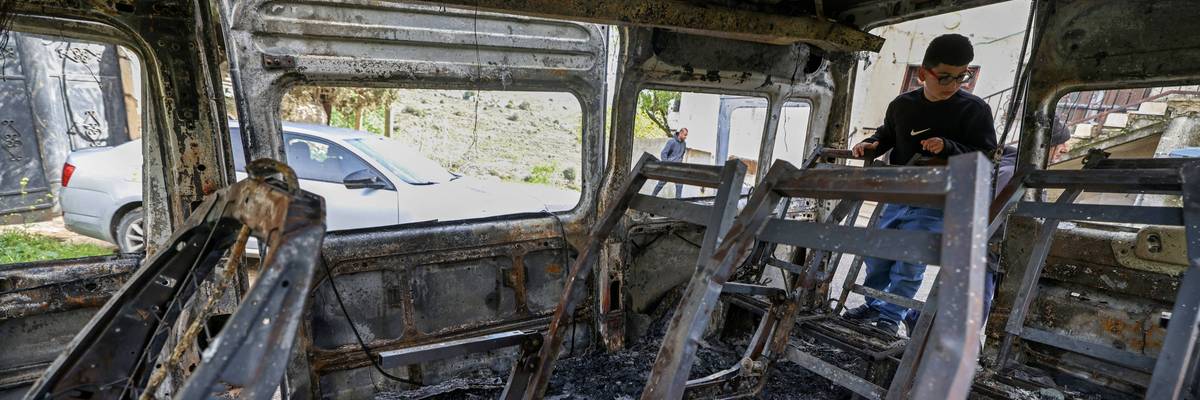
A Palestinian boy looks at a burnt vehicle following a reported attack by Israeli settlers in Jalud village, south of Nablus in the occupied West Bank, on March 22, 2026.
(Photo by Jaafar Ashtiyeh/ AFP via Getty Images)


Ramzy Baroud
Jun 19, 2026
Common Dream


Israeli Prime Minister Benjamin Netanyahu is facing perhaps the most precarious moment of his political career. He knows it. His allies know it. And his rivals—both within his coalition and across Israel’s political spectrum—are preparing to capitalize on his growing weakness.

Former Israeli Justice Minister Haim Ramon, who also served as deputy prime minister between 2007 and 2009, is among the latest Israeli political figures to join a growing chorus of criticism directed at Netanyahu.

“In the final result,” Ramon said in an interview with Radio Galey, cited by the Israeli outlet Srugim, “we did not win.” He then broke down that failure in blunt terms: “We did not win in Lebanon, we did not win in Iran, and we did not win against Hamas.”

Another prominent critic is former Israeli army chief Gadi Eisenkot, who joined Netanyahu’s emergency war government following the events of October 7, 2023, before resigning with Benny Gantz in June 2024.

Arab and Muslim countries, along with their allies in the international community, must not wait for Israel to launch a much larger assault on the West Bank before responding.

Beyond accusing Netanyahu of failing to protect Israel on October 7, Eisenkot argues that the prime minister has effectively surrendered Israel’s political decision-making to US President Donald Trump, thereby strategically weakening Israel.

Ironically, Netanyahu’s coalition partners have often been even more opportunistic than the opposition.

Since the formation of the current coalition government on December 29, 2022—widely regarded as the most right-wing government in Israel’s history—figures such as National Security Minister Itamar Ben-Gvir and Finance Minister Bezalel Smotrich have repeatedly used Netanyahu’s political vulnerability to expand their own influence. Whenever Netanyahu needed political support to remain in power, they demanded concessions in return.

For Israel’s far-right extremists, Netanyahu’s inability to secure decisive strategic victories has often translated into opportunities to advance their own agendas. Every setback on the battlefield became an opening for greater settlement expansion, harsher measures against Palestinians, and deeper entrenchment of extremist policies.

Unable to deliver “victory,” Netanyahu turned perpetual war into a political strategy in its own right. The result has been a genocidal war in Gaza, widespread devastation in Lebanon, and a dangerous confrontation with Iran that has repeatedly brought the region to the brink of a wider catastrophe.

For a time, this formula proved politically sustainable. Netanyahu successfully enlisted unwavering US support to keep the fires of war burning. At the same time, the failure of Europe and much of the international community to hold a wanted war criminal accountable provided him with the political space necessary to continue his bloody calculations.

Yet that formula may be nearing its limits. While this possibility may appear encouraging, it comes with a serious warning. If Netanyahu can no longer sustain the wars that have prolonged his political life for nearly three years, he may escalate where resistance is weakest: the occupied West Bank.

Regarding Iran, there is growing recognition that the current confrontation is unsustainable indefinitely and that some form of arrangement will eventually emerge. Likewise, regardless of whether Lebanon is formally included in any future agreement, Israel’s ambition of permanently occupying parts of Lebanese territory remains untenable.

Historically, when Israel fails to secure a strategic breakthrough on one front, it seeks compensation on another—typically where Palestinians are most vulnerable and where international scrutiny is weakest.

As Israeli elections approach, it is therefore reasonable to fear a further escalation of the genocide in Gaza, pushing both the death toll and the level of destruction to new heights. According to Gaza health authorities, nearly 1,000 Palestinians have been killed since the ceasefire agreement was announced in October, bringing the overall death toll of Israel’s genocide in Gaza to 73,000 Palestinians.

Though Israel’s war has already failed to break Palestinian steadfastness, the broader objective remains unchanged: the ethnic cleansing of Palestinians from Gaza and the transformation of the strip into a space that can no longer sustain Palestinian life.

The West Bank, however, presents a different challenge.

There, Israel faces a fragmented political landscape and a Palestinian Authority that refuses to develop an effective strategy for confronting accelerating Israeli violence, ethnic cleansing, home demolitions, land confiscation, and the relentless expansion of illegal settlements.

This vulnerability has enabled Israel to move from discussing annexation to implementing it in practice. The strategy rests on two interconnected pillars: extreme violence and displacement on the one hand, and rapid settlement expansion on the other.

According to an Oxfam International study published on June 12, Israel has killed 1,244 Palestinians, including 268 children, in the occupied West Bank since 2023—more than the total number killed during the previous 17 years combined.

This bloodshed has been accompanied by large-scale displacement that has already uprooted nearly 46,000 Palestinians, many of them from refugee camps and vulnerable communities across the northern West Bank.

An Amnesty International report published on June 10 documented the full or partial displacement of at least 117 Palestinian Bedouin and herding communities between January 2023 and April 2026.

Expectedly, the violence, displacement, settlement expansion, and land seizures are not isolated developments but components of a coherent political project. In September 2025, Smotrich openly proposed the annexation of 82% of the occupied West Bank. What was once presented as a political vision is now steadily being translated into facts on the ground.

The era of Netanyahu may be nearing its end, but before this bloody political chapter closes, countless more Palestinians may be forced to bear the cost.

Arab and Muslim countries, along with their allies in the international community, must not wait for Israel to launch a much larger assault on the West Bank before responding.

The matter demands urgent attention and immediate action.


Our work is licensed under Creative Commons (CC BY-NC-ND 3.0). Feel free to republish and share widely.


Ramzy Baroud
Ramzy Baroud is a journalist and the Editor of the Palestine Chronicle. He is the author of five books including: "These Chains Will Be Broken: Palestinian Stories of Struggle and Defiance in Israeli Prisons" (2019), "My Father Was a Freedom Fighter: Gaza's Untold Story" (2010) and "The Second Palestinian Intifada: A Chronicle of a People's Struggle" (2006). Dr. Baroud is a Non-resident Senior Research Fellow at the Center for Islam and Global Affairs (CIGA), Istanbul Zaim University (IZU). His website is www.ramzybaroud.net.
Full Bio >


Israel Hits Lebanon With Drone Strikes Hours After Trump and Iran Sign Interim Peace Deal

A spokesperson for Iran’s Foreign Ministry said the agreement with the US would be “nullified” if the Trump administration refused to “force” Israel to end its assault on Lebanon.


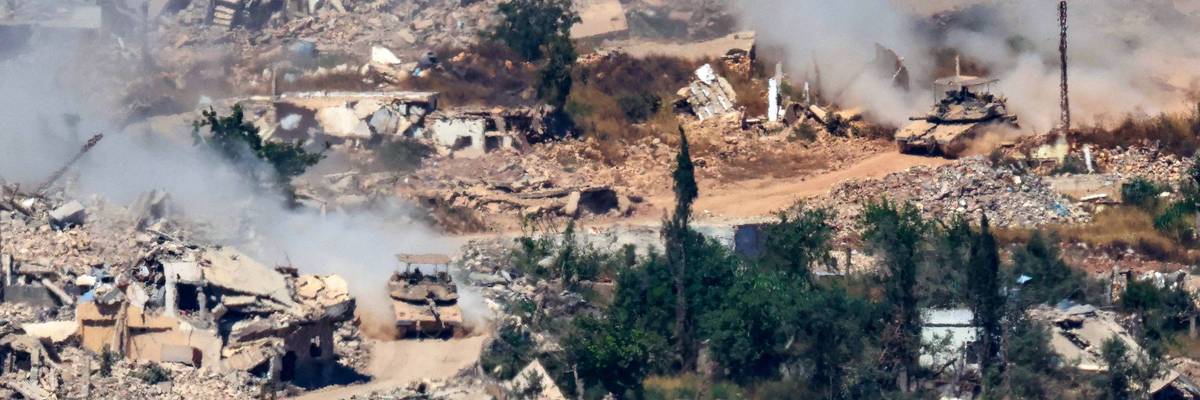
A photo taken from a position in northern Israel shows Israeli Merkava tanks driving along a road past destroyed buildings in southern Lebanon on June 17, 2026.
(Photo by Jack Guez/AFP via Getty Images)

Jake Johnson
Jun 18, 2026
COMMON DREAMS

The Israeli military carried out drone strikes in southern Lebanon on Thursday, just hours after the presidents of the US and Iran signed a memorandum of understanding that establishes a framework for negotiations to end the war launched by the Trump administration and Israel in late February.

Lebanese media reported that “an Israeli drone dropped a munition on Beit Yahoun, injuring two people.” A separate drone strike “on a vehicle at the roundabout between Kfartebnit and Arnoun killed one person and critically wounded another,” according to Lebanon’s National News Agency.

The attacks underscored the threat that Israel’s ongoing military occupation of and assault on Lebanon poses to the prospects of a final peace agreement between the US and Iran. The memorandum of understanding (MOU) that Trump signed in France late Wednesday explicitly includes Lebanon and indicates that continued Israeli attacks would violate the deal.

“The United States of America and the Islamic Republic of Iran and their allies in the current war, by signing this MOU, declared the immediate and permanent termination of military operations on all fronts, including in Lebanon, and undertake from now on not to initiate any war or any military operation against each other and to refrain from the threat or use of force against each other and ensuring the territorial integrity and sovereignty of Lebanon,” the document states.

Israeli Prime Minister Benjamin Netanyahu, who has been accused of working to sabotage diplomatic progress, has voiced defiance in response to negotiations between the US and Iran, refusing to commit to the withdrawal of Israeli troops from southern Lebanon. Since March 2, Israeli attacks on Lebanon have killed around 3,800 people, including hundreds of children, according to Lebanese authorities.


Reuters reported Thursday that Israel is “holding negotiations with the US as it seeks to continue its deployment of troops in southern Lebanon.” An unnamed senior Israeli official, described as close to Netanyahu, told the news outlet that “Israel would not back down on its positions, including keeping troops deployed in the area south of Lebanon’s ⁠Litani River.”

“A second Israeli official told Reuters that the outcome of the talks would ultimately depend on whether US President Donald ⁠Trump ‘decides to force the issue’ by threatening repercussions if Israel does not abide by the interim Iran pact’s terms,” the outlet added.

Speaking during a press conference on Wednesday, Trump called Netanyahu “a very good man” and an “amazing prime minister.”

“We have a little dispute over Lebanon,” the president added. “I say, ‘You can do a little softer touch, Bibi. You don’t have to knock down a building every time somebody walks into it that’s from Hezbollah.’”

Esmaeil Baqaei, the spokesperson for Iran’s Foreign Ministry, said Thursday that the MOU signed Wednesday would be “nullified” in the absence of a full Israeli withdrawal from Lebanon and an end to military attacks.

“It is the responsibility of the US,” said Baqaei, to “force” Israel to “respect the US commitments to Iran in this document.”