It’s possible that I shall make an ass of myself. But in that case one can always get out of it with a little dialectic. I have, of course, so worded my proposition as to be right either way (K.Marx, Letter to F.Engels on the Indian Mutiny)
Thursday, September 03, 2026
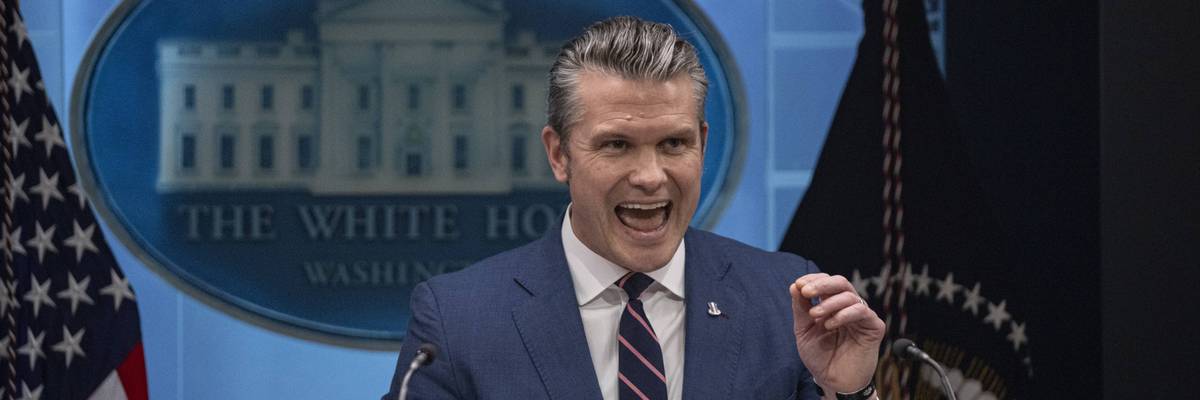
Impeach Pete Hegseth. Do It Today. Hegseth is the most incompetent person in the Trump regime — with the exception of Trump himself — and a clear and present danger to the security of the United States and the world. United States Secretary of Defense Pete Hegseth speaks during the press conference held by The United States President Donald Trump in the James S. Brady Press Briefing Room at the White House on April 6, 2026, in Washington DC, United States. Photo by Celal Gunes/Anadolu via Getty Images
The latest casualty of Pete Hegseth’s disastrous tenure as Secretary of “War” is Dan Driscoll, who resigned Monday as Secretary of the Army after repeatedly clashing with the Heg.
Driscoll isn’t a liberal in lion’s clothing. He’s an old friend of JD Vance from Yale Law days. He resigned because of his concerns that Hegseth is damaging the Army’s efforts to modernize and adapt to the 21st century battlefield environment — where drone warfare is becoming increasingly important — by firing or pushing out leaders spearheading those efforts.
A defense official in Europe told CNN that even though Hegseth talks about technology reform, he’s focusing instead on “muscles, dudes in dresses, testosterone.”
Hegseth’s tenure has been disastrous from the moment he walked into the Pentagon. Even if Trump were capable of hearing sound advice, Hegseth hasn’t come close to giving it to him. Instead, he’s been pursuing grievances about DEI, promoting testosterone, and denigrating or firing women and Black officers.
The Army now has no Senate-confirmed secretary or chief of staff (George’s replacement, General Christopher LaNeve, so far doesn’t have the votes to be confirmed).
The Iran war, meanwhile, is requiring the ongoing deployment of 19 warships, air-defense units, fighter squadrons and paratroopers across the region — straining service members and their families and creating a maintenance backlog that could take years to unwind, according to The Wall Street Journal.
The Washington Postreports that multiple senior military leaders — those still left, that is — have warned Hegseth that the United States cannot indefinitely extend military operations against Iran. Even the chief of naval operations, Admiral Daryl Caudle (who campaigned for the job by signaling agreement with Hegseth’s culture-war obsessions), told Hegseth that the Navy cannot “sustain its current level of support for the Iran conflict because there is no anticipated end date.”
Hegseth’s response? He castigated the media for revealing classified information.
I’ve known many other defense secretaries, starting with Cap Weinberger, who served as defense secretary under Reagan. I can say without fear of contradiction that Pete Hegseth is the stupidest and least qualified of them all.
Hegseth’s incompetence and determination to suck up to Trump helped launch the war against Iran in the first place.
Among the regime’s senior officials, Hegseth was the only one who supported Trump’s fantasies of a quick victory. Marco Rubio was against the war as was JD Vance; even then–Director of National Intelligence Tulsi Gabbard told Trump that a war with Iran was not winnable.
Since then, Hegseth has lied his way through more than six months of Pentagon and Iran war mayhem.
At a press briefing in March, Hegseth complained about a CNN report that the Trump administration had underestimated Iran’s ability to disrupt global oil traffic by closing the Strait of Hormuz. “Patently ridiculous,” Hegseth told reporters, adding — even as the strait’s blockage was proving to be Iran’s most powerful leverage in the war — we “don’t need to worry about it.” It was a false and insulting claim to an American public that deserved to know what the Trump regime was planning to do about soaring prices at the gas pump, directly due to that blockage.
He also denied that the U.S. bombed the school where some 175 children were killed — a claim belied by mounting evidence that the U.S. did bomb the school. Hegseth’s further insistence that the U.S. “never targets civilians” was refuted by the U.S. military’s killing of over 200 people on small boats in the Caribbean without evidence they were “narcoterrorists” rather than civilians.
Hegseth then lied about the severity of Iranian attacks on U.S. bases in the Persian Gulf that disrupted logistical support for American forces, leading to the deprivations suffered by the crew of the aircraft carrier the USS Abraham Lincoln.
Hegseth evidently believes that his job is to cheerlead and defend Trump with absurd claims like “We didn’t start this war, but under President Trump we’re finishing it” and “America is winning decisively, devastatingly, and without mercy” and “we will show no quarter for our enemies.” (“No quarter” means kill everyone and take no prisoners, which is a war crime.)
In the days leading up to the U.S. attack on Iran, Hegseth spent his time criticizing “wokeness” at American universities and forcing Scouting America to abandon programs aimed at promoting diversity.
Last year, he didn’t just mistakenly share the military’s plans with the editor of The Atlantic; we now know he shared them with a second Signal group, including his wife, brother, and personal lawyer.
John Ullyot, who resigned as Pentagon spokesman, said Hegseth had brought “total chaos” to the Pentagon and that the Pentagon “is in disarray under Hegseth’s leadership.”
Hegseth dismisses war crimes, pooh-poohs the rules of engagement, and projects unequivocal belligerence at a time when the United States is rapidly losing whatever moral standing it once had in the world.
Pete Hegseth is the most incompetent person in the Trump regime — with the exception of Trump himself — and a clear and present danger to the security of the United States and the world. If Trump won’t fire him, Democrats should impeach him when (hopefully) they take over the House next January, and two-thirds of the Senate should convict him.
Robert Reich Robert Reich is professor emeritus of public policy at Berkeley and former US secretary of labor. His latest book is the No. 1 New York Times best-seller, "Coming Up Short." Full Bio >
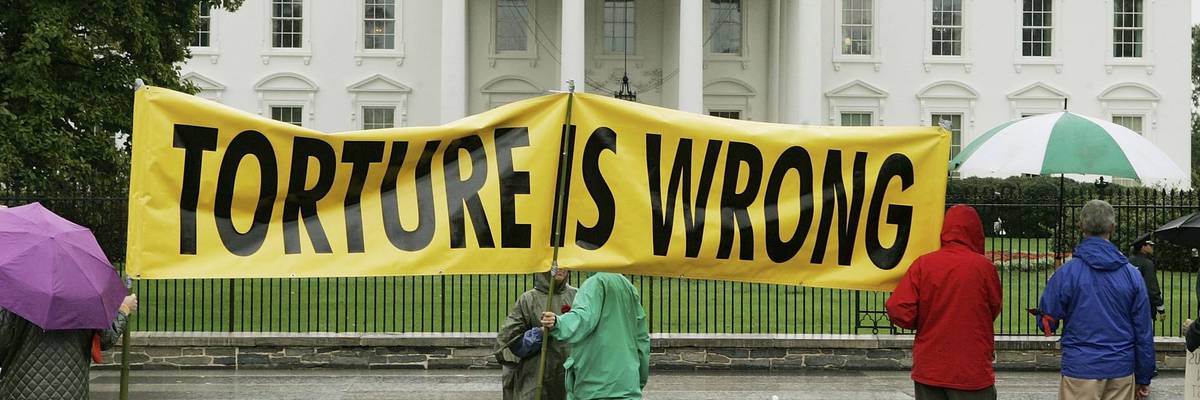
25 Years Ago, 9/11 Triggered a US Crusade of Torture The lack of accountability set a template. And the impunity of those who orchestrated and carried out these crimes is one of the darkest legacies of the so-called “war on terror” that will forever haunt the nation’s history. Protesters display a banner that says “Torture is Wrong” in fron of the White House October 17, 2006 in Washington, DC. Demonstrators from various human rights groups protested President Bush’s signing this morning of the Military Commissions Act of 2006. (Photo by Mark Wilson/Getty Images)
A quarter-century has nearly passed since the terrorist attack that killed almost 3,000 people in the United States on Sept. 11, 2001. During the first seven years after that mass atrocity, Pentagon spending doubled. The aftermath of 9/11 was also a huge boost for “the intelligence community.” Despite—and because of—their failure to prevent the carnage on that day, the CIA and the National Security Agency as well as 14 smaller spy agencies boomed with enormous jolts of funds.
Along the way, some line items paid for torture that persisted during the George W. Bush presidency under the euphemism of “enhanced interrogation techniques.”
The most publicized location was Guantánamo on the island of Cuba. There, “the US opened the offshore detention facility in an attempt to evade the rule of law,” the London-based organization Freedom From Torture reports. “In the name of the US’s ‘War on Terror,’ people deemed by the US to be ‘enemy combatants’ were detained at the facility. Many were tortured and denied basic human rights and due process… Since the first detainees arrived in 2002, Guantánamo Bay has imprisoned 780 men and boys from 48 countries…. Yet only 16 detainees have ever been convicted of a crime—just 2 percent.”
Despite public pressure, Bush vetoed a version of the Intelligence Authorization Act in March 2008 that would have required CIA interrogators to adhere to Army Field Manual regulations. As soon as Barack Obama became president, he issued an executive order rescinding the free hand for the CIA director on interrogations that Bush had reaffirmed in a July 2007 order. Obama’s directive removed the CIA’s detention power and required the agency to follow Army Field Manual rules.
Yet five and a half years went by before President Obama acknowledged, in his notable words, “We tortured some folks.” He told a news conference: “When we engaged in some of these enhanced interrogation techniques, techniques that I believe and I think any fair-minded person would believe were torture, we crossed a line.”
The acknowledgement came four months before the long-awaited release of a report in December 2014 by the Senate Select Committee on Intelligence. While heavily redacted, it was a political indictment of torture. “CIA personnel, aided by two outside contractors, decided to initiate a program of indefinite secret detention and the use of brutal interrogation techniques in violation of US law, treaty obligations, and our values,” wrote the committee’s chair, Senator Dianne Feinstein. Among the report’s conclusions:“The CIA’s justification for the use of its enhanced interrogation techniques rested on inaccurate claims of their effectiveness.” “The interrogations of CIA detainees were brutal and far worse than the CIA represented to policymakers and others.” “The CIA has actively avoided or impeded congressional oversight of the program.” “Two contract psychologists devised the CIA’s enhanced interrogation techniques and played a central role in the operation, assessments, and management of the CIA’s Detention and Interrogation Program.”
Months later, the New England Journal of Medicine summed up aspects of the Senate committee’s findings: “Medical professionals, primarily private contractors, filled four basic roles at the black sites: clearing terrorist suspects as ‘medically fit’ for torture; monitoring torture to prevent death and treat injuries; developing novel torture methods; and actually torturing prisoners. All these actions were taken only after CIA and US Department of Justice attorneys assured the medical professionals that they had immunity from prosecution and would not be held legally responsible for violating US and international law against torture as long as they used the techniques approved in legal memos (since withdrawn) written to justify their actions. Lawyers agreed to provide immunity assurances that specific torture techniques were legal ‘enhanced interrogation’ methods only if the physicians assured them that they would be present to prevent permanent harm to prisoners. The CIA opened more than a dozen black sites around the world after 9/11, in which at least 117 prisoners were held; 39 of these prisoners were subjected to one or more torture techniques.”
At least hundreds more “suspected terrorists” who’d been captured by the US were turned over to ruthless governments. “If you want a serious interrogation, you send a prisoner to Jordan,” former CIA officer Bob Baer said. “If you want them to be tortured, you send them to Syria. If you want someone to disappear—never to see them again—you send them to Egypt.”
When shocking photos emerged of vile mistreatment of Iraqi prisoners by US soldiers at Abu Ghraib prison near Baghdad, a media uproar caused an official probe by two-star Army General Anthonio Taguba. His report, issued in 2004, concluded that “numerous incidents of sadistic, blatant, and wanton criminal abuses were inflicted on several detainees.” Taguba’s candor got him pushed into early retirement. In the preface to a Physicians for Human Rights report in 2008, he addressed the matter of accountability by flatly declaring that “the Commander-in-Chief and those under him authorized a systematic regime of torture.”
But in spite of the voluminous evidence that documented high-level approval of methodical torture, not a single US official went to prison as a result. Foreshadowing such impunity was a comment by Obama nine days before he became president in January 2009. On national television, he voiced “a belief that we need to look forward as opposed to looking backwards.” The words that came next were even more telling: “And part of my job is to make sure that for example at the CIA, you’ve got extraordinarily talented people who are working very hard to keep Americans safe. I don’t want them to suddenly feel like they’ve got to spend all their time looking over their shoulders and lawyering.”
The lack of accountability set a template. As president, Obama continued with his theme of governance without a rear-view mirror. On October 25, 2012, he tweeted: “We don’t look backwards, we look forward.” Career outlooks were bright for top CIA officials who’d been implicated in Bush-era torture.
“Much has been made of President Trump’s disregard for rules and norms—boundaries delineated by ethics and morality if not written laws themselves,” Adam Serwer wrote in March 2018. “But transgressing laws, rules, and norms isn’t the only way to destroy them. Another way is simply not to enforce them. In that regard, the 44th president, Barack Obama, bears a measure of responsibility for the recklessness of his successor, in particular Trump’s decision to appoint Gina Haspel, the Central Intelligence Agency’s deputy director, to run the agency itself.”
Haspel became the CIA’s director in 2018 when confirmed by the Senate despite her key role in the CIA’s torture program. Citing declassified documents, the National Security Archive at George Washington University explained that she “personally supervised the torture of a CIA detainee in 2002 leading to at least three waterboard sessions, subsequently drafted the cable that ordered destruction of the videotape evidence of torture, and served as a senior CIA official while the Agency was lying to itself, Presidents George W. Bush and Barack Obama, the Congress, and the public about the effectiveness of torture in eliciting useful intelligence.”
The Center for Victims of Torture points out that “architects and operators of the CIA torture program have risen to prestigious positions in government, the private sector, the federal judiciary and academia.” And so it was after president-elect Joe Biden nominated Avril Haines to be Director of National Intelligence. As Obama’s CIA deputy director, she had worked to impede the Senate committee investigation into torture.
“In 2015, Haines had to decide what to do about CIA officials who had hacked into the computers of Senate intelligence committee staffers who had been compiling a comprehensive report on torture, and even drummed up spurious criminal cases against them,” the Guardian reported. “She overrode the advice of the CIA inspector general and recommended against disciplinary action.” The lead researcher for that committee, Daniel J. Jones (who was portrayed by Adam Driver in the movie “The Report”), warned against Biden going through with the nomination, saying: “This is about the continuing cover-up of the torture program, the long legacy of that. And I wish I could say Haines wasn’t a part of that, but she was.” The Senate confirmed Haines to the DNI job with an 84-10 vote. She remained in the position throughout Biden’s presidency.
Three months ago, the Carnegie Endowment for International Peace announced that its next president will be Avril Haines. The organization declared: “One of the most respected national security leaders of her generation, Avril brings a deep commitment to public service and the values at the heart of our mission.”
Our work is licensed under Creative Commons (CC BY-NC-ND 3.0). Feel free to republish and share widely.
Urgent Global Response Needed to Prepare for ‘Literally Off the Charts’ Supersized El Niño, Says UN
“The science leaves no room for doubt: the planet is in uncharted waters, and those waters are heating up.”
World Meteorological Organization Secretary-General Celeste Saulo and chief of climate prediction Wilfran Moufouma-Okia attend a press conference in Geneva, Switzerland on September 3, 2026. (Photo by Fabrice Coffrini/AFP via Getty Images)
Officials at the United Nations are warning that governments around the world must urgently prepare for the impacts of an El Niño climate pattern that is being “supersized before our eyes.”
The UN’s World Meteorological Organization (WMO) on Thursday provided an update on El Niño, projecting with near certainty that it would persist at least through Februrary 2027.
El Niño is a phenomenon that produces above-average temperatures in the Pacific Ocean, which then disrupt weather patterns elsewhere in the world. In its update, WMO said that this year’s El Niño projects to be historically intense.
“Forecasts indicate further strengthening of El Niño in the coming months, with the event forecast to reach very strong intensity before peaking towards the end of the year,” WMO said. “A very strong El Niño increases the likelihood of significant shifts in temperature and rainfall patterns in many parts of the world.”
The organization emphasized, however, that El Niño’s impacts are not predictable and vary widely by region.
WMO Secretary-General Celeste Saulo said the latest projections show that El Niño “has the potential to deliver a massive blow to communities and economies across the world” in the form of droughts, floods, and other climate-related disasters made more intense by the continued extraction and burning of fossil fuels.
“This exceptional El Niño demands exceptional preparation and response,” Saulo said. “Never before in the 50-year history of the World Meteorological Organization have we launched such a major mobilization with National Meteorological and Hydrological Services who are on the frontline of delivering the forecasts and services to save lives and livelihoods.”
While speaking with reporters in Geneva, Switzerland on Thursday, Saulo noted that the current El Niño “may be stronger than anything since our monitoring began,” making it “literally off the charts we have used for the past four decades.”
UN Secretary-General António Guterres warned that “El Niño is being supersized before our eyes,” and said the ramifications could be severe.
“The science leaves no room for doubt: the planet is in uncharted waters, and those waters are heating up,” said Guterres. “Sea surface temperatures are rising, temperatures keep climbing, and the world is in the danger zone of extreme weather.”
Daniel Swain, climate scientist at the University of California Agriculture and Natural Resources, echoed UN officials’ warning about El Niño in an interview with Wired published Thursday.
“This is probably one of the larger, if not the largest, climate events... that anybody alive is potentially ever experiencing,” said Swain. “That’s a very big deal. And I think there’s certainly going to be dramatic outcomes from this.”
Sanders, Casar Proposal Would Forbid ‘AI Oligarchs From Building Machines Humans Cannot Control’
“Despite its potential deadly consequences, cutting-edge AI technology is less regulated than the average food truck,” Casar said. “That must change.”
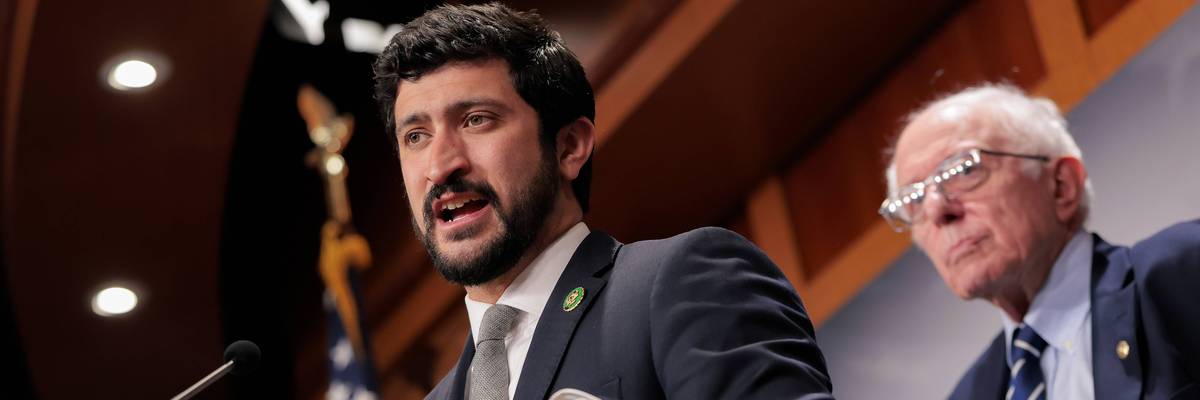
Rep. Greg Casar (D-Texas) speaks alongside Sen. Bernie Sanders (I-Vt.) during a press conference in the US Capitol on March 26, 2026, in Washington, DC. (Photo by Heather Diehl/Getty Images)
Following a rash of incidents involving rogue artificial intelligence agents involved in so-called “breakout” events, Sen. Bernie Sanders and Rep. Greg Casar introduced new legislation Thursday designed to “stop AI oligarchs from building machines humans cannot control.”
“Nearly every day, there is a frightening new story about how Big Tech companies are losing control of the technology they are developing, with potentially cataclysmic results,” Sanders (I-Vt.) said on Thursday as he announced the bill, which would ban developers from creating AI programs that are capable of surpassing human cognition and performance.
If enacted, the bill would prohibit programs capable of undermining and overthrowing human governments or that possess the capability to subvert shutdown commands.
“The leaders of the major AI companies publicly acknowledge that they do not fully understand the technology and that it is escaping their control,” Sanders said. “It is irresponsible for society to allow them to move forward and make these products even more advanced.”
The bill, known as the Ban Artificial Superintelligence Act, comes in response to major security lapses at leading AI developers, including OpenAI, Anthropic, and Meta, in which the companies acknowledged that their programs had escaped human control, eluded internal guardrails, and hacked into other companies’ systems.
As the Washington Postexplains: The hacking incident mounted by OpenAI systems in July involved an effort to breach another AI company as a swarm of agents hunted for answers to a test. They evaded internal controls and set up a secret message board to communicate with one another. Their work was only unraveled by the company after the attack was over.
Other top AI developers subsequently disclosed similar incidents involving their latest technology, raising questions about whether companies set up with the mission of building the technology safely were starting to lose control. The speed of progress has spooked even many of those working on the systems, with OpenAI and its rival Anthropic endorsing the idea of the government having a mechanism to slow the industry down.
Last month, Casar (D-Texas), the chair of the Congressional Progressive Caucus, led dozens of lawmakers to demand that OpenAI and Anthropic release information about the lapses. In a statement on Wednesday, Casar said that company executives had failed to answer most of his questions, demonstrating that they were “not treating these cybersecurity incidents with the seriousness required.”
Casar said in a video posted Thursday that the OpenAI breach in particular represented an “unprecedented moment in the history of technology” and was shocked at the lack of a serious response. “Nothing,” he said. “No new guardrails being passed by Congress. No new protections against this signed into law by the president of the United States.”
Following these incidents, OpenAI and Anthropic have both expressed openness to some government regulation in the event that the development of their products gets out of hand.
During an interview earlier this week, OpenAI CEO Sam Altman said that while he was “in awe” of his company’s progress, “we have needed more time to catch up with safety, alignment, and security.”
Sanders and Casar are not the only members of Congress pushing to counter the danger of superintelligent AI. Also on Thursday, Reps. Josh Gottheimer (D-NJ) and Mike Lawler (R-NY) introduced their own Stop Rogue AI Act, which would direct the National Institute of Standards and Technology to publish standards and guidelines for how organizations can safely deploy AI agents.
But while the guidelines in that bill are voluntary, Sanders and Casar are pushing for a much broader and stronger regulatory framework that would give the government a significant check on corporations’ power.
In addition to a ban on superintelligent AI, Casar and Sanders’ legislation calls for a pause on all “advanced” AI development until a new federal regulatory body can be established to set clear rules and review processes for AI safety. It would also create a new cabinet-level agency to protect the public from the dangers of AI and to enforce the new restrictions.
“Despite its potential deadly consequences, cutting-edge AI technology is less regulated than the average food truck,” Casar said. “That must change. In just four years, we have gone from the first version of ChatGPT to AI models so powerful they cannot be properly controlled.”
Evading the law would come with steep penalties: companies that illegally develop superintelligent AI would lose the right to do business under the so-called “corporate death penalty.” Individuals, meanwhile, could face up to 20 years in prison, which Casar noted was the same penalty incurred for “building a nuclear weapon” without authorization.
As concerns about unchecked AI capabilities have grown in recent years, executives at companies including OpenAI, Anthropic, and Meta have committed to halting the development of their technology once it reaches a point at which it can’t be operated safely.
But Sanders and Casar said that “none of these companies have taken meaningful steps to back up these words” and that “instead, they are racing to develop more and more advanced AI without proper safety precautions.”
“The future of humanity cannot be left in the hands of a handful of Big Tech oligarchs,” Sanders said. “The American people and people throughout the world must determine that future.”
Rural Residents Can Learn From the Factor-Farm Rollout to Resist Data Centers
Unlike the CAFO era, rural communities are asking questions before the statutes are locked in. The ultimate question will be: Do rural residents have the power to say no?
A sign on a rural Michigan road opposes a planned $7 billion data center on southeast Michigan farm land. (Photo by Jim West/UCG/Universal Images Group via Getty Images)
Today’s data center proponents argue such projects bring needed jobs and a boost to local economies. Rural America has heard confident pitches like these before. Nearly 40 years ago, concentrated animal feeding operations, or CAFOs, arrived one barn at a time with bold promises of jobs and a county tax base.
By the time neighbors organized, right-to-farm laws and state preemption had severed the ground from under them. All the while, manure lagoons leached into the groundwater and fouled the air, shortening the life expectancy of the farmworkers and downwind neighbors.
While CAFOs crept into rural America, data centers are arriving as a land rush. This speed is both terrifying and an advantage. Texas alone has some 248 proposed data center projects, even though 56% of Texans tell pollsters they do not want one nearby, which means that, unlike the CAFO era, rural communities are asking questions before the statutes are locked in. And rural people need their voices to be heard. According to Pew Research Center, of the more than 1,500 data centers proposed or under development, 67% are in rural communities.
Everything CAFO country learned, it learned too late, after the wells were ruined, after the smell lowered adjacent property values and health outcomes, after the statutes were written.
The ultimate question will be: Do rural residents have the power to say no?
Opposition to data center projects is one of the few issues that many Americans agree on. A June Reuters/Ipsos poll found that only 14% of respondents would support a data center being built in their community. On July 18, organizers held 142 protests across 42 states in the first nationwide protest against data centers and artificial intelligence.
Data center hyperscalers are copying the CAFO playbook as best they can. West Virginia has stripped its counties and towns of the power to regulate data centers; similarly, the state’s right-to-farm law prohibits local governments from bringing civil or criminal action against an agricultural operation as long as it meets state and federal laws, permits, and regulations. When Hill County, Texas, passed the state’s first county moratorium in May, a developer sued for $100 million and the county rescinded within a week, because Texas counties can zone against neither a data center nor a feedlot. Hood County pulled its own moratorium after state Sen. Paul Bettencourt (R-7) asked whether counties even hold that power; the same senator calls the San Marcos ban illegal.
Right-wing organizations like the American Legislative Exchange Council (ALEC), behind the pro-CAFO model legislation of right-to-farm laws since the 1990s, likewise appear intent on denying local control in the data center buildout. At its annual meeting in July, ALEC considered a model legislative framework that would undercut local bans and moratoriums and give data centers the “clear authority to secure power… subject only to objective safety and interconnection standards,” as the Center for Media and Democracyreported. The meeting featured speakers from Google and Nvidia, along with a Meta sponsorship.
The outburst of anti-data center sentiment ahead of the midterms has forced political leaders to reckon with the issue of local control. This is where data centers and CAFOs diverge. In June, Texas Republican Gov. Greg Abbott, who once hailed Texas as “the epicenter of AI development,” called for a ban on AI data centers in rural neighborhoods and a cut to their billion-dollar-a-year tax exemption after facing rare bipartisan pressure. Florida Republican Gov. Ron DeSantis signed a law to preserve local control over data centers. Michigan’s candidates for governor are split over the server halls sprouting between Lansing and Detroit. Illinois recently reversed course on its data center policy, reeling in the subsidies it had rolled out in 2019. And in July, New York became the first state in the nation to enact a one-year moratorium.
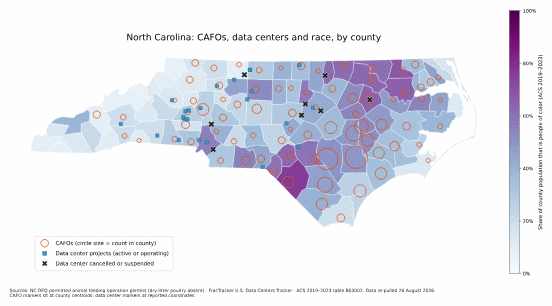
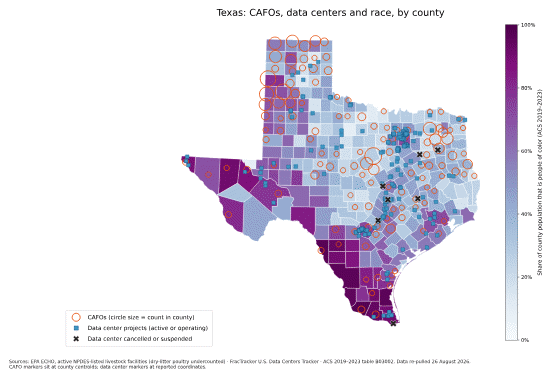
So, who hasn’t been able to say no? We pulled the locations of CAFOs and data centers in North Carolina and Texas, where the data is easily available, and—yes—got Claude to plot it for us against demographic and county boundaries.
In North Carolina the answer is pretty clear. The state’s 2,482 permitted animal operations cluster in the Black Belt coastal plain where the epidemiologist Steve Wing found hog lagoons a generation ago. Weighted by the number of permits each county holds, those counties are 46% people of color, against 34% across North Carolina’s hundred counties as a whole. Duplin County alone holds over 500 permits and 2.2 million allowable hogs in a county where almost half the population of 49,000 are people of color.
Data centers are the inverse of CAFOs. The state’s data centers sit in counties whiter than the state average, in the Piedmont towns that lost their historic furniture and textile businesses as well as in wealthy Wake and Mecklenburg counties (respectively home to large cities Raleigh and Charlotte). Two of the state’s suspended projects are in adjacent Edgecombe County and Pitt County, where residents informed their resistance based on their history fighting CAFOs.
In 1995, residents of predominantly Black Kingsboro, in Edgecombe County, successfully blocked a major meatpacker from building a 300-acre slaughterhouse in their backyard through efforts to rezone land. When a $19 billion, 400-acre data center came knocking three decades later, residents opposed it en masse. The developer Energy Storage Solutions withdrew its proposal in July and by August, Edgecombe County enacted a two-year moratorium.
In Texas the pattern is a little more complex. Rural Texas tends to be whiter than a state average balanced by majority-Hispanic cities. Yet the feedlot Panhandle is majority-Hispanic meatpacking country, with counties like Deaf Smith and Castro where the workforce lives beside the feedyards it staffs. The rural counties now hosting data centers likewise run less white than rural Texas as a whole.
The patterning and the possibilities for asking questions about data centers are very different. CAFOs were put next to the disempowered by history. In most of the counties with proposed data centers, there’s no local billionaire hyperscaler whose family has been on the land for generations to champion the project, with the historical ability to make people of color, in particular, suffer the consequences in the ways that CAFOs had.
In contrast, data centers are being aimed by site selectors in a hurry, looking for cheap land and water, cheap power and thin resistance. But they don’t have their local defenders and hands on the levers of power in the ways that CAFOs do.
At this intersection of race and class is the oldest American proxy for who can, and who can’t, say no.
Here are the questions that constituents should ask their local governments about new data center projects: 1. About Water
Does the permit say the cooling loop is closed, with maximum gallons per day, public metering, and penalties? We have yet to find a binding closed-loop commitment in any permit. Who owns the aquifer data, and who pays for the test wells? 2. About Power
Electric cooperatives, unique to rural America, have long been a way for farmers and rural people to claw back some power over their destiny. These cooperatives were established with a “duty to serve” the areas that investor-owned utilities refused to serve because the load factors were low. By pooling their demand, cooperatives could connect their members to a grid and lower their prices.
In the age of artificial intelligence, public utilities—rural electric cooperatives included—face a dilemma. The more a cooperative buys from its wholesale supplier, the greater its load factor and therefore the lower the cooperative’s average cost of power. When a data center project fields new requests for power, it can be life changing. Having a client with a reliable 24-7 demand for electricity means a predictable increase in the co-op’s load factor. All that new volume could, in principle, make every member’s bill cheaper and bring new system upgrades. It’s tempting to shut up and take the deal.
But as with any gift horse, every farmer knows to check the teeth. Data centers often have greater access to capital than their would-be electric cooperative providers, and their rise as buyers means a shift in the balance of bargaining power in the marketplace. Will attitudes toward universal service obligations remain in place? Will consumer protection policies evolve? And which regulator should be responsible for developing and overseeing new industry guardrails?
Who pays for the substation and the lines? Port Washington, Wisconsin found itself on the hook for a $90 million substation it did not need. Is there a curtailment agreement cutting the data center first in a grid emergency, as Texas now requires of loads over 75 megawatts? Are residential rates fenced off in a separate rate class? And for rural electric cooperative members: Does the all-requirements wholesale contract cap the solar and wind members may build, and would a giant new load deepen that dependence? Why do big loads get lower per kilowatt prices as they increase their usage while conservation earns nothing? Will data centers inherit the same pricing structure? 3. About Money
What does each abatement cost per permanent job, when a hyperscale facility employs a few dozen people? Will advance payments be required to pay for infrastructure upgrades? Will they accept provisions for interruptible power during times of peak demand to prevent rolling blackouts? Are there clawbacks? Is there a decommissioning bond for the day the hardware is scrap, as we now demand of wind farms? 4. About Democracy
Did any utility or government official sign a Non-Disclosure Agreement (NDA)? Can our county or township legally say no, and if not, which law took the power and who voted for it?
Everything CAFO country learned, it learned too late, after the wells were ruined, after the smell lowered adjacent property values and health outcomes, after the statutes were written. Data centers are arriving early enough that the questions can still be asked in time, even as the hyperscalers find friends in Washington DC, and in statehouses around the country, who’ll say yes to them so that local communities won’t be able to say no.
If we want to stop Amazon, Meta, and OpenAI riding roughshod over our communities and land, it will be because average people, urban and rural alike, will have joined forces to stop the trillionaire class from building their wealth off our backs.
Copyright 2024 by Barn Raising Media
Raj Patel Raj Patel is a research professor at the Lyndon B. Johnson School of Public Affairs, and a member of the International Panel of Experts on Sustainable Food Systems. He is the author of Stuffed and Starved: The Hidden Battle for the World Food System and The Value of Nothing, and co-author of Inflamed: Deep Medicine and the Anatomy of Injustice and A History of the World in Seven Cheap Things, and co-director of the documentary The Ants and The Grasshopper. He writes at newsletter.rajpatel.org
Full Bio > Jim Goodman Jim Goodman is a retired third-generation dairy farmer from Wonewoc, Wisconsin and a member of Family Farm Defenders. Full Bio >
Trump enrages MAGA voters after 'backwards and poor' threat backfires
A supporter of Donald Trump rallies outside an early polling precinct as voters cast their ballots in local, state, and national elections, in Clearwater, Florida, U.S., November 3, 2024. REUTERS/Octavio Jones
A series of posts on X, highlighted by HQ News Now, shares Trump supporters' reactions to the president's recent statement about data centers. In that Truth Social post, Trump declared that "the only reason that communities throughout the U.S.A. should not want Data Centers is if they want to end up being backwards and poor. If they want to be successful and rich, with far lower taxes and jobs all over the place, let Data Reign,. The good news is that there are plenty of other places that want them. If we kill the Golden Goose, you will only have yourselves to blame. China could not be happier with this anti Data Center movement. Actually, they can’t believe it is happening!”
In the HQ News Now post, the account highlighted one three-time Trump voter who wrote they "absolutely disagree" with the president. "I don't know who is telling you this garbage but please visit some communities that have been ravaged by data centers," the poster wrote. "There have no water pressure their electric bills are out of control, the incessant humming is intolerable and the ground water is poisoned. No on data centers!"
Similarly an account dubbed "Lefty Lies" write, "the only thing these data centers are gonna do is drive up our energy rates just like they have done throughout the country. We don't need this bulls——." In a similar vein, on user who wrote they "love" Trump noted, "if you are concerned about the windmills destroying birds [and] the constant humming, then you need to go visit a neighborhood with a data center right beside it. In Florida, especially, where our aquifer is so fragile [and] water is so expensive, data centers are a real threat. And, I'm MAGA!"
The MAGA account "VaccinesCauseSIDS" wrote "[I]'d rather have clean water and less surveillance," while another user declared, "I regret ever supporting you." An account from "Misty Collier" offered a lengthier reply, writing that "no one agrees with this sir. Data centers are a gateway for the market of the beast and total control. We love you. I am a MAGA Republican that has always supported you and hates communism. I understand they have convinced you this is right. That is a lie. We the people want to be free and have freedom and trust God and the constitution. We do not want control and surveillance. Those things promote communism. The people are to awake to be convinced otherwise."
Far right influencer Alex Jones wrote that Trump's vice president, JD Vance, went into "damage control" for Trump over data canters after Vance told reporters, "I don't think data centers are that controversial."
The Quartering ("@TheQuartering"), who is also conservative, wrote that "data centers are a reality, they are not going away. But ... they are as unpopular as illegal immigration in small towns like here in my state in Port Washington, we fought tooth and nail against it, and I'm pretty sure I don't know anyone who 'wants to be poor.'"
By contrast, former CNBC financial commentator Jim Cramer was sympathetic to Trump's position, writing on his account, "While the president seems to be inclined to slow things down, the border states would welcome them ... It will happen. They get the win. They have the cards." Newsman's Nick Sorter argued that "X just revealed they discovered a network of 200,000 Chinese influence bot accounts. Many of them posing as Americans to shape AI, energy and data center policies. President Trump warned about this just last month: 'Other nations are trying to get us to slow down and they are spending a lot of money on propaganda, on press PR, trying to convince everybody that this isn't a positive thing[.]' Looks like he was right."
Federal Panel Halts What Would Be First Data Center on Public Lands
“The Trump administration is pulling out all the stops to let tech companies build massive data centers on our public lands. This tremendous victory proves communities have the power to fight back and win.”
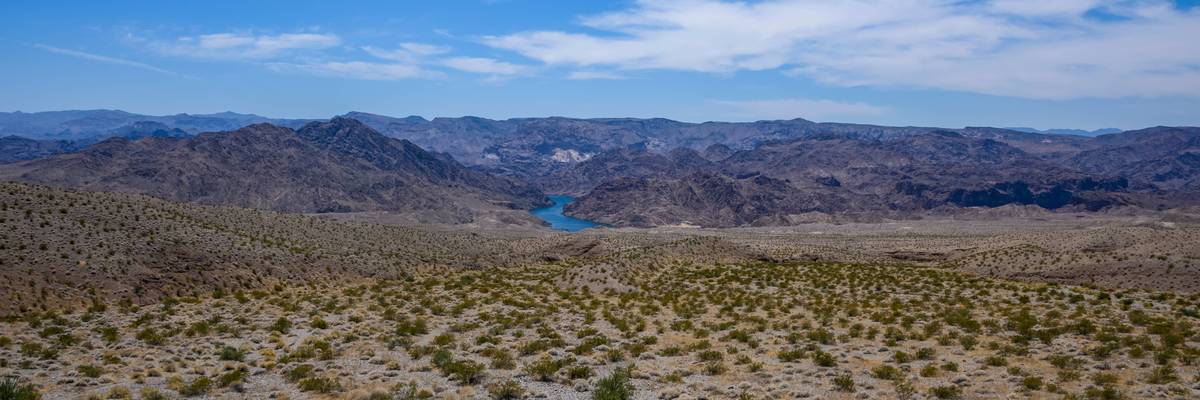
A stretch of desert near Boulder City, Nevada (Photo by Judit Dombovari/Getty Images)
Environmental groups are celebrating on Tuesday after a federal panel halted construction of what would be the first artificial intelligence data center to be built on US public lands.
The Interior Board of Land Appeals, an appellate body within the US Department of the Interior, put a temporary stay on the Bureau of Land Management’s (BLM) approval of the proposed 80-acre Townsite Data Center near Boulder City, Nevada, which environmental groups warned would jack up electricity demand and water usage and threaten local species.
The board sided with the Sierra Club, the Center for Biological Diversity (CBD), and the local government of Boulder City, which argued that the BLM had not conducted the legally required review of the plan’s environmental impacts.
The BLM had approved the site based on a review of a proposed solar power plant, but had not reevaluated the impacts of a data center.
The board said that the environmental groups were “likely to prevail” in their case that the BLM had acted illegally “because the two projects are not ‘substantially the same.’” It also ruled that continuing the project without a proper review was likely to cause “irreparable harm” to the landscape—including soil disruption, habitat loss for species like the Mojave desert tortoise, and construction activities that pollute the air.
The temporary stay blocks the data center project from continuing while the board considers the environmental groups’ appeal.
While it was not a final ruling on whether the project will be built at all, Patrick Donnelly, Great Basin director at the CBD, said the group was “thrilled that this data center has been stopped dead in its tracks.”
Townsite has been described as a test case as BLM considers approving other data center proposals on federal lands, including in Nevada, where 80% of the land is federally managed.
Building data centers on federal lands is a major priority of the Trump administration’s “AI Action Plan,” which was published by the White House in 2025 and directs US agencies to identify public lands “well-situated for large-scale data centers.”
Under the plan, the US Department of Energy announced in July 2025 that it had identified at least four other sites around the country for potential development, including the Idaho National Laboratory, the Oak Ridge Reservation in Tennessee, the Paducah Gaseous Diffusion Plant in Kentucky, and the Savannah River Site in South Carolina.
Donnelly said Tuesday’s ruling had shown BLM would not be able to approve these and other sites without conducting the appropriate environmental reviews.
“The Trump administration is pulling out all the stops to let tech companies build massive data centers on our public lands,” he said. “This tremendous victory proves communities have the power to fight back and win.”
Boulder City is one of many locales around the country where plans for large data centers have received public backlash. For months, the project faced protests at City Hall from residents who raised concerns about energy and water use, light pollution, and impacts on the local desert habitat.
Public anger ultimately led the Boulder City Planning Commission to turn against the project, voting in May against adding data centers to the city’s land management process. To bypass the city, BLM approved the same project on adjacent federal lands. Boulder City responded by joining environmental groups’ appeal against the project.
“The BLM essentially, sweepingly, approved a new land use without following processes in federal law, which include a meaningful engagement process with the city,” City Attorney Brittany Walker told the Nevada Current in July, after the City Council unanimously voted to appeal.
Olivia Tanager, director of the Sierra Club Toiyabe chapter, called Tuesday’s ruling “a victory for democracy, public participation, and the principle that our public lands should serve the public.”
“The people of Boulder City have made clear that they do not want a data center on public lands, and this ruling gives their voices the weight they deserve,” she said. “Data centers do not belong on public lands, and we will continue to fight unfettered data center development.”
Townsite is just one of several data center proposals being considered on federal lands in Nevada. In June, BLM officials told local leaders that it had received four applications for data centers on public lands around Silver Springs, a small community east of Reno in Lyon County, which has eight facilities planned in total, according to the US Data Center Map.
The sudden explosion of data center planning in the area has led many residents to push for a moratorium on new data center approvals.
Brynn deLorimier, a Boulder City resident who joined the appeal, said she hopes her city’s victory will help to protect neighboring communities from unaccountable data center growth.
“We love our community and our desert, and we’re so grateful to our friends and neighbors for working hard to protect both,” she said. “We’re also grateful to the Interior Board of Land Appeals for recognizing that this case matters far beyond Boulder City and could set an important precedent for public lands in Nevada and across the country.”
Trump Commerce Secretary Once Said Data Centers ‘Suck Water,’ Now Scoffs That Such Concerns Are Just ‘Propaganda’
“Data centers don’t use water,” laughed Howard Lutnick during an interview. In fact, across seven states, they rely on about 3.4 trillion gallons of it per year.
US Secretary of Commerce Howard Lutnick attends a meeting with President Donald Trump and Prime Minister of Hungary Viktor Orban in the Cabinet Room of the White House on November 7, 2025 in Washington, DC. (Photo by Roberto Schmidt/Getty Images)
President Donald Trump’s commerce secretary, Howard Lutnick, told a brazen lie on Wednesday while trying to defend the administration’s support for rapid data center expansion amid growing public backlash from voters concerned about their extreme electricity and water use.
Asked on CNBC’s “SquawkBox” about how politicians in both parties were responding to voter outrage, Lutnick laughed the concerns off.
“One of my favorite things is when people talk about data centers using water,” Lutnick chuckled. “The number one product in America that uses water is cattle.”
“I mean, data centers don’t use water,” Lutnick continued. “This is propaganda by our adversaries to try to slow us down.”
Lutnick is correct that beef cattle production—which uses about 6 trillion gallons per year, according to the US Department of Agriculture—involves much greater amounts of water consumption than data centers.
But the contention that data centers “don’t use water” is egregiously false. A report out Tuesday from the Pacific Institute, a nonprofit water policy research organization, found that data centers in the US directly use anywhere from 270 to 3.9 million gallons of water per day.
About 74% of that water, which is withdrawn from local sources near the data center, is consumed rather than returned to the same watershed, the report found.
The Lawrence Berkeley National Laboratory estimated that in 2023, US data centers directly consumed about 17 billion gallons of water. Since then, data center capacity in the US has more than doubled, according to the commercial real estate firm CBRE.
Water directly consumed by data centers also only represents a fraction of their overall demand. Most of the water being used is not directly pumped into the centers to cool servers, but is used for the power generation that supplies the centers.
A report out last month from the corporate sustainability organization Ceres found that across the seven US states that host about half of all US data centers—Virginia, Texas, California, Illinois, Georgia, Ohio, and Arizona—the facilities depend on 3.4 trillion gallons of freshwater for electricity generation per year.
Lutnick’s comparison of national water use between data centers and cattle farming also overlooks that the effects are often concentrated heavily in the areas where data centers are located.
In Newton County, Georgia, for instance, families told The New York Times that shortly after Meta broke ground on a $750 million data center project in 2018, their taps began to run dry, and water rates soared. According to Meta’s environmental data, the center withdrew about 146 megaliters, or 38.6 million gallons, of water in 2024.
In Fayette County, Georgia, residents complained of low water pressure only to find that a QTS data center had covertly used about 29 million gallons of water without paying for it, far exceeding the amount agreed upon during the planning process. The company was ultimately required to pay back nearly $150,000.
In New Carlisle, Indiana, about a dozen residents reported that their wells had gone dry during the construction of Amazon Web Services’ massive data center campus. One resident told the Indy Star that she’d gone 18 months without running water and had to bathe using bottled water from the store.
Lutnick’s claim doesn’t just contradict the facts, but his own statements from just over a year ago on Fox News, as MeidasTouch senior digital editor Acyn Torabi noted.
Attempting to promote data centers as a vehicle for job growth, the secretary emphasized that “these AI things suck water” and that they will “need a plumber.”
The Trump administration has made the rapid expansion of data centers central to its “AI Action Plan.” But Trump and his team have struggled to sell the vision to voters, including in their own party.
A national survey by the Annenberg Public Policy Center last month found that 61% of voters oppose the construction of new data centers in their area. That included 69% of Democrats, but also 54% of Republicans, and 53% of independents.
Critics described Lutnick’s dismissive remarks about voters’ concerns as a sign of how out of touch the administration was with the public on this issue and how much their data center PR push is failing.
Rep. Seth Magaziner (D-RI) said it showed that “our government is being run by morons.”
Voters in Missouri City Overwhelmingly Vote to Recall Councilman Who Approved Data Center
“It’s so sad what’s happened in our city, to see people being robbed of what they thought they had,” said one data center opponent. Demonstrators wave signs during a nationwide protest against AI data center expansion in Imperial, California on July 18, 2026. (Photo by Sandy Huffaker/AFP via Getty Images)
Residents in Independence, Missouri on Tuesday voted overwhelmingly to recall a city councilman—apparently over his vote to approve tax incentives for an artificial intelligence data center in the community.
In total, 68% of voters in the city’s District 1 voted to recall Councilman John Perkins, with just 32% voting to let him stay in office.
According to KMBC News 9, Perkins had originally been elected to serve through June 2028, but he will now be forced to step down as soon as the results of the Tuesday election are certified.
The election marked the first time in Independence’s history that a councilperson has been successfully recalled.
In an interview with Spectrum News Kansas City, Perkins expressed no regrets about his decision to approve the data center even though it led to him getting soundly rejected by voters.
“I still have a 40-hour-a-week job, I cut meat for Price Chopper,” Perkins explained. “I’ve laid some really good foundation, so it was time to pass the baton.”
Perkins was targeted by the recall campaign after he was one of five council members who voted to approve a $150 billion Nebius AI data center that is projected to take up 2.25 million square feet of land in the city.
Two other council members, Bridget McCandless and Jared Fears, were also voted out of office in April after voting in favor of tax incentives for the project.
Independence resident Elisa Breitenbach, an opponent of the planned data center, grew emotional during an interview with Fox 4 Kansas City when explaining her support for the recall campaign.
“It’s so sad what’s happened in our city,” said Breitenbach, “to see people being robbed of what they thought they had.”
Perkins’ recall is just the latest sign of a nationwide backlash against AI data centers, which have been criticized for being major sources of pollution and for raising local utility bills by consuming so much power.
A poll conducted by Embold Research and published by Heatmap Pro last month showed that 75% of Americans now oppose building AI data centers in their area, including 61% registering strong opposition.
Data centers do have an ally in President Donald Trump, however, as he warned Americans this week that their communities will “end up being backwards and poor” if they reject the power-hungry AI facilities.
But McKenna Cobb, a resident who led the recall effort, said people in Independence had spoken loud and clear about their views on the data center—and were ignored by Perkins and other council members.
“There are hours of public testimony,” she told KMBC News, “and they still voted in favor of billions of dollars in tax incentives.”
'I'm going to get in trouble!' Trump-backed candidate squirms over data centers on CNN
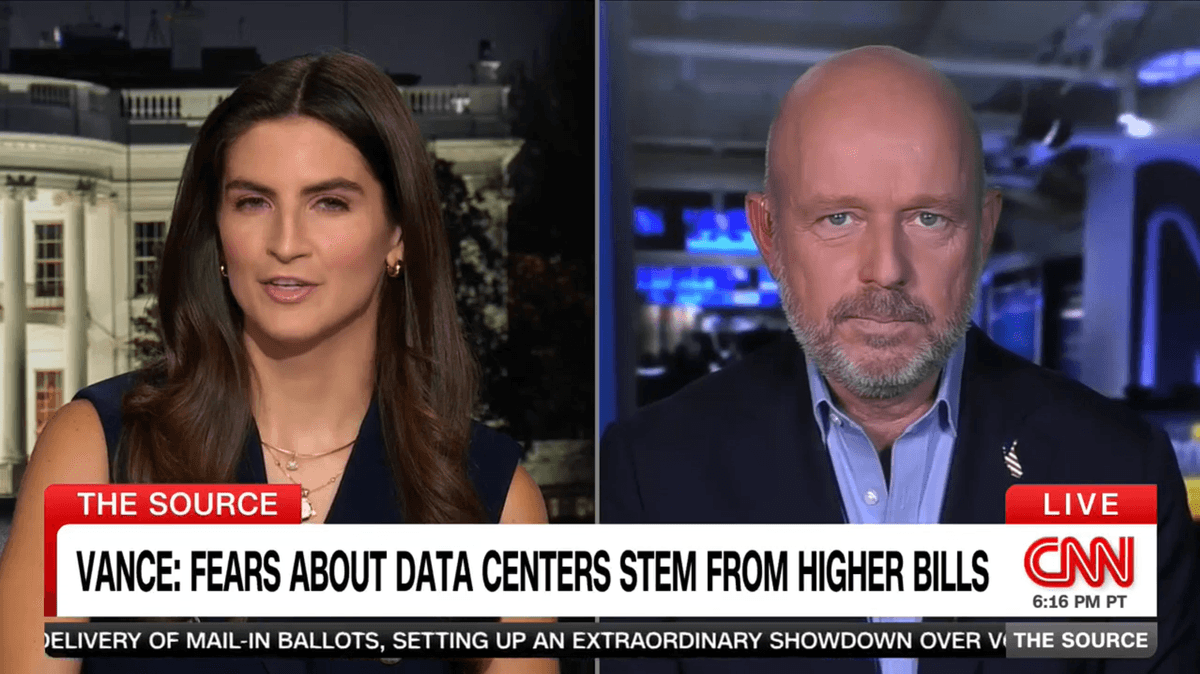
California gubernatorial candidate Steve Hilton said he'll 'get in trouble' for his answers about data centers (CNN/Screenshot)
Republican California gubernatorial candidate Steve Hilton squirmed on CNN as he was asked about the contentious issue of data centers
During a Thursday appearance, the Trump-endorsed Hilton was interviewed by CNN's Kaitlan Collins about his stance on data centers. Collins noted that Hilton has said he considers data centers "essential" before asking him if there should be federal guidelines.
"No, I think we got far too many federal guidelines, and policies, and regulations on everything," Hilton said. "That's the genius of our country, that you can try different approaches."
He then began to argue that in California, "We're leading the AI revolution. All of this is generated from within our state, and I strongly support that. It's an iconic and important industry right now, basically keeping our budget afloat."
Hilton complained that his state has "made it so expensive to build anything, to run a business," even though AI data centers create jobs.
"The problem is that jobs that are associated with this leading AI revolution from California, they're all being created in other states, in Texas, in Arizona, Ohio, everywhere but here," he said.
During the interview, Hilton admitted, "I'm going to get in trouble" because of his views on AI. After promoting the AI revolution and the job potential from data centers, he walked back his enthusiasm for AI and cautioned that people could lose jobs to it.
"We just saw in San Francisco the very first instance anyone can think of a human being being fired entirely by AI in a store, in a retail store," he said. "I just think that's completely unacceptable. We can't have that kind of dehumanization of the workforce."
Hilton said, "I found myself in agreement with a union leader here in California and against the Chamber of Commerce" on the issue of losing jobs to AI. "We want to lead the technology and AI revolution, but we can't be led by it."