Monday, October 19, 2026


'We tore it up': French looters brag online as minister admits police 'lost control'

Shopkeepers in Paris surveyed the damage after a night of rioting.
Copyright AP Photo

By Simon Ormiston
Published on


More than 2,000 shops were hit and the damage is put at hundreds of millions of euros, leaving the government to answer for its failure to see the violence coming.

Young people who took part in the weekend’s looting in France have posted videos on TikTok and X boasting about the goods they took and about beating the riot police.

“Thank you Paris, thank you Paname,” a young man says in one video on TikTok, using a slang name for the capital. "You’re killers, guys, we tore it all up."

His eyes are red, apparently from tear gas, and he goes on to list his haul. "I grabbed some new Under Armour," he says, referring to the American sportswear brand.

He then turns to the CRS riot police. "You ran like that, guys, we wiped you out," he says, before signing off: "Generation Z, respect."


‘You save money by looting’

In a second video, a young man explains to an interviewer why he joined in. He says he was protesting about fuel prices because his mother has a car, and that he took clothes and goods from a sports shop.

"In the end, you save money by looting," he says.

Asked for his view of France, he says: "I think France is racist, and we should all be equal." He says a restaurant turned him away earlier that day but let in "a French person".

The interviewer asks whether looting will only reinforce the image of "the North African who steals". He replies: "If we carry on like this, it’s going to be chaos."

‘You couldn’t look shopkeepers in the eye’

The bravado contrasts sharply with the mood in government. On Monday, Interior Minister Laurent Nuñez admitted that police had lost control.

"On Saturday, in some major cities, you couldn’t look shopkeepers in the eye after hundreds of shops had been looted and tell them we hadn’t lost control," he said.

Nuñez acknowledged a "lack of anticipation" in the deployment of security forces. He said around 60,000 police and gendarmes were on duty nationwide on Saturday, too few to handle the large crowds of rioters and looters on the fringes of the demonstrations.

"Given the damage that has been caused, it was only right that I should hand in my resignation," he said. President Emmanuel Macron refused to accept it

Damage in the ‘hundreds of millions’

Around half a million people marched across France on Saturday against the cost of living. The protests then turned into some of the worst violence the country has seen in years, with town halls and shops looted and set on fire.

In Paris, crowds of masked men in black hoodies yanked at metal shutters until they gave way. They cleared shelves of cigarettes, sunglasses, clothes, jewellery and food, AFP journalists reported. Looters left a supermarket with bags stuffed with cakes, fruit juice and alcohol.

Stores across Paris had windows smashed and products stolen by gangs of youths in hoodies. 18 October, 2026. AP Photo

Antique clocks disappeared from a small jewellery shop, and whole display racks of sunglasses vanished. Inside some shops, looters smashed cash registers onto the floor, only to find them empty.

More than 2,000 shops are expected to have been affected nationwide, according to Alain Di Crescenzo, president of the chamber of commerce. He put the damage at "hundreds of millions of euros".

More than 2,500 people were arrested, and almost 1,000 members of the security forces were injured. Protesters were hurt too, among them a demonstrator whose hand was blown off by a police crowd-control grenade.

Justice Minister Gérald Darmanin said more than 2,330 people had been taken into police custody over the weekend, 70% of them adults.


France: Rioters Set Limoges City Hall Ablaze


Protests and riots in Paris, France on 17 October 2026. 

Photo Credit: Jorge Jaramillo, Wikimedia Commons

October 19, 2026
 Al Bawaba News
By Osama Ali


Key Takeaways:

The 143-year-old Limoges town hall was heavily damaged by fire on Saturday, October 17, during nationwide demonstrations against rising living costs, with the roof collapsing onto lower floors except in the western wing.

Mayor Guillaume Guérin alleged the attack was premeditated and said people inside feared for their lives; firefighters controlled the blaze by Sunday morning.

Prime Minister Sébastien Lecornu pledged that the building would be rebuilt, public services maintained, and insurance compensation accelerated.


(Albawaba) — A French town hall that survived two world wars has been devastated by fire during nationwide unrest, with the mayor of Limoges alleging a deliberate attempt to burn down the building while people were inside.

Residents confronted the damage on Sunday, October 18, after flames tore through the 143-year-old landmark during Saturday’s demonstrations against rising living costs.


The ornate, 19th-century building became one of the most striking scenes of destruction during France’s worst unrest in years, Reuters reported.

Mayor Guillaume Guérin alleged that the attack was premeditated and said those inside had feared for their lives. His account did not establish who organised the attack.

Haute-Vienne prefect Maurice Barate said the roof had collapsed onto lower floors except in the western wing. Officials described the building as severely damaged and largely lost, with assessments continuing.

Firefighters battled the blaze overnight before bringing it under control on Sunday morning.

Guérin condemned the destruction, saying no disagreement or demand could justify attacks on public property.

Prime Minister Sébastien Lecornu pledged that the town hall would be rebuilt. He also promised continuity of public services and government efforts to accelerate insurance compensation, according to Le Monde.

The immediate challenge now extends beyond restoring a historic landmark: authorities must maintain the services it provided while determining the full extent of the damage.


About Al Bawaba News
Al Bawaba provides top stories and breaking news about the Middle East and the world. The Al Bawaba network consists of several web portals and media platforms.
View all posts by Al Bawaba News →



Britain’s New Arctic Policy: Between Security, Strategic Competition and the Search for Cooperation – OpEd


Britain’s Arctic policy has moved from scientific cooperation and environmental protection towards greater emphasis on security, reflecting the Ukraine war, Greenland developments and growing geopolitical tensions.
 
Russia’s military presence, China’s Arctic ambitions and the emerging Northern Sea Route have intensified strategic competition. Britain’s NATO-first approach strengthens Western military preparedness while raising concerns about further militarisation.
 
Climate change, resource competition and expanding shipping opportunities are transforming the Arctic. The critical challenge is preventing geopolitical rivalry from undermining international cooperation, environmental protection and the interests of Indigenous communities.


The Arctic has already emerged as one of the geopolitically contested regions in the world. Climate change, expanding military activities, competition over natural resources and the opening of new maritime routes have significantly changed a region once associated primarily with scientific exploration and environmental cooperation. For Britain, these developments have acquired greater urgency. The United Kingdom’s October 2026 policy document, The UK and the Arctic: An Update to the United Kingdom’s Arctic Policy Framework, indicates a changing assessment of the region’s geopolitical and economic significance. It also underlines how the Arctic has become part of the wider confrontation between Russia and the Western alliance, with China emerging as another important participant.

Introducing the policy framework, Uma Kumaran, Britain’s Minister for the Polar Regions, observes:

…we must also be clear-eyed about a more contested geopolitical context. While our ambition is for a more secure and co-operative Arctic, the challenges to that vision continue to intensify. The region today is far removed from the ‘zone of peace’ envisaged at the end of the Cold War, and the conditions that enabled close co-operation, including through the Arctic Council, have been significantly undermined.


She continues:

Russia’s sustained militarisation of the Arctic over nearly two decades, compounded by its full-scale invasion of Ukraine, has disrupted established patterns of cooperation and increased risks to regional stability. At the same time, wider strategic competition, including China’s stated ambition to become a Polar great power by 2030, is shaping the region in new ways. Greater accessibility is opening economic opportunities, from shipping to resource development, but also increasing pressure on environmental and social systems.

These observations point to the major dilemma confronting British Arctic policy. The government seeks to preserve international cooperation and environmental protection while preparing for an increasingly militarised regional order. Its latest framework attempts to reconcile these objectives, although the growing emphasis on NATO raises questions about whether military competition will eventually overshadow the Arctic’s environmental and developmental priorities.

From Arctic Cooperation to Strategic Competition

Britain’s Arctic policy has evolved considerably over the past decade. Its 2013 framework, Adapting to Change, approached the region primarily through scientific cooperation, environmental protection and responsible economic engagement. The 2018 policy document, Beyond the Ice, continued this approach while acknowledging the growing economic significance of Arctic resources and shipping.

The February 2023 framework, Looking North, indicated a more pronounced concern with regional security. Russia’s invasion of Ukraine in February 2022 had already disrupted diplomatic cooperation and raised questions about the future of Arctic governance. Nevertheless, Britain continued to emphasise scientific partnerships, environmental responsibilities and international institutions.

The October 2026 update marks a further change. It explicitly declares that the era of Arctic exceptionalism, commonly associated with the expression High North, low tension, has ended. The Arctic is now treated as an essential component of Britain’s national security and NATO’s collective defence.

This change has several explanations. Russia’s military infrastructure in the Arctic has expanded over many years. Finland and Sweden have joined NATO, substantially altering the strategic geography of northern Europe. China’s economic and scientific engagement has increased. Meanwhile, climate change is making previously inaccessible areas more open to navigation, resource extraction and military operations.


The British response brings out these developments. However, the assumption that greater military preparedness will necessarily produce regional stability deserves closer examination. An expanding NATO presence may strengthen deterrence, but it could also encourage Russia to reinforce its military capabilities, creating a cycle of mutual suspicion.
Russia, Ukraine and the Expansion of NATO

The Ukraine war has profoundly affected Britain’s assessment of Arctic security. Russia’s Northern Fleet, based on the Kola Peninsula, remains central to its naval and nuclear deterrence capabilities. Moscow has modernised military installations, strengthened surveillance systems and expanded its ability to operate across the Barents Sea and North Atlantic.


The British framework identifies Russian submarine activities, threats to undersea infrastructure and the growing use of sanctions-evading vessels as major security concerns. It specifically refers to Russia’s Main Directorate for Deep-Sea Research, whose capabilities have raised Western concerns about the vulnerability of submarine cables and pipelines. Britain’s response is increasingly organised around NATO. Its 2025 Strategic Defence Review established a NATO-First approach, which the new Arctic framework incorporates into regional policy.

Britain plans to double the number of troops undertaking cold-weather training in Norway from 1,000 to 2,000 by 2029. It is expanding maritime surveillance across the Greenland–Iceland–UK Gap, strengthening cooperation with Iceland and Canada, and developing advanced naval capabilities under the Atlantic Bastion programme. This programme combines maritime patrol aircraft, frigates, autonomous systems and artificial intelligence to improve the detection and monitoring of potential threats. In September 2026, Britain assumed command of NATO’s Joint Force Command Norfolk, which has responsibilities across the North Atlantic and Arctic. The UK also intends to coordinate more closely with NATO’s Arctic Sentry initiative through the ten-country Joint Expeditionary Force.

The accession of Finland and Sweden has strengthened NATO’s geographical position. Seven of the eight Arctic states are now NATO members, leaving Russia as the only Arctic state outside the alliance. This transformation has major implications. From NATO’s perspective, the enlargement strengthens collective security. From Moscow’s perspective, the expansion brings the Western military alliance closer to strategically sensitive Russian territories. Britain’s framework recognises the danger of escalation and repeatedly states that it does not seek unnecessary militarisation. However, its operational commitments indicate that defence and deterrence are becoming increasingly prominent in British Arctic policy.

Greenland, Trump and the Changing Atlantic Relationship

Greenland has acquired renewed importance in Arctic geopolitics, particularly following President Donald Trump’s efforts to strengthen American strategic influence over the territory. The September 2026 agreement involving the United States, Denmark and Greenland is an important development in this context. The agreement addresses American security interests while recognising the constitutional and political position of Greenland within the Kingdom of Denmark. Britain’s new Arctic framework welcomes the agreement, describing it as a contribution to Arctic and North Atlantic security. It also explicitly supports Denmark’s sovereignty and territorial integrity and Greenland’s right to self-determination. This position underlines Britain’s attempt to maintain two important relationships: its longstanding strategic partnership with Washington and its commitment to European allies, particularly Denmark.

Trump’s approach to Greenland has nevertheless exposed tensions within the Western alliance. American interest in Greenland is driven by its strategic location, military facilities, critical minerals and growing significance in Arctic navigation. For Denmark and Greenland, questions of sovereignty, political autonomy and control over natural resources remain fundamental. Britain’s response has been relatively cautious. Rather than directly challenging Washington’s expanding Arctic ambitions, London has welcomed the negotiated arrangement while seeking stronger bilateral relations with Greenland.

The UK resumed negotiations on a Partnership, Trade and Cooperation Agreement with Greenland in October 2025. It is also expanding scientific collaboration, including research into climate tipping points. The larger question is whether Greenland will increasingly become an arena of strategic competition among major powers. Britain’s position suggests that it recognises this possibility while seeking to protect its diplomatic and economic interests.
China, Russia and the Northern Sea Route

China’s expanding Arctic presence has been another major concern for Britain. Beijing describes itself as a near-Arctic state and has developed scientific, commercial and technological partnerships across the region. Its cooperation with Russia has become particularly important following the deterioration of Moscow’s relations with Western countries. The Northern Sea Route, running along Russia’s Arctic coastline, is central to this emerging partnership. It offers a potentially shorter maritime connection between East Asia and northern Europe.


In October 2026, Russian and Chinese officials discussed proposals to integrate China’s Maritime Silk Road with Russia’s Trans-Arctic Transport Corridor. These included port development, container shipping connections, shipbuilding cooperation and maritime technologies. As Adriel Kasonta argues, such cooperation could gradually create an alternative maritime network less dependent on traditional shipping routes and Western strategic influence. For China, the Northern Sea Route offers an opportunity to diversify maritime connections and reduce dependence on vulnerable chokepoints such as the Strait of Malacca and Suez Canal. For Russia, Chinese investment and shipping demand could accelerate the development of Arctic infrastructure.

Britain’s position towards the Northern Sea Route is more complex than outright opposition. The October framework acknowledges the commercial opportunities arising from Arctic shipping. Britain could benefit through its ports, maritime insurance industry, shipping technologies and associated services. London remains an important centre for international maritime insurance and financial services.

However, the report also expresses concern about the environmental and operational risks associated with the route. It notes that sanctioned vessels account for nearly one-third of cargo traffic along the Northern Sea Route, raising concerns about maritime safety, environmental damage and sanctions enforcement. The UK therefore approaches the route as both a potential commercial opportunity and a strategic concern.

There is also a wider geopolitical dimension. Greater Chinese participation could strengthen Russia’s economic resilience and reduce the effectiveness of Western sanctions. At the same time, the development of alternative shipping corridors could weaken the relative importance of established maritime networks. However, the Northern Sea Route faces considerable limitations. Seasonal ice conditions, inadequate infrastructure, insurance costs and environmental risks continue to restrict its commercial viability. Its emergence as a major alternative to the Suez Canal remains uncertain.
Climate Change, Science and Economic Interests

Although security dominates much of the new framework, climate change continues to be fundamental to Britain’s Arctic engagement. The Arctic is warming much faster than the global average. Melting sea ice, thawing permafrost, coastal erosion and changing ecosystems are affecting Indigenous communities and regional livelihoods. These developments also have consequences for weather patterns, sea levels and environmental security beyond the Arctic.


Britain has invested substantially in polar research. The framework records more than £145 million in investment by the Natural Environment Research Council in Arctic science since 2014. It also identifies new funding commitments for research cooperation with Norway, Greenland and other partners. Scientific collaboration is increasingly connected with technological development. Satellite communications, artificial intelligence, climate modelling and maritime monitoring are becoming important areas of investment.

The economic dimension is equally significant. Arctic critical minerals are attracting attention because of their importance for clean energy technologies, advanced manufacturing and defence industries. Britain seeks diversified mineral supply chains and stronger commercial partnerships with Arctic states. It also emphasises environmental safeguards, Indigenous participation and responsible resource development.

A contradiction, however, remains. Climate change is creating new economic opportunities precisely because the Arctic environment is deteriorating. Expanding shipping, tourism and mineral extraction could intensify ecological pressures in an already vulnerable region. Britain’s commitment to environmental protection will therefore be tested by its willingness to regulate commercial activities, including those involving its own companies and strategic partners.
Can the Arctic Remain a Region of Cooperation?

The October 2026 framework reflects a fundamental change in Britain’s understanding of the Arctic. What was previously approached mainly as a region of scientific cooperation and environmental responsibility is increasingly being incorporated into the strategic calculations of NATO and the wider Western alliance.

Russia’s military activities, China’s growing economic influence, the Ukraine war and the renewed geopolitical significance of Greenland have accelerated this transition. Nevertheless, the framework retains important commitments to international law, the Arctic Council, scientific cooperation and Indigenous rights. These commitments deserve greater attention because the challenges facing the Arctic cannot be addressed through military preparedness alone. Climate change, marine pollution, environmental degradation and threats to Indigenous livelihoods require sustained international cooperation, including engagement across geopolitical divisions.

The growing confrontation between NATO and Russia, combined with China’s expanding Arctic activities, could further weaken the institutions that have historically supported regional cooperation. The danger is that the Arctic may become another geopolitical terrain of global strategic rivalry at precisely the moment when collective environmental action is most urgently required. Britain’s new policy recognises this dilemma but offers no easy resolution. Its emphasis on deterrence shows genuine security concerns, while its commitment to cooperation points to the continuing need for collective governance.


For Britain and the other Arctic powers, the critical question is whether they can prevent strategic competition from overwhelming the shared responsibility to protect the High North whose future has consequences for the entire world.


About K.M. Seethi
K.M. Seethi is Director, Inter University Centre for Social Science Research and Extension (IUCSSRE), Mahatma Gandhi University (MGU), Kerala. He also served as ICSSR Senior Fellow, Senior Professor of International Relations and Dean of Social Sciences at MGU. One of his latest works is "ENDURING DILEMMA Flashpoints in Kashmir and India-Pakistan Relations."
View all posts by K.M. Seethi →
GOP Spending Swells US Deficit To Nearly $2 Trillion For 2026 – OpEd


October 19, 2026
 MISES
By Ryan McMaken


Key Takeaways:

The Treasury reported a $1.99 trillion federal deficit for fiscal year 2026, the third-largest on record and a 12 percent increase from the prior year, marking the 25th consecutive annual deficit.

Interest payments on the more than $40 trillion national debt reached about $1.3 trillion, while entitlement spending remains the largest category and the administration has called for a 50 percent rise in defense outlays to $1.5 trillion.

The article argues that continued mega-deficits, combined with calls for higher defense spending and monetary accommodation, point toward further debt accumulation and reliance on inflation to manage the real burden rather than fiscal restraint.


The Treasury Department released its monthly statement on Friday and has now confirmed what we all suspected: the US federal government, under the Trump Administration, will finish the 2026 fiscal year with an annual fiscal deficit of about $2 trillion.

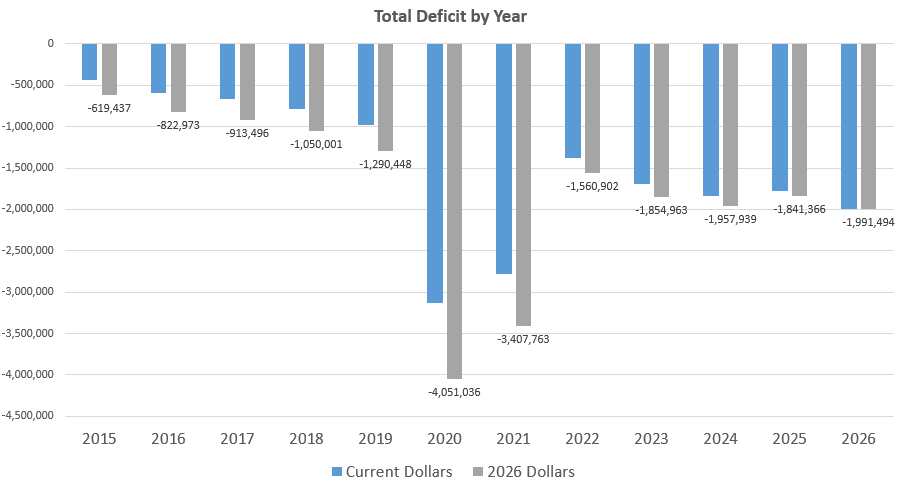
To be precise, the federal deficit for the 2026 fiscal year, which ended on September 30, is $1.99 trillion. That’s the third largest deficit ever recorded. From fiscal year 2025 to 2026, the deficit grew by 12 percent and that’s the largest growth rate since 2023. Last year, the federal deficit was $1.84 trillion, which was slightly smaller than the 2024 deficit of $1.95 trillion.


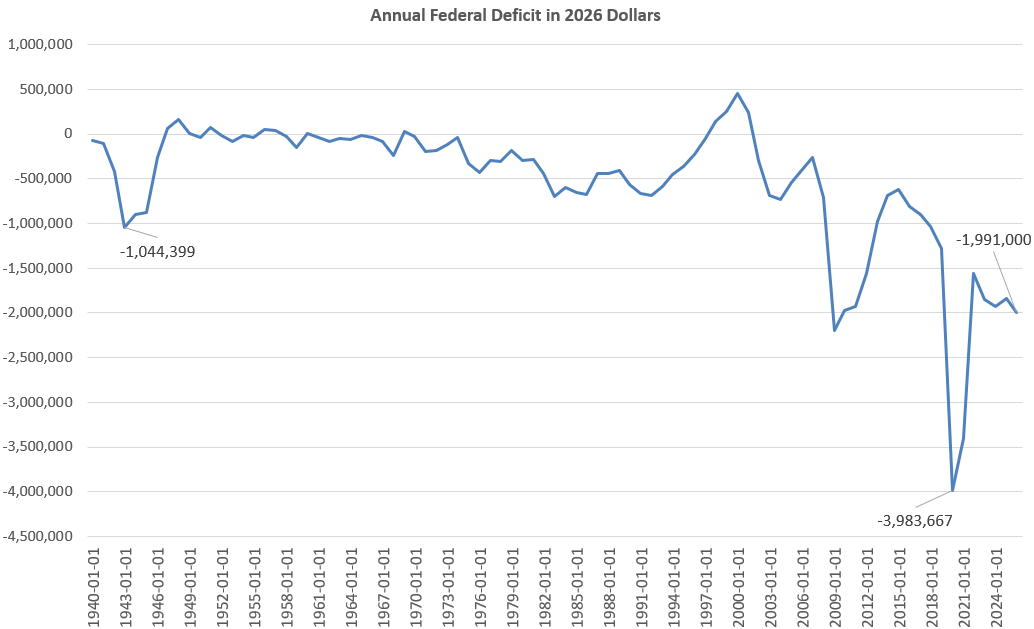
Even when adjusted for CPI inflation, however, 2026’s deficit remains the third largest ever, even including the Second World War, when the deficit in 2026 dollars reached an eye-watering $1 trillion.That was considered an off-the-charts deficit at the time. Today, World-War-Two style spending looks quaint compared to Covid-era spending and the past two years of Trump deficits.


Moreover, 2026 is the 25th annual deficit in a row, with the last federal surplus having been recorded during the 2001 fiscal year (measured in nominal dollars.) The US federal government now appears locked in to perennial mega-deficits exceeded only by the runaway spending of the Covid lockdowns when the federal government embarked on an unprecedented effort to spend out trillions of dollars to essentially pay Americans to stay home and not revolt as businesses closed and jobs evaporated.

Since then, federal deficits never even returned to the pre-Covid “normal.” Trump-administration spending during his first term was unprecedented for peace time spending outside of a major recession. This helped pave the way for the out-of-control spending that came during the Covid years. The $4 trillion deficit of 2020, of course, occurred entirely during the Trump administration, with Joe Biden taking over four months into the 2021 fiscal year.

Tax receipts have been largely stable, and the Trump administration has repeatedly bragged about raising import taxes on Americans. Studies have shown—including this study from the New York Fed—that Americans pay the lopsided majority of the tariff revenue collected by the administration. Therefore, the rising deficits are being largely driven by continued increases in federal spending. As the new treasury report makes clear. most of this spending comes from entitlement programs like Social Security, Medicare, and Medicaid. Yet, a new major factor under this administration has been rising obligations to pay debt service. The Treasury report shows that interest on the national debt—which now exceed $40 trillion—totals about $1.3 trillion for 2026. That’s up from 2025’s total interest outlay of $1.2 trillion. Interest on the debt is quickly moving toward becoming the second or third largest expense category, behind Social Security and health care.

If the Trump administration has anything to say about it, however, the category with the most enormous outlays will be “national defense,” and the administration has repeatedly demanded a 50-percent increase to defense spending, totaling $1.5 trillion.

Even without such enormous increases, the Trump White House continues to double down on its joint war with the State of Israel against Iran. This is likely to drive significant new military expenses in coming years as the US must scramble to replenish its missile stockpiles which have been largely depleted in recent months.

In other words, there is no end in sight for current spending trends, and the Trump administration has entirely abandoned whatever attempts at fiscal restraint had been announced earlier in the administration. A year ago. we heard a lot about the so-called DOGE cuts, but these amounted to virtually nothing, and the US is now adding trillions of dollars more to the national debt every year.

It took the United States more than 200 years to build up a national debt in excess of $1 trillion. Since Trump was sworn in for his second term—less than two years ago—the national debt has grown by more than $4 trillion.

This will continue to drive up the need for trillions of dollars in payments on debt service alone. That is, American taxpayers will see nearly one-fifth of all their tax payments go to nothing more than paying off the costs of old welfare payments and lost military debacles of yesteryear. Americans will soon likely see more than a quarter of their tax bill go just to interest. Rising deficits will also put upward pressure on interest rates as the federal Treasury must issue new trillion-dollar piles of debt to the existing hoard of Treasurys that now finance the national debt.


Yet, the federal government also can’t allow interest rates to increase substantially, because that would lead to unmanageable levels of interest expense, potentially leading to an eventual sovereign debt crisis. So, we can expect the Federal Reserve to intervene to manipulate interest rates downward by buying up Treasurys. This, however, will lead to inflation since the Fed’s intervention will be done with newly created dollars. The result will be a rising cost of living for ordinary people.

Not that inflation weighs on the conscience of Donald Trump. Indeed, in recent weeks, Trump has even suggested outright devaluation of the dollar as a means of inflating away the national debt. In a Time magazine interview published October 1, Trump said, “Certain levels of inflation will also pay off that debt very rapidly. Very rapidly.” Trump then went on the say that the Fed is allowing interest rates to move too high—which is another way of saying that the Fed isn’t using enough monetary inflation to push interest rates downward.

Needless to say, the massive federal debt, and the continual piling on of trillions of dollars every year, is not going to end in any sort of fiscally sound reform. What is most likely to happen is the federal government will do what Trump has suggested—and what bankrupt Latin American regimes have often done: the US government will inflate away the real value of the debt and continually rely on monetary inflation as the method of managing multi-trillion-dollar annual deficits.

As the Republicans have made very clear in recent years, there is no interest in fiscal reform, even among the allegedly “fiscally conservative” politicians.


About the author: Ryan McMaken (@ryanmcmaken) is editor in chief at the Mises Institute, a former economist for the State of Colorado, and the author of two books: Breaking Away: The Case of Secession, Radical Decentralization, and Smaller Polities and Commie Cowboys: The Bourgeoisie and the Nation-State in the Western Genre. He is also the editor of The Struggle for Liberty: A Libertarian History of Political Thought. Ryan has a bachelor’s degree in economics and a master’s degree in public policy, finance, and international relations from the University of Colorado. 


Source: This article was published by Mises

About MISES
The Mises Institute, founded in 1982, teaches the scholarship of Austrian economics, freedom, and peace. The liberal intellectual tradition of Ludwig von Mises (1881-1973) and Murray N. Rothbard (1926-1995) guides us. Accordingly, the Mises Institute seeks a profound and radical shift in the intellectual climate: away from statism and toward a private property order. The Mises Institute encourages critical historical research, and stands against political correctness.
View all posts by MISES →
Southwest Illegal Border Crossing Reach Lowest Level For One Year In U.S. History


Key Takeaways:

CBP preliminary data show southwest border apprehensions fell 95 percent in fiscal 2026, with total nationwide encounters at 379,243—the lowest in agency history and 88 percent below the fiscal 2023 peak of 2.7 million.

The administration reported zero Border Patrol releases for the first time and the 17th consecutive month of zero releases, while 8,348 unaccompanied children were processed, most at the southwest border.

Drug seizures reached a record nearly one million pounds, a 63 percent rise from the recent four-year average, as the administration completed 250 miles of new barrier and obligated $34.3 billion for additional wall projects.


(The Center Square) – Illegal border crossings at the southwest border reached their lowest level in U.S. history over the past fiscal year, according to U.S. Customs and Border Protection preliminary fiscal 2026 data.

Southwest border apprehensions dropped by 95% from Oct. 1, 2025, through Sept. 30, 2026, CBP said.

CBP made the announcement on Saturday without publishing the data for the month of September. An estimate by The Center Square puts September nationwide encounters and apprehensions at close to 30,000. Every month, this number has hovered between 30,000 and 34,000, with the exception of February, according to CBP data.

Southwest apprehension totals hovered between 9,000 and 12,000 over the past fiscal year. At the northern border, they fluctuated between 3,500 and 6,500, according to CBP data.

Over the past fiscal year through Aug. 31, nearly 350,000 had been apprehended nationwide, The Center Square reported.

The total number of apprehensions is down from 3.2 million reported in 2023, the highest on record, according to CBP data.

The Trump administration again claimed fiscal 2026 is “the first-ever fiscal year with zero Border Patrol releases. September marked the 17th consecutive month with ZERO releases.”

According to federal policy, unaccompanied alien children (UACs) are consistently released into the country, including to so-called sponsors. In fiscal 2026, 8,348 UACs were reported nationwide, according to CBP data through Aug. 31. The majority, 7,608, were at the southwest border, according to the data.

“FY 2026 demonstrated what focused enforcement, strong partnerships, and the commitment of our frontline personnel can achieve,” CBP Commissioner Rodney Scott said in a statement. “DHS and CBP are securing the border, stopping dangerous drugs and criminals, protecting communities, and ensuring our personnel have the resources necessary for this critical mission.”

CBP says its “enforcement posture” drove Border Patrol apprehensions to their lowest level in agency history of less than 99,000. It is referring to southwest border apprehensions between ports of entry. When apprehensions at ports of entry are included, the number is higher. Total apprehensions at the southwest border through Aug. 31 were 128,000, according to CBP data.

According to CBP’s Saturday announcement, CBP preliminary data shows total nationwide encounters in fiscal 2026 were the lowest in agency history at 379,243, compared to the 2.7 million per year reported under the Biden administration. This puts fiscal 2026 encounters at 88% lower than those during fiscal 2023, a year with the most encounters reported in U.S. history.

Neither the Biden nor Trump administrations publicly release gotaway data to disclose how many foreign nationals illegally enter between ports of entry to intentionally evade capture. Under the Biden administration, more than 2 million gotaways were reported, according to data exclusively reported by The Center Square after obtaining it from Border Patrol agents.


Gotaways are still coming through under the Trump administration. In Texas, they are being apprehended by Texas Operation Lone Star border security law enforcement working with Border Patrol. Federal troops are also at the southwest border responding to cartel shootings and supporting CBP and Border Patrol efforts, The Center Square reported.

The 95% drop at the southwest border reflects “sustained enforcement and the deterrent effect of a secure border. Illegal aliens have received a clear message: don’t try to enter the country illegally, or you will be apprehended, detained, and deported,” CBP said. These policies are also “saving lives by reducing unlawful crossings, leading to a dramatic decline in border-related deaths,” it added, without stating the number of deaths.

At the same time, more Americans and noncitizens have been shot by U.S. Immigration and Customs Enforcement officers. Three shootings have occurred in Texas alone, leading to two deaths of Hispanic men, including one U.S. citizen. The second shooting in Houston prompted Gov. Greg Abbott to call for a state investigation.

ICE and Border Patrol agents have also been the target of violence, with assaults against ICE up by more than 1,700% nationwide, The Center Square reported. Federal agents in Texas have been a consistent target of high-profile shootings, bomb threats, white powder being mailed among other threats. In these cases, the shooters and those making bomb threats were killed or convicted of domestic terrorism.

The administration has so far completed 250 miles of new border barrier construction along the southwest border since January 20, 2025. Through the “One Big Beautiful Bill,” CBP obligated $34.3 billion to support Smart Wall projects along the southwest border. Several billion of these funds were awarded to construction companies with a history of scandals, The Center Square reported.

The administration is also being sued over border wall construction in the Big Bend region of Texas. The case is before the U.S. Supreme Court after a federal judge halted construction.

With more agents in the field, more drugs are being apprehended. According to preliminary CBP data, drug seizures in fiscal 2026 totaled a record nearly one million pounds, the agency said. This represents a 63% increase from the 600,000-pound annual average over the last four years.


About The Center Square
The Center Square was launched in May 2019 to fulfill the need for high-quality statehouse and statewide news across the United States. The focus of their work is state- and local-level government and economic reporting.
View all posts by The Center Square →


Russia wins UN committee vote branding Western sanctions a form of colonialism

Russia wins UN committee vote branding Western sanctions a form of colonialism
Every BRICS member backed the Russian-drafted text, while the US, the UK, Japan, Israel, Ukraine and all 27 EU states voted against it. / bne IntelliNews
By Ben Aris in Berlin October 18, 2026

Neo-colonialism is back as a hot button issue and has been very effectively used by the Kremlin to undermine the West’s influence in Africa while binding these countries more closely to Russia’s expanding influence in the Global South.

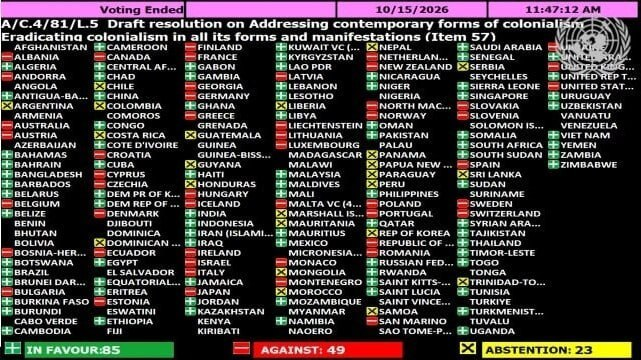
A Russian-drafted resolution equating unilateral economic sanctions to modern colonialism cleared a UN General Assembly committee by 85 votes to 49, with 23 abstentions, on October 15. Notably most of Africa voted with Russia while most of the Global North voted against the motion.

The Fourth Committee voting board for draft A/C.4/81/L.5 on October 15: 85 in favour (green), 49 against (red), 23 abstentions (yellow). Source: UN

The General Assembly's Fourth Committee, which handles special political and decolonisation questions, approved draft A/C.4/81/L.5, "Addressing contemporary forms of colonialism", in a recorded vote, according to the UN's own meetings coverage. It was one of more than 20 drafts the committee approved that day. A committee vote is not final: the text now goes to the full General Assembly for adoption in plenary.

The vote is the latest test of Moscow's campaign to recast Western sanctions as colonialism and part of Putin’s big bet on the Global South Century. Every member of BRICS - Brazil, Russia, India, China, South Africa, Egypt, Ethiopia, Indonesia, Iran and the UAE - voted in favour, the voting board shows, while the US, the UK, Japan, Israel, Ukraine and all 27 EU member states voted against. Brazil and Russia had already rejected unilateral coercive measures as unlawful in a joint statement signed in Brasilia in February, and Foreign Minister Sergei Lavrov used last year's General Assembly session to network with dozens of global south delegations. Sanctions sit at the heart of the economic war between Russia and the West.

Russia has been held the Russia-African summit twice in Russia and colonialism has been a major theme at both. Russia’s claim to fame is the Soviet Union was a rare western power that did not follow a colonial policy and during the Cold War the communists usually backed the domestic independent movements, something many African countries remain grateful until this day.

At the same time, as IntelliNews reported, the Western “globalisation” model has until recently been a polite neologism for an updated neo-colonialism model: up to 80% of its manufacturing is exported to low-wage emerging markets – exactly the problem that US President Donald Trump’s Liberation Day tariffs was trying to tackle - exporting the human capital wealth of poor market back to Western markets in the form of cheap iPhones and other goods, according to one study.

Under the text, the UN Assembly would recognise that "colonialism persists in contemporary forms and practices in relations among States, and may be expressed through resort to unilateral economic, financial or trade measures not in accordance with international law and the Charter", the UN said in its summary of the draft. The text also lists the threat or use of force against the territorial integrity or political independence of any state, interference in states' internal affairs and restrictions on access to markets and services.

Moscow tables, Washington pushes back

Russia's representative introduced the draft on behalf of the Group of Friends in Defence of the Charter of the United Nations, a bloc formed in July 2021 that includes China, Cuba and Iran. He said the text offered a positive alternative by encouraging stronger international co-operation to reduce structural inequality, according to the UN. When the committee opened its general debate on October 1, the Russian delegate said "modern-day colonialism is seen, among other things, through unilateral coercive measures", and announced the group would table a new resolution on the issue, the UN's coverage of that meeting shows.

The US representative told the committee that sanctions, export controls and sovereign trade decisions are lawful tools of statecraft and that every nation has the right to choose its trading partners and respond to threats, according to the UN summary. She also said Havana had for years used Venezuela's oil wealth to prop up its failed economy, and that the US had arrested Venezuela's dictator - a reference to the seizure of Nicolas Maduro, whose release Moscow has demanded.

"We are not surprised by the position taken by the Government of the United States, the main promoter of unilateral coercive measures and economic blockades," Cuba's delegate replied.

Ukraine called the draft "another attempt by Russia to present itself as a champion of decolonization" while Moscow pursues neocolonial policies of its own, and said sanctions are a legitimate response to Russia's aggression. Liechtenstein, speaking also for Iceland and Norway, said implementing the principles behind the draft in full "would entail a significant policy shift by the drafter of this text". "Norway cannot accept a resolution presented by a state violating another state's sovereignty, independence and territorial integrity," Norway's UN mission said in a statement on October 15.

How emerging markets voted

The board shows all five Central Asian states - Kazakhstan, Kyrgyzstan, Tajikistan, Turkmenistan and Uzbekistan - voting in favour, along with Belarus. Georgia and Moldova voted against, as did Albania, Bosnia and Herzegovina, Montenegro and North Macedonia. Serbia abstained. Hungary and Slovakia, the EU members most reluctant on Russia sanctions, voted against with the rest of the bloc. No vote is recorded for Turkey, Armenia or Azerbaijan.

Saudi Arabia, Qatar, Kuwait, Bahrain and Oman voted in favour alongside the UAE, as did Pakistan, Bangladesh, Vietnam, Malaysia, Thailand, the Philippines and Singapore. In Africa, Egypt, Ethiopia, Algeria and Ghana backed the text and Morocco abstained, while no vote is recorded for Nigeria or Kenya. South Korea and Mongolia abstained.

Latin America split. Brazil, Mexico, Uruguay, Cuba and Nicaragua voted in favour, Ecuador voted against, and Argentina, Chile, Colombia, Peru, Paraguay and Panama abstained. Argentina gave no official explanation for its abstention, MercoPress reported on October 16, and drew criticism from Carlos Bianco, the government minister of Buenos Aires province, who said "the Malvinas Question deserves a diplomacy that is not on its knees".

The split is far sharper than on last year's Russian-backed text declaring December 14 the International Day against Colonialism in All Its Forms and Manifestations, which the General Assembly adopted on December 5, 2025 by 116 votes to two, with only the US and Israel against and 54 abstentions, according to the voting record. The UK and France, which abstained on that text, voted against this one.


Zambia, Egypt, Malawi and Mauritania join World Bank's $19bn minerals financing drive

Zambia, Egypt, Malawi and Mauritania join World Bank's $19bn minerals financing drive
/ bne IntelliNewsFacebook
By bne IntelliNews October 18, 2026

Zambia, Egypt, Malawi and Mauritania are among the first eight countries selected for a World Bank Group initiative targeting $19bn in metals and minerals financing and private capital mobilisation through 2030, as African producers seek greater investment in mining, processing and supporting infrastructure.

World Bank President Ajay Banga announced the target on October 16 at the International Monetary Fund (IMF) and World Bank annual meetings in Bangkok, saying the institution had identified 20 potential partner countries, Reuters reported.

The World Bank aims to increase support more than fivefold, from $3.6bn during fiscal 2021–2025 to $19bn in fiscal 2026–2030. The target combines World Bank Group financing with private capital mobilisation rather than representing new lending commitments, and no specific share has been allocated to the African participants.

“In critical minerals, we plan to quintuple our business in five years,” Banga said.

The initiative forms part of the bank's Metals and Minerals strategy, which seeks to help resource-rich developing countries develop refining and manufacturing industries alongside mineral extraction.

Africa's mineral processing gap

Africa produces around 70% of the world's cobalt, three-quarters of its manganese and nearly one-fifth of its copper, but captures less than 1% of the value generated by manufacturing clean-energy technologies and components, according to International Energy Agency estimates cited by IntelliNews in September.

Reliable electricity, transport infrastructure, financing and technical skills remain major obstacles to expanding the continent's processing capacity.

See IntelliNews: Africa’s push for local mineral processing reshapes mining investment

The four African countries joined Argentina, Bolivia, India and Kazakhstan in launching the first partnerships and country compacts on October 16. These identify priorities for regulatory reform, infrastructure and investment rather than constituting approved financing packages.

The programme follows a separate United Nations initiative launched in September to help Guinea, Madagascar, Nigeria, Zambia and Zimbabwe develop higher-value mineral industries. Unlike the World Bank's financing and mobilisation target, the UN programme focuses on policy and regulatory assistance and has no announced funding allocation, IntelliNews reported on October 6.

See IntelliNews: Who stands to gain most from the UN’s critical minerals push in Africa?

Zambia targets copper expansion as Egypt develops mineral hubs

Zambia's World Bank compact focuses on increasing copper production and domestic processing through improved geological data, licensing, electricity supply and transport infrastructure. The country aims to produce 3mn tonnes of copper annually by 2031, alongside greater investment in supporting industries.

The expansion faces existing infrastructure constraints. Zambia temporarily suspended its 10% duty on copper-concentrate exports in 2025 and extended the waiver until September 2026 to help miners clear stockpiles during smelter maintenance, IntelliNews reported in June.

See IntelliNews: Zambia extends copper concentrate export-duty waiver, prioritising output over beneficiation amid smelter constraints

Egypt aims to increase mining's contribution to GDP to 6% by 2030 and raise metals and minerals-related exports to $9.8bn by 2040. Its compact includes regulatory reforms, improved geological information and mineral-processing hubs, supported by the World Bank Group and European Bank for Reconstruction and Development.

Malawi's programme prioritises mining governance, transport and energy infrastructure, local suppliers and greater transparency in mineral licensing and revenues.

Mauritania is seeking to combine mineral development with renewable energy investment to support lower-emission processing and increase the economic benefits retained domestically.

The four countries have different mineral resources and industrial capacities, but their compacts share an emphasis on infrastructure and investment conditions. Neither the national production targets nor the identified projects constitute guaranteed outcomes of the World Bank initiative.

Financing, guarantees and competition for African minerals

The World Bank will provide policy advice and public financing, while its private-sector arm, the International Finance Corporation (IFC), will invest and mobilise commercial capital. The Multilateral Investment Guarantee Agency (MIGA) will offer guarantees aimed at reducing investment risks.

For African mineral producers, the availability of electricity, transport links and commercially viable processing facilities will be critical to attracting investment beyond extraction.

The programme comes amid growing competition for copper, cobalt, manganese and other minerals used in electric vehicles, batteries, renewable energy equipment and advanced manufacturing.

The United States, the World Bank's largest shareholder, has pressed the institution to expand support for mineral extraction, processing and infrastructure as Washington seeks to diversify strategic supply chains.

The US International Development Finance Corporation (DFC) said on October 9 that it planned to take more equity stakes in African critical-minerals projects. It has committed more than $3bn to critical minerals and related investments in Africa.

See IntelliNews: US development agency plans more direct investment in African critical minerals

US Treasury Secretary Scott Bessent also called for World Bank involvement in deep-sea mining during the annual meetings. Banga did not endorse such projects, while the bank's strategy calls for a precautionary approach consistent with its environmental and social policies.

Separately, six multilateral development banks, including the World Bank and African Development Bank, have agreed to coordinate financing, guarantees, infrastructure investment and environmental standards for critical-mineral supply chains.

The collaboration could provide additional channels for African countries seeking investment in electricity networks, transport corridors and processing facilities, although neither initiative establishes a country-specific financing allocation.