ANOTHER DAY, ANOTHER WAR CRIME
Trump admin admits to striking another foreign boat and killing 4
Robert Davis
April 14, 2026
RAW STORY
President Donald Trump's administration admitted on Tuesday to striking another foreign boat and killing four people, according to a new report.
The strike is the second in as many days, the New York Times reported, and marks the revival of one of the administration's most controversial policies. Since Trump began his second term, the administration has conducted 50 strikes against foreign boats, many of which were alleged to be carrying drugs. In all, the strikes have killed roughly 174 people.
"The U.S. Southern Command, led by Gen. Francis L. Donovan of the Marine Corps, announced the strike on social media with a 16-second video that showed a stationary boat floating in the water and then exploding," the report reads in part.
"Legal specialists on the use of lethal force have said the strikes are illegal, extrajudicial killings because the military cannot deliberately target civilians who do not pose an imminent threat of violence, even if those people are suspected of engaging in criminal acts," it added. "The Trump administration has not provided evidence of drug smuggling."
President Donald Trump's administration admitted on Tuesday to striking another foreign boat and killing four people, according to a new report.
The strike is the second in as many days, the New York Times reported, and marks the revival of one of the administration's most controversial policies. Since Trump began his second term, the administration has conducted 50 strikes against foreign boats, many of which were alleged to be carrying drugs. In all, the strikes have killed roughly 174 people.
"The U.S. Southern Command, led by Gen. Francis L. Donovan of the Marine Corps, announced the strike on social media with a 16-second video that showed a stationary boat floating in the water and then exploding," the report reads in part.
"Legal specialists on the use of lethal force have said the strikes are illegal, extrajudicial killings because the military cannot deliberately target civilians who do not pose an imminent threat of violence, even if those people are suspected of engaging in criminal acts," it added. "The Trump administration has not provided evidence of drug smuggling."
‘More Murder’: Trump Admin Kills Two People in Latest Illegal Boat Bombing
The attack was announced hours after Trump threatened Iranian vessels near the Strait of Hormuz with “the same system of kill that we use against the drug dealers on boats at Sea.”

A screengrab of video footage posted by US Southern Command shows a boat in the eastern Pacific just moments before it was bombed by American forces on April 13, 2026.
(Photo: US Southern Command)
Jake Johnson
Apr 14, 2026
COMMON DREAMS
The US military on Monday attacked a vessel in the eastern Pacific accused, without evidence, of engaging in “narco-trafficking operations.” The strike killed at least two people and brought the known death toll from the Trump administration’s lawless boat-bombing spree in international waters to more than 170.
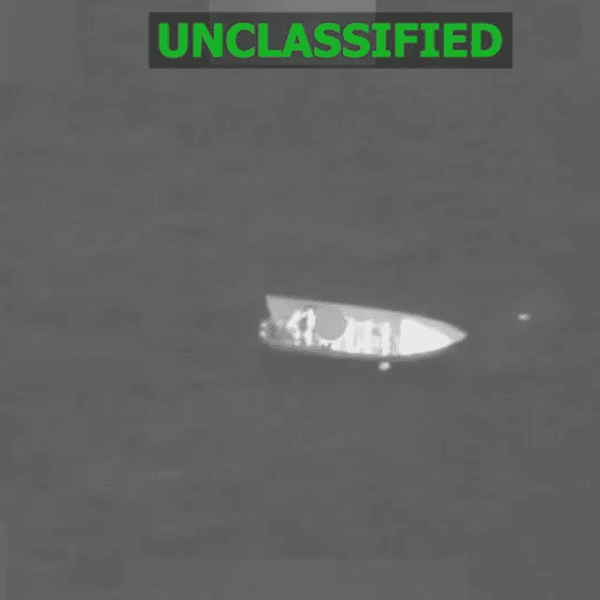
As has been its custom since the boat bombings began last September, US Southern Command posted an unclassified video clip of the attack on social media. SOUTHCOM described the bombing as “a lethal kinetic strike on a vessel operated by Designated Terrorist Organizations,” but did not provide any evidence against the boat’s operators.
Monday’s deadly strike came days after the April 11 US bombings of two other boats in the eastern Pacific, attacks that killed at least five people. United Nations experts and human rights organizations have condemned the bombings in international waters as extrajudicial killings and murder—and argued those ordering and carrying out the attacks should be prosecuted for homicide.
“More murder,” The Intercept’s Nick Turse wrote in response to Monday’s boat bombing.
Hours before SOUTHCOM announced the latest strike, Turse reported that the Trump administration is “waging a pressure campaign against the leading inter-American human rights watchdog to squash a potential investigation into illegal US attacks on boats in the Caribbean Sea and the Pacific Ocean.”
Brian Finucane, a senior adviser to the US Program at the International Crisis Group, said Monday that it is “funny how the Trump administration is very happy to continue to post snuff films of these lawless killings but not defend the legal merits of these strikes.”
Last month, the Inter-American Commission on Human Rights held a hearing during which experts testified to the illegality of the boat strikes.
“The administration’s desire to play imperial superpower in the region cannot be a reason to completely displace the foundations of international law,” Angelo Guisado, senior staff attorney at the Center for Constitutional Rights, told the commission.
On Monday, US President Donald Trump threatened to expand his administration’s illegal boat-bombing spree to Iranian vessels that “come anywhere close” to the US naval blockade of the Strait of Hormuz that the president ordered over the weekend.
Trump wrote on social media that Iranian vessels seen approaching the blockade “will be immediately ELIMINATED, using the same system of kill that we use against the drug dealers on boats at Sea.”
“It is quick and brutal,” the president added.
Trump’s Military Murders 5 More People in ‘Lawless’ Boat Bombing Campaign
The Trump administration’s boat strikes have now killed at least 168 people, according to NPR.
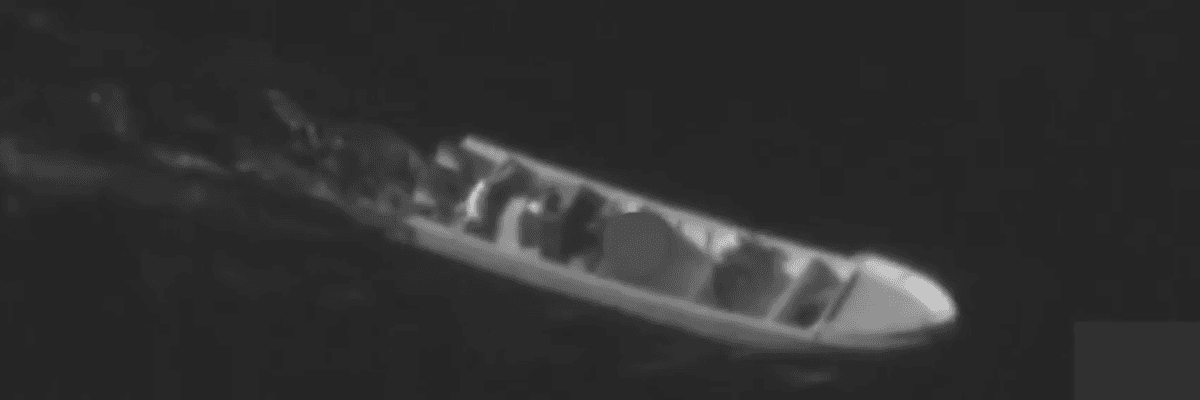
US Southern Command shared on social media a 34-second clip of two strikes on boats in the eastern Pacific that killed five people on April 13, 2026.
(Photo: screen cap via SOUTHCOM / X)
Brad Reed
Apr 13, 2026
COMMON DREAMS
The United States military has killed five more people suspected of drug smuggling in the latest boat bombing operation that many international law experts consider to be acts of murder.
In a Sunday social media post, US Southern Command (SOUTHCOM) announced it had “conducted two lethal kinetic strikes on two vessels” that it had deemed to be run by “designated terrorist organizations.” As with the dozens of other boat bombings the Trump administration has conducted since last September, the military did not provide evidence that the vessels were involved in drug trafficking.
“Intelligence confirmed the vessels were transiting along known narco-trafficking routes in the Eastern Pacific and were engaged in narco-trafficking operations,” SOUTHCOM said. “Two male narco-terrorists were killed, and one narco-terrorist survived the first strike. Three male narco-terrorists were killed during the second strike.”
SOUTHCOM said that it had alerted the US Coast Guard to conduct a search and rescue operation of the lone survivor of the two strikes, although it provided no further details of his well-being.
According to NPR, the US has now killed at least 168 people with its strikes on suspected drug boats, which began in September and have since continued despite being denounced by human rights organizations such as Human Rights and Amnesty International.
Brian Finucane, senior adviser with the US Program at the International Crisis Group, took note of the latest boat strike by remarking, “The lawless killing spree at sea continues.”
A coalition of rights organizations led by the ACLU last year sued the Trump administration to demand it release documents that provide legal justification for its boat-bombing campaign.
The groups said that the Trump administration’s rationales for the strikes deserve special scrutiny because their justification hinges on claims that the US is in an “armed conflict” with international drug cartels akin to past conflicts between the US government and terrorist organizations such as al-Qaeda.
The groups argued there is simply no way that drug cartels can be classified under the same umbrella as terrorist organizations, given that the law regarding war with nonstate actors says that any organizations considered to be in armed conflict with the US must be an “organized armed group” that is structured like a conventional military and engaged in “protracted armed violence” with the US government.
Before President Donald Trump’s Pentagon began conducting the lethal boat strikes last year, drug trafficking in international waters was treated as a criminal offense, with law enforcement agencies and the US Coast Guard intercepting boats suspected of carrying drugs and arresting suspects.
Trump’s bombings of boats in the Caribbean and eastern Pacific have been called “extrajudicial killings” by advocacy groups including Amnesty International
The attack was announced hours after Trump threatened Iranian vessels near the Strait of Hormuz with “the same system of kill that we use against the drug dealers on boats at Sea.”
A screengrab of video footage posted by US Southern Command shows a boat in the eastern Pacific just moments before it was bombed by American forces on April 13, 2026.
(Photo: US Southern Command)
Jake Johnson
Apr 14, 2026
COMMON DREAMS
The US military on Monday attacked a vessel in the eastern Pacific accused, without evidence, of engaging in “narco-trafficking operations.” The strike killed at least two people and brought the known death toll from the Trump administration’s lawless boat-bombing spree in international waters to more than 170.
As has been its custom since the boat bombings began last September, US Southern Command posted an unclassified video clip of the attack on social media. SOUTHCOM described the bombing as “a lethal kinetic strike on a vessel operated by Designated Terrorist Organizations,” but did not provide any evidence against the boat’s operators.
Monday’s deadly strike came days after the April 11 US bombings of two other boats in the eastern Pacific, attacks that killed at least five people. United Nations experts and human rights organizations have condemned the bombings in international waters as extrajudicial killings and murder—and argued those ordering and carrying out the attacks should be prosecuted for homicide.
“More murder,” The Intercept’s Nick Turse wrote in response to Monday’s boat bombing.
Hours before SOUTHCOM announced the latest strike, Turse reported that the Trump administration is “waging a pressure campaign against the leading inter-American human rights watchdog to squash a potential investigation into illegal US attacks on boats in the Caribbean Sea and the Pacific Ocean.”
Brian Finucane, a senior adviser to the US Program at the International Crisis Group, said Monday that it is “funny how the Trump administration is very happy to continue to post snuff films of these lawless killings but not defend the legal merits of these strikes.”
Last month, the Inter-American Commission on Human Rights held a hearing during which experts testified to the illegality of the boat strikes.
“The administration’s desire to play imperial superpower in the region cannot be a reason to completely displace the foundations of international law,” Angelo Guisado, senior staff attorney at the Center for Constitutional Rights, told the commission.
On Monday, US President Donald Trump threatened to expand his administration’s illegal boat-bombing spree to Iranian vessels that “come anywhere close” to the US naval blockade of the Strait of Hormuz that the president ordered over the weekend.
Trump wrote on social media that Iranian vessels seen approaching the blockade “will be immediately ELIMINATED, using the same system of kill that we use against the drug dealers on boats at Sea.”
“It is quick and brutal,” the president added.
Trump’s Military Murders 5 More People in ‘Lawless’ Boat Bombing Campaign
The Trump administration’s boat strikes have now killed at least 168 people, according to NPR.
US Southern Command shared on social media a 34-second clip of two strikes on boats in the eastern Pacific that killed five people on April 13, 2026.
(Photo: screen cap via SOUTHCOM / X)
Brad Reed
Apr 13, 2026
COMMON DREAMS
The United States military has killed five more people suspected of drug smuggling in the latest boat bombing operation that many international law experts consider to be acts of murder.
In a Sunday social media post, US Southern Command (SOUTHCOM) announced it had “conducted two lethal kinetic strikes on two vessels” that it had deemed to be run by “designated terrorist organizations.” As with the dozens of other boat bombings the Trump administration has conducted since last September, the military did not provide evidence that the vessels were involved in drug trafficking.
“Intelligence confirmed the vessels were transiting along known narco-trafficking routes in the Eastern Pacific and were engaged in narco-trafficking operations,” SOUTHCOM said. “Two male narco-terrorists were killed, and one narco-terrorist survived the first strike. Three male narco-terrorists were killed during the second strike.”
SOUTHCOM said that it had alerted the US Coast Guard to conduct a search and rescue operation of the lone survivor of the two strikes, although it provided no further details of his well-being.
According to NPR, the US has now killed at least 168 people with its strikes on suspected drug boats, which began in September and have since continued despite being denounced by human rights organizations such as Human Rights and Amnesty International.
Brian Finucane, senior adviser with the US Program at the International Crisis Group, took note of the latest boat strike by remarking, “The lawless killing spree at sea continues.”
A coalition of rights organizations led by the ACLU last year sued the Trump administration to demand it release documents that provide legal justification for its boat-bombing campaign.
The groups said that the Trump administration’s rationales for the strikes deserve special scrutiny because their justification hinges on claims that the US is in an “armed conflict” with international drug cartels akin to past conflicts between the US government and terrorist organizations such as al-Qaeda.
The groups argued there is simply no way that drug cartels can be classified under the same umbrella as terrorist organizations, given that the law regarding war with nonstate actors says that any organizations considered to be in armed conflict with the US must be an “organized armed group” that is structured like a conventional military and engaged in “protracted armed violence” with the US government.
Before President Donald Trump’s Pentagon began conducting the lethal boat strikes last year, drug trafficking in international waters was treated as a criminal offense, with law enforcement agencies and the US Coast Guard intercepting boats suspected of carrying drugs and arresting suspects.
Trump’s bombings of boats in the Caribbean and eastern Pacific have been called “extrajudicial killings” by advocacy groups including Amnesty International
State Department Pushes Human Rights Watchdog to Ignore Deadly, Illegal Boat Strike Campaign
As the Inter-American Commission on Human Rights was advised not to investigate the bombings, Pentagon officials expressed support for strikes on land, ostensibly against drug traffickers.
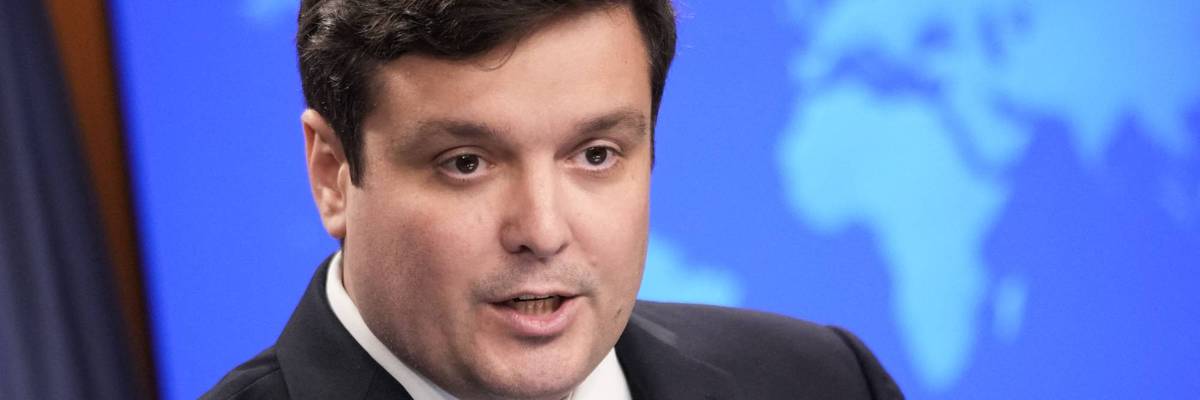
US Deputy State Department spokesperson Tommy Pigott speaks during a press briefing at the State Department in Washington, DC on July 31, 2025.
(Photo by Oliver Contreras/AFP via Getty Images)
Julia Conley
Apr 14, 2026
COMMON DREAMS
The former president of a top international human rights watchdog views the United States’ monthslong campaign of bombing boats in the Caribbean Sea and eastern Pacific Ocean as a clear-cut case of “murder,” he told The Intercept Monday, but he warned that pressure from the Trump administration may stop the body from investigating the Pentagon’s actions.
Juan Méndez, a former president of the Inter-American Commission on Human Rights, noted that a month after the IACHR held a hearing on the boat bombing campaign, officials “may well feel that this is a very delicate situation, and if they take the initiative, they’re going to incur the wrath of the United States.”
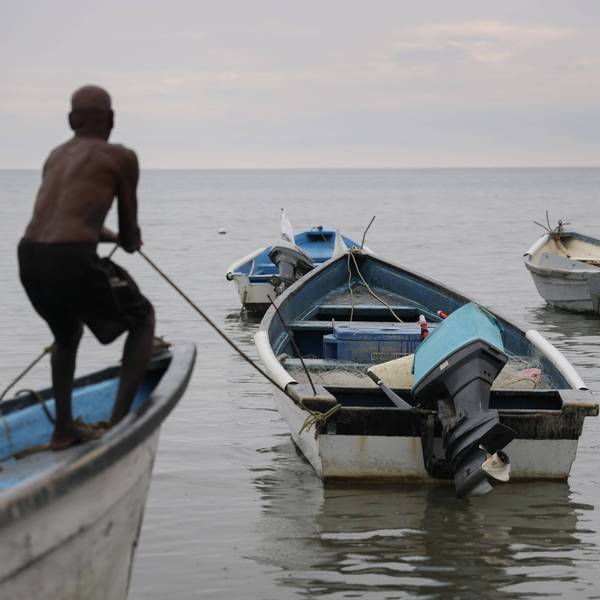
With Nearly 50 Boats Attacked, US Strikes Highlight ‘Pattern of Unlawful Use of Lethal Force’: Human Rights Watch
The hearing last month was the first of its kind and included testimonies from the ACLU, the Center for Constitutional Rights, International Crisis Group, and Ben Saul, the United Nations special rapporteur on counterterrorism and human rights. The groups presented evidence that the US has been violating both domestic and international law by bombing vessels that it has claimed—without making any evidence publicly available—are involved in drug trafficking. Nearly 170 people have been killed in dozens of strikes, and legal experts worldwide have asserted the US is violating international law and has committed extrajudicial killings—potentially making those involved in the strikes liable for murder.
The hearing was followed by a statement from Tommy Pigott, a State Department spokesperson, who said the IACHR had “strayed far outside its mandate” by looking into the boat attacks—as the family of one man killed in a bombing requested it to—and accused the ACLU of trying to manipulate the body.
“The United States calls on the commission to adhere to its statute and rules of procedure in the future and avoid inserting itself into matters that are in active domestic litigation and fall outside the human rights sphere,” said Pigott. “Convening hearings under these circumstances risks undermining—not strengthening—the credibility of the inter-American human rights system.”
Pigott also called on the commission to “redirect its focus toward the individual petitions languishing on its docket, sometimes for decades.” He did not mention specific petitions or issues the IACHR should focus on.
Carl Anderson, a legal adviser at the State Department, also rebuked the commission for holding the proceedings.
“If the United States cuts the funding, they probably would have to shut down—at least for a while.”
A person with close ties to the IACHR told The Intercept that Pigott’s demand that the commission focus on other topics pointed to a pressure campaign aimed at stoking fear that the IACHR could lose its funding.
President Donald Trump’s zeroed out US contributions to the commission during his first term in 2018, and withdrew some funding the following year due to its support for abortion rights. The administration terminated funding last year for at least 22 programs under the IACHR’s parent body, the Organization of American States, of which the US is the largest international funder.
“They are stretched for funding,” Méndez told The Intercept. “And if the United States cuts the funding, they probably would have to shut down—at least for a while.”
Stuardo Ralón, the IACHR’s current president, denied that there is “pressure from the United States on the Inter-American Commission on Human Rights,” but suggested it may not conduct a comprehensive investigation into the Trump administration’s boat bombings—saying the body “does not conduct investigations.”
The Intercept noted that the IACHR has conducted numerous investigations that it has publicly acknowledged and described as such, including into US immigration detention centers and the kidnapping and apparent killing of 43 students in Mexico in 2014.
Ralón told the outlet that it has not yet taken any steps to launch an investigation into the strikes following the hearing, and said it “will continue to monitor the situation in accordance with its mandate.”
Jamil Dakwar, director of the ACLU’s human rights program, emphasized that “the commission is within its competency and its bounds to fully investigate the egregious violations of international law happening in its own backyard.”
“We have asked the commission to fulfill its responsibilities as the premier regional human rights body to conduct a fact-finding investigation of these heinous killings,” Dakwar told The Intercept, “and to ensure that no country can act in this fashion because that will have severe implications on human rights in the region and beyond.”
As the State Department has pushed the IACHR away from probing the legality of the boat bombings, administration officials like Joseph Humire, acting assistant secretary of war for homeland defense and Americas security affairs, have warned that the attacks at sea are “just the beginning” of what officials claim is an effort to defeat drug cartels—against which Congress has not authorized any military action.
US Southern Command announced a joint ground operation with Ecuador last month to defeat “narco-terrorists.”
Humire said the Pentagon supports “joint land strikes,” while Gen. Francis Donovan, the head of US Southern Command who has been directing the boat attacks, told the Senate Armed Service Committee that the Pentagon is moving toward “a counter-cartel campaign process that puts total systemic friction across this network.”
“I believe,” he said, “these kinetic [boat] strikes are just one small part of that.”
As the Inter-American Commission on Human Rights was advised not to investigate the bombings, Pentagon officials expressed support for strikes on land, ostensibly against drug traffickers.
US Deputy State Department spokesperson Tommy Pigott speaks during a press briefing at the State Department in Washington, DC on July 31, 2025.
(Photo by Oliver Contreras/AFP via Getty Images)
Julia Conley
Apr 14, 2026
COMMON DREAMS
The former president of a top international human rights watchdog views the United States’ monthslong campaign of bombing boats in the Caribbean Sea and eastern Pacific Ocean as a clear-cut case of “murder,” he told The Intercept Monday, but he warned that pressure from the Trump administration may stop the body from investigating the Pentagon’s actions.
Juan Méndez, a former president of the Inter-American Commission on Human Rights, noted that a month after the IACHR held a hearing on the boat bombing campaign, officials “may well feel that this is a very delicate situation, and if they take the initiative, they’re going to incur the wrath of the United States.”
With Nearly 50 Boats Attacked, US Strikes Highlight ‘Pattern of Unlawful Use of Lethal Force’: Human Rights Watch
The hearing last month was the first of its kind and included testimonies from the ACLU, the Center for Constitutional Rights, International Crisis Group, and Ben Saul, the United Nations special rapporteur on counterterrorism and human rights. The groups presented evidence that the US has been violating both domestic and international law by bombing vessels that it has claimed—without making any evidence publicly available—are involved in drug trafficking. Nearly 170 people have been killed in dozens of strikes, and legal experts worldwide have asserted the US is violating international law and has committed extrajudicial killings—potentially making those involved in the strikes liable for murder.
The hearing was followed by a statement from Tommy Pigott, a State Department spokesperson, who said the IACHR had “strayed far outside its mandate” by looking into the boat attacks—as the family of one man killed in a bombing requested it to—and accused the ACLU of trying to manipulate the body.
“The United States calls on the commission to adhere to its statute and rules of procedure in the future and avoid inserting itself into matters that are in active domestic litigation and fall outside the human rights sphere,” said Pigott. “Convening hearings under these circumstances risks undermining—not strengthening—the credibility of the inter-American human rights system.”
Pigott also called on the commission to “redirect its focus toward the individual petitions languishing on its docket, sometimes for decades.” He did not mention specific petitions or issues the IACHR should focus on.
Carl Anderson, a legal adviser at the State Department, also rebuked the commission for holding the proceedings.
“If the United States cuts the funding, they probably would have to shut down—at least for a while.”
A person with close ties to the IACHR told The Intercept that Pigott’s demand that the commission focus on other topics pointed to a pressure campaign aimed at stoking fear that the IACHR could lose its funding.
President Donald Trump’s zeroed out US contributions to the commission during his first term in 2018, and withdrew some funding the following year due to its support for abortion rights. The administration terminated funding last year for at least 22 programs under the IACHR’s parent body, the Organization of American States, of which the US is the largest international funder.
“They are stretched for funding,” Méndez told The Intercept. “And if the United States cuts the funding, they probably would have to shut down—at least for a while.”
Stuardo Ralón, the IACHR’s current president, denied that there is “pressure from the United States on the Inter-American Commission on Human Rights,” but suggested it may not conduct a comprehensive investigation into the Trump administration’s boat bombings—saying the body “does not conduct investigations.”
The Intercept noted that the IACHR has conducted numerous investigations that it has publicly acknowledged and described as such, including into US immigration detention centers and the kidnapping and apparent killing of 43 students in Mexico in 2014.
Ralón told the outlet that it has not yet taken any steps to launch an investigation into the strikes following the hearing, and said it “will continue to monitor the situation in accordance with its mandate.”
Jamil Dakwar, director of the ACLU’s human rights program, emphasized that “the commission is within its competency and its bounds to fully investigate the egregious violations of international law happening in its own backyard.”
“We have asked the commission to fulfill its responsibilities as the premier regional human rights body to conduct a fact-finding investigation of these heinous killings,” Dakwar told The Intercept, “and to ensure that no country can act in this fashion because that will have severe implications on human rights in the region and beyond.”
As the State Department has pushed the IACHR away from probing the legality of the boat bombings, administration officials like Joseph Humire, acting assistant secretary of war for homeland defense and Americas security affairs, have warned that the attacks at sea are “just the beginning” of what officials claim is an effort to defeat drug cartels—against which Congress has not authorized any military action.
US Southern Command announced a joint ground operation with Ecuador last month to defeat “narco-terrorists.”
Humire said the Pentagon supports “joint land strikes,” while Gen. Francis Donovan, the head of US Southern Command who has been directing the boat attacks, told the Senate Armed Service Committee that the Pentagon is moving toward “a counter-cartel campaign process that puts total systemic friction across this network.”
“I believe,” he said, “these kinetic [boat] strikes are just one small part of that.”
No comments:
Post a Comment