It’s possible that I shall make an ass of myself. But in that case one can always get out of it with a little dialectic. I have, of course, so worded my proposition as to be right either way (K.Marx, Letter to F.Engels on the Indian Mutiny)
Thursday, April 16, 2026
Op-Ed: Critical mineral sovereignty starts with deep tech
Canada’s policy language frames critical minerals in terms of sovereignty, economic resilience, and geopolitical risks. (Image: Prime Minister Mark Carney at auto parts manufacturing facility. Prime Minister Office | Lars Hagberg.)
Sovereignty is one of those words governments use when they want to sound serious. In critical minerals, it should be taken literally. Ottawa’s March 2026 announcement of up to $40 million for the Canadian Digital Core Library is more than another mining news release, and an admission that geological data is strategic infrastructure. It also marks a shift toward treating drill samples as part of Canada’s competitiveness toolkit.
It is too early to treat this as mission accomplished. Sovereignty in critical minerals is synonymous with controlling enough of the value chain to matter, and the federal critical minerals strategy makes that plain. It frames the opportunity across the full chain, from exploration and extraction through processing, manufacturing, and recycling, and argues that value must be added across that system if Canada is to become a supplier of choice. Sovereignty, in other words, starts long before production.
Critical minerals now sit in that same category. Historically, global supply was treated as a market problem, with the assumption that price signals would do the rest. China treated critical minerals as strategy, while much of the rest treated them as procurement. Canada’s own policy language shows the shift by explicitly frame critical minerals through sovereignty, economic resilience, and the risks of geopolitical threats, unfair market practices, and foreign control.
That is why a small investment in drill-core digitization matters far beyond a technical side project or modernization exercise. It is part of the upstream capability stack that determines how quickly geology is turned into strategic advantage. The federal drill-core initiative is a real opportunity, and related geoscience data efforts across the country point in the same direction. These are early pieces of a modern exploration system.
The argument turns blunt here. Scanning is absolutely necessary, and scanning is insufficient on its own. Institutions that capture data while leaving preprocessing, interpretation, hosting, and workflow integration to external dependency digitize the rock and export the advantage. Buying tools while outsourcing the brains creates dependence rather than sovereignty. The same is true when operation of equipment is mistaken for the competence to analyze, interpret, and apply data at scale. That is the line between procurement and nation-building.
The right policy funds the full capability stack around tools, workflows, and domestic analytical competence. In the near term, that means pairing any scanning program with Canadian-led hardware and software infrastructure. It also means procurement rules that reward domestic analytical capability over foreign pass-through arrangements or domestic front ends for foreign-controlled platforms, processing, or commercial capture.
Just as important, this cannot be treated as a one-time modernization project. There are better models. Australia’s National Virtual Core Library has been two decades in the making. Today, the system is large, open, and continuous.
The process and mechanism for digitizing geological assets are just as important as the outcome. The larger opportunity is to use that effort to build the domestic capability that critical mineral sovereignty requires.
––––––––––––––––––––––––––––––
*Masoud Aali is the founder and CEO of Nova Scotia, Canada-based Scient Analytics Inc.
CATL earmarks $4.4B for critical minerals mining arm
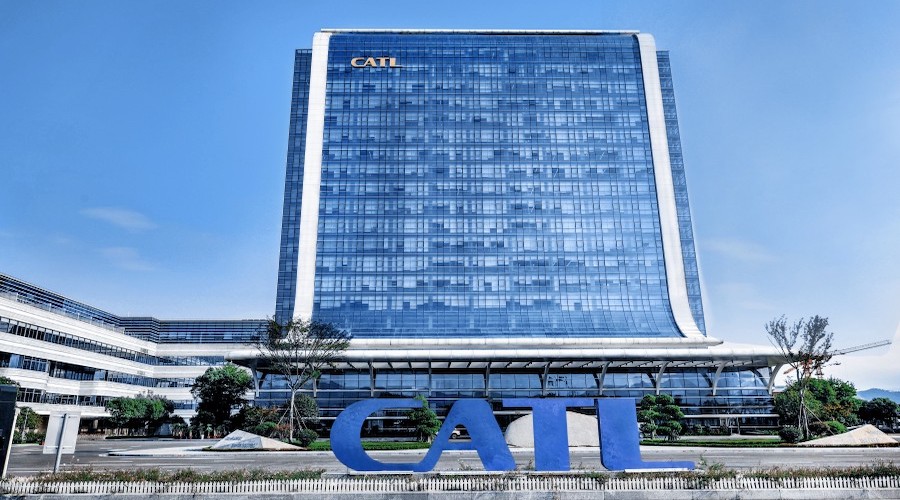
CATL’s headquarters in Ningde, in China’s Fujian Province. (Image courtesy of CATL.)
Contemporary Amperex Technology Ltd (CATL) has earmarked $4.4 billion to expand its critical minerals mining business amid a global energy shock that raised fears over its supply of battery raw materials.
On Wednesday, the Chinese EV battery maker — one of the world’s largest — said it will create a new subsidiary to act as an investment and operations platform for the new energy mining sector. Its business scope would include mineral resources exploration, metals processing and sales of chemical products, it added.
The investment arm, with a registered capital of 30 billion yuan (approximately $4.4 billion), will “integrate existing mining assets, pursue high-quality mineral projects at home and abroad, and safeguard supply of raw materials for the company’s core business,” its securities filing to the Shenzhen Stock Exchange reads.
The move comes at a time when battery manufacturers are grappling with rising costs and supply uncertainty for their raw materials such as lithium, whose price has risen more than 140% over the past year. Other metals like nickel and cobalt have also seen their prices surge in recent months due to measures taken by their respective leading suppliers (Indonesia and Congo).
CATL already owns a major lithium mine in Jiangxi province, but that has been mothballed since August due to permit issues. The company said it has since gradually increased exposure to upstream materials including lithium, nickel and phosphorus.
CATL’s plans to establish an upstream mining business could also accelerate its entry into the automotive and energy storage system (ESS) markets, analysts said. “The slumbering EV market in China will not stop CATL from improving its earnings as ESS becomes a new growth driver,” Zhou Ling, a hedge fund manager at Shanghai Shiva Investment, told the South China Morning Post.
Last week, Bloomberg reported that the company has tapped Chen Jinghe — founder and ex-chairman of Zijin Mining Group — as an advisor for its growing mining business. Chen, who stepped down last year, helped to transform Zijin from a small gold operation in China to one of the world’s largest miners.
Also on Wednesday, CATL released its results for the January-March quarter, highlighted by a 49% year-on-year jump in net income in the first quarter to 20.7 billion yuan, beating analysts’ estimates. In 2025, the Ningde, Fujian-based company posted a net profit of 72.2 billion yuan, up 42% from a year earlier.
India-Zambia talks on critical minerals stall over mining rights
India’s talks with Zambia over critical minerals mining have stalled amid a lack of assurances from Lusaka on mining rights, two sources familiar with the matter told Reuters.
India last year received an allocation of 9,000 square km (3,474.92 square miles) to explore cobalt — a key component in batteries for electric vehicles and mobile phones — as well as copper, widely used in power generation, electronics and construction.
The exploration program in Zambia was set to run for three years, after which New Delhi had planned to invite private sector companies to participate, subject to securing mining rights.
It was not immediately clear why Zambia was withholding assurances for mining rights.
New Delhi is making efforts to restart discussions with Zambia, but the situation is still uncertain, one of the sources said.
They declined to be identified as the discussions are not public. India’s federal Ministry of Mines did not respond to a Reuters request for comment.
India has been in talks with several African countries to acquire critical mineral blocks on a government-to-government basis, while also exploring opportunities in Australia and Latin America.
The Indian government last year held internal discussions over the country’s growing vulnerability to a tightening global copper market and ways to secure supplies from resource-rich countries during ongoing trade negotiations.
India’s copper imports have risen sharply since the 2018 closure of Vedanta’s Sterlite copper smelter. The country imported 1.2 million metric tons of copper in the fiscal year ending March 2025, up 4% from the previous year.
India is almost entirely dependent on cobalt imports, with shipments of cobalt oxide rising 20% in 2024-25 to 693 metric tons, government data showed.
(By Neha Arora; Editing by Mayank Bhardwaj and Janane Venkatraman)
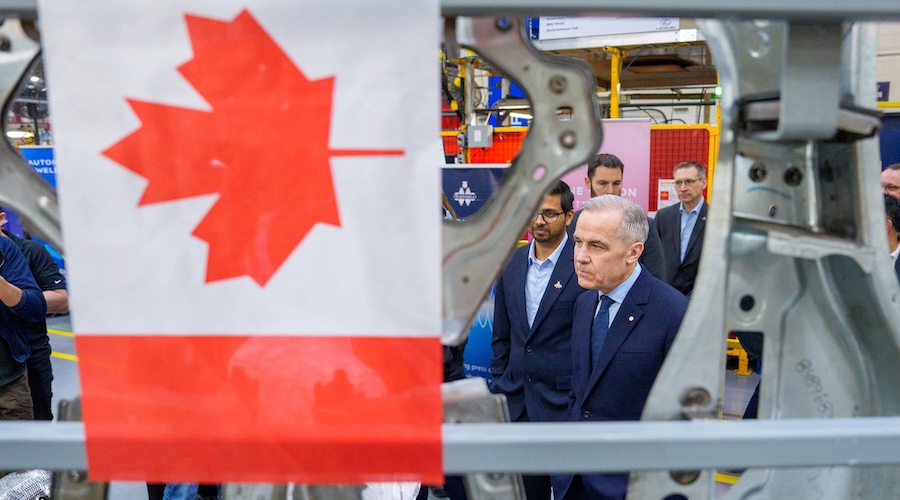 Canada’s policy language frames critical minerals in terms of sovereignty, economic resilience, and geopolitical risks. (Image: Prime Minister Mark Carney at auto parts manufacturing facility. Prime Minister Office | Lars Hagberg.)
No comments:
Post a Comment