It’s possible that I shall make an ass of myself. But in that case one can always get out of it with a little dialectic. I have, of course, so worded my proposition as to be right either way (K.Marx, Letter to F.Engels on the Indian Mutiny)
Thursday, April 16, 2026
How Iran and the U.S. Justify Differing Views on Freedom of Navigation
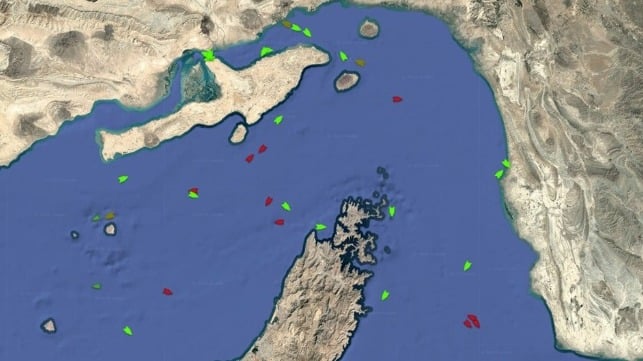
Underway merchant traffic in the Strait of Hormuz, April 15 (Pole Star)
The Strait of Hormuz exists in the eye of the beholder.
While everyone agrees that, geographically speaking, it is a strait – a narrow sea passage connecting two places that ships want to go – its political and legal status is rather more complicated.
The United States and Iran both eye the strait – a choke point through which 20% of the world’s oil passes – very differently. Washington sees the Strait of Hormuz as exclusively an international waterway, whereas Tehran sees it as part of it territorial waters.
It follows that Iran’s toll-charging of ships is seen by the U.S. as illegal. Similarly, U.S. President Donald Trump’s blockade of the passage is a “grave violation” of sovereignty to Iran.
As an expert in the law of the sea, I know part of the problem is that the U.S. and Iran are living in two different worlds when it comes to the international laws governing the strait. Further complicating matters, both are in a different legal universe than most of the rest of the world.
The law of the sea
The “law of the sea” is a network of international laws, customs and agreements that set out the foundation for rights of access and control in the ocean. The framework sits apart from the laws of warfare, which are also relevant to the Persian Gulf situation.
The United Nations Convention on the Law of the Sea, or UNCLOS, is a major plank of the law of the sea. Completed in 1982 and in force since 1994, it aims to create a stable set of zones and places – like international straits – where everyone agrees on who can do what. It has been ratified by 171 countries and the European Union, but not Iran or the United States. Iran has signed it but has yet to ratify; the U.S. has done neither.
This means that the rules which almost every country in the world has consented to can’t serve as a basis of agreement over how the U.S. and Iran should govern their actions in the strait during the current war.
The view from Iran
Both Iran and the U.S. agree that under the law of the sea, the Strait of Hormuz is an international strait, but not on what kind of international strait it is. Moreover, they disagree on the relevant laws that exist, and how they apply.
For Iran, the Strait of Hormuz is an international strait as set out under international law predating UNCLOS – notably the International Court of Justice’s ruling in the 1949 Corfu Channel case and the 1958 Territorial Seas Convention.
These older standards state that foreign ships have a right of “innocent passage” through international straits. Put in other terms, this means that if a ship is simply passing through, without doing anything else and without harming the security of the coastal countries, it must be allowed passage.
This gives Iran – and Oman, the strait’s other bordering country – power to make and enforce some rules over passage, such as rules for safety and the environment. They also have wide discretion to decide if passage is “non-innocent” and therefore not allowed. But it does not give them the right to impede innocent passage.
Contrary to the older standard, however, Tehran claims the right to “suspend” passage through its half of the strait, citing the waters as its territorial sea. This is a violation of the 1958 Territorial Seas Convention that Iran relies on for legal support, which says that when a territorial sea is also an international strait, innocent passage cannot be suspended.
The US interpretation
For the U.S., the Strait of Hormuz is an international strait requiring “transit passage,” as per UNCLOS. Although the United States is not a member of UNCLOS, it argues that the agreement’s updated concept of an “international strait” should apply.
Understanding a waterway as the newer type of “international strait,” which requires transit passage, shifts the balance against a coastal country’s control and toward free navigation.
Under this standard, countries bordering straits – like Iran and Oman in the case of Hormuz – must also allow overflight and submarines below the surface. Passage must be allowed so long as it is “continuous and expeditious.”
The U.S. has forcefully asserted this position at sea through regular “Freedom of Navigation” patrols through the Strait of Hormuz and other straits around the world. The patrols are a visible rejection of claims over the ocean that the U.S. deems illegal or excessive.
The basic U.S. argument is supported by some leading legal scholars, such as James Kraska, a professor of international maritime law at the U.S. Naval War College, who decries the Iranian position as “lawfare” and argues that Iran must abide by the compromises made in UNCLOS.
A ‘persistent objector’
But the U.S. is a global outlier here, and one of only a handful of countries – alongside the United Kingdom, France, Australia, Thailand and Papua New Guinea – which argue that “transit passage” is required by custom.
Custom, in this sense, is established if a practice at sea is seen as consistent and is backed by wide agreement over its legality. If something is seen as customary law, it applies to everyone. The only way to prevent a custom from applying to you is through the “persistent objection rule,” which gives a country an exemption to newly emerging standards if it has shown itself to be consistently against it.
Legal scholars are split on whether transit passage is customary law – although law of the sea specialists tend to say it is not.
Tehran argues that even if transit passage were customary international law, Iran is a “persistent objector,” and therefore, the rule doesn’t apply to them.
And it is true that Iran’s objection has been consistent. Both Iran and Oman argued in favor of innocent passage, and against transit passage, at the UNCLOS negotiations.
Iran reaffirmed its perspective upon signing UNCLOS in 1982. Tehran argues that because transit passage is tied up in the compromises made by UNCLOS, only countries that ratify the treaty can claim the right to transit passage – and neither the U.S. nor Iran has ratified it.
Navigating troubled waters
The complex military situation and economic disruption are only part of the story of the Strait of Hormuz.
What lies beneath is a complicated legal situation. Not only do the U.S. and Iran disagree about the legal status of the strait, but the countries that flag oil tankers – and which are therefore responsible for them – must also navigate their own commitments and perspectives under the law of the sea.
Every nation wants to avoid a legal precedent that is contrary to its long-term interests. But for international law to function – to reduce conflict and enable trade – what is needed is an agreement about what rules exist, and a shared commitment to abide by them.
Only that would achieve a stable post-war status for the Strait of Hormuz. How we get there, however, requires navigating some very tricky waters.
Elizabeth Mendenhall is an Associate Professor in the Departments of Marine Affairs and Political Science at the University of Rhode Island. She received her PhD in International Relations from Johns Hopkins University in 2017.
This article appears courtesy of The Conversation and may be found in its original form here.
The opinions expressed herein are the author's and not necessarily those of The Maritime Executive.
Two Sanctioned Tankers May Have Bypassed U.S. Navy Blockade on Iran
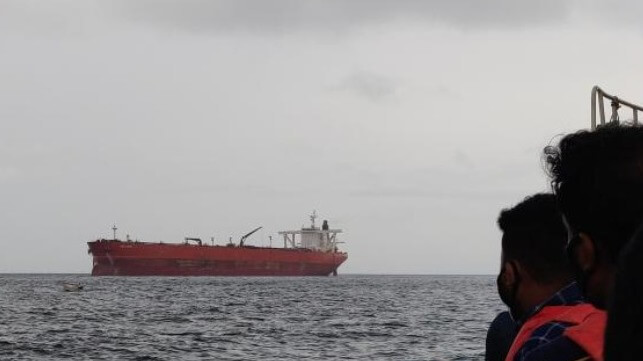
The VLCC Alicia (VesselFinder / Chinmaya Mohapatra)
Despite U.S. Central Command's claims of a total lockdown of Iranian shipping, vessel tracking consultancies have identified Iran-linked, sanctioned tankers that appear to have transited the Strait of Hormuz without difficulty - with AIS enabled and publicly broadcasting their positions. AIS data can be manipulated, and the transits could not be immediately confirmed.
Within the last 24 hours, two sanctioned "shadow fleet" VLCCs - identified as IMO 9208215 (current name Rhn) and IMO 9281695 (current name Alicia) - appear to have transited the strait en route to Iran, according to TankerTrackers.com. Iran has officially claimed that the Alicia made a successful transit.
Together, the VLCCs have the capacity to take on about four million barrels of Iranian oil, which would be valued at about $400 million (if they can exit the Gulf and deliver to Iran's largely Chinese customers). Even without making the return journey out of the Gulf, they would still provide Iran with extra floating storage, enabling another three days of continued production without shut-ins.
The tankers' destination was predictable. "These two dames of steel have transported 60 million barrels of Iranian crude oil since 2023," wrote TankerTrackers.com.
CENTCOM maintains that the blockade is airtight, and says that it has already turned around about 10 outbound vessels with links to Iran. "American forces halted economic trade going into and out of Iran by sea," the command said in a statement Wednesday. "During the first 48 hours of the U.S. blockade on ships entering and exiting Iranian ports, no vessels have made it past U.S. forces."
So far, the U.S. Navy has not announced any boarding, search and seizure operations in connection with the blockade. An opposed boarding would be a step change in the campaign, and would be viewed as a violation of flag state sovereignty; the U.S. is said to be close to resuming formal peace talks with Iran, and may wish to avoid an escalatory act pending further diplomatic developments.
Shipping has been forewarned about the possibility of a boarding. U.S. forces have issued a stern notice to mariners, advising that any passing vessels could be "subject to interception, diversion, and capture" if it is discovered that they are headed to or from Iranian ports.
"Neutral vessels may still be subject to the right of visit and search to determine the presence of contraband cargo," the NOTAM advises. "Humanitarian shipments including food, medical supplies, and other goods essential for survival of the civilian populations will be permitted, subject to inspection."
Vessels that are headed to and from ports in other GCC nations are explicitly allowed to pass the U.S. naval cordon. AIS data suggests that among neutral vessels that choose to make a Hormuz transit, many appear to be taking the Iranian-controlled "Tehran Tollbooth" route near the island of Larak, complying with the terms of the Iranian blockade as well as the U.S. blockade. This includes the first unsanctioned, "clean" supertanker to make the crossing since the start of the U.S. blockade, the Malta-flagged Agios Fanourios I, transiting in ballast and bound for Iraq.
The U.S. Treasury is once again taking aim at the network of Iranian "shadow fleet" industry leader Mohammad Hossein Shamkhani, son of senior Iranian advisor Ali Shamkhani, who was killed in an airstrike in February. The Shamkhani shipping network has moved millions of barrels of oil for the Islamic Revolutionary Guard Corps (IRGC), and it is a primary target of Treasury's "maximum pressure" campaign on Iran's energy exports. In the latest round announced Tuesday, the department blacklisted nine vessels and more than a dozen companies and individuals linked to Shamkhani.
The Shamkhani network operates through reputable-looking front companies, many in the United Arab Emirates, where foreign interests intermingle in a lightly-regulated "free zone" business environment. In this new round of actions, Treasury sanctioned the holding company Oriel Group and a constellation of related Shamkhani affiliates, all based in the Emirates. These include Corplinx Consultancy; House of Shipping Investment FZCO; Meritron DMCC; Helmatic Consultancy DMCC; and Taylor Shipping FZCO.
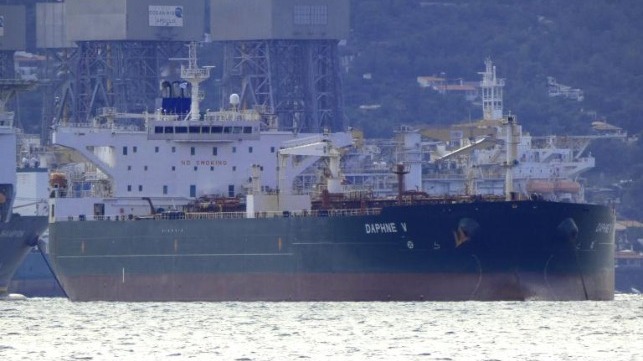
Treasury also targeted more shadow-fleet vessels operated by the Shamkhani network, to include Aura (IMO 9274563), Horae (IMO 9413004), Versa (IMO 9379301), Anaya (IMO 9326885), Daphne V (IMO 9321677), Silvar (IMO 9291262), Cauveri (IMO 9282508), Bellaris (IMO 9332614), and Anika (IMO 9417464).
The new sanctions on the Shamkhani arrive just as Iran's state oil company is said to be shifting its trading and shipping operations back in-house, an adaptation to the high fatality rate among IRGC members who previously coordinated the gray-market trade. State-run news agency IRNA and Iranian outlet Tehran Times both claimed this week that the National Iranian Oil Company (NIOC) will take back exclusive control over the sale of the nation's oil - a shift away from the informal sales network operated by the IRGC.
As an additional action, Treasury also sanctioned an Iranian oil-for-gold trading scheme that provided support for the government of former Venezuelan dictator Nicolas Maduro (now under arrest in the U.S.). The department identified Iranian national Seyed Naiemaei Badroddin Moosavi as a facilitator for the IRGC's oil sales, the profits from which were used to underwrite Lebanese terrorist group Hezbollah, an IRGC proxy force. One such scheme involved shipping Iranian oil into Venezuela in exchange for gold from the Maduro regime. The gold would then be resold in overseas markets.
Treasury identified two UAE-based companies, ACS Trading and Lotus Universal, as linked to Moosavi. An additional affiliated firm, ACS Global, is based in the Netherlands, the department said.
The US Navy is presently navigating an intensely complex geopolitical situation, balancing its deployments not only so as to be able to resume active operations against Iran in a week’s time, if the ceasefire should not be extended, but also shuffling assets for both deterrence and other contingencies.
The world’s attention is focused on the Strait of Hormuz and its approaches, as Central Command imposes a blockade on Iranian ships and those seeking to leave or enter Iranian ports, both within the Gulf and on the Gulf of Oman coast. So far, it seems as if CENTCOM has been able to impose effective control via radio communications with potential blockade-runners, without needing to physically board ships. But the naval presence is on hand to intervene physically – and also ready to resume active war fighting, at very short notice.
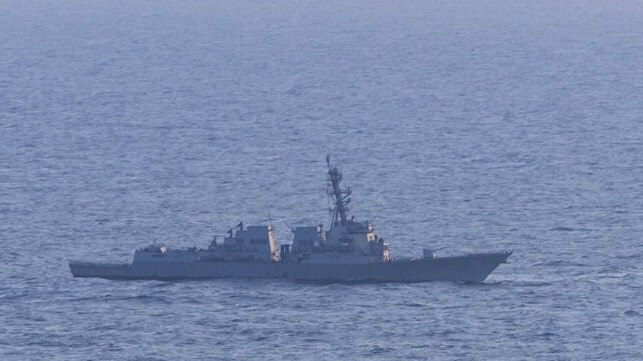
The contingency reinforcement appears to have two major elements. The San Diego-based Wasp Class landing ship USS Boxer (LHD-4), with F-35Bs and the 11th Marine Expeditionary Unit aboard, is a week away from reinforcing the Japanese-based USS Tripoli (LHA-7), which with the 13th Marine Expeditionary Unit aboard is already in the CENTCOM area. Ready to reinforce the USS Abraham Lincoln (CVN-72) CSG also already active in the Arabian Sea, the USS George H.W. Bush (CVN-77) CSG, last seen off Namibia, appears to be heading for the Cape of Good Hope escorted by Arleigh Burke guided missile destroyers USS Donald Cook (DDG-75), USS Mason (DDG-87) and USS Ross (DDG-71), supported by the fast oiler USNS Arctic (TAOE-8).
The dispatch of the USS George H.W. Bush CSG on the long route from Virginia to the Arabian Sea suggests a desire not to provoke the Houthis into closing the Bab el Mandeb. The Iranians would dearly love the Houthis to do so at this particular juncture, when they are pressured and under blockade. But the United States is maintaining the ceasefire and providing no pretext for doing so – while still advertising a capability to respond should the Houthi leadership choose to resume their attacks on shipping.
In the meantime, the United States maintains a discreet presence in the northern Red Sea with Arleigh Burke guided missile destroyers USS Bainbridge (DDG-96) and USS Thomas Hudner (DDG-116), supported by Poseidon P-8A surveillance flights over the area. Keeping the Red Sea open for transit of oil from Yanbu to Asia is clearly extremely important for Saudi Arabia, so a non-provocative but ready-to-respond stance is clearly what is needed.
Should the blockade of Iranian ships and ports continue successfully, the next phase is likely to be the further roll-out of the mine clearance operation in the Strait of Hormuz. This will need those additional strike assets coming into theater, to deter and provide a response to any attempt by Iran to interdict shipping, but also a specialized mine clearance capability.
This appears to be on the way in the form of two Japanese-based Avenger Class mine countermeasures ships USS Chief (MCM-14) and USS Pioneer (MCM-9), which left Singapore heading west on April 10. These two ships are of the same class as the four minesweepers which were withdrawn from Bahrain immediately prior to the war.
Minesweeping-equipped Littoral Combat Ships USS Canberra, USS Tulsa and USS Santa Barbara departed the Gulf region prior to the beginning of hostilities, the latter two vessels ending up in Singapore; Canberra is reported to be under way in the Indian Ocean, and USS Tulsa was spotted transiting the Strait of Malacca westbound on April 3. There are also reports that the Royal Navy’s RFA Lyme Bay (L3007) is preparing to forward-deploy to Duqm in Oman with remote-controlled surface and submersibles, plus the Royal Navy’s Mine and Threat Exploitation Group on board. The Lyme Bay is still in Gibraltar, 10 day’s sailing from Duqm.
Completing the precautionary deployments, in the Eastern Mediterranean the USS Gerald R Ford and her escorts - including three Arleigh Burke-class destroyers - are 175 nm south of Cyprus, ready for an escalation of fighting both in Lebanon and Israel.
The presence off the coast of Ecuador of the carrier USS Nimitz (CVN-68), escorted by Arleigh Burke destroyer USS Gridley (DDG-101), raises the intriguing possibility that it too is well-positioned to act as a reinforcement for CENTCOM. The Nimitz is heading in the right direction as it is due to round the Cape of Good Horn en route to Norfolk, Virginia, and scheduled for retirement. But the US Navy has recently announced the Nimitz will be kept in service for additional 10 months due to the delayed delivery of USS John F. Kennedy, the second Ford-class carrier.
The US Navy is certainly stretched, perhaps more so than at any time in the last 50 years. But balancing a readiness for operations with positioning to act as an effective deterrent, it is coping admirably with multiple, conflicting and sometimes unpredictable political priorities, in an exemplary manner which no doubt will feature strongly in future naval histories.
Iran-Linked Tankers Test Limits of U.S. Hormuz Blockade
While Iran-linked vessels appear to steer clear of the U.S. blockade outside the Strait of Hormuz, several ships have undertaken lengthy and winding routes in recent hours to move from the UAE coast to the actual Strait close to Iran’s shoreline.
At least two vessels linked to Iran and sanctioned by the United States entered the Persian Gulf on Thursday through a new route, ship-tracking data compiled by Bloomberg showed.
LPG carrier G Summer, broadcasting China owner and crew, has made its way into the Gulf by passing between Iran’s Larak and Qeshm islands. The Hong Lu, another vessel under U.S. sanctions due to ties with Iran, also moved through the same route shortly after, according to the data compiled by Bloomberg. The Hong Lu is a supertanker capable of carrying up to 2 million barrels of crude and was headed into the Persian Gulf empty. The vessel had briefly signaled Iraq’s Basrah as a destination, but now indicates it is waiting for orders.
Ship-tracking has not been a reliable assessment of how and which tankers move around the Strait of Hormuz and the Gulf of Oman, as dark activity and spoofing have flourished since the Iran war began.
“During the first 48 hours of the U.S. blockade on ships entering and exiting Iranian ports, no vessels have made it past U.S. forces,” the U.S. Central Command said on Wednesday.
“Additionally, 9 vessels have complied with direction from U.S. forces to turn around and return toward an Iranian port or coastal area.”
Yet, observed AIS positioning and vessel traffic suggest Iran-linked vessels have been in and out of the Strait of Hormuz, maritime intelligence firm Windward said in its daily note on Wednesday.
“Between April 14 and 15, an empty, falsely flagged, U.S.-sanctioned VLCC was observed entering the Strait inbound via Iranian territorial waters, likely using coastal positioning to reduce exposure, and is similarly assessed as a blockade-breaking movement,” the firm said.
“Iranian export activity continues, supported by loading at Kharg Island and deceptive operational patterns, including spoofing and reduced visibility.”
Concluded Windward, “The operating environment is defined by simultaneous enforcement, evasion, and selective movement, with vessel behavior evolving in real time as the practical limits of the blockade are tested.”

No comments:
Post a Comment