The Anti-Fascist and Anti-Imperialist Conference in Porto Alegre: Great achievements, challenges and opportunities (plus statements)
First published at Fourth International.
The First Anti-Fascist Conference for the Sovereignty of Peoples was a unique experience, nowhere else on the planet has anything like this been achieved. It represented a broad anti-fascist and anti-imperialist front, going far beyond revolutionary organizations. Nevertheless, it had limitations, stemming from the difficulties faced by internationalist resistance movements.
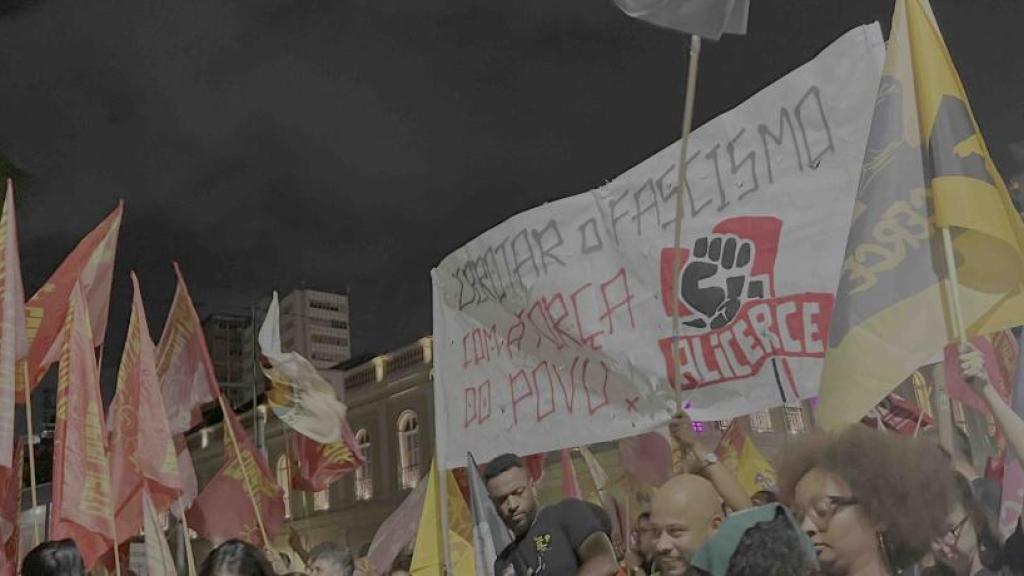
Nearly 7,000 people took part in the opening demonstration, with a significant presence of Fourth International organizations. We witnessed the militant fervour of the World Social Forums of the heyday and of the 2003 anti-war movement, in which thousands of people from very different backgrounds come together and discuss everything. These are the kind of militant moments in which shared understandings and common objectives are forged, and in which the consciousness of the militant vanguard is shaped.
From outside Brazil, the Argentine delegation was the largest, with 200 people, many of whom had travelled by coach, including our comrades from Marabunta. Comrades came from Africa (South Africa, Mali, Congo, Kenya, Ivory Coast, Morocco) and Asia (India, Pakistan, the Philippines, etc), particularly through the CADTM (the Committee for the Abolition of Illegitimate Debt, which played a central role in organizing along with the Local Organizing Committee of the conference).
Delegations from imperialist countries (the United States, Canada, Australia and European countries such as Belgium, Denmark, France, Italy) were, of course, present. There were important delegations of Ukrainian and Russian activists.
The conference proceedings
Following a “parliamentarians’ panel” and an “elected representatives’ panel” which highlighted an essential link with actions taken within institutions, several thousand people took part in numerous debates on a variety of topics: analysis of the rise of the far right, the struggle against Milei, the resistance to Trump in the US centring on Minneapolis, the specific nature of struggles in the world of work, the situation in Brazil, the Palestinian resistance, the climate crisis, feminism, education, and many different forms of international solidarity.
In addition to taking part in the eleven plenary sessions of the “official” programme, organizations and activists of the Fourth International proposed a number of self-organized activities, among the 150 scheduled. Our comrades played a significant role in these, particularly through a presentation of our Manifesto for an Ecosocialist Revolution — Break with Capitalist Growth, which was attended by over 600 people. This meeting was led notably by Michael Löwy, one of the main drafters of the Manifesto, and Penelope Duggan, who represented the Fourth International.
We also organized or contributed significantly to debates on the anti-racist and anti-capitalist struggle, solidarity with Ukraine, with Russian prisoners, the situation in France and solidarity with migrants. The first of these in particular brought together several hundred people.
Important activities were organized by CADTM on immigration, Gen Z mobilizations, the hoarding of wealth, the grabbing of natural resources of Ukraine, DRC and Venezuela, the situation in Africa, and others.
The Fourth International distributed a statement, “Against Neo-Fascist Authoritarianism and All Forms of Imperialism”, (see statement below) to the conference participants in four languages.
The final declaration
The conference’s final declaration summarizes the broad agreements that made its organization possible: a reminder of the major mobilizations against Milei, against the far right in Britain, the No Kings! mobilizations in the United States, and solidarity with Cuba.
It also sets out a series of social, environmental, anti-racist, feminist, and LGBTIQ+ demands, and of course demands against imperialism. It states clearly: “We oppose all imperialisms and support the struggle of peoples for their self-determination, by all necessary means.” In particular, the declaration opposes the genocide in Palestine, the attacks on Lebanon and Iran, as well as the invasion of Venezuela and the threats against Cuba.
This broad consensus brought together extremely diverse organizations, which contributed to the conference’s success.
Limited mobilization by mass workers’ organizations
The great success of the conference does not blind us to some significant limitations. These were apparent during the preparation of the conference, and we tried, with limited success, to address them.
One was the lack of active participation from traditional mass organizations both in Brazil and elsewhere. While the conference secured the formal participation of both the Workers’ Party, and of the majority of the PSOL nationally, as well as the CUT Brazil, CTB Brazil, and other teachers and trade unions, these contributed little to the building of the mobilization outside the state of Rio Grande do Sul where Porto Alegre is situated. The Andes teachers’ union and the Communist Party of Brazil (PCdoB) had a larger militant presence.
In fact, our organizations — in particular the MES, a tendency within the PSOL that is particularly strong in Rio Grande do Sul — made up a large part of the attendance: on the one hand, this is something to be proud of, but on the other, it reflects the fact that the struggle for unity, for building a mass movement alongside reformist organizations and the trade unions, still lies ahead of us.
From outside Brazil the conference was also supported by La France Insoumise (LFI), and a series of trade-union organizations notably from the Spanish state and Latin America.1 In the run-up to the conference, repeated attempts were made to convince many other organizations of the conference’s importance for their movements, but this struggle for the broadest possible unity within the movement must continue to be waged with the utmost determination.
Opposing all imperialisms
Another was the almost exclusive focus in practice on imperialism as US imperialism alone, despite the final statement’s opposition to “all imperialisms”. Thus, under the influence of the “campist” sectors of the conference, there was no condemnation of Putin’s Russia’s invasion of Ukraine, nor a clear stance on the nature of the dictatorial regime in Russia.
This is a serious problem and potential obstacle to joint activity with anti-fascists from Russia and Ukraine. Russia is undoubtedly one of the regimes that most closely resembles fascism, whilst the Ukrainian people — and the Russian people too! — are suffering under this regime through deprivation and hundreds of thousands of deaths.
The presence of Russian and Ukrainian comrades, and the workshops organized with the support of the Fourth Internationalists giving a voice to Russian oppositionists, and a Ukrainian delegation of two leading trade unionists and a representative of Sotsialnyi Rukh, was an important counterweight. This was welcomed by the delegations concerned and in the words of the European Network for Solidarity with Ukraine (ENSU) representative:
The presence of Ukrainian comrades, as well as that of Russian socialist opposition figures, was highlighted […] particularly during the conference’s closing session led by Roberto Robaina. They were also able to speak with activists from Brazil and other countries. And they gave interviews and filmed videos which are currently being circulated amongst left-wing organizations.
They hope to build on this to broaden solidarity for their struggles, notably in Latin America. (See ENSU statement to conference below).
In several plenaries, Fourth International comrades (Penelope Duggan from the FI leadership, Rafael Bernabe from Puerto Rico, Sushovan Dhar from India,...) and others (Patricia Pol from ATTAC France and LFI) also spoke against these positions, defending Russian prisoners and oppositionists in exile, the right to self-determination of Ukraine and the battle of the Ukrainian people against the Russian invasion and the neoliberal and anti-democratic policies of their own government, and in support of the Iranian women’s and democratic movement.
Our stance is for the right to self-determination of all the peoples of the world by their own action and not by aligning with any government, but it is clear that this fundamental battle was not fully resolved at the conference. In the self-organized workshops several FI comrades speaking (André Frappier from Canada, Eric Toussaint from Belgium, Bruno Magalhães from Brazil) also condemned the Russian invasion of Ukraine and supported the right of Ukraine self-determination.
Mixed message on Iran
Although the final statement “upholds the self-determination of the Iranian people”, an unofficial representative of the Islamic Republic of Iran was present and justified — in very moderated tones — the regime’s policies.
While we defend the Islamic Republic’s right to defend itself against imperialist aggression, and wish for the defeat of this attack, we fully support the social movements in Iran, particularly the feminist movements, which have nothing to do with the representatives of the Shah sponsored by the United States and Israel.
Strengthening democracy in the movement
It was undoubtedly inevitable in a conference of thousands of activists that there was the lack of real forums of debate among the participants, both on the political topics discussed in the central plenary sessions (the self-organized workshops were different), and in particular on the final statement and what it proposed.
While we all agree with building the initiatives enumerated and the Fourth International will be present at them all, the organizing nucleus must be broadened and develop mechanisms of democratic accountability. This is important both in terms of political representativity but also — as had been pointed out in the international organizing committee — gender parity.
Moreover, while we can note a presence of women speakers in all the panels, the problematics of feminism were largely absent from the official panels, although of course present in a number of self-organized workshops.
Let us continue the struggle
In conclusion, the conference is an extremely important step forward in the battle against fascism and imperialism: let us not forget that it has been years since any social forum brought together so many people.
The practices of building international and internationalist movements have been lost and must be rebuilt.
The decision to seek a united anti-fascist and anti-imperialist front entailed some loss of clarity in the common statements, given that understanding on the left and among popular sectors regarding such basic questions as who are the fascists or neo-fascists, or who are the imperialists, vary greatly.
Thus, the decision that guided the organization of the Conference — and which was also the position of the Fourth International — was that it was important to hold the conference, even at the cost of a significant loss of clarity. The only alternative would have been not to hold the Conference, to renounce the possibility of bringing together thousands of activists to discuss points of agreement and disagreement and commit to the ongoing struggle against fascism and imperialism.
Political battles are fought in practice, by participating in the movements that actually exist; we can only exert influence if we participate fully. The organization of this conference, and the series of pre-conferences notably in Brazil that were an important aspect of mobilizing for the conference, relied largely on activists from the Fourth International, particularly our organizations in Brazil — notably the MES, Centelhas and Ecossocialistas — our comrades involved in broad-based organizations and associations, and other internationalist, anti-colonial and anti-imperialist organizations.
There is no doubt that the debates and struggles will continue, and the next events are already set: the G7 counter-summit in France and Switzerland in June 2026, the anti-NATO gathering in Turkey in July 2026, and the World Social Forum in Benin in August 2026. Also proposed are continental conferences, notably in North and South America, as well as the Ecosocialist Encounters in May in Belgium.
It is through all these events that the alliances necessary to counter fascism and imperialism are being forged. It is up to us to involve the trade unions, human rights organizations, feminist and LGBTQI+ movements, anti-racist organizations, those campaigning for Palestine, and those standing in solidarity with the Ukrainian and the Iranian people. It is in this way — and by defending our eco-socialist revolutionary perspectives — that we will build the movement needed to change the world.
Manuel Rodriguez Banchs, Penelope Duggan, Israel Dutra, Antoine Larrache, João Machado, Reymund de Silva and Eric Toussaint are members of the Fourth International Bureau and International Committee.
Against neo-fascist authoritarianism and all forms of imperialism
Declaration of the Fourth International at the 1st International Anti-Fascist Conference for the Sovereignty of Peoples
Unite the anti-fascist struggle throughout Latin America! For a global anti-fascist and anti-imperialist front!
Donald Trump's second term, with its far-right agenda, has brought about a shift in the international situation. In his eagerness to reaffirm a hegemony as weakened as his economy, he tramples on the United Nations Charter and the sovereignty of peoples with a foreign policy of recolonization and war.
Together with his partner in massacres, Netanyahu, Trump is bombing Iran to ensure complete domination of the oil and gas market. This comes after the genocide of the people of Gaza, the invasion of Venezuela, the attempt to strangle Cuba, and threats to annex Greenland.
The tyrant is striving to normalize genocidal language, blackmail, and interventionism, as well as racism, misogyny, and hatred of migrants — attempting to expel millions of workers from the United States. He supports Bolsonaro, Milei, Bukele, and the "patriotic" (read: far-right) European parties.
Bloody authoritarianism is the central instrument of imperialism in our time, because it needs to impose policies of hunger, the proliferation of ecocidal technologies and practices, the excessive power of Big Tech, the dispossession of natural and energy resources from all peoples, and increased military spending. If it is not defeated, Yankee imperialism will embark on a blind march toward ecological disaster.
The peoples of the US, Argentina, and India show the way
But imperialism's march is already beginning to encounter tremendous obstacles. The victorious struggle of the people of Minneapolis/Saint Paul and of all the community and popular resistance in the United States to the persecution of migrants points the way to defeating the extreme right. Only the combination of the international struggle of the peoples with a defeat of Trump on his own turf can stop their joint project.
The same is true of the working classes in Argentina against Milei and the peasants in India against Modi's policies. In Argentina, Milei faced the fourth general strike, now against labour reform, in an example of unified struggle that has the left as one of its pillars, with 90% of the population opposed to this measure. In Brazil, the victory of the indigenous resistance struggle against Cargill and the privatization of large Amazonian rivers points to hope and paths forward.
A united front of the exploited and oppressed!
There is an urgent need for a united front of the exploited and oppressed, free from subordination to governments and parties, capable of acting with full independence to confront the new faces of fascism with mobilization and coordination among the oppressed.
This 1st International Anti-Fascist Conference for the Sovereignty of Peoples is an extraordinary opportunity to deploy across the globe, starting with the American continent, a strong united action by the forces present here against hegemonic imperialism. New conferences and meetings must be held on other continents and in other major regions: the United States, Europe, Africa, Asia. Let us make this meeting a modest but strong starting point for an international campaign that serves the struggles and, at the same time, the construction of an alternative program to that presented to us by the representatives of capital.
The far right is growing by presenting itself as a radical alternative to the status quo, its elites, and its parties. We know that it does so demagogically to defend the system it claims to challenge, but there is a key lesson here: in order to grow, resistance must also be a radical alternative to the crisis of the prevailing system, its policies of hunger and repression, its worn-out institutions, and its parties.
The crisis of capitalist civilization (economic, political, ecological, climatic) raises the possibility and necessity of linking immediate concerns, including the anti-fascist struggle, with the need to overcome capitalism. A set of demands is needed that, based on the most urgent popular concerns, leads to the questioning of private control of production and to an understanding of the need to place it under the democratic control of working people and their communities.
No illusions in capitalist ‘models’
Trump's national security strategy states:
The disproportionate influence of the largest, richest, and strongest nations is an immemorial truth of international relations.
It is, quite simply, an invitation to divide the world among the most powerful.
There is no room for illusions here. Neither the European Union or its components, nor the governments of Russia or China represent an alternative or a wall of defense against US imperialism — as their sterile actions in the face of US attacks on Venezuela, Cuba, and Iran have shown us.
China has become a capitalist power more interested in consolidating its business and its own areas of military (in Asia) and economic (Eurasia, Africa, and Latin America) influence. More regional in nature, Putin's Russia seeks to reestablish what was once the Tsarist empire, with a militarized economy and an increasingly authoritarian regime. In this context of tensions between old and new or aspiring powers, the task of the left cannot be to celebrate the multipolarity resulting from the confrontation between capitalist projects.
Solidarity with the oppressed of the world!
To Trump's supposed "immemorial truth" of the domination of the powerful, we oppose three orientations: the defense of the right of all peoples to self-determination, solidarity with the exploited and oppressed in all countries, and therefore opposition to all forms of imperialism.
We reject the United States' aggression against Venezuela and the kidnapping of its president and former deputy, and we also reject the Russian Federation's aggression against Ukraine. We recognize the right of Venezuela, Cuba, Iran, and any country attacked by the United States to defend itself, including militarily, and to seek the material means necessary for that resistance wherever they can find them, and we recognize the same right for Ukraine, which is under attack by Russian imperialism.
We denounce and combat anti-immigrant, xenophobic, and Islamophobic policies in the United States and Western Europe. We take the same stance toward the Chinese government's repression of various peoples and ethnic groups.
We repudiate the persecution, repression, and censorship in the United States, the United Kingdom, Germany, and other countries of protests against the genocide in Palestine, and we also denounce the repression and imprisonment in Russia of opponents of the war of aggression against Ukraine.
We do not support the Maduro government. We denounce its anti-democratic and anti-worker actions. But no objectionable action by the Maduro government can validate the United States' aggression against Venezuela. We therefore demand the withdrawal of the US from Venezuela and the release of former deputy Cilia and President Maduro.
We propose the dissolution of NATO, as well as the Collective Security Treaty Organization. We do not support the Zelensky government in Ukraine. We denounce its anti-worker, corrupt, anti-democratic, and chauvinist policies. But no questionable policy of this government justifies the Russian invasion and bombing. Therefore, we organize our solidarity with the Ukrainian people.
Reject intervention, support the struggles
Bourgeois governments refuse to recognize that popular mobilizations against them are the result of deep social contradictions. Typically, they attribute them to the action of internal or external “agents”. We cannot accept this conspiracy conception of history. Undoubtedly, imperialism and its agencies try to take advantage of struggles, such as that of the Iranian people against authoritarian theocracy, but that does not reduce those struggles to an operation of imperialism. We must oppose such intervention, while continuing to support those struggles.
Preaching to the people that they must accept dictatorships that oppress and mistreat them as the “lesser evil” turns those who do so into promoters of resignation and submission. Oppressed peoples will have little interest in anti-imperialism or geopolitical analysis that excludes their most pressing democratic and economic demands. It is up to us to ensure that activists see our anti-imperialism as their ally, or that, tragically, they will find encouragement and support only in the camp of imperialism that seeks to exploit them.
Universal demands of the working class
Historically, US and NATO imperialism have acted in the name of freedom, democracy, etc. The left is not fooled by these proclamations. But we must be consistent. The same is true of rival imperialisms: we must explain how, in the name of multipolarity, anti-hegemony, rejection of the hypocritical model of Western democracy and Eurocentrism, attempts are made to justify the denial of democratic rights to the working class, women, religious minorities and LGBTTQI+ people.
In the face of cultural relativism tailored to authoritarian governments (in Russia and China, among others), we affirm that trade-union rights, women’s rights, freedom of expression, assembly, and association, and the election and recall of rulers are not “Western values” or “liberal models” or Eurocentric ideas that imperialism seeks to impose: they are historical demands of the international working class. That is why we defend them throughout the world, in all countries, without exception.
We reject the blackmail that any criticism or demand made of progressive governments, or those that proclaim themselves progressive, is destructive and favorable to imperialism. What weakens the struggle is not criticism and debate, but their suppression.
The hypocrisy of the West and consistent anti-imperialism
We are familiar with the hypocrisy of Western imperialism when it denounces repression in Iran or the invasion of Ukraine. What moral authority can the accomplices of genocide in Gaza claim? What respect can those who have just kidnapped the president of Venezuela deserve? But denouncing the hypocrisy of the West and its crimes cannot become our silence on the abuses of the governments of Putin or Xi Jinping, or the idea that these abuses are “inventions of imperialism.”
We do not oppose the double standards of Western imperialism with another double standard, but with the rejection of all those who exploit and oppress.
Today more than ever, we must practice consistent internationalism, a solidarity without borders that encompasses the struggles of workers, the oppressed, and for self-determination in all countries of the world, without exception. It is a policy that opposes all forms of imperialism. It does not subordinate the struggle in any country to that of another country. It is the policy that corresponds to the slogan Workers of the world, unite!
For solidarity without borders! For internationalism without exceptions!
Antifascism must fight all tyrannies
Statement by the European Network for Solidarity with Ukraine for the 1st International Anti-Fascist Conference for the Sovereignty of Peoples.
The European Network for Solidarity with Ukraine (ENSU) strongly supports the goal of this conference, namely “to confront the expressions of the far right and fascism and put into practice solidarity among resisting people.”
In championing the national and social rights of the Ukrainian people, our network of social movements, trade unions, solidarity groups and political parties from Eastern and Western Europe also shares the internationalism and anti-imperialism this goal expresses. As ENSU’s founding statement says,
we fight for peace and equality, democratic freedoms, social and climate justice through cooperation and solidarity between peoples.
We believe that antifascism must oppose every violation of human rights by regimes and rulers that elevate maintaining their own power above everything else, including the rights of peoples to determine their future. For ENSU, “from Ukraine to Palestine, occupation is a crime” and the Ukrainian people must be recognised as a resisting people fully deserving of solidarity in the face of terrible aggression.
Over the last four years, the Russian armed forces implementing the Kremlin’s “special military operation” against Ukraine have: illegally occupied 20% of internationally recognised Ukrainian territory; unleashed a murderous campaign to destroy Ukraine’s energy and water supply infrastructure and freeze the population into submission; bombarded the country’s schools, hospitals and residential districts; deported thousands of Ukrainian children from the territories occupied by Russia (a crime for which Vladimir Putin has been charged by the International Criminal Court); imposed a campaign of compulsory Russification in these regions; targeted cultural sites as part of a deliberate policy of erasing Ukrainian culture and language; imprisoned tens of thousands of non-combatant Ukrainian citizens, and used assassination, torture and sexual violence to compel obedience from an occupied population. All this after years of abuses against the Crimean Tatars, including forced disappearances.
But despite this wave of genocidal crimes, Ukraine survives, and not only through the efforts of its armed forces but because of the persistent self-organisation of its civil society — the trade unions, community, neighbourhood and veterans’ organisations, women’s and LGBTIQ+ collectives and environmental and civil liberties associations.
Putin’s ‘antifascist’ holy war
There is, however, a feature of Ukraine’s resistance that differs from that of other peoples fighting for freedom: the Russian aggressor brands Ukraine’s defensive struggle as itself “fascist” and defines its own goal as “eliminating the neo-Nazi regime in Kyiv” (Putin). In short, the Kremlin invokes antifascism … to justify its own war crimes.
This cynical manipulation of the concepts of “antifascism” and “anti-Nazism” is best analysed in the Rosa Luxemburg Foundation’s publication Putin’s Four Antifascist Myths — How Russia Uses ‘Antifascism’ to Justify the War in Ukraine, by Anastasia Spartak
It explains how the present rulers in the Kremlin converted the original antifascism, born of the heroic anti-Nazi resistance of the peoples of the Soviet Union, into exaltation of Russia as a historic power destined to “embrace” the peoples around its borders. Those like the Ukrainians who opposed this imperial project became “fascists” and “Nazis” — irrespective of the real presence of the far right within their societies.
As for those brave people inside Putin’s Russia who have denounced his criminal invasion of Ukraine and sought to maintain genuinely democratic and antifascist values — they have been murdered, jailed, locked up in psychiatric “hospitals”, exiled or ostracised as “foreign agents” and “undesirables”.
Behind the smokescreen of its annual UN General Assembly motherhood resolution against Nazism, the Russian Federation has implemented a domestic policy of setting far-right gangs against democrats and leftists and a foreign policy of giving lavish support to xenophobic outfits like the French National Front (now National Rally).
Russia has become central to a reactionary international alliance that includes Trump’s USA, Orban's Hungary, Le Pen’s National Rally, the Alternative For Germany and Reform UK. This league of ethno-nationalist, anti-democratic authoritarians is opposed to everything this conference stands for. All of them seek to deflect responsibility for Putin’s invasion onto Ukraine or “the collective West”, an alert to anti-fascists as to the true nature of the Russian imperial project.
No to an imperialist ‘peace’
The “antifascism” of a regime dedicated to Making Russia Great Again has many sinister parallels with the operations of Putin’s “partner” (his term) Trump. The bomber of Iran endlessly pressures Ukraine to agree to a ceasefire on Russia’s terms, cynically cancels agreed embargoes on Russian oil and gas exports, and has his envoys check out opportunities for “deals” with Putin and his oligarch mates.
If forced on Ukraine, the outcome of this sort of imperial “peace”, would be to perpetuate the cruel injustice and suffering the country has experienced, with no guarantee that Putin would not restart hostilities when he judges he could get away with it. The only acceptable ceasefire is one Ukraine itself can negotiate and its people support.
Support Ukraine as a sovereign nation, its people and its working class
Let’s never forget that the only way the concept of antifascism can strengthen the interests of oppressed peoples is if it is applied without exception. If a blind eye is turned to the oppression of any people or nation it will serve the interests of their oppressor — even if unintentionally. Moreover, if the antifascist movement neglects the rights, suffering and struggles of any one people, its action in support of other oppressed peoples will lose credibility and the power that comes from mutual solidarity.
Give unreserved support to Ukraine’s resistance struggle! This does not in any way entail supporting the undemocratic neoliberal policies of the Ukrainian government. Indeed, ENSU has supported all the struggles of Ukraine’s workers, students, feminists, LGBTI+ collectives and civil rights organisations against the government’s attempts to impose a radically pro-corporate economic policy, cut back the rights of workers and their unions, and protect the corrupt within its own ranks from investigation by the country’s independent anticorruption agencies.
Again, if you want to understand this experience, please take time to speak with the representatives of Ukrainian trade unionism and the Ukrainian left present at this conference. Their fight should also be yours.
For the European Network in Solidarity with Ukraine, the only possible position for a consistent antifascism is to support Ukraine’s right to self-determination and self-defence; to demand the removal of all Russian forces from its internationally recognised territory; to support the return of its kidnapped children and other civilian prisoners; and to call for full reparation for the damage inflicted by the Russian invasion and accountability in international law for those who initiated it.
- 1
Including the two main Basque trade unions ELA and LAB, the Intersindicals of Valencia, Galicia and Catalunya, CTA A Argentina, CTA TT Argentina, PIT CNT Uruguay, SME Mexico, CUT Chile, CUT Colombia.
No comments:
Post a Comment