Trump, Putin and Ukraine: Towards a division of spheres of influence at the expense of the people
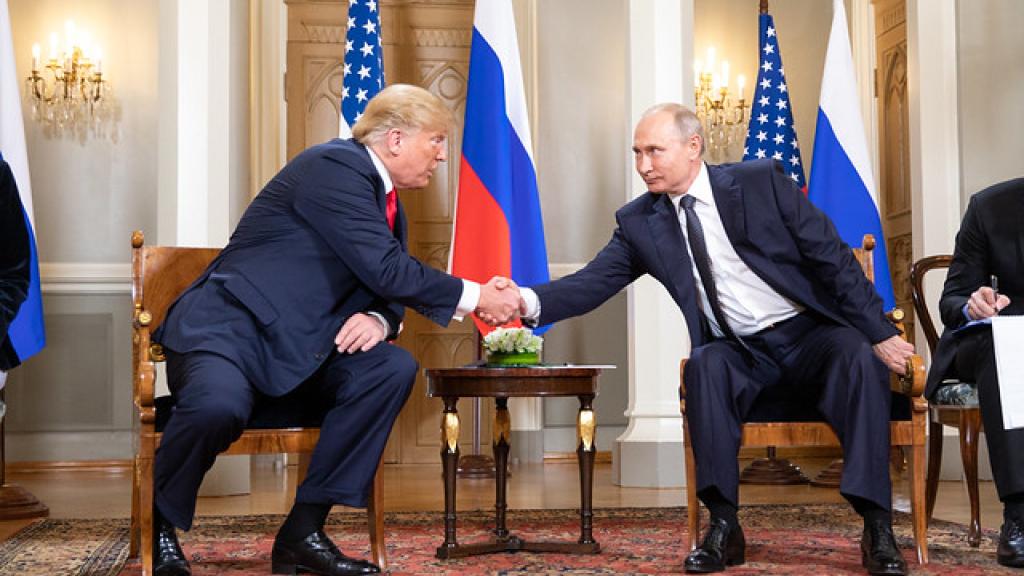
First published at CADTM.
Since the start of his second term, Donald Trump has been redefining US international strategy according to a brutal logic of power relations between major powers. Whilst stepping up aggressive policies in the Middle East and the Americas, his administration has embarked on a strategic repositioning vis-à-vis Russia.
Far from being presented as the central enemy of the world order, Moscow is now treated as a secondary adversary with whom an arrangement might be possible. Washington’s objective is clear: to prevent Russia from further strengthening its alliance with China, regarded as the United States’ main systemic rival. This marks a departure from his first term and from that of Joe Biden from 2021 to 2024.
Strategic documents published by the Trump administration between December 2025 and early 2026 confirm this shift. Russia is described therein as a “persistent but manageable” threat, whilst European leaders are accused of exaggerating the danger it poses and harbouring unrealistic expectations regarding the outcome of the war in Ukraine. At the same time, Washington claims it wants to negotiate a swift end to the war under its auspices.
This shift paves the way for a scenario with far-reaching consequences: a deal between imperialist powers — the United States and Russia — that will be at the expense of the Ukrainian people.
Trump’s policy towards Russia
Since the start of his second term, Donald Trump has secured an agreement from Vladimir Putin that, beyond verbal protests, he will not react to acts of aggression and war perpetrated by Washington against Moscow’s allies, be it Venezuela or Iran, or in relation to the total blockade of Cuba in place since late January 2026.1 Trump has marked a shift from the policy adopted during his first term, in which he treated China and Russia as equals, viewing them as adversaries seeking to challenge the Washington-dominated international order.
Trump is sending a message to Putin that he is prepared to accept Moscow’s use and abuse of force in its geographical sphere, particularly in Ukraine, just as Washington does in the Americas, the Middle East and elsewhere. Trump asserts his right to use force anywhere in the world and effectively recognises Putin’s right to do the same within a more limited sphere corresponding to part of the territory of the former Russian Empire of the Tsarist era and the former Soviet Union. This follows the classic logic of an implicit division of spheres of influence between major imperialist powers.
Trump has reduced direct US military support for Ukraine by shifting the burden of this support to his Western European allies within NATO. In January 2026, he invited Moscow and its allies in Belarus and Hungary to join his World Peace Council.
On 5 March 2026, Trump announced that he was temporarily allowing Russia to export its oil to India without sanctions, with India either consuming it or re-exporting it to other parts of the world, including Europe. One of the unspoken reasons is to persuade Russia to confine itself to issuing verbal protests against the massive aggression by Washington and Israel against Iran, its ally.
Trump in full
Trump reveals a number of positions regarding Europe, Russia and Ukraine in the document on the new national security strategy released on 3 December 2025. He considers that the EU and the UK “enjoy a significant hard power advantage over Russia by almost
every measure, save nuclear weapons”2 and that European leaders are exaggerating the threat posed by Russia.
The Trump administration’s document continues:
As a result of Russia’s war in Ukraine, European relations with Russia are now deeply attenuated, and many Europeans regard Russia as an existential threat.
From the way the text is written, one can infer that Trump is telling European governments that Russia does not pose an existential threat to them. On certain occasions, Trump has described Russia as an existential threat, but this is not the case in either the National Security Strategy published in December 2025 or the National Defence Strategy published in late January 2026.
Trump believes that the EU and the UK must adopt a different approach to that taken so far in negotiations with Russia regarding the latter’s demands. This is particularly clear in the following passage:
The Trump Administration finds itself at odds with European officials who hold unrealistic expectations for the war perched in unstable minority governments, many of which trample on basic principles of democracy to suppress opposition.
It should be noted that Trump claims that European governments are suppressing patriotic parties, i.e. the neo-fascist far right.
Trump’s text continues:
A large European majority wants peace, yet that desire is not translated into policy, in large measure because of those governments’ subversion of democratic processes.
And he adds:
This is strategically important to the United States precisely because European states cannot reform themselves if they are trapped in political crisis.
This means that Trump is declaring that it is in the United States’ interest for patriotic parties (i.e. far-right and neo-fascist) to be in government, which, according to the current administration, would resolve the political crisis.
There is, of course, in the passage above, a very clear rejection of the German, French, British, Spanish, Danish, Polish and other governments. Conversely, this strengthens the position of Hungarian Prime Minister Viktor Orbán and Slovak Prime Minister Robert Fico, whom Marco Rubio, the US Secretary of State, visited in February 2026 following the Munich Security Conference. It should be noted that both these governments are in favour of easing sanctions against Putin’s Russia and have expressed their support for Trump.
Regarding relations between the EU, the UK, Russia and Ukraine, it is clear that Trump wants to remain at the centre of the diplomatic game:
Managing European relations with Russia will require significant U.S. diplomatic engagement, both to reestablish conditions of strategic stability across the Eurasian landmass, and to mitigate the risk of conflict between Russia and European states.
It can also be inferred from the previous passage that, given the military superiority of the EU countries and the UK over Russia, the rebalancing should be in Russia’s favour. The same idea is found in the following passage:
It is a core interest of the United States to negotiate an expeditious cessation ofhostilities in Ukraine, in order to stabilize European economies, prevent unintended escalation or expansion of the war, and reestablish strategic stability with Russia, as well as to enable the post-hostilities reconstruction of Ukraine to enable its survival as a viable state.
In the passage above, Trump reaffirms that he wants a swift end to hostilities and puts pressure on the EU, the UK and Ukraine to make concessions to Russia, all under Washington’s auspices.
Trump’s policy towards Ukraine
Trump has no regard for the Ukrainian people’s right to defend their sovereignty. Yet if the February 2022 invasion was largely thwarted, it is because the Ukrainian people resisted and demonstrated their commitment to their country’s sovereignty. Had the Ukrainian people not overwhelmingly supported the resistance, the arms sent by Western powers to the authorities in Kyiv would not have been enough to thwart Putin’s initial plan, which was to march his army into Kyiv, change the regime and seize a significant portion of Ukrainian territory, starting with the east of the country.
Stating this must go hand in hand with a critique of the neoliberal and chauvinistic nationalist policies of Volodymyr Zelensky’s right-wing government, and with a condemnation of NATO and the imperialist ambitions of Trump and the Europeans regarding Ukraine. It is also important to point out that Ukraine is not an imperialist power.
Trump couldn’t care less about international law and believes he can use force to seize control of Venezuela’s or Iran’s oil resources after launching a military attack on those countries. He believes that Putin’s Russia, within its immediate sphere of influence, can do the same as long as it does not harm US interests in Eastern Europe. Trump is prepared to strike a deal with Putin at the expense of the Ukrainian people.
Putin may retain or seize control of part of Ukraine’s territory, population and natural resources if US companies secure corresponding benefits in the rest of Ukrainian territory. On this condition, Washington would be prepared to protect the weakened Ukrainian authorities and the territory over which they retain control, provided that the authorities in Kyiv allow US companies to amass maximum profits.
What Trump is proposing is an agreement between two predatory imperialist powers, the US and Russia, which agree to flout the right of peoples to self-determination and to exercise sovereignty over their territories and the natural resources found therein. The European imperialist powers are largely sidelined by Trump, even though they too seek to promote their own interests and those of their large private corporations, which covet Ukraine’s natural resources, land and market.
Trump’s stance on Russia
Trump believes that previous administrations made the mistake of encouraging the formation of an alliance between Russia and China, which has strengthened China’s position. Trump wishes to separate Russia from China or, at the very least, weaken the ties between these two powers.
Washington, which identifies China as its primary and systemic adversary, is therefore attempting to reduce Russia’s inclination to strengthen its ties with China.3 The 2025 NSS regards Russia as a serious but strategically secondary military adversary, to be contained without elevating it to the status of a civilisational enemy, in order to concentrate US resources (military and economic) on combating China.
The Kremlin’s reaction to the publication of the NSS 2025
Dmitry Peskov, the Russian president’s spokesperson, commented on the National Security Strategy document during an interview on 7 December 2025 with the Russian state journalist Pavel Zarubin for the Rossiya 1 channel, which was widely reported by Russian media outlets such as Interfax, Fontanka and TASS:
The adjustments made to the US national security strategy largely correspond to our vision.
The full press release published by the Russian online media outlet Fontanka.ru on 7 December 2025 states:
Peskov commented on the new US national security strategy. The adjustments made to the US national security strategy largely correspond to the Russian government’s vision. This is how Dmitry Peskov, the Kremlin spokesperson, commented on the update to the document to journalist Pavel Zarubin. The President’s spokesperson expressed the hope that the new strategy would enable Washington and Moscow to continue their constructive collaboration on the Ukrainian issue. The updated strategy was published on Friday 5 December by the administration of US President Donald Trump. Relations with Europe and the conflict in Ukraine feature prominently in the document. It is also emphasised that NATO must not be an “endlessly expanding alliance”. Peskov stressed that the implementation of this concept must be closely monitored.
The Interfax news agency, for its part, wrote on 7 December 2025:
The Kremlin has welcomed the wording regarding NATO in the US National Security Strategy. Medvedev sees the new US National Security Strategy as an attempt to improve relations with Russia. The Kremlin welcomes the wording in the updated US National Security Strategy concerning the freeze on NATO enlargement, but will closely monitor the practical implementation of this document.
It should be noted that Dmitry Medvedev is Deputy Chairman of the Russian Security Council and Chairman of the ruling United Russia party.
The shift in Washington’s characterisation of Russia between Trump I and Trump II
In the National Defence Strategy 2026 published at the end of January 2026 (NDS 2026), Russia is identified as “a persistent but manageable threat” to NATO, a shift in Russia’s favour compared with the more alarming characterisations in previous documents, which described Russia as a “revisionist power” during Trump’s first term in 2017, and as an “immediate threat to the international order” and an “acute threat” in 2022, during Joe Biden’s presidency. The Biden administration’s 2022 NSS asserted that Russia “has shattered the peace in Europe”.
In the strategic language of the US government, “revisionist power” refers to a state seeking to alter the rules, institutions or balance of power of the existing US-dominated international order. In documents from the first Trump administration and the Biden presidency, Russia and China were portrayed as revisionist powers.
Here are some extracts from the NDS 2026 concerning Russia:
the Russian military threat is primarily focused on Eastern Europe’, ‘Moscow is in no position to make a bid for European hegemony. European NATO dwarfs Russia in economic scale, population, and, thus, latent military power...
Fortunately, our NATO allies are substantially more powerful than Russia — it is not even close. Germany’s economy alone dwarfs that of Russia.
Common ground between Trump and Putin
Despite their geopolitical rivalries, Donald Trump and Vladimir Putin share a significant set of ideological and political positions.
Both are characterised by staunch anti-Communism and unreserved support for the capitalist system, including its most brutal forms of exploitation of labour and natural resources.
Trump and Putin are nationalists who assert the primacy of the rights of the dominant nation to which they belong. Trump supports white supremacists and asserts the primacy of US interests over those of foreign nations, which he does not hesitate to treat in racist terms. Putin espouses Great Russian chauvinism and denounces Lenin for the ‘creation’ (sic) of Ukraine and the recognition of its right to secede from the USSR in the early 1920s.
They also advocate an energy policy based on the intensive exploitation of fossil fuels, thereby contributing to the worsening of the ongoing global ecological catastrophe.
On the social front, their positions converge towards homophobic stances and hostility towards the rights of LGBTQIA+ people, accompanied by the promotion of conservative values underpinned by a reactionary vision of Christianity.
On the international stage, both Trump and Putin favour the use of military force to impose their political and economic objectives, in defiance of international law. This approach is accompanied by determined support for the rapid and massive expansion of the arms industries, as well as the increased use of military power.
Their foreign policies are also based on the repeated use of questionable or unfounded pretexts to justify the use of force. Furthermore, both cultivate a great-power chauvinism and an exaggerated nationalism, characteristics of authoritarian political projects.
Furthermore, they maintain close ties with European far-right forces, which in turn express strong sympathy towards them.
Trump offers full support to the Israeli government led by Benjamin Netanyahu, who is a neo-fascist and responsible for genocide in Gaza. Putin, for his part, maintains cordial relations with Netanyahu and continues Russian exports to Israel — coal, oil and grain — without calling into question existing trade agreements.
Putin has also agreed in principle to the creation of a World Council chaired by Trump and wants Russia to be a member. In this context, he is calling on the United States to lift the freeze on Russian assets so that Russia can pay the $1 billion membership fee required to become a permanent member of this body, which is entirely illegitimate.
Both Trump and Putin make extensive and controversial use of the term ‘genocide’, whilst refusing to acknowledge or condemn the genocide of the Palestinian people. Trump thus claims that the government in Pretoria is responsible for a ‘genocide of whites’ in South Africa, whilst Putin maintains that the government in Kyiv is carrying out genocide against the Russian populations in Ukraine.
Beyond these ideological and geopolitical convergences, Trump and Putin also display marked similarities in their approach to exercising and conceiving of power. Both favour a highly personalised style of leadership, centred on the figure of a leader presented as the direct embodiment of the nation and its will. Their political discourse regularly relies on rhetoric pitting ‘the people’ against political, media or economic elites, accused of betraying national interests.
In this context, they display marked distrust of multilateral institutions and international law when these are perceived as obstacles to their strategic objectives. Furthermore, their political practices are accompanied by constant criticism of media deemed hostile and intensive use of communication strategies aimed at circumventing or delegitimising institutional checks and balances. These elements contribute to embedding their political projects within a highly personalised, imperialist and neo-fascist authoritarian conception of power.
What are the differences between Trump and Putin?
One difference worth highlighting lies in their approach to war and the direct use of military force. Trump is convinced that it is possible to win conflicts without committing US troops to the ground for any length of time, by prioritising technological superiority, strikes from a distance and military operations of limited duration, with virtually no US casualties. Trump’s illusion was shattered in his war against Iran in February–April 2026.
Conversely, Putin chose a different strategy with the massive military invasion of Ukraine in 2022, involving the deployment of very large ground forces and resulting in extremely high human casualties on both the Russian and Ukrainian sides.
Another fundamental difference concerns the position of their respective states within the global hierarchy of capitalism. Trump leads the world’s principal capitalist and imperialist economic and military power, the US. Putin, for his part, heads a secondary capitalist imperialist power, one that is weakened and in relative decline, but which remains a major strategic player due to its possession of a nuclear arsenal broadly comparable to that of the United States.
Finally, their geopolitical ambitions differ in the scale of their intervention. Trump’s imperialist policy targets the entire globe, while Putin’s focuses primarily on the post-Soviet space and its immediate periphery, even though Russia has attempted to extend its influence into other regions, such as Syria — where it has, however, suffered a setback with the fall of Bashar al-Assad’s regime.
Do Trump and the US military-industrial complex have an interest in a swift end to the war in Ukraine?
At this stage in 2026, contrary to his claims during the election campaign or at the start of his term, ending the war in Ukraine is not a priority for Trump, for several reasons.
Indeed, the continuation of the war lends greater credibility to the US argument for persuading its European NATO allies to continue significantly increasing their military spending, which boosts arms exports by major US private companies.
Furthermore, Washington has secured an agreement with European NATO countries that is highly favourable to its interests. These countries purchase from the US the weapons they supply to Ukraine, which are being used at an intensive rate for as long as the active conflict continues. Trump has virtually brought an end to new direct arms supplies to Ukraine.
The continuation of the war also partly diverts attention from the aggressions perpetrated by the United States under Trump’s command in the rest of the world.
The continuation of the war in Ukraine and the strain this places on the Russian economy and its population prevents Putin from deploying military forces to other continents, except in a few African countries in the form of a Russian private army.
Finally, on 5 March 2026, Trump eased sanctions against Russia regarding oil sales. When combined with the rise in global fuel prices resulting from the war in the Middle East instigated by Washington and Israel, Putin’s Russia is seeing an increase in its export revenues, which helps sustain the war of aggression against Ukraine.
Conclusion
Ultimately, Trump’s policy towards Russia follows the classic logic of great-power rivalry: to curb the growing rapprochement between Moscow and China, to keep the United States at the centre of the diplomatic arena, and to make European countries bear the main cost of the war in Ukraine. Behind the official rhetoric calling for a swift end to hostilities, Washington does not necessarily have an interest in an immediate peace.
In this context, the prospect of a deal between Washington and Moscow at the expense of the Ukrainian people cannot be ruled out. The ideological and political similarities between Trump and Putin — a commitment to authoritarian capitalism, great-power nationalism, aggressive military imperialism, contempt for international law and proximity to far-right forces — facilitate such a logic of power relations between states.
Beyond their rivalries and differences in power, the two leaders share the same worldview. In such a scenario, the peoples — and in particular the Ukrainian people — risk becoming the main victims of a new geopolitical balance based on the division of spheres of influence.
But we must not rule out a possible shift in Trump’s stance in the future. If he fails to achieve his aims in negotiations with Putin, he is capable of adopting a much tougher stance and portraying Russia as a far more serious threat than is suggested in the documents we have just analysed.
What is certain is that the negotiations between Trump and Putin do not take into account the interests and rights of the people. We must build solidarity between peoples from the ground up in order to strengthen resistance to the rise of neo-fascism and the increase in imperialist aggression, wherever it comes from.
The author would like to thank Sushovan Dhar, Antoine Larrache and Maxime Perriot for proofreading this text.
- 1
Russia sent an oil tanker to Cuba, which arrived at the port of Matanzas in late March 2026 with a cargo of oil sufficient to meet the country’s needs for around a fortnight. It is the first oil tanker to reach Cuba since January 2026. Trump allowed this to happen despite the total embargo imposed on oil deliveries to the island’s authorities. This is likely a gesture by Trump towards Moscow in connection with the ongoing war in the Middle East.
- 2
Extract from the National Security Strategy document published in December 2025, p. 25 (NSS 2025). https://www.whitehouse.gov/wp-content/uploads/2025/12/2025-National-Security-Strategy.pdf?internal=true
- 3
Since the start of the war in Ukraine, Russia has become increasingly economically dependent on China, particularly for its energy exports and technology imports, casting doubt on Washington’s objective of weakening the Moscow-Beijing alliance.
No comments:
Post a Comment