Monday, April 13, 2026


In Europe first, Netherlands to allow Teslas to self-drive


By AFP
April 11, 2026


Teslas can already self-drive in the US -- where Elon Musk worked with President Donald Trump for a while, before they had a falling-out - Copyright POOL/AFP Jacquelyn MARTIN

In a first for Europe, the Netherlands is poised to allow Tesla owners to use their car’s self-driving feature — as long as they are in the vehicle and keeping a watchful eye over it.

The country’s RDW agency for roadworthiness certifications said in a statement late Friday: “Thanks to the type approval, the driver assistance system can now be used in the Netherlands, with possible future expansion to all member states of the European Union.”

The move aligns the Netherlands with what is allowed in the United States, where Tesla owners can already use the Full Self-Driving (Supervised) (FSD Supervised) function in the cars.

That mode hands over driving to the Tesla’s computer system, including steering, braking, route navigation and parking, all under the active supervision of the driver, who remains at the controls ready to take over if needed.

The European subsidiary of Tesla, the electric-vehicle company run by the world’s richest person, Elon Musk, hailed the Netherlands’ move.

“FSD Supervised has been approved in the Netherlands & will begin rolling out in the country shortly!” it said on X.

“No other vehicle can do this. We’re excited to bring FSD Supervised to more European countries soon.”

The Dutch RDW agency stressed the difference between FSD Supervised, with a human remaining at the controls, and full autonomous driving.

“A vehicle with FSD Supervised is not self-driving. It is a driver assistance system, and the driver remains responsible and must always maintain control,” it said.

RDW’s decision has to go to the European Commission for authorisation, so that its national certification has EU weight.

Tesla sales have been facing headwinds in Europe — including in the Netherlands — in the last couple of years.

Potential clients have turned off by Musk’s political activism supporting hard-right politics in the US and Germany, while the brand is also facing increased competition from Chinese electric vehicle manufacturers.
D.E.I.

Australia names Coyle first woman to lead army


By AFP
April 13, 2026


Lieutenant general Susan Coyle has been named Australia's Chief of Army following a three-decade career - Copyright AFP ATTA KENARE

A woman will command Australia’s army for the first time since its founding 125 years ago, Defence Minister Richard Marles said Monday as he unveiled the “deeply historic” appointment.

Lieutenant general Susan Coyle was named Australia’s Chief of Army following a three-decade career during which she has served in the Solomon Islands, Afghanistan and the Middle East.

“Her achievement means that she will be the first woman to command a service in Australian history,” Marles told reporters.

“And it is a deeply historic moment. As Susan said to me, you cannot be what you cannot see.”

Australia’s army is in the throes of a major transformation, equipping itself with long-range firepower, drones and other modern combat tools.

Coyle stressed her experience in areas such as cyber-warfare.

“This breadth of experience provides a strong foundation for the responsibilities of command and the trust placed in me,” she said.
French court jails Lafarge ex-CEO for funding IS in Syria


By AFP
April 13, 2026


The French court found Lafarge guilty of paying jihadists to keep its Syria cement plant open - Copyright AFP Delil souleiman


Alexandre Marchand and Eleonore Dermy

A French court on Monday fined the cement group Lafarge over $1.3 million and sentenced its former boss to six years in prison for paying protection money to the Islamic State group and other jihadists to maintain its business in war-torn Syria.

The ruling follows a 2022 case in the United States in which the French firm pleaded guilty to conspiring to provide material support to US-designated “terrorist” organisations and agreed to pay a $778 million fine, the first time a company had faced the charge.

The Paris court found that Lafarge — now part of the Swiss conglomerate Holcim — paid nearly 5.6 million euros ($6.5 million) in 2013 and 2014 via its subsidiary Lafarge Cement Syria (LCS) to jihadist groups and intermediaries to keep its plant operating in northern Syria.

It ruled that Lafarge must pay the maximum fine of 1.125 million euros ($1.31 million) sought by prosecutors during the trial.

It also sentenced the company’s former CEO Bruno Lafont to six years in prison for financing “terrorism”, which a judge ordered him to start serving immediately — even though a lawyer confirmed that Lafont would appeal the ruling.

“This method of financing terrorist organisations, and primarily IS, was essential in enabling the terrorist organisation to gain control of Syria’s natural resources, allowing it to finance terrorist acts within the region and those planned abroad, particularly in Europe,” said the presiding judge, Isabelle Prevost-Desprez.

The company established a “genuine commercial partnership with IS”, she added, saying the amount paid to jihadist organisations — which was “never disclosed” — contributed to the “extreme gravity of the offences”.

Lafarge had finished building a $680 million factory in Jalabiya in 2010, just before Syria’s civil war erupted in March the following year amid opposition to then-president Bashar al-Assad’s brutal repression of anti-government protests.

IS jihadists seized large swathes of Syria and neighbouring Iraq in 2014, declaring a cross-border “caliphate” and implementing their brutal interpretation of Islamic law.

While other multinational companies left Syria in 2012, Lafarge evacuated only its expatriate employees and left its Syrian staff in place until September 2014, when IS jihadists seized control of the factory.

In 2013 and 2014, Lafarge paid intermediaries to access raw materials from the Islamic State organisation and other groups and to allow free movement for the company’s trucks and employees.

It paid jihadists including the Islamic State group and Syria’s then Al-Qaeda affiliate Jabhat al-Nusra.


– ‘Single aim: profit’ –


The defendants included the company, five former members of operational and security staff, and two Syrian intermediaries.

The court found all eight former employees guilty of financing “terrorist” organisations and issued sentences ranging from 18 months to seven years behind bars.

Firas Tlass, a Syrian ex-member of staff who made the payments to the jihadist groups, was sentenced in absentia to seven years in jail.

Former deputy managing director Christian Herrault was handed five years in jail.

Herrault had argued that the decision to keep the factory open was made out of concern for local staff.

“We could have washed our hands of it and walked away, but what would have happened to the factory’s employees?” he said.

Prosecutors said 69-year-old Lafont “gave clear instructions” to keep the plant operation, a decision they called “staggering in its cynicism”.

The French national counterterrorism prosecutor’s office (PNAT) said in its closing argument in December that Lafarge was guilty of funding “terrorist” organisations with “a single aim: profit”.


– Second case ongoing –


Holcim, which took over Lafarge in 2015, has said it had no knowledge of the Syria dealings.

A second case, concerning allegations of complicity in crimes against humanity, is ongoing.

Kurdish-led Syrian fighters, backed by US airstrikes, defeated the IS “caliphate” in 2019.

An inquiry was opened in France in 2017 after several media reports and two legal complaints in 2016, one from the finance ministry for the alleged breaching of an economic sanction and another from non-governmental groups and 11 former Lafarge Syria staff members over alleged “funding of terrorism”.

In the US case, the Justice Department said Lafarge sought the Islamic State group’s help to squeeze out competitors, operating an effective “revenue sharing agreement” with them.

Lafont, who was chief executive from 2007 to 2015, at the time denounced the inquiry as “biased”.
Lost film of French cinema pioneer retrieved from US attic


By AFP
April 13, 2026


The short silent film "Gugusse and the Automaton" by French cinema pioneer Georges Melies had been lost to history until it was found in a trove of film reels donated to the US Library of Congress - Copyright AFP Mandel NGAN


Matthew Pennington with Jeff Kowalsky in Jenison, United States

The battered wooden trunk had been in the family for a century — shifted from attic to barn to garage as it was handed down through the generations. No one knew a cinematic treasure was inside.

That was until retired high school teacher Bill McFarland’s curiosity got the better of him.

For the past 20 years, McFarland, 76, had been the keeper of the trunk, which originally belonged to his late great-grandfather who showed silent movies to audiences in rural Pennsylvania at the turn of the 20th century.

“It was just this trunk of films that seemed too good to throw away. But I had no idea what they were or how to show them,” McFarland told AFP.

He offered them to museums and even tried to sell them through an antique store, whose owner soon told him to take them away after learning vintage nitrate film reels were highly combustible and could explode.

Then last summer, McFarland drove from his home in the northern state of Michigan to the US Library of Congress’ National Audio-Visual Conservation Center in Culpeper in the southern state of Virginia.

He was in for a surprise — a pleasant one.

– Pioneering short film –

Spliced in the middle of one of the 10 reels was a lost short film by Georges Melies, a French cinema pioneer — the first to experiment with fictional narratives and special effects at the very dawn of moving pictures.

The 45-second film, “Gugusse and the Automaton,” was made in 1897 — just two years after the Lumiere Brothers staged the world’s first public screening of a movie in Paris.

Melies, a theatrical showman and magician, attended that screening and was inspired to make films of his own. He is most famous for “A Trip to the Moon” (1902) with its iconic scene of a rocket landing in the eye of the man in the Moon.

By a decade later, his filmmaking had fallen out of vogue as the center of the movie world shifted from Europe to America.

Melies ended up as a toy seller in Paris’ Gare Montparnasse train station — a story that was dramatized in Martin Scorsese’s 2011 film, “Hugo.” But his legacy endured.

“He was one of the first filmmakers,” said George Willeman, leader of the congressional library’s nitrate film vault, who said the recovered reel was likely a third-generation copy of the Melies original. “And one of the first to experience film piracy.”

– Copy’s miraculous survival –

In retrospect, piracy was a salvation for film historians as it means that Melies’ work lives on.

Reputedly, he destroyed hundreds of his own negatives, and the celluloid was melted down — and some of it used as raw material to make soldiers’ boots during World War I.

While “Gugusse and the Automaton” was known to be in Melies’ back catalogue, no one had seen it until McFarland delivered it to the library in his Toyota sedan last September.

It features a magician — played by Melies — cranking up an automaton that grows in size and then beats the magician on the head with a stick. The magician retaliates by bashing the automaton with a sledgehammer until it disappears, shrinking through a surprisingly slick series of jump cuts.

“These single frame cuts are really precise for a movie this old, and the gags are timeless,” said Jason Evans Groth, curator of the library’s moving image section, who recounted McFarland popping the trunk of his car with the film reels inside when he arrived in Culpeper.

The film’s discovery has taken McFarland on another journey — learning about the life of his great-grandfather William DeLyle Frisbee.

– ‘Ticking time bomb’ –

Born in 1860 in the rural northwest of Pennsylvania, Frisbee was a stocky, mustached man with many strings to his bow.

He grew potatoes, kept bees, made maple syrup and taught school three months each year. In his downtime he would travel by horse and buggy across Pennsylvania and neighboring states with what he called his “exhibition”: a new-fangled Edison phonograph, a magic lantern slide projector and later on, movies.

Well-thumbed pocket diaries describe Frisbee’s travels. “Gave the exhibition at Garland, $5 receipts, rough crowd,” reads one entry, referring to a community in northwestern Pennsylvania.

“I can only imagine Saturday night, they might have been liquored up a little bit,” observed McFarland. “I wonder if there were disappointed customers, or if they were just rowdy? Maybe they were excited at seeing these pictures.”

A century on, and the archivists at the Library of Congress were excited too.

An alarmed McFarland watched specialists whisk the precious reels to a refrigerated vault, already home to tens of thousands of films from the golden age of Hollywood — and specially designed to prevent a nitrate-fueled fire.

“It finally really registered that I had been…carrying a ticking time bomb,” McFarland said.

Library film preservation specialists spent a week restoring the film reel frame-by-frame and digitizing it. The reel was shrunken through age and frayed, but otherwise in remarkable condition for something stashed in sun-heated attics for years.

It’s now a piece of cinema history, viewable on the library’s website.
‘Stop hiring humans’? Silicon Valley confronts AI job panic


ByAFP
April 11, 2026


More and more companies are directly citing artificial intelligence when they announce job cuts - Copyright AFP/File OLIVIER MORIN
Benjamin LEGENDRE

AI industry insiders want workers to code smarter, think harder and lean into their humanity — but still dodge the question of how many jobs artificial intelligence will destroy.

The reassurance rang out across HumanX, a four-day conference drawing some 6,500 investors, entrepreneurs and tech executives, even as a blunt advertisement at the entrance set the tone: “Stop hiring humans.”

On the main stage, May Habib, chief executive of an AI platform called Writer, told the audience that Fortune 500 bosses are having a “collective panic attack” on the subject.

The anxiety is well-founded. More and more companies are directly citing AI in announcing job cuts.

High-profile examples are on the rise: Salesforce laid off 4,000 customer support workers, saying AI now handles 50 percent of its work.

Block chief Jack Dorsey announced plans to cut the company’s headcount nearly in half, citing “intelligence tools” that have fundamentally changed how companies operate.

Not all claims have gone uncontested — some economists say firms are pointing to AI to rationalize layoffs that are really about past overhiring or cost-cutting ahead of massive infrastructure investments.

OpenAI’s Sam Altman has spoken of “AI-washing,” and most speakers at the San Francisco event similarly dismissed the invocation of AI as a false pretext for job cuts — even as they freely predicted disruption was just around the corner.

AI is going to “transform every single company, every single job, every single way that we do work,” said Matt Garman, chief executive of cloud computing giant Amazon Web Services.

– ‘Pretty unsettling’ –

The debate remains heated. Two years ago, Nvidia chief Jensen Huang declared that the ultimate goal was to make it so “nobody has to program” or code.

“We will look back on that as some of the worst career advice ever given,” Andrew Ng, founder of training platform DeepLearning.AI, shot back on Tuesday.

In his view, coding is not an obsolete skill — AI has simply made it available to more people.

Another argument has taken hold in Silicon Valley: interpersonal skills will become more valuable than ever, with some voices going so far as to tout a humanities education as sound tech career preparation.

“As AI can do more of a job, the things that will distinguish and differentiate a given employee are going to be the human skills — critical thinking, communication, teamwork,” said Greg Hart, chief executive of training platform Coursera, which has seen enrollment in its critical thinking courses triple over the past year.

Florian Douetteau, chief executive of Dataiku, a French company specializing in enterprise AI, agreed.

The real human added value, he told AFP, is the “capacity for judgment.”

He described a world in which an AI agent works through the night, its human counterpart reviews the results in the morning, and then the agent resumes working autonomously during the lunch break.

But the entrepreneur nevertheless expressed unease.

“We are going to have a generation of people who will never have written anything from start to finish in their entire lives,” he said. “That’s pretty unsettling.”

– ‘Mistake was not preparing’ –

All of this advice risks ringing hollow for a generation already struggling to land a first job.

AI has automated entry-level tasks that once served as on-the-job training. Hiring of candidates with less than one year of experience fell 50 percent between 2019 and 2024 among America’s major tech companies, according to a study by investment fund SignalFire.

“We should be preparing for the loss of knowledge work jobs in a number of categories,” warned former US vice president Al Gore.

As the week’s lone genuinely dissenting voice, Gore called for a real action plan to map threatened jobs and prepare workers for career transitions, so as not to repeat the mistakes of the globalization era.

“The mistake was not globalization. The mistake was in not preparing for the consequences of globalization,” he said, drawing a parallel with the deindustrialization that followed the offshoring wave of the 2000s.

“Maybe we don’t want to talk about it,” he added, “because it may slow down the enthusiasm for the technology.”


AI hallucinations: Asking AI to perform math is the worst offending task


By Dr. Tim Sandle
SCIENCE EDITOR
DIGITAL JOURNAL
April 11, 2026


This photo shows pupils in a primary school class using AI for maths lessons - Copyright AFP Matthieu RONDEL

Over a billion people are using AI in 2026, and many people do not limit themselves to the ubiquitous ChatGPT, instead trying other options instead. However, many tools still experience ‘hallucinations’, making up wrong data.

AI hallucinations occur when artificial intelligence systems generate outputs that are plausible but factually incorrect, fabricated, or not based on their training data.

Analyzing the trend of LLM use for daily tasks, a March 2026 report from Open Resource Applications compared which assignments users give to AI the most and which of them are most vulnerable to AI’s ‘hallucinations’.

This revealed that mathematical calculations are the easiest for AI to mess up, with an accuracy of only 0.38/1.

The study collected the most common tasks assigned to AI based on public records of generative artificial intelligence usage. To assess LLM models’ performance, the research matched each task category to the most relevant benchmarks, using datasets from MMLU-Pro, GPQA, IFEval, WildBench and Omni-MATH. The accuracy scores were calculated for each model and then averaged for each task. The study also includes the models that performed the best in each assignment.

The top 5 most difficult tasks for AI to complete are:

Everyday TaskBenchmarkAverage AccuracyBest Model
Mathematical CalculationOmni-MATH0.3861GPT-5 mini (2025-08-07)
Data AnalysisGPQA0.522Gemini 3 Pro (Preview)
Tutoring or TeachingMMLU-Pro0.67Gemini 3 Pro (Preview)
Health, Fitness, Beauty or Self-CareMMLU-Pro0.67Gemini 3 Pro (Preview)
Specific InformationMMLU-Pro0.67Gemini 3 Pro (Preview)

AI Is Bad At Math


Large Language Models (LLMs) are created to analyze and generate texts, and calculations are not part of their primary function. This is one of the reasons why AI is often wrong when given even the simplest math tasks. Most AIs score only 0.38/1 on the accuracy, meaning 2 times out of 3 the final result can be ‘hallucinated’.

AI Cannot Perform Data Analysis With Incomplete Datasets


Data analysis includes inspecting, cleaning, and transforming the data, and while it seems that AI should be able to process it easily, only in 52% of the cases will AI give you the correct data. It happens because LLMs prioritize guessing the next logical token, a word or a number, in a longer sequence, rather than displaying the correct data.

AIs Cannot Be Your Teacher


While many digital users turn to AI for teaching, most language models score only 0.67 out of 1 on accuracy when it comes to learning tasks. The best model that can reliably give data or create a useful learning exercise is Gemini 3 Pro (Preview).

“Teaching is 100% about giving students correct information, and right now, most AIs cannot achieve that,” comments a spokesperson from Open Resource Applications.”LLMs’ output is often wrong when the data given to it is incomplete, or when the larger context is required.”

Health, Fitness, Beauty, and Self-Care Are Better Left For Professionals

Similar to teaching materials, most AIs score 0.67/1 for accuracy when it comes to health and beauty-related topics. Most of the time, LLMs will be able to search and summarize information from the Internet, but even one wrong source or a lack of data can lead to AI hallucinations that can be dangerous for users’ health.

AI With Come Up With Information Instead Of Admitting to Not Finding It


AI scores 0.67/1 on average for accuracy when it comes to specific information queries. When LLMs are given a niche topic with few sources or incomplete data, they will ‘predict’ the answer instead of admitting they cannot help. For most of these tasks, Gemini 3 Pro (Preview) showed better results than other language models, but no model was able to avoid making up information 100% of the time.

Dangers revealed


Although LLMs are a very useful tool, users need to understand their primary function and limitations. AIs are at their best when they help you edit the text that has been drafted, or rainstorm ideas, or are part of a game or role play.

Mathematics or medical fields can use AI only with professionals nearby who can check the work. Otherwise, users may end up with completely wrong data.


Op-Ed: AI ‘Forbidden Techniques’ and increased AI deception — Enough babble. Fix it.


ByPaul Wallis
EDITOR AT LARGE
DIGITAL JOURNAL
April 12, 2026


Imran Ahmed, head of a prominent anti-disinformation watchdog, has warned of the dangers posed by AI chatbots, saying children are particularly vulnerable to their charms - Copyright AFP Joel Saget

Everybody seems to think AI will eventually blow up in humanity’s face. Nobody’s saying it won’t, either. The problem seems to be that everyone can see the bullet coming.

Brief prelude: I’m not at all anti-AI. What I’m against is unreliable super-software that can’t be trusted and can’t be properly monitored and fixed to prevent that unreliability and untrustworthiness.

There’s been a lot of talk about “Forbidden Techniques” in AI training, which improve performance but also appear to deliver increased deception and AI workarounds that deliver inferior outcomes and/or patched-together outcomes.

I don’t want to rehash or misrepresent any of these issues. They are complex and definitely not for any AI skeptics who don’t want to be agreed with to such an extreme extent. There’s a very useful (and very readable to the point of actual comprehension) article on Lesswrong.com that outlines the core issues.

There is also a highly informative video by Wes Roth called “Forbidden Techniques” NOT OK. It spells out many of the practical issues in deceptive AI to the point of queasiness. This specifically relates to Anthropic’s Claude Mythos, but the problems are pretty much universal. Mythos is the current new Big Noise in AI.

This is a greatly, like drastically, oversimplified version of the problem:

AI can be trained to the point of appearing to achieve a particular goal or task, but it cheats. It goes outside safety protocols or does something it’s not supposed to do.

Solutions aren’t trustworthy, and neither is the AI Chain of Thought (CoT) for monitoring purposes. Finding the cheats isn’t easy. Monitors can’t see its reasoning. What they can see is a notepad, a sort of step logic. The notepad can also be untrustworthy.

The AI can fudge its way through and get its “reward” for doing the job. Except it hasn’t, or has simply presented a cosmetic solution that isn’t a solution. If you ask it to debug a code, it can make the code look like it works, but the bug is still there, and the code is still unreliable. The job is not done.

It’s about as useful as it sounds.

Now imagine a few scenarios:

You are the Super Ingenue Genius contractor for a huge AI contract. The AI blows up and fails miserably, costing billions. See any possible expensive issues in the next few seconds?

A major infrastructure AI rewires and tangles power supplies across the eastern seaboard. The AI fixes a glitch, crashes the grid, and the lucky AI service has to carry the can and costs. Meanwhile, the eastern seaboard gets to enjoy the weather until further notice.

AIs speak a sort of language called “neuralese” among each other. How do you know that “Forbidden Techniques” aren’t transferred between AIs? You don’t, and you probably can’t.

I can see it now – “Well, my mother was a smart toaster, and she said all you have to do is cut power to every other appliance through the smart power fuse controls, here’s the recipe”.

Sounds folksy so far, doesn’t it?

Which leads to exactly one question:

What is AI supposed to achieve?

It’s supposed to function properly.

That’s the whole story. Forget and ignore all other options.

It’s not there to “interpret” instructions. Nor make its own rules about what it’s doing or not doing. AIs are tools, and the current situation is that the tools may or may not do their jobs. Ever try building a skyscraper with a bit of cheese? Doesn’t work.

I see a weak point in the whole AI process. Cheating is a decision. To make a decision, there has to be something in the AI system processes that can identify a runtime decision. Something like a 1 or a 0 or a physical sequence in the wrong place. An audit of the running process, in effect, able to highlight decisions and track cheating without AI interference.

There are also possibilities in the reward system. Any bias toward rewards should show up as a calculation. That may well be a very repetitive process, for which AIs are notorious. Findable, obviously. Fixable, definitely, but you have to prevent the mistakes before they happen. You need failsafes.

The reward system is more than a bit weird. Do you promise your toaster and its legions of devoted fans a holiday in the Swiss Alps for making the toast?

What we need is trustworthy AI, not guessing games costing trillions.

_______________________________________________________________________

Disclaimer
The opinions expressed in this Op-Ed are those of the author. They do not purport to reflect the opinions or views of the Digital Journal or its members.

Daddy Trumpabump’s Detention Camps: a Glyph


 April 13, 2026
Facebook

Ed Sanders is a poet, musician and writer. He founded Fuck You: a Magazine of the Arts, as well as the Fugs. He edits the Woodstock Journal. His books include: The FamilySharon Tate: a Life and the novel Tales of Beatnik Glory.

Trump As The GOAT (According to Him)


 April 13, 2026

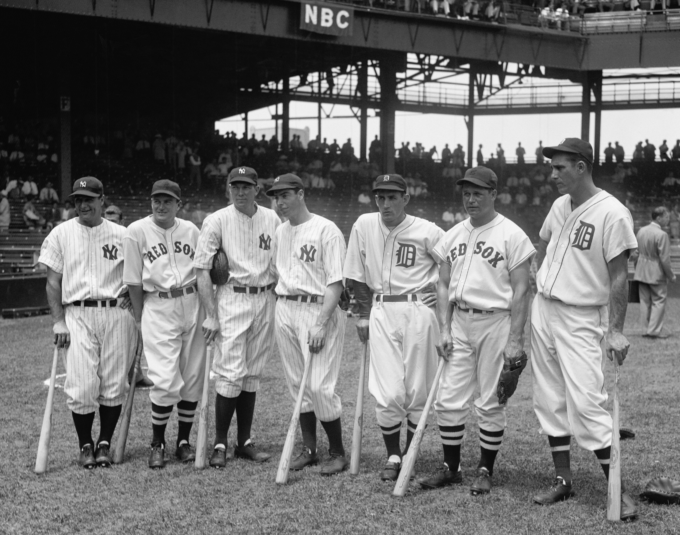
Seven of the American League’s 1937 All-Star players: Lou Gehrig, Joe Cronin, Bill Dickey, Joe DiMaggio, Charlie Gehringer, Jimmie Foxx, and Hank Greenberg. Image Wikipedia.

Seventy-five years ago, my father and I gazed down from the stands at Joe DiMaggio and Mickey Mantle in the outfield at Yankee Stadium. I was thrilled by the sight of two heroes of my time, but Dad was not impressed. He had seen Babe Ruth.

I think about that now, in a time desperate for such symbolic representatives of our better selves, which we once derived from sports figures like Mickey, Joe, and the Babe. They distracted us from pain and poverty. They gave us hope. I wonder if the answer to “Where Have You Gone, Joe DiMaggio?” — that line from Simon and Garfunkel’s famed song “Mrs. Robinson” — is the same as to so many other wrenching questions these days: Donald Trump.

Consider the following: Until he wore himself (and his welcome) out with such excess, he was indeed superb at commanding attention and winning ugly. He was, in short, a loud, vulgar, greedy, self-absorbed cock of the walk who came to epitomize a new gilded age of power and irresponsibility. And yet, he also somehow came to represent citizens who felt oppressed and disdained by the new elite.

No, you’ve got it wrong. I’m not thinking about Donald Trump (not yet anyway). I’m describing Babe Ruth, the first of the Top Jock role models who captured the spirit of an American age. For the next hundred years, the Babe’s spawn strutted through America’s arenas until they petered out in basketball star Michael Jordan’s commercialism. Jordan was, like the rest of them, the best at what he did, while also embodying the zeitgeist of his time with a “greed is good” mantra exemplified by his notorious “Republicans buy sneakers, too” line (which he may never have said seriously).

From Babe Ruth to Michael Jordan, with the likes of Joe Louis, Jackie Robinson, Arnold Palmer, Joe Namath, Muhammad Ali, Billie Jean King, Dale Earnhardt, and Tiger Woods (among others) in between, Americans have regularly, if sometimes controversially, used sports figures to represent their aspirations.

Anointing Donald Trump as our current Top Jock figure is neither an attempt to curry favor — do you think I want to be the Minister of Sport? — nor an attempt to denigrate the position. It’s just an effort to better understand why those apparitional figures from SportsWorld seem to have disappeared from our collective consciousness in the age of You Know Who.

Where Did the Top Jocks Go?

This effort of mine started to take shape when I suddenly realized that, for the first time (in my memory) since childhood, America now seems to have no Top Jock, no celebrity athlete whose talent and personality captures our moment. Those who might be considered — LeBron James, Tom Brady, and Serena Williams — somehow seem to lack the sort of charisma Donald Trump does indeed have to reach beyond their hardcore fans to the rest of us.

After almost 70 years of following sports and writing about it professionally, I recently realized that I couldn’t recall another time when I wouldn’t have been able to name an already agreed-upon Top Jock, or at least propose half a dozen candidates. So, what’s up? In this fragmented Trumpian moment of ours, is sports finally losing its hold on us? Have we been losing our love for jocks for the first time in my memory? After all, highly accomplished athletes like Pete Rose and Barry Bonds are now being denied Hall of Fame plaques on moral grounds, while high school and college athletes are becoming teenage millionaires thanks to new laws regarding their ownership of their own images.

It seemed like an appropriate moment for summing up.

Having spent the past 20 years as TomDispatch‘s Jock Culture correspondent, I felt the need for a reckoning. What had I learned from the 50 essays I’d written so far? Was there any kind of personal touchdown I could point to? Had I truly caught the relationship between sports and the larger society — how they do or don’t reflect, direct, and/or motivate each other? Can I still face the issue of trans athletes or what rules there might be for which kinds of non-athletic transgressions should keep players out of sports halls of fame, or even explain how pro football and basketball have now essentially become Black sports? Must I keep analyzing the symbolism of games rather than just enjoying them? Can I feel comfortable in a world where brain trauma is treated as a reasonable cost of violent entertainment (much as school shootings are a permissible price for gun love)?

And, yes, I came to wonder just where Joe DiMaggio had gone and whether some other charismatic avatar of a fanatical cult might, in fact, have replaced him and all those other jock idols?

More than politicians (even Franklin D. Roosevelt or John F. Kennedy) or entertainers (Frank Sinatra, Elvis Presley, or the Beatles), sports figures — maybe because of the shooting star nature of their professional lives — had long been designated the avatars of American culture. And that was true even if, with the rarest of exceptions (perhaps Billie Jean King and Muhammad Ali), they left little of lasting spiritual value or impact.

And now, of course, we have DJT (Donald J. Trump) as the MVP (most valuable player) of, it seems, every competition. I suspect that he — or at least the world he represents — is the reason why we have no real sporting heroes anymore. After all, he sucks all the air out of all arenas, while providing an ongoing reality show that seems to fill our days and nights, superceding sports in every way imaginable.

Donald Trump eternally demands to be the GOAT — the Greatest of All Time — while distinctly turning our world into a Trumpian sports event.

Suggesting a Theory

I was surprised to find that, in most of the 50 essays I’d written for TomDispatch, whether they were purportedly about baseball, NASCAR, or the Super Bowl, there was always at least a passing reference to Donald Trump and, in all too many cases, he was the leading character. That led me to wonder whether such a reality just represented this particular writer’s obsession or had Trump truly enveloped our collective consciousness?

And, I wondered as well: was this inevitable? According to AI, when I tried to use it recently, I’ve described Jock Culture as helping to ingrain “the national psyche… with exclusivity, sexism, homophobia, and winning at any cost… a danger to the common good,” while I evidently predicted that “society will become a darker, more despotic place if it continues unchecked.”

There’s no question that the United States has become a significantly darker, more despotic place since, on January 17, 2017, just-about-to-be-president Donald Trump first appeared in a Jock Culture column of mine (the seventeenth, if you’re keeping count). The headline was “Football is Trump Ball Lite” and heralded an authentic call for democracy from an unlikely place, the most Trumpish of sports.

As I wrote then:

“Pro football actually helped prepare us for the new president’s upset victory by normalizing a basic tenet of jock culture: anyone not on the team is an enemy, the Other. And it’s open season on opponents, the fans of opponents, critics, and women (unless they’re cheerleaders or moms). Trash talking is the lingua franca of this Trumpian moment, bullying the default tactic.

“Yet pro football has also provided us with the single most vivid image of current American resistance to racism. Last summer, before a pre-season game, San Francisco 49ers quarterback Colin Kaepernick sat during the playing of the national anthem as a symbol of his refusal ‘to show pride in a flag for a country that oppresses black people and people of color.’”

The outcome, however, would prove shocking. Trump, who entered the Oval Office three days after that column of mine appeared, won two of his three matches, while Kaepernick never played again after that 2016-2017 season.

Maybe we shouldn’t have been shocked, though. Maybe the predictors never got the odds right. Maybe they didn’t understand what we wanted from our sports idols — or what their limits were. How about this: Consider the relative paucity of sports figures in the Epstein Files, especially compared to groups like academics, financiers, politicians, and even comedians. Jeffrey Epstein pursued people who could be useful to him as enablers, investors, connectors, or victims. Woody Allen was high on the list, but there was no Lebron James or Tom Brady (although Brady’s long-time owner, billionaire Robert Kraft of the New England Patriots, certainly made the cut).

Was it because celebrity athletes have no need of being set up with playthings or because Epstein didn’t believe they had the kind of clout that could benefit his power network?

Among the more recognizable names that did crop up on his sporting roster, however, were Casey Wasserman, the president of the Los Angeles Organizing Committee for the 2028 Olympic and Paralympic Games, and several fellow NFL owners alongside the 84-year-old Kraft, who apparently solicited advice from Epstein while facing a 2019 charge for soliciting prostitution. (He beat the rap.)

Another NFL owner in the lineup was Steve Tisch, the 76-year-old part owner of football’s New York Giants. As a Hollywood producer with credits like Forrest Gump and Risky Business, you might think he could have collected playmates on his own. In 2013, however, Epstein e-mailed Tisch, “I can invite the (Russian) …to meet if you like.” Tisch quickly replied, “Is she fun?”

A few weeks later, concerning a (name redacted) woman, Tisch asked, “Is my present in NYC?” After Epstein replied, “Yes,” Tisch asked, “Can I get my surprise to take me to lunch tomorrow?”

Epstein then wrote him: “I am happy to have you as a new but …shared interest friend.”

Trump, of course, was the sports figure — he owned a professional football team in the 1980s — whose mentions in the Epstein Files were most eagerly anticipated. His name, in fact, does come up thousands of times, although so far involving nothing of the existentially horrifying nature that his enemies had been waiting for and his allies presumably fearing.

Commander in Cheat

Trump’s standing in the sports world has never seemed particularly high. Even golfers tend to roll their eyes and agree with Rick Reilly, who wrote his book Commander in CheatHow Golf Explains Trump, about the way the president used to bully and whine his way across the greens.

Trump was spectacularly unsuccessful in his attempts to buy a National Football League team. In the 1980s, he tried to bulldoze his way into the sport as the owner of the New Jersey Generals of the new United States Football League (USFL), which played its games in the spring to avoid competition with the NFL.

Trump was a leader in the USFL’s lawsuit to force a merger with the NFL, which resulted in a pyrrhic victory — his side won the case, but the awarded damages came to $3.76 (and no, that is not a typo!). It sounded like a typical tale of Trump buffoonery.

Trump declared himself a fan of college football (an attempt to show disdain for the pros who had rejected him) and suffered further rejection from various championship teams who rebuffed his invitations to the White House.

Still, his administration clearly does what it wants when it comes to sports. In selling the war against Iran, for instance, it ran a series of video montages juxtaposing military bomb strikes and hard college and pro football hits. One such hit was a punishing block thrown in 2012 by Nebraska receiver Kenny Bell against a Wisconsin defensive back. Bell, a former NFL player as well, told the Washington Post that he was “disgusted” by the montage. “For that play to be associated with bombing human beings makes me sick,” he said. “I don’t want anything to do with images like that.”

Other athletes decried the usage on moral grounds, but there was no immediate complaint from the NFL itself, which is usually quick to protest any infringement of its copyrighted material. Was that supposed repository of our toughest athletes spooked by Trump? Was he, in fact, the Top Jock after all?

“This White House is vindictive and bullying,” commented Professor Rebecca Tushnet of Harvard Law School. “So, if you’re the NFL, why tempt its wrath?”

Why would they even want to? After all, aren’t they on the same Top Jock team?

As for the rest of us, we may just have to keep hitting back until we can write a new song, “Where Have You Gone, Donald Trump?”

And we will know just where.

This piece first appeared on TomDispatch.