Monday, April 13, 2026

'Worst-case scenario': Financial experts predict major Trump economic downturn


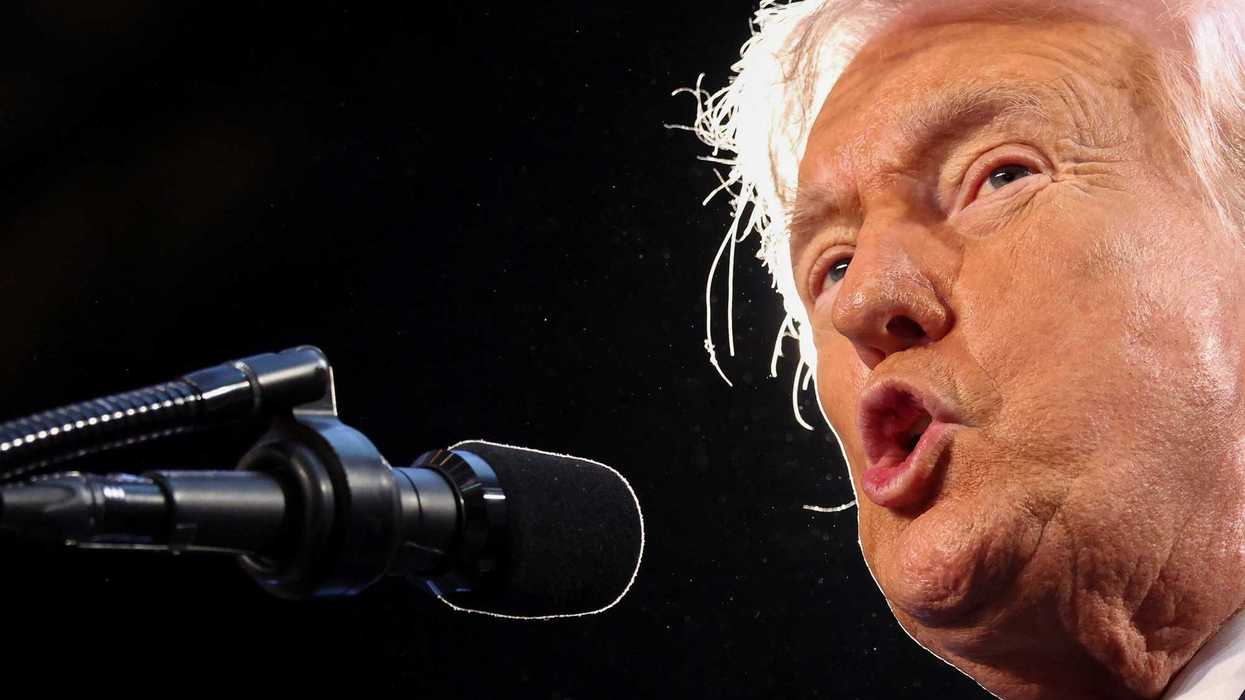
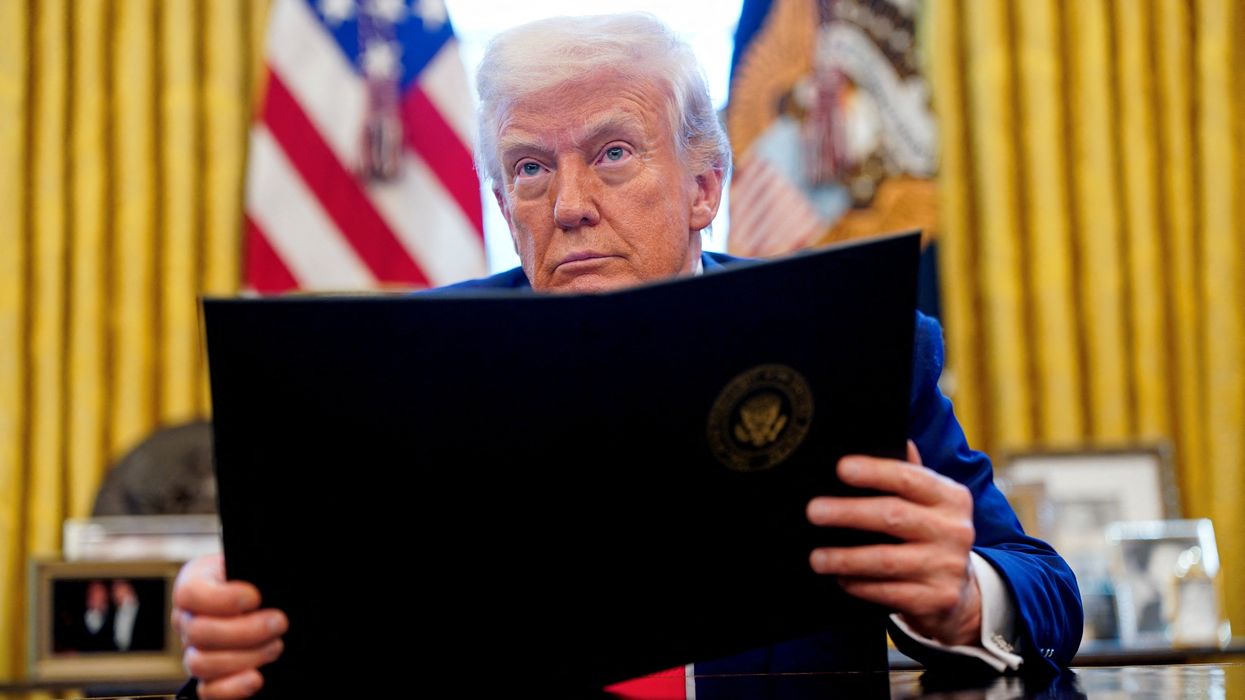
U.S. President Donald Trump looks on, as he signs executive orders and proclamations in the Oval Office at the White House in Washington, D.C., U.S., April 9, 2025. REUTERS/Nathan Howard
April 12, 2026
ALTERNET

President Donald Trump’s economy seems to be doing well now but that could rapidly change, according to a respected financial journalist.

“Based solely on performance, Wall Street has been thrilled to have President Donald Trump in the White House,” wrote The Motley Fool's Sean Williams on Sunday. “During Trump's first, non-consecutive term, the mature-stock-driven Dow Jones Industrial Average (DJINDICES: ^DJI), benchmark S&P 500 (SNPINDEX: ^GSPC), and tech-stock-inspired Nasdaq Composite (NASDAQINDEX: ^IXIC) rallied 57%, 70%, and 142%, respectively.”

Williams added, “While these major indexes have risen under most presidents since the late 1890s, the annualized returns under Trump are among the best.”

One problem facing Trump’s economy is the artificial intelligence (AI) revolution. While it has added trillions in value to the economy, and has even been conjoined with lucrative flushes for the quantum computer and space industries, all of these trends may prove ephemeral. Indeed, Trump has already added one element to the economic brew that could throw a wrench into all of the gears.

“On Feb. 28, at Trump's command, U.S. military forces, along with Israel, began military attacks against Iran,” Williams wrote. “Shortly after these military operations commenced, Iran virtually closed the Strait of Hormuz to oil exports. Approximately 20 million barrels of petroleum liquids, equating to 20% of the world's demand, pass through the Strait of Hormuz daily.”

He added, “While Iran partially reopened the Strait of Hormuz on April 5, we're still talking about the largest energy supply disruption in history. This energy supply chain monkey wrench has sent crude oil prices soaring.”

Williams elaborated on how crude oil prices are rising and there is sticker shock at the fuel pump. “Keep in mind that this rapid uptick in inflation comes at a time when the price stickiness of Donald Trump's tariffs is still being felt in the goods sector,” he also observed. Then you throw the expensiveness and volatility of a Middle Eastern war into the mix, and it all starts to look terrible economically.

“Even if the Iran war wraps up in the next couple of weeks, the inflationary effects of this conflict will linger for several quarters to come,” Williams wrote. “It's a worst-case scenario for the Trump bull market.”

Earlier on Sunday, Williams wrote a separate piece linking the Iran war’s effects to the economy.

“Though the toll on human life is incalculable during war, military conflicts often have far-reaching effects that extend beyond the battlefield,” Williams wrote. “The most notable impact of the Iran war, which began on Feb. 28 at Trump's command, has been observed in the energy arena.”

He added, “Shortly after the U.S. and Israel commenced attacks on Iran, the latter closed the Strait of Hormuz to most oil exports. Although this closure remains somewhat fluid, as of this writing on April 8, what can be said with certainty is that, for over a month, we've witnessed the largest energy supply disruption in modern history. In the wake of this virtual closure, crude oil prices have soared. This has led to higher prices at the pump for consumers, as well as steeper transportation and production costs for businesses.”
Watch: Zohran Mamdani Disses Trump-Israel War on Iran With Legendary Tupac Lyric

“Tupac said it decades ago, it continues to be true.”


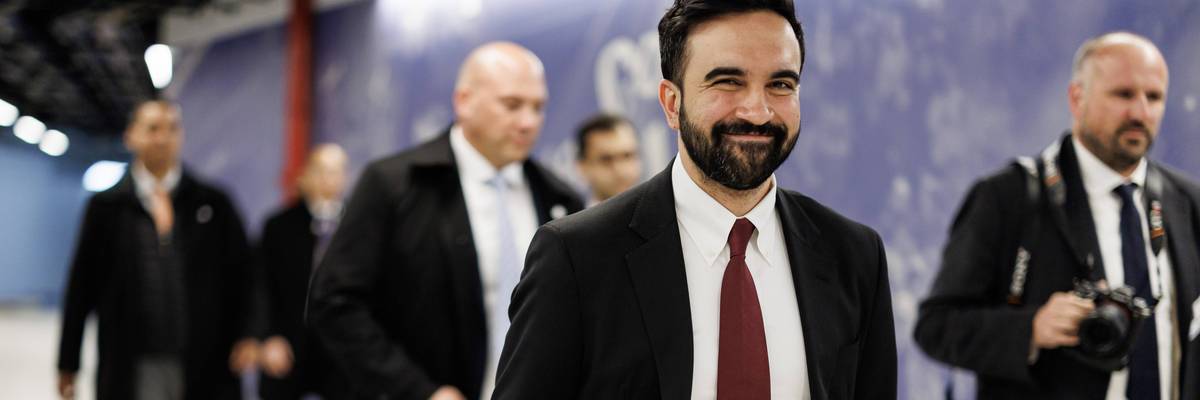
New York City Mayor Zohran Mamdani visits employees at Citi Field prior to the game between the Arizona Diamondbacks and New York Mets on April 9, 2026 in Queens.
(Photo by Caean Couto/Getty Images)

Brett Wilkins
Apr 10, 2026
COMMON DREA,S

He may prefer Biggie over Tupac, but New York City Mayor Zohran Mamdani gave a nod to the latter’s immortal observation on misplaced national priorities during an interview in which he condemned the US-Israeli war against Iran.

“I’ve made clear my very deep opposition to this war in Iran,” Mamdani told Richard Gaisford in a “Talk to Al Jazeera” segment aired Thursday on the Qatari news network. “It is an opposition not just of a procedural nature or a political nature, but frankly of a moral nature.”


Famed Iranian Musician Holds Sit-In to Shield Power Plant From War Criminal Trump

“We are speaking about a war that has killed thousands of civilians, a war that is deeply unpopular across this city and across this country,” Mamdani said. “Not just because of what we are seeing it result in, but also because it is utilizing tens of billions of dollars to kill people, money that could otherwise be spent on making life easier for people across this city and this country.”

“The very things that I often speak about that are necessary for working class New Yorkers that we are told are impossible or unrealistic, they would cost a fraction of this tens of billions that we’re seeing,” the mayor asserted.

Gaisford asked Mamdani if he is frustrated that “$900 million a day [is] being spent on the war, when you have projects that cost much less that can make a difference.”

“I think it should frustrate all of us, you know what I mean?” the democratic socialist mayor replied. “Tupac said it decades ago, it continues to be true, about the fact that we always seem to have money for war but not to feed the poor. And that is not the way politics should be; that is not what Americans want politics to be.”

Mamdani was referring to Tupac Shakur’s 1993 track “Keep Ya Head Up,” which contains the lyrics, “You know, it’s funny when it rains it pours/They got money for wars, but can’t feed the poor.”

Shakur’s 1998 song “Changes” also feels relevant today, as the slain rapper asks, “Can’t a brother get a little peace?/It’s war on the streets and the war in the Middle East/Instead of war on poverty, they got a war on drugs so the police can bother me.”

Watch Mamdani’s interview with Gaisford here:


Join the Citizens’ Movement to Impeach Tyrant Trump

He is a dangerously unstable, egomaniacal, eruptive personality, wielding the most lethal powers of anyone on Earth. He needs to go.


A man holds a sign reading “Impeach Trump” as he takes part in the “No Kings” national day of protest in Howell, Michigan, on March 28, 2026.
(Photo by Jeff Kowalsky / AFP via Getty Images)

Ralph Nader
Apr 11, 2026
Common Dreams

This week two events (1) the citizens’ “Expert Legal Symposium,” and (2) Rep. John Larson’s introduction on April 6, 2026 of House Resolution 1155 “Impeaching Donald J. Trump, President of the United States, for high crimes and misdemeanors in violation of his constitutional oath of office to preserve, protect, and defend the Constitution of the United States” may spark the rise of citizen movement to impeach President Donald Trump. Already a majority want him out!

Rep. Larson (D-Conn.) is a mainstream Democrat serving his 14th term of office. The 13 articles in his H. Res 1155, drafted with constitutional law specialist Bruce Fein, portray the violations of the most lawless president in American history. Trump’s dictatorship is rapidly intensifying (though his support is dropping in the polls). Trump regularly boasts that “I can do whatever I want as president,” “Nothing can stop me,” and “This is only the beginning.”


Over 1 Million Americans Say Impeach and Remove Trump Ahead of ‘No Kings 3’ Rallies

84% of Democrats and 55% of Independents Support Impeaching Trump a Third Time

Chronically lying Tyrant Trump is an open, clear, and present danger to our Republic. He is driven by a fact-deprived, perilous, megalomaniacal, and vengeful personality.

The citizens’ symposium, first of its kind held inside the House of Representatives, gathered experts and advocates for Trump’s removal from office to provide the legal case, highlighting three planks. They were:President Trump’s usurpation of the congressional war power;
The credible fear that President Trump will obstruct, interfere with, or invoke the Insurrection Act to outright cancel the 2026 midterm elections; and
Trump’s “industrial scale bribery and extortion.”

Audience questions following each panel expanded on the presentations. You can see the entire four-and-a-half hours on C-SPAN: https://www.c-span.org/program/public-affairs-event/activists-lawyers-and-others-discuss-possibility-of-additional-trump-impeachment-proceedings/677013.

Participants at the symposium exhibited a strong sense of urgency, not just from Trump’s escalating war crimes but from the lassitude of Congress, whose bipartisan leadership never considered canceling their two-week recess to address the burgeoning violent outlawry pouring from the White House, most prominently illegally blowing apart Iran and indirectly Lebanon.

The event was co-sponsored by Essential Information, RootsAction, and Free Speech for People with participants from Public Citizen and the Cato Institute.

The Republican Trump lapdogs continue to betray, with historic cowardliness, the people of America.

FOR TRUMP, IT IS ONLY GOING TO RAPIDLY GET WORSE, MUCH WORSE. The strongest critics of Trump can’t keep up with his onslaught, understating his foreign and domestic crimes. He is a dangerously unstable, egomaniacal, eruptive personality, wielding the most lethal powers of anyone on Earth.

Not receiving the Nobel Peace Prize, which he craves, by asserting falsely that he had ended eight wars since January 2025, Trump told the dumbfounded prime minister of Norway, “your Country decided not to give me the Nobel Peace Prize” so he no longer felt “an obligation to think purely of Peace.” That was Trump’s signal that he was going to be engaging in wars. What’s the street language here—a head case in the White House.

Trump constantly creates or fails to address catastrophes. Recall, his calling the climate crisis “a hoax,” that Covid-19 is just like getting a cold, losing valuable time in 2020, costing many American lives. Trump stereotypes journalists as “deranged and demented,” as he extorts millions of dollars from television networks via grossly malicious lawsuits.

The question is why 77.3 million voters support a man few would want as a friend, co-worker, or neighbor, much less a boss with the power of life, death, deprivation, and tyranny over them.

Having pardoned over 690 convicted violent criminals and additional fraudsters, he lets it be known that his loyal, extremist supporters can do what he wants and expect to be pardoned.

Credit Trump with teaching us how weak our democratic institutions are to thwart the US fascist dictatorship emerging from the 2024 election. He taught us, with luminous exceptions, that the media, the academic world, the legal profession, the labor unions, the retired military (brass who despise Trump and his norm-busting secretary of defense), and the civic community, among other constituencies, have not risen to the urgent need to counter tyrant Trump. He has issued one illegal executive order after another and then transgressed beyond those dictates in fits of fearsome rage.

He also reminds us that there has been a price to pay for pushing aside civic education, teaching civic history, skills, and providing students with “learning by doing” in their community or neighborhood. Decade after decade of vocational and rote teaching for multiple-choice testing ignores critical norms of moral restraint and accountability. No wonder they atrophy.

Two examples illustrate how low our standards have fallen. President Dwight D. Eisenhower’s chief of staff, Sherman Adams, a former governor of New Hampshire, had to resign after a press report that he accepted a vicuna coat as a gift from a textile industrialist friend. Later, in 1984, Sen. Gary Hart, competing for the Democratic presidential nomination against Vice President Walter Mondale, was photographed with a young lady—not his wife—on a small sailboat off Miami (he denied an affair). The norms of that time pushed him to quit the race.

Fast forward. Any one of Trump’s many vile transgressions would have stopped anyone from being a candidate, much less getting elected President. He is a daily chronic liar about serious matters and his business and political record as well as about people he dislikes; he is a convicted felon (and was under four criminal indictments); a draft dodger; a mocker of people with disabilities; serial adulterer; he consorted with pedophiles; he is an intense racist and brutal misogynist; and a business crook who cheats workers, consumers, and creditors. He openly committed many violations of federal statutes in his first term, when he also defied over 125 congressional subpoenas (Nixon was about to be impeached for defying two in 1973-1974); and he is an inciter of violence at his rallies and in his remarks. The list goes on.

The question is why 77.3 million voters support a man few would want as a friend, co-worker, or neighbor, much less a boss with the power of life, death, deprivation, and tyranny over them. That question is best answered by the so-called leaders of the Democratic Party, who, instead of landsliding this loser, this crusher of decency and truth, lost both the popular and electoral college presidential vote.

A mere switch of 240,000 votes in Pennsylvania, Michigan, and Wisconsin in 2024 would have sent Trump back to golfing at Mar-a-Lago. That could have been achieved had the Democrats really championed raising the stagnant federal minimum wage to $15 per hour instead of the $7.25 per hour still today (that would help 25 million workers) and cracking down on corporate greedhounds stealing from consumers and lobbying against raising the Social Security benefits, frozen since 1971, paid for by raising the limit of Social Security taxes on higher income people (over 60 million people benefiting).

(For many more vote-getting compacts shunted aside by the dominant corporate Democrats and their corporate-conflicted consultants, see winningamerica.net).


OPINION 
ROBERT REICH

How to impeach Trump — for real this time

U.S. President Donald Trump delivers remarks to members of the Republican Party, at Trump National Doral Miami in Miami, Florida, U.S., March 9, 2026. REUTERS/Kevin Lamarque

April 13, 2026 
ALTERNET

Speaking at a January 6 retreat for House Republicans, Trump stated, “You gotta win the midterms ‘cause, if we don’t win the midterms, it’s just gonna be — I mean, they’ll find a reason to impeach me. I’ll get impeached.”

This was before Trump’s agents murdered Renee Good and Alex Pretti in Minneapolis, before the Justice Department released more Epstein files, before Trump’s disastrous war in Iran, before Trump threatened death to the entire Iranian civilization, before a gallon of gas hit $4 or more, before other prices also began rising because of the blockage of the Strait of Hormuz, and before additional price hikes associated with Trump’s tariffs had kicked in.

It was also before Trump’s polls slid to record lows, before the MAGA faithful began complaining that Trump had betrayed his promise to avoid foreign entanglements, and before a slew of special elections in which Democratic candidates have won Republican districts (and even when they didn’t win, lost by far smaller margins than Trump won by in 2024).

Until recently I thought impeaching Trump and convicting him in the Senate was a pipe dream. I was concerned that even talk of impeachment at this stage might distract attention from the affordability crisis brought on by Trump and could even fortify Republican charges of Democratic “extremism.”

No longer.


The president of the United States is stark-raving mad. He’s a clear and present danger to America and the world. The American public is beginning to see it.

We’ve got to do whatever we legally can to remove him from office. The 25th Amendment would be useful if Trump’s Cabinet and key advisers had any integrity, but they don’t. They’re ambitious, unprincipled traitors.

Which leaves impeachment.


You may be skeptical. After all, he’s already been impeached twice, to no avail. How can the third time be the charm?

Because it seems likely that Democrats will retake control of the House and the Senate in this fall’s midterm elections (unless Trump prevents free and fair elections).

And because it’s also possible that there will be enough votes in the Senate starting next January to convict Trump of impeachable offenses and send him packing.


I understand how difficult this may seem. Both times Trump was impeached in the House, he was saved by the Constitution’s requirement that two-thirds of the Senate (67 senators, assuming all 100 are present) convict in order to remove a president.

The highest Senate vote count against Trump came in 2021, and it was 10 votes short of the constitutional requirement. Fifty-seven senators, including seven Republicans, voted to convict him of inciting an insurrection at the U.S. Capitol. It was the most bipartisan impeachment vote in U.S. Senate history, but it still fell well short of the 67 votes needed to convict Trump.

So why do I think it’s possible now? Because public sentiment has swung further against Trump now than it was in 2021. And it’s likely to swing even further against him, because he’s going out of his mind at a rapid rate.

The way to accomplish this is to defeat enough incumbent Republican senators who are up for reelection in 2026 to create a Democratic majority in that chamber, totaling some 54 votes, and pressure at least 13 Republicans up for reelection in 2028 to vote to convict him.


That’s not impossible. In the upcoming midterms it’s likely that Maine Republican Senator Susan Collins will be replaced by a Democrat (either Janet Mills or Graham Platner). I also assume that former North Carolina Governor Roy Cooper will replace Republican Senator Thom Tillis, who’s retiring.

And I’d like to believe that the good people of Ohio will see the light and reelect Sherrod Brown over Jon Husted, the dullard who was appointed to fill the remainder of JD Vance’s term.

James Talarico could take the Texas Republican Senate seat now occupied by John Cornyn. In Alaska, I’d put odds on Mary Peltola defeating incumbent Republican Senator Dan Sullivan. In Nebraska, assume that Dan Osborn prevails over incumbent Republican Senator Pete Ricketts. And so on.

Republican senators last elected in 2022 who will be on the ballot in November 2028 include some who are vulnerable because they’re in swing states, such as North Carolina’s Ted Budd and Wisconsin’s Ron Johnson; or are in states that could be competitive, such as Indiana’s Todd Young; or are vulnerable to internal party shifts, such as Louisiana’s John Kennedy and South Carolina’s Tim Scott.

Those vulnerabilities mean that their constituents could push them to vote to convict Trump in an impeachment, or else threaten to vote against them in 2028.

So it’s possible to get the 67 Senate votes, my friends. And it’s absolutely necessary that we try.

The vast No Kings demonstrations should be considered a prelude to targeting enough Republican Senate incumbents and open races to flip the Senate this fall, and pressuring Republicans up for reelection in 2028 to do their constitutional duty.

Now is the time to show the size and intensity of America’s commitment to removing Trump from office, for the good of us all.

Robert Reich is a professor of public policy at Berkeley and former secretary of labor. His writings can be found at https://robertreich.substack.com/.


Top Democrats Make Momentum Behind Trump Impeachment Screech to a Halt

Rather than calling for impeachment, Schumer criticized Trump for what he said was worsening Iran’s “nuclear ambition.”

By Sharon Zhang , 
April 10, 2026
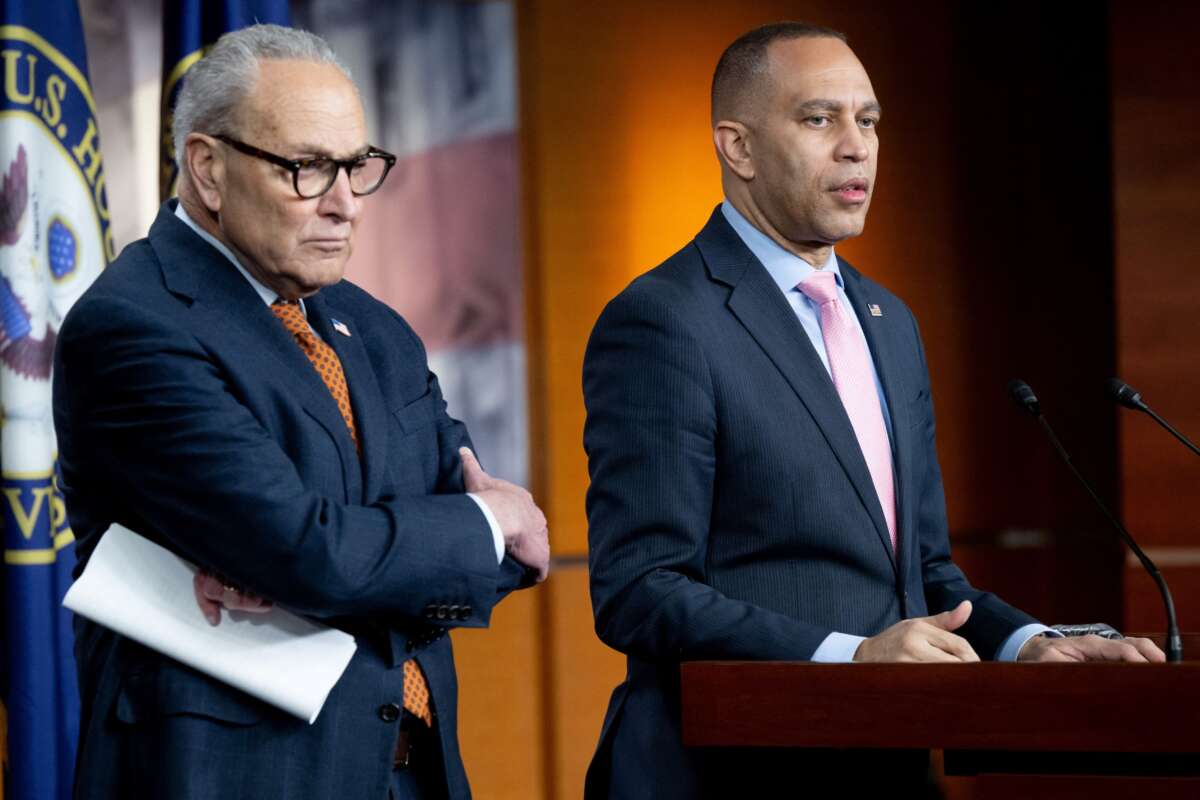
U.S. Senate Minority Leader Chuck Schumer and U.S. House Minority Leader Hakeem Jeffries hold a press conference on Capitol Hill in Washington, D.C., on January 8, 2026.SAUL LOEB / AFP via Getty Images

Truthout is a vital news source and a living history of political struggle. If you think our work is valuable, support us with a donation of any size.

Awave of momentum behind impeaching President Donald Trump for his genocidal threats toward Iran on Tuesday came to a screeching halt by the end of the week as Democratic leaders like Senate and House minority leaders Chuck Schumer (New York) and Hakeem Jeffries (New York) hand-wrung over such a process being a “distraction,” reporting says.

After Trump threatened that “a whole civilization will die tonight” on Tuesday morning, over 70 lawmakers, including a handful of senators, called for Trump to be impeached or be removed via the 25th Amendment over the threat. His threat was so beyond the pale that even far right figures like Candace Owens and Tucker Carlson criticized him, and called for an end to the war.

This was the biggest wave of calls for impeachment during Trump’s second term yet, coming as speculation flew over what horrors Trump would unleash upon the country of 93 million people — amid a war in which the U.S. and Israel have killed over 1,700 civilians thus far, including at least 254 children, according to human rights group Human Rights Activists News Agency.

But the calls likely won’t lead to consequences for Trump any time soon. Time reported on Friday that “[b]oth paths — impeachment or the 25th Amendment — are, to the mind of party Leadership, a distraction from their planned midterm campaign focused on high costs and unchecked corruption.”

Neither Jeffries nor Schumer has called for impeachment or removal in response to the threat. Their refusal to act is sure to ignite further fury as the Democratic Party still manages to garner worse approval ratings than Republicans due to widespread views that the party is weak and ineffective.

On Wednesday, Schumer, a longtime supporter of Israel, held a press conference criticizing Trump for the war and the ceasefire — making critiques not necessarily of the concept of war with Iran itself, but of the way that Trump is going about it.

“The Iranian regime is still standing. Not just standing, but now emboldened,” he said. “Iran’s nuclear ambition, worse. The bottom line is that Iran still has its nuclear stockpile. Its nuclear ambitions are still unchecked, if not accelerated.” He said that the Senate would undertake a war powers resolution next week — far past Trump’s deadline for civilization-wide annihilation that ultimately did not come to pass on Tuesday.

Party leaders evidently believe an impeachment effort highlighting Trump’s horrific war would fail, and thus isn’t worth trying — even as Rep. Al Green (D-Texas) pointed out that introducing articles of impeachment is a way to demonstrate the gravity of the situation. Jeffries directly stated he wouldn’t be backing an impeachment effort, saying: “I don’t want to get out ahead of that discussion … we want to be able to do [impeachment] in an informed way.”

Time further reported: “A failed impeachment effort, a party leader suggested privately, risks being framed as tacit approval of the President’s conduct, while also diverting attention from the party’s core economic message on affordability and health care — issues party leaders believe resonate more directly with voters.”

This belief simply isn’t true, and ignores the support that Democrats could gain by taking a principled stance.

Trump’s approval has been driven to new lows amid his war on Iran, which has broken records for unpopularity. Polling for IMEU Policy Project and Demand Progress by Data for Progress recently found that 43 percent of voters say they are less likely to vote for Republicans due to the war, demonstrating a huge swath of voters that the Democrats could appeal to by staking out an anti-war stance.

Further, affordability issues are directly tied to the war, with the U.S. and Israel’s aggression prompting the retaliatory closure of the Strait of Hormuz, causing energy costs — and costs of goods downstream from that — to soar. Republicans are reportedly even considering enacting further cuts to health care subsidies in order to pay for the White House’s towering $200 billion supplemental funding request for the war.


Staircase to Nowhere: MAGA’s Crowning Achievement


The former East Wing
Photo by Pedro Ugarte/AFP via Getty Image

Abby Zimet
Mar 31, 2026

Poor deplorable MAGA. Maybe they’re disheartened by Trump’s well-deserved plunging approval rating, now at barely 33%. Maybe it’s because their regime is such a half-assed shitshow and their people are such self-serving, hypocritical dickwads. As in: Amidst a government shutdown that’s seen TSA agents (starting salary $34,454) compelled to work without pay as Congress takes a two-week recess (pay over $170,000) on the taxpayers’ dime, TMZ urged readers to send in photos of vacationing pols, and here comes Lindsey Graham at Disney World, “The Most Magical Place On Earth,” gaily twirling a Little Mermaid bubble wand yet. America and Megyn Kelly: WTF.


Or maybe it’s because Commander-In-Chief Private Bonespurs started another forever quagmire without legal or political justification, and it turns out wars in the Middle East are hard and complex and above his pay grade - like health care! - to solve, and now with no good options he’s spewing up only staggering incoherence for strategy, like hailing “great progress” in imaginary “serious discussions” while pivoting to rabidly threatening to “conclude our lovely ‘stay’ in Iran” by “obliterating” their civilian infrastructure, electricity, energy and drinking water, which is a war crime. But talks are going “unbelievably well.”


Serious discussions with Iran    Image from Australia's The Shovel


Anyway, his true passion is turning every crass, stupid thing he or Elvis can think of fake gold like the Oval bordello and even Social Security cards, and slathering his repulsive name on structures, coins, currency, and building trashy, illegal monuments to himself like an obscene, unapproved, un-permitted, $400 million ballroom twice the size of the White House, because, “They’ve always wanted a ballroom,” except now it’s suddenly, “essentially a shed for what goes under it,” a massive military complex, presumably a bunker where, as merciful history would have it, he’ll finally free us of him, “and we’re doing it very well.”

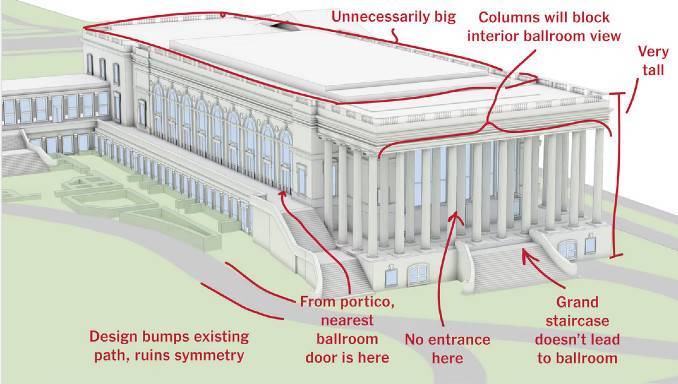
He’s so ballroom-enraptured that on Air Force One he just pulled out a swath of drawings to show reporters, explaining, “I thought I’d do this now because it’s easier. I’m so busy...fighting wars and other things.” Quick mindless pivot to “hand-carved, beautiful, Corinthian columns” - “Corinthian wut” - he’s also reportedly re-imagining for the White House facade, a change deemed “at odds with universally held historic preservation standards.” Same, experts say of “barely scrutinized” ballroom plans, “riddled with design flaws” - disproportionate, pillars block windows, grand staircase to nowhere. WH lackey on “the best builder in the world”: “The American people can rest well knowing this project is in his hands.” We feel better already.


Trump's "plan" for his oversized shed/ballroomImages from New York Times


And then there’s his new gold toilet, mounted on a 10-foot throne near the Lincoln Memorial. The new masterwork of Secret Handshake (Best Friends Forever), it celebrates the renovation of the White House Lincoln Bedroom bathroom, all in gold, and “what this President has actually accomplished.” The toilet’s plaque reads, “In a time of unprecedented division, escalating conflict, and economic turmoil, President Trump focused on what truly mattered: remodeling the Lincoln Bathroom....This, his crowning achievement, is a bold reminder that (he) isn’t just a businessman, he’s taking care of business. It stands as a tribute to an unwavering visionary who looked down, saw a problem, and painted it gold.”


A Throne Fit For a King.Photo from Secret Handshake

The US G20 Presidency Could Take Trump’s Pro-Billionaire Agenda Global

There’s a real risk that the US presidency could advance an economic agenda that prioritizes the interests of the wealthy while sidelining efforts to tackle inequality, strengthen fair taxation, and resolve deepening debt crises worldwide.


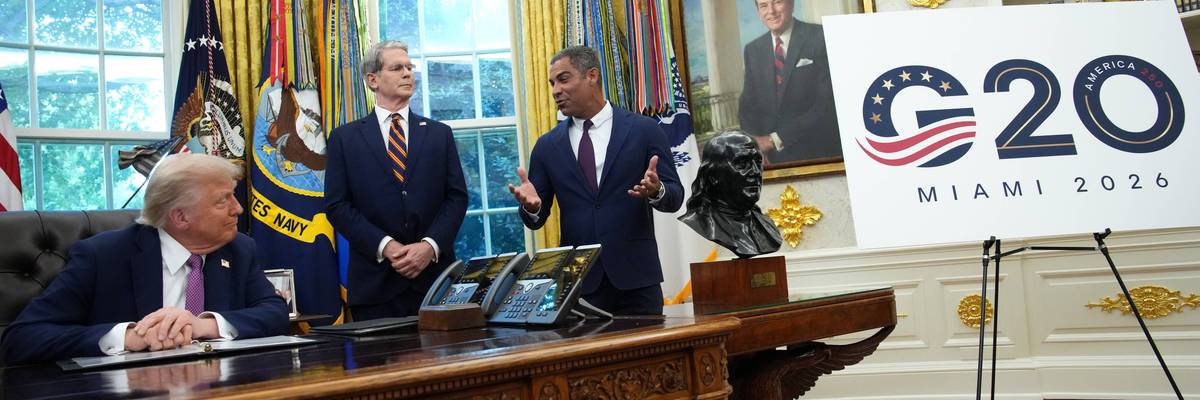
Miami Mayor Francis Suarez (R) speaks as US President Donald Trump announces plans to host the 2026 G20 summit in Miami, Florida while US Treasury Secretary Scott Bessent (C) looks on during a press availability in the Oval Office of the White House on September 5, 2025 in Washington, DC.
(Photo by Kevin Dietsch/Getty Images)

Charlotte Friar
Apr 12, 2026
Inequality.org

In just a year, the wealth of the 10 richest US billionaires increased by $698 billion dollars, while low-wage workers struggled as the Trump administration pushed an inequality-fueling agenda. Now, concerns are growing that the same policy choices—those driving a massive transfer of wealth to the richest—could be projected onto the global stage.

The United States recently assumed the presidency of the G20—a major platform for heads of state and governments to address global economic issues. The presidency is a role that carries significant influence over global economic priorities. There’s a real risk that the US presidency could advance an economic agenda that prioritizes the interests of the wealthy while sidelining efforts to tackle inequality, strengthen fair taxation, and resolve deepening debt crises worldwide.

Instead of focusing the G20 on poverty alleviation, reducing inequality, or dealing with a pending global economic crisis, the US government focus will center on removing regulatory burdens, unlocking energy supply chains, and pioneering new technologies and innovation. This marks a sharp departure from the 2025 theme of “Solidarity, Equality, and Sustainability” and signals a shift toward exporting the Trump administration’s domestic agenda to the global stage.

This all comes at a time when inequality is rising across most countries, and many low- and middle-income nations face mounting debt and stagnant growth.

As the US government so blatantly prioritizes wealthy interests, it is a critical moment for civil society to step forward—organizing and advancing an agenda that breaks decisively from the G20’s all-too-often emphasis on preserving the status quo.

US officials are pitching a “back to the basics” approach—which in reality is a sidelining of issues such as inequality, poverty, labor, climate, and gender. It is also widely anticipated that the Trump administration will restrict avenues for civil society participation.

Current plans suggest a focus on the leaders’ summit and financial track; a reduction in working groups; and formal engagement limited to business stakeholders, excluding civil society organizations, women’s groups, labor unions, and youth representatives. Even acknowledging that past G20 efforts on sustainable development have been uneven, this “back to the basics” approach risks abandoning critical priorities altogether.

Recent G20 presidencies led by Brazil and South Africa demonstrated a different trajectory, placing inequality and debt at the center of global discussions. South Africa’s 2025 presidency elevated the urgency of inequality by commissioning the first-ever G20 report on the issue. Led by professor Joseph Stiglitz, the report described a global “inequality emergency” and proposed the creation of an International Panel on Inequality to guide coordinated action.

Against this backdrop, the Trump administration’s domestic policies, including the 2025 One Big Beautiful Bill Act (OBBBA), represent one of the largest upward transfers of wealth in decades, making it unlikely that current US leadership will champion similar efforts internationally.

Progress on global tax cooperation is also under threat. Brazil’s 2024 presidency achieved a breakthrough agreement to cooperate on taxing high-net-worth individuals. While extreme wealth concentration has increased in recent years, research shows billionaires pay effective tax rates close to 0.3% of their wealth—well below what average workers contribute.

Yet in 2025, the Trump administration has already taken actions that undermine these efforts, including withdrawing from United Nations tax negotiations, pressuring other advanced economies to shield US corporations from global tax agreements, and opposing measures such as digital services and carbon taxes.

Climate action presents another area of concern. G20 countries are responsible for approximately 80% of global greenhouse gas emissions, yet many continue to fall short of their commitments. The US administration’s withdrawal from the Paris Agreement and rollback of domestic climate policies reflect a broader retreat from climate leadership.

The Trump administration’s emphasis on expanding energy supply chains raises the possibility that fossil fuel development could be prioritized over clean energy transitions, particularly if multilateral development banks are encouraged to increase investments in oil and gas projects.

Taken together, these signals suggest that the 2026 US G20 presidency could mark a significant retreat. Rather than building on recent efforts to address inequality, debt, and climate change, it may instead shift the forum toward a narrower agenda that prioritizes elite and corporate interests.

The direction ultimately taken will have far-reaching consequences, not only for the credibility of the G20 but for the future of global economic cooperation. As the US government so blatantly prioritizes wealthy interests, it is a critical moment for civil society to step forward—organizing and advancing an agenda that breaks decisively from the G20’s all-too-often emphasis on preserving the status quo.

Now is the time for people, institutions, and movements to unite and champion bold new forms of multilateral cooperation that serve billions, not billionaires.


This work is licensed under a Creative Commons Attribution-Share Alike 3.0 License.


Charlotte Friar
Charlotte Friar is a senior policy analyst at Oxfam America.
Full Bio >
Trump to the Nation: Money for Guns, Not Butter

The federal government cannot pay for both war and education, health, and housing, according to the president. He promised the opposite on the campaign trail. We are supposed to forget that.

US Air Force military ground personnel prepare Joint Direct Attack Munitions for a US Air Force B-1 Lancer bomber jet on the tarmac at RAF Fairford in south-west England on March 12, 2026.
(Photo by Henry Nicholls/ AFP via Getty Images)

Seth Sandronsky
Apr 11, 2026
Common Dreams


President Donald Trump says the quiet part out loud. He is plain as day when it comes to policy preferences to line the pockets of his donor class. You can’t blame him alone for supporting the military-industrial complex, sometimes called the Blob, the enforcer of economic imperialism.

There’s a bipartisan history of like-minded presidential administrations and Congress critters funding war spending on the taxpayers’ dime since the Cold War. It ended with the fall of the former Soviet Union. Still, the corporate gravy train for war contractors keeps on rolling.


‘Modern-Day Royalty’: 50 Billionaire Families Have Already Pumped Over $430 Million Into Midterms


‘Not Another Penny for Another Endless War,’ Ilhan Omar Says as Trump Seeks $200 Billion

Meanwhile, the federal government cannot pay for guns (war) and butter (education, health, and housing), according to the president, at the White House during an Easter luncheon. He promised the opposite on the campaign trail. We are supposed to forget that.

“It’s not possible for us to take care of day care, Medicaid, Medicare, all these individual things,” Trump said. “They can do it on a state basis. You can’t do it on a federal. We have to take care of one thing: military protection. We have to guard the country.”

As citizens of an empire in decline, the American population is facing in part a battle with the Blob over federal assistance.

You heard it there. State funding can replace the budget duties of the federal government, since the role of Uncle Sam is to finance war primarily, according to the president. What’s wrong with this picture?

The federal government can and does run budget shortfalls. The federal debt and deficit are proof of that. Such borrowing requires willing lenders.

State governments can do no such borrowing. One need not be an economist to see a budgetary outcome. Sharp funding cuts to education, health, and housing assistance that help the US working class living in blue, red, and purple states.

Federal assistance to cool and heat homes? Cut. Federal assistance for nutrition? Cut.

Federal assistance for disease control? Cut. Federal assistance to address wage theft and help small businesses? Cut.

Apparently, the unprovoked US-Israel war on Iran, a violation of international law, is an example of guard duty for the country. Tell that to the survivors of Israeli bombings of residential neighborhoods in South Lebanon and US strikes against hospitals and schools in Iran. Israel is the top recipient of US military assistance, year after year.

Trump’s 2027 budget proposal calls for a Pentagon funding increase of $445 billion, 15 times the annual price tag for Obamacare subsidies. US war corporations such as Boeing, General Dynamics, Lockheed Martin, Northrop Grumman, and RTX Corporation welcome the increased federal funding. The Blob has quite an appetite.

It would feast larger in part from shifting federal assistance away from providing fresh produce to poor women and children. The proposed budget from Trump for assistance to Women, Infants, and Children (WIC) would create more hunger among them.

“The science-based increase to WIC’s fruit and vegetable benefits has led to meaningful improvements in how families eat,” according to a statement from Georgia Machell, head of the National WIC Association, “Young children now consume an additional one-fourth cup of fruits and vegetables per day, and parents report being better able to afford a healthier, more varied diet. The proposed cuts would reverse that progress, reducing benefits to levels that would meet just 19% of the recommended intake for children and 12% for breastfeeding mothers, short of what families need to support healthy growth and development.”

It’s what the war corporations demand and get the old-fashioned way, the economic playbook since WWII. That is war spending as an economic stimulus policy. Congress and the White House receive campaign contributions from war corporations to make that policy happen.

Despite overwhelming US public opposition to the current war of choice, the president is doubling down on his more guns, less butter approach to the federal budget. Meanwhile there is a global economic crisis due to the unprovoked US-Israel war on Iran. The economics and politics of this are fraught with a harmful prognosis, from higher energy and fertilizer prices to use of nuclear weapons.

How the US public responds is key to their best interests and that of global humanity. As citizens of an empire in decline, the American population is facing in part a battle with the Blob over federal assistance. To say that much hangs in the balance is a mighty understatement.
Congress; Pass a Windfall Tax on the Oil Companies Profiting From Trump’s Iran War

The oil and gas companies that invested at least $75 million in Trump’s reelection are cashing in on the instability he has caused.


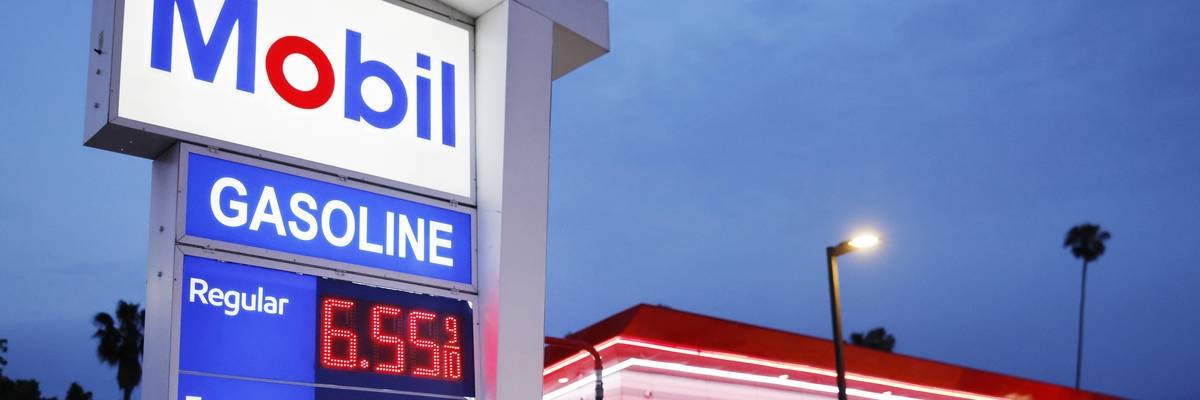
Gas prices are displayed at a Mobil gas station on March 30, 2026 in Pasadena, California.
(Photo by Mario Tama/Getty Images)
Cassidy Dipaola
Apr 11, 2026
OtherWords


Our dependence on fossil fuels does more than pollute our air. It destabilizes the world and empowers the ultra wealthy to profit off of that volatility, leaving working families to pay the price.

This dynamic has been on full display since President Donald Trump’s attack on Iran.


Big Oil Windfall Tax Would Return ‘Egregious’ Iran War Profits to Struggling US Families


Windfall Tax on Big Oil Demanded as Trump’s Iran War Pads Profits of Fossil Fuel Giants

Trump’s invasion of one of the world’s most oil-rich regions jolted energy markets, sending gas prices soaring to the highest level in either of his terms. In 2024 he campaigned on cutting them in half. Instead, Americans are now on track to pay roughly $720 more for gasoline this year.

The full cost to working families will be much steeper as high gas prices drive up prices on consumer goods across the board. We’re already seeing that ripple effect take hold, as the US Postal Service has proposed a temporary 8% fuel surcharge on package deliveries to offset rising transportation costs tied directly to the war-driven spike in oil prices.

To reclaim our foreign policy from those who see a global crisis as a line item on an earnings call, we must break the billionaire grip on our energy system, economy, and democracy writ large.

At the same time, the oil and gas companies that invested at least $75 million in Trump’s reelection are cashing in on this instability. A recent Financial Times analysis estimates that US oil companies could collect an additional $63 billion in revenue this year if crude prices remain at these wartime levels. In March alone, the industry is expected to generate $5 billion in extra cash flow.

This type of windfall isn’t a fluke. We’ve seen this pattern for decades.

Oil has a way of appearing in the background of every chapter of US military intervention in the Middle East and beyond. Iran nationalized its oil industry in the 1950s, and a CIA-backed coup followed. Iraq, sitting on some of the world’s largest reserves, was invaded in 2003. And earlier this year, the US invaded Venezuela and immediately began plans for a taxpayer-backed oil industry takeover.

Dependence on fossil fuels keeps us trapped in this cycle. Oil executives have spent billions to maintain this status quo, backing politicians like Trump who will protect their profits. As the oil industry rakes in eye-popping profits, it gains more power to elect leaders who prioritize policies that ensure Americans remain reliant on fossil fuels.

Following Russia’s invasion of Ukraine, Congress considered a windfall profits tax on large oil companies that would capture the excess profits generated by the crisis—and return the money to American households. Roughly 80% of Americans supported the idea.

Failure to advance that legislation cost us. Researchers calculated that if the US had redistributed the portion of fossil fuel profits that exceeded 2021 returns, every American household could have received $1,715.

As oil executives profit off the war in Iran, Congress must once again push for a windfall profits tax on the largest oil companies. This isn’t an outlandish idea. Other countries have already done it. After the 2022 energy shock, the United Kingdom enacted a windfall tax on oil and gas companies, raising about $3.3 billion in its first year and roughly $4.5 billion the next—money used to help households pay their energy bills.

The current situation in Iran underscores how unchecked extreme wealth fuels corporate control, leaving working families vulnerable. New data from Impact Research for Tax the Greedy Billionaires shows that voters blame billionaires for the affordability crisis and want leaders to do more to address this. In fact, 77% of voters nationwide—including 65% of Republicans, 75% of Independents, and 91% of Democrats—support raising taxes on billionaires.

Under the Trump administration, war profiteering has reached new extremes. Confronting corporate power and taxing the ultra wealthy isn’t just about economic fairness—it’s a national security imperative.

To reclaim our foreign policy from those who see a global crisis as a line item on an earnings call, we must break the billionaire grip on our energy system, economy, and democracy writ large. If we want a democracy that works for the people, we must stop letting it be sold to the highest bidder.


This column was distributed by OtherWords.

Meghan Schneider
Meghan Schneider is the communications director for Tax the Greedy Billionaires.
Full Bio >

Cassidy Dipaola
Cassidy DiPaola is the communications director of Make Polluters Pay.
Full Bio >
NO DEMOCRACY WITHOUT ECONOMIC DEMOCRACY

Sanders Leads Launch of ‘Worker Power’ Movement to Fight ‘Status Quo Economics’


“Unless we fundamentally transform our economic and political systems, the worst is yet to come,” Sen. Bernie Sanders warned.


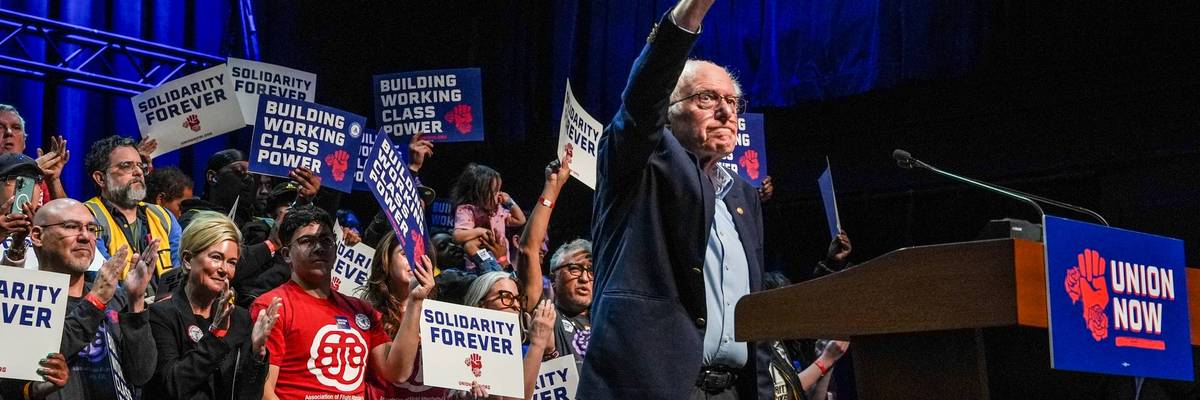
US Sen. Bernie Sanders (I-VT) speaks during a pro-union rally on April 12, 2026 in New York City.
(Photo by Ryan Murphy/Getty Images)


Brett Wilkins
Apr 13, 2026
COMMON DREAMS

As Republican policies, union-busting corporations, and the imminent threat of artificial intelligence put unprecedented pressure on the US workforce, Sen. Bernie Sanders headlined Sunday’s launch of a movement “to strengthen the labor movement and expand worker power across the country.”

Sanders (I-VT) spoke at the “Union Now: Building the Labor Movement” rally at Terminal 5 in Hell’s Kitchen in Midtown Manhattan alongside New York City Mayor Zohran Mamdani, Association of Flight Attendants-CWA international president Sara Nelson, and other labor and social movement leaders.

“Unless we fundamentally transform our economic and political systems, the worst is yet to come,” Sanders warned. “If the middle class of this country is going to survive, we must understand that status quo politics and status quo economics is no longer good enough.”


“It’s absolutely important that all of us here and every American understand that in the ruling class of this country today, there is an extraordinary level of arrogance and cruelty,” the senator said.

“The truth is that the 1% the people on top, people running this country have never, ever had it so good,” Sanders told the crowd. “But the sad reality is that for these people, all that they have is not good enough. They want more and more and more, and they don’t care who they step on to get what they want.”

“These guys are extremely, extremely greedy people, and they could care less in terms of what happens to our children, what happens to our parents and our grandparents, and what happens to our environment today,” the senator argued.

“One of the goals of the oligarchs and the media that they own is to make ordinary people feel that there is nothing that they can do to shape the future,” he added. “And what we are here today to say to [Elon] Musk and his friends: Go to hell.”

Mamdani, who marked 100 days in office, said: “When we talk about the importance of taking on the crisis of income inequality, we know that the most effective tool to do so is increasing union density. Organizing drives and strikes can, frankly, be lonely work. So Union Now is going to support workers and provide them with more resources, and my administration will stand right alongside them. This moment demands nothing less.”


“AI and robots are coming for human jobs,” the mayor warned. “Worker protections are being eroded. There are companies that think that exploitation is a viable business model. They are wrong.”

Nelson asserted that “growing union membership and bargaining power is crucial for workers’ rights and economic justice.”

“Too often, the boss has all the power to starve workers during a fight,” she said. “Union Now will work with unions directly to ensure workers have the means to win.”

Brittany Norris, a Delta AFA Organizing Committee member and flight attendant, told the crowd that “when it comes to striking, when it comes to public actions, a lot of those things cost money and it’s a lot of time, dedication, and efforts coming from the workers.”

“We continuously hear about the profits... that our industry is making, but then we’re begging for a raise that comes up close to what the cost of living increase is every year,” she added.


Sunday’s Union Now launch comes amid Sanders’ ongoing “Fighting Oligarchy” tour, which has drawn large crowds across the country, including in so-called “red” states. The rally also follows last year’s “Workers Over Billionaires” Labor Day rallies and marches in over 1,000 locations.

The Union Now launch also coincides with growing wealth inequality not only in the United States but around a world in which the richest 10% of the global population own three-quarters of planetary wealth and account for nearly half of all consumer spending.

“If [President Donald] Trump and his fellow oligarchs get their way, we will be living in a society where fewer and fewer people have more and more wealth and more and more power, where democracy will be undermined, where workers will be thrown out on the street with no recourse,” Sanders said Sunday. “That is not the America we want for ourselves or for our kids.”

“The good news is,” he added, “if we stand together and we not let Trump and his friends divide us up, when we stand together and fight for a government that works for all of us, there is nothing that we cannot accomplish.”


New Evidence Bolsters Claim That US Lied About Another Iran Airstrike Massacre

Munitions experts and The New York Times say a US missile designed to inflict maximum casualties was used in a February bombing that killed 21 people, including at least five children.


Fire and other emergency workers are seen at the site of a February 28, 2026 US missile strike on a residential area of Lamerd, Iran.
(Photo by Tasnim News Agency/Wikimedia Commons)

Brett Wilkins
Apr 11, 2026
COMMON  DREAMS

New information published Friday by the New York Times further suggests that the US military may have lied when it tried to pin the blame for a February airstrike that killed 21 people in Iran on the Iranian government, with evidence indicating that the US carried out the attack with a new missile designed to inflict maximum casualties.

While much of the world knows about the February 28 massacre of around 175 children and staff at the Shajareh Tayyebeh girls’ elementary school in Minab—and about how President Donald Trump initially blamed Iran for the slaughter—the strike that hit a sports hall and playground in Lamerd on the same day, the first day of the war, received far less media coverage.


‘Slaughtered in Cold Blood’: Iranians Describe US Massacre of School Children to UN Human Rights Council

Munitions experts and the Times concluded that US-made Precision Strike Missiles, or PrSMs—pronounced “prism”—struck the residential area of the southern Iranian city. Developed by Lockheed Martin, PrSMs are airburst weapons, exploding above their targets and blasting 180,000 lethal tungsten pellets in every direction. Video footage of the Lamerd strike shows multiple airbursts.


The Times verified the identities of 21 people killed in the strike. At least five victims were children, the youngest of them just 2 years old. Helma Ahmadizadeh, 10, and Elham Zaeri, 11, were attending volleyball practice at the sports hall when it was bombed. Helma survived the strike with no visible injuries. However, she told her coach that she felt something enter her body. A medical examination at a local hospital revealed a small object in her body. She subsequently died.

“A young boy, Ilia Khatami, was killed alongside his coach, Mahmoud Najaf,” the newspaper said. “The Times confirmed their deaths, and the death of a second boy, Abdul Mosavar Rahmani, who was from Afghanistan.”

The 2-year-old, Avina Barzegar, was mortally wounded by a small object while she was playing outside her home. Video posted on Telegram shows her being treated in a local hospital before she died.

Local officials said 100 other people were injured in the attack.

Pentagon officials previously denied US responsibility for the attack following the March 29 publication of a Times investigation that used video analysis to identify PrSMs as the missiles used in the strike. US Central Command (CENTCOM) spokesperson Capt. Tim Hawkins issued a statement on March 31 calling reports that the US carried out the attack “false” and suggesting that weapon used in the strike was an Iranian Hoveyzeh cruise missile.

The Times’ latest analysis is “based on new video footage of detonations, new photo evidence of the damage, a missile-trajectory assessment, and the perspectives of multiple experts, including three US government officials.”

Findings include distinctive damage patterns consistent with tungsten pellet dispersion from a PrSM airburst, the discovery of a third detonation site consistent with a PrSM, a strike trajectory indicating the missile was launched from where US forces are based, and the sports hall’s proximity to an Islamic Revolutionary Guards Corps base. The Minab girls’ school is also located very close to an IRGC base.

Critically, Iran does not have any missiles in its arsenal that function in a similar manner to PrSMs.

“The problem is that CENTCOM chose as an alternative a very identifiable missile,” Amaël Kotlarski, who leads the weapons team at the defense intelligence firm Janes, told the Times. “And the Hoveyzeh’s distinct features aren’t seen in the video.”

Shahryar Pasandideh, another military analyst consulted by the Times, said “there is no public information to suggest that Iranian cruise missiles, including the Hoveyzeh, are equipped with an airburst fuse, let alone an airburst fuse and pre-formed tungsten pellets.”

After the Minab massacre, Trump claimed that Iran had somehow acquired a US Tomahawk missile and used it to blow up the school.

An earlier investigation by the BBC Verify also concluded that the Lamerd strike was carried out using US PrSM missiles.


More than 3,000 people have been killed over 42 days of US and Israeli strikes on Iran, according to medical officials there. This figure reportedly includes over 1,300 civilians, hundreds of whom are women and children.