Thursday, April 16, 2026


ABS Publishes Leading Whitepaper on Human Readiness Levels for the Industry

ABS
Human Readiness Complements Technical Maturity

Published Apr 15, 2026 9:01 PM by The Maritime Executive


[By: ABS]

“Emerging maritime technologies require qualification processes that extend beyond technical maturity; Human Readiness Levels (HRLs) provide a structured approach that supports safer operations while reducing unnecessary cost and rework.”

That is an excerpt from the latest industry-leading research from ABS, Beyond Technology Readiness: Applying Human Readiness Levels in Maritime Systems, which examines existing gaps in maritime human?system integration and demonstrates how HRLs can be integrated into current maritime qualification processes.

“Technical maturity alone is not sufficient to achieve operational safety. While existing frameworks offer valuable insight into technical maturity, they do not account for the human element that ultimately interacts with, operates, maintains and makes decisions with the technology. In this whitepaper, ABS is providing guidance for owners and vendors to incorporate human factors early so new technologies can be introduced more safely, effectively and with greater confidence,” said Michael Kei, ABS Vice President, Technology.

Technology readiness levels focus on hardware and software performance, while HRLs evaluate: operator roles and responsibilities; cognitive workload and decision authority; interface usability and interpretability; alarm strategy effectiveness; training effectiveness; procedural completeness; and organizational readiness.

The ABS whitepaper builds on existing guidance from the American National Standards Institute (ANSI) and the International Maritime Organization (IMO) and provides HRL maritime application examples for remote inspections, autonomous operations, AI decision support tools and augmented reality devices.

Recent research on maritime autonomous surface ships (MASS) has highlighted emerging risks associated with supervisory control, automation trust, alarm overload and degraded situational awareness. ABS identifies ways to integrate HRLs into maritime qualification processes such as the ABS New Technology Qualification program, SMART notations and verification and validation guides.

The products and services herein described in this press release are not endorsed by The Maritime Executive.


AI-Enabled ETA Management Could be the Key to Solving Port Congestion
iStock
iStock

Published Apr 13, 2026 8:25 AM by Petter Andersen, VP Shipping, StormGeo


An expanding global fleet. Bigger ships. Growing trade volumes. Slower port turnarounds.

Port capacity is under increasing pressure and congestion is a significant challenge – raising operational costs for shippers, disrupting global supply chains and hitting economic activity. But AI-driven predictive ETA management can optimize port turnarounds to ease logistical impacts.

The smooth transit of 90% of global trade carried by sea remains hostage to port congestion stemming from supply-demand imbalances, operational inefficiencies and lagging investments in infrastructure. Weather also has an impact, along with labour issues and logistical constraints such as a lack of crane availability, yard space and inadequate landside transport connections.

Visibility is therefore key for vessel operators to avoid the ‘rush to wait’ at ports. This requires actionable data insights to determine accurate ETAs that can inform speed decisions to save fuel and optimize arrival times.

Counting cost of congestion

Congestion at ports can affect schedule reliability – adding days or weeks to transit times – as well as disrupt industrial production and push up freight rates due to a dearth of vessel capacity, while also increasing demurrage and detention charges. Consequently, carriers may be forced to reroute vessels or blank sailings.

As well as the negative costs and revenue impacts of port congestion, this can result in higher emissions from unplanned idle time at anchorage or suboptimal ETA management leading to higher than necessary speeds, while there are also safety concerns due to crowded waters.

Port congestion is compounded by the productivity demands of modern megaships – with ultra-large containerships discharging and loading 3000-5000 containers per call to extend berth times – that can put a strain on terminal capacity, especially if several such vessels arrive simultaneously.

Ports are also vulnerable to sudden demand surges caused by pre-holiday shipping rushes or global trade upheaval triggered by tariff changes that can lead to front-loading ahead of implementation to boost cargo shipments – causing delays, higher freight rates and congestion.

Port infrastructure issues

For example, berth waiting times can extend to several days during peak periods at Singapore – the world’s second-largest container port by TEU volume – while the European gateway ports of Antwerp and Rotterdam experience seasonal congestion, especially during the peak Q3/Q4 shipping season and when industrial action disrupts operations, according to research firm Kpler.

The biggest challenge is matching port capacity with shipping demand.

There is a lack of transparency about berthing slot availability in relation to expected ship traffic and arrival times, particularly in the container trade and possibly more so in bulkers and tankers. This means a slot may cease to be available for a waiting vessel if a port is working at full capacity, or available berths may not be used if expected vessels fail to arrive.

This leads to sub-optimal port utilization, putting intraport capacity utilization under pressure. Consequently, a port may develop port infrastructure that isn’t really needed. This also results in bottlenecks, slower vessel turnaround times and voyage delays.

Such bottlenecks – when the volume of ships calling at ports exceeds terminal capacity to efficiently process them – cause a domino effect where a delay due to congestion at one port ripples down to other ports on the route to hit entire trade lanes. Local congestion thus becomes global disruption.

S&P Global’s latest global port congestion analysis indicates a general decline in port efficiency globally with decreased port moves per hour, longer arrival processing times and increased average port hours at most ports across five regions – Northern Europe, North-East Asia, North America, South-East Asia and the Mediterranean.

Optimizing port traffic flows with AI

However, port traffic flows can be optimized by leveraging AI-driven intelligence used in smart voyage management that can enable predictive ETAs and earlier decisions on berth planning when there is a transparent flow of information between the port and shipping company.

Predictive ETA management uses AI analytics and advanced algorithms to forecast accurate arrival times based on a range of real-time data inputs – weather, vessel performance, traffic and navigational, and port and terminal operations.

This can enable more efficient planning of port calls through integration of port congestion insights, berth availability data, traffic events and analysis of avoidable waiting time.

Voyage intelligence, which combines meteorological, technical and operational data to predict ETAs, makes it possible to better navigate port call congestion when port information is included in the data stream.

Faster turnarounds, fuel savings

Real-time updates allow dynamic recalculation of optimal routes and speeds based on scenario analysis to determine the best route with the lowest fuel use and optimal arrival window.

One possible scenario is that a vessel could adjust speed 48 hours out to align with an open berth slot, thereby cutting waiting time from 18 hours to zero. It is all about facilitating the shift from a ‘rush to wait’ to just-in-time arrivals.

Ship operators are increasingly using cost-benefit analysis to vary speeds and save fuel within traditional contracts as part of intelligent routing, which can result in faster port turnarounds and savings of 5-8% in fuel and emissions, while also improving CII ratings. This is low-hanging fruit with minimal investment.

'Air traffic control system’ for ports

There is clearly also potential for wider application of smart ETA management to serve as an ‘air traffic control system’ for ports to allow more efficient berth allocation, improved resource coordination and enhanced capacity utilization.

This can provide visibility of all vessels sailing into a port for more precise scheduling of marine operation resources – such as pilots, shore labour and equipment – and better alignment with outbound logistics to avoid unnecessary costs.

Predictive ETA management can alleviate chronic port congestion to deliver measurable gains in shipping efficiency and sustainability – and dramatically improve the reliability of the global supply chain.

The opinions expressed herein are the author's and not necessarily those of The Maritime Executive.
 

Construction Starts on Port of Montreal's Long-Delayed Container Terminal

Contrecouer
Courtesy Port of Montreal

Published Apr 13, 2026 9:31 PM by The Maritime Executive


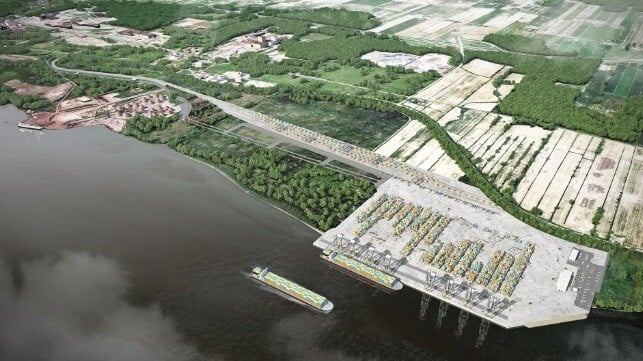
Canada has finally started the construction on the new Contrecoeur container terminal at the Port of Montreal. The megaproject, which was first proposed nearly 40 years ago and has been the subject of delays and controversies, is expected to expand the capacity of the port by approximately 60 percent, making it the largest Atlantic coast port expansion in the country's history. The project will add up to 1.15 million TEU in annual container handling capacity, effectively eliminating capacity constraints that have bogged down the facility.

Prime Minister Mark Carney broke ground on the project, stating that the federal government through the Canada Infrastructure Bank has committed US$839 million in financing. Other financiers include the Government of Quebec that is contributing $94 million and Transport Canada with $108.5 million.

For the current Canadian government, Contrecoeur is a priority project for ongoing efforts to double non-U.S. exports and diversify trade partnerships, particularly in Asian markets. The new terminal will offer the shortest shipping route from North America's industrial heartland to Europe and the Mediterranean, two of the most promising alternative markets for Canadian importers and exporters. To seize this opportunity, the administration launched the Major Projects Office (MPO) in August last year, which streamlined approvals for the project, developed the financing model and helped secure permits in record time.

The project involves the construction of two berths, a container handling area, an intermodal marshalling yard connected to the main rail network, a truck gate connected to the road network, and secondary facilities. Work on phase 1, which includes in-water works such as dredging and quay wall construction, started in October last year; phase 2 is set to begin next year. Commercial operations of the new terminal are targeted for 2030, with DP World Canada having secured the agreement to operate the facility for 40 years.

Montreal has built a reputation as one of Canada's critical gateways to the world, handling over 35 million tonnes of cargo annually and around 2,000 ship calls. The port generates nearly $72.3 billion for the economy annually and supports approximately 590,000 jobs.


Net Zero by 2050? This Decade's Fuel Choices Will Decide

iStock
iStock

Published Apr 12, 2026 2:24 PM by Daniel Bischofberger


Green-hydrogen based synthetic fuels are stalled by a coordination problem across industries. Pooling demand and investment across sectors could unlock the production scale needed for shipping and other hard-to-abate industries, while strengthening energy security in the transition to net zero.

The debate over whether net zero is possible by 2050 may continue for years, while global emissions and temperatures continue to rise. But the question of green hydrogen’s role in achieving it has swung from hype to skepticism to a pragmatic center: shipping and several other hard-to-abate sectors need green hydrogen to reach net zero. Yet, the hydrogen itself remains elusive. Demand waits for supply. Supply waits for demand. It’s an ouroboros.

Technology ahead of fuel

Taking shipping as an example, the industry has innovated and invested in dual-fuel ships capable of running on both conventional fuels and synthetic ammonia or methanol – and these ships are already setting sail. Their engines are designed to use fuel as efficiently as possible: today to reduce emissions from fossil fuels, and in the future, to make the most efficient use of the more expensive synthetic ammonia and methanol.

The problem is that while ship technology ran ahead, the fuel front was stalling.

First, hydrogen fuel production is a massive undertaking: renewable energy, electrolysis, synthesis plants, storage, pipelines, and ports.

Second, the bill. To reach net zero by 2050, shipping alone will need 100 to 150 million tons of green hydrogen annually as feedstock, even at maximum efficiency across the sector. The hard-to-abate sectors together will need 500 to 600 million, an investment of $9 trillion.

So, just for the feedstock, shipping would need to fund $2 to 3 trillion upfront. Which sector can afford today to commit three trillion dollars for a fuel that will be ready in 5-10 years and require upfront purchase contracts of 10 to 15 years?

And yet, that’s the timeline: 25 years to 2050.

The snake eating its tail

Meanwhile, the collapse of hydrogen projects around the world proves that the challenge is more than isolated anomalies; it is systemic.

Underpinning shipping’s deadlocked fuel transition is a set of five tightly linked factors – fuel fragmentation, geography, finance, regulation, and port constraints, that reinforce each other.

First, fuels. In the absence of synthetic fuels, shipping is trying to juggle oil, diesel, liquefied natural gas, and biofuels. This hedging is rational, but it dilutes investment and prevents any single fuel from scaling. It would be comparable to an electric vehicle charging infrastructure with 12 different types of current, which thankfully isn’t the case, or there would probably be no electric vehicles.

Second: geography. Following the oil and gas model, hydrogen production is concentrated in a few nation-scale projects – some as large as half of Switzerland. For shipping, 80% of the global fleet operates on flexible routes. An early market that forces trade to reroute from 6,000 ports to a mere handful of fuel supply hubs will limit adoption. Aviation would face a similar challenge.

Third: finance. Shipping’s low-cost, low-margin business model is predicated on the universal availability of the cheapest fuel in the global mix. Synthetic fuel contracts overturn every precedent: expensive, long-term, limited.

Fourth: regulation. Shipping’s global regulation should be a strength. Global carbon pricing could level the playing field for the entire industry. However, that strength depends on a two-thirds vote from member states. With the onus on national governments and local producers to assemble subsidies, permits, materials, and financing, many are reticent to approve the carbon pricing that would force demand. Aviation faces a similar challenge.

Fifth: ports. Ports are already stretched for power, land, and trained operators. Most cannot justify investment in new bunkering systems without predictable supply and demand.

The ouroboros tightens, and every hard-to-abate sector faces some version of this deadlock loop.

Breaking the loop

There is one way to get the snake to release its tail: give it more to eat – with coordinated demand across sectors.

Both shipping and aviation giants have tried to make their own hydrogen and synthetic fuel supplies. Each industry has tried to pool demand within the industry. It hasn’t worked, because no single company or sector can carry the cost and scale of green hydrogen alone. The balance sheet requires multiple industries. Shared offtake produces contracts large enough to start building, and allows sequential planning. Shared risk makes early projects insurable, and shared infrastructure avoids duplication.

Competition across sectors is stalling production, but collaboration can enable it.

Chance or illusion?

The willingness to embrace cross-sector collaboration depends on whether fossil fuels are still regarded as the safer economic bet.

However, even the oil majors are beginning to question that assumption. Wood Mackenzie estimates that oil and gas production could fall nearly 40% by 2040 without hundreds of billions of dollars in new upstream investment. Oil companies therefore face the same dilemma as hydrogen producers: demand uncertainty is freezing investment on both sides of the energy transition.

In the Asia-Pacific region, that same uncertainty, combined with volatile fossil import supply, is accelerating the shift toward carbon-neutral energy security.

China made that decision before many others had even asked the question. It cornered the global market in critical mineral processing for clean technologies, overbuilt renewables that can now be converted into hydrogen and synthetic fuels, and scaled its shipbuilding industry within four decades. As with electric vehicles, China can absorb early fuel price differentials through subsidies and leverage its domestic market to drive costs down.

China’s integrated energy, industrial, and shipping policy is material to developing the cross-sector sequencing required to make the transition work. Despite its size, it is also bringing smaller, modular e-fuel facilities online faster and cheaper, with one unit producing over 300,000 tons of green ammonia per year, already on export to Asia Pacific and Europe.

In Japan, Korea, and Singapore, the focus is on imports. Utilities are committing to ammonia offtake under national energy strategies, allowing safety standards, terminals, and bunkering systems to develop ahead of shipping demand.

Meanwhile, the Chinese modular approach is already being exported to Brazil. Vast land availability and very low solar power costs give Brazil a strong advantage in exporting synthetic fuels, and the country is already developing the ports of Açu and Pecém as green hydrogen and e-fuel hubs for power generation, industry, and shipping.

Across these cases, the pattern is consistent: land-based sectors lead; investment, risk, infrastructure, and offtake are shared and publicly supported; shipping follows once the regulatory framework is in place.

The decade of decision

At a time when the global debate between reinvesting in fossil systems and accelerating a fossil-free future is hardening once again, which path is industry betting on?

Is net zero possible by 2050? That depends on the decisions taken in this decade. The trade-offs will be felt by the next generation, one way or the other.

The task for industry and institutions is to move beyond siloed efforts and coordinate demand, infrastructure and investment across sectors to build a secure, net-zero energy future.

Daniel Bischofberger is chief executive of Accelleron, a maker of turbochargers, fuel-injection systems and digital technologies for the energy and shipping industries.


The opinions expressed herein are the author's and not necessarily those of The Maritime Executive.
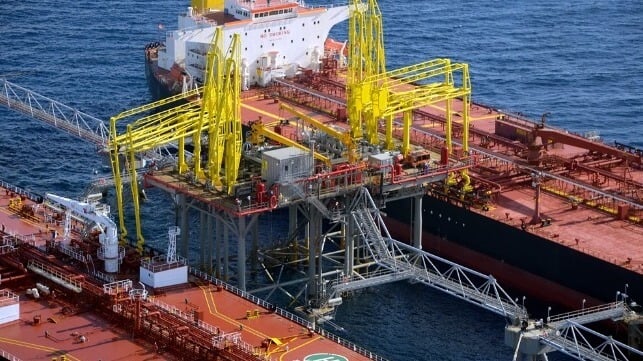
S. Korea Donates Patrol Vessel to Help Ecuador Fight Drug Smuggling

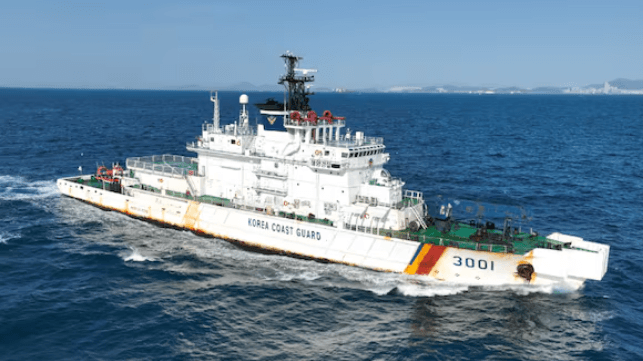
Korea Coast Guard's patrol ship 3001, recently refurbished and painted in haze gray to become BAE Jambeli (Korea Coast Guard file image)

Published Apr 13, 2026 6:05 PM by The Maritime Executive


Ecuador intends to push its full-scale war on drug trafficking and organized crime a notch higher with the impending arrival of a multipurpose vessel that was donated by South Korea in 2024.

The Ecuadorian Ministry of National Defense says that the BAE Jambelí is currently in San Diego, U.S, en route to South America. She is slated to become a key asset in the war against the cartels that have turned Ecuadorian waters into a haven of drug trafficking to key markets in Europe and the U.S.

Christened Jambelí, the vessel is a former Korea Coast Guard ship that was commissioned in 1994. The 3,000-tonnes Tae Pyung Yang-class offshore patrol vessel served for three decades before being decommissioned in March 2024. Measuring 105 meters in length with a 15-meter beam, the vessel underwent full modernization and refitting before departing South Korea in January this year for a 62-day journey.

Upon arrival in Ecuador, the vessel is expected to become a critical asset for the Ecuadorian Navy. Her primary mission will be the fight against drug trafficking and organized crime. Apart from being armed with two 20 mm six-barrel Sea Vulcan cannons, the ship can carry three pursuit boats, a medium helicopter and 60 personnel. Endurance is 40 days, ideal for extended coastal patrols.

Jambelí’s other critical missions will include maritime surveillance and control, search and rescue, deterring illegal fishing and protecting the country’s marine environment off the Galapagos Islands. She also expected to provide logistical support to other military units.

“The countdown has already begun. Ecuador is preparing to receive a new force at sea. The country is strengthened and will not take a single step backwards in the defense of its people,” said the Ministry of National Defense in a statement.

Owing to its geographical location between Colombia and Peru - the world's largest producers of cocaine - Ecuador has in recent years become a key transit country for illicit drugs destined for Europe and the U.S. Recent estimates show that as much as 70 percent of cocaine produced in Colombia and Peru is shipped through Ecuador. The country’s Pacific ports, especially those in Guayaquil, act as the most efficient gateways for bulk cocaine concealed in containerized cargo.

President Daniel Noboa, who came into office in November 2023, has prioritized the war against drug cartels that have seen the country become one of the most violent in the region. Last month, the government deployed more than 75,000 police officers and soldiers in some of the most dangerous regions and is also expanding cooperation with the U.S. military and private security.


Op-Ed: Mideast Conflict Provides a Test of Economic Resilience

Areiram / CC BY SA 4.0

Published Apr 14, 2026 6:13 PM by The Conversation


[By Adi Imsirovic and Antonio Fatas]

The world economy survived the shocks of the Ukraine-Russia conflict, which has had limited impact on economic growth. But the escalation of hostilities in the Middle East has transformed what had been, until early 2026, a surprisingly benign outlook into a far more uncertain one. It has created the ultimate test for how resilient the world economy really is.

Amid stalled ceasefire negotiations, the US president, Donald Trump, has threatened a blockade of vessels transiting through Iranian ports in the strait of Hormuz. This sent oil prices back up over US$100 (£74) a barrel. Meanwhile the current ceasefire is looking very shaky.

The key economic factor in this conflict is straightforward: the near-halting of shipments through the strait and the closure of energy infrastructure.

These elements have disrupted roughly one-fifth of global oil production and nearly another 20% of the world’s trade in liquefied natural gas (LNG). With little spare capacity elsewhere, the result has been a sharp and rapid surge in energy prices.

Forecasts of price surges for benchmark oils

This is a classic energy price shock. The consequences for the world economy are predictable in direction but uncertain in magnitude. The latest interim economic outlook from the Organisation for Economic Co-operation and Development (OECD) projects global GDP growth at 2.9% in 2026. This is almost unchanged from its forecast before the war started.

But the OECD report also highlights the conflict’s expected consequences: energy exporters gain from improved terms of trade, while importers – including most of Europe, Japan, Korea, and much of emerging Asia – face a squeeze on real incomes.

For example, US growth has been revised up by 0.3 percentage points (to 2%) while growth in the euro area and the UK have been revised down by 0.4 and 0.5 percentage points respectively.

When it comes to inflation, exporters and importers face similar cost increases. Inflation is expected to increase everywhere, with headline inflation in the group of G20 countries predicted to rise by 1.2 percentage points to 4%. The European Central Bank (ECB) has made similar predictions for growth and inflation.

But these estimates are based on specific (and possibly optimistic) assumptions about energy prices. In their baseline scenarios, energy prices are expected to peak below US$100 per barrel this quarter and begin falling gradually from the middle of the year – as priced in by oil futures markets.

And what about less benign scenarios such as a resumption of the conflict or Trump’s threatened blockade limiting traffic in the strait of Hormuz? Energy prices could stay higher for longer and would be unlikely to be eased by a temporary ceasefire.

The here and now

The most immediate impact of the war on the global economy has been a sharp shortage of distillate fuels, particularly gasoil and jet fuel. This disruption comes at a time of seasonally high demand, driven by agricultural planting and the approach of peak holiday travel, when air traffic typically rises.

Gulf oil producers are key suppliers of these fuels to Asian markets, leaving countries such as South Korea, Singapore, Taiwan and Australia especially vulnerable to supply constraints.

Compounding the problem, crude oil from the Gulf is particularly suited to producing jet fuel and diesel, and cannot easily be replaced by refining alternative grades of oil. As a result, distillate prices in affected markets have surged dramatically, in some cases rising by as much as 200%.

Further blockage of the strait will starve the global market of at least 10% of its demand. This would result in a “demand destruction” (the curtailment of demand for road and air travel in particular) that can only be achieved through raised prices.

If the war in Iran were to go on just for another couple of months, prices for Brent could reach US$120 per barrel. Six months of conflict could see prices exceed US$200 a barrel. This is because supply losses are cumulative – as commercial and strategic reserves are depleted, the supply risk increases.

Oil price projections if the hostilities continue

The ECB’s March 2026 projections for the euro area incorporate some of these scenarios. For example, in what it calls an adverse scenario where oil prices peak at US$120 and decline slowly, economic growth in the euro area becomes negative for 2026.

And in its most pessimistic scenario, oil prices shoot even higher (US$140), which results in a deeper recession and inflation reaching more than 6%.

The last two scenarios are the perfect example of the stagflationary world that policymakers dread: contracting output and high inflation. In this environment, the levers that they have at their disposal are severely constrained.

Central banks face a classic dilemma: raising interest rates to contain inflation risks slowing growth even more. But cutting them to encourage spending and faster growth risks increasing prices at precisely the wrong moment. The ECB’s data-dependent, meeting-by-meeting approach is the right posture, but it offers no easy exits.

Fiscal policy faces its own challenges. Governments will be tempted to protect households and firms from higher energy costs, as they did after the 2022 energy crisis. Some targeted support for the most vulnerable would be legitimate and necessary, but broad subsidies that suppress energy prices send the wrong signal.

Countries that import energy have become poorer, and policies that negate this fact will only sustain energy demand at a time when the opposite approach is required. Put simply, everyone needs to be more efficient or use less energy. And let’s not forget that governments, because of high levels of debt, now have even less fiscal room to support the economy through this crisis. With no clear path out of the hostilities, the resilience of the global economy is facing a very tough test.

Adi Imsirovic is a Lecturer in Energy Systems, University of Oxford.

Antonio Fatás is a Professor of Economics at INSEAD.


This article appears courtesy of The Conversation and may be found in its original form here

The Conversation

The opinions expressed herein are the author's and not necessarily those of The Maritime Executive.


IMF Warns Against Fuel Hoarding as Reality of Oil Supply Cut Sets In

Damage to the tanker Al-Salmi after an Iranian attack, March 2026 (KPC)

Published Apr 13, 2026 7:49 PM by The Maritime Executive


Following news of a collapse in talks between the U.S. and Iran last weekend and the launch of a new U.S. Navy blockade at the Strait of Hormuz, oil markets are adapting to the prospect of a longer period of supply constraints. Benchmark Brent prices for June delivery remain below $100 per barrel, but the volume of physical barrels has not changed - and the last of the tankers that made it out of the Gulf before hostilities began will finish their delivery voyages soon, to be followed by a gap. 

From here out, energy analysts warn, the world must adapt to the reality of 10-15% less oil until several basic constraints are satisfied: a durable security arrangement at Hormuz that satisfies shipowners; inbound empty tankers arriving at Gulf loading terminals; and a restart of shut-in wells in Iraq, Kuwait, the UAE and Saudi Arabia. As onshore storage is limited in the GCC, the long process of restarting well production cannot begin until empty tankers pass westbound through Hormuz and reach loading berths, thereby providing a tank for the oil to go into. At present, about eight million bpd of wellhead production is offline, according to OPEC; even if the U.S. and Iran conclude a peace agreement, the process of restoring full flow will take several months. 

Adaptations to the limited oil supply are varied, from demand destruction (Sri Lanka and Thailand) to fuel tax breaks (Europe) to product export bans (China). On Monday, the International Energy Agency, World Bank and International Monetary Fund urged national governments to reject the temptation to hoard fuel supplies by closing down exports. "The first principle should be to not impose export controls that only make the imbalance worse," said IMF managing director Kristalina Georgieva at an event sponsored by the Atlantic Council. 

Fatih Birol, head of the IEA, told Reuters that the organization stands ready to authorize an additional release from the international petroleum reserve system. It has already green-lit a coordinated release of 400 million barrels, and has room to go further, though the speed of delivery to the global market is constrained by practical limits of storage and distribution infrastructure. 

How Iran and the U.S. Justify Differing Views on Freedom of Navigation

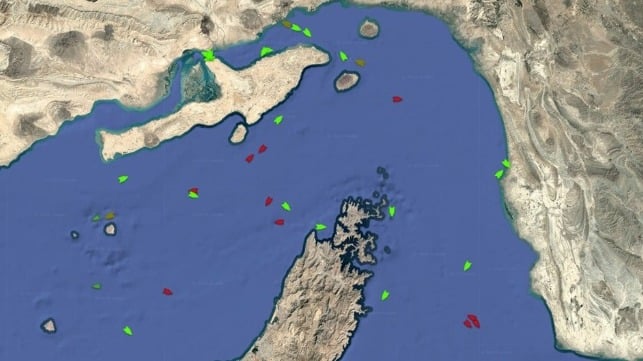
Underway merchant traffic in the Strait of Hormuz, April 15 (Pole Star)

Published Apr 15, 2026 2:20 PM by The Conversation


[By Elizabeth Mendenhall]

The Strait of Hormuz exists in the eye of the beholder.

While everyone agrees that, geographically speaking, it is a strait – a narrow sea passage connecting two places that ships want to go – its political and legal status is rather more complicated.

The United States and Iran both eye the strait – a choke point through which 20% of the world’s oil passes – very differently. Washington sees the Strait of Hormuz as exclusively an international waterway, whereas Tehran sees it as part of it territorial waters.

It follows that Iran’s toll-charging of ships is seen by the U.S. as illegal. Similarly, U.S. President Donald Trump’s blockade of the passage is a “grave violation” of sovereignty to Iran.

As an expert in the law of the sea, I know part of the problem is that the U.S. and Iran are living in two different worlds when it comes to the international laws governing the strait. Further complicating matters, both are in a different legal universe than most of the rest of the world.

The law of the sea

The “law of the sea” is a network of international laws, customs and agreements that set out the foundation for rights of access and control in the ocean. The framework sits apart from the laws of warfare, which are also relevant to the Persian Gulf situation.

The United Nations Convention on the Law of the Sea, or UNCLOS, is a major plank of the law of the sea. Completed in 1982 and in force since 1994, it aims to create a stable set of zones and places – like international straits – where everyone agrees on who can do what. It has been ratified by 171 countries and the European Union, but not Iran or the United States. Iran has signed it but has yet to ratify; the U.S. has done neither.

This means that the rules which almost every country in the world has consented to can’t serve as a basis of agreement over how the U.S. and Iran should govern their actions in the strait during the current war.

The view from Iran

Both Iran and the U.S. agree that under the law of the sea, the Strait of Hormuz is an international strait, but not on what kind of international strait it is. Moreover, they disagree on the relevant laws that exist, and how they apply.

For Iran, the Strait of Hormuz is an international strait as set out under international law predating UNCLOS – notably the International Court of Justice’s ruling in the 1949 Corfu Channel case and the 1958 Territorial Seas Convention.

These older standards state that foreign ships have a right of “innocent passage” through international straits. Put in other terms, this means that if a ship is simply passing through, without doing anything else and without harming the security of the coastal countries, it must be allowed passage.

This gives Iran – and Oman, the strait’s other bordering country – power to make and enforce some rules over passage, such as rules for safety and the environment. They also have wide discretion to decide if passage is “non-innocent” and therefore not allowed. But it does not give them the right to impede innocent passage.

Contrary to the older standard, however, Tehran claims the right to “suspend” passage through its half of the strait, citing the waters as its territorial sea. This is a violation of the 1958 Territorial Seas Convention that Iran relies on for legal support, which says that when a territorial sea is also an international strait, innocent passage cannot be suspended.

The US interpretation

For the U.S., the Strait of Hormuz is an international strait requiring “transit passage,” as per UNCLOS. Although the United States is not a member of UNCLOS, it argues that the agreement’s updated concept of an “international strait” should apply.

Understanding a waterway as the newer type of “international strait,” which requires transit passage, shifts the balance against a coastal country’s control and toward free navigation.

Under this standard, countries bordering straits – like Iran and Oman in the case of Hormuz – must also allow overflight and submarines below the surface. Passage must be allowed so long as it is “continuous and expeditious.”

The U.S. has forcefully asserted this position at sea through regular “Freedom of Navigation” patrols through the Strait of Hormuz and other straits around the world. The patrols are a visible rejection of claims over the ocean that the U.S. deems illegal or excessive.

The basic U.S. argument is supported by some leading legal scholars, such as James Kraska, a professor of international maritime law at the U.S. Naval War College, who decries the Iranian position as “lawfare” and argues that Iran must abide by the compromises made in UNCLOS.

A ‘persistent objector’

But the U.S. is a global outlier here, and one of only a handful of countries – alongside the United Kingdom, France, Australia, Thailand and Papua New Guinea – which argue that “transit passage” is required by custom.

Custom, in this sense, is established if a practice at sea is seen as consistent and is backed by wide agreement over its legality. If something is seen as customary law, it applies to everyone. The only way to prevent a custom from applying to you is through the “persistent objection rule,” which gives a country an exemption to newly emerging standards if it has shown itself to be consistently against it.

Legal scholars are split on whether transit passage is customary law – although law of the sea specialists tend to say it is not.

Tehran argues that even if transit passage were customary international law, Iran is a “persistent objector,” and therefore, the rule doesn’t apply to them.

And it is true that Iran’s objection has been consistent. Both Iran and Oman argued in favor of innocent passage, and against transit passage, at the UNCLOS negotiations.

Iran reaffirmed its perspective upon signing UNCLOS in 1982. Tehran argues that because transit passage is tied up in the compromises made by UNCLOS, only countries that ratify the treaty can claim the right to transit passage – and neither the U.S. nor Iran has ratified it.

Navigating troubled waters

The complex military situation and economic disruption are only part of the story of the Strait of Hormuz.

What lies beneath is a complicated legal situation. Not only do the U.S. and Iran disagree about the legal status of the strait, but the countries that flag oil tankers – and which are therefore responsible for them – must also navigate their own commitments and perspectives under the law of the sea.

Every nation wants to avoid a legal precedent that is contrary to its long-term interests. But for international law to function – to reduce conflict and enable trade – what is needed is an agreement about what rules exist, and a shared commitment to abide by them.

Only that would achieve a stable post-war status for the Strait of Hormuz. How we get there, however, requires navigating some very tricky waters.

Elizabeth Mendenhall is an Associate Professor in the Departments of Marine Affairs and Political Science at the University of Rhode Island. She received her PhD in International Relations from Johns Hopkins University in 2017.

This article appears courtesy of The Conversation and may be found in its original form here

The Conversation

The opinions expressed herein are the author's and not necessarily those of The Maritime Executive.
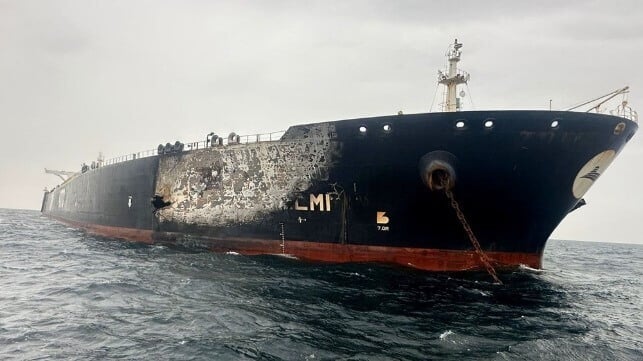
Two Sanctioned Tankers May Have Bypassed U.S. Navy Blockade on Iran

Vesselfinder
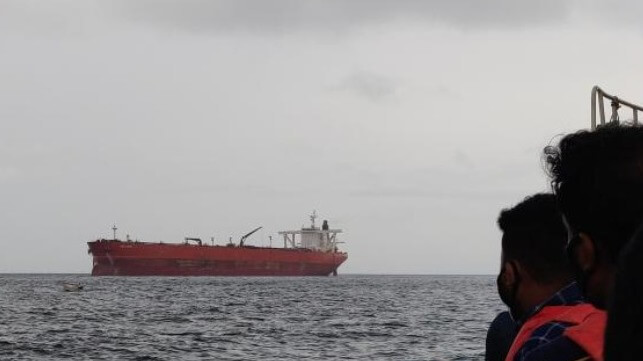
The VLCC Alicia (VesselFinder / Chinmaya Mohapatra)

Published Apr 15, 2026 6:26 PM by The Maritime Executive


Despite U.S. Central Command's claims of a total lockdown of Iranian shipping, vessel tracking consultancies have identified Iran-linked, sanctioned tankers that appear to have transited the Strait of Hormuz without difficulty - with AIS enabled and publicly broadcasting their positions. AIS data can be manipulated, and the transits could not be immediately confirmed.

Within the last 24 hours, two sanctioned "shadow fleet" VLCCs - identified as IMO 9208215 (current name Rhn) and IMO 9281695 (current name Alicia) - appear to have transited the strait en route to Iran, according to TankerTrackers.com. Iran has officially claimed that the Alicia made a successful transit. 

Together, the VLCCs have the capacity to take on about four million barrels of Iranian oil, which would be valued at about $400 million (if they can exit the Gulf and deliver to Iran's largely Chinese customers). Even without making the return journey out of the Gulf, they would still provide Iran with extra floating storage, enabling another three days of continued production without shut-ins. 

The tankers' destination was predictable. "These two dames of steel have transported 60 million barrels of Iranian crude oil since 2023," wrote TankerTrackers.com.

CENTCOM maintains that the blockade is airtight, and says that it has already turned around about 10 outbound vessels with links to Iran. "American forces halted economic trade going into and out of Iran by sea," the command said in a statement Wednesday. "During the first 48 hours of the U.S. blockade on ships entering and exiting Iranian ports, no vessels have made it past U.S. forces."

So far, the U.S. Navy has not announced any boarding, search and seizure operations in connection with the blockade. An opposed boarding would be a step change in the campaign, and would be viewed as a violation of flag state sovereignty; the U.S. is said to be close to resuming formal peace talks with Iran, and may wish to avoid an escalatory act pending further diplomatic developments.

Shipping has been forewarned about the possibility of a boarding. U.S. forces have issued a stern notice to mariners, advising that any passing vessels could be "subject to interception, diversion, and capture" if it is discovered that they are headed to or from Iranian ports. 

"Neutral vessels may still be subject to the right of visit and search to determine the presence of contraband cargo," the NOTAM advises. "Humanitarian shipments including food, medical supplies, and other goods essential for survival of the civilian populations will be permitted, subject to inspection."

Vessels that are headed to and from ports in other GCC nations are explicitly allowed to pass the U.S. naval cordon. AIS data suggests that among neutral vessels that choose to make a Hormuz transit, many appear to be taking the Iranian-controlled "Tehran Tollbooth" route near the island of Larak, complying with the terms of the Iranian blockade as well as the U.S. blockade. This includes the first unsanctioned, "clean" supertanker to make the crossing since the start of the U.S. blockade, the Malta-flagged Agios Fanourios I, transiting in ballast and bound for Iraq.

Top image: The sanctioned VLCC Alicia (VesselFinder / Chinmaya Mohapatra)


U.S. Treasury Takes Aim at Iran's Shamkhani Shipping Network

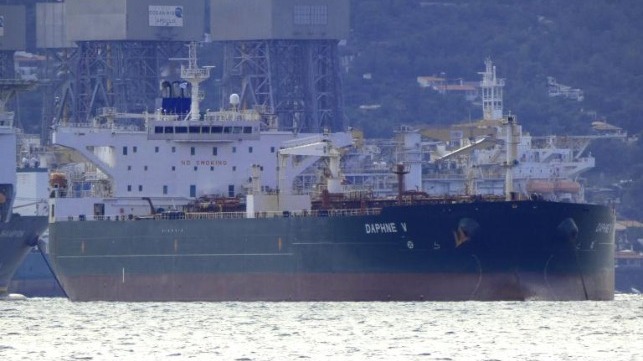
Daphne V, one of the vessels sanctioned in Wednesday's action (VesselFinder / Giwrgos Mertis)

Published Apr 15, 2026 10:02 PM by The Maritime Executive


The U.S. Treasury is once again taking aim at the network of Iranian "shadow fleet" industry leader Mohammad Hossein Shamkhani, son of senior Iranian advisor Ali Shamkhani, who was killed in an airstrike in February. The Shamkhani shipping network has moved millions of barrels of oil for the Islamic Revolutionary Guard Corps (IRGC), and it is a primary target of Treasury's "maximum pressure" campaign on Iran's energy exports. In the latest round announced Tuesday, the department blacklisted nine vessels and more than a dozen companies and individuals linked to Shamkhani. 

The Shamkhani network operates through reputable-looking front companies, many in the United Arab Emirates, where foreign interests intermingle in a lightly-regulated "free zone" business environment. In this new round of actions, Treasury sanctioned the holding company Oriel Group and a constellation of related Shamkhani affiliates, all based in the Emirates. These include Corplinx Consultancy; House of Shipping Investment FZCO; Meritron DMCC; Helmatic Consultancy DMCC; and Taylor Shipping FZCO. 

Treasury also targeted more shadow-fleet vessels operated by the Shamkhani network, to include Aura (IMO 9274563), Horae (IMO 9413004), Versa (IMO 9379301), Anaya (IMO 9326885), Daphne V (IMO 9321677), Silvar (IMO 9291262), Cauveri (IMO 9282508), Bellaris (IMO 9332614), and Anika (IMO 9417464). 

The new sanctions on the Shamkhani arrive just as Iran's state oil company is said to be shifting its trading and shipping operations back in-house, an adaptation to the high fatality rate among IRGC members who previously coordinated the gray-market trade. State-run news agency IRNA and Iranian outlet Tehran Times both claimed this week that the National Iranian Oil Company (NIOC) will take back exclusive control over the sale of the nation's oil - a shift away from the informal sales network operated by the IRGC.

As an additional action, Treasury also sanctioned an Iranian oil-for-gold trading scheme that provided support for the government of former Venezuelan dictator Nicolas Maduro (now under arrest in the U.S.). The department identified Iranian national Seyed Naiemaei Badroddin Moosavi as a facilitator for the IRGC's oil sales, the profits from which were used to underwrite Lebanese terrorist group Hezbollah, an IRGC proxy force. One such scheme involved shipping Iranian oil into Venezuela in exchange for gold from the Maduro regime. The gold would then be resold in overseas markets.

Treasury identified two UAE-based companies, ACS Trading and Lotus Universal, as linked to Moosavi. An additional affiliated firm, ACS Global, is based in the Netherlands, the department said. 

Top image: VesselFinder / Giwrgos Mertis


U.S. Navy Redeploys for Next Phase of Gulf Operations

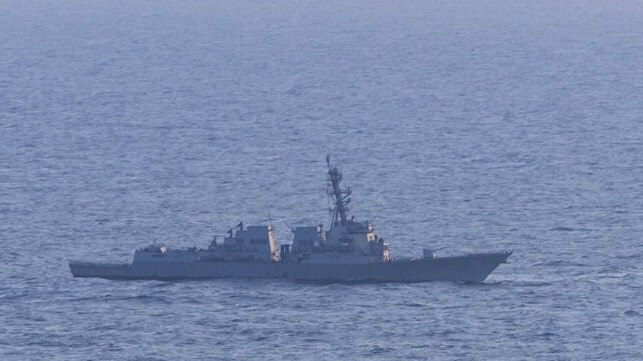
A U.S. Navy destroyer patrols the blockade zone in the Gulf of Oman, April 2026 (CENTCOM)

Published Apr 15, 2026 4:50 PM by The Maritime Executive


The US Navy is presently navigating an intensely complex geopolitical situation, balancing its deployments not only so as to be able to resume active operations against Iran in a week’s time, if the ceasefire should not be extended, but also shuffling assets for both deterrence and other contingencies.

The world’s attention is focused on the Strait of Hormuz and its approaches, as Central Command imposes a blockade on Iranian ships and those seeking to leave or enter Iranian ports, both within the Gulf and on the Gulf of Oman coast. So far, it seems as if CENTCOM has been able to impose effective control via radio communications with potential blockade-runners, without needing to physically board ships. But the naval presence is on hand to intervene physically – and also ready to resume active war fighting, at very short notice.

The contingency reinforcement appears to have two major elements. The San Diego-based Wasp Class landing ship USS Boxer (LHD-4), with F-35Bs and the 11th Marine Expeditionary Unit aboard, is a week away from reinforcing the Japanese-based USS Tripoli (LHA-7), which with the 13th Marine Expeditionary Unit aboard is already in the CENTCOM area. Ready to reinforce the USS Abraham Lincoln (CVN-72) CSG also already active in the Arabian Sea, the USS George H.W. Bush (CVN-77) CSG, last seen off Namibia, appears to be heading for the Cape of Good Hope escorted by Arleigh Burke guided missile destroyers USS Donald Cook (DDG-75), USS Mason (DDG-87) and USS Ross (DDG-71), supported by the fast oiler USNS Arctic (TAOE-8).

The dispatch of the USS George H.W. Bush CSG on the long route from Virginia to the Arabian Sea suggests a desire not to provoke the Houthis into closing the Bab el Mandeb. The Iranians would dearly love the Houthis to do so at this particular juncture, when they are pressured and under blockade. But the United States is maintaining the ceasefire and providing no pretext for doing so – while still advertising a capability to respond should the Houthi leadership choose to resume their attacks on shipping.

In the meantime, the United States maintains a discreet presence in the northern Red Sea with Arleigh Burke guided missile destroyers USS Bainbridge (DDG-96) and USS Thomas Hudner (DDG-116), supported by Poseidon P-8A surveillance flights over the area. Keeping the Red Sea open for transit of oil from Yanbu to Asia is clearly extremely important for Saudi Arabia, so a non-provocative but ready-to-respond stance is clearly what is needed.

Should the blockade of Iranian ships and ports continue successfully, the next phase is likely to be the further roll-out of the mine clearance operation in the Strait of Hormuz. This will need those additional strike assets coming into theater, to deter and provide a response to any attempt by Iran to interdict shipping, but also a specialized mine clearance capability.

This appears to be on the way in the form of two Japanese-based Avenger Class mine countermeasures ships USS Chief (MCM-14) and USS Pioneer (MCM-9), which left Singapore heading west on April 10. These two ships are of the same class as the four minesweepers which were withdrawn from Bahrain immediately prior to the war.

Minesweeping-equipped Littoral Combat Ships USS Canberra, USS Tulsa and USS Santa Barbara departed the Gulf region prior to the beginning of hostilities, the latter two vessels ending up in Singapore; Canberra is reported to be under way in the Indian Ocean, and USS Tulsa was spotted transiting the Strait of Malacca westbound on April 3. There are also reports that the Royal Navy’s RFA Lyme Bay (L3007) is preparing to forward-deploy to Duqm in Oman with remote-controlled surface and submersibles, plus the Royal Navy’s Mine and Threat Exploitation Group on board. The Lyme Bay is still in Gibraltar, 10 day’s sailing from Duqm.

Completing the precautionary deployments, in the Eastern Mediterranean the USS Gerald R Ford and her escorts - including three Arleigh Burke-class destroyers - are 175 nm south of Cyprus, ready for an escalation of fighting both in Lebanon and Israel.

The presence off the coast of Ecuador of the carrier USS Nimitz (CVN-68), escorted by Arleigh Burke destroyer USS Gridley (DDG-101), raises the intriguing possibility that it too is well-positioned to act as a reinforcement for CENTCOM. The Nimitz is heading in the right direction as it is due to round the Cape of Good Horn en route to Norfolk, Virginia, and scheduled for retirement. But the US Navy has recently announced the Nimitz will be kept in service for additional 10 months due to the delayed delivery of USS John F. Kennedy, the second Ford-class carrier. 

The US Navy is certainly stretched, perhaps more so than at any time in the last 50 years. But balancing a readiness for operations with positioning to act as an effective deterrent, it is coping admirably with multiple, conflicting and sometimes unpredictable political priorities, in an exemplary manner which no doubt will feature strongly in future naval histories.