It’s possible that I shall make an ass of myself. But in that case one can always get out of it with a little dialectic. I have, of course, so worded my proposition as to be right either way (K.Marx, Letter to F.Engels on the Indian Mutiny)
Friday, June 27, 2025
Iranian Naval Forces Suffered Casualties From Israeli Air Strikes
Iranian ship Saviz (Tasmin News Agency - CC BY 4.0)
Iranian naval forces did not escape unscathed in the recent 12-day Israeli aerial assault on Iran that began on June 12.
In the first two days of the Israeli attack, regular Iranian Navy (Nedaja) vessels largely remained in port. As naval vessels are at their most vulnerable when tied up in port, this move suggested that the Nedaja command was putting on a non-confrontational display, which assumed that Israel’s targeting priorities would be elsewhere. But on June 14, Nedaja vessels left the Bandar Abbas Naval Harbour - which is home base to most of the principal ships Nedaja Southern Fleet - in somewhat of a hurry, taking up dispersal positions largely in the sea area between Bandar Abbas and the islands of Qeshm and Hormuz. As of June 27, the fleet has not yet returned to port.
Seen now in retrospect, the targeting focus of the Israeli attacks was evidently air defense assets, nuclear weapons-associated research, development and scientists, key IRGC leaders, and the IRGC Aerospace Force network of ballistic missile and drone launching, storage and production sites. Except for those elements of the air defense network which were manned by the regular Iran Air Defense Force - who suffered 35 fatalities during the 12-day war - almost all of this target deck fell under the organizational structure of the Islamic Revolutionary Guard Corps (IRGC). Thus, the Nedaja’s initial assumption that they would not be a targeting priority turned out to be largely correct.
However, the regular Armed Forces (Artesh) were not exempt. The Artesh Chief of Staff Major General Mohammad Bagheri, assassinated on June 13, was probably targeted because besides being a hardline ideologue, he was determined to be significantly more competent than anyone likely to succeed him. Additionally, it has emerged that the Nedaja was targeted on a number of other occasions.
The three Nedaja fatalities of the attack on Bandar Abbas
On June 21, buildings of the Nedaja’s 1st Naval District at Bandar Abbas were attacked, and three conscripts were killed. This suggests either that a headquarters building was attacked which was not manned at the time, or that a storage depot was hit. In either case, the conscripts who died were likely to have been guarding the facility. Social media reports suggested that the targets attacked were armories containing unmanned aerial vehicles and munitions. By this time, ships of the 1st Naval District had already long since left the nearby Bandar Abbas naval harbor.
The Israelis would have had a focused interest in attacking those elements of Nedaja's capability that posed a particular threat to Israel. This target list is likely to have included stocks of Abu Mahdi 650-mile range anti-ship missiles, which can be launched either from ships or coastal defense batteries. The Israelis would also have wanted to destroy long-range drones, which the Nedaja has often demonstrated it can fire from its warships.
Abu Mahdi anti-ship missile (IRIB)
The IRGC Navy (Nedsa) suffered more attention. Also on June 21, the base of the Nedsa’s 5th (Imam Mohammad Bagher) Naval District at Bandar Lengeh was attacked, which is one of the suspected locations of an IRGC coastal cavern housing missile boats; an unlocated such cavern has featured frequently in Nedsa propaganda videos released in recent months. At the same time, what the Israelis described as an IRGC intelligence gathering ship was struck in the Nedsa area of the Bandar Abbas Naval Harbour. Some external open source observers suggested that the vessel attacked was the Nedaja intelligence collection frigate IRINS Zagros (H313), but the target description better fits either the Nesda’s MV Saviz or Behshad; up-to-date imagery of the areas where these ships normally berth, in the Shahid Bahonar area in the north-west of the Bandar Abbas Naval Harbour, unfortunately, does not provide easy identification of who exactly was the targeted victim.
As yet, a threat to shipping traffic in the Straits of Hormuz has not emerged. But ships of both the Nedsa and the Nedaja are still at sea, likely to be putting on a display of strength in the Straits area in an attempt to suggest that they are still a force to be reckoned with.
Constant GPS Jamming Disrupts Navigation in Strait of Hormuz
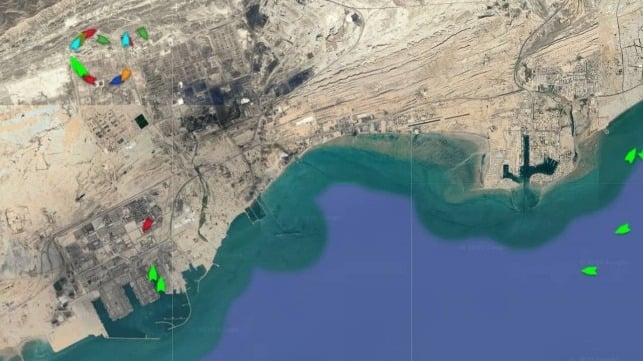
AIS signals from a dozen vessels circle over the Persian Gulf Star Refinery near Bandar Abbas, top left, June 26 (Pole Star)
With a U.S.-brokered ceasefire between Israel and Iran in effect, traffic in the Strait of Hormuz has returned to near-normal levels, including a revival of westbound transits into the Arabian Gulf. But the intense levels of GPS jamming in the region remain an issue, and are hindering navigation.
Last weekend, GPS jamming incidents surged by 60 percent, affecting about 1600 vessels (including small craft), according to consultancy Windward. At peak, nearly one quarter of all vessels in the region experienced GPS disruption at least once in a 24-hour period.
The jamming has affected AIS signals across the area - not just on the Iranian side of the Gulf, but in the UAE and Qatar as well. Crude tankers, product tankers, large boxships and LNGCs were among the vessels affected.
The disruption has prompted shipping stakeholders to take precautionary measures. QatarEnergy has reportedly halted nighttime movements of tankers and LNGCs near Mesaieed, citing safety concerns from GPS jamming affecting navigation.
On Tuesday, Navios Maritime Partners CEO Angeliki Frangou told CNBC that "continuous" GPS interruption is affecting safety in the Strait of Hormuz, and that some operators are modifying their itineraries to account for it. Liners, in particular, are waiting to transit the strait in daylight hours, she said.
"They don’t want to pass during the nighttime because they find it dangerous. So it’s a very fluid situation," Frangou said. "Safety conditions are something that is at the forefront of our minds. This is why we are constantly monitoring all this."
Windward has also found that some operators have been using AIS to broadcast conciliatory messaging in hopes of deterring Iranian attack. About 55 vessels used novel messages during the peak period of tensions from June 12-24, the firm told Reuters. Some of the messages are familiar from patterns seen in the Red Sea and Gulf of Aden during the Houthi shipping crisis, when many masters would type in the destination field on their AIS unit as "China owned" or "Russian crude" and then broadcast this signal to the world. The strategy was intended to make the vessel appear like an unsuitable target.


No comments:
Post a Comment