Sanctions on Ice-Class LNGCs Could Halt Russia's LNG Exports
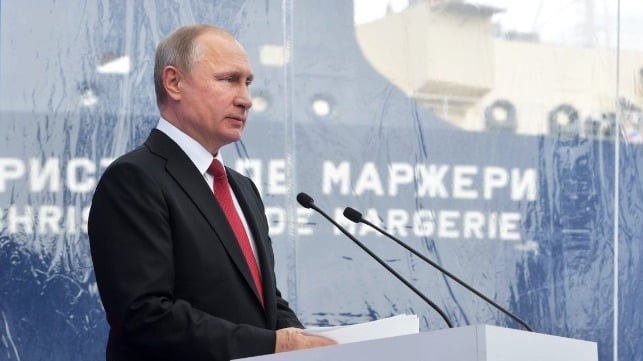
Russia's Yamal LNG plant in the Siberian Arctic is one of the country's last remaining sources of energy sales to European markets. Last year, Yamal LNG sent about 16.6 million tonnes to Europe, supplying fully 20 percent of the bloc's imported liquefied natural gas - even though the EU has largely shut off Russian oil and pipeline gas, steps taken in order to reduce the Kremlin's revenue for its war in Ukraine.
Though it continues to buy Russian LNG at record rates, the EU has taken the step of banning Russian LNG transshipments through EU ports. Yamal operator Novatek once relied upon ports in France and Belgium to transload and re-export LNG to markets overseas, like China. The use of these EU-based LNG terminals allowed Novatek to shorten the voyages of its unique icebreaking LNG carriers, freeing them up for more trips to and from Yamal.
This arrangement has come to an end: the EU ban on Russian LNG re-exports took effect in March 2025, and is now in force. To adapt, Novatek began transshipping its Yamal cargoes off the coast of Murmansk - but these activities are still within the reach of EU and UK sanctions, according to the Center for Research on Energy and Clean Air (CREA).
This alternative is less efficient, according to CREA's Petras Katinas. Yamal LNG's transshipment volume is down by nearly half, suggesting that Murmansk is less ideal than the EU ports that handled these cargoes previously (particularly Zeebrugge). " The increased voyage distances and operational complexity are likely contributing to higher costs, longer delivery times, and mounting logistical bottlenecks," says Katinas.
However, there is potential for European governments to show this system down even more. Yamal LNG is wholly reliant on its fleet of 15 icebreaking LNG carriers to carry its cargo to Murmansk. Though they only serve Russia's Northern Sea Route, they are operated by shipping companies in Greece, Japan, the United Kingdom, and Singapore. All 15 are insured in nations that comply with G7 sanctions, including the UK, Japan and the Bahamas.
These vessels are not easily replaceable: Novatek has been trying to build additional hulls at Zvezda Shipyard in the Russian Far East, with encouragement from the Russian government, but the project has been delayed by sanctions. If the Western operators of the existing hulls were forced to cease serving Yamal, it would put a significant dent in the facility's ability to export, especially during the long Arctic winter.
In addition, most of the conventional LNG carriers that meet up with the Arc-7s for transshipment are also Western-operated, and could also be vulnerable to sanctions if implemented.
"Moscow’s workaround relies heavily on Western-built, Western-owned, and Western-insured vessels — an undeniable vulnerability that the West has yet to exploit fully. The genuine strategic opportunity lies in targeting this dependency directly, by banning transshipment operations involving Western-controlled ships and tightening restrictions on their insurance and port access," suggested Katinas. "As long as these vessels remain operational under Western ownership and insurance, sanctions will only create bottlenecks — not a blockade — that Russia can still navigate."
Sanctioning Yamal LNG's logistics system in a way that still preserves Russian LNG exports to Europe would be a challenging balance to strike. But the EU Commission has proposed a gradual phase-out of all Russian natural gas from the European market, including LNG, which - if adopted - would bring an end to Europe's own dependence on imports from Yamal.
Royal Navy Tracks Russian Warships in a Game of “Cat-and-Mouse”
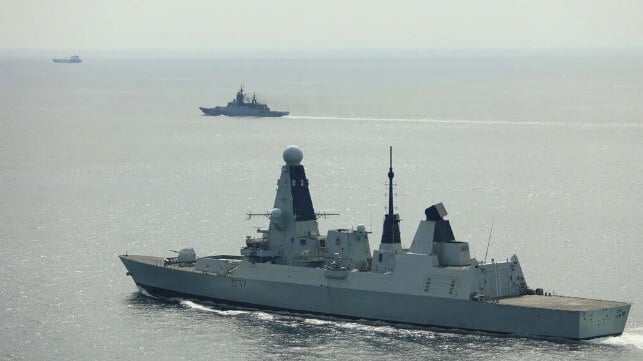
Days after it came out that a Russian warship had sailed with two sanctioned shadow fleet tankers through the English Channel and North Sea, the Royal Navy confirmed it was tracking the warship as part of its standard monitoring efforts. It was the fifth activation this year for Royal Navy vessels based in Portsmouth to track Russian warships in UK waters.
“Russian warships are increasingly sailing through the English Channel, and every time they do, a Royal Navy vessel will be keeping an eye on them,” said Luke Pollard, UK Minister for the Armed Forces. “I have every confidence, as should the British public, that our Royal Navy will continue to defend our waters and keep our undersea cables safe.”
The corvette Boikiy (2,100 tons displacement), a Steregushchy-class corvette, has drawn special attention and media coverage for its efforts transiting the English Channel. The vessel was commissioned in 2013 and, of late, has been seen on several occasions sailing with merchant ships. The Royal Navy previously reported in March and early May that it tracked the same vessel during transits of the English Channel.
BBC Verify confirmed online open source reports that Boikiy made the most recent transit last weekend concealing its identity. While it notes that it is common for warships to sail without AIS signals, Boikiy was transmitting a generic ID during its transit. BBC quotes an analyst who called the “camouflaging” episode “very, very uncommon.”
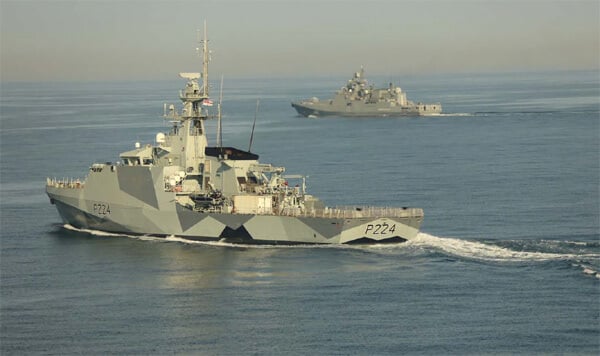
HMS Trent tracked a Russian frigate as part of a NATO effort (Royal Navy)
The Royal Navy reports it had been tracking Boikiy for some time deploying multiple vessels. In May, HMS Tyne tracked the corvette, and last week HMS Duncan picked up the vessel near the southwestern end of the Channel on June 20. BBC reports the corvette was traveling back from West Africa, and a diplomatic visit to Conakry, Guinea, after earlier reports had identified the ship traveling with merchant ships as it passed Gibraltar.
HMS Duncan used its sensors and radar to track Boikiy and the Royal Navy notes that they observed the corvette is now missing an anchor. HMS Mersey assumed the tracking effort off the Isle of Wight on June 21 and followed the corvette, which was with the two tankers until they exited into the North Sea.
Lieutenant Commander Daniel Wardle, Commanding Officer of HMS Mersey, noted it was “routine business for the Royal Navy,” tracking the vessels.
The Royal Navy also reported that another of its vessels, HMS Trent was tasked to track the Admiral Grigorovich, a 4,000-ton displacement guided missile frigate. The Royal Navy vessel performed the monitoring as a joint effort with NATO, picking up the Russian warship as it passed Gibraltar. They also employed a Wildcat helicopter for the monitoring as they made their way through the English Channel and into the North Sea. HMS Trent was returning to the UK after four years overseas on missions that took it to the Mediterranean, West Africa, and the Caribbean.
No comments:
Post a Comment