WAR ON THE DRUZE
Dilemma in Damascus: What next for Syria after Suweida violence?
Bedouin-Druze violence in Suweida and Israeli military aggression in the province have laid bare the enormous challenges facing Syria's new authorities

Analysis
Cian Ward
19 July, 2025
THE NEW ARAB
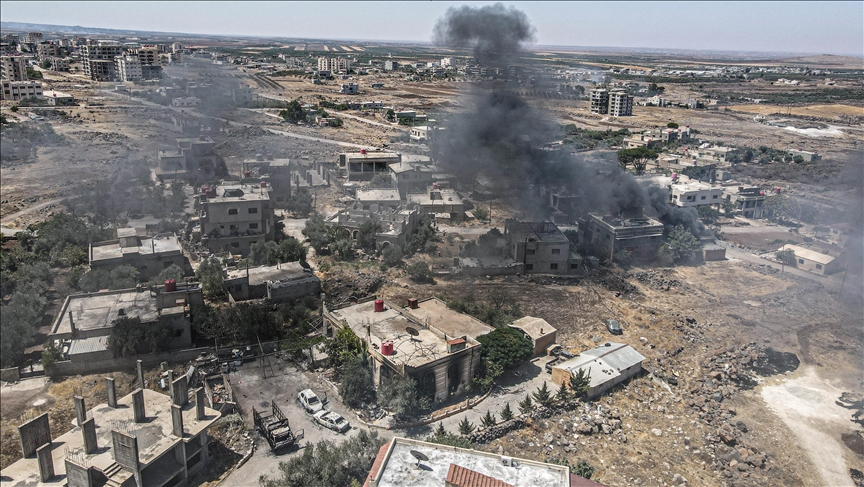
The ground in Syria has fundamentally shifted following days of escalating fighting in the southern region of Suweida.
The conflagration began as communal clashes between Bedouin and Druze communities following the reported kidnapping of a Druze man by Bedouin gunmen on 11 July.
Over the subsequent days, a cycle of reciprocal attacks raged, until Damascus announced the intervention of its security forces last Monday, in what was nominally a peacekeeping operation.
However, the result was the exact opposite of peacekeeping, as government forces quickly became entangled with Druze militias, and violations committed by government-affiliated forces emerged online.
The Druze spiritual leader Hikmat Al-Hijri reversed his initial acceptance of Damascus’ intervention, instead calling on the Druze to “confront this barbaric campaign”.
Israel soon intervened, launching a blistering campaign of airstrikes against government forces, ostensibly to protect the Druze minority, that culminated in the bombing of the Ministry of Defence building in the heart of Damascus.
By Wednesday evening, a US-mediated ceasefire had been agreed, with government forces withdrawing from the region, and Syrian President Ahmad Al-Sharaa announcing in a televised address that he would “assign local factions and Druze religious leaders the responsibility for maintaining security in Suweida”.
However, on Thursday, retaliatory killings targeting Bedouin communities in Suweida sparked a general mobilisation of the Bedouin tribes, heralding that the conflict is far from over.
Cian Ward
Tensions in Suweida between Bedouin and Druze had been building for months, “reflecting a continuity of chronic insecurity across southern Syria that has persisted since before the fall of the former regime,” Aymenn Al-Tamimi, a British-Iraqi translator and historian specialising in Syria, told The New Arab.
Many of the state's basic security functions collapsed in southern Syria during the civil war, with criminality becoming prevalent as the regions of Suweida and Daraa grew into key captagon smuggling routes into Jordan and the Gulf.
Following the fall of the regime in December, Damascus and Druze leaders agreed upon a security settlement which forbade government security services from entering the province, and left the Druze militias as the primary security providers in the region.
However, these militias refused to extend their security umbrella into the Bedouin communities, fearing their presence could spark communal violence. As a result, many Bedouin villages on the fringes of the province were left as pseudo-lawless spaces that were frequently penetrated by outside actors who entered to commit violence.

These acts served to deepen suspicions between the communities and would sporadically set off a cycle of communal recriminatory attacks. This is what happened on 11 July, except this time, local notables were unable to rein in the escalatory cycle before it was too late.
Things worsened after a government “miscalculation that they could keep solving Syria’s security crises by coercive means alone,” Nanar Hawach, Senior Analyst at the International Crisis Group, told TNA.
The security services had previously deployed into the Damascus suburbs of Jaramana and Ashrafiyat Sahnaya to quell communal violence between Sunni and Druze at the end of April.
However, this time their forces were quickly implicated in severe violations. Videos emerged online of the execution and public humiliation of prisoners and civilians. One video depicts fighters shaving off the moustache of 80-year-old Sheikh Marhej Shaheen in the village of Al-Thaala.
In the old quarter of Suweida city, 18 members of the Al-Rawad family were murdered in their home on Tuesday.
Hawach identifies one of the root causes of these violations as the government's “exclusive approach to governance and failure to adequately integrate minorities within its security apparatus”.
He argues this serves to “embolden” actors who feel they have a close affiliation with the centre of power in Damascus to commit violations without the risk of accountability, at the expense of those groups who have been marginalised in Syria’s new power structure.
These violations have only “served to send a message to the armed factions, that their only leverage lies in their weapons”.
Alex Martin Astley
Impact on the government
The Syrian government “finds itself in a weakened position having overplayed its hand and suffered a serious military defeat” in Suweida over the last several days," explains Al-Tamimi.
Government forces withdrew after “taking heavy losses from the Israeli airstrikes and resistance on the ground,” he adds, which he believes will now strengthen Israel’s hand to dictate terms in southern Syria.
This ceasefire was in essence a return to the security settlement that was in place before the fighting, which forbade government security services from entering the region, except, “what was once a diplomatic pact reached mutually between the two sides is now a military settlement backed up by Israeli airpower,” says Al-Tamimi.
This heavily limits the government's room for manoeuvre in the region and is likely to embolden the Druze to seek more favourable conditions. Sheikh Hikmat Al-Hijri has begun calling for corridors to be opened between Suweida, Jordan, and the Syrian Democratic Forces (SDF) in the country’s northeast, respectively.
According to Al-Tamimi, one of the most significant outcomes is that it dealt a “blow to the idea that the government firmly imposing its control over the whole country is a matter of inevitability”.
This has major implications for the government's negotiations with the SDF over the future of the country’s north-east, which remains in their hands, and have stalled in recent months. “[the SDF] will look at this and think if these sectarian violations happen even when they are invited in, why should we disarm”.
However, the flip side is that the government, having witnessed how potentially damaging such a military option can be, may be more reluctant to enforce a military solution on the SDF.
For the Druze, there is a perception that the threat is now “existential,” argues Makram Rabah, Assistant Professor of History at the American University of Beirut, which has had the effect of “uniting the Druze militias” in the face of the threat, despite bickering between the leadership.
This weakens Ahmed Al-Sharaa’s chances of reaching a political settlement whilst fighting is ongoing, he adds.
 Some analysts say the Syrian interim government now finds itself in a weaker position after the violence in Suweida. [Getty]
What comes next?
Following the announcement of the ceasefire and the withdrawal of government forces from the region, a string of what Hawach describes as “systematic killings” were committed by Druze forces on Bedouin communities throughout Thursday.
On Friday morning, the leaders of several Bedouin tribes announced a general mobilisation, as armed columns began moving south from across the country. The scale of the mobilisation appears significant, with tribal groups mobilised across several provinces.
Sheikh Hikmat Al-Hijri has subsequently reversed his denunciation of government forces entering the region, instead demanding, via sources speaking to Al-Jazeera, that Damascus send peacekeeping forces to the region.
“What happens next depends upon whether the government allows these formations to pass,” argues Hawach.
Hugo Goodridge
However, it remains unclear if the government has the capacity to stop the tribal fighters. They could attempt to physically block their passage on the roads, which itself could be inflammatory, or lean on the Bedouin leadership to recall its men.
On Saturday, Syrian interior ministry forces began deploying in Suweida as part of a US-brokered deal to prevent further Israeli military intervention in the province.
Despite Al-Sharaa announcing an "immediate ceasefire" which he called on all parties to “fully respect”, the truce remains fragile, with rocket fire and gunfire reported between Bedouin and Druze fighters.
The Israeli dimension also remains unclear. They could restart their air campaign in ‘defence’ of the Druze and may hold Damascus culpable for failing to halt the mobilisation of the Bedouin.
Damascus now finds itself standing under an international spotlight, stuck in the middle of a raging blood vendetta far more severe than anyone could have predicted. How it responds may be a defining moment for this young government.
Cian Ward is a journalist based in Beirut, covering conflict, migration, and humanitarian issues
Follow him on X: @CP__Ward
Syrian troops move into Suwayda as violence continues

One day after reaching a ceasefire with Israel, Syrian military forces began moving into the country’s Suwayda Governorate (pictured) where dozens of people have been killed in recent days amid fighting between warring tribes.
July 19 (UPI) -- One day after reaching a ceasefire with Israel, Syrian military forces began moving into the country's Suwayda Governorate, where dozens of people have been killed in recent days amid fighting between warring tribes.
"Internal Security Forces have begun deploying in Suwayda province as part of a national mission with the primary goal of protecting civilians and restoring order," Syrian Interior Ministry spokesperson Nour al-Dean Baba told CNN in a statement, adding the move came "following the bloody events caused by outlaw groups."
This past week has seen continued fighting in southern Syria between several of the country's minority groups, including the Arab Druze and Bedouins.
At least 30 people were killed and over 100 injured during clashes between armed groups on Monday in the Suwayda Governorate capital city of As-Suwayda.
Related
Syria's president accuses Israel of 'trying to drag us into war'
30 killed in sectarian violence in Syria
That fighting continued Saturday, with further violence between Bedouin and Druze factions. Witnesses reported sporadic gunfire and columns of smoke in the city, which has a population of around 138,000 people in its metropolitan area.
"Syria is not a playground for separatism or sectarian incitement. Now more than ever, it is essential to return to the path of reason and come together on a unified national foundation," Syrian President Ahmed al-Sharaa said in a speech Saturday on state TV, translated to English by CNN.
He added the continued fighting was a "dangerous turning point in Syria's security and political landscape."
On Friday, al-Sharaa said his country had reached a ceasefire with Israel, after the Israel Defense Forces intervened in Syria.
Israeli warplanes bombed parts of Syria, including the capital of Damascus. Israel's Prime Minister Benjamin Netanyahu said the move was meant to protect the Druze minorities, which are also prevalent in Israel.
At the time, al-Sharaa accused Israel of "trying to drag us into war."
July 19, 2025

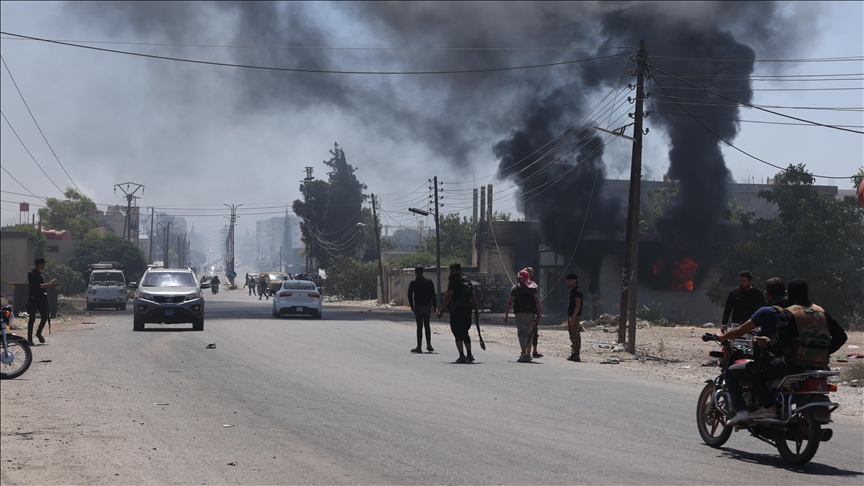
Security forces redeployed to protect civilians, preserve territorial integrity, and maintain public security as clashes continue between Bedouin Arabs and some Druze armed groups in Syria’s southern Suwayda province on July 19, 2025. [İzettin Kasım – Anadolu Agency]
Armed clashes continued Saturday between Bedouin tribal fighters and local armed groups in Suwayda, Syria even as internal security forces began deploying across the province to implement a nationwide ceasefire agreement, Anadolu reports.
According to the state-run news agency SANA, security units have already started their deployment in and around Suwayda to enforce the terms of the ceasefire and help stabilize the situation.
However, intense fighting remains underway in parts of the province, it said.
Earlier on Saturday, the Syrian presidency announced a comprehensive and immediate ceasefire following days of unrest in the southern province.
On July 13, clashes broke out between Bedouin Arab tribes and armed Druze groups in Suwayda.
Violence escalated and Israeli airstrikes followed, including on Syrian military positions and infrastructure in the capital Damascus.
Israel cited the need to protect Druze communities as a pretext for its attacks on Syrian soil.
Bashar al-Assad, Syria’s leader for nearly 25 years, fled to Russia in December, ending the Baath Party regime, which had been in power since 1963.
A new transitional administration led by President Ahmad al-Sharaa was formed in Syria in January.
Despite the ceasefire, Syria’s Al-Sharaa faces unrest
Issued on: 19/07/2025 - FRANCE24
The Syrian presidency on Saturday announced an immediate ceasefire after days of sectarian violence in the predominantly Druze province of Sweida that left more than 900 people dead, according to a war monitor. The US envoy to Syria earlier said that Israel and Syria had agreed to a ceasefire following Israel’s intervention this week in support of Druze armed groups that clashed with Bedouin clans and government forces. Eliza Herbert has more.
Jordan, Syria, US hold trilateral talks to back Syria’s Suwayda ceasefire, reconciliation, humanitarian aid
Trilateral meeting brings together Jordanian, Syrian foreign ministers, US special envoy to Syria in Amman
Rania Abu Shamala |19.07.2025 - TRT/AA
ISTANBUL
Jordan’s Foreign Minister Ayman Safadi, his Syrian counterpart Asaad al-Shaibani, and US Special Envoy to Syria Thomas Barrack held trilateral talks on Saturday to discuss the situation in Syria and efforts to solidify the ceasefire reached earlier in the day in the Suwayda province.
Meeting in Jordan’s capital Amman, Shaibani, Safadi, and Barrack – who also serves as US ambassador to Türkiye – “agreed on practical steps aimed at supporting Syria in implementing the agreement, ensuring the country’s security and stability, protecting civilians, and upholding state sovereignty and the rule of law across all Syrian territory,” the Syrian Foreign Ministry said in a statement.
The operational steps include “stabilizing the ceasefire, deploying Syrian security forces in the Suwayda province, releasing detainees held by all parties, advancing community reconciliation efforts in the province, promoting civil peace, and facilitating the entry of humanitarian aid.”
Such allegations are part of ‘clear disinformation campaign aimed at distorting Türkiye’s foreign policy,’ says statement by center
Esra Tekin |19.07.2025 - TRT/AA
ISTANBUL
Türkiye’s Center for Combating Disinformation on Saturday firmly rejected claims that the country is targeting the Druze in Syria.
A statement issued by the center said that provocative, misleading content claiming that Türkiye is targeting the Druze community living in Syria has been systematically circulated in certain media outlets.
The statement underlined that such allegations are part of a “clear disinformation campaign aimed at distorting Türkiye’s foreign policy,” which is based on humanitarian principles.
“Türkiye pursues a resolute and principled foreign policy based on respect for human rights and adherence to international law, with a focus on regional peace and stability. Türkiye’s approach, which has consistently supported Syria’s political unity, sovereignty, and territorial integrity, does not allow for ethnic, religious, or sectarian discrimination; the primary concern is the protection of human dignity and fundamental rights,” the statement added.
Citing President Recep Tayyip Erdogan’s remarks saying Türkiye’s stance on Syria is not based on ethnic or sectarian identity, the statement said this understanding guides all the nation’s humanitarian aid activities and diplomatic initiatives on the ground.
Since the beginning of the Syrian crisis, displaced Syrians have been welcomed without any discrimination, and humanitarian aid and social support programs have been implemented to cover all groups, the center said.
"No Syrian community has been excluded, and everyone, regardless of their sectarian or ethnic identity, has been treated equally. Ye it is clearly evident that certain circles making these baseless accusations against Türkiye aim to stir up turmoil between religious groups within the region's sensitive demographic structure."
"They are clearly conducting a geopolitical, self-interested propaganda campaign. Türkiye continues to fulfill its responsibilities in ensuring regional peace, stability, and social cohesion with determination. A firm stance is being taken against divisive activities and sectarian conflict scenarios that threaten Syria's political unity, sovereignty, and territorial integrity, and such initiatives are never given any ground,” it added.
The center also stated that they continue to ensure the national and international public are accurately informed in light of the facts.
It urged that no trust to be placed in content that is unverified, distorted, or produced for tendentious ends.
July, 19, 2025 -
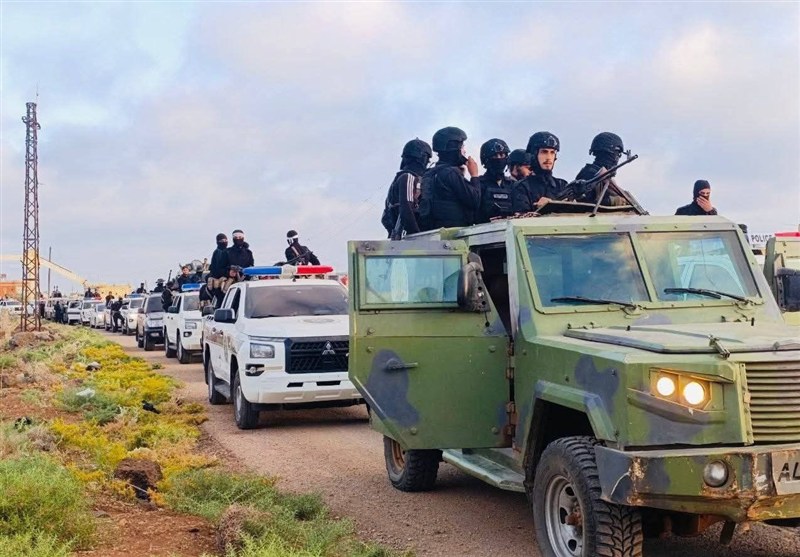
Noureddine al-Baba, spokesman for the interior ministry under the Jolani-controlled government, said internal security forces had begun operations in Suwayda to "protect civilians and end the chaos."
He stated that “political and security institutions will exert all efforts to stop the attacks and restore stability to the province.”
Syrian state television, however, reported a full withdrawal of Jolani-aligned security convoys from Suwayda’s outskirts toward Daraa.
The UK-based Syrian Observatory for Human Rights confirmed ongoing heavy clashes in Suwayda city and reported expanded frontlines after reinforcements arrived from tribal militias.
Tribal forces reportedly opened a new axis from the eastern Tlal al-Safa region and advanced toward the western entrance of Suwayda at Douar al-Omran.
These movements led to high casualties on both sides.
The tribal fighters have rejected Jolani’s demand to vacate their positions, further undermining the viability of the ceasefire.
Fighting erupted on Monday when armed groups affiliated with Jolani launched attacks on Suwayda.
The death toll since then has reached 718, according to local sources.
Sporadic clashes continue in rural areas surrounding the city, despite the official ceasefire announcement.
Tensions escalated further after Syrian media revealed that Israeli regime conducted more than 160 airstrikes in southern Syria within 24 hours, under the pretext of supporting the Druze minority.
Targets included Syrian army headquarters, the presidential palace vicinity, the defense ministry, and military convoys in Damascus, Suwayda, and Daraa.
Despite Jolani’s declared ceasefire, tribal groups in Suwayda remain hostile to the terms.
In a Saturday statement, Jolani’s transitional government called for “an immediate and comprehensive ceasefire in Suwayda” and warned that violations would be considered breaches of Syrian sovereignty.
It added that security forces had begun deploying in various locations to enforce the ceasefire.
Meanwhile, US envoy Tom Barrack said a truce had been reached through US mediation between Jolani and Israeli Prime Minister Benjamin Netanyahu.
According to Barrack, the deal had backing from Turkey, Jordan, and regional players and was intended to pave the way for a new phase in Syria’s conflict.
He called on all ethnic and religious factions—including Druze, Bedouins, and Sunnis—to disarm.
Despite these diplomatic moves, Arab tribes continue to reject the ceasefire and accuse the deal of facilitating normalization with Israel.
Armed clashes resumed in villages such as al-Matouna and Lahtha in Suwayda’s countryside.
Some tribal groups have declared the agreement illegitimate and politically motivated.
Turkish Foreign Minister Hakan Fidan spoke by phone with US Secretary of State Mark Rubio, calling for a rapid end to Syria’s fighting and vowing that terrorist groups would not be allowed to exploit the unrest in the south.
In a contradictory stance, the Jolani-appointed Grand Mufti issued a fatwa condemning any request for Israeli assistance as “treason and religiously forbidden.”
The fatwa came despite the administration’s tacit cooperation with Israel, whose attacks recently struck key Jolani-controlled sites.
UN Human Rights Chief Volker Türk called for urgent accountability and a halt to escalating violence in the southern Syrian city of Suweida on Friday, following credible reports of mass killings, arbitrary executions, looting, and the forced displacement of civilians.
Speaking at a press briefing in Geneva, UN Human Rights Office Spokesperson Ravina Shamdasani emphasized that “the bloodshed and the violence must stop, and the protection of all people must be the utmost priority, in line with international human rights law.” She cited reports of gross violations, including the deliberate killing of civilians, kidnappings, and the destruction of homes in the predominantly Druze governorate.
The human rights chief noted that hundreds of people have been killed since July 12, including the “unlawful killing” of at least 13 people and the reported summary execution of at least 6 men on July 15. The office also documented that one Druze man was forced to shave his mustache, which represents “an important cultural symbol for the Druze community.”
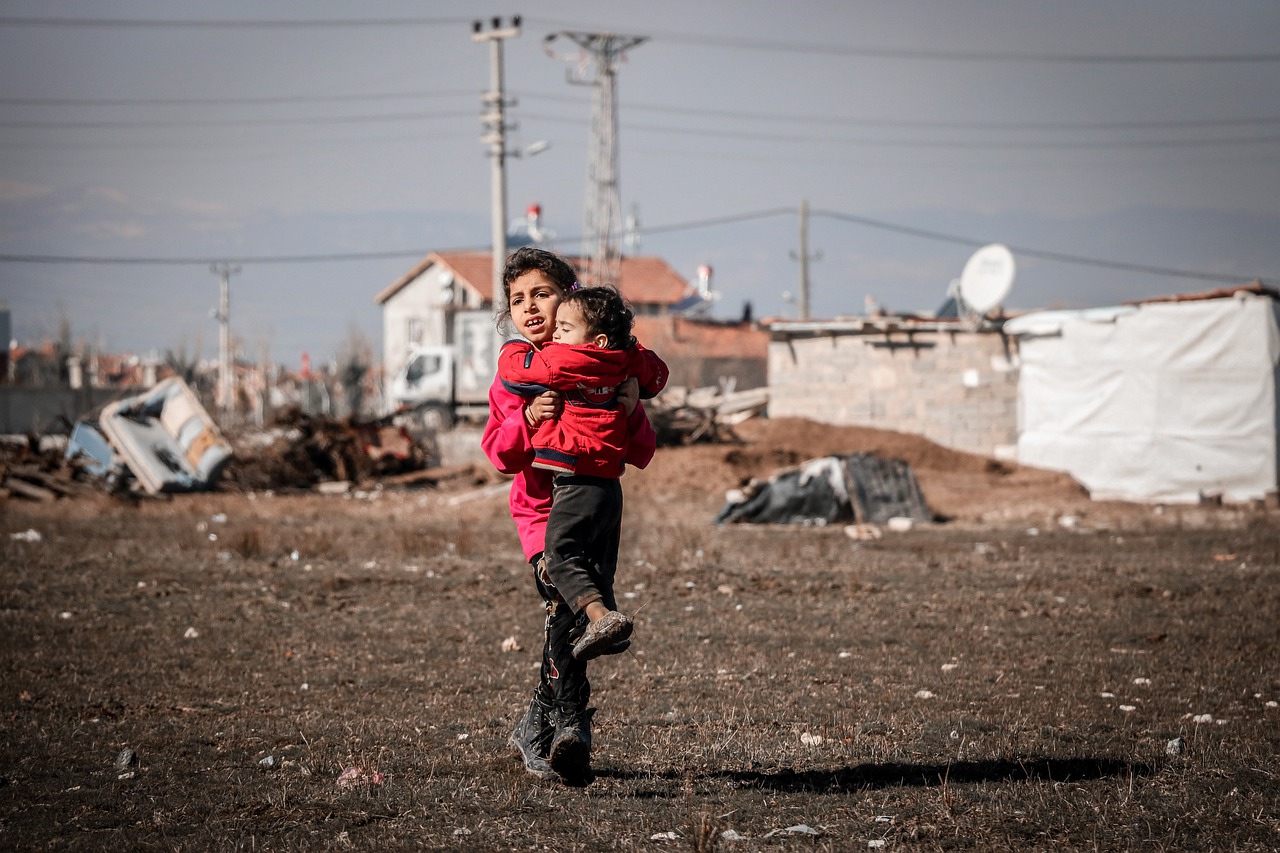
The wave of violence has triggered mass displacement, with thousands of families fleeing their homes in fear. “My Office has received accounts of distressed Syrians who are living in fear for their lives and those of their loved ones,” Türk said. “The deployment of State security forces should bring safety and protection, not add to the fear and violence.”
Türk warned that Syria’s interim authorities must ensure justice through independent and transparent investigations, or risk undermining public trust in the country’s fragile transition. He stated, “Syrians deserve truth, accountability, and guarantees that such violations will not be repeated.”
International legal observers warn that the reported acts, if verified, may constitute violations of international human rights law and, in some cases, grave breaches of international humanitarian law. Arbitrary executions and attacks on civilians violate the right to life under Article 6 of the International Covenant on Civil and Political Rights. The deliberate targeting of noncombatants and the displacement of populations could also rise to the level of war crimes or crimes against humanity under Article 8 of the Rome Statute of the International Criminal Court. Both international and customary law obligate states to investigate serious violations and hold perpetrators accountable.
Syria's leader urges Bedouin tribes to commit to ceasefire ending clashes with Druze
Ahmad al-Sharaa thanks Bedouins 'for their heroic stances' but demands 'they fully commit to the ceasefire and comply with the state's orders,' claims Israeli intervention 'pushed the country into a dangerous phase'
Associated Press| JULY 19, 2025
Syria's interim President Ahmad al-Sharaa urged Sunni Muslim Bedouin tribes Saturday to "fully commit" to a ceasefire aimed at ending clashes with Druze-linked militias that left hundreds dead and threatened to unravel the country's post-war transition.
Government forces that were initially sent to restore order but effectively sided with the Bedouins against the Druze were redeployed to halt renewed fighting that erupted late Thursday in the southern province of Sweida. The violence has also drawn airstrikes against Syrian forces by neighboring Israel before a truce was reached.
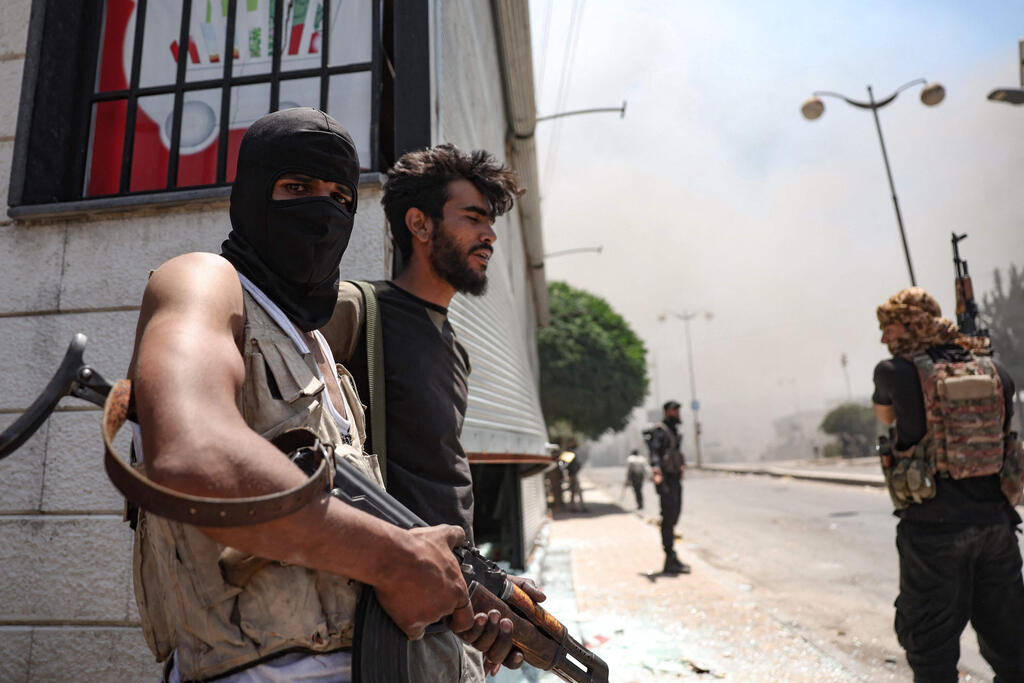
Sectarian violence in Syria's Sweida province
(Photo: OMAR HAJ KADOUR / AFP)
In his second televised address since the fighting started, al-Sharaa blamed "armed groups from Sweida" for reigniting the conflict by "launching retaliatory attacks against the Bedouins and their families." He also said Israeli intervention "pushed the country into a dangerous phase."
Israel had launched dozens of airstrikes on convoys of government fighters and even struck the Syrian Defense Ministry headquarters in central Damascus, saying it was in support of the Druze, who form a substantial community in Israel and are seen as a loyal minority, often serving in the Israeli military.
Reports had surfaced of Syrian government-affiliated fighters executing Druze civilians and looting and burning homes over the four-day violence.
The U.S. envoy to Syria, Tom Barrack, announced that Israel and Syria had agreed to a ceasefire early Saturday. Al-Sharaa made no direct reference to the agreement in his speech, but said "American and Arab mediations stepped in" to restore calm.
Addressing the Bedouins, al-Sharaa said they "cannot replace the role of the state in handling the country's affairs and restoring security." He also said: "We thank the Bedouins for their heroic stances but demand they fully commit to the ceasefire and comply with the state's orders."
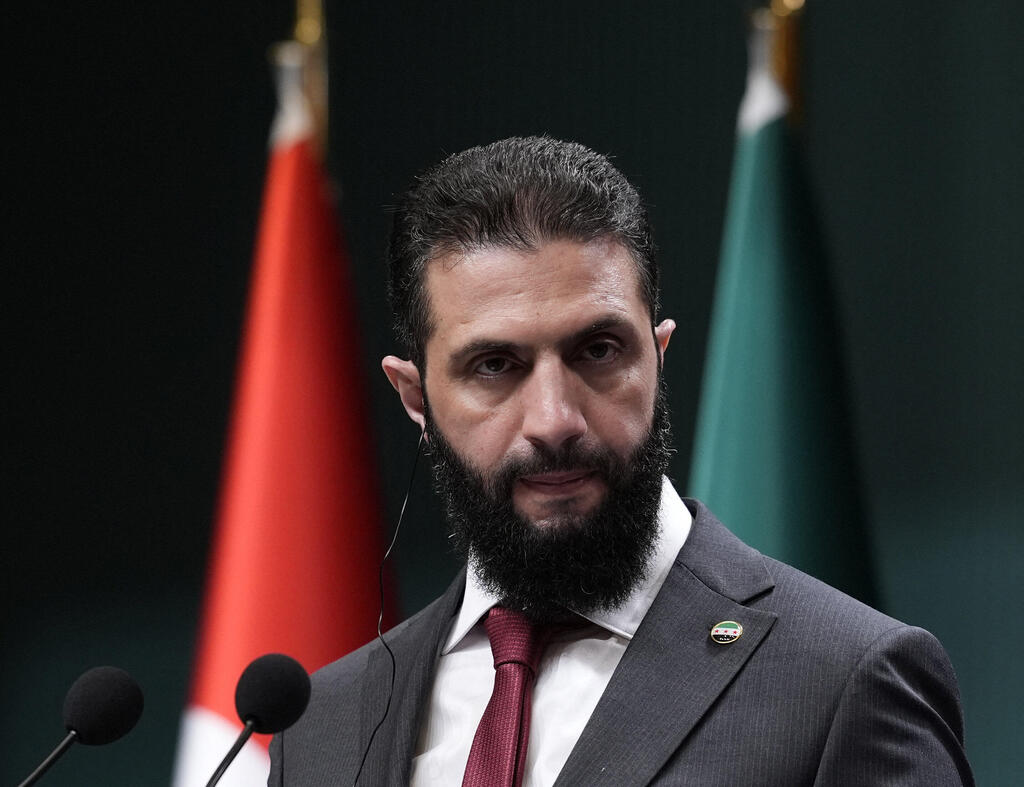
Syria's interim President Ahmad al-Sharaa
(Photo: MEHMET ALI OZCAN / Anadolu via AFP)
Meanwhile, a prominent Druze leader, Sheikh Hikmat Al-Hijri, who opposes the current government and has distanced himself from the two ceasefires announced on Tuesday and Wednesday, said that an agreement brokered under the sponsorship of guarantor states contained several measures aimed at de-escalating tensions in Sweida.
They include the deployment of checkpoints outside the province's administrative borders to contain clashes and prevent infiltration, a 48-hour ban on entry by any party into border villages, and safe, guaranteed passage for remaining members of the Bedouin tribes still inside the province.
Sharaa reiterated that Sweida "remains an integral part of the Syrian state, and the Druze constitute a fundamental pillar of the Syrian national fabric," vowing to protect all minorities in Syria.
He also thanked the United States for its "significant role in affirming its support for Syria during these difficult times," as well as Arab countries and Turkey, which mediated Wednesday's truce.
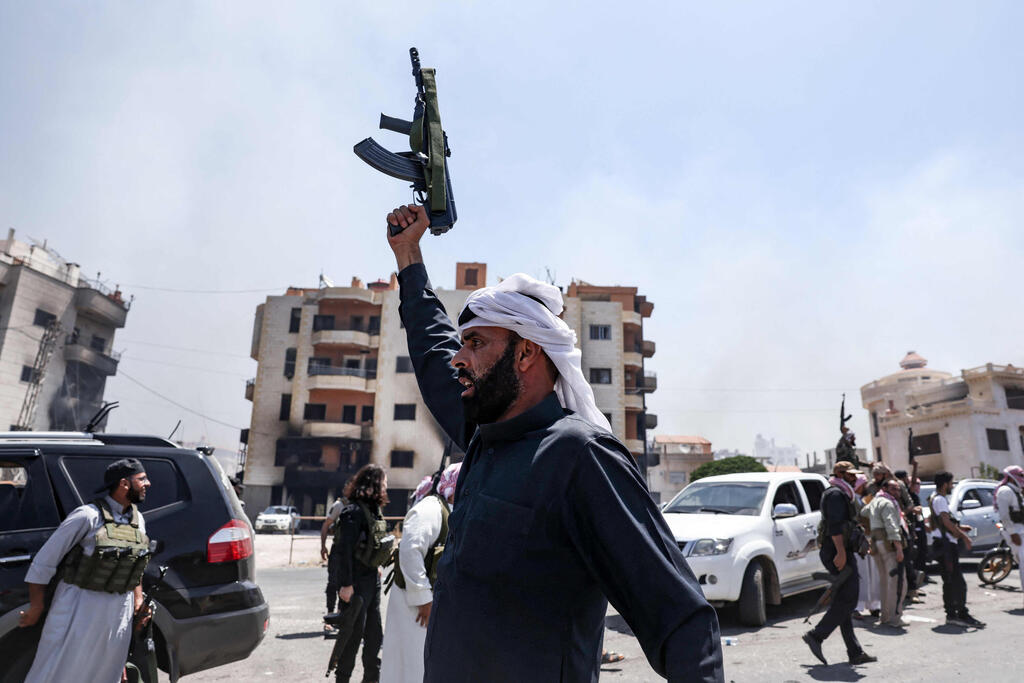
Sectarian violence in Syria's Sweida province
(Photo: Bakr ALkasem / AFP)
More than half of the roughly 1 million Druze worldwide live in Syria. Most of the other Druze live in Lebanon and Israel, including in the Golan Heights, which Israel captured from Syria in the 1967 Six-Day War and annexed in 1981.
The UN estimates more than 87,000 people have been displaced in Sweida province since July 12 due to heavy shelling, sniper fire and abductions.
Entire communities have fled on foot, with many now crammed into overcrowded schools, churches and public buildings under dire conditions, the UN Office for the Coordination of Humanitarian Affairs said in a report. Infrastructure damage has cut electricity, water and telecommunications in much of the area, it said. The main hospital in Sweida was operating at just 15% capacity due to staff shortages and a lack of fuel.
The security situation is also endangering humanitarian workers. The White Helmets, also known as the Syrian Civil Defense, reported that one of their emergency team leaders went missing on July 16 while responding to a call for help from a UN team, OCHA said.
“Tribal Invasion”: Structure, Mobilization, and Relationship with “The Authorities” in the Suwayda Attack.

The mobilization of tribes to launch attacks far from their native lands proves that the military leadership of the Transitional Administration is seeking low-cost war tools, relying on the abundance of fighters and their rapid movement across existing lines of control.

The mobilization of tribes to launch attacks far from their native lands proves that the military leadership of the Transitional Administration is seeking low-cost war tools, relying on the abundance of fighters and their rapid movement across existing lines of control.
daraj
Mazen Ezzi
Published on 19.07.2025
The recent attacks on Suwayda Governorate represent a dangerous turning point in the course of the Syrian conflict, with the “Transitional Administration,” controlled by “Hay’at Tahrir al-Sham,” transitioning to sectarian and tribal cleansing campaigns against one of the most cohesive and distinctive communities in the country. The massacre that occurred in mid-July, and the subsequent tribal mobilization from outside the geographical and social environment of the governorate, raise questions about the nature of the tribal actors and the extent of their connection to the state’s structure and its military and security apparatuses.
This article focuses on how the Al-Oqaydat and Al-Nu’aim tribes – who have to ties to Suwayda- were recruited, and the role played by the Transitional Administration leadership and Hay’at Tahrir al-Sham in transforming this loose tribal kinship into a geographically transcendent tool of conflict, , and what this means for the purely political exploitation of tribal mobilization in the context of the current Syrian conflict.
The problem began in late April/May when tribal forces from the Al-Mutallah Bedouins area in the Al-Kiswah region of Rural Damascus, affiliated with the General Security of the Ministry of Interior, set up a security checkpoint on the Damascus-Suwayda road. The checkpoint was established after a takfiri campaign entitled “We Want to Annihilate the Druze” against the Druze was launched, following a fabricated audio recording attributed to a Druze sheikh cursing the prophet (PBUH).
The military campaign led at that time by forces from the Ministries of Defense and Interior and tribal militias, in late April and early May, against the Druze of Sahnaia, Ashrafiyet Sahnaia, Jaramana, and the large village of Al-Sour in northern Rural Suwayda, resulted in the killing of about 130 people, extensive destruction in the village of Al-Sour, and the displacement of Druze from Ashrafiyet Sahnaia.
The Al-Mutallah checkpoint committed repeated violations against Druze travelers between Suwayda and the capital Damascus, ranging from theft, sectarian insults, and repeated road blockages. Over time, the scale of violations escalated, with the Transitional Administration using it as a political tool to punish Suwayda, whose factions refused to surrender their weapons.
The checkpoint arbitrarily blocked the road for various reasons and for days, causing major crises in Suwayda related to the supply of fuel, food, and medical supplies, as well as the movement of students and employees. On multiple occasions, the Al-Mutallah Bedouins used machine guns against passing buses and cars without reason. After repeated demands by Suwayda notables, the General Security sent another force from Damascus to take over the checkpoint, but they claimed to have engaged in an armed clash with the tribes and returned to Damascus.
On July 12, a Druze merchant was subjected to torture, theft, and sectarian insults by checkpoint elements. In response, a local gang from Suwayda, which had ties with the Military Intelligence during the Assad regime, carried out a suspicious kidnapping operation, targeting a group of Bedouins from the Al-Maqos area northeast of Suwayda city, claiming it was in protest of what the merchant had endured. In response, and in a first-of-its-kind move, a tribal group from Al-Maqos kidnapped a group of Druze at a checkpoint.
There is no actual relation between the Bedouins of Al-Maqos and the Bedouins of Al-Mutallah. The Bedouins of Al-Mutallah are primarily branches of the Al-Nu’aim tribe, especially Nu’aim of the Golan and Wadi Ajam, who settled on the outskirts of Ghouta Damascus in the mid-20th century. Meanwhile, the Bedouins of Suwayda belong to Zubayd, Anzah, Bani Khalid, and Al-Fawa’ira; they settled around Jabal al-Arab since the 18th century.
At that time, forces from the Ministries of Interior and Defense began sending their elements, supported by jihadist factions and tribal groups, to eastern Rural Daraa, with the aim of carrying out a military operation in Suwayda against the “Al-Hijri gangs” and to “resolve the conflict” between the Bedouins and the Druze. Despite a hostage exchange operation, Transitional Administration forces launched an armed attack on the villages of Al-Mazra’a, Al-Shaqrawiyah and Al-Maqos in western Rural Suwayda, with the help of the Al-Lajat and Suwayda tribes.
Bedouins in Suwayda number about 35,000, out of approximately 700,000 inhabitants of the governorate. The Bedouin tribes of Suwayda, Rural Damascus, and Daraa receive support and funding from the tribal sheikh Rakan Al-Khudair, a Syrian-Jordanian leader of the “Gathering of Southern Syrian Tribes,” and one of the most prominent names mentioned in smuggling files between the Syrian and Jordanian borders. Al-Khudair claimed in television statements during the events that Druze factions had committed massacres against the Bedouins and detained more than two thousand Bedouins, demanding the Syrian government protect the tribes and allow them to defend themselves.
Between July 15 and 16, the forces of the two ministries assisted by tribal militias carried out a military operation using excessive force with tanks, artillery, mortar shells, and drones. The attacking forces seized western Rural Suwayda and parts of Suwayda city. As a result of the resistance of local Suwayda factions, popular resistance, and also Israeli airstrikes on the General Staff in Damascus and on the convoys of the attacking forces, the Transitional Administration was forced to withdraw its forces.
As dawn broke on July 17, the aftermath of the massacre committed by these forces began to emerge, which is believed, according to initial estimates, to have left more than 500 dead in Suwayda city alone, most of them civilians killed in their homes. All areas entered by these forces were subjected to a systematic pattern of field executions, torture, insult, and humiliation, and hundreds of residents went missing. Also, these forces looted the houses they entered and set many of them on fire.
Before Suwayda could comprehend the extent of the horrific extermination suffered by its people, before they could collect the bodies of their loved ones from streets and homes, and before the factions could comb the villages of the western countryside, the Transitional Administration moved to implement an alternative plan.
On the morning of July 17, several gruesome photos of violations committed by the Druze against Bedouin tribes in the governorate were circulated, which later turned out to be mostly fabricated. However, violations against Bedouin tribes were committed by elements of the druze factionsImmediately afterward, a widespread media campaign began, heavily focusing on the violations against the Bedouins, on the day Suwayda woke up to the largest mass massacre in the history of the Druze community.
Immediately, tribal gatherings from Deir ez-Zor Governorate began arriving in Suwayda, as part of what is known as the “Faza’at of Arab Tribes” (tribal aid/revenge) to retaliate against the druze. Tribal mobilizations began quickly arriving at the gathering points of the Transitional Administration forces north and west of Suwayda Governorate, , even though the distance they traveled from Deir ez-Zor Governorate in eastern Syria is about 550 kilometers, taking approximately 7 hours by car. The fighters were transported by all possible means, including buses, pickups, trucks, and cargo trucks.
The large tribal convoys passed through all security and military checkpoints belonging to the Transitional Administration, as well as checkpoints belonging to the Syrian Democratic Forces. The pattern of tribal mobilization, the method of fighter movement, and their rapid arrival through security and military checkpoints show that it was not a spontaneous or retaliatory response, but part of a pre-planned alternative plan, implemented immediately after the failure of the first attack on Suwayda.
The mobilization participating in the “Faza’at of Arab Tribes” consists mainly of two influential tribes: Al-Oqaydat and Al-Nu’aim, spread in eastern Deir ez-Zor, in areas either under the control of the Transitional Administration led by Hay’at Tahrir al-Sham or the Syrian Democratic Forces.
The Al-Oqaydat tribe receives direct guidance from two central figures in the Transitional Administration: the head of the intelligence apparatus in the Transitional Administration, Hussein Al-Salameh, and the prominent leader in Hay’at Tahrir al-Sham, Youssef Al-Hajr, both of whom are from Al-Oqaydat.
As for the Al-Nu’aim tribe, it is concentrated in the town of Al-Shuhail in Deir ez-Zor, which is under the control of the Syrian Democratic Forces. Al-Nu’aim is led by Mohammed Al-Jassim “Abu Amsha,” a prominent commander in the Ministry of Defense, internationally sanctioned for war crimes and crimes against humanity against Alawites and Kurds. “Abu Amsha” originally hails from the Al-Nu’aim tribe in the Al-Ghab Plain in northwestern Rural Hama, although he sometimes promotes his affiliation with the Turkmen to gain political support.
It is striking that other large tribes in Deir ez-Zor and Raqqa, such as Al-Baggara, Al-Jubour, Al-Afadleh, Shammar, Wilda, and Tayy, did not participate in this mobilization, nor do they have representation in decision-making positions within Hay’at Tahrir al-Sham or the Transitional Administration, which weakens the representative tribal nature of the “Faza’at” and shows the politically and militarily directed nature of the campaign.
While there is a weak link between the Bedouins of Al-Mutallah in Rural Damascus and the Al-Nu’aim tribe in Deir ez-Zor, there are no kinship or family ties connecting the Bedouins of Suwayda Governorate with the Al-Nu’aim or Al-Oqaydat tribes, and no relationship has been recorded between these components, which supports the hypothesis of direct political exploitation of this mobilization.
On July 18, from dawn, the tribes mobilized on more than one axis and began their attack, managing to enter some locations in Suwayda city and various areas in its countryside. Again, these tribes committed systematic acts of extermination, field executions of entire families, looting, then burning and detonating homes and residences.
The greatest strength possessed by this tribal mobilization was the large number of fighters, estimated between 7,000 and 10,000, which enabled them to spread across many axes and caused the collapse of some combat fronts. The Druze defenders, who were mainly local residents armed to protect their areas, and also local Suwayda factions, had suffered heavy losses in lives, equipment, and defensive lines after the attacks by the ministries’ forces. Meanwhile, the weakness of those forces, their poor organization, and their focus on looting became clear, and the popular resistance and local factions were able to repel those forces and inflict losses on them.
By the evening of July 18, the villages of Jareen, Al-Majdal, and Lahtha had fallen into the hands of the tribes, where horrific atrocities following the same pattern were committed: field executions, looting from houses to farmingto equipment, and then burning.
On the night of July 18, suddenly, after reaching an agreement sponsored by the United States, Turkey, Jordan, and Saudi Arabia, the ceasefire began, and the tribal convoys started withdrawing, leaving behind burned and devastated areas, without achieving any meaningful political objective, similar to the attacks of the ministries.
The mobilization of tribes to launch attacks far from their native lands proves that the military leadership of the Transitional Administration is seeking low-cost war tools, relying on the abundance of fighters and their rapid movement across existing lines of control.
However, this strategy reveals the fragility of Ahmad al-Shara’s government’s authority; it accumulates new enmities with local factions and regional parties and fails to achieve sustainable political gains. Also, the absence of a unifying project or a permanent social bond between the attacking tribes and the targeted region makes the mobilization closer to a plundering raid than a stabilization campaign, and necessarily means that any sudden withdrawal will leave scorched earth, without any strategic gain.
Reliance on tribal mobilization will not grant Hay’at Tahrir al-Sham long-term influence but rather portends the transformation of the entire Syrian geography, and perhaps adjacent border areas, into desecrated zones.
In this Syria, the distance between Damascus and Suwayda has become further than ever before. Suwayda today, despite repelling the dual military attack against it—Salafist and tribal—is devastated, awaiting the discovery of the full dimensions of the campaign against it, to heal its wounds, bury its dead, and ponder its relationship with the rest of the ailing Syrian body.
'Syrian Jihadist groups' targeting Druze today will target Israel tomorrow, Katz tells Ted Cruz
Defense Minister Israel Katz said southern Syria would remain a demilitarized zone despite Israel allegedly allowing Syrian forces a limited presence in Sweida.
 Defense Minister Israel Katz meets with Senator Ted Cruz to discuss Syria.(photo credit: ARIEL HARMONI/DEFENSE MINISTRY)
JULY 19, 2025
Israel’s Defense Minister Israel Katz told US Senator Ted Cruz on Thursday that he “did not trust” Syrian Interim President Ahmed al-Sharaa, claiming that the allegedly reformed Islamist would use “jihadist groups” against Israel in the future.
He made the comments to Cruz during a meeting as part of his ongoing visit to Washington.
He also thanked Cruz for his unwavering support for Israel.
Katz said that while Sharaa is operating the “jihadist groups” against minorities, like Syria’s Druze community, now, those same groups would eventually turn their attention to the Golan Heights.
“From the moment we realized that the Syrian regime was behind the attacks and complicit in the massacre of the Druze, we acted with full force against it," he told Cruz. While the US has sought to encourage warm relations between Damascus and Jerusalem, Israeli officials have applied a cautious approach to Syria, given the abuse of Druze.
"We only trust God and the IDF to protect the State of Israel,” Katz said. “I did not trust Assad the father, nor Assad the son, and certainly do not trust a leader like Sharaa, who relies on jihadist groups that he operates against minorities in Syria, such as the Druze now, and tomorrow he could use them against Israeli settlements in the Golan Heights.”
Agreement between Jerusalem and DamascusDespite Katz insisting on the continuation of IDF presence on Mount Hermon and southern Syria being demilitarized, an Israeli official confirmed on Friday that Israel had agreed to allow Syrian forces limited access to the Sweida area for the next two days.
Sweida province has been engulfed by nearly a week of violence, which began with clashes between Bedouin fighters and Druze factions before government security forces were sent in.
In a statement on Saturday, the Syrian presidency announced an immediate and comprehensive ceasefire and urged all parties to end hostilities immediately. The interior ministry said internal security forces had begun deploying in Sweida.
Sharaa called for calm and said Syria would not be a "testing ground for partition, secession, or sectarian incitement."
Syria announces Sweida ceasefire as monitor says 940 killed in sectarian fighting
Issued on: 19/07/2025 - FRANCE24
The Syrian presidency on Saturday announced an immediate ceasefire after days of sectarian violence in the predominantly Druze province of Sweida that left more than 900 people dead, according to a war monitor. The US envoy to Syria earlier said that Israel and Syria had agreed to a ceasefire following Israel’s intervention this week in support of Druze armed groups that clashed with Bedouin clans and government forces. France24 International Affairs Editor Kethevane Gorjestani explains.
Video by: Kethevane GORJESTANI
718 Killed in Ongoing Clashes in Syria’s Suwayda As Humanitarian Crisis Deepens
July, 19, 2025 - IRAN NEWS SERVICE
TEHRAN (Tasnim) – The death toll in Syria’s southern province of Suwayda has climbed to 718 amid fierce clashes between armed tribal factions and militant groups linked to the Jolani government, according to the UK-based Syrian Observatory for Human Rights (SOHR).
The situation in the city of Suwayda has rapidly deteriorated, with reports of massacres, looting, and a total collapse of essential services.
The Syrian Observatory for Human Rights reported that hostilities remain intense in Suwayda city, with the scale of fighting expanding as reinforcements arrive from tribal militias.
Armed tribal groups have reportedly opened a new front from the Talaa al-Safa area in southeastern Syria and advanced towards the al-Omran roundabout at the western entrance of Suwayda.
Heavy casualties have been reported on both sides during the latest confrontations.
Meanwhile, sporadic clashes were also recorded in the Jaramana region on the outskirts of Damascus, accompanied by gunfire from the al-Mleha and Kashkoul districts. These skirmishes reportedly lasted for more than an hour.
SOHR confirmed that the humanitarian situation in Suwayda is rapidly deteriorating. All phone and internet connections have been severed, and hospitals are out of service due to relentless bombardment and fighting.
Widespread looting and theft have worsened the plight of civilians, while access to medical and food supplies remains completely cut off.
According to the same source, 19 civilians — including women — were slaughtered in the village of Sahwat al-Blata in rural Suwayda after militants affiliated with the Jolani government stormed the area.
This massacre brought the total death toll since the outbreak of violence to 718.
According to SOHR, since Sunday, July 4, a total of 226 residents of Suwayda province have been killed, including 80 civilians—among them 4 children and 4 women.
Additionally, 305 fighters affiliated with the so-called Jolani government have died, including 18 members of Bedouin tribes.
Israeli airstrikes have resulted in the deaths of 15 Jolani-linked militants.
Furthermore, three individuals, including a woman and two unidentified persons, were killed in the Israeli bombing of the ministry of defense building.
One journalist also lost his life while reporting on the clashes in Suwayda.
The Observatory also revealed that Jolani-affiliated forces have executed 165 people, including 26 women, 6 children, and an elderly man, in field executions described as war crimes.
These developments unfold amid continued Zionist airstrikes, which further compound the crisis and highlight the growing threat of foreign intervention in Syria’s internal
The recent attacks on Suwayda Governorate represent a dangerous turning point in the course of the Syrian conflict, with the “Transitional Administration,” controlled by “Hay’at Tahrir al-Sham,” transitioning to sectarian and tribal cleansing campaigns against one of the most cohesive and distinctive communities in the country. The massacre that occurred in mid-July, and the subsequent tribal mobilization from outside the geographical and social environment of the governorate, raise questions about the nature of the tribal actors and the extent of their connection to the state’s structure and its military and security apparatuses.
This article focuses on how the Al-Oqaydat and Al-Nu’aim tribes – who have to ties to Suwayda- were recruited, and the role played by the Transitional Administration leadership and Hay’at Tahrir al-Sham in transforming this loose tribal kinship into a geographically transcendent tool of conflict, , and what this means for the purely political exploitation of tribal mobilization in the context of the current Syrian conflict.
The problem began in late April/May when tribal forces from the Al-Mutallah Bedouins area in the Al-Kiswah region of Rural Damascus, affiliated with the General Security of the Ministry of Interior, set up a security checkpoint on the Damascus-Suwayda road. The checkpoint was established after a takfiri campaign entitled “We Want to Annihilate the Druze” against the Druze was launched, following a fabricated audio recording attributed to a Druze sheikh cursing the prophet (PBUH).
The military campaign led at that time by forces from the Ministries of Defense and Interior and tribal militias, in late April and early May, against the Druze of Sahnaia, Ashrafiyet Sahnaia, Jaramana, and the large village of Al-Sour in northern Rural Suwayda, resulted in the killing of about 130 people, extensive destruction in the village of Al-Sour, and the displacement of Druze from Ashrafiyet Sahnaia.
The Al-Mutallah checkpoint committed repeated violations against Druze travelers between Suwayda and the capital Damascus, ranging from theft, sectarian insults, and repeated road blockages. Over time, the scale of violations escalated, with the Transitional Administration using it as a political tool to punish Suwayda, whose factions refused to surrender their weapons.
The checkpoint arbitrarily blocked the road for various reasons and for days, causing major crises in Suwayda related to the supply of fuel, food, and medical supplies, as well as the movement of students and employees. On multiple occasions, the Al-Mutallah Bedouins used machine guns against passing buses and cars without reason. After repeated demands by Suwayda notables, the General Security sent another force from Damascus to take over the checkpoint, but they claimed to have engaged in an armed clash with the tribes and returned to Damascus.
On July 12, a Druze merchant was subjected to torture, theft, and sectarian insults by checkpoint elements. In response, a local gang from Suwayda, which had ties with the Military Intelligence during the Assad regime, carried out a suspicious kidnapping operation, targeting a group of Bedouins from the Al-Maqos area northeast of Suwayda city, claiming it was in protest of what the merchant had endured. In response, and in a first-of-its-kind move, a tribal group from Al-Maqos kidnapped a group of Druze at a checkpoint.
There is no actual relation between the Bedouins of Al-Maqos and the Bedouins of Al-Mutallah. The Bedouins of Al-Mutallah are primarily branches of the Al-Nu’aim tribe, especially Nu’aim of the Golan and Wadi Ajam, who settled on the outskirts of Ghouta Damascus in the mid-20th century. Meanwhile, the Bedouins of Suwayda belong to Zubayd, Anzah, Bani Khalid, and Al-Fawa’ira; they settled around Jabal al-Arab since the 18th century.
At that time, forces from the Ministries of Interior and Defense began sending their elements, supported by jihadist factions and tribal groups, to eastern Rural Daraa, with the aim of carrying out a military operation in Suwayda against the “Al-Hijri gangs” and to “resolve the conflict” between the Bedouins and the Druze. Despite a hostage exchange operation, Transitional Administration forces launched an armed attack on the villages of Al-Mazra’a, Al-Shaqrawiyah and Al-Maqos in western Rural Suwayda, with the help of the Al-Lajat and Suwayda tribes.
Bedouins in Suwayda number about 35,000, out of approximately 700,000 inhabitants of the governorate. The Bedouin tribes of Suwayda, Rural Damascus, and Daraa receive support and funding from the tribal sheikh Rakan Al-Khudair, a Syrian-Jordanian leader of the “Gathering of Southern Syrian Tribes,” and one of the most prominent names mentioned in smuggling files between the Syrian and Jordanian borders. Al-Khudair claimed in television statements during the events that Druze factions had committed massacres against the Bedouins and detained more than two thousand Bedouins, demanding the Syrian government protect the tribes and allow them to defend themselves.
Between July 15 and 16, the forces of the two ministries assisted by tribal militias carried out a military operation using excessive force with tanks, artillery, mortar shells, and drones. The attacking forces seized western Rural Suwayda and parts of Suwayda city. As a result of the resistance of local Suwayda factions, popular resistance, and also Israeli airstrikes on the General Staff in Damascus and on the convoys of the attacking forces, the Transitional Administration was forced to withdraw its forces.
As dawn broke on July 17, the aftermath of the massacre committed by these forces began to emerge, which is believed, according to initial estimates, to have left more than 500 dead in Suwayda city alone, most of them civilians killed in their homes. All areas entered by these forces were subjected to a systematic pattern of field executions, torture, insult, and humiliation, and hundreds of residents went missing. Also, these forces looted the houses they entered and set many of them on fire.
Before Suwayda could comprehend the extent of the horrific extermination suffered by its people, before they could collect the bodies of their loved ones from streets and homes, and before the factions could comb the villages of the western countryside, the Transitional Administration moved to implement an alternative plan.
On the morning of July 17, several gruesome photos of violations committed by the Druze against Bedouin tribes in the governorate were circulated, which later turned out to be mostly fabricated. However, violations against Bedouin tribes were committed by elements of the druze factionsImmediately afterward, a widespread media campaign began, heavily focusing on the violations against the Bedouins, on the day Suwayda woke up to the largest mass massacre in the history of the Druze community.
Immediately, tribal gatherings from Deir ez-Zor Governorate began arriving in Suwayda, as part of what is known as the “Faza’at of Arab Tribes” (tribal aid/revenge) to retaliate against the druze. Tribal mobilizations began quickly arriving at the gathering points of the Transitional Administration forces north and west of Suwayda Governorate, , even though the distance they traveled from Deir ez-Zor Governorate in eastern Syria is about 550 kilometers, taking approximately 7 hours by car. The fighters were transported by all possible means, including buses, pickups, trucks, and cargo trucks.
The large tribal convoys passed through all security and military checkpoints belonging to the Transitional Administration, as well as checkpoints belonging to the Syrian Democratic Forces. The pattern of tribal mobilization, the method of fighter movement, and their rapid arrival through security and military checkpoints show that it was not a spontaneous or retaliatory response, but part of a pre-planned alternative plan, implemented immediately after the failure of the first attack on Suwayda.
The mobilization participating in the “Faza’at of Arab Tribes” consists mainly of two influential tribes: Al-Oqaydat and Al-Nu’aim, spread in eastern Deir ez-Zor, in areas either under the control of the Transitional Administration led by Hay’at Tahrir al-Sham or the Syrian Democratic Forces.
The Al-Oqaydat tribe receives direct guidance from two central figures in the Transitional Administration: the head of the intelligence apparatus in the Transitional Administration, Hussein Al-Salameh, and the prominent leader in Hay’at Tahrir al-Sham, Youssef Al-Hajr, both of whom are from Al-Oqaydat.
As for the Al-Nu’aim tribe, it is concentrated in the town of Al-Shuhail in Deir ez-Zor, which is under the control of the Syrian Democratic Forces. Al-Nu’aim is led by Mohammed Al-Jassim “Abu Amsha,” a prominent commander in the Ministry of Defense, internationally sanctioned for war crimes and crimes against humanity against Alawites and Kurds. “Abu Amsha” originally hails from the Al-Nu’aim tribe in the Al-Ghab Plain in northwestern Rural Hama, although he sometimes promotes his affiliation with the Turkmen to gain political support.
It is striking that other large tribes in Deir ez-Zor and Raqqa, such as Al-Baggara, Al-Jubour, Al-Afadleh, Shammar, Wilda, and Tayy, did not participate in this mobilization, nor do they have representation in decision-making positions within Hay’at Tahrir al-Sham or the Transitional Administration, which weakens the representative tribal nature of the “Faza’at” and shows the politically and militarily directed nature of the campaign.
While there is a weak link between the Bedouins of Al-Mutallah in Rural Damascus and the Al-Nu’aim tribe in Deir ez-Zor, there are no kinship or family ties connecting the Bedouins of Suwayda Governorate with the Al-Nu’aim or Al-Oqaydat tribes, and no relationship has been recorded between these components, which supports the hypothesis of direct political exploitation of this mobilization.
On July 18, from dawn, the tribes mobilized on more than one axis and began their attack, managing to enter some locations in Suwayda city and various areas in its countryside. Again, these tribes committed systematic acts of extermination, field executions of entire families, looting, then burning and detonating homes and residences.
The greatest strength possessed by this tribal mobilization was the large number of fighters, estimated between 7,000 and 10,000, which enabled them to spread across many axes and caused the collapse of some combat fronts. The Druze defenders, who were mainly local residents armed to protect their areas, and also local Suwayda factions, had suffered heavy losses in lives, equipment, and defensive lines after the attacks by the ministries’ forces. Meanwhile, the weakness of those forces, their poor organization, and their focus on looting became clear, and the popular resistance and local factions were able to repel those forces and inflict losses on them.
By the evening of July 18, the villages of Jareen, Al-Majdal, and Lahtha had fallen into the hands of the tribes, where horrific atrocities following the same pattern were committed: field executions, looting from houses to farmingto equipment, and then burning.
On the night of July 18, suddenly, after reaching an agreement sponsored by the United States, Turkey, Jordan, and Saudi Arabia, the ceasefire began, and the tribal convoys started withdrawing, leaving behind burned and devastated areas, without achieving any meaningful political objective, similar to the attacks of the ministries.
The mobilization of tribes to launch attacks far from their native lands proves that the military leadership of the Transitional Administration is seeking low-cost war tools, relying on the abundance of fighters and their rapid movement across existing lines of control.
However, this strategy reveals the fragility of Ahmad al-Shara’s government’s authority; it accumulates new enmities with local factions and regional parties and fails to achieve sustainable political gains. Also, the absence of a unifying project or a permanent social bond between the attacking tribes and the targeted region makes the mobilization closer to a plundering raid than a stabilization campaign, and necessarily means that any sudden withdrawal will leave scorched earth, without any strategic gain.
Reliance on tribal mobilization will not grant Hay’at Tahrir al-Sham long-term influence but rather portends the transformation of the entire Syrian geography, and perhaps adjacent border areas, into desecrated zones.
In this Syria, the distance between Damascus and Suwayda has become further than ever before. Suwayda today, despite repelling the dual military attack against it—Salafist and tribal—is devastated, awaiting the discovery of the full dimensions of the campaign against it, to heal its wounds, bury its dead, and ponder its relationship with the rest of the ailing Syrian body.
Defense Minister Israel Katz said southern Syria would remain a demilitarized zone despite Israel allegedly allowing Syrian forces a limited presence in Sweida.
Israel’s Defense Minister Israel Katz told US Senator Ted Cruz on Thursday that he “did not trust” Syrian Interim President Ahmed al-Sharaa, claiming that the allegedly reformed Islamist would use “jihadist groups” against Israel in the future.
He made the comments to Cruz during a meeting as part of his ongoing visit to Washington.
He also thanked Cruz for his unwavering support for Israel.
Katz said that while Sharaa is operating the “jihadist groups” against minorities, like Syria’s Druze community, now, those same groups would eventually turn their attention to the Golan Heights.
“From the moment we realized that the Syrian regime was behind the attacks and complicit in the massacre of the Druze, we acted with full force against it," he told Cruz.
"We only trust God and the IDF to protect the State of Israel,” Katz said. “I did not trust Assad the father, nor Assad the son, and certainly do not trust a leader like Sharaa, who relies on jihadist groups that he operates against minorities in Syria, such as the Druze now, and tomorrow he could use them against Israeli settlements in the Golan Heights.”
Agreement between Jerusalem and DamascusDespite Katz insisting on the continuation of IDF presence on Mount Hermon and southern Syria being demilitarized, an Israeli official confirmed on Friday that Israel had agreed to allow Syrian forces limited access to the Sweida area for the next two days.
Sweida province has been engulfed by nearly a week of violence, which began with clashes between Bedouin fighters and Druze factions before government security forces were sent in.
In a statement on Saturday, the Syrian presidency announced an immediate and comprehensive ceasefire and urged all parties to end hostilities immediately. The interior ministry said internal security forces had begun deploying in Sweida.
Sharaa called for calm and said Syria would not be a "testing ground for partition, secession, or sectarian incitement."
Issued on: 19/07/2025 - FRANCE24
The Syrian presidency on Saturday announced an immediate ceasefire after days of sectarian violence in the predominantly Druze province of Sweida that left more than 900 people dead, according to a war monitor. The US envoy to Syria earlier said that Israel and Syria had agreed to a ceasefire following Israel’s intervention this week in support of Druze armed groups that clashed with Bedouin clans and government forces. France24 International Affairs Editor Kethevane Gorjestani explains.
Video by: Kethevane GORJESTANI
July, 19, 2025 - IRAN NEWS SERVICE
TEHRAN (Tasnim) – The death toll in Syria’s southern province of Suwayda has climbed to 718 amid fierce clashes between armed tribal factions and militant groups linked to the Jolani government, according to the UK-based Syrian Observatory for Human Rights (SOHR).
The situation in the city of Suwayda has rapidly deteriorated, with reports of massacres, looting, and a total collapse of essential services.
The Syrian Observatory for Human Rights reported that hostilities remain intense in Suwayda city, with the scale of fighting expanding as reinforcements arrive from tribal militias.
Armed tribal groups have reportedly opened a new front from the Talaa al-Safa area in southeastern Syria and advanced towards the al-Omran roundabout at the western entrance of Suwayda.
Heavy casualties have been reported on both sides during the latest confrontations.
Meanwhile, sporadic clashes were also recorded in the Jaramana region on the outskirts of Damascus, accompanied by gunfire from the al-Mleha and Kashkoul districts. These skirmishes reportedly lasted for more than an hour.
SOHR confirmed that the humanitarian situation in Suwayda is rapidly deteriorating. All phone and internet connections have been severed, and hospitals are out of service due to relentless bombardment and fighting.
Widespread looting and theft have worsened the plight of civilians, while access to medical and food supplies remains completely cut off.
According to the same source, 19 civilians — including women — were slaughtered in the village of Sahwat al-Blata in rural Suwayda after militants affiliated with the Jolani government stormed the area.
This massacre brought the total death toll since the outbreak of violence to 718.
According to SOHR, since Sunday, July 4, a total of 226 residents of Suwayda province have been killed, including 80 civilians—among them 4 children and 4 women.
Additionally, 305 fighters affiliated with the so-called Jolani government have died, including 18 members of Bedouin tribes.
Israeli airstrikes have resulted in the deaths of 15 Jolani-linked militants.
Furthermore, three individuals, including a woman and two unidentified persons, were killed in the Israeli bombing of the ministry of defense building.
One journalist also lost his life while reporting on the clashes in Suwayda.
The Observatory also revealed that Jolani-affiliated forces have executed 165 people, including 26 women, 6 children, and an elderly man, in field executions described as war crimes.
These developments unfold amid continued Zionist airstrikes, which further compound the crisis and highlight the growing threat of foreign intervention in Syria’s internal
Latest South Syria Ceasefire Crumbles, At Least 638 Killed
Fighting between the Druze and Bedouins in Syria’s Suwayda Governorate continues to rage, despite the second ceasefire of the week being declared on Wednesday. The toll in the fighting and killing since Sunday is now up to at least 638, according to the Syrian Observatory for Human Rights.
The fighting started Sunday in the Bedouin neighborhood of Maqus, with both sides claiming tit-for-tat kidnappings, eventually leading Druze forces into the area and the locals called nearby Bedouin tribes. That escalated quickly across the governorate, and now both sides are trading blame for respective massacres in the area, and given the enormous death toll it’s not unlikely that both are accurate.
The Bedouins, backed by Syrian government forces, were accused to executing Druze several times in the area, while Syrian state media is reporting a large massacre in a hospital by forces loyal to a Druze cleric. The death tolls overall split among hundreds of civilians, hundreds of combatants, and even hundreds of Syrian Defense Ministry forces that got attacked by Israel when trying to enter the region in defiance of Israel’s “ban” on Syria deploying troops to southern Syria.
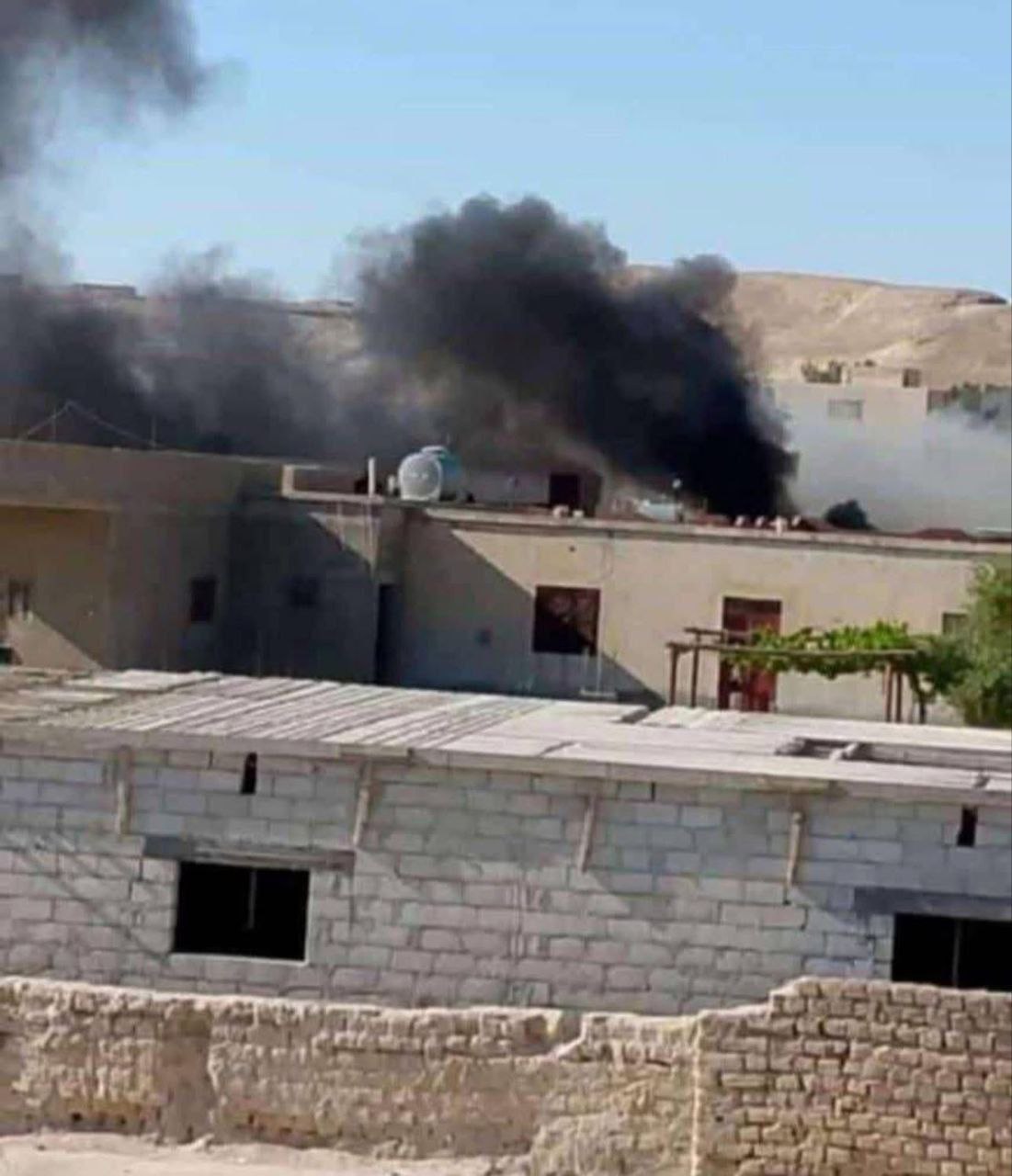
Fighting rages in Suwayda Governorate | Image from X
Israel reiterated on Thursday that the ban remained in place, and Prime Minister Netanyahu bragged that the Wednesday ceasefire was only achieved because of Israeli force. Now that the ceasefire seems to be failing, Israel announced on Friday it is allowing Syrian troops to go back to the area for 48 hours to try to tamp down the violence.
Syrian troops are said to be being redeployed. Whether that’s going to actually slow the violence remains to be seen, as the Syrian troops are accused of participating in summary executions and other violence against the Druze.
Fighting in going on outside of the city of Suwayda in nearby villages, with more and more forces massing on each side. The Bedouins are reportedly preparing a counter-attack against Suwayda itself after seizing several towns and villages on the outskirts.
The death toll is likely even higher than is being reported by the Syrian Observatory for Human Rights. One hospital in Suwayda alone claims to have received more than 400 bodies since Monday. The actual toll may not ultimately be known for some time, but one thing is clear, it continues to rise and this situation is far from resolved.
Netanyahu Reiterates Demand for South Syria to Remain Demilitarized
Israeli Prime Minister Benjamin Netanyahu has reiterated long-standing demands that the entire south of Syria south of Damascus remain absolutely demilitarized, and vowed that Israel will continue to carry out attacks on Syria to enforce that as one of his “red lines.”
Netanyahu also presented a second red line of “protecting the brothers of our brothers, the Druze in the Druze mountains.” Though Israel has been attacking Syria and carrying out a ground invasion since December, the Druze have only occasionally been a talking point as a pretext for those operations.
This is one of those occasions though, as fighting in the Suwayda Governorate has left over 500 people dead this week, and Israel continues to attack that area intermittently. Netanyahu even bragged that Wednesday’s ceasefire, which doesn’t seem to be particularly effective, was only achieved through Israeli force of arms.
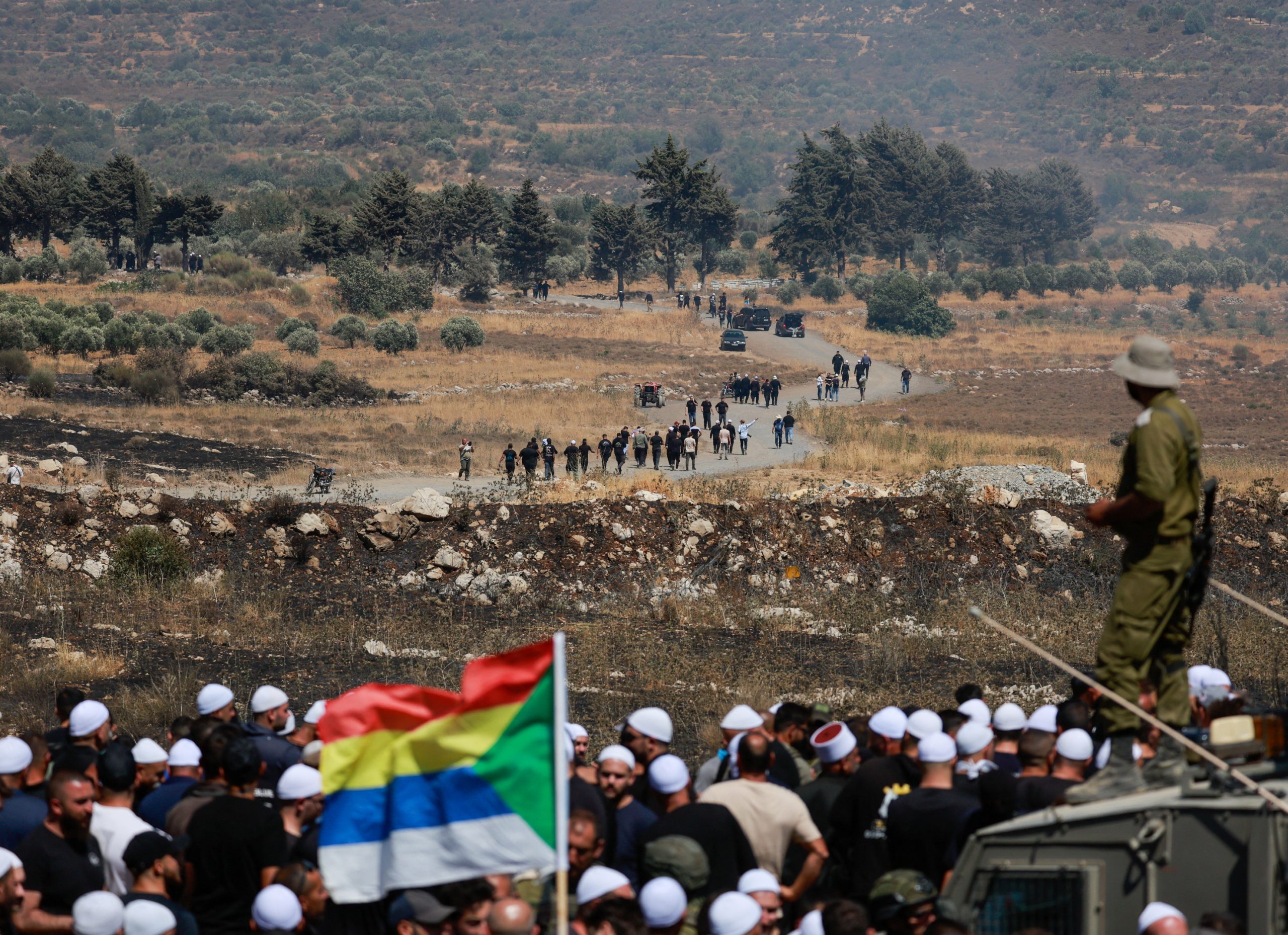
Israeli Druze cross the border to check on their family members in Syria, amid the ongoing conflict in the Druze areas in Syria, in Majdal Shams, near the ceasefire line between the Israeli-occupied Golan Heights and Syria, July 16, 2025. REUTERS/Ammar Awad
The Israeli Druze are generally supportive of Israel using its military to protect the much larger Syrian Druze population, but many analysts warn that the strikes are more just a Netanyahu military goal and that the Druze, when they’re mentioned at all, are just another talking point in support of that.
Israel invaded Syria in December, after the ouster of the Assad government. They have engaged in talks with the new Islamist government, but the invasion and the attacks never really stopped. Lately, the Syrian government has reiterated its right to self defense and been more publicly critical of Israeli attacks.
The US insisted it did not support the recent Israeli attacks on Syria, indicative of the Trump Administration’s increasingly favorably view of Islamist leader Ahmed al-Sharaa. The US criticizing Israeli attacks on their neighbors is highly unusual, and indeed the US has previously expressed support for the Israeli invasion, though the administration now seems to have grown weary of the ever growing and increasingly aimless operation, which is undermining normalization talks the US supports.
More Than 500 Killed After Days of Clashes, Executions, and Israeli Airstrikes in Syria’s Suwayda
More than 500 people have been killed after days of clashes, massacres, and Israeli airstrikes in Syria’s southern Suwayda province, according to numbers from the UK-based Syrian Observatory for Human Rights.
Clashes began between Druze militias and Bedouin tribes, with the al-Qaeda-linked Syrian government quickly intervening against the Druze. Among the dead were 154 civilians, including 83 who were “summarily executed by members of the defense and interior ministries.”
The SOHR counted the deaths of 243 government personnel, including at least 15 who were killed by Israeli airstrikes, 79 Druze fighters, and 18 Bedouin fighters. Three members of the Bedouin tribes were also ” summarily executed by Druze fighters.”
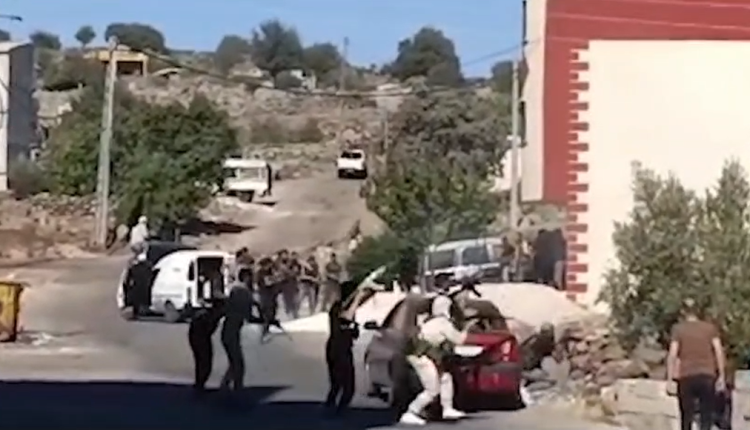
The executions of Druze follow a pattern of mass killings of civilians by the new Syrian government, which is led by Ahmed al-Sharaa, the founder of al-Qaeda in Syria, who rebranded in recent years to gain international support. His group of Jihadists, known as Hayat Tahrir al-Sham, took power in Damascus in December 2024 after ousting former President Bashar al-Assad.
Sharaa claimed on Thursday that he would “protect” the Druze minority and that there would be accountability for “those who transgressed and abused our Druze people because they are under the protection and responsibility of the state.” However, there has been no accountability for the more than 1,500 civilians, mainly Alawites, who were massacred by government-linked fighters in March.
Sharaa said that government forces “succeeded in restoring stability and expelling outlaw factions in Suwayda, despite Israeli interventions” and said Israel was “sowing discord” by launching airstrikes.
Syrian government troops mostly withdrew from the area, though the government on Thursday accused the Druze of violating the ceasefire, suggesting that the fighting may not be over. The Syrian presidency accused Druze forces of conducting “horrific violence” against Bedouin civilians.
A Syrian Bedouin commander also told Reuters that Bedouin fighters were launching another offensive against Druze militias despite the ceasefire. He said that the truce only applied to government forces and not to them.
Israeli airstrikes continued in southern Syria on Thursday despite the US saying it doesn’t support the Israeli attacks. According to the SOHR, an Israeli drone hit a gathering of Bedouin fighters
Dave DeCamp is the news editor of Antiwar.com, follow him on Twitter @decampdave.
Syria and the Dangers of Playing with Fire
Thursday 17 July 2025, by Gilbert Achcar
Whatever is the origin of the recent bloody clashes in the Suwayda Governorate—whether they were merely the result of the chaos prevailing in post-Assad Syria, or a manoeuvre by Israel in order to escalate its hypocritical intervention in the region, or a manoeuvre by Hay’at Tahrir al-Sham (HTS) to extend its control over southern Syria—what is unmistakable is that the first factor, the prevailing chaos, provided the conditions for the explosion.
The Bedouins who ignited the fuse by attacking a resident of the province were encouraged by the attitude of the new regime in Damascus, which is pressuring all minorities to surrender their weapons while exerting no pressure on various Sunni Arab groups. Instead, it is facilitating the arming of the latter, using them similarly to the former regime’s use of the so-called “Shabiha” (with the difference in sectarian affiliation, of course).
It is striking and extremely dangerous that the new Damascus government has not responded to repeated calls to maintain security on the road between Damascus and Suwayda. This unruliness of the situation, or rather the lack of intervention in controlling it, has paved the way for the current explosion. It could have been prevented had the government shown the same enthusiasm in controlling the Bedouin groups allied with it as it has now shown in seizing the opportunity of the clashes to enter Suwayda, offering a spectacle that looks more like an occupation than like a liberation of the local population. As Al-Quds Al-Arabi’s correspondent in Damascus wrote last Sunday:
At the end of last April, the Suwayda Governorate had witnessed an agreement between the Syrian government and the sheikhs of Suwayda stipulating the activation of police within the governorate, with the Syrian government assuming responsibility for protecting the Damascus-Suwayda road, a vital artery for hundreds of thousands of residents within the governorate. However, the continued attacks on this road and the failure to secure it for civilian traffic have exacerbated societal tensions within the Suwayda Governorate...” (Heba Mohammed, “Syrian Suwayda: Deaths in Clashes Between Druze and Bedouins, and Kidnappings, Al-Quds Al-Arabi, 13 July 2025).
Last Friday, before the outbreak of clashes in Suwayda, the Syrian Observatory for Human Rights (SOHR) warned about the chaotic situation:
“Human losses continue to occur daily across Syria under various circumstances as a result of the ongoing escalating violence, military operations, targeted killings, assassinations, unexploded ordnance, and many other causes that claim the lives of many, civilians primarily and personnel from all the military forces controlling the Syrian territory.” (SOHR, “Escalation of Violence in Various Syrian Regions Leaves 35 Dead in 72 Hours”, 11 July 2025, in Arabic).
The same pattern threatens to recur in other areas escaping the control of the new Damascus government, especially those with a Kurdish majority. It is well known that the Kurdish armed forces are much stronger than those in the Druze regions, and even stronger than those of HTS in its new “official” iteration. On Monday, the SOHR published a report on its website describing the Syrian government’s continued blocking of petroleum products to the predominantly Kurdish neighbourhoods of Sheikh Maqsud and Ashrafieh in Aleppo for more than 15 days. The report added that residents of the area indicated that “the authorities are using a method similar to that previously used by the Assad regime, through economic and service pressure by withholding fuel, electricity, and basic resources, in an attempt to extort political or financial concessions from the Autonomous Administration [of North and East Syria] ...” (SOHR, “The Former Regime’s Method...”, 14 July 2025, in Arabic).
Given this chaotic situation, it is no surprise that Israel continues to fish in troubled waters, claiming to champion the Druze community. That is the same Israel that annexed the occupied Golan Heights in 1981, despite the opposition of the local Druze population, who overwhelmingly rejected the annexation and, along with it, the Israeli citizenship that was offered to them. The Golan Druze population even carried out a five-month general strike in 1982, which the Zionist state quelled by imposing a siege on them. Israel seized the opportunity of the new clashes in Suwayda to destroy more equipment inherited by the HTS forces from the previous Syrian regime. It certainly hopes for an escalation of violence in order to take advantage of it to strengthen the influence of the minority among the Syrian Druze that aspires to establish a Druze emirate under Israeli protection.
In the face of what is happening, allow me to recall what I wrote more than two months ago: “The blame lies primarily with those who attributed the collapse of the Assad regime exclusively to themselves … HTS should have modestly acknowledged the limitations of its own forces, which are quite weaker than those of the Kurdish forces in the northeast, and far too weak to allow it to extend its control over all the Arab regions that were controlled by the ousted regime with the assistance of Russia and Iran. Instead, Ahmad al-Sharaa got euphoric about replacing Bashar al-Assad in his presidential palace (he even began to increasingly look like a bearded version of the deposed president). He acted as if he could dominate all of Syria…”
After describing the inclusive democratic process that HTS’s rule should have launched, as most of the former opposition to the Assad regime had demanded, I concluded: “These are the only conditions that can cleanse Syria’s waters and reassure the various components of its population. What the HTS regime has done so far, however, is dangerously muddying the waters, opening the way for various regional adepts of fishing in troubled waters, foremost among them the Zionist state.” (“Syria: Fishing in Troubled Waters”, Al-Quds Al-Arabi, 6 May 2025).
15 July 2025
Translated by the author for his blog from the Arabic original published in Al-Quds al-Arabi.
P.S.
If you like this article or have found it useful, please consider donating towards the work of International Viewpoint. Simply follow this link: Donate then enter an amount of your choice. One-off donations are very welcome. But regular donations by standing order are also vital to our continuing functioning. See the last paragraph of this article for our bank account details and take out a standing order. Thanks.
Attached documentssyria-and-the-dangers-of-playing-with-fire_a9087.pdf (PDF - 909.1 KiB)
Extraction PDF [->article9087]
Syria
Three Requisites for Syria’s Reconstruction Process
Syria: Fishing in Troubled Waters
Syria’s Economic Transition: From Kleptocracy to Islamic Neoliberalism in a War-Torn Economy
Against Campism, for International Working-Class Solidarity
Free Syria scares Israel, that’s why it sows hatred and occupies
Gilbert Achcar grew up in Lebanon. He is currently Professor of Development Studies and International Relations at the School of Oriental and African Studies (SOAS) in London. A regular and historical contributor to the press of the Fourth International, his books include The Clash of Barbarisms. The Making of the New World Disorder (2006), The Arabs and the Holocaust: The Arab-Israeli War of Narratives (2012), The People Want: A Radical Exploration of the Arab Uprising (2022). His most recent books are The New Cold War: The United States, Russia and China, from Kosovo to Ukraine (2023) and the collection of articles Israel’s War on Gaza (2023). His next book, Gaza, A Genocide Foretold, will come out in 2025. He is a member of AntiCapitalist Resistance in Britain.
International Viewpoint is published under the responsibility of the Bureau of the Fourth International. Signed articles do not necessarily reflect editorial policy. Articles can be reprinted with acknowledgement, and a live link if possible.
Syria: Sharaa’s authoritarian centralisation stumbles in Suweida
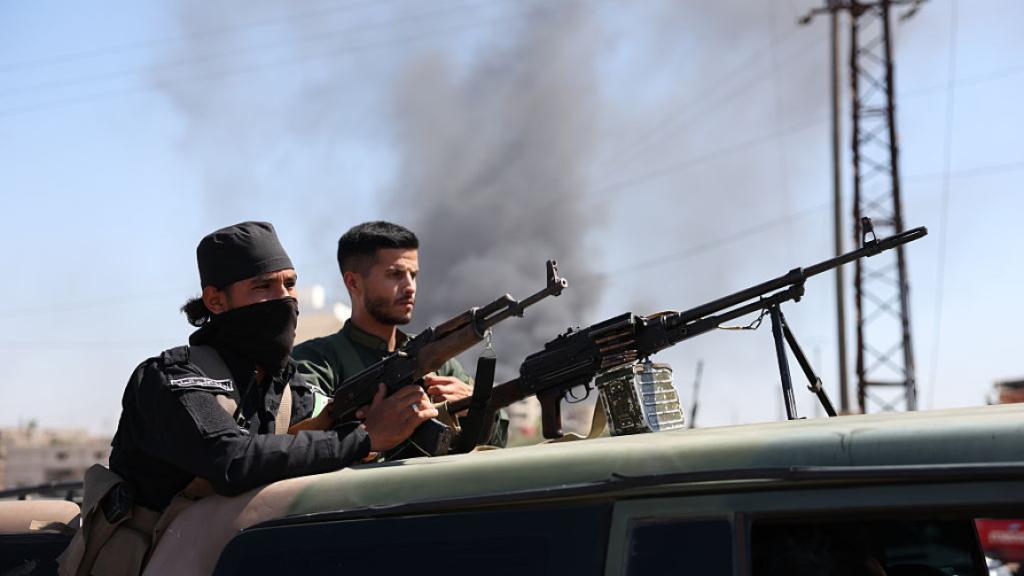
First published at The New Arab.
Violent clashes and tensions have been ongoing in Suweida since Syria’s self-proclaimed president Ahmad Al Sharaa announced the transfer of the responsibility of maintaining security in the province, to local armed factions and Druze religious dignitaries. Yesterday’s decision comes a day after an agreement was concluded between the Syrian ruling authority led by Hayat Tahrir Sham (HTS) and Druze religious dignitaries in Suweida.
Currently, security forces are preparing to re-enter Suweidawith the claim from the Syrian interior ministry that they seek to quell fighting between Druze and Bedouin fighters.
This all follows previous attacks by armed groups supportive of the current government in both Suweida and near Damascus in April and May, which left over 100 people dead.
In reality, the recent move by Al Sharaa is clearly an attempt to consolidate his power over a fragmented Syria, undermine Suweida’s autonomy, and break democratic dynamics from below.
Controlling Suweida
Suweida has a predominantly Druze population and gained some level of political autonomy during the Syrian uprising. Following the fall of the Assad regime, most Druze local armed forces and religious dignitaries maintained discussions with the new ruling authorities in Damascus. Nevertheless, they had refused to lay down their arms, because of the lack of a democratic and inclusive political transition, and absence of guarantees for Suweida.
However, on July 13 the area was effectively transformed into a war zone, was attacked at a checkpoint by Bedouin armed factions. This resulted in rising tensions and fights between Druze and Bedouin fighters. In response, the interim leadership sent armoured vehicles from Damascus to try to control the province.
Within five days, the Syrian Network for Human Rights (SNHR) documented that more than 200 people have been killed (including Druze and Bedouin civilians), and several hundreds have been injured.
People’s houses and businesses have been looted and destroyed, and sectarian hatred has spread in abundance — an example of this was filmed Druze local inhabitants being forced to have their moustaches cut or shaved off by fighters as an attempt to humiliate them.
While not reaching similar level of cruelty, the actions of the armed forces supportive of the government in Suweida reminded many of the massacre that had taken place in Syria’s coastal areas against the Alawites.
This armed operations against Suweida must be seen within the wider strategy by the Syrian government to consolidate its power over a fragmented country.
Whilst initially the HTS-led authority pursued a strategy based on gaining external recognition and legitimacy to foster its domination over Syria, it has been progressively taking control of state institutions, the army, and social actors. And sectarianism has been weaponised in order for the leadership to control the population.
Syria’s sectarianism
To be clear, sectarian tensions in Syria are not due to ancient religious divisions, nor have they been something intrinsic to the people of the region – contrary to what is often portrayed in Western media. They have deep political roots in Syria.
The rise in sectarian rhetoric and violence by both the new ruling authority, and armed forces supportive of them, has been directed towards the Alawite populations at first, and progressively also the country’s Druze communities.
There’s been a heavy instrumentalising of the “Mazlumiya Sunniya” (Sunni victimhood) narrative to try to unite large segments of the Arab Sunni community around Al Sharaa’s government, despite the many political, social and regional differences that exist within it.
Sectarian tensions also serve to break the potential for democratic spaces, or movements from below. It is therefore no surprise that Suweida has been a target by the government given that for many years it has been (and continues to be) a symbol of popular resistance against the Assad regime. Under the former dictatorship, demonstrations and marches continued, there was a vibrant local civil society, as well as attempts to create alternative trade unions and professional associations.
It is clear so far that the new ruling authorities quickly understood that sectarianism is a useful political tool to consolidate their domination over any territories where resistance to their leadership exists.
Israel is exploiting the situation
To add to the horrific tragedies in recent months, and divisions being sown, Israel is also exploiting the current tensions.
Human rights violations being committed by pro-government armed forces against Druze populations are being used by Israel stir up sectarian tensions. The Israeli government is attempting to present itself as the defender of the Druze in southern Syria and threatening to militarily intervene for their “protection”.
Aside from the Druze religious dignitary Hikmat al-Hijri’s calls to the Israeli government, large segments of the Druze population in Suweida and elsewhere have overwhelmingly rejected any Israeli intervention, and reaffirmed their loyalty to Syria and the unity of the country.
Ultimately, Israel has no interest in helping the Druze, it is simply using the opportunity to increase divisions within Syrian society, and moreover send a message to the HTS led government, that they will not tolerate any military presence in southern Syria, including the provinces of Quneitra, Daraa and Suweida.
This was exactly the point of the Israeli occupation forces’ recent strikes on Damascus and elsewhere.
Through its attacks, the Israeli government seeks to gain more concessions from the Syrian state — which has already showed a willingness to normalise with the occupation. Al Sharaa’s government confirmed that negotiations and discussions with Israeli officials have already taken place. This is despite Israel’s continuous attacks of Syrian territories (particularly in the occupied Syrian lands), and the destruction of agricultural lands and civilian infrastructures.
This is also why Damascus did not condemn Israel’s strikes in Iran. The Syrian government is in favour of the weakening of Iran, as well as of Hezbollah in Lebanon. This position is not only connected to Iran’s role in supporting the Assad regime during the uprisings, but also to Al Sharaa seeking to root the country in a US led axis to consolidate power internally.
Indeed, from seeking good relations with Western powers and their regional allies, to the potential normalisation with Israel, the Syrian government is ruling with the one goal in mind: consolidating HTS-led rule over the country. The interests of the masses, and their democratic aspirations, are being ignored and undermined in the process.
The latest events in Suweida therefore demonstrate, once again, that Syria is not witnessing a democratic and inclusive political transition. Instead, there is an attempt — which is far from complete — to build a new authoritarian regime led by HTS that is establishing itself under the façade of institutional and international legitimacy.
Joseph Daher is an academic and author of Syria after the Uprisings, The Political Economy of State Resilience; Hezbollah: the Political Economy of Lebanon’s Party of God; and Marxism and Palestine.
No comments:
Post a Comment