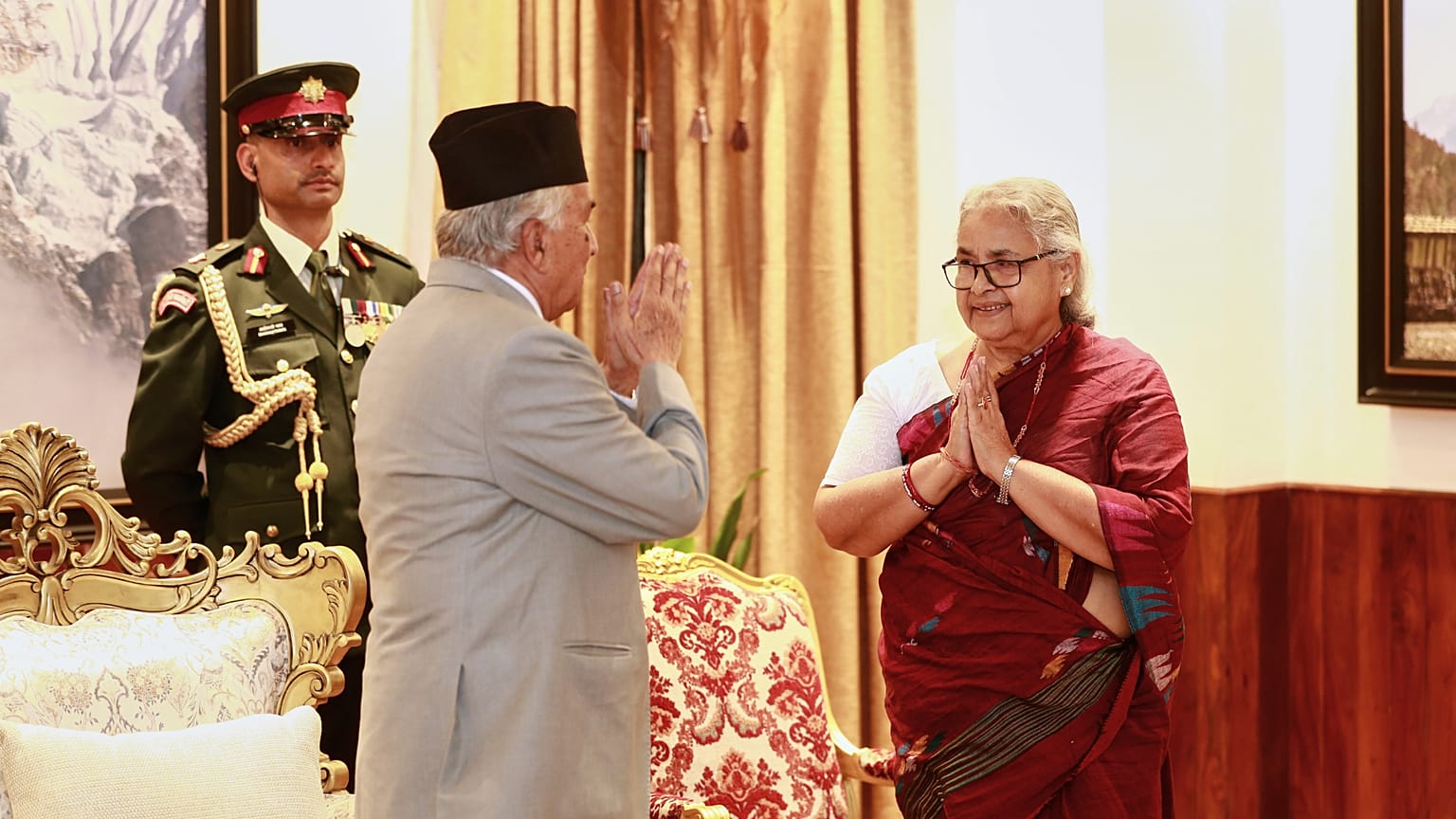
Copyright AP Photo/Sujan Gurung
By Evelyn Ann-Marie Dom with AP
Published on 13/09/2025
Former Supreme Court Chief Justice Sushila Karki was the only female chief justice in 2016 and 2017 and was known for her stance against government corruption during that period.
Nepal's first woman prime minister was sworn into office on Friday on an interim basis, as calm has returned to the country following mass protests that caused the previous government to collapse. On Saturday, authorities lifted a curfew implemented earlier in the week in the country's capital and surrounding areas.
President Ram Chandra Poudel appointed former Supreme Court Chief Justice Sushila Karki as interim prime minister and the first woman to head the Himalayan nation's government.
Poudel also set 5 March as the date for elections based on the recommendation of the new prime minister. The most recent legislative elections were held in 2022.
Karki, a popular figure, was the only female chief justice in 2016 and 2017 who was known for her stance against government corruption during this period. Some lawmakers unsuccessfully tried to impeach her in 2017 amid accusations of bias. The attempt to impeach had been criticised as an attack on the judiciary.
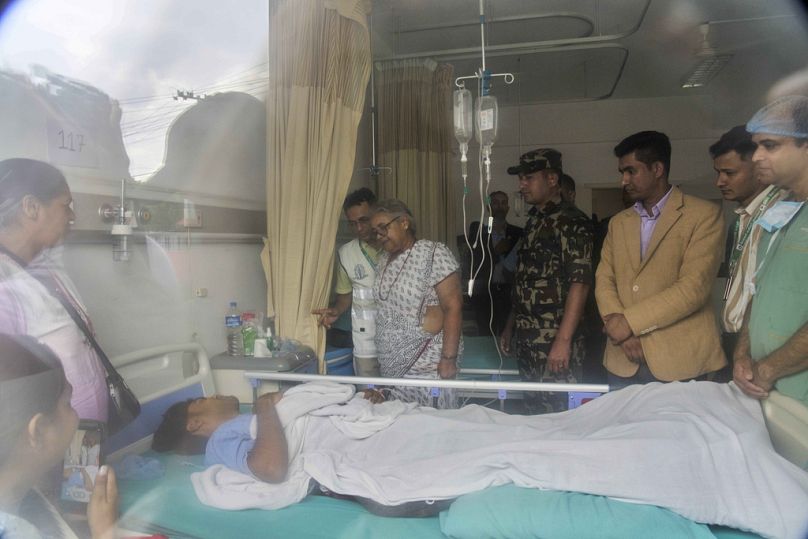
On her first day, Karki visited injured protesters at the Civil Hospital in the capital, pledging to do what's best for the country, "I will work with everything I have," she said.
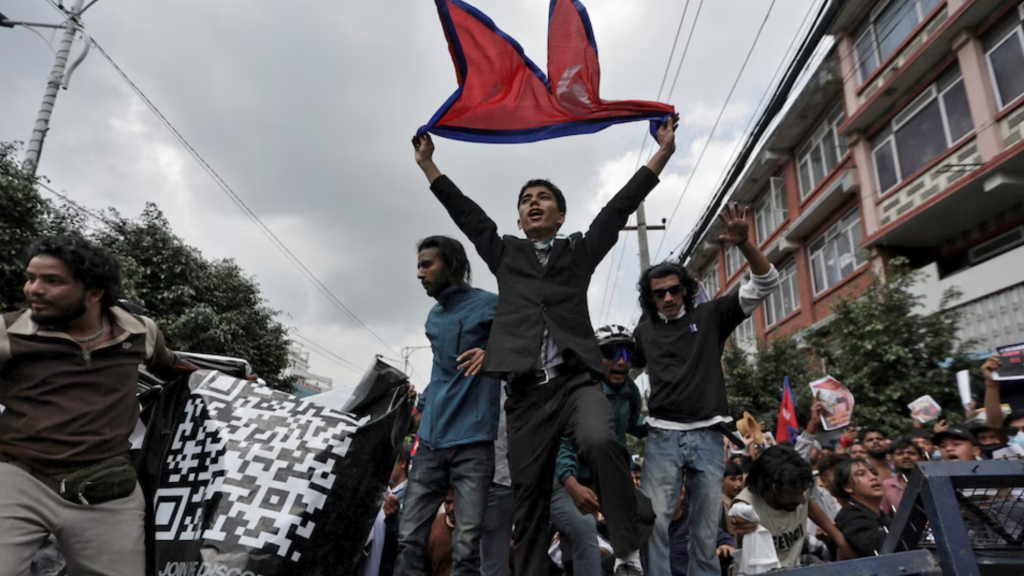
Street demonstrations, dubbed the 'Gen Z protest,' broke out in the country's capital Kathmandu on Monday. A social media ban imposed by the government the previous week had been the final straw for Nepal's youth, who expressed broader grievances with the government over a range of issues, mostly to do with corruption, unemployment, and frustration with the country's political elite.
Many young people also expressed anger over the lavish lifestyle political leaders and their children, who they call 'nepo kids', seem to enjoy, which they often flaunted on social media, while most youth struggle to find work.
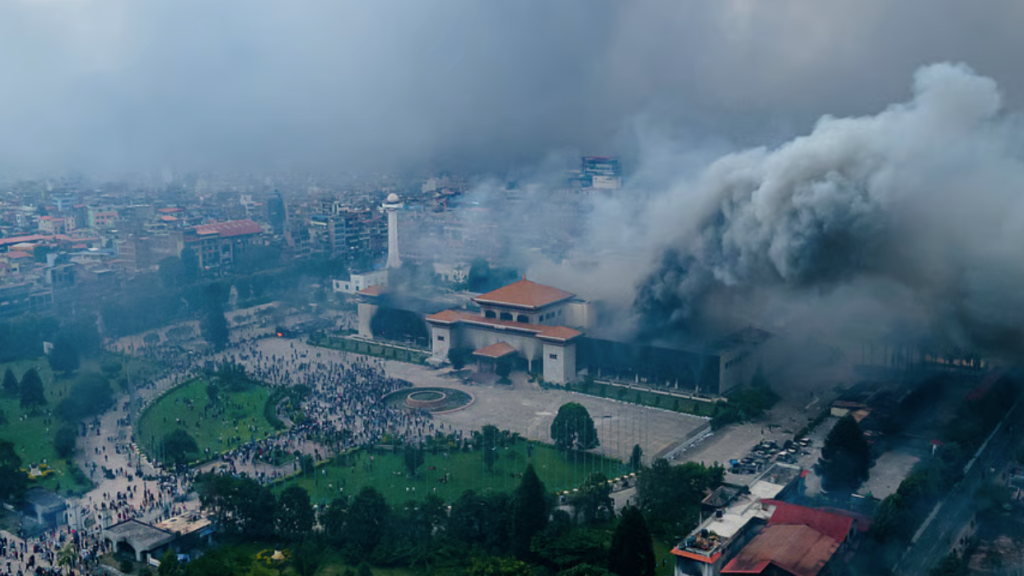
Tens of thousands of protesters blocked roads, stormed government facilities, and torched government buildings, including the parliament, politicians' homes, and businesses.
Violence over the past week also resulted in 51 deaths, many of whom were protesters killed by police fire. Other were inmates trying to break out of the main jail in central Kathmandu after they overpowered police guards and set fire to buildings with cells and guard houses. Three police officers were also killed, authorities reported.
On Tuesday, Prime Minister Khadga Prasad Oli resigned and fled his official residence. It marked the start of negotiations between protesters, the army, and the president over an interim government.
The curfew, which was enforced by the military late Tuesday and gave residents a few hours per day to leave their homes to buy essentials, was lifted by Nepalese authorities on Saturday.
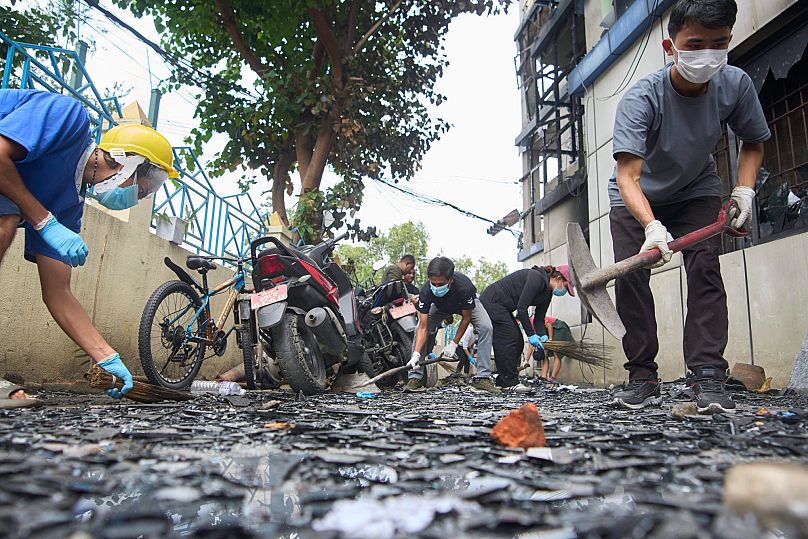
Nepalese society has largely returned to its usual daily routine, and videos circulating on social media show protesters cleaning the streets following days of unrest.
Zofeen T. Ebrahim
ON Sept 8, the Nepalese capital erupted in chaos. The world witnessed thousands of young protesters in school uniform — who identified themselves as Gen Z — on the streets of Kathmandu, demonstrating against a ban on social media.
The protest spiralled into violence after clashes with police left 22 people dead in just a few hours. The following day, an incensed mob set ablaze government and private buildings including parliament, the office of the Nepali Congress Party, the supreme court and the homes of politicians before vandalising them. There were also reports of prison breakouts with over 1,200 hardened inmates managing to escape. To date, the death toll in the country stands at 51, with over 1,300 injured.
Media experts in Nepal, such as Kanak Mani Dixit, believe that the demonstrations started by Gen Z underlined genuine concerns regarding poor governance and corruption. However, he believed that the rally was hijacked by anarchists, including those with nefarious political affiliations within and outside Nepal, which led to the toppling of the coalition government. Even the media covering the protests were not spared. Angry youth set fire to the premises of the Kantipur Media Group (KMG) on Sept 9. Thankfully, there were no casualties.
“You can burn the newsroom, you can’t destroy the spirit,” posted Anup Kaphle, former editor of the Kathmandu Post, a part of KMG and housed within its premises. That spirit was put to the test and the papers affiliated with this media group — the Nepali-language Kantipur Daily and its English-language sister publication, The Kathmandu Post — hit the stands the next morning on Sept 10.
The mob attack did not deter Nepal’s media.
The group continued publishing reports on their social media platforms, including Facebook and X, as the ban had already been lifted. It was heartening to see Nepalese journalists bravely continuing to report despite intimidation. But then, nothing less was expected from this media powerhouse — known for fiercely guarding its editorial independence. By taking a principled stance and reporting the truth, without pandering to any government, political party or corporation, the media house has frequently drawn the ire of various displeased groups.
The mob attack on the media has come as a rude shock to mainstream journalists in Nepal, who, unlike their counterparts in many other South Asian countries, have so far enjoyed relatively more media freedom. As one senior journalist put it, “For the first time, I understood what self-censorship feels like.”
No journalist should have to feel this way. But in Pakistan, many do. Pakistani media face backlash from multiple actors — the state, corporations, religious groups, political elites and militants. These threats are met with inaction, with perpetrators rarely held accountable. Internal divisions further weaken the media amid external pressures. Attacks on one outlet are ignored by others, due to political alignments. What media fail to realise is that unity is vital when under attack.
The attack on its media is not just Nepal’s problem. It’s a regional clarion call. All South Asian media must unite — when journalism becomes a casualty, democracy is at stake.
However, unity alone is not enough. Media must earn public trust and support through journalistic integrity. In Pakistan, this link is sorely missing. While attacks on the press must never be tolerated, media houses should invest in safety training and safe evacuation of their staff (KMG staff were swiftly evacuated when their offices came under attack). At the same time, they need systems to continue reporting after attacks. Do Pakistani media have such contingency plans in place?
The attack on the press in Nepal did not occur in isolation. It followed the clampdown on digital freedoms. Nepal’s youth, having never experienced such bans before, found it particularly unsettling as social media plays a huge part in their everyday informational and commercial needs. Weeks before the ban, a viral social media campaign called ‘Nepo kids’ had been exposing the extravagant lifestyles of politicians’ children, prompting allegations of corruption and nepotism.
The Nepalese government’s attempt to silence Gen Z’s demand for a corruption-free society by blocking their access to social media platforms, backfired. Therein lies a lesson for Pakistan — which has a restless youth bulge of 44.6 million. Ignoring their energy and frustration can lead to dangerous consequences. Economist Dr Hafeez A. Pasha has repeatedly warned of the 34 per cent — or 15.1m — that are idle; they are neither in educational institutes, nor employed. In contrast, the rate is 18pc in Sri Lanka, 24pc in India, and 30pc in Bangladesh. The question is: do our rulers have a plan to stem their discontent, or are they waiting for a Nepal-like situation to erupt?
Published in Dawn, September 13th, 2025
Nepal protests have deeper roots
Friday 12 September 2025, by Alex de Jong
Under the right conditions, a spark can start a prairie fire. Protests against a social media in Nepal ban grew into a full blown uprising after police killed 19 protesters. Houses of prominent politicians were attacked, the parliament set on fire and the government is in shambles. But what is next?
In an article for Himal Southasian, Roman Gautam pointed out the influence of other uprisings; ‘when Sri Lankans rose up in 2022 to boot out the Rajapaksa regime’, Nepalis ‘took notice. Then came Bangladesh and its July Revolution last year, with Sheikh Hasina and the entire political system around her in the public’s sights’. And in footage of protests in Nepal, the same skull & bones flag that became a symbol of Indonesian protests can be seen.
The initial trigger was a ban on social media, something many people who run small businesses rely on. Social media such as Whatsapp and Messenger is also line of communication with the millions of Nepali migrant workers abroad. About 7.5 percent of Nepal’s population lives abroad and remittances account for over a quarter of the country’s GDP, more than official development assistance and foreign direct investment combined. The large scale migration is driven by poor prospects at home, where almost one in four young people is unemployed. Viral recordings of the children of politicians enjoying lavish lifestyles added fuel to the fire.
Under such conditions, protest against a social media ban quickly widened into one a movement against the corrupt and unaccountable politicians held to be responsible for a lack of prospects. And then on September 8, police opened fire, killing 19. Among the dead were children still in their school uniform. This kind of violence was carried out by a government led by a self-declared communist, K.P. Sharma Oli of the Communist Party of Nepal (Unified Marxist–Leninist) or CPN (UML). Anger escalated into outrage. A day later, Oli stepped down and the social media ban was lifted but this was too little to late.
The discrediting of the Oli-led coalition of CPN (UML) and the Nepali Congress is not limited to those two parties. Tellingly, on Tuesday the house of opposition politician and former prime-minster Prachanda was also attacked. Like Oli, Prachanda is a self-declared Communist; he is the chairman of the Communist Party of Nepal (Maoist Centre). CPN UML, Nepali Congress and Maoist Centre are the three major political parties in the country. Since 2008, Nepal has had 13 governments, with these three parties cycling in and out of power.
Decline and collapse of a revolution
This is not the first time in recent history that Nepal has seen a mass uprising. In 1990, popular protests ended monarchical rule in Nepal and the country became a multi-party constitutional monarchy. The CPN UML, which began as a left front participating in this movement, then estlibshed itself as one of the country’s major political parties.
Despite its name, there is little communist about this party’s ideology. In the early nineties, its Secretary General Madan Bhandari formulated the party’s approach, the ‘theory of people’s multiparty democracy’. This was essentially a continuation of the party’s previous Stalinist stagist theory of revolution. It maintained the old conception that before any kind of socialism would be possible, there needed to be a phase in which, in alliance with so-called ‘national capitalists’, capital accumulation would be developed. Bhandari’s formulation added that this ‘New democratic’ phase would be achieved through electoral means, via parliament, and respect political pluralism. In what became the CPN UML’s foundational documents Bhandari, who died in 1994, stressed that New Democracy is ‘not different in socio-economic structure and production system’. It would be a ‘basically capitalist production system’, to be achieved by the ‘working people and common people’.
Much of Nepali politics in the nineties were characterized by competition between the CPN UML, NC, a nominally social-democratic party, and the Hindu-nationalist, monarchist Rastriya Prajatantra Party. Much of the criticism the parties directed at each other revolved around accusations of corruption and nepotism, rather than political ideology. One difference was in international orientation: NC was historically seen as pro-India while the CPN-UML ‘admires the great achievements of building socialism with Chinese characteristics’ by the Chinese Communist Party. Despite such differences, all three of these parties at different times formed (government-)coalitions in the years between 1990 and 2005 when the king assumed executive power.
Part of the tragedy of Nepal is that Prachanda’s Maoist movement arose as revolutionary movement that promised an end to social and economic stagnation and to break the dominance of the established parties. In 1996 the Maoists presented the government, at that point led by the NC, with a 40-point list of demands that included land distribution, a system of unemployment benefits, health care and education as well as an end to caste-based discrimination and autonomy for marginalized regions. When their demands were not met, they launched an armed struggle against the Nepali state.The Maoist ‘people’s war’ gathered strength around the turn of the century when the Maoists controlled large parts of the countryside. As the insurgency grew, Nepali king Gyanendra, who was also the commander of the army, concentrated power in his own hands.
But by doing so, the king antagonized most of the political parties, including the Nepali Congress and CPN UML. In April 2006, a mass movement broke out in Nepal’s cities. Named Jana Andolan II or People’s Movement II after the 1990 movement, the protests led to the stripping of all powers from the king and reinstatement of parliamentary rule. The Maoists in the meantime had come to an agreement with the opposition parties and committed themselves to a negotiated end of the armed struggle. Their goal now was ‘multiparty competition within a stipulated constitutional framework’, as Prachanda put it. On November 21, 2006, the Maoists announced the end of their insurgency and the dissolving of the political organs it led in the country side. The Maoists then joined the interim government.
During the people’s war, the Maoists emphasized that their immediate goal was to ‘build a new type of national capitalist relations, oriented towards socialism’. When speaking in 2001 with a reporter from The Washington Times, Baburam Bhattarai, their main ideologue at the time, implored him to ‘please note that we are not pressing for a “communist republic” but for a bourgeois democratic republic.’ This strategy was similar to that of CPN UML but differed on how to achieve the preparatory phase of ‘national capitalism’, either through elections or armed struggle.
In 2001, Bhattarai also declared there was ‘absolutely no possibility’ of the Maoists turning into a ‘parliamentary party’ and thereby ‘betray the revolutionary aspirations of the masses’. But this is exactly what happened after 2006. As successful as they had been on the battlefield, in the institutional arena the Maoists were first outmaneuvered by the established parties and then quickly assimilated.
The progressive character of the draft constitution was steadily whittled down. It did not take long for the Maoist leadership to fall apart and start accusing each-other of corruption. Even money that was meant to go to the former fighters who were to be integrated into the national army went missing. The change in lifestyle of someone like Prachanda was indeed conspicuous. Some radical groups left the party, but those offered little more than a repeat of the old dogmas and a promise of something few people want; a return to the people’s war at some future point.
Musical chairs
Once the new constitution was introduced, it did contain some progressive changes, such as the country becoming a secular republic. But other democratic provisions, such as more political power for marginalized regions in a federal system, were not or only partially implemented. For many working Nepalis little changed in their daily lives.
Since 2008, Maoists were prime-minsters of Nepal four times: Bhattarai once, Prachanda three times, most recently from 2022 to 2024. At different times, the Maoists formed coalitions with each of the main parties of the recently collapsed government. In 2018, the CPN UML and the Maoists, parties that not long before had been at each-other’s throat, even went through a short-lived fusion. The failure of this fusion, like other splits from the CPN UML and the Maoists in 2021, was largely caused by disagreements over positions. A cynic might say that almost 20.000 people died in the people’s war so that the Maoists could join the political game of musical chairs.
With many of the country’s fundamental problems unresolved, it is no surprise that right-wing forces are making a comeback. Earlier this year, Nepal saw substantial protests of monarchists. Restoring the kingdom is a minority position but the monarchists are energized by the obvious failure of CPN UML, NC and Maoist Centre. The ‘resurgence of pro-monarchy activities’, as one Nepali journalist put it, ‘is reflective more of the old guard trying to cash in on widespread public frustration rather than a show of support for the discredited institution’. There are rumors that right-wing, monarchist forces have also been stoking the recent violence. Likewise, fingers are pointed at India and Hindu nationalist forces that would like to see Nepal’s status as a Hindu state restored and Nepal’s foreign orientation shifted away from China to India. That such forces are attempting to benefit from the current situation is quite possible. Obviously these kind of manouvers were made possible in the first place by wide-spread anger and disappointment.
The legitimate anger over corruption can be a step towards social radicalism. But there is also a risk of such energy being captured by more conservative forces, as the fate of other anti-corruption protests shows. Especially among urban middle-classes and NGO- activists, neoliberal notions of ‘good governance’ locate the root of poverty and underdevelopment not in imperialism and capitalist exploitation but in the failure to ‘uphold the rule of law’. The feeling that ‘they are all corrupt’ can fuel the desire for a strong man, for an outsider who will ‘drain the swamp’.
Protest movements can bring down a government but taking power to actually change the course of society is another thing. Anti-corruption agencies are not enough when what is at stake are matters like land reform, minority self-determination, workers rights and fighting the rule of capital.
The cases of Sri Lanka, where popular revolt led to a government that is essentially continuing neoliberal policies, and Bangladesh, where after the July 2024 uprising, it is the right-wing that is set to grow are sobering examples. But it would be a grave mistake to draw from this the lesson that the left should abstain from such protests, or even worse support governments whose blatant corruption and incompetence has led them to lose popular support. History is made when the masses enter into action. Socialists need to be part of such struggles in order to be able to point to a better way.
11 September 2025
Attached documentsnepal-protests-have-deeper-roots_a9166.pdf (PDF - 917.1 KiB)
Extraction PDF [->article9166]
Alex de Jong is editor of Grenzeloos, the journal of the Dutch section of the Fourth International.
International Viewpoint is published under the responsibility of the Bureau of the Fourth International. Signed articles do not necessarily reflect editorial policy. Articles can be reprinted with acknowledgement, and a live link if possible.
Nepal joins regional wave of revolt as popular anger at repression and inequality spreads across South Asia
Since 2022, a wave of movements that originated in Sri Lanka has spread across South Asia. In Bangladesh, the anti-quota movement sparked widespread protests in 2024, prompting the Sheikh Hasina government to respond with severe repression. In retaliation, individuals from various backgrounds took to the streets. As calls for an uprising against the government intensified, Hasina was forced to flee the country, despite her efforts to suppress the popular movement.
This wave of protest has now reached neighbouring Nepal. Politically, left and right factions have offered differing interpretations of the situation. However, both sides attribute the mass movement in Nepal to the influence of US imperialism. While there is currently no concrete evidence of direct US involvement, it would be premature to rule out any such sleight of hand.
But we can reasonably assert that imperialist conspiracies are not the sole cause of Nepal’s uprising. Rather, it was driven by growing discontent among ordinary Nepalis, which has been escalating for nearly two decades due to political manoeuvring at their expense. The recent ban on social media served as a catalyst. Similar to the quota protests in Bangladesh, which reflected deep public dissatisfaction, the undemocratic act of shutting down social media in Nepal may have been the tipping point that brought down an anti-people government.
After decades of bloody struggle, the establishment of democracy in Nepal in 2008 marked a historic milestone. At a time when Communist parties globally were experiencing setbacks, the seizure of state power in Nepal under Communist leadership ignited renewed hope for the left. A mass uprising in Nepal effectively toppled the existing regime, leading to high expectations in the newly-formed government. However, in recent years, Nepal’s three major political parties — the Nepali Congress, Communist Party of Nepal (Unified Marxist–Leninist), and the Maoist Centre — have engaged in a game of musical chairs for power. This effort resulted in no significant improvement in the daily lives of ordinary citizens.
Before delving into this issue further, it is essential to briefly revisit the history of Nepal’s anti-monarchy movement, as understanding this movement is crucial for grasping the context of the current wave of protests.
Anti-monarchy movement in Nepal (2001–08)
In June 2001, a tragic massacre occurred in the royal palace of Nepal, resulting in the deaths of King Birendra, Queen Aishwarya, heir Dipendra, and nearly the entire royal family. Following this event, King Gyanendra Singh ascended to the throne. However, his reign soon led to widespread public discontent. In February 2005, Gyanendra dissolved parliament and assumed executive power. A state of emergency was declared, newspapers were suppressed and political parties were effectively banned. The international media characterised this move as an authoritarian step.
In this context, political parties and the Maoists signed the significant “12-point agreement” in Delhi in 2005, aiming primarily to overthrow the monarchy and establish a democratic framework. In April 2006, the People’s Movement-2 commenced. For 19 consecutive days, millions defied curfews and took to the streets. Workers, students, women and rural peasants all participated in this movement. Under mounting pressure, Gyanendra was compelled to reinstate parliament, marking the onset of the monarchy’s decline.
In December 2007, the interim parliament officially passed a resolution to abolish the monarchy, laying the groundwork for declaring Nepal a republic. International media reported, “Lawmakers formally approved … to abolish the centuries-old monarchy and declare the country a republic” (Dawn). On April 10, 2008, elections for the Constituent Assembly were held, with the Maoists securing the most seats. Following the election, they announced the monarchy would cease to exist.
Finally, on May 28, 2008, during the first meeting of the Constituent Assembly, a vote was conducted that officially ended Nepal’s monarchy. Of the representatives, 560 voted in favour, while only four were opposed. Consequently, Nepal was declared a Federal Democratic Republic. On the same day, the royal flag was lowered from Narayanhiti Palace, and the national flag was raised; the palace was subsequently converted into a museum.
Post-2008 Communist rule and controversies
With Nepal becoming a federal democratic republic, many hoped that a stable and progressive government could lead the country forward. However, Nepal’s Communist-led governments have faced accusations, instability and fragmentation, resulting in unfulfilled aspirations among the populace. From the outset, internal conflicts within the Communist parties became evident.
The party that emerged from the Maoist armed rebellion had promised to draft a new constitution upon gaining power; yet in practice, they used parliament and the government to consolidate their authority. There were allegations of corruption, nepotism and excessive control over the state apparatus against the Maoist leadership. The Maoists consistently delayed the constitution-drafting process, creating ongoing conflicts in parliament concerning the balance of power, which ultimately fostered a growing sense of uncertainty among the people.
Another powerful political current in Nepal was the Unified Marxist-Leninists, or CPN (UML). Sometimes they allied with the Maoists; sometimes they opposed them. In 2018, a major event occurred when the CPN (UML) and the Maoist Centre united to form the Nepal Communist Party. Then-Prime Minister K. P. Sharma Oli and former Maoist leader Prachanda came to power with joint leadership. Many people believed this unity would lead to long-term stability. But internal tensions soon became apparent. Oli was accused of trying to monopolise power, weakening constitutional institutions, and using the judiciary and the president’s office for his own interests. He was also accused of bypassing parliament through executive decisions and suppressing critics.
In 2020, the political crisis reached its peak when Oli abruptly announced the dissolution of parliament. Opponents labelled this act as not only unconstitutional but overtly anti-democratic. Eventually, the Supreme Court reinstated parliament. During this tumultuous period, large protests erupted on the streets, further eroding confidence in the government. The unity of the Nepal Communist Party was short-lived as well. In 2021, the court annulled its legal existence due to registration errors and unresolved internal conflicts. Consequently, the Maoist Centre and CPN (UML) split again. This division weakened leftist politics in Nepal and diminished their credibility in the eyes of the public.
The government’s activities faced significant criticism, particularly due to various corruption scandals. Accusations were levelled against the government for irregularities in large development projects, and for providing financial benefits to party leaders and wasting public funds. Newspapers and civil society organisations consistently reported that Communist leaders were exploiting state resources to consolidate their power rather than addressing the challenges faced by ordinary citizens. A key factor contributing to the erosion of public trust was the government’s evident incompetence and weak management during the pandemic. Inadequate health services, a poor vaccine procurement policy and corruption in relief distribution angered the population throughout COVID-19.
There were allegations regarding the suppression of dissenting voices. Lawsuits targeting critical journalists, threats directed at civil society leaders, and police crackdowns on protests significantly undermined Nepal’s democratic practices. In 2019, Khem Thapaliya, editor of the online portal Jhaljhaliya, and Sajjan Saud of Ijhjalco were arrested for purported connections to a rebel Communist group. Additionally, Deepak Pathak, a board member of Radio Nepal, faced arrest for criticising a former prime minister on social media.
In March 2025, during a pro-monarchy rally in Kathmandu, police employed force — including tear gas, rubber bullets and water cannons — resulting in two fatalities, alongside numerous other anti-democratic occurrences. Human rights organisations have consistently accused the government of using force against peaceful demonstrators. Furthermore, the government’s failure to safeguard the rights of minority ethnic groups and Dalit communities became increasingly apparent.
Another significant weakness of Nepal’s Communist movement was internal factionalism. Oli, Prachanda and Madhav Nepal, who when on to lead the Communist Party of Nepal (Unified Socialist), a later split from the CPN (UML), each used the party to bolster their influence. Consequently, there were frequent changes of government. From 2008 to 2025, Nepal experienced over a dozen changes, primarily involving leftist or left-led administrations. However, this instability did not result in consistent development or democratic progress for the populace. Instead, ordinary citizens perceived Communist leaders as preoccupied with power struggles.
Apart from internal conflicts, Nepal’s foreign policy also attracted controversy. The government has repeatedly struggled to manage its relations with India, navigate the growing influence of China, and address pressures from international donors. Critics argue that Communist governments have at times capitulated to Chinese influence and, at other times, succumbed to Indian pressure, thereby limiting Nepal’s capacity for independent decision-making. Consequently, the situation led to a rise in support for nationalist movements and pro-monarchy groups.
The primary failure of the Communist-led government has been its inability to ensure political stability. The process of drafting a new constitution was excessively prolonged, the implementation of the new provincial structure proved ineffective, and economic inequality remained unaddressed. The absence of consensus among political parties, coupled with ongoing power struggles, has heightened public frustration. Many analysts believe that Nepal’s political landscape is caught in a cyclical pattern: left parties ascend to power, falter due to corruption and repression, and subsequently, a new alliance emerges, only for the same issues to arise again.
The 2022 Kathmandu mayoral election
In the 2022 mayoral election in Kathmandu, the triumph of independent candidate Balen Shah triggered an important change in Nepal’s political landscape. For an extended period, Communist parties had maintained a strong grip on the politics of both the capital and the country. Many believed that the Nepal Communist Party’s influential role in local elections would persist, even following its split. However, Shah’s victory challenged this assumption, acting as an early warning signal to Nepal’s Communist leadership.
Shah gained popularity primarily as a rapper and an independent cultural figure, remaining unaffiliated with any political party. He emerged as a symbol of protest against the established political system. When he contested the Kathmandu mayoral election, many viewed his candidature as a symbolic challenge. However, the election results demonstrated that voters were not merely seeking to send a symbolic message; they elected him as a means of rejecting the existing political system altogether.
The Communist parties failed to hold on to a central position like Kathmandu in this election. Their candidates could not gain voters’ trust, because long-standing rule, allegations of corruption, internal splits and power struggles had tired the people. Shah tapped into this frustration during his campaign. He promised a clean city, better services and accountable administration, which attracted voters.
Shah’s victory not only opened new doors in Nepal’s political landscape but also highlighted the shortcomings of the Communist parties. It is evident that Shah’s success was not merely a triumph for an independent candidate; rather, it reflected the public’s diminishing trust in established political forces. The faith in leftist politics, which had been evident during the 2008 fall of the monarchy, began to wane in this election. The defeat of the Communist candidate in a strategically significant city such as Kathmandu served as a clear indication of their organisational weaknesses.
After 2022, Nepal’s political and social landscape gradually became more complex. Shah’s victory in Kathmandu highlighted public frustration; however, in the ensuing years, the central government continued to wallow in the mire of outdated politics instead of heeding this message. As a result of administrative failures, corruption and political instability, Nepal’s governance system fell into a deep crisis.
In the 2022–23 fiscal year, youth unemployment for those aged 15–24 reached 22.7%, a significant increase from 7.3% in 1995–96 (CESLAM). Concurrently, overall unemployment stood at 12.6%, up from 11.4% in 2017–18 (CESLAM). Consequently, frustration among unemployed youth grew, accompanied by a rising disillusionment with the government.
Economic inequality has continued to rise, with an increasing gap between urban and rural areas. In the 2022–23 fiscal year, the poverty rate for those living below the cost of living threshold was 18.34% in urban areas, compared to 24.66% in rural areas (Asia News Network). The urban elite have monopolised most of the wealth and benefits, leaving rural populations neglected. The agricultural sector has fallen into crisis, leading to a decline in productivity.
Many young people have sought to migrate due to a lack of domestic employment opportunities. Although remittances from migrant workers have kept the economy afloat to some extent, they have not succeeded in reducing internal economic inequality. According to World Bank data, 20% of Nepal’s population lives below the poverty line. The same report notes that the income of the richest 10% of the country is more than three times that of the poorest 40%. This highlights the substantial income gap between the upper and lower classes.
Ongoing protest movement and present scenario
Today’s anti-government mass movement in Nepal did not emerge spontaneously. Instead, it developed as a result of two decades of ineffective and unproductive politics by Communist parties. Regardless of the narratives surrounding US imperialism that may circulate, the reality is that democratic space in Nepal has been diminishing. For an extended period, extreme repression, a failure to decentralise power, and the establishment of a bureaucratic system have fostered a climate in which power is perceived as might, making the system’s collapse inevitable.
While the right may concoct various tales to suggest a conspiracy by the US against India, it is disheartening to witness the left overlook the political awareness of the working class. It is undeniable that, in the name of establishing democracy and peace, the US has conducted imperialist invasions in numerous countries, including in Central Asia, Afghanistan and Iraq. It is the duty of the left to stand in solidarity with the people of these nations, prioritising internationalism. However, this does not imply that every struggle for democracy should be dismissed as an imperialist conspiracy — such a dismissal merely exposes a form of unrealistic arrogance.
The demands for food and democracy are not mutually exclusive; rather, when the left attains power, one of its primary responsibilities, along with addressing inequality and unemployment, is to democratise the governance system to ensure that the voices of the most marginalised are heard within the state administration. Should there be attempts to centralise social power through dictatorship and the establishment of a bureaucratic class, a rebellion among the people is inevitable. The outcomes of such a rebellion will likely be seized by whichever forces are most organised within the movement at that time, whether on the right or left.
In Nepal’s case, a positive indication is the presence of various leftist forces actively participating in the streets and leading segments of this movement. If they are able to maintain leadership, they will be able to challenge the right and achieve victory. Furthermore, parties such as the Nepali Congress have rejected the proposal to establish US military bases. It remains uncertain how effectively the US can leverage this movement to sustain its influence in Asia. However, if the demands of workers and peasants are overlooked in the struggle for democracy, and individuals are viewed merely as puppets of imperialist forces, they are essentially reduced to “passive objects” manipulated by external powers.
It is evident that Nepal’s political system, along with the succession of leftist governments, has failed to meet the expectations of the working masses. The promise of reform that began after the end of the monarchy has devolved into a pattern of unpredictability, intra-party conflicts and widespread dissatisfaction. This failure has eroded the credibility of political leaders, allowing emerging social movements and self-governing organisations to challenge the dominance of mainstream political entities.
While reestablishing some form of political stability is likely, the critical and unresolved question remains: can the left regain its footing? Historically, when revolutionary periods are halted — failing to move beyond superficial reforms aimed at achieving deeper social change — they can have significant repercussions for the working class and the disadvantaged. Consequently, such outcomes often lead not only to disappointment but the rise of reactionary alternatives, a decline in progressive forces, and a weakening of the democratic spaces that the revolution sought to create.
Today, Nepal finds itself at a pivotal juncture. The left’s inability to consolidate its achievements and transform the revolution’s aspirations into sustainable structures of democracy and social justice has created a precarious void. Should autocratic or self-serving forces fill this vacuum, the original goals of the 2008 Republican revolution may face serious delays and compromises. The pressing issue is not whether stability will return — it is highly likely that it will — but under whose leadership it will manifest and what form that stability will take.
For the left, the challenges are substantial. To regain its credibility, it must establish an integrated organisational framework and undergo a genuine transformation towards accountability, inclusivity and a true democratic process. Without such a shift, the historic significance of the revolution risks being remembered increasingly as a missed opportunity that fostered lasting resentment among those it aimed to empower.
Nepal’s horrific reckoning with its failed political class
First published at Himal.
Nepalis don’t often pay attention to the politics of their Southasian neighbours beyond India. But when Sri Lankans rose up in 2022 to boot out the Rajapaksa regime, they took notice. Then came Bangladesh and its July Revolution last year, with Sheikh Hasina and the entire political system around her in the public’s sights. Again, Nepal took note. In numerous conversations in Kathmandu, on both occasions, I heard the same refrain: our turn will come.
So here it is now. Young people, under the banner of “Gen Z protests”, took to the streets on 8 September — sick of a corrupt political system and political class, sick of seeing the same discredited old men taking turns to lead and loot the country, sick of seeing no future path but to leave for work abroad, which thousands do every single day. The peaceful protests suddenly veered into violence, and after police opened fire the death toll climbed to 19, with hospitals packed full of the injured. It was the single deadliest day of protest that Nepal has ever seen.
On the morning of 9 September, sorrow and rage brought thousands out, defying curfews. Throughout the country, anything connected to the government and the political establishment was suddenly fair game. Party offices and politicians’ homes went up in smoke. By afternoon, heavy columns of soot rose from the bowl of the Kathmandu Valley. The country’s main airport was closed, with flights diverted away. At new ministerial quarters in the south of the capital, helicopters landed to ferry residents away to safety. Then, more gunfire, more sirens, explosions, even thicker plumes of smoke.
Ministers began resigning, following in the wake of the home minister, who had quit the previous night. Opposition parliamentarians resigned en masse, with calls growing to dissolve the government and call for fresh elections. Before 3 pm the prime minister, K P Sharma Oli — in his third stint in power, and as stubborn and self-serving as they come — also announced that he was stepping down.
As the day proceeded, things spiralled completely out of control. This was no longer the Gen Z protestors of the previous day. The mob had taken over. Videos circulated of political leaders being thrashed, their homes being stoned and set alight. The prime minister’s house was burning, the president’s residence, the Supreme Court, the parliament, supermarkets, police stations, and much more. And, of course, more deaths to count. The chief of the army made an appearance to call for restraint and calm, but this did little to stop the looting and violence. Finally, well into the night, came an announcement that the army was being deployed to restore order.
Today Nepal woke up to deep uncertainty. The feeling is the government had to answer for the 19 dead, that Oli and the old guard had to go. But the scale of the arson, the bloodletting, the mob running free — past the red haze of anger, few can justify all of that. Nobody knows who is now in charge. Nobody can say what happens next.
The last two days’ events, with their speed and scale, almost defy sense. But there are patterns from the past that will make themselves felt as Nepalis turn to the question of what next.
First: this has been a long time coming, and the entrenched system will take some serious undoing. The anger evident in the reactions to Sri Lanka and Bangladesh’s uprisings had been building up for years. Nepal’s exit from its civil war, ended almost two decades ago, had been full of hope. The establishment parties — foremost among them the Nepali Congress and Oli’s Communist Party of Nepal (Unified Marxist-Leninist), the same parties that led the government that has just come down — promised a new democratic dawn after they finally turned against the monarchy. The Maoists, having laid down arms and agreed to stand for democratic election, had sold dreams of a more just society to millions of Nepalis who had never gotten a fair deal. Then, by and large, hopes were shattered, the promises broken.
The Maoists won the first post-war vote, a sign of how hungry Nepal’s people were for change. But they failed to make any real impact and soon became just another establishment party. Their failure is best symbolised by how their leader — Chairman Prachanda himself — soon became known more for his personal wealth than his revolutionary credentials. A new draft constitution, shockingly progressive in Nepal’s historical context, was stalled and stalled until it was forced through after much watering down. Subsequent elections have seen the vote fractured largely between the three establishment parties, with backroom deals and public backstabbings delivering a revolving carousel of the same discredited leaders coming and going from power.
Nepal has made progress in the years since the war, but this has been slow and tortuous, and more often won despite the government than because of it. Public services remain dismal, even as tax burdens are high. For most Nepalis, the main sources of hope and uplift are the remittances from their relatives toiling abroad, many of them under terrible conditions. Meanwhile those in the political elite — dominated, as it has long been, by dominant-caste men from the country’s Pahad region — have been doing just fine, and have carefully cultivated their preferred crony capitalists. A long series of corruption scandals in recent years implicating politicians, bureaucrats and businessmen from across the establishment spectrum has only reinforced the public’s dismal view of the system.
Second: Nepalis have some idea how to wage a popular revolution, but they have never really figured out how to make one stick. The country’s first democratic upsurge, in the 1950s, deposed the hereditary Rana prime ministers and won the people a free vote. But the monarchy, freed from over a century of Rana control, soon turned on the fledgling democratic parties, and the Shah dynasty reasserted its power. After decades of Panchayat rule — a kind of managed, sham democracy under the monarchy — Nepalis rose up again in 1990. That revolution brought the democratic parties back to power, albeit with the king as constitutional monarch, before it too foundered. Misrule and an escalating Maoist insurgency opened the door to a royal coup d’état in 2005. Then came the end of the war, in 2008; the end of the monarchy; and all the hopes betrayed.
This moment is Nepal’s latest attempt at correction. It may not go down as a revolution — certainly nobody is asking to overturn the system of government — but what the people want is a seismic change in the rules of power. Unfortunately the past is a powerful foe, and Nepal’s old ways have too often reincarnated with new faces. The public mood now is to turn towards a seeming new guard: upstart figures like Rabi Lamichhane, a television anchor turned politician, or Balen Shah, a rapper turned Kathmandu’s mayor. The former founded a new party in mid-2022, and it won a stunning 10 percent of the vote in a national election just months later. The latter came out of nowhere that same year to upset two establishment candidates as he swept the capital’s municipal election. But both men’s records leave more than a little room for concern, even if many Nepalis might ignore this in a search for saviours.
Lamichhane is dogged by numerous controversies, including charges of corruption that had him behind bars until he was let out amid the uprising. These charges are politically motivated, a way for the old establishment to beat down a challenger — but it is also not clear if they are wholly unsubstantiated, and Lamichhane has work to do to prove he is clean. What's more, Lamichhane showed no compunction in joining hands with the old order during a short-lived stint in government after the 2022 election. Shah’s tenure as mayor has been marred by administrative dysfunction, and his main accomplishment remains the cult of personality he has built online. If the old guard is truly to go, can Nepalis be sure such a new guard will be better?
Lamichhane and Shah’s electoral results, delivering black eyes to the old parties, were harbingers of the anti-establishment anger that has now boiled over. If Nepal goes to the polls again anytime soon, the smart money will be on the vote swinging hard against the old parties. But that alone cannot guarantee new leaders with the wherewithal to resist the temptations that undid those before them, or a government that will deliver real change. When it comes to systemic fixes, to really reinventing the country’s politics, Nepal ventures onto uncharted ground.
With Nepal’s uprising to add to those in Bangladesh and Sri Lanka, it is tempting to see a Southasian Spring, akin to the Arab Spring of the early 2010s. The elements are there: rotten governments, fed-up people, one uprising linking to the next. But also: death, devastation, and no sure path to a better place. It is sobering to remember how the Arab Spring ended up, with democracy snuffed out again by autocracy. In Bangladesh the mobs had their way too after the Hasina government’s necessary fall, and an interim government has struggled to clean up the system as the country approaches a necessary new election. The next government there could well bring certain old powers back, and with them old ways. In Sri Lanka, a new government shorn of the old establishment is breaking its earlier promises one by one. There has not been any blazing new dawn. And now Nepal, from its present abyss, dreams of a new politics that actually works for the people. Let it not have to see more blood in its striving.
For now there is all the horror to process from these days, bodies still to cremate, some semblance of order to restore. Nothing that comes next will be easy.
The day Kathmandu burned
Triggered by a recent social media ban, Nepal's Gen Z took to the streets against corruption and nepotism. But none of them had foreseen the violence and unrest that transpired.

The week of September 8, 2025, was just another week for RC Gautam, an errand boy at Kantipur Television. During two decades of his employment at the station, he had seen several street protests, dire political situations, a civil war, shootouts, violence and even an attack on the channel’s headquarters. But September 9 panned out a bit differently for him.
“I can’t even begin to tell you how many people stormed our station. It all happened so quickly,” he told me over the phone.
An irate mob rushed into the Kantipur TV building on Tuesday, set fire to three buildings on its premises, torched two dozen bikes and over a dozen cars. The station was just one of the hundreds of buildings and homes that came under attack in the wake of what is being dubbed the ’Gen Z’ protests in Nepal, which quickly spiralled out of control on September 8.

Triggered by a recent social media ban, the demonstrators took to the streets against corruption and nepotism. Every day, about 2,000 Nepalis leave for the Gulf, Malaysia and other countries for work, and while the country runs on a remittance economy, the children of leaders and politicians lead lavish lifestyles — something the Gen Z have been criticising on social media.
When the protesters took to the streets on Monday, they had expected it to be peaceful. Initially, there was music and dancing as well, and some local celebrities showed up to support the movement. But things quickly spiralled out of control when some of the older men in the crowd targeted the parliament.
Thus began the rioting. Subsequently, the Kathmandu chief district officer issued orders to open fire, resulting in the deaths of 22 protesters. The numbers have since risen. Some of the protesters who died were in school uniforms. By September 10, a total of 30 people were reported dead. More than a thousand people injured in the protests are being treated in hospitals.
But the figures on casualties are being called conservative estimates. Many people remain missing and unaccounted for in similar events in different parts of the country.
The inferno
On September 9, violence escalated as groups of arsonists showed up on the streets, vandalising and torching private homes of ministers and businesses connected to those in power. Entire ministerial quarters, government buildings, police stations, the Supreme Court and the country’s main administrative block, Singha Durbar, were among those set on fire.
On Tuesday, Kathmandu burned and smelled of rage. The air was so thick, it was choking.
When smoke started filling the air in the Budanilkantha area, the north of the capital, where I live, and army choppers encircled the sky above me relentlessly, my instinct as a former reporter made me step out.

The Deuba residence, the home of former Prime Minister Sher Bahadur Deuba and his wife, former minister Arju Deuba, had been attacked. A plume of smoke rose from their residence and lifted towards the Shivapur hill. Choppers made several rounds attempting to airlift the couple, who had been manhandled by the mob, but didn’t succeed. Gunshots were heard, and neighbours said two men had died — their deaths, not verified. The Deubas, injured, were eventually evacuated through the back door.
On the street across from where I live, smoke rose towards the sky — the air stank.
When I arrived at the scene, the arsonists had just left, and the public had open access to former President Bidhya Bhandari’s house, which was blazing. The crowd outside lingered and engaged in a tone of chit-chat. What I overheard:
“What did you take?”
“I didn’t really get my hands on anything.”
“There were 240,000 Nepalese rupees, and some USD. Some people took it.”
“Someone took a mattress.”
“I only took a cake.”
On my evening walks, going past the Bhandari home, I would often quickly scan the former president’s house, and the guards would be stationed at the security posts, armed. On Tuesday, as the house burned and the residents had been evacuated, the guards were still there outside the gate, waiting.
“This is our duty,” they said.
The scene at the Bhandari home was a common one across Kathmandu as arsonists ventured from neighbourhood to neighbourhood, torching and plundering the homes of ministers and administrators, beating them, stripping them.
Kathmandu was an inferno on September 9, as the fire brigades were forbidden to move by the police for security reasons. Even if they had been mobilised, they were never prepared for fire on such a great scale. No one had foreseen the violence and unrest of the nature that transpired.
The lull of sleeplessness
Most Nepalis have slept poorly since the killings on September 8. Most are seething or grieving. Or tired and scared. While the anger initially was directed at the KP Oli government and the ruling coalition for killing unarmed protesters, emotions had cascaded into confusion by the next day.
People no longer knew who was backing the arsonists or who seemed to be targeting specific homes and establishments as though they had been operating by a list, exercising what appeared like premeditated attack tactics.
Men on motorcycles were going door to door, causing arson and leaving behind a trail of what sounded like victory cries during battles. Some of them wielded guns they had stolen from police stations they had stormed. In Maharajgunj Chakrapath, the neighbourhood I grew up in, a high-ranking policeman was beaten to death by the mob. Some policemen were rescued and airlifted by army choppers on a sling.

This was the station my family and neighbours had looked to for security.
By the time the ‘Gen Z’, who were the ones to launch the protest in the first place, called for calm on social media and absolved themselves of responsibility for the riots, too much damage had been done. Their call had been for peaceful protests against corruption. But they no longer had control over the situation. Their movement had been hijacked.
When the Nepali army chief’s address was delivered on the evening of September 9, offering security — coupled with prohibitory orders — people sensed some form of respite in knowing that at least the rampage would stop if nothing more. Army trucks patrolled the city, but people still spent the night in fear. Unknown groups broke into private residences in some places; looting was reported in others. Prisoners had escaped en masse in different parts of the country.
As the mayhem unfolded, I was texting a young journalist friend who’s from outside Kathmandu and lives in the capital for work and studies. She said she felt scared. I told her I would probably sleep with a pair of scissors under my pillow, just in case. There were rumours that there had been stray incidents of men entering homes and raping women, something confirmed by the army later in an announcement.
Media during anarchy
During the attack on Kantipur TV on Tuesday, my former colleague, RC Gautam, was able to get away to safety. But with the army clampdown and curfew in place, he still hasn’t arrived home as I write this, and is instead sheltering with an acquaintance nearby.
“What will happen next, didi?” He asked me. “How am I going to feed the kids? How will I educate them? The office I worked at is gone.” I didn’t have an answer to give RC, but I mourned with him the loss of my former place of work, among many other things that have been lost to us within two days.
Kantipur TV, the biggest private legacy media, was known as an institution that stood its ground. And while media houses are also about their owners and their advertisers, they’re mostly about the journalists who run them. Especially the non-partisan ones, who give their lives to journalism so they can uphold high standards. Kantipur Media Group has had many journalists like that over the years, who’ve taken stands when the nation and the people needed it.

A man walks past a graffiti that reads “Hang the Killer!” following Monday’s deadly anti-corruption protests triggered by a social media ban, which was later lifted, in Kathmandu, Nepal, September 11, 2025. — Reuters
During the April 2006 street protests, hundreds of people had stopped outside the Kantipur complex in Tinkune to clap and show gratitude for the good journalism it had done. Those of us who worked there at the time looked outside the window, and some of us had tears of gratitude streaming down our faces.
The same establishment received a different kind of treatment. For many journalists who worked at Kantipur, their work was their home from where they launched treatises into the world, asked difficult questions and urged the Nepali people to think. The burning of Kantipur also points towards a troublesome point in Nepal’s history, where dedication to journalism has been vilified. Sure, some journalists take shortcuts, and all legacy media is funded by businesses, but they’re also run by journalists who believe in truth-telling. Free and fair journalism is the foundation of democracy, and pulling down a media house like Kantipur signals the close of a period that trusted independent media.
Questions abound
If one of the things this movement is demanding is the restoration of freedom of speech, then taking down a media house is a symbolic contradiction.
Which brings me back to the basics. Where does Nepal go from here? There’s no intel on this right now. Are there foreign elements at play? Vested interests of dormant political groups? Who instigated the riots? Who should lead next?
By the night of September 10, the Gen Z had spent an entire day discussing and closing in on who their choice of an interim leader could be. But discord and constitutional hurdles riddled their choices, as the nation listened in. Nepal is steeped in questions right now, and even though the answers are aplenty, none of them are right or wrong.

As of now, the country’s former chief justice, Sushila Karki, has claimed to have accepted the Gen Z protesters’ request to lead the interim government. “When they requested me, I accepted,” Karki told Indian news channel CNN-News18. “Gen Z” representatives told reporters that they met army officials later and proposed Karki as their choice to head an interim government.
International media and friends want to know what’s happening. Our DMs are flooded with messages of both care and mere curiosity, but the people are too tired right now. We’ve seen homes burn, we’ve watched loved ones die suddenly and quickly, our colleagues have been shot at, beaten up, and our friends and family robbed. We’ve also seen men brandishing guns and khukuris (a traditional knife, also the national weapon of Nepal), threatening innocents.
Who are these men? Who is mobilising them? Where have the former ministers fled? Where are the ones who got away safely and went into hiding? Who is being sheltered at the army barracks? What is the army move likely to morph into? Who will the nation pick as its new leader? Will the president call for snap elections? Will the Constitution be amended? Who will comfort the mothers whose children died in the protests? What will happen to all the people who have lost their jobs because the buildings they worked in are now gone? Questions abound.
But for now, just in this moment, these queries must take a step back. Because right now, Nepalis need rest, support, and the strength to build back when all of this chaos ends and the air has cleared.
Header image: A demonstrator waves a flag as he stands atop a vehicle near the entrance of the Parliament during a protest against corruption and government’s decision to block several social media platforms, in Kathmandu, Nepal, September 8.
The author is a former journalist and spent a lifetime with Kantipur Media Group or Kantipur Television. Presently, she is a columnist at Nepali Times.
Five Theses on the Situation in Nepal

Scene from the protests in Kathmandu, Nepal in September 2025. Photo via Facebook
If your house is not clean, then the ants will come through the door and draw in the snakes.
The crisis in Nepal escalated in early September, bringing down the center-right government of Prime Minister KP Oli. The immediate spur was the regulation and banning of social media on September 4. Protests over this action were met by police firing, which resulted in the killing of 19 protestors. This escalated into major manifestations, leading to attacks on the homes of politicians and the national parliament building as well as the presidential building.
Several narratives are circulating about the current upheaval, but two dominate:
- Systemic governance failure: That years of unmet promises, corruption, and opportunistic alliances produced a legitimacy crisis not for this or that party, but for the establishment. The present upsurge is explained as a popular backlash due to the cumulative neglect.
- Color Revolution thesis: That the protests are engineered by an external force, most of the fingers pointing at the United States and at the US Congress’ National Endowment for Democracy’s funding towards Hami Nepal (established in 2015).
Both theories make it easy for the stakeholders within Nepal to deflect responsibility – either onto foreign meddlers or onto a vague idea of the “political class”. There is no discussion in these theories of the underlying bourgeois order and its problems in Nepal: a century-long patronage economy, the control of land, finance, and government contracts in the hand of an oligopoly with close ties to the monarchy, and a growth paradigm depending on the export of migrant workers and of debt-financed infrastructural development. The structural sources of peoples’ grievances are flattened into simplistic, but evocative concepts such as “corruption” and “color revolution”.
Read more: Nepal’s Gen-Z uprising is about jobs, dignity – and a broken development model
Neither of these theories are totally incorrect or correct but are only partial and their partiality can be very misleading. This article cannot by itself correct that partiality, but it hopes to offer some ideas for discussion. The five theses below are intended only to frame the debate that we hope will be held not only over Nepal’s predicament, but that of many countries in the Global South.
1. Mismanagement of the opportunity. After the new Constitution was enacted in Nepal in 2015, there was immense hope that the broad left would be able to advance the social situation of Nepalis. Therefore, in 2017, the various communist parties won 75% of the seats in the national parliament. The following year, the larger communist parties joined together to form the Nepal Communist Party – although the unity was not very deep because the parties had their own structures and their own programs and could not truly form a unified party, but mainly a unified electoral bloc. The lack of a common program for communist political activity, and a common agenda to solve the people’s problems through the instrument of the State led to the dissipation of the opportunity provided to the left.
The unified party split in 2021, and since then the various left parties rotated in power, which people saw as individualism and opportunism. When the Home Minister Narayan Kaji Shrestha (2023-2024) of the Maoist Center tried to use the instruments of the state to investigate corrupt practices – even in his own party – he was hounded out of office. Since 2024, the government in Nepal included a rightist fraction of the left (led by K. P. Oli) and the one fraction of the right (the Nepali Congress), which made it a center-right government. The long fight for democracy that began with the 1951 Revolution, deepened with the 1990 Jana Andolan, and then appeared to be cemented with the 2006 Loktantra Andolan only appears to be defeated, when in fact that long struggle will reappear in another form.
2. Failure to tackle the basic problems of the people. The problems in Nepal in 2015, when the new Constitution was adopted, were grave. A massive earthquake in Gorkha devastated the province, leaving over 10,000 people dead and rendering hundreds of thousands homeless. At least a quarter of Nepalis lived under the poverty line. Caste and ethnic discrimination created a great sense of despair. The Madhesh region along the Nepal-India border was particularly angered by the sense of disadvantages and then by an analysis of being further marginalized by the 2015 Constitution. Weak public healthcare and education – underfunded for a century – could not meet the aspirations of the emerging middle class.
The left governments did put forward various policies to address some of these issues, lifting large sections of the population from poverty (child poverty went from 36% in 2015 to 15% in 2025) and from infrastructural abandonment (electricity access now at 99% and a registered improvement in the Human Development Index).
There remains, however, a huge gap between the expectations and the reality, with inequality rates not dropping fast enough and migration at startlingly high levels. Corruption levels also remained too high in the country as corruption perceptions deteriorated (ranked 107/180 in 2024). Corruption, inequality, and inflation could not be contained by the government, which made very poor deals for trade and for finance (the return to the IMF’s Extended Credit Facility narrowed its fiscal possibilities).
3. The tendency to seek refuge in the idea of the Hindu Monarchy. The Nepali petty bourgeoisie, which sent their children to English medium schools, and often come from oppressed or “backward” Hindu castes are frustrated by the continual domination of upper castes and are inspired by the right-wing Hindutva petty bourgeoisie politics of India’s Uttar Pradesh, one of the states that borders Nepal. That is why there were many posters in the protests of Yogi Adityanath, a leader of India’s right-wing Bharatiya Janata Party (BJP) and the leader of the Uttar Pradesh government. This fraction of the population is also in the mood to “return” to monarchy, which is a Hindu monarchy. Several political forces back these tendencies, such as the pro-monarchy party (Rashtriya Prajatantra Party or RPP) and its broader allies (Joint Peoples’ Movement Committee – formed in March 2025 as part of the return to monarchy protests, Shiv Sena Nepal, Vishwa Hindu Mahasabha).
Since the 1990s, the Hindu Swayamsevak Sangh (HSS), the Indian RSS’s international affiliate, has quietly built shakhas (groups) and cadre since the 1990s. The HSS – along with a tentacular group of organizations such as the Shiv Sena and the RPP – has campaigned against secular policies and for a return to Hindu Raj. Rather than merely target secularism, the Hindutva bloc has focused attention on what it says is a revolving door of elites in Kathmandu that has held power ever since the monarchy was abolished in 2008. They frame their civilizational rhetoric around anti-corruption and charity, with mobilizations through Hindu festivals and through online influencers as well as selective outreach to marginalized and oppressed castes in the name of Hindu unity. This bloc, powerfully organized unlike the youth, has the capacity to seize power and to restore order in the name of the Hindu state and the monarchy, bringing back authoritarianism in the name of anti-corruption.
4. Tired of the Migration Escape Valve. If we ignore small countries such as Montserrat and Saint Kitts and Nevis, Nepal is the country with the highest per capita rate of migration for work. With a population of 31 million there are currently 534,500 Nepalis (recorded) who work overseas – 17.2 people per 1,000 Nepalis. The numbers have surged in recent years. In 2000, the recorded figure for Nepalis who obtained foreign employment permits was 55,000, now it is ten times higher. There was a new record in 2022-23 with 771,327 permits issued).
Large sections of youth are angry that they have not been able to meet their needs for employment within Nepal but are forced to migrate and often to horrible jobs. A terrible incident in February 2025 took place in Yeongam (South Korea), when a 28-year-old migrant, Tulsi Pun Magar, likely committed suicide because the employer at the pig farm where he worked kept revising the wage rate downwards. Tulsi came from the Gurkha community in Pokhara. In the wake of his suicide, reports came that 85 Nepalis have died in South Korea in the past five years, half of them by suicide. News of stories such as these increased the frustration and anger at the government. Online, many shared the sentiment that the government was more considerate of foreign direct investors than of its own migrants, whose investment in Nepal through remittances is far higher than any foreign capital.
5. The external influences of the United States and India. The center-right government of KP Oli had been close to the United States. Nepal had joined the US government’s Millennium Challenge Corporation (MCC) in February 2017, a decision by a left government that was hugely contested by large sections of the left. Due to the pressure from below, Nepal’s government stayed away from the MCC, but Oli’s center-right government welcomed John Wingle (Deputy Vice President of the MCC) to Kathmandu in August 2025 to hold talks about resumption of US aid and to discuss the continuation of infrastructural projects. Meanwhile, India’s far-right government of Narendra Modi sought to promote the role of the Hindu nationalist far right party in Nepal, which has thus far been at the margins. If there was any external activity in the 2025 protests, it is more likely that India, and not the US, had a hand in the events. However, even here, it is possible that the far-right wing in Nepal will merely take advantage of the collapse of the Oli government and the enormous sentiment against corruption.
It is important to recognize that no home or office of the RPP was attacked, whereas in March the RPP cadre attacked one communist office – a foreshadowing of what happened in September.
The army appears to have restored some calm in Nepal. But this is a calm that is one of disorder and danger. What comes next is to be seen. It will take time for the dust to settle. Will the army invite one of the online celebrities to take over such as Kathmandu mayor Balendra Shah? The protestors have suggested Sushila Karki, who is a highly respected former Chief Justice of Nepal (2016-2017), who has made a career of being independent of political parties. These are caretaker choices. They will not have the mandate to make any significant changes. They will pretend to be above politics, but that will only disillusion people with democracy and plunge the country into a long-term crisis. A new Prime Minister will not solve Nepal’s problems.
Vijay Prashad is the Director of Tricontinental: Institute for Social Research, where Atul Chandra is the co-coordinator of its Asia program.
Courtesy: Peoples Dispatch
Nepal: An Uprising About Jobs, Dignity, Broken Development Model

A vehicle was set on fire in front of the office of the CPN (Unified Socialist) in Kathmandu, Nepal on September 9. Photo: Surendra Kandel
Kathmandu is on edge not because of “apps”, but because a generation raised on the promise of democracy and mobility has collided with an economy and political order that keeps shutting every door. The proximate trigger was regulatory: the government ordered 26 major social-media platforms to register locally and began blocking those deemed non-compliant, including Facebook, YouTube, Instagram, WhatsApp, X, and others. Crowds surged toward Parliament; police deployed tear gas, rubber bullets and, in several places, live fire. By late September 9, at least 19 people were killed and well over 300 injured. Under pressure, the government lifted the social-media ban and Prime Minister KP Sharma Oli resigned.
The spark was the ban. The fuel was political economy
It is tempting – especially from afar – to narrate this as a clash over digital freedoms. That would be analytically thin. For Gen-Z Nepalis, platforms are not just entertainment; they are job boards, news wires, organizing tools, and social lifelines. Shutting them off – after years of economic drift – felt like collective punishment. But the deeper story is structural: Nepal’s growth has been stabilized by remittances rather than transformed by domestic investment capable of producing dignified work. In FY 2024/25, the Department of Foreign Employment issued 839,266 exit labor permits – staggering out-migration for a country of ~30 million. Remittances hovered around 33% of GDP in 2024, among the highest ratios worldwide. These numbers speak to survival, not social progress; they are a referendum on a model that exports its youth to low-wage contracts while importing basics, and that depends on patronage rather than productivity.
That is why the ban detonated so quickly. With youth under- and unemployment already high at 20.82% as seen in 2024, ministerial churn being the norm, and corruption scandals ambient, attempts to police the digital commons looked less like “order” and more like humiliation. The movement’s form – fast, horizontal, cross-class – echoed Bangladesh’s student-led mobilizations and Sri Lanka’s Aragalaya movement: school and college students in uniform, unemployed graduates, gig and informal workers, and a broader, disillusioned public converged around a shared verdict on misrule.
Facts on the ground: casualties, curfews, and climb-down
The event’s sequence is unambiguous. An expansive registration order and blocking decision ignited protests; security forces responded with escalating force; by Monday night, 19 were dead and hundreds injured; curfews and assembly bans spread; the Home Minister quit; an emergency cabinet huddle withdrew the ban; by Tuesday, Oli resigned.
Importantly, the grievance was never only digital. Protest signs and chants centered on corruption, elite impunity, and the absence of a credible development horizon. Amnesty International demanded an independent probe into possible unlawful use of lethal force – another reason the uprising hardened from a platform quarrel into a legitimacy crisis.
Migration as the silent plebiscite
If one metric explains the generational mood, it is Exit labor permits. The 839,266 exit labor permits issued in FY 2024/25 (up sharply from the previous year) translate into thousands leaving every day at the peak. These are not tourists; they are the very cohort now on the streets. Their remittances – about 33% of GDP – keep households afloat and the import bill paid, but they also mask a lack of structural transformation in the domestic economy. In a system that cannot absorb its educated youth into stable, value-adding work, the public square – online and offline – becomes the one place where dignity can be asserted. Trying to close that square amid scarcity was bound to provoke an explosion.
A self-inflicted wound for Nepal’s Left
Following Nepal’s four-year IMF Extended Credit Facility (ECF) program, the government faced pressure to boost domestic revenue. This led to a new Digital Services Tax and stricter VAT rules for foreign e-service providers, but when major platforms refused to register, the state escalated by blocking them. This move, which began as a tax enforcement effort, quickly became a tool of digital control, and it occurred as the public was already dealing with rising fuel costs and economic hardships driven by the program’s push for fiscal consolidation. The government’s platform ban became the final trigger for widespread protests against corruption, joblessness, and a lack of opportunities, highlighting that the unrest was less about a “color revolution” and more about material grievances fueled by austerity measures.
That the crackdown and its political finale unfolded under a CPN (UML) prime minister makes this a strategic calamity for Nepal’s left. Years of factional splits, opportunistic coalitions, and policy drift had already eroded credibility among the young. When a left-branded government narrows civic space instead of widening material opportunity, it cedes the moral terrain to actors who thrive on anti-party cynicism – individual-cult politics and a resurgent monarchist right. The latter has mobilized visibly this year; with Oli’s resignation, it will seek to portray itself as the guarantor of “order”, even as its economic vision remains thin and regressive. This is the danger: the very forces most hostile to egalitarian transformation can capitalize on left misgovernance to expand their footprint.
From an anti-imperialist vantage – one that opposes Northern privilege yet insists on unsentimental analysis – the crisis is textbook dependency without development. Remittances smooth consumption but entrench external dependence; donor-driven governance tweaks rarely become employment-first industrial policy; and procurement-heavy public spending feeds rent circuits more than productive capacity. In such an order, the state is tempted to police visibility rather than transform conditions. That is why an attempt to regulate platforms by switching them off – rather than by ensuring due process and narrow tailoring – was read as an effort to manage dissent, not to solve problems.
What opposition signals tell us (and what they don’t)
Opposition statements recognized the larger canvas sooner than the government did. Pushpa Kamal Dahal (Prachanda) expressed condolences, urged action on anti-corruption demands, and called for removing “sanctions on social networks.” The CPN (Unified Socialist) and CPN (Maoist Center) statements condemned the repression, demanded an impartial investigation, and linked digital curbs to failures on jobs and governance. These reactions matter analytically because they show that even within mainstream politics there is acknowledgment that the crisis is about livelihoods and legitimacy, not merely law-and-order.
But these signals also reveal the predicament of the left: if its leading figures can only react to a youth uprising rather than prefigure the development horizon that would have prevented it, then the arena will be dominated by anti-establishment and royalist currents claiming to deliver order faster – even at the cost of democratic space.
The bottom line
These protests in Nepal began because a government tried to regulate by switching off the public square. They exploded because that square is where a precarious generation looks for work, community and voice in the absence of opportunity at home. A complete accounting must therefore record both the human toll – 19 dead and hundreds injured – and the structural toll: hundreds of thousands compelled to leave each year and remittances that prop up consumption while postponing transformation. With Oli’s resignation and the ban withdrawn, the immediate confrontation may ebb, but the verdict delivered by Gen-Z will not. Until Nepal replaces remittance complacency and coalition arithmetic with an employment-first development model, the streets will remain the most credible arena of accountability.
Atul Chandra is a researcher at Tricontinental: Institute for Social Research. His areas of interest include geopolitics in Asia, left and progressive movements in the region, and struggles in the Global South.
Pramesh Pokharel is a political analyst and part time lecturer of Anthropology at Tribhuvan University. He is a Central Committee Member of CPN (Unified Socialist) and General Secretary of All Nepal Peasants Federation.
This article was produced by Globetrotter.
Courtesy: Peoples Dispatch

No comments:
Post a Comment