
Indonesia leader in damage control, installs loyalists after protests
Jakarta (AFP) – In removing Indonesia's finance minister and U-turning on protester demands, the leader of Southeast Asia's biggest economy is scrambling to restore public trust while seizing a chance to install loyalists after deadly riots last month, experts say.
Issued on: 14/09/2025 -

Demonstrations that were sparked by low wages, unemployment and anger over lawmakers' lavish perks grew after footage spread of a paramilitary police vehicle running over a delivery motorcycle driver.
The ensuing riots, which rights groups say left at least 10 dead and hundreds detained, were the biggest of Prabowo Subianto's presidency and the ex-general is now calling on the public to restore their confidence in his government.
He vowed tough action on the officers who ran over 21-year-old Affan Kurniawan, backtracked on lawmaker housing allowances, and on Monday removed five ministers, including respected finance minister Sri Mulyani Indrawati.
"We can read this as damage control after the wave of public anger, especially at... the misdirected budget efficiency," Rani Septyarini, a researcher at the Center of Economic and Law Studies, told AFP.
Prabowo has focused on expensive social mega-projects funded by widespread budget cuts that already roused protests in February. His flagship policies include a free meal programme and a new sovereign wealth fund.
But his new finance chief Purbaya Yudhi Sadewa said Wednesday he would inject an unprecedented $12 billion into the economy to spur growth and calm simmering public anger.
"Prabowo sees this problem as something that needs to be anticipated seriously," said Airlangga Pribadi Kusman, political analyst at Airlangga University.
"He wants to prevent further social damage."
Consolidating power
Prabowo surged to victory in last year's election and maintained a high approval rating of more than 80 percent 100 days after entering office in October, according to polls.
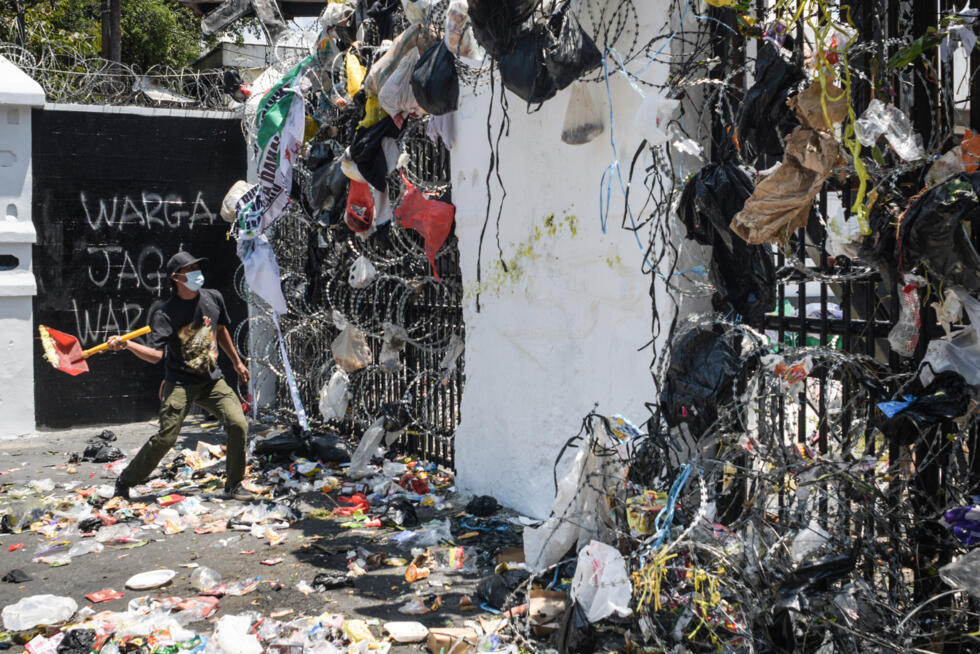
But the protests turned increasingly angry against the country's political elite, with mobs burning buildings and looting politicians' homes.
"This shows that the public has a real, legitimate problem with this administration," said Airlangga.
Yet the Indonesian leader has used the reshuffle to replace officials linked to popular predecessor Joko Widodo, more commonly known as Jokowi, with his own people.
Sri Mulyani served for eight years under Jokowi, while new finance minister Purbaya is close to key government economic adviser Luhut Binsar Pandjaitan -- an ex-military colleague of Prabowo.
"Prabowo is using the moment to slowly consolidate his political power by erasing Jokowi's influence," said Virdika Rizky Utama, a political researcher at think tank PARA Syndicate.
State Secretary Prasetyo Hadi said on Monday the replacements were the right people for the job.
The presidential palace did not respond to an AFP comment request.
To win back public trust, experts say Prabowo -- former son-in-law of late dictator Suharto -- needs to address an expanding wealth gap and weakening democracy in a nation long known for dynastic politics which only emerged from autocracy in the 1990s.
"What we need is the determination from the president, a political will, and real progress," said Airlangga.
'Closest circles'
But in installing loyalists to oversee budget and security, Prabowo appears to be trying to uphold his flagship programmes, rather than change course.
"Putting trust in people who are well-known becomes key to securing (his) policies," said Wasisto Raharjo Jati, political analyst at the National Research and Innovation Agency, who added those hired were from Prabowo's "closest circles".
"Prabowo will be more comfortable moving forward if his flagship programmes are handled by trusted figures."
Yet it's still unclear if Prabowo's new hires are up to the job of making life better for Indonesians.
While Sri Mulyani had stints at the World Bank and International Monetary Fund, Purbaya is a relatively unknown finance professional who immediately lauded Prabowo's ambitious growth goal of eight percent annually as achievable.
"Their competence, experience, and technological skills must still be demonstrated," said Wasisto.
Some say Prabowo should change course on his social projects as the country grapples with stagnant wages and rising unemployment.
"If the corrections are half-hearted... the perception of justice will worsen, and the social pressure will continue," said Rani.
The conciliatory moves and a call for calm appear to have bought Prabowo time.
But without addressing the root of the public's anger, analysts say another inflammatory incident could ignite bigger protests.
"This will be a time bomb," said Virdika.
"If things pile up, it will blow up."
© 2025 AFP
Thursday 11 September 2025, by Michael G. Vann
The Indonesian president, Prabowo, would like to turn the clock back to the dark days of the Suharto dictatorship. But he’s been confronted with an unexpected wave of protest after the killing of a young man by police in Jakarta, the country’s capital.
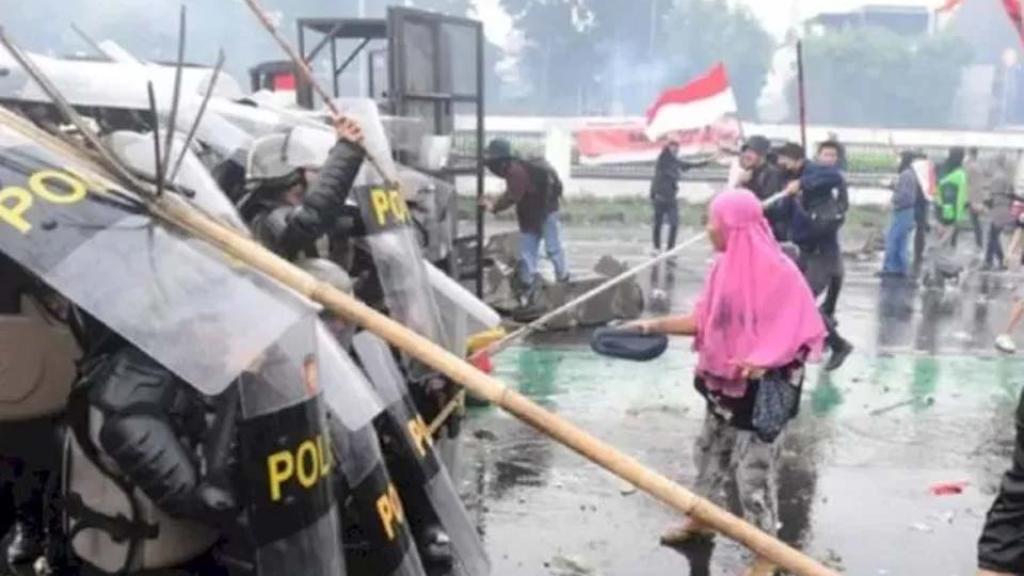
A woman strikes a police officer with a bamboo stick as police push back students during a protest outside the parliament building in Jakarta on August 28, 2025. (Bay Ismoyo / AFP via Getty Images)
Jakarta is burning. So are Makassar, Bandung, Surabaya, Mataram, and other cities throughout Indonesia. Discontent that started as outrage over the lavish perks of lawmakers evolved swiftly into a searing indictment of police brutality, elite privilege, economic precarity, wealth disparities, and democratic erosion.
The horrific death of a young man named Affan Kurniawan at the hands of the police pushed Indonesia over the edge. At the moment, it is unclear how far things will fall. But even Indonesia’s authoritarian president, Prabowo Subianto, is making concessions to the massive outburst of social anger.
Dark Indonesia
As the fourth-largest nation in the world and (at least for now) the world’s third-largest democracy, Indonesia has grappled with the legacies of authoritarianism and free-market discipline since the people power revolt that overthrew Suharto’s dictatorial New Order.
Over the past week, diverse acts of dissent, long simmering beneath the surface, coalesced into violent mass actions across the archipelago. With unprecedented ferocity and velocity, thanks to social media, thousands upon thousands of disillusioned citizens erupted in defiance.
Tension have been building through 2025. In February, a series of student demonstrations across Indonesia challenged Prabowo. Organized under the hashtag #IndonesiaGelap or #DarkIndonesia, the protesters opposed a range of policies, including massive budget cuts, the role of the military in domestic governance, nepotism, corruption, and a controversial free school lunch program.
The youth movement joyously embraced a punk DIY aesthetic and adopted Sukatani’s “Bayar, Bayar, Bayar” (“Pay, Pay, Pay”) as their anthem. The mixed-gender duo’s song blended punk, goth, and retro New Wave sensibilities in a raucous condemnation of police corruption.
While these demonstrations eventually dissipated, the pessimistic sentiment of Dark Indonesia spread. Many spoke about leaving their homeland. The hashtag #KaburAjaDulu, or “Just Run Away First,” went viral, reflecting widespread dissatisfaction among young Indonesians faced with weak domestic job opportunities and career prospects.
Prabowo and his administration reacted harshly, dismissing the trend, mocking the youth, and suggesting that it was part of a conspiracy. The opposition MP Charles Honoris countered by describing the hashtag as “a wake-up call, not a reason to label young people as unpatriotic or discourage them from returning. . . . Instead of reacting negatively to this trend, the government should focus on strengthening worker placement and protection programs.”
Rewriting History
In May, minister of culture Fadli Zon, a long-term Prabowo sycophant and rabid Sinophobe, appalled many Indonesians when he announced that he was writing a new national history. The project was an obvious exercise in the whitewashing of Suharto-era human rights violations. Zon then made dismissive remarks about the mass rapes of Chinese women during the chaotic last days of the New Order, implying that rumors had exaggerated the extent of these well-documented crimes.
The 1998 anti-Chinese violence was part of a strategy to redirect popular anger away from Suharto and toward a reliable scapegoat. Prabowo, then a high-ranking general and Suharto’s son-in-law, was dishonorably discharged for his role in kidnapping, torturing, and disappearing activists. In a committee hearing, opposition politicians Mercy Chriesty Barends and Bonnie Triyana publicly condemned Zon for trying to erase these crimes from the record.
Faced with dissent from various directions, Prabowo decided to unite the nation by literally rallying around the flag. As August 17 would mark eighty years since Sukarno’s declaration of independence, he ordered everyone to fly the red and white national flag in an act of patriotism. Flags and patriotic light displays quickly went up all over the nation’s 17,000 islands, weeks ahead of the date when communities would normally decorate for the holiday.
But then, something strange happened on Indonesia’s infamously busy roads. Truck drivers who were frustrated with long hours and burdensome regulations refused to fly the national flag. In a cheeky act of dissent, they flew the “One Piece flag,” a modified piratical Jolly Roger from a popular Japanese anime. After images of the truckers went viral on social media, the flags began to appear everywhere.
Prabowo was furious. In an act of pettiness comparable to Donald Trump’s various obsessions, Indonesia’s coordinating minister for political and security affairs, Budi Gunawan, warned of criminal consequences (such as five years in prison or a US$30,000 fine) for those who dared raised the comical skull and crossbones adorned with a straw hat.
In contrast, the Speaker of Indonesia’s House of Representatives, Puan Maharani, suggested a more conciliatory approach to the good-natured protest: “These expressions can be in the form of short sentences like ‘Kabur Aja Dulu,’ sharp satire such as ‘Dark Indonesia,’ political jokes like ‘Konoha country,’ [another anime reference] and new symbols like the One Piece flag and many more that are widely circulated in the digital space.”
As well as being the first female Speaker, Puan is the daughter of Indonesia’s first female president and the granddaughter of Sukarno, its first leader after independence. She reminded her listeners that democracies must allow dissent and criticism.
Flash Point
As Independence Day neared, frustration with the government took a violent turn in Central Java’s Pati Regency. Between August 10 and 13, at least 85,000 people poured into the streets to reject an outrageous 250 percent increase in land and building taxes. What began as a protest against regressive taxation metastasized into demands for the resignation of Regent Sudewo and the rollback of multiple unpopular local policies.
An indignant Sudewo taunted the demonstrators but soon found himself overwhelmed with popular anger. When he called in riot police — the infamous Brimob, or Mobile Brigade — to rescue him, he and the officers were pelted with garbage and chased from the town center. After several days of clashes between protestors and Brimob, the local legislature canceled the tax hike and began the impeachment of Sudewo. This rare victory empowered the activists in Jakarta.
By most accounts, the celebrations for Hari Merdeka, marking eighty years since Sukarno and Mohammad Hatta’s declaration of the end of Dutch rule, were large and joyous events. Admittedly many activists chose not to take part. Prabowo hosted a massive celebration at the Istana (the neoclassical presidential palace, formerly the headquarters of the governor of the Dutch East Indies), complete with military parades, honor guards, and a cavalry procession but also multiple coordinated dance routines with soldiers, officers, bureaucrats, and oligarchs joining in. Non-VIPs turned out for a large parade and aircraft flyovers around Monas, the national monument.
A week later, on Monday, August 25, the mood in the national capital was dramatically different. A dam broke when revelations surfaced that the 580 members of the House of Representatives had been receiving a monthly housing allowance worth 50 million rupiah — over US$3,000, or nearly ten times Jakarta’s minimum wage — on top of their salaries and other benefits. Student protesters, incensed at such grotesque displays of entitlement, moved to storm the parliamentary compound. Riot police unleashed tear gas; students retaliated with stones and set fires beneath an overpass. Roads were blocked, and the city convulsed.
The protests quickly widened and deepened. On August 28, labor unions joined the fray. Thousands of students, workers, and green-jacketed motorcycle rideshare (ojol) drivers marched demanding a halt to outsourcing, higher minimum wages, and protection from mass layoffs. The confrontation with police escalated into full-blown street battles. Using tear gas and high-pressure water cannons, Brimob battled protestors in the areas around parliament, spreading to malls, expressways, and train stations, and paralyzing Central Jakarta.
Uprising
A horrific death dramatically increased the stakes. On Thursday evening, outside Indonesia’s House of Representatives, an armored police vehicle struck and then proceeded to run over Affan Kurniawan, before fleeing the scene at high speed. The twenty-one-year-old victim was working as an ojol, an exhausting and dangerous low-wage job. The death was caught on video and immediately uploaded to social media. In a similar way to the 2020 police murder of George Floyd, the heartbreaking video went viral, producing sorrow and rage.
Suddenly the uprising spread out of Jakarta. More than twenty-five cities from Aceh to Papua became theaters of revolt. Protesters in Medan burned tires and erected barricades; in Pontianak, student leaders were arrested (then released on condition that they promised not to repeat their actions). In Makassar, a blaze engulfed the local parliament building, killing three public servants and injuring five in a horrific spectacle.
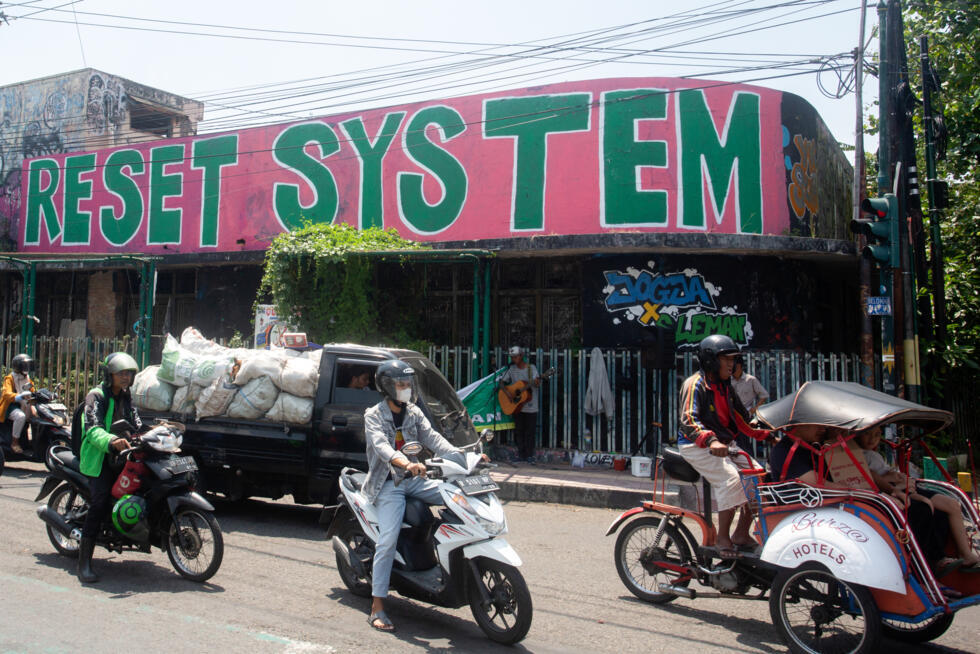
Youth in Lombok also burned the regional legislature, while in Surabaya, the governor of East Java’s offices were looted and set ablaze. In Yogyakarta, the provocation culminated in the burning of an integrated driving-license service building — a defiant act of symbolic resistance, even as the region’s sultan sought to quell tensions through dialogue. The violence echoed across Java, with buildings torched, police posts destroyed, and malls shuttered.
In most cases, the police completely lost control of the situation. Out of anger or panic, scores of officers responded with seemingly indiscriminate violence. Tear gas, water cannons, and gunfire has become common in all major cities and some smaller towns. There have been thousands of injuries, many serious, throughout the country. More deaths have been reported, and sadly more are expected as the violence does not seem to be abating after almost a week.
With evidence of police misconduct and acts of mass defiance being uploaded to social media, TikTok temporarily shut down its services in a vain effort to slow the rapid escalation and stop the spread of misinformation. Yet on all social media platforms, rumors are spreading of agent provocateurs encouraging the crowds in order to justify police violence.
In an all-too-familiar antisemitic trope, Russian media speculated that George Soros was behind the unrest. Left-wing activists have pointed out that attacks have focused on PolRI, the national police force and spared the army (Indonesian National Armed Forces, TNI). Considering the long and at times violent TNI-PolRI rivalry, it is possible that some elements within the military might use this opportunity for their own purposes.
Others note that as the unrest is tarnishing the reputation of both Prabowo and the House of Representatives, failed 2024 presidential candidate Anies Baswedan has the most to gain. Considering his past opportunistic use of Islamic identity politics, mass mobilizations, and Sinophobia to destroy the careers of rivals such as Basuki Tjahaja Purnama, the point is worthy of consideration.
Conciliation and Coercion
On Saturday, the violence continued. Multiple police stations in Jakarta and elsewhere came under attack, including groups throwing stones but also Molotov cocktails. The East Jakarta police station was burned to the ground. Social media was filled with hundreds of videos of skirmishes, some with alarming acts of violence.
In Jakarta’s wealthy enclaves, hundreds of people forced their way into gated communities and attacked the homes of particularly notorious politicians. Eko Patrio, who had posted messages on social media mocking the demonstrators, had his house looted. Videos showed people carrying chairs, lights, suitcases, studio speakers, and mattresses out of the house.
Lawmaker Ahmad Sahroni’s home was invaded and vandalized, the perpetrators making off with luxury bags, a large safe, a television, fitness equipment, a piano, and a life-size Iron Man statue. Finance minister Sri Mulyani Indrawati’s home was ransacked. Echoing the plot of the recent film Mountainhead, the attack on her residence may have been sparked by an AI-generated video of her allegedly ridiculing public school teachers.
Faced with a swarming revolt, President Prabowo canceled a scheduled trip to China to directly confront the crisis, expressing condolences and promising investigation. In a dramatic change from his response to similar unrest in 1998, he immediately visited Affan Kurniawan’s family and professed deep regret.
On Sunday, August 31, he delivered a mostly conciliatory speech that promised to eliminate excessive parliamentary stipends and other benefits. However, he did also encourage police to hunt down miscreants: “The rights to peaceful assembly should be respected and protected. But we cannot deny that there are signs of actions outside the law, even against the law, even leaning toward treason and terrorism.”
The state is cracking down on the demonstrations. Jakarta alone witnessed over a thousand arrests. With thousands more detained elsewhere, one wonders how the overburdened police and courts will handle due process. National police and the military were staged to restore “order” — a shorthand term increasingly used to justify suppressing dissent. Social media continues to document the heavy-handed tactics.
Usman Hamid, executive director of Amnesty International Indonesia, rejected the president’s speech as insensitive and missing the point. He urged Prabowo to seriously consider the people’s complaints.
Crisis Snapshot
The 2025 protests have thus become a snapshot of a broader crisis: austerity measures hitting civil institutions, the elite’s inexorable enrichment, and the underlying fragility of Indonesia’s democratic fabric. Citizens — notably youth, laborers, and gig-economy workers — posed a blunt question: Who exactly is this government serving?
These uprisings lay bare the fundamental contradictions of Indonesia’s political economy: the gap between the ruling class and the governed, the collusion of austerity and excess, and the simmering resentment of a generation that is seeing its future mortgaged.
The state’s twin impulses, concession and crackdown, expose its insecurity. Victories in Pati or the softening of rhetoric in Jakarta do little to change the structural tensions. If unchecked, the backlash could accelerate a collapse of democratic accountability. Neighboring countries such as Thailand, Cambodia, and the Philippines offer object lessons on the fragility of democracy.
In this sense, August 2025 is not just another cycle of protest. It is potentially a turning point at which Indonesia’s civic spirit collided, head-on, with elite impunity. How will the state respond? Repression or reform? Indonesia’s future has never been less clear.
4 September 2025
Source Jacobin.
Attached documentsthe-indonesian-protests-are-a-revolt-against-oligarchy_a9165.pdf (PDF - 899.5 KiB)
Extraction PDF [->article9165]
Michael G. Vann is a professor of history at California State University, Sacramento, and the coauthor of The Great Hanoi Rat Hunt: Empire, Disease, and Modernity in French Colonial Vietnam.
International Viewpoint is published under the responsibility of the Bureau of the Fourth International. Signed articles do not necessarily reflect editorial policy. Articles can be reprinted with acknowledgement, and a live link if possible.
GEBRAK (Indonesia): End violence against protesters, reform tax system, revoke elite privileges
First published in Indonesian at Arah Juang. Translation from IndoLeft.
The end of August was marked by the widespread anger of the people. Spreading to various points, hundreds of thousands of people took control of the streets to protest the policies and character of the regime of President Prabowo Subianto and Vice President Gibran Rakabuming Raka and the House of Representatives (DPR), which have used their power to unilaterally raise lawmakers' incomes by hundreds of millions of rupiah per month and living luxuriously in the midst of the crisis experienced by the ordinary people.
The demonstrations were responded to brutally with violence by the apparatus of the TNI (Indonesian Military) and Polri (Indonesian Police). The latest information is that an online motorcycle taxi (ojol) driver named Affan Kurniawan has died and thousands of people, the majority being youths, have been forcibly arrested.
Affan (21), as he was greeting by fellow drivers and comrades, was a young man who was also anxious about a variety of government policies. Affan was the backbone of his family, who had to die after being crushed by a paramilitary police Mobile Brigade (Brimob) Barracuda tactical vehicle in the Hilir Dam area of Central Jakarta.
He had fled to avoid teargas but then fell. The statement by police in response to his death is a lie. A number of witnesses and a video recording prove that Affan was run over. Affan is a martyr who today is a symbol of resistance after the crimes of the regime through the security forces occurred in various places and times.
Affan was one of thousands of other demonstrators. Among the 600 people arrested, the majority were young people. Work uncertainty, expensive education costs and resentment over an uncertain future show that government policies are moving away from the interests of the working class. Besides Affan, many are lying in hospital. Fractured skulls, broken legs and other injuries suffered at the hands of an apparatus that is armed by the fascist and oligarchic government.
In the land of Papua, in Sorong to be specific, the state also carried out a massive repression in responding to a solidarity action opposing four political prisoners being transferred to Makassar, South Sulawesi. On August 28, the police and the TNI responded to the solidarity action with the arrest of 18 activists. The authorities also fired live rounds resulting in one person being injured.
The Labour Movement with the People (GEBRAK) views this situation as a manifestation of the economic and political crisis that is strangling the lives of the mass of ordinary people. A crisis of low wage politics, mass layoffs, the eviction of farmers and the urban poor from their land for corporate and state projects, high living costs, silencing human rights defenders and the oppression of women. At the same time, state officials and the rich throw money around and party with the wealth originating from the toil and sources of people's livelihoods.
Rising tax rates, increasing the salaries and allowances of state officials, the arrogance of the authorities and the brutality and violence of the TNI-Polri has ignited the awareness of the mass of people to fight. The working class, the urban poor, young people, high school and university students have actively initiated these brave actions.
In today's situation, we see that these actions in the struggle for democracy must be supported as widely as possible. These actions must be launched with a clear political position and in accordance with the pressing needs of the Indonesian people today.
The urgency of mass mobilisations today is to find a solution to the problems that are growing significantly, tiny teachers' wages, while at the same time the allowances and salaries of DPR members are skyrocketing, and the budget allocation for tools of state repression (the police and TNI), which should be cut significantly.
At the same time, the cost of education for young people today is also increasing, the free nutritious school meals (MBG) program continues to claim casualties due to poisoning, and also state spending in the defence security sector is increasing.
Of course, the struggle must continue. Don't let Prabowo-Gibran, the DPR, the ruling party elite and TNI-Polri officials just apologise. GEBRAK calls for rebuilding the unity of the organised movements, advancing demands that touch on changes to people's lives, and launching brave and sustainable actions to strike back at oligarchic power.
The GEBRAK Alliance is therefore putting forward the following demands:
1. Condemning the brutality of the police against the demonstrating masses;
2. Stop militarism and repression by the state apparatus against the demonstrating masses. Immediately free all the participants arrested at actions;
3. Cancel increases in tax rates born by the poor and middle class. Bring prosperity to workers, farmers, fishers, honorary teachers, lecturers, medical and health personnel. Increase progressive taxes for companies, banks and the conglomerates;
4. Lower the price of basic commodities, electricity tariffs, fuel, water and toll road rates;
5. Abolish the privileges and salaries of state officials, high-ranking military officers, non-ministerial institutions, commissioners and director of state-own enterprises (BUMN) and pay them the equivalent of an average worker's wage and use the savings for free education and healthcare, people's subsidies and welfare for workers and the ordinary people;
6. Cut the budget for state institutions, ministries and positions that are not related to the people's welfare, including the Ministry of Defence, the National Police, the Attorney General's Office, the State Intelligence Agency (BIN), the DPR and the People's Consultative Assembly (MPR) and so forth, and use the savings for free education and welfare, people's subsidies and welfare for workers and the ordinary people;
7. Arrest and try the corruptors, lower the salaries and allowances of DPR members and senior state officials;
8. Arrest, try and imprison the perpetrators of gross human rights violations, both those committed in the past as well as recently;
9. Cancel and revoke policies that oppress the ordinary people (the Omnibus Law on Job Creation, the Criminal Code, the Minerals and Coal Mining Law, National Strategic Projects, the Draft Criminal Procedural Code etc.);
10. Totally reform of the country's economic and political system for justice and the sovereignty of the Indonesian people. Realise genuine people's democracy;
11. Abolish outsourcing systems, realise job security, decent wages, genuine agrarian reform, quality and free education;
12. Reform the police, reduce the budget for the TNI and Polri;
12. Build a strong national industrialisation program under the control of the people and entirely for the welfare of the people.
Winning these urgent demands can only be realised with the unity of the oppressed people throughout Indonesia. Unity regardless of race, ethnicity, religion and specific beliefs. A victory that believes the only enemy of the people is the oligarchic political elite today. This means that the Prabowo-Gibran regime and its allies: the human rights violating military generals, the members of parliament in Senayan and the ministers that are the accomplices of the oligarchy.
GEBRAK comprises the following organisations:
1. The Indonesian Trade Union Congress Alliance (KASBI)
2. The Confederation of United Indonesian Workers (KPBI)
3. The National Trade Union Confederation (KSN)
4. The National Labour Movement Centre (SGBN)
5. The Media and Creative Industries Trade Union for Democracy (SINDIKASI)
6. The Banking Trade Union Communication Network (Jarkom SP Perbankan)
7. The Agrarian Reform Consortium (KPA)
8. The Progressive Students School (SEMPRO)
9. The United People's Struggle (KPR)
10. The Indonesian Workers Federation of Struggle (FPBI)
11. The Indonesian Students Union (SMI)
12. The Indonesian Student League for Democracy (LMID)
13. The Indonesian High-School Students Federation (FIJAR)
14. The Jakarta Legal Aid Foundation (LBH Jakarta)
15. The Indonesian Legal Aid Foundation (YLBHI)
16. United People's Struggle (KPR)
17. The Food and Beverage Trade Union Federation (FSBMM)
18. The Independent Trade Union Federation (FSPM)
19. The Industry Workers Federation (FKI)
20. The Indonesian Transport Workers Union (SPAI)
21. The Indonesian Forum for the Environment(WALHI)
22. Greenpeace Indonesia (GP)
23. Trend Asia (TA)
24. The Alliance of Independent Journalists (AJI)
25. Commission for Missing Persons and Victims of Violence (Commission for Missing Persons and Victims of Violence)
26. Jentera College of Law (STIH Jentera) Student Executive Council (BEM)
27. The Campus Employees Union (SPK)
28. Amartya House
29. Student Struggle Centre for National Liberation (Pembebasan)
30. The Sedane Labour Resource Centre (LIPS)
31. Free Women (Perempuan Mahardhika)
32. The Indonesian Revolutionary Education Committee (KRPI)
33. The Indonesian United Health and Medical Workers Trade Union (KSPTMKI)
34. Destructive Fishing Watch (DFW)
35. The Indonesian Planned Parenthood Association (PKBI)
36. The Socialist Union (Perserikatan Sosialis)
37. The Socialist Youth Group Organisation

No comments:
Post a Comment