Trump's obsession with Saudi Arabia 'backfiring' on US oil companies: report
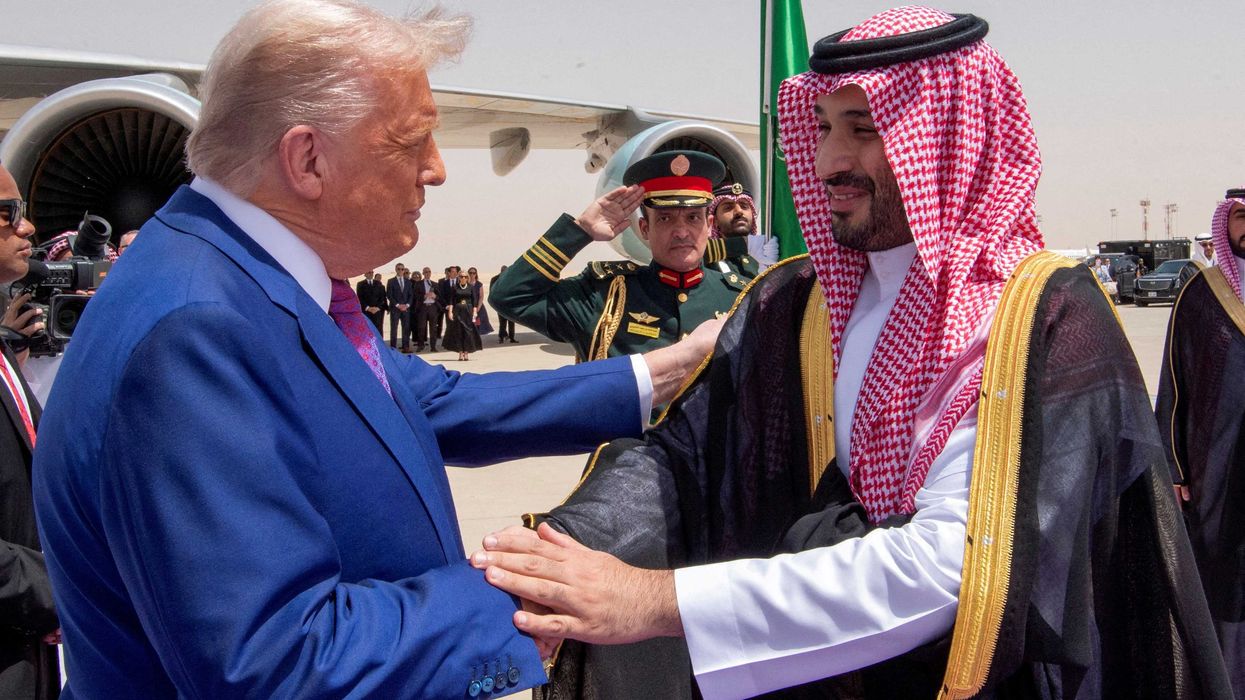
U.S. President Donald Trump shakes hands with Saudi Crown Prince Mohammed Bin Salman during a welcoming ceremony in Riyadh, Saudi Arabia, May 13, 2025. Bandar Algaloud/Courtesy of Saudi Royal Court/Handout via REUTERS
New York Times reporter Noah Shachtman says Trump made a “corrosive pact” with the U.S. oil industry, and today that pact is “wiping out jobs at home and strangling what little hope was left of avoiding a climate disaster.”
“Trump promised them he would do them so many favors that a billion dollars in donations would feel like a ‘deal.’ The executives gave him only a fraction of the money he sought. Mr. Trump, on the other hand, has given them more than they asked for,” said Shachtman.
As predicted, Trump scaled back regulations and encouraged more drilling. He’s also worked to crush the industry’s green competition, pulling the plug on the largest solar project in North America, which was on track to supply enough power for nearly two million homes. Trump also put a $5 billion wind farm project in New York temporarily on hold, threatening thousands of jobs until the state approved a new gas pipeline. And he’s killed incentives for electric vehicles, sales of which had more than doubled since his first term.
It's all outdated political instinct from the 1970s, said Shachtman, back when Saudi Arabia and the rest of the OPEC cartel cut production and brought the world economy to its knees. For decades afterward, Trump expressed a mixture of admiration and resentment of the kingdom’s resource wealth.
But now, Trump is taking on damaging OPEC-like maneuvers, trying to dominate the international market, warning the world to buy more fossil fuels — or else. Now America is the planet’s leading producer of oil and natural gas, but his America First energy goals have their contradictions.
“In his total commitment to a hydrocarbon-heavy world, he has pushed not only domestic producers but also Saudi Arabia and the rest of the OPEC nations to keep pumping out more, more, more cheap oil,” said Shachtman. “That might be good news for consumers, offsetting some of these high electric rates. But with oil prices down to around $60 per barrel, American companies say they can’t afford to open up new wells, especially now that [Trump’s] tariffs have made drilling equipment so expensive. The total number of active rigs is down year over year.”
Meanwhile the combo of more data centers and fewer renewables is spiking average Americans’ electric bills. Natural gas prices are up, thanks to Trump’s export deals.
“If you gave me a piece of paper and asked me to think about the most creative way, the most effective way, to raise electricity prices in the United States, it would look a lot like what they’ve done,” said Ethan Zindler, a former climate counselor in the Biden Treasury Department who works on policy at Bloomberg New Energy Finance.
The U.S. oil and gas business would probably be thrilled were Trump’s “capricious attacks on renewables and the big swings in energy policy” not also a liability for an industry forced by the nature of its complex engineering projects to plan years, or even decades, ahead.
“Ever-changing policy, particularly as administrations change, is not good for business. It’s not good for the economy and ultimately, it’s not good for people,” said Exxon Mobil’s chief executive, Darren Woods.
Energy executives are unhappy, but they can’t be surprised, said Shachtman. Trump’s favor was always transactional and he wanted to use his oil industry favor to make their energy a tool to leverage his own personal power.
“If they drill themselves out of business, I don’t give a damn,” Trump told voters at a rally last year.
Read the New York Times report at this link.
U.S. and Saudi Arabia Rebuild a Strategic Alliance
- Saudi Arabia pledged up to $1 trillion in U.S. investments, strengthening ties with Washington across energy, defense, and technology.
- Aramco signed $30 billion in new deals with U.S. firms, including major LNG investments in Energy Transfer’s Lake Charles and Commonwealth LNG projects.
- The partnership also includes nuclear technology sharing and critical minerals projects, such as a rare earth processing plant by MP Materials and Ma’aden.

Saudi Arabia made investment commitments of as much as $1 trillion during the visit of Crown Prince Mohammed bin Salman in the United States. The sum is a substantial increase on an original pledge of $600 billion, but it is also a sign that the relationship between two of the world’s largest oil producers is back on track.
The relationship, dating back to the early 20th century, was rather damaged during the Biden administration, in part due to its focus on the energy transition, which put it at odds with Saudi Arabia as an economy heavily dependent on oil revenues. Another part of the reason for the worsened bilateral relations was the issue of human rights and the murder of a dissident Saudi journalist, which included President Biden at one point calling the kingdom a pariah state. On top of those complications, President Biden at one point threatened to punish Saudi Arabia if Riyadh did not ramp up oil production to lower prices. In short, the Biden administration did not play well with the Saudis.
President Trump changed all that, bringing relations back to the friend zone and extracting massive investment commitments across industries, but notably in LNG, defense, and critical minerals. The two also made progress on nuclear energy, with the U.S. agreeing to share its nuclear power technology with the Saudis on the condition that it would not be used for weapons-grade uranium enrichment.
The latter had been a thorny issue for years, ever since talks about nuclear tech sharing began during the first Trump administration. At the time, the Saudis refused to sign off on the non-enrichment clause, which delayed the deal. Now, Chris Wright and Abdulaziz bin Salman signed a preliminary deal for the tech sharing, with specific steps forward presumably to follow.
Aramco, meanwhile, announced preliminary agreements with U.S. companies worth a total $30 billion, noting the prospective deals build on earlier investment commitments made this year, with a value of up to $90 billion. The areas that the deals cover span from LNG to advanced materials manufacturing and financial services, the company said.
In liquefied gas specifically, Aramco is looking into an investment in the Lake Charles project led by Energy Transfer, and an offtake deal for Commonwealth LNG.
The Lake Charles LNG project is fully permitted, uses existing infrastructure, and benefits from an abundant natural gas supply through existing connections to the Henry Hub and connectivity to Energy Transfer’s vast network of natural gas pipelines. It will have an annual capacity of some 15 million tons of liquefied natural gas once completed. Finding equity partners for 80% of the facility is the condition Energy Transfer has set for making the final investment decision for the project.
The Commonwealth LNG facility in Cameron Parish, Louisiana, will have an annual capacity of 9.5 million tons of liquefied gas. The construction of the first phase will cost $11 billion, according to Commonwealth LNG, and generate annual export revenues of some $3.5 billion. However, the company has yet to make the final investment decision on the project, just like Energy Transfer, after revising the timeline for the project’s completion, with commissioning moved from 2027 to 2031.
Critical minerals and metals were another area of interest for both. Saudi Arabia has considerable deposits of some of these minerals and metals. The United States needs them. That one was really a no-brainer, and only a matter of time. During the Saudi visit, U.S. MP Materials announced a deal with Saudi Maaden and the U.S. federal government for the construction of a rare earths processing plant in Saudi Arabia.
Nuclear, LNG, and critical minerals—this is more or less all the priority boxes ticked, plus weapons and military equipment supply deals to cement the mended fences. Now, the only question is how many of the preliminary commitments will progress to full deals.
By Charles Kennedy for Oilprice.com

By Can Kasapoğlu
President Donald Trump’s announcement that the United States will sell F-35 combat aircraft to the Kingdom of Saudi Arabia is a turning point for airpower dynamics in the Middle East, with broad geopolitical implications.
The Lockheed Martin F-35, a fifth-generation, multirole stealth aircraft with unrivaled information superiority features, represents the leading edge of American tactical military aviation. Its high-end capabilities, from providing deep battlespace awareness to enabling distributed, networked precision strikes in nonpermissive airspace, make it one of the rare assets that can single-handedly alter the outcome of a conflict.
The announcement that Saudi Arabia will be the first Arab nation to procure this system has severe implications for three key pillars of American engagement in the Middle East:Outcompeting China in the quest for long-term influence over the region’s militaries and weapons markets.
Boosting the capabilities of Washington’s Gulf Arab partners to counter Iran.
Preserving Israel’s qualitative military edge (QME) in a worsening threat landscape.
Geopolitical Importance: Preventing the Saudis from Hedging toward China
President Trump’s announcement, made on the eve of Crown Prince Mohammed bin Salman’s White House visit, is an important step for preventing Saudi Arabia from drifting further into China’s military orbit. The sale likely cleared a Pentagon review in advance of the president’s meeting with the de facto Saudi monarch. If it goes through, Saudi Arabia will acquire 48 F-35s, making it the first Arab nation to operate a fifth-generation combat aircraft.
The United States Defense Intelligence Agency reportedly warned Trump administration officials that, because of Riyadh’s defense partnership with Beijing, selling the F-35 to Saudi Arabia might give China access to the aircraft’s critical technologies. Nonetheless, Saudi Arabia’s increasing ties with China were likely a key reason why President Trump decided to go through with the sale. Riyadh has signaled that it will not depend solely on the United States for its security—and that if Washington hesitates, the kingdom will pursue other avenues. Moreover, Riyadh’s recent strategic mutual defense agreement with Pakistan—a China-aligned Muslim-majority nation with a capable military and nuclear assets—sent an unmistakable message to the US about the House of Saud’s leverage.
Beijing has been deeply involved in supplying the kingdom with armaments, especially missile and drone warfare assets, for at least a decade. Geospatial analysis shows that Saudi Arabia has significantly expanded the Royal Saudi Strategic Missile Force in recent years while also seeking to expand its indigenous defense industrial base. The crown prince has also pressed for local production agreements as a condition of major defense acquisitions—especially missile programs. Saudi Arabia now has a solid-propellant motorproduction line at the al-Watah ballistic missile base, and US intelligence assesses that Riyadh is manufacturing an undisclosed slate of ballistic missiles with direct Chinese assistance.
For many countries, ballistic missile cooperation with China would end any hope of close military ties with the US—let alone an F-35 acquisition. But whenever Washington withholds a capability that Riyadh views as vital, the kingdom hedges further toward Beijing. When America withheld Pershing ballistic missiles from Riyadh in the 1980s, the Saudis sought DF-3 missiles from China. The eventual $3.5 billion deal between Riyadh and Beijing was the start of a pattern that endures today. It is therefore likely that the Trump administration believed that the crown prince’s major ask was more than mere posturing.
Beijing has publicly signaled that its ostensible fifth-generation competitor to the F-35, the J-20 stealth fighter, remains under strict export restrictions. But the strategic situation is fluid. If China’s leadership sees a chance to score a strategic victory over the United States, those export barriers could quickly fall. The United Arab Emirates—another Gulf state that Washington has thus far shut out from F-35 procurement over concerns about Chinese defense technology espionage through local Huawei 5G infrastructure—has reportedly shown interest in the J-20. If the right opportunity to erode US aerospace dominance in the Gulf presents itself, Beijing may decide to seize it.
Fortunately for the White House, providing Riyadh with the F-35 might serve multiple US strategic interests—if the political-military perspective holds and the diplomatic stars line up. As mentioned, it boosts America’s position as it competes with China for regional influence. F-35s would be an effective but American-dependent asset for the Saudis to operate. Second, Washington needs capable Gulf partners that can plug seamlessly into the US military’s regional architecture to help counter Iran. This architecture became even more critical when the US officially moved Israel from the European Command (EUCOM) area of responsibility to Central Command (CENTCOM) in 2021. Having an allied F-35 detachment in the Gulf would allow CENTCOM to respond even more forcefully to future Iranian aggression, enhancing deterrence. Finally, Saudi Arabia, sitting at the nexus of the Red Sea and the Gulf, is a valuable geopolitical partner. Its critical role in global energy markets and its fast-growing portfolio of high-tech and defense industrial investments under its Vision 2030 further increase its importance. Militarily, the kingdom remains one of the few states capable of hosting large-scale US detachments to anchor American deterrence against Iran.
The Trump administration’s decision to sell the F-35 to Saudi Arabia reveals the strategic trust Washington is willing to extend to its longtime ally—and reinforces the alignment it expects from Riyadh in return. In the White House’s calculus, this deal benefits the US and its Saudi allies while harming China.
Stealth in the Gulf: The Potential Military Transformation behind Fifth-Gen Air Superiority
Saudi Arabia, thanks to its considerable wealth, is already one of the world’s top defense spenders. Between 2020 and 2024, the kingdom ranked fourth among the world’s arms importers and was the primary Middle Eastern recipient of US-made munitions. But Riyadh has, for years, viewed the acquisition of a fifth-generation combat aircraft as the capstone of its Vision 2030 defense transformation agenda—an ambitious program to rapidly advance its military capabilities.
The stealth-equipped F-35 is the backbone of the North Atlantic Treaty Organization’s tactical aviation deterrent. According to Lockheed Martin, more than 600 F-35s will be stationed across NATO air bases in Europe by the 2030s. For reference, the French military has ordered just 234 of its indigenous Dassault Rafale combat aircraft as of November 2025. Beyond Europe, the F-35I has given the Israeli Air Force operational freedom in hostile Middle Eastern skies.
The F-35’s stealth and information superiority capabilities would dramatically shift the Saudi-Iranian balance of power. The aircraft’s ability to operate deep in nonpermissive airspace and overcome layered air defense architectures would allow Saudi Arabia to threaten the Islamic Revolutionary Guard Corps’ missile sites, drone nests, command hubs, and other critical infrastructure.
Moreover, the F-35 would serve as a force multiplier, enhancing the effectiveness of the rest of the kingdom’s air warfare posture. Fifth-generation platforms like the F-35 operate within smart battle networks, or systems of systems. In Israel’s recent 12-day war with Iran, F-35Is played a central role in the Israeli Air Force’s strike packages. The fifth-generation aircraft’s advanced computational systems and data fusion capabilities enhanced Israeli forces’ real-time awareness. Its high-end sensors, including the AN/AAQ-37 Distributed Aperture System and the AN/APG-81 active electronically scanned array (AESA) radar, fed continuous targeting and threat information to fourth-generation F-15Is and F-16Is, supercharging their lethality and survivability. The F-35 would offer a similar boost to the Saudi Royal Air Force’s F-15s, giving Riyadh access to a realm of operational concepts that is unique among Arab militaries.
The Shifting Regional Balance: Saudi Ambitions Encroach on Israel’s Qualitative Military Edge
No Arab state has ever operated a platform that rivals, let alone matches, Israel’s prime air warfare asset. This is no accident. Israel has long insisted on maintaining its QME, undergirded by a US policy commitment to ensure the Israeli military’s regional superiority.
The Israeli strategic community is now wondering whether Washington will end Israel’s long-standing regional monopoly on stealth technology, or whether the Trump administration will give the Israeli Defense Forces a new, decisive warfighting advantage.
Israeli planners have seen this dynamic play out before. When Washington agreed to transfer F-15s and airborne early warning and control system (AWACS) aircraft to Saudi Arabia in the 1980s, Israeli diplomatic efforts convinced the Reagan administration to restrict the supplies Riyadh received. Washington thus withheld its most advanced jamming configurations and forbade Saudi AWACS aircraft from flying outside the nation’s borders. The Trump administration could place similar technical and operational limits on the F-35s it sells to Riyadh.
Yet even if Saudi Arabia receives fully capable F-35s, Israel’s advantage would not disappear overnight. Israel’s unmatched combat experience flying F-35s in hostile airspace and the modifications unique to the Israeli F-35I Adir, including its indigenous electronic warfare suite, would help the Israeli Air Force retain its edge.
Nonetheless, a strategic calculus will likely inform Israel’s response to the Saudi F-35 acquisition. Rather than citing the QME policy to oppose Riyadh’s fifth-generation airpower ambitions, the Israeli government will likely press Washington to make a normalization of Saudi-Israeli diplomatic relations a precondition of the F-35 sale.
Conclusion
The Trump administration’s decision to supply Saudi Arabia with F-35s could reshape airpower in the Middle East for a generation. A fifth-generation fleet in the kingdom could enhance deterrence against Iran, strengthen the US-led regional coalition, and anchor the US—rather than China—as Saudi Arabia’s main defense industrial partner.
Yet the move also challenges Israel’s long-standing stealth exclusivity and the long-standing QME framework. Israel’s position on the Saudi acquisition of the F-35—conditional openness tied to normalization of relations—reflects a recognition that outright rejection is no longer politically or militarily sustainable. But the Israeli defense establishment nonetheless realizes that safeguards, restrictions, and political reciprocity will best serve its qualitative edge privileges and strategic interests.
For the United States, the choice is clear. Anchoring Riyadh in the US-led security architecture by delivering a carefully designed F-35 deal that preserves Israel’s QME advances US military and economic interests and regional stability. On the other hand, if the White House balks at the deal, it risks ceding strategic ground to Beijing in the Gulf’s most strategically vital market.
How the Trump administration navigates this deal will be a key test of US statecraft in the Middle East, with major implications for great power competition against China. The sale of F-35s to Saudi Arabia is fraught with risks—but charged with massive upside.About the author: Can Kasapoğlu is a nonresident senior fellow at Hudson Institute. His work at Hudson focuses on political-military affairs in the Middle East, North Africa, and former Soviet regions. He specializes in open-source defense intelligence, geopolitical assessments, international weapons market trends, as well as emerging defense technologies and related concepts of operations.
Source: This article was published by the Hudson Institute
Hudson Institute is a nonpartisan policy research organization dedicated to innovative research and analysis that promotes global security, prosperity, and freedom.
No comments:
Post a Comment