Trump Gaza Plan Condemned as ‘Concentration Camps Within a Mass Concentration Camp’
After previous plans by Israel for the mass expulsion of Palestinians, onlookers fear the proposal to house some displaced Palestinians in “compounds” they may not be allowed to leave.
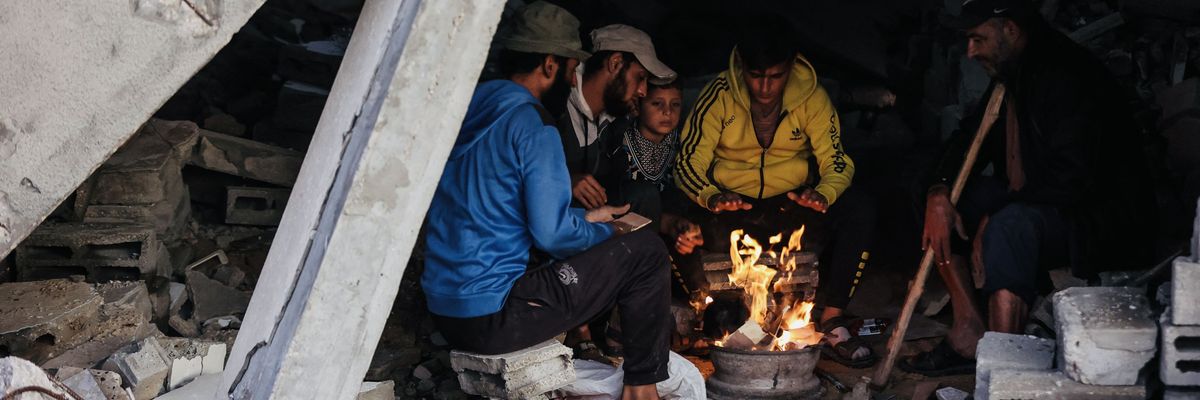
Displaced Palestinians warm up by the fire after their homes were destroyed following heavy rain in Gaza City, on November 25, 2025.
(Photo by Omar al-Qattaa/AFP via Getty Images)
Stephen Prager
Nov 26, 2025
After previous plans by Israel for the mass expulsion of Palestinians, onlookers fear the proposal to house some displaced Palestinians in “compounds” they may not be allowed to leave.
Displaced Palestinians warm up by the fire after their homes were destroyed following heavy rain in Gaza City, on November 25, 2025.
(Photo by Omar al-Qattaa/AFP via Getty Images)
Stephen Prager
Nov 26, 2025
COMMON DREAMS
A new Trump administration plan to put Palestinians living in the Israeli-occupied parts of Gaza into “residential compounds” is raising eyebrows among international observers, who fear it could more closely resemble a system of “concentration camps within a mass concentration camp.”
Under the current “ceasefire” agreement—which remains technically intact despite hundreds of alleged violations by Israel that have resulted in the deaths of over 300 Palestinians—Israel still occupies the eastern portion of Gaza, an area greater than 50% of the entire strip. The vast majority of the territory’s nearly 2 million inhabitants are crammed onto the other side of the yellow line into an area of roughly 60 square miles—around the size of St Louis, Missouri, or Akron, Ohio.
As Ramiz Alakbarov, the United Nations’ deputy special coordinator for the Middle East Peace Process, explained Monday at a briefing to the UN Security Council: “Two years of fighting has left almost 80% of Gaza’s 250,000 buildings damaged or destroyed. Over 1.7 million people remain displaced, many in overcrowded shelters without adequate access to water, food, or medical care.”
The New York Times reported Tuesday that the new US proposal would seek to resettle some of those Palestinians in what the Trump administration calls “Alternative Safe Communities,”on the Israeli-controlled side of the yellow line.
Based on information from US officials and European diplomats, the Times said these “model compounds” are envisioned as a housing option “more permanent than tent villages, but still made up of structures meant to be temporary. Each could provide housing for as many as 20,000 or 25,000 people alongside medical clinics and schools.”
The project is being led by Trump official Aryeh Lightstone, who previously served as an aide to Trump’s first envoy to Jerusalem. According to the Times: “His team includes an eclectic, fluctuating group of American diplomats, Israeli magnates and officials from the Department of Government Efficiency (DOGE)—the sweeping Washington cost-cutting effort overseen earlier this year by Elon Musk.”
The source of funding for the project remains unclear, though the cost of just one compound is estimated to run into the tens of millions. Meanwhile, the newspaper noted that even if ten of these compounds were constructed, it would be just a fraction of what is needed to provide safety and shelter to all of Gaza’s displaced people. It’s unlikely that the first structures would be complete for months.
While the Times said that “the plan could offer relief for thousands of Palestinians who have endured two years of war,” it also pointed to criticisms that it “could entrench a de facto partition of Gaza into Israeli- and Hamas-controlled zones.” Others raised concerns about whether the people of Gaza will even want to move from their homes after years or decades of resisting Israel’s occupation.
But digging deeper into the report, critics have noted troubling language. For one thing, Israeli officials have the final say over which Palestinians are allowed to enter the “compounds” and will heavily scrutinize the backgrounds of applicants, likely leading many to be blacklisted.
In one section, titled “Freedom of Movement,” the Times report noted that “some Israeli officials have argued that, for security reasons, Palestinians should only be able to move into the new compounds, not to leave them, according to officials.”
This language harkens back to a proposal earlier this year by Israeli Defense Minister Israel Katz, who called for the creation of a massive “humanitarian city” built on the ruins of Rafah that would be used as part of an “emigration plan” for hundreds of thousands of displaced Palestinians in Gaza.
Under that plan, Palestinians would have been given “security screenings” and once inside would not be allowed to leave. Humanitarian organizations, including those inside Israel, roundly condemned the plan as essentially a “concentration camp.”
Prior to that, Trump called for the people of Gaza—“all of them”—to be permanently expelled and for the US to “take over” the strip, demolish the remaining buildings, and construct what he described as the “Riviera of the Middle East.” That plan was widely described as one of ethnic cleansing.
The new plan to move Palestinians to “compounds” is raising similar concerns.
“What is it called when a military force concentrates an ethnic or religious group into compounds without the ability to leave?” asked Assal Rad, a PhD in Middle Eastern history and a fellow at the Arab Center in Washington, DC.
Sana Saeed, a senior producer for AJ+, put it more plainly: “concentration camps within a mass concentration camp.”
The Times added that “supporters insist that this would be a short-term arrangement until Hamas is disarmed and Gaza comes under one unified government.” Lightstone has said that reconstruction of the other parts of Gaza, where the vast majority of the population still lives, will not happen unless Hamas, the militant group that currently governs the strip, is removed from power.
But while Hamas has indicated a potential willingness to step down from ruling Gaza, it has rejected the proposal that it unilaterally disarm and make way for an “International Stabilization Force” to govern the strip, instead insisting that post-war governance should be left to Palestinians. That plan, however, was authorized last week by the UN Security Council.
In addition to raising concerns that “those moving in would never be allowed to leave,” the Beirut-based independent journalist Séamus Malekafzali pointed to other ideas Lightstone and his group want to implement. According to the Times, “It has kicked around ideas ranging from a new Gaza cryptocurrency to how to rebuild the territory in such a way that it has no traffic.”
Malekafzali said, “Former DOGE personnel are attempting to make Gaza into yet another dumb tech experiment.”
Like Katz’s plan months ago, the new Trump proposal calls for a large compound to be built in Rafah, which Egyptian officials warned, in comments to the Wall Street Journal, could be a prelude to a renewed effort to push Palestinians across the border into the Sinai Peninsula.
But even if not, Jonathan Whittall, the former head of the UN Office for the Coordination of Humanitarian Affairs in Palestine, said it hardly serves the humanitarian role the Trump administration and its Israeli co-administrators seek to portray.
“If plans for these ‘safe communities’ proceed, they would cement a deadly fragmentation of Gaza,” he wrote in Al Jazeera. “The purpose of creating these camps is not to provide humanitarian relief but to create zones of managed dispossession where Palestinians would be screened and vetted to enter in order to receive basic services, but would be explicitly barred from returning to the off-limits and blockaded ‘red zone.’”
He noted that there is a conspicuous lack of any clear plan for what happens to those Palestinians who continue to live outside the safe communities, warning that Israel’s security clearances could serve as a way of marking them as fair targets for even more escalated military attacks.
“Those who remain outside of the alternative communities, in the ‘red zone,’” he said, “risk being labelled ‘Hamas supporters’ and therefore ineligible for protection under Israel’s warped interpretation of international law and subject to ongoing military operations, as already seen in past days.”
A new Trump administration plan to put Palestinians living in the Israeli-occupied parts of Gaza into “residential compounds” is raising eyebrows among international observers, who fear it could more closely resemble a system of “concentration camps within a mass concentration camp.”
Under the current “ceasefire” agreement—which remains technically intact despite hundreds of alleged violations by Israel that have resulted in the deaths of over 300 Palestinians—Israel still occupies the eastern portion of Gaza, an area greater than 50% of the entire strip. The vast majority of the territory’s nearly 2 million inhabitants are crammed onto the other side of the yellow line into an area of roughly 60 square miles—around the size of St Louis, Missouri, or Akron, Ohio.
As Ramiz Alakbarov, the United Nations’ deputy special coordinator for the Middle East Peace Process, explained Monday at a briefing to the UN Security Council: “Two years of fighting has left almost 80% of Gaza’s 250,000 buildings damaged or destroyed. Over 1.7 million people remain displaced, many in overcrowded shelters without adequate access to water, food, or medical care.”
The New York Times reported Tuesday that the new US proposal would seek to resettle some of those Palestinians in what the Trump administration calls “Alternative Safe Communities,”on the Israeli-controlled side of the yellow line.
Based on information from US officials and European diplomats, the Times said these “model compounds” are envisioned as a housing option “more permanent than tent villages, but still made up of structures meant to be temporary. Each could provide housing for as many as 20,000 or 25,000 people alongside medical clinics and schools.”
The project is being led by Trump official Aryeh Lightstone, who previously served as an aide to Trump’s first envoy to Jerusalem. According to the Times: “His team includes an eclectic, fluctuating group of American diplomats, Israeli magnates and officials from the Department of Government Efficiency (DOGE)—the sweeping Washington cost-cutting effort overseen earlier this year by Elon Musk.”
The source of funding for the project remains unclear, though the cost of just one compound is estimated to run into the tens of millions. Meanwhile, the newspaper noted that even if ten of these compounds were constructed, it would be just a fraction of what is needed to provide safety and shelter to all of Gaza’s displaced people. It’s unlikely that the first structures would be complete for months.
While the Times said that “the plan could offer relief for thousands of Palestinians who have endured two years of war,” it also pointed to criticisms that it “could entrench a de facto partition of Gaza into Israeli- and Hamas-controlled zones.” Others raised concerns about whether the people of Gaza will even want to move from their homes after years or decades of resisting Israel’s occupation.
But digging deeper into the report, critics have noted troubling language. For one thing, Israeli officials have the final say over which Palestinians are allowed to enter the “compounds” and will heavily scrutinize the backgrounds of applicants, likely leading many to be blacklisted.
In one section, titled “Freedom of Movement,” the Times report noted that “some Israeli officials have argued that, for security reasons, Palestinians should only be able to move into the new compounds, not to leave them, according to officials.”
This language harkens back to a proposal earlier this year by Israeli Defense Minister Israel Katz, who called for the creation of a massive “humanitarian city” built on the ruins of Rafah that would be used as part of an “emigration plan” for hundreds of thousands of displaced Palestinians in Gaza.
Under that plan, Palestinians would have been given “security screenings” and once inside would not be allowed to leave. Humanitarian organizations, including those inside Israel, roundly condemned the plan as essentially a “concentration camp.”
Prior to that, Trump called for the people of Gaza—“all of them”—to be permanently expelled and for the US to “take over” the strip, demolish the remaining buildings, and construct what he described as the “Riviera of the Middle East.” That plan was widely described as one of ethnic cleansing.
The new plan to move Palestinians to “compounds” is raising similar concerns.
“What is it called when a military force concentrates an ethnic or religious group into compounds without the ability to leave?” asked Assal Rad, a PhD in Middle Eastern history and a fellow at the Arab Center in Washington, DC.
Sana Saeed, a senior producer for AJ+, put it more plainly: “concentration camps within a mass concentration camp.”
The Times added that “supporters insist that this would be a short-term arrangement until Hamas is disarmed and Gaza comes under one unified government.” Lightstone has said that reconstruction of the other parts of Gaza, where the vast majority of the population still lives, will not happen unless Hamas, the militant group that currently governs the strip, is removed from power.
But while Hamas has indicated a potential willingness to step down from ruling Gaza, it has rejected the proposal that it unilaterally disarm and make way for an “International Stabilization Force” to govern the strip, instead insisting that post-war governance should be left to Palestinians. That plan, however, was authorized last week by the UN Security Council.
In addition to raising concerns that “those moving in would never be allowed to leave,” the Beirut-based independent journalist Séamus Malekafzali pointed to other ideas Lightstone and his group want to implement. According to the Times, “It has kicked around ideas ranging from a new Gaza cryptocurrency to how to rebuild the territory in such a way that it has no traffic.”
Malekafzali said, “Former DOGE personnel are attempting to make Gaza into yet another dumb tech experiment.”
Like Katz’s plan months ago, the new Trump proposal calls for a large compound to be built in Rafah, which Egyptian officials warned, in comments to the Wall Street Journal, could be a prelude to a renewed effort to push Palestinians across the border into the Sinai Peninsula.
But even if not, Jonathan Whittall, the former head of the UN Office for the Coordination of Humanitarian Affairs in Palestine, said it hardly serves the humanitarian role the Trump administration and its Israeli co-administrators seek to portray.
“If plans for these ‘safe communities’ proceed, they would cement a deadly fragmentation of Gaza,” he wrote in Al Jazeera. “The purpose of creating these camps is not to provide humanitarian relief but to create zones of managed dispossession where Palestinians would be screened and vetted to enter in order to receive basic services, but would be explicitly barred from returning to the off-limits and blockaded ‘red zone.’”
He noted that there is a conspicuous lack of any clear plan for what happens to those Palestinians who continue to live outside the safe communities, warning that Israel’s security clearances could serve as a way of marking them as fair targets for even more escalated military attacks.
“Those who remain outside of the alternative communities, in the ‘red zone,’” he said, “risk being labelled ‘Hamas supporters’ and therefore ineligible for protection under Israel’s warped interpretation of international law and subject to ongoing military operations, as already seen in past days.”
It would be a mistake for Pakistan to send troops for the stabilisation force in Gaza.
Published November 24, 2025
DAWN
The writer is a former ambassador to the US, UK and UN.
BY approving a US-sponsored resolution, the UN Security Council handed an international mandate to President Donald Trump’s 20-point ‘peace plan’ for Gaza. But it did this without any input from Palestinians. Hamas rejected the resolution saying it fails to meet Palestinian rights and demands and “imposes a mechanism to achieve the [Israeli] occupation’s objectives”.
The resolution can only be implemented if Hamas signs up to it. This means complex negotiations lie ahead if the plan is to progress beyond the present ceasefire, which is being violated daily by Israeli forces, who have also been crossing the ‘yellow line’. This has taken the Palestinian death toll to almost 70,000 in the two-year genocidal war imposed by Israel.
The UNSC resolution is short on specifics and ambiguous in key areas. It ignores all previous resolutions on Palestine. It authorises the creation of a vaguely defined transitional governance body, the Board of Peace, chaired by Trump and members decided by him, to oversee a Palestinian “technocratic” committee responsible for day-to-day running of Gaza. It also authorises the BoP to establish a temporary multinational international stabilisation force (ISF) “to deploy under unified command acceptable to the BoP”.
This will not be a UN peacekeeping mission nor be overseen by the UN. Its mandate is unclear and details are lacking on its scope and structure. It is however tasked to “demilitarise the Gaza Strip” and carry out “permanent decommissioning of weapons from non-state armed groups”, including Hamas.
The original US draft made no reference to Palestinian statehood. But at the insistence of Muslim countries, the final resolution mentions a “credible pathway to Palestinian self-determination and statehood”. But this is wrapped in so many conditions that it denudes it of real meaning. Weak Arab negotiators failed to get a firm commitment to a Palestinian state in the resolution. Meanwhile, Israeli Prime Minister Benjamin Netanyahu remains firmly opposed to any Palestinian state.
The UNSC resolution was welcomed across the world as a step towards peace despite concerns of many countries and Council members, including Pakistan, about its lack of clarity in core areas. China and Russia, who abstained on the vote, both voiced concern about the vague nature of key elements, lack of Palestinian participation and absence of commitment to a two-state solution.
China’s ambassador to the UN, Fu Cong, said the resolution “does not [reflect] the fundamental principle of Palestinians governing Palestine”. Russia’s UN envoy, Vassily Nebenzia, described the stabilisation force as “reminiscent of colonial practices”. In a scathing critique, the UN special Rapporteur for Palestine said, “Rather than charting a pathway towards ending the occupation and ensuring Palestinian protection, the resolution risks entrenching external control over Gaza’s governance, borders, security, and reconstruction. The resolution betrays the people it claims to protect.”
In Gaza itself, the UNSC resolution’s main provisions were viewed with great scepticism, according to Al Jazeera reporters on the ground. One resident told the news outlet “Our people … are able to rule ourselves. We don’t need forces from Arab or foreign countries to rule us”. The transitional governing arrangement is seen as outsiders deciding the fate of Palestinians. The international stabilisation force is viewed with deep suspicion — “not as a guarantee of protection but rather a foreign security arrangement imposed without their consent”.
Of course, it is the stance of Hamas and other Palestinian factions that is consequential for the resolution’s enforcement. Hamas still controls Gaza up to the ‘yellow line’ held by Israel. Its popularity has risen since the ceasefire, according to the latest poll by the West Bank-based Palestinian Centre for Policy and Survey Research. Hamas has rejected the UN resolution on a number of grounds. It said the resolution “imposes an international guardianship mechanism on the Gaza Strip”. Assigning the international force to disarm groups resisting the occupation “strips it of its neutrality, and turns it into a party to the conflict in favour of the occupation”.
Hamas has argued that any international force, if established, “must be deployed only at the borders to separate forces, monitor the ceasefire, and be fully under UN supervision”. “It must also operate exclusively in coordination with official Palestinian institutions.” “Resisting the occupation by all means is a legitimate right guaranteed by international laws and conventions.” Hamas also said disarmament is an “internal matter” linked to the end of occupation and creation of a Palestinian state.
It is possible Hamas may be prepared to disarm in exchange for total Israeli withdrawal from Gaza, which would end its occupation. But that can only be tested in serious negotiations that have to take place if the UN-endorsed Trump plan is not to collapse.
The expectation from the stabilisation force to demilitarise Gaza and disarm resistance groups is likely to deter several Muslim countries from joining it. Some of them are engaged in talks to contribute to the force. Israel has to approve countries that can be part of the force. So far it has rejected Turkiye’s participation. The international force will be answerable to the BoP and is intended to work with Egypt and Israel to demilitarise the Gaza Strip. That means it can get caught in a shooting war and act like an enforcement force rather than a peacekeeping one. Its task will also be to secure the borders and train the Palestinian police.
There are at least three reasons why Pakistan should not join ISF. One, it should not be part of a force whose key task is to police Hamas, not protect Palestinians. The implications for Pakistan, for example, of any clash between its troops and Palestinians would be serious. Two, deployment would involve close cooperation with Israel and arguably lure Pakistan into a trap to recognise Israel and join the Abraham Accords. Moreover, Israel’s continuing ceasefire violations and occupation of over half of Gaza pose major obstacles to Trump’s plan. In these circumstances, Hamas will not disarm. Walking into such a quagmire would therefore be a mistake for Pakistan.
The challenges facing implementation of the Gaza peace plan are formidable. At this inflection point for the plan, it is uncertain whether it will be able to deliver peace or meet the same fate as so many failed plans for Palestine have in the past.
The writer is a former ambassador to the US, UK and UN.
Published in Dawn, November 24th, 2025
DAWN
The writer is a former ambassador to the US, UK and UN.
BY approving a US-sponsored resolution, the UN Security Council handed an international mandate to President Donald Trump’s 20-point ‘peace plan’ for Gaza. But it did this without any input from Palestinians. Hamas rejected the resolution saying it fails to meet Palestinian rights and demands and “imposes a mechanism to achieve the [Israeli] occupation’s objectives”.
The resolution can only be implemented if Hamas signs up to it. This means complex negotiations lie ahead if the plan is to progress beyond the present ceasefire, which is being violated daily by Israeli forces, who have also been crossing the ‘yellow line’. This has taken the Palestinian death toll to almost 70,000 in the two-year genocidal war imposed by Israel.
The UNSC resolution is short on specifics and ambiguous in key areas. It ignores all previous resolutions on Palestine. It authorises the creation of a vaguely defined transitional governance body, the Board of Peace, chaired by Trump and members decided by him, to oversee a Palestinian “technocratic” committee responsible for day-to-day running of Gaza. It also authorises the BoP to establish a temporary multinational international stabilisation force (ISF) “to deploy under unified command acceptable to the BoP”.
This will not be a UN peacekeeping mission nor be overseen by the UN. Its mandate is unclear and details are lacking on its scope and structure. It is however tasked to “demilitarise the Gaza Strip” and carry out “permanent decommissioning of weapons from non-state armed groups”, including Hamas.
The original US draft made no reference to Palestinian statehood. But at the insistence of Muslim countries, the final resolution mentions a “credible pathway to Palestinian self-determination and statehood”. But this is wrapped in so many conditions that it denudes it of real meaning. Weak Arab negotiators failed to get a firm commitment to a Palestinian state in the resolution. Meanwhile, Israeli Prime Minister Benjamin Netanyahu remains firmly opposed to any Palestinian state.
The UNSC resolution was welcomed across the world as a step towards peace despite concerns of many countries and Council members, including Pakistan, about its lack of clarity in core areas. China and Russia, who abstained on the vote, both voiced concern about the vague nature of key elements, lack of Palestinian participation and absence of commitment to a two-state solution.
China’s ambassador to the UN, Fu Cong, said the resolution “does not [reflect] the fundamental principle of Palestinians governing Palestine”. Russia’s UN envoy, Vassily Nebenzia, described the stabilisation force as “reminiscent of colonial practices”. In a scathing critique, the UN special Rapporteur for Palestine said, “Rather than charting a pathway towards ending the occupation and ensuring Palestinian protection, the resolution risks entrenching external control over Gaza’s governance, borders, security, and reconstruction. The resolution betrays the people it claims to protect.”
In Gaza itself, the UNSC resolution’s main provisions were viewed with great scepticism, according to Al Jazeera reporters on the ground. One resident told the news outlet “Our people … are able to rule ourselves. We don’t need forces from Arab or foreign countries to rule us”. The transitional governing arrangement is seen as outsiders deciding the fate of Palestinians. The international stabilisation force is viewed with deep suspicion — “not as a guarantee of protection but rather a foreign security arrangement imposed without their consent”.
Of course, it is the stance of Hamas and other Palestinian factions that is consequential for the resolution’s enforcement. Hamas still controls Gaza up to the ‘yellow line’ held by Israel. Its popularity has risen since the ceasefire, according to the latest poll by the West Bank-based Palestinian Centre for Policy and Survey Research. Hamas has rejected the UN resolution on a number of grounds. It said the resolution “imposes an international guardianship mechanism on the Gaza Strip”. Assigning the international force to disarm groups resisting the occupation “strips it of its neutrality, and turns it into a party to the conflict in favour of the occupation”.
Hamas has argued that any international force, if established, “must be deployed only at the borders to separate forces, monitor the ceasefire, and be fully under UN supervision”. “It must also operate exclusively in coordination with official Palestinian institutions.” “Resisting the occupation by all means is a legitimate right guaranteed by international laws and conventions.” Hamas also said disarmament is an “internal matter” linked to the end of occupation and creation of a Palestinian state.
It is possible Hamas may be prepared to disarm in exchange for total Israeli withdrawal from Gaza, which would end its occupation. But that can only be tested in serious negotiations that have to take place if the UN-endorsed Trump plan is not to collapse.
The expectation from the stabilisation force to demilitarise Gaza and disarm resistance groups is likely to deter several Muslim countries from joining it. Some of them are engaged in talks to contribute to the force. Israel has to approve countries that can be part of the force. So far it has rejected Turkiye’s participation. The international force will be answerable to the BoP and is intended to work with Egypt and Israel to demilitarise the Gaza Strip. That means it can get caught in a shooting war and act like an enforcement force rather than a peacekeeping one. Its task will also be to secure the borders and train the Palestinian police.
There are at least three reasons why Pakistan should not join ISF. One, it should not be part of a force whose key task is to police Hamas, not protect Palestinians. The implications for Pakistan, for example, of any clash between its troops and Palestinians would be serious. Two, deployment would involve close cooperation with Israel and arguably lure Pakistan into a trap to recognise Israel and join the Abraham Accords. Moreover, Israel’s continuing ceasefire violations and occupation of over half of Gaza pose major obstacles to Trump’s plan. In these circumstances, Hamas will not disarm. Walking into such a quagmire would therefore be a mistake for Pakistan.
The challenges facing implementation of the Gaza peace plan are formidable. At this inflection point for the plan, it is uncertain whether it will be able to deliver peace or meet the same fate as so many failed plans for Palestine have in the past.
The writer is a former ambassador to the US, UK and UN.
Published in Dawn, November 24th, 2025
NAKBA II
Tubas (Palestinian Territories) (AFP) – Israel's military on Wednesday launched a new operation against Palestinian armed groups in the occupied West Bank, where a local governor told AFP that Israeli forces had raided several towns.
Issued on: 26/11/2025 - FRANCE24
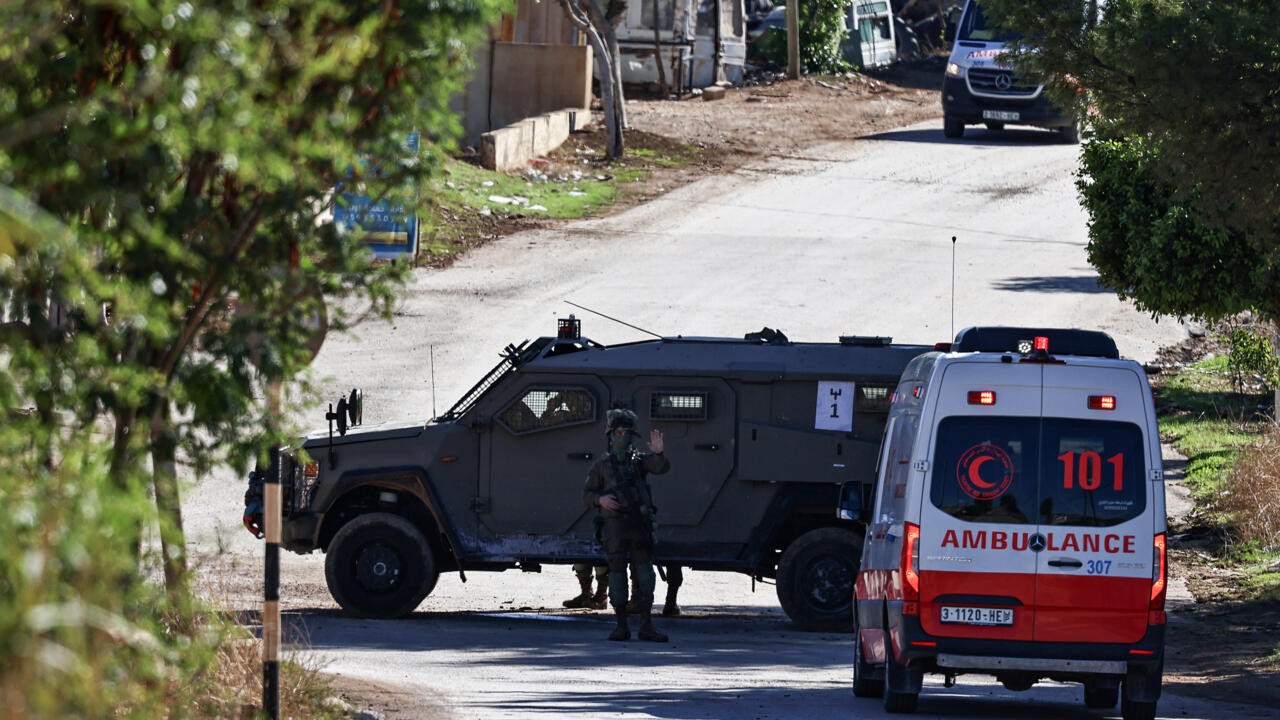
The Israeli army confirmed to AFP that it was a new operation, and not part of the one launched in January 2025 © Zain JAAFAR / AFP
The Israeli military, police and internal security service said in a joint statement that they had begun "a broad counter-terrorism operation" in the north of the Palestinian territory after they received intelligence about "attempts to establish terrorist strongholds".
The military said the operation began with air strikes to isolate the area, which were followed by "searches" on the ground, during which suspects were apprehended and funds were confiscated.
The Israeli army confirmed to AFP that it was a new operation, and not part of the one launched in January 2025, which primarily targeted Palestinian refugee camps in the northern West Bank.
Israel has occupied the West Bank since 1967.
The operation, which began overnight, was taking place in predominantly agricultural Tubas, the northeasternmost of the 11 governorates in the West Bank.
Ahmed al-Asaad, governor of the Tubas region, told AFP: "This is the first time that the entire governorate is included -- the whole governorate is now under Israeli army operations."
Asaad said Israeli forces raided the towns of Tammun and Tayasir, and the Al-Faraa Palestinian refugee camp.
"The army has closed the city entrances with earth mounds, so there is no movement at all," he added.
He told AFP that "an Apache helicopter" was involved in the operation, and claimed it had fired in the direction of residential areas.
"This is a political operation, not a security one," he said.
Injuries reported
An AFP photographer saw some soldiers walking around inside Tubas city, with a few armoured cars driving through and a surveillance aerial vehicle buzzing overhead. Most shops were closed.
The road entrance to nearby Tammun had been closed off by a military vehicle.
An ambulance was allowed to go through but citizens were not. Armoured cars were driving around at the scene.
The Palestinian Red Crescent Society said its teams in the governorate had treated 10 injured people, four of whom had to be transferred to hospital.
The Israeli military, police and internal security service said in a joint statement that they had begun "a broad counter-terrorism operation" in the north of the Palestinian territory after they received intelligence about "attempts to establish terrorist strongholds".
The military said the operation began with air strikes to isolate the area, which were followed by "searches" on the ground, during which suspects were apprehended and funds were confiscated.
The Israeli army confirmed to AFP that it was a new operation, and not part of the one launched in January 2025, which primarily targeted Palestinian refugee camps in the northern West Bank.
Israel has occupied the West Bank since 1967.
The operation, which began overnight, was taking place in predominantly agricultural Tubas, the northeasternmost of the 11 governorates in the West Bank.
Ahmed al-Asaad, governor of the Tubas region, told AFP: "This is the first time that the entire governorate is included -- the whole governorate is now under Israeli army operations."
Asaad said Israeli forces raided the towns of Tammun and Tayasir, and the Al-Faraa Palestinian refugee camp.
"The army has closed the city entrances with earth mounds, so there is no movement at all," he added.
He told AFP that "an Apache helicopter" was involved in the operation, and claimed it had fired in the direction of residential areas.
"This is a political operation, not a security one," he said.
Injuries reported
An AFP photographer saw some soldiers walking around inside Tubas city, with a few armoured cars driving through and a surveillance aerial vehicle buzzing overhead. Most shops were closed.
The road entrance to nearby Tammun had been closed off by a military vehicle.
An ambulance was allowed to go through but citizens were not. Armoured cars were driving around at the scene.
The Palestinian Red Crescent Society said its teams in the governorate had treated 10 injured people, four of whom had to be transferred to hospital.
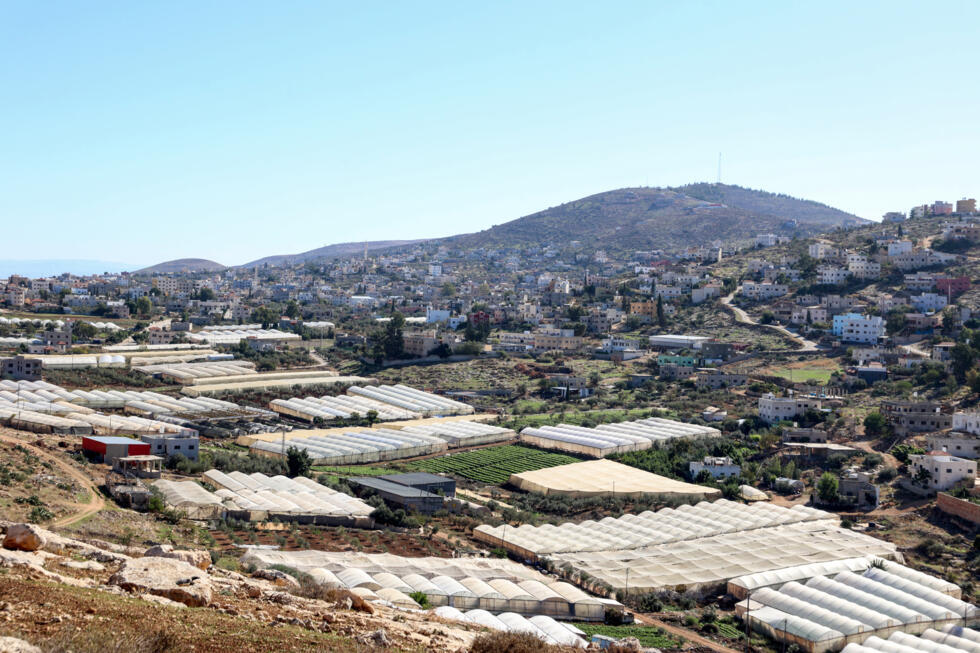
The operation, which began overnight, was taking place in predominantly agricultural Tubas © Zain JAAFAR / AFP
It added that some of its teams were "facing obstruction in transporting patients in the city of Tubas and the town of Tammun since dawn", and were still responding to calls for help following the raids.
Hamas and Islamic Jihad, two Palestinian militant groups proscribed as terror organisations by many countries, condemned the Israeli operation.
Hamas said in a statement that it was part of a policy "aimed at crushing any Palestinian presence in order to achieve complete control over the West Bank".
Violence in the West Bank has soared since Hamas's October 2023 attack on Israel triggered the Gaza war, and has not ceased despite the fragile truce between Israel and Hamas coming into effect last month.
Israeli troops or settlers have killed more than 1,000 Palestinians, many of them militants, but also scores of civilians, in the West Bank since the start of the Gaza war, according to an AFP tally based on Palestinian health ministry figures.
At least 44 Israelis, including both soldiers and civilians, have been killed in Palestinian attacks or Israeli military operations, according to official Israeli figures.
© 2025 AFP
It added that some of its teams were "facing obstruction in transporting patients in the city of Tubas and the town of Tammun since dawn", and were still responding to calls for help following the raids.
Hamas and Islamic Jihad, two Palestinian militant groups proscribed as terror organisations by many countries, condemned the Israeli operation.
Hamas said in a statement that it was part of a policy "aimed at crushing any Palestinian presence in order to achieve complete control over the West Bank".
Violence in the West Bank has soared since Hamas's October 2023 attack on Israel triggered the Gaza war, and has not ceased despite the fragile truce between Israel and Hamas coming into effect last month.
Israeli troops or settlers have killed more than 1,000 Palestinians, many of them militants, but also scores of civilians, in the West Bank since the start of the Gaza war, according to an AFP tally based on Palestinian health ministry figures.
At least 44 Israelis, including both soldiers and civilians, have been killed in Palestinian attacks or Israeli military operations, according to official Israeli figures.
© 2025 AFP
No comments:
Post a Comment