The Asian Development Bank follows World Bank in revising policy on support for nuclear power financing

The Asian Development Bank has revised its energy policy to allow direct support for nuclear power, signalling a notable shift in how multilateral lenders approach baseload generation in emerging Asian economies, World Nuclear News (WNN) reports. The move opens the door for financing in countries that opt to integrate nuclear technology into their long-term energy strategies, reflecting a broader reassessment of the role atomic power could play in meeting rising electricity demand while curbing dependence on fossil fuels.
Established in 1966 and backed by 69 member states, the bank channelled $3.8bn into energy projects in 2024 and positions the policy change as part of its commitment to fostering resilient and sustainable growth across the region. According to WNN, the revision is accompanied by a new cooperation agreement with the International Atomic Energy Agency, intended to help countries evaluate nuclear options, strengthen governance frameworks and build the institutional capacity required to manage complex technologies throughout their full life cycle.
The partnership will focus on areas such as energy-sector planning, fuel-cycle management, radioactive-waste oversight and the long-term stewardship of nuclear facilities. The IAEA will also provide guidance on safety, security and public engagement — all prerequisites for informed decision-making. The report adds that discussions are expected to explore potential joint initiatives, including the deployment of small modular reactors, which several governments in the region are assessing.
The ADB’s shift follows a similar step by the World Bank earlier in the year, adding momentum to the view that nuclear energy may serve as a credible low-carbon alternative in markets seeking both reliability and emissions reductions. The IAEA notes that 37 countries are currently considering or preparing to adopt nuclear power, underlining the scale of prospective demand for finance, expertise and regulatory support.
In parallel, the ADB has broadened the scope of its energy policy to include methane-management projects and expanded its eligibility criteria for carbon capture, utilisation and storage to cover schemes using depleted oil and gas reservoirs for long-term carbon dioxide storage, further signalling its intention to support a wider toolkit of technologies aimed at decarbonising Asia’s energy systems.
Asian Development Bank to start investing in nuclear
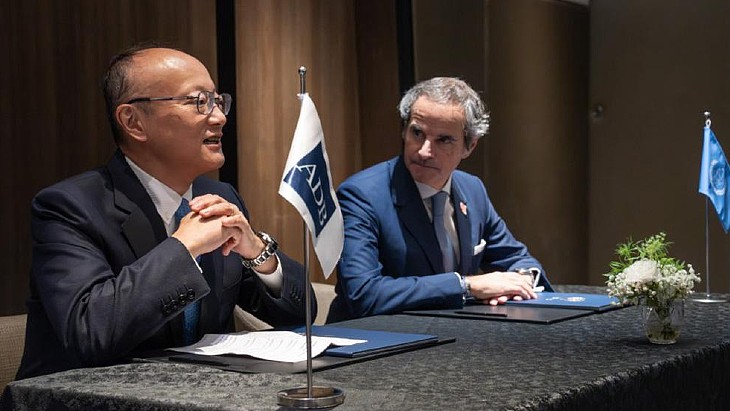
Asian Development Bank (ADB) President Masato Kanda said: "These changes further enhance ADB’s ability to support countries in Asia and the Pacific as they work to meet their rapidly growing energy needs. Nuclear power, for example, is an important technology option for countries looking for reliable alternatives to baseload electricity."
Founded in 1966 and owned by 69 member states, including 50 from the region, ADB committed USD3.8 billion to energy projects in 2024. It says it aims to support "inclusive, resilient, and sustainable growth across Asia and the Pacific".
As part of the new policy, it has signed an agreement with the International Atomic Energy Agency (IAEA) to cooperate in supporting countries in Asia and the Pacific who are exploring nuclear energy as part of their energy and development strategies. Discussions will include identifying potential projects for collaboration, including those involving small modular reactors.
Kanda said: "With ADB’s updated energy policy recognising nuclear power as an alternative to fossil fuels for baseload generation, this agreement ensures that developing member countries choosing this path do so with robust safeguards, strong governance and a clear commitment to sustainability."
IAEA Director General Rafael Mariano Grossi said: "As ADB opens the door to financing nuclear power, we will move quickly to identify practical areas of collaboration that respond to rising energy needs of countries across the region … our teams will now begin shaping concrete initiatives that deliver reliable, low-carbon energy and strengthen resilience for millions of people."
The Asian Development Bank’s move to consider funding nuclear energy projects follows a similar one by the World Bank earlier this year, with the IAEA saying "it further broadens that international momentum, strengthening support for countries that are turning to nuclear energy to enhance energy access, security and resilience".
The memorandum of understanding with the IAEA will see the two "collaborate to build knowledge and technical capacity across the full nuclear life cycle. Key areas of cooperation include energy planning, the management of nuclear fuel cycles and radioactive waste, and nuclear facilities’ life-cycle management. The IAEA will also support informed decision-making by providing guidance on safety, security, safeguards, and stakeholder engagement".
The IAEA lists 37 countries as considering, planning or being in the process of introducing nuclear power into their energy mix.
Other amendments agreed to its energy policy mean the ADB can now finance projects that manage methane, and also expands its backing of carbon capture, utilisation, and storage (CCUS) to projects which use depleted gas and oil wells to store carbon dioxide.
Radical reforms needed to UK nuclear regulation, says taskforce
The Nuclear Regulatory Taskforce was announced by Prime Minister Keir Starmer in February. Led by John Fingleton, former CEO of the Office of Fair Trading, the taskforce's objective is to speed up the approval of new reactor designs and streamline how developers engage with regulators. The taskforce issued an interim report in August, which identified six areas where it sees the greatest opportunities for a radical reset.
"The United Kingdom's nuclear sector is at a critical juncture," the taskforce says in its final report. "The safe and efficient delivery of nuclear technology is essential for achieving national security, energy security, and Net Zero targets. However, the current regulatory and delivery model is failing. A comprehensive reform of the regulatory framework is a matter of strategic national importance. Today, [the UK] has become the most expensive place in the world to build nuclear projects. Both civil and defence programmes suffer from large cost overruns and schedule delays. Regulation is central to this relative decline. The increasing complexity and risk aversion of our regulatory system has contributed to a weakening of the UK's leadership and competitiveness."
The expert group says there is a "systemic failure within the regulatory framework ... the issues span regulators, government, and industry, creating a cycle of inefficiency, delay, and excessive cost. This is deeply rooted and embedded in the sector's culture. Interconnected failures feed on each other, acting as bottlenecks that prevent the effective delivery of critical nuclear projects."
In its final report, the taskforce says a "radical reset" is needed and outlines 47 recommendations for the government to speed up building new nuclear projects at a lower cost and on time.
The taskforce's recommendations include five root-and-branch propositions: stronger political leadership, including the government providing a robust strategic direction for the civil and defence nuclear sectors; establishing a Commission for Nuclear Regulation to be a unified decision maker across all regulators, planners, and approval bodies; clarifying risk tolerability and proportionality, bringing Britain into line with the rest of the world; merging the Defence Nuclear Safety Regulator into the Office for Nuclear Regulation (ONR); and avoiding regulation which prioritises bureaucracy over safe outcomes.
The taskforce assesses that reforms could lead to: faster delivery of reliable low-carbon power to electrify the economy and meet net-zero commitments; a quicker and cheaper renewal of the nuclear deterrent including the Dreadnought programme and AUKUS submarines; savings of tens of billions from the current GBP150 billion (USD196 billion) projected cost of decommissioning legacy nuclear activities; lower energy costs for consumers, industry, and public services; and near-term boost to investment into the UK and economic growth and productivity.
"The overarching vision of this report is to create a regulatory environment that enables the UK to capitalise fully on the strategic benefits of nuclear technology for the nation," the report says. "Implementing these recommendations will transform the sector, enabling the safe, timely, and cost-effective delivery of the nuclear programmes essential to our future. These reforms are designed to be radical but measured, addressing the root causes of systemic failure. By simplifying structures, restoring proportionality, and modernising processes, the UK can overcome its current challenges. This will allow the nation to reclaim its position as a global leader and capitalise on the worldwide nuclear renaissance, ensuring a secure and prosperous future."
"This is a once-in-a-generation opportunity," said taskforce chairman John Fingleton. "The problems are systemic, rooted in unnecessary complexity, and a mindset that favours process over outcome. Our solutions are radical, but necessary. By simplifying regulation, we can maintain or enhance safety standards while finally delivering nuclear capacity safely, quickly, and affordably."
Recommendations welcomed
"This government is delivering a golden age of new nuclear as we drive for energy sovereignty and abundance," said Energy Secretary Ed Miliband. "A crucial part of that is delivering the reforms we need to drive forward new nuclear in a safe, affordable way."
Tom Greatrex, Chief Executive of the Nuclear Industry Association, added: "This report presents an unprecedented opportunity to make nuclear regulation more coherent, transparent and efficient, in turn making projects faster and less expensive to deliver. Too often, costly and bureaucratic processes have stood in the way of our energy security, the fight against the climate crisis, and protecting the natural environment, to which nuclear is essential.
"Our standards of regulation are world-renowned, but our processes have sometimes developed in a piecemeal way. The UK's nuclear sector has a strong safety record, and these recommendations will ensure that continues to be the case while addressing duplication, contradiction and excess complexity. We are grateful to the government for commissioning John Fingleton to lead this review, for the timely way in which they have undertaken their work and we urge the adoption of the Taskforce recommendations as soon as possible. We also recognise the industry's responsibility to play our part in ensuring nuclear regulation maintains public confidence whilst not hindering delivery."
ONR Chief Executive and Chief Nuclear Inspector Mike Finnerty said: "We have worked closely with the taskforce to help shape the future of UK nuclear regulation, recognising the expansion, growth and technological advancements happening across the sector. The taskforce work has informed the development of our new strategy, which will be published for public consultation next month. The draft strategy sets out a modern, agile and productive regulatory approach, with public trust and strong standards of nuclear safety and security at its heart. We believe this approach is crucial if the Office for Nuclear Regulation is to continue to regulate the industry effectively through the renaissance we are witnessing. ONR is ready to implement recommendations that remove any unnecessary burden from the regulatory framework, while maintaining rigorous safety standards."
Pete Bryant, CEO of the World Nuclear Transport Institute said: "It has been a privilege to engage with the Prime Minister's Nuclear Regulatory Taskforce throughout this process. This report represents a positive and practical step toward ensuring that the UK's nuclear future is delivered safely, securely, and sustainably."
Sama Bilbao y León, Director General of World Nuclear Association said: "This is a bold step change for the UK nuclear regulatory framework. We applaud the leadership of the UK Government in evaluating pragmatically what needs to be done to accelerate the cost-effective delivery of new nuclear while maintaining the highest standards of safety. World Nuclear Association advocates the streamlining and optimisation of national nuclear regulatory systems, the international harmonisation of nuclear regulation, and taking a proportionate approach to managing low-level radiation, as essential to enable faster project delivery and to facilitate efficient scaling of nuclear energy globally. We are proactively working together with governments, regulators, and the global nuclear industry to implement bold change to a delivery mindset."
No comments:
Post a Comment