As Trump prepares to escalate attacks on unions and immigrant workers, the labor movement must build power to stop him.
By Michael Arria ,
December 27, 2025
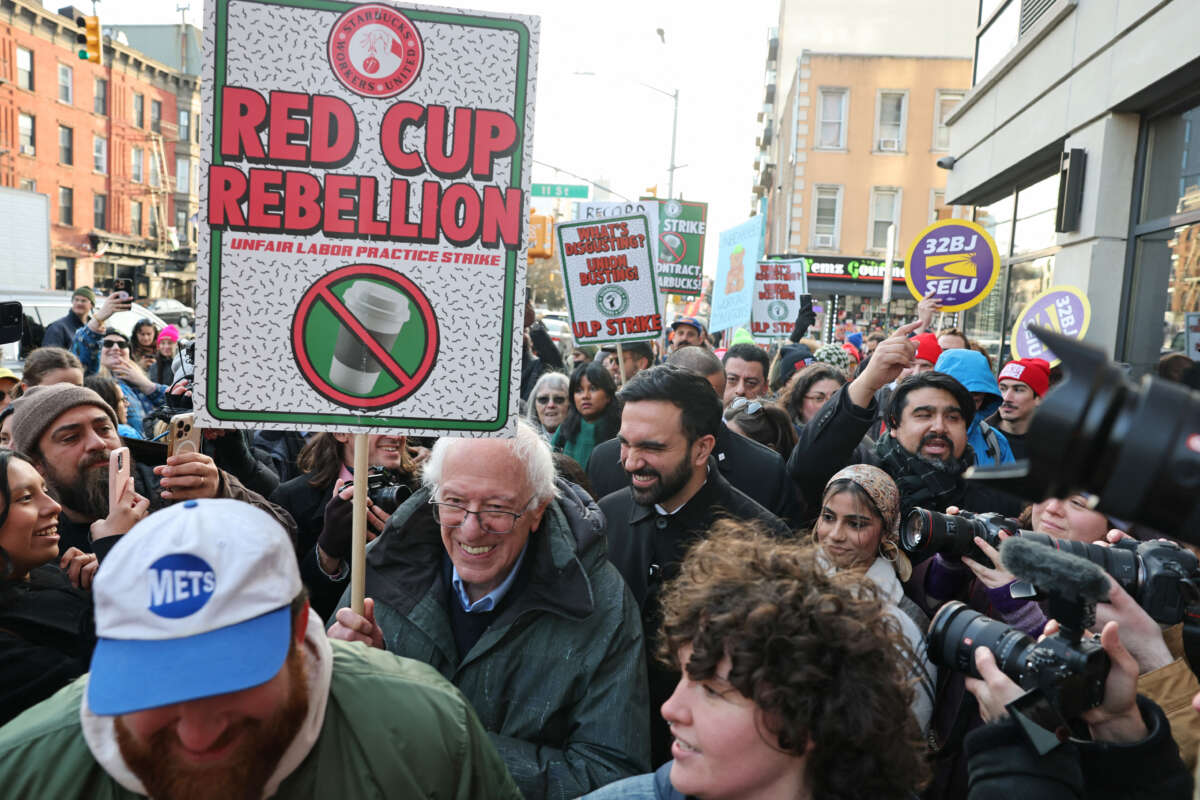
New York City Mayor-elect Zohran Mamdani (R) and U.S .Senator Bernie Sanders join striking Starbucks workers in New York City, on December 1, 2025.ANGELA WEISS / AFP via Getty Images
President Donald Trump launched a war against workers as soon as he reclaimed power in January 2025. Now, nearly a year into his second administration, it’s possible to take stock of the year’s notable victories and the challenges looming in 2026.
Some of the administration’s immediate moves included rescinding a Biden-era executive order that raised the minimum wage for federal workers, rolling back laws prohibiting workplace discrimination, pulling out of an international agreement that would have imposed a minimum tax on corporations, and killing dozens of workplace safety rules.
Some of Trump’s most vicious moves targeted immigrant workers, many of whom have been terrorized by the unrelenting barrage of ICE raids throughout their communities and workplaces.
“The administration’s worksite immigration enforcement actions are targeting underpaid immigrant workers from predominantly Indigenous, Latine, and Black communities who are already at high risk of exploitation by employers,” Marisa Díaz, the Immigrant Worker Justice Program director at the National Employment Law Project, told Truthout. “These attacks push vulnerable workers further into the shadows, reward exploitative employers who profit on violating workers’ rights, and make workplaces less safe for all. We call for an end to these raids and stand with all who are organizing for the dignity and safety of all workers.”
An Economic Policy Institute (EPI) report found that Trump’s deportation agenda will potentially eliminate 6 million jobs.
President Donald Trump launched a war against workers as soon as he reclaimed power in January 2025. Now, nearly a year into his second administration, it’s possible to take stock of the year’s notable victories and the challenges looming in 2026.
Some of the administration’s immediate moves included rescinding a Biden-era executive order that raised the minimum wage for federal workers, rolling back laws prohibiting workplace discrimination, pulling out of an international agreement that would have imposed a minimum tax on corporations, and killing dozens of workplace safety rules.
Some of Trump’s most vicious moves targeted immigrant workers, many of whom have been terrorized by the unrelenting barrage of ICE raids throughout their communities and workplaces.
“The administration’s worksite immigration enforcement actions are targeting underpaid immigrant workers from predominantly Indigenous, Latine, and Black communities who are already at high risk of exploitation by employers,” Marisa Díaz, the Immigrant Worker Justice Program director at the National Employment Law Project, told Truthout. “These attacks push vulnerable workers further into the shadows, reward exploitative employers who profit on violating workers’ rights, and make workplaces less safe for all. We call for an end to these raids and stand with all who are organizing for the dignity and safety of all workers.”
An Economic Policy Institute (EPI) report found that Trump’s deportation agenda will potentially eliminate 6 million jobs.

Trump’s Anti-Worker Team Is Solidified for 2026
Things may become even more dire in 2026, as many Trump appointees are poised to wield power.
Wayne Palmer, a coal industry executive, will serve as the assistant secretary of the Mine Safety and Health Administration. David Keeling will head the Occupational Safety and Health Administration (OSHA). Keeling previously oversaw health and safety protocols at Amazon and UPS, and the companies collectively racked up over 300 workplace safety citations and $2 million in OSHA fines while he was in charge. Andrew Rogers, a former attorney at the anti-union law firm Littler Mendelson, will serve as the next administrator of the Labor Department’s Wage and Hour Division.
Additionally, Trump’s National Labor Relations Board (NLRB) may soon begin deciding cases.
Upon arriving in the White House, Trump illegally fired board member Gwynne Wilcox, depriving the agency of the necessary quorum of at least three members. The board also paused all active investigations, including two dozen inquiries into companies owned by Trump megadonor Elon Musk.
In July, Trump finally selected two new members: James Murphy, who has spent many years as counsel to Republican NLRB members, and Scott Mayer, who currently serves as the chief labor counsel for Boeing and formerly worked for the anti-union law firm Morgan, Lewis & Bockius. In February, NLRB Acting General Counsel William Cowen rescinded more than two dozen Biden-era General Counsel memos addressing issues such as the electronic monitoring of workers and the employment status of college athletes.
If its quorum is reestablished, the board is expected to take these efforts a step further and overturn Biden-era rulings. These include the ban on “captive audience” meetings, in which employers effectively force workers to sit through anti-union propaganda and the 2023 Cemex case decision, which determined that, if a majority of workers sign union affiliation cards, employers have to either recognize the union or hold an election within two weeks.
“There is a very strong likelihood that the NLRB will achieve quorum in the new year and begin a more aggressive attack on workers’ right to organize and collectively bargain,” Margaret Poydock, a senior policy analyst at EPI, told Truthout. “President Trump is the largest union buster in U.S. history, and his interference with the independence of the NLRB will result in the further weakening of our nation’s labor laws.”
Despite these potential obstacles, U.S. workers are still looking toward 2026 with the hope of building on the victories of 2025 and establishing the power necessary to counter the Trump regime.
Things may become even more dire in 2026, as many Trump appointees are poised to wield power.
Wayne Palmer, a coal industry executive, will serve as the assistant secretary of the Mine Safety and Health Administration. David Keeling will head the Occupational Safety and Health Administration (OSHA). Keeling previously oversaw health and safety protocols at Amazon and UPS, and the companies collectively racked up over 300 workplace safety citations and $2 million in OSHA fines while he was in charge. Andrew Rogers, a former attorney at the anti-union law firm Littler Mendelson, will serve as the next administrator of the Labor Department’s Wage and Hour Division.
Additionally, Trump’s National Labor Relations Board (NLRB) may soon begin deciding cases.
Upon arriving in the White House, Trump illegally fired board member Gwynne Wilcox, depriving the agency of the necessary quorum of at least three members. The board also paused all active investigations, including two dozen inquiries into companies owned by Trump megadonor Elon Musk.
In July, Trump finally selected two new members: James Murphy, who has spent many years as counsel to Republican NLRB members, and Scott Mayer, who currently serves as the chief labor counsel for Boeing and formerly worked for the anti-union law firm Morgan, Lewis & Bockius. In February, NLRB Acting General Counsel William Cowen rescinded more than two dozen Biden-era General Counsel memos addressing issues such as the electronic monitoring of workers and the employment status of college athletes.
If its quorum is reestablished, the board is expected to take these efforts a step further and overturn Biden-era rulings. These include the ban on “captive audience” meetings, in which employers effectively force workers to sit through anti-union propaganda and the 2023 Cemex case decision, which determined that, if a majority of workers sign union affiliation cards, employers have to either recognize the union or hold an election within two weeks.
“There is a very strong likelihood that the NLRB will achieve quorum in the new year and begin a more aggressive attack on workers’ right to organize and collectively bargain,” Margaret Poydock, a senior policy analyst at EPI, told Truthout. “President Trump is the largest union buster in U.S. history, and his interference with the independence of the NLRB will result in the further weakening of our nation’s labor laws.”
Despite these potential obstacles, U.S. workers are still looking toward 2026 with the hope of building on the victories of 2025 and establishing the power necessary to counter the Trump regime.
The Victories of 2025
The climate for workers has undeniably become more hostile, but 2025 still saw its share of significant labor wins nonetheless.
After a brief strike in October 2024, dockworkers on the East and Gulf coasts approved a contract that raises wages by over 60 percent over the course of six years and assures that jobs are guaranteed as employers move toward automation.
During the summer, teachers in Philadelphia reached an agreement with the school district, narrowly averting a strike. In addition to securing bonuses, a new sick day policy, and yearly raises for all bargaining unit members, the new contract offers five weeks of paid parental leave, a historic first for the district.
After a series of marches and rallies, California grocery workers at Kroger and Albertsons brand stores have ratified new contracts that include wage increases, a new pension plan, and enhanced health care benefits.
After three years of bargaining, workers at the Daily News secured their first contract in over 30 years, establishing minimum salaries, wage increases, and new benefits for part-time employees.
In a landmark decision, unionized journalists at POLITICO and E&E News (PEN Guild) prevailed in an arbitration case against POLITICO management over the company’s adoption of AI at the website. The arbitrator found that POLITICO violated its collective bargaining agreement by adopting two AI-powered editorial products without the necessary, negotiated safeguards.
“Workers across the country are fed up with corporate greed and an economy that rewards those at the top while working people struggle to get by.”
“This ruling affirms that employers cannot use emerging technology as an end-run around contractual obligations,” said Washington-Baltimore News Guild General Counsel Amos Laor in a statement on the decision. “AI tools may be new, but the legal principles we secured in the agreement are not: management must provide notice, bargain with the union, and ensure that innovation does not come at the expense of workers’ rights or diminish their work. For journalists, issues of journalistic integrity are directly tied to their reputation, relationship with readers, and ability to perform their duties, and we view the protection of newsroom ethical standards as an integral part of their labor rights.”
In the fall, democratic socialist Zohran Mamdani — who has repeatedly stood in solidarity with striking workers — prevailed over former Governor Andrew Cuomo to become the next mayor of New York City.
Mamdani found widespread support and built an energized base through a campaign that focused on affordability, and many believe his historic win will spark further progressive electoral campaigns throughout the country.
“The working people of New York have been told by the wealthy and the well-connected that power does not belong in their hands,” Mamdani told the crowd at his victory party. “Fingers bruised from lifting boxes on the warehouse floor; palms calloused from delivery bike handlebars; knuckles scarred with kitchen burns — these are not hands that have been allowed to hold power. And yet, over the last 12 months, you have dared to reach for something greater. Tonight, against all odds, we have grasped it.”
In November, after four strikes and 16 months of negotiations, the union representing 21,000 health care, research, and technical professionals in the University of California system ratified their “best contract yet.”
The new agreement, which was approved by 98 percent of voting members, established combined pregnancy and child care leave, year-to-year raises, equity pool adjustments, and a minimum wage of $25 across all job titles.
“Today, I am overjoyed that I will be able to afford a safe place to sleep close enough to commute to my job at the University of California, San Francisco,” said union rep and Animal Health Technician Carina Jauregui in a statement. “I am thrilled that my coworkers will finally be able to provide for their families without having to worry about how they’re going to pay the bills. And I am emboldened to keep telling my story, which is now not just a story of loss, but of victory.”
The year concluded with a strike by Starbucks workers. The action kicked off on November 13, the corporation’s annual “Red Cup Day,” and included more than 65 stores across 40 cities. Since then, it has expanded to at least 120 stores across 85 cities. Workers are demanding better staffing, higher take-home pay, and a resolution to hundreds of outstanding unfair labor practice charges against the company.
Amid the strike, New York City reached a $38.9 million settlement with the company after the Department of Consumer and Worker Protection found it had violated local labor laws more than half a million times since 2021. The settlement will result in restitution payments for more than 15,000 workers.
“Our nationwide Red Cup Rebellion shows that workers across the country are fed up with corporate greed and an economy that rewards those at the top while working people struggle to get by,” Sabina Aguirre, a barista from Columbus, Ohio, told Truthout. Starbucks executives keep getting richer while baristas can’t earn a livable wage or get enough hours for benefits.
“Instead of working with us to fix those problems, the company continues to break labor law and ignore the baristas who power their profits,” she continued. “We know our strength is in our solidarity as working people, and we have allies all over the world who have stepped up to back our cause.”
Such worker solidarity could prove to be the only effective answer to Trump’s anti-labor agenda.
This article is licensed under Creative Commons (CC BY-NC-ND 4.0), and you are free to share and republish under the terms of the license.

Michael Arria
Michael Arria is the U.S. correspondent for Mondoweiss. Follow him on Twitter: @michaelarria.

No comments:
Post a Comment