Queer and Trans People Were Under Attack in 2025. Here’s How We Fought Back.
From ICE jails to public libraries to Instagram, queer and trans people battled fascism on every front this year.
By Toshio Meronek & Eric A. Stanley ,
December 27, 2025
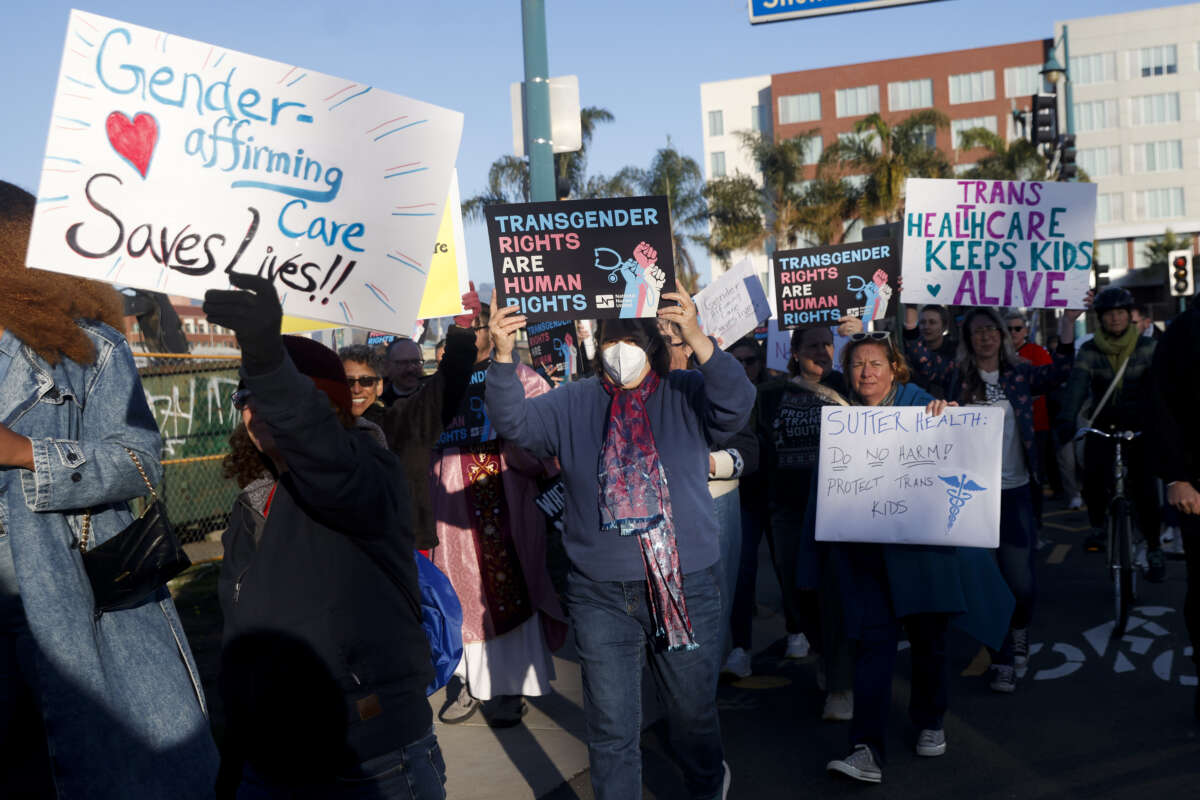
Members of Rainbow Families Action march from Bay Street in Emeryville, California, on December 8, 2025 to the Sutter corporate offices on Powell Street to protest the end of gender-affirming care to patients under age 19.Jessica Christian / San Francisco Chronicle via Getty Images
This year — 2025 — was bleak. There’s trans joy around, but to keep it from drying up we’re going to need to stay with the horror of our current moment. Not so long that it destroys us, but long enough to strategize against its creeping totality.
The right-wing descent that took place during this long year was predicted by Miss Major Griffin-Gracy, the Stonewall riot veteran and mentor to us both who passed this year. Queer and trans people like Major who were alive during the 1980s remember the early days of the AIDS epidemic and the reign of Reagan as a similarly bleak time, in jarring contrast to the revolutionary 1960s and ’70s.
Major kept pushing during that period, behind the wheel of San Francisco’s first needle exchange van, and with a group of trans people dubbed Angels of Care who treated people dying from the virus (at the time, many established doctors and nurses refused). Groups like Angels of Care and the direct action-focused AIDS Coalition to Unleash Power (ACT UP) provided where the state and traditional institutions would not.
Following this lineage, queer and trans people in 2025 organized against the fascist takeover of the federal government. Indeed, despite the ascendant right wing, in 2025 queer and trans people in the U.S. organized on battlegrounds such as ICE jails, public libraries facing book bans, and on Instagram. Below are some of the grounds where we fought.
This year — 2025 — was bleak. There’s trans joy around, but to keep it from drying up we’re going to need to stay with the horror of our current moment. Not so long that it destroys us, but long enough to strategize against its creeping totality.
The right-wing descent that took place during this long year was predicted by Miss Major Griffin-Gracy, the Stonewall riot veteran and mentor to us both who passed this year. Queer and trans people like Major who were alive during the 1980s remember the early days of the AIDS epidemic and the reign of Reagan as a similarly bleak time, in jarring contrast to the revolutionary 1960s and ’70s.
Major kept pushing during that period, behind the wheel of San Francisco’s first needle exchange van, and with a group of trans people dubbed Angels of Care who treated people dying from the virus (at the time, many established doctors and nurses refused). Groups like Angels of Care and the direct action-focused AIDS Coalition to Unleash Power (ACT UP) provided where the state and traditional institutions would not.
Following this lineage, queer and trans people in 2025 organized against the fascist takeover of the federal government. Indeed, despite the ascendant right wing, in 2025 queer and trans people in the U.S. organized on battlegrounds such as ICE jails, public libraries facing book bans, and on Instagram. Below are some of the grounds where we fought.

A Struggle Over the Stonewall National Monument
Miss Major was one of the people who fought the cops at the famous 1969 anti-police uprising outside the Stonewall Inn in New York City. The space was commemorated as the country’s first LGBT national monument under the Obama administration, but this year Donald Trump’s White House removed the words “queer” and “transgender” and later, references to bisexuals, from the monument’s signage and website, with the National Park Service instituting a new policy that only allows traditional rainbow flags. Rather than demanding that we simply return to the domestication that the initial monument offered, what if we demanded a commemoration as insurgent at the uprising itself? As Major noted, a commemorative plaque was nice, but free housing and free healthcare for trans people would be much more meaningful. Acting autonomously, people have replaced the flags on and off, regardless of the official policy.
Related Story

NC County Board Dissolves Library Panel Over Refusal to Ban Trans Book
The action by county commissioners “shows a blatant disregard for the expertise of librarians,” one critic said. By Chris Walker , Truthout December 19, 2025
Resistance in Public Libraries and Schools
In 2025, thought police calling themselves “parents’ rights advocates” continued to target people such as the librarian in Georgia who was fired for displaying a book with a trans character, and the Florida teacher who lost their job because they called a student by their chosen name.
These sorts of attacks aren’t new: Look back to the firings of gay teachers in the 1970s and 1980s around the Briggs Initiative in 1978, which was a failed attempt to ban gays and lesbians from working in California schools. Painting queer people as “dangerous” is a tactic that Christian conservatives have deployed as long as queer movements have existed. The Trump Administration along with the Heritage Foundation’s Project 2025 have reanimated the tactic.
As we write this, a trans University of Oklahoma teaching assistant has been removed from teaching for giving low marks to a paper that called social acceptance of trans identities “demonic,” turned in by a conservative undergraduate student named Samantha Fulnecky. A second instructor was put on leave for offering to excuse students to attend a protest in support of the other suspended teacher. One bright spot at the end of the year: the students organizing in support of the trans teacher at the University of Oklahoma, against the outsized influence of Turning Point USA.
On a broader scale, resistance is happening every time librarians and professors refuse to self-censor, and continue to stock library shelves and syllabi with queer and trans media, teach classes at radical info shops outside of academia, and help people access banned books through projects like the Queer Liberation Library.
At the Hospital and in Doctors’ Offices
Recent wins around gender-affirming health care were tested and in some cases rolled back. As one policy brief has it, “the United States has become the world’s most restrictive developed democracy for transgender healthcare access” — restrictions that will almost certainly result in suicides among people unable to access care.
In December, feds threatened Medicare funding for trans-supporting hospitals, while many health insurance companies have already cut trans services from their policies. This has resulted in protests since the year’s start.
Despite the ascendant right wing, in 2025 queer and trans people in the U.S. organized on battlegrounds such as ICE jails, public libraries facing book bans, and on Instagram.
Northern California’s largest healthcare provider recommitted to providing trans health care for young people, in part thanks to protests against the provider, Sutter Health.
The Trans Youth Emergency Project connects trans youth and families in conservative states with small grants and volunteer guides across state lines, and DIY hormone replacement therapy is also filling in necessary gaps.
Clashes Over Social Media
As tech oligarchs sucked up to Trump and snatched the best seats in the house at this year’s inauguration, Mark Zuckerberg’s Meta (the near-monopoly that owns Facebook, Instagram, and Threads) attempted an anti-queer makeover in the style of Elon Musk’s X, allowing more dehumanizing language under the guise of “free speech,” while users report shadowbanning and censorship of LGBTQ+ content.
Some have left anti-LGBTQIA platforms for others, like Bluesky. Some are spending more time in real life, at reading groups with a political education bent. Examples of these include the Noname Book Club, which describes itself as a “Black owned business connecting community members both inside and outside carceral facilities with radical books,” and Bay Area groups such as Shattered Glass (it has no website, just send an email to join) and Queering the Canon. Zines and festivals centered around physical media are another way people are communicating offline.
Censorship of queer and trans media isn’t new to our movements, which means we’ve long carved out space at leftist and anarchist book fairs; we donate books and labor to organizations like LGBT Books to Prisoners to get books to places where they’re harder to find.
With free or cheap “third spaces” on the decline, libraries and bookstores are even more important as meeting and organizing spaces — places like A Room of One’s Own in Madison, Wisconsin; Midnight Books in Los Angeles; Red Emma’s in Baltimore; and Sour Cherry Comics in San Francisco.
Contestations at Pride
Was anyone shocked when corporations pulled Pride sponsorships this year? Capitalist-friendly Pride parties flailed as companies cut their diversity, equity, and inclusion budgets, and in too many cases failed to support queer and trans people calling for LGBTQIA+ organizations to condemn Israel’s genocide of Palestinians. Our local Dyke March here in San Francisco split into competing marches, as some organizers bowed to a few Zionists who argued that officially adopting an anti-Zionist stance was anti-inclusive of some lesbians.
At the same time, trans-specific celebrations grew. Trans Pride march in San Francisco, for one, reportedly swelled to become the largest ever, with organizers highlighting the connections between anti-colonial struggle, prison abolition, and trans liberation.
Struggles Against Prisons and Immigration Jails
This year LGBTQ+ asylum seekers like Andry Hernández Romero and Hilary Rivers faced deadly conditions inside ICE’s growing deportation machine, leaving many refugees separated from their families, prone to sexual assault by guards, and contemplating or succeeding in taking their own lives.
In response, queer and trans people with autonomous collectives like Gay Shame protested and worked to provide cover to immigrants against the most expensive domestic policing force in U.S. history. Compton’s Coalition worked to oust GEO Group, the largest private prison contractor in the U.S., from the San Francisco site of the Compton’s Cafeteria riot, where three years before Stonewall, queer and trans people raged against the police.
Behind the walls of domestic prisons, the Department of Justice indicated it plans to roll back policies meant to protect imprisoned children and adults from rape in December; it’s too early to know the fallout.
In LGBTQ Spaces Targeted by the Right
Even as cities massively increase their police budgets, violence against trans/queer people continues. The right and its media attempted to scapegoat trans people for mass shootings, while the Department of Justice erased a study showing right-wingers and white supremacists are largely responsible for terrorist attacks in the U.S. Last month in San Diego, trans women were shot by pellet guns outside a bar in the Hillcrest gayborhood, while a wannabe “martyr” for Charlie Kirk admitted to planning a mass shooting targeting trans people in Arizona.
On the Front Lines of the Class War
A number of gay men in positions of authority have worked to make our lives more miserable this year, including Trump’s top finance guy Scott Bessent, who has been working to justify the president’s tariffs while blaming the media for the affordability crisis; surveillance juggernaut Palantir’s Peter Thiel, who keeps making money off of spying on us all; and OpenAI’s Sam Altman, who despite stating that AI could end the world, keeps pushing for more data centers while angling for a government bailout for his unprofitable chatbot company.
But even as these “gay faces in high places” betrayed the rest of us, queer grassroots resistance persists against gay capitalists who put solidarity with fellow rich people first. Trans and queer people are essential to movements to curb FLOCK surveillance cameras, thwart data centers, and shame companies into cutting contracts with Israel.
This article is licensed under Creative Commons (CC BY-NC-ND 4.0), and you are free to share and republish under the terms of the license.
Toshio Meronek
Toshio Meronek is coauthor of the book Miss Major Speaks and host of the podcast Sad Francisco; they have reported on housing and queer politics for Truthout since 2013.
Eric A. Stanley
Eric A. Stanley is the author of Atmospheres of Violence: Structuring Antagonism and the Trans/Queer Ungovernable. They organize and teach in the Bay Area.


No comments:
Post a Comment