THE LAST COLONY, VIVA INDEPENDENCE
France’s efforts to steer New Caledonia towards a new institutional settlement are entering a sensitive new phase. With the Bougival agreement facing delays, political pushback and lingering doubts over consensus, President Emmanuel Macron is seeking to relaunch talks with local leaders in the new year.
Issued on: 16/12/2025 -RFI
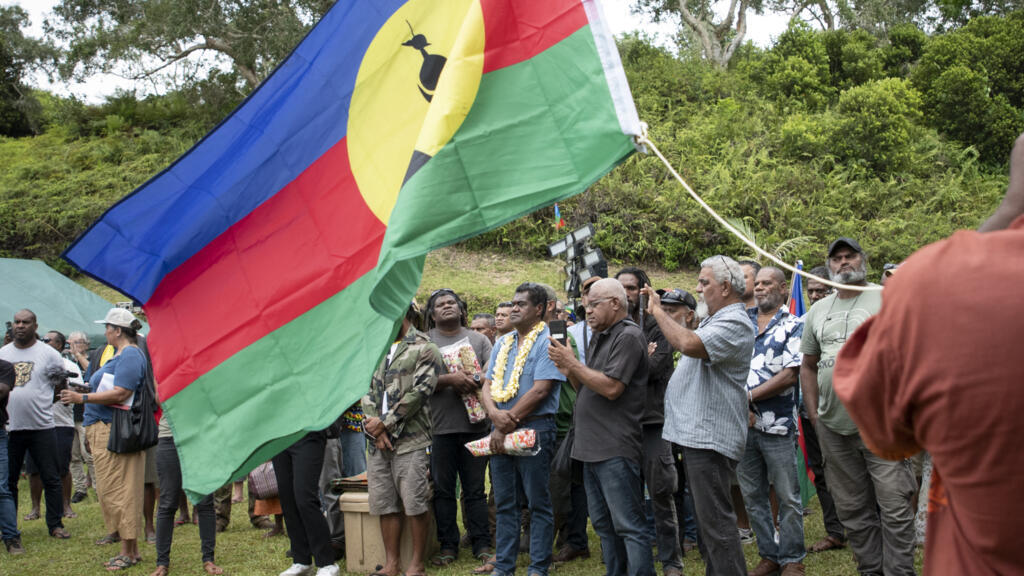
Kanak pro-independence leader Christian Tein (in C with a blue polo shirt) stands in respect as the FLNKS flag during the congress of the Kanak and Socialist National Liberation Front (FLNKS), New Caledonia's main pro-independence movement, in Ponerihouen, in the French overseas collectivity of New Caledonia, on 6 December 2025. AFP - DELPHINE MAYEUR
French President Emmanuel Macron has announced he will meet New Caledonian elected officials on 16 January in a bid to “continue the dialogue” on the Pacific archipelago’s institutional future and to “provide clarification on the Bougival agreement” signed last July.
In a letter to local elected representatives, President Macron said the meeting would build on talks held earlier this year and aim to reopen political discussion at a time when the agreement’s future looks increasingly uncertain.
“Following the discussions initiated at the Summit for the Future of New Caledonia held on 2 July at the Élysée Palace, in order to clarify the 12 July agreement, I have decided to organize a new forum for exchange to continue the dialogue,” the president wrote.
He added that this “progress report, aimed at opening up new political perspectives in which I would like you to participate,” would take place on 16 January with “New Caledonian elected officials”.
French President Emmanuel Macron has announced he will meet New Caledonian elected officials on 16 January in a bid to “continue the dialogue” on the Pacific archipelago’s institutional future and to “provide clarification on the Bougival agreement” signed last July.
In a letter to local elected representatives, President Macron said the meeting would build on talks held earlier this year and aim to reopen political discussion at a time when the agreement’s future looks increasingly uncertain.
“Following the discussions initiated at the Summit for the Future of New Caledonia held on 2 July at the Élysée Palace, in order to clarify the 12 July agreement, I have decided to organize a new forum for exchange to continue the dialogue,” the president wrote.
He added that this “progress report, aimed at opening up new political perspectives in which I would like you to participate,” would take place on 16 January with “New Caledonian elected officials”.
Fragile timetable and mounting scepticism
The announcement comes as momentum around the Bougival agreement appears to be faltering.
A bill to organise an early consultation of New Caledonians on the text will not, after all, be presented to the Council of Ministers on Wednesday, as had initially been planned. The government spokesperson confirmed the delay on Monday, underlining how fragile the timetable has become.
At the same time, questions remain about the precise format and objectives of the meeting proposed by the president – and about whether it could reopen hard-fought compromises.
“Everyone understands that they are going to try to get us to renegotiate, to reopen the Bougival agreement to allow the FLNKS to come forward with its demands,” said New Caledonian MP Nicolas Metzdorf on the NC La 1ère channel. He also regretted that “the fear of possible new violence in New Caledonia … is guiding political action” in Paris.
From the loyalist camp, scepticism is equally pronounced. The Loyalists – a centrist and anti-independence right-wing alliance – have reportedly “made all the concessions they could” and would refuse any attempt to call into question the political balance struck by the agreement.
The announcement comes as momentum around the Bougival agreement appears to be faltering.
A bill to organise an early consultation of New Caledonians on the text will not, after all, be presented to the Council of Ministers on Wednesday, as had initially been planned. The government spokesperson confirmed the delay on Monday, underlining how fragile the timetable has become.
At the same time, questions remain about the precise format and objectives of the meeting proposed by the president – and about whether it could reopen hard-fought compromises.
“Everyone understands that they are going to try to get us to renegotiate, to reopen the Bougival agreement to allow the FLNKS to come forward with its demands,” said New Caledonian MP Nicolas Metzdorf on the NC La 1ère channel. He also regretted that “the fear of possible new violence in New Caledonia … is guiding political action” in Paris.
From the loyalist camp, scepticism is equally pronounced. The Loyalists – a centrist and anti-independence right-wing alliance – have reportedly “made all the concessions they could” and would refuse any attempt to call into question the political balance struck by the agreement.
Searching for consensus
Signed in July between the French government, the independence movement and the anti-independence movement, the draft Bougival agreement sets out plans for the creation of a New Caledonian state within the French Constitution.
However, the text suffered a major setback in August when it was rejected by the Kanak and Socialist National Liberation Front (FLNKS), the main pro-independence coalition.
Despite this rejection, a majority of New Caledonia’s political forces continue to support the agreement in principle.
Several of them argue, however, that amendments are necessary in order to secure the broad consensus they see as essential for the deal to be implemented.
Against this backdrop, the French government has been searching for ways to revive a stalled process in an archipelago still scarred by deadly violence in the spring of 2024. Those unrests left 14 people dead and severely weakened New Caledonia’s economy.
In that context, Overseas Minister Naïma Moutchou floated the idea of organising an “early citizen consultation” in March 2026, ahead of the adoption of the constitutional law required to bring the agreement into force. The proposal was intended to re-engage the population and restore political momentum.
Yet even this prospect has drawn reservations, including from some supporters of Bougival. The National Union for Independence (UNI) made its backing conditional on amendments to the text.
Meanwhile, the Caledonian Congress, asked for its opinion on 8 December, confirmed that the bill was deadlocked, with 19 votes in favour, 14 against and 19 abstentions.
The doubts also reached Paris by early December, when the Socialist Party urged Prime Minister Sébastien Lecornu to “suspend” the early consultation, arguing that it exposed a “lack of real consensus” around the agreement and made adoption of the bill unlikely.
(with newswires)
Signed in July between the French government, the independence movement and the anti-independence movement, the draft Bougival agreement sets out plans for the creation of a New Caledonian state within the French Constitution.
However, the text suffered a major setback in August when it was rejected by the Kanak and Socialist National Liberation Front (FLNKS), the main pro-independence coalition.
Despite this rejection, a majority of New Caledonia’s political forces continue to support the agreement in principle.
Several of them argue, however, that amendments are necessary in order to secure the broad consensus they see as essential for the deal to be implemented.
Against this backdrop, the French government has been searching for ways to revive a stalled process in an archipelago still scarred by deadly violence in the spring of 2024. Those unrests left 14 people dead and severely weakened New Caledonia’s economy.
In that context, Overseas Minister Naïma Moutchou floated the idea of organising an “early citizen consultation” in March 2026, ahead of the adoption of the constitutional law required to bring the agreement into force. The proposal was intended to re-engage the population and restore political momentum.
Yet even this prospect has drawn reservations, including from some supporters of Bougival. The National Union for Independence (UNI) made its backing conditional on amendments to the text.
Meanwhile, the Caledonian Congress, asked for its opinion on 8 December, confirmed that the bill was deadlocked, with 19 votes in favour, 14 against and 19 abstentions.
The doubts also reached Paris by early December, when the Socialist Party urged Prime Minister Sébastien Lecornu to “suspend” the early consultation, arguing that it exposed a “lack of real consensus” around the agreement and made adoption of the bill unlikely.
(with newswires)
No comments:
Post a Comment