EU will maintain Arctic cooperation with US, von der Leyen says amid Greenland tensions
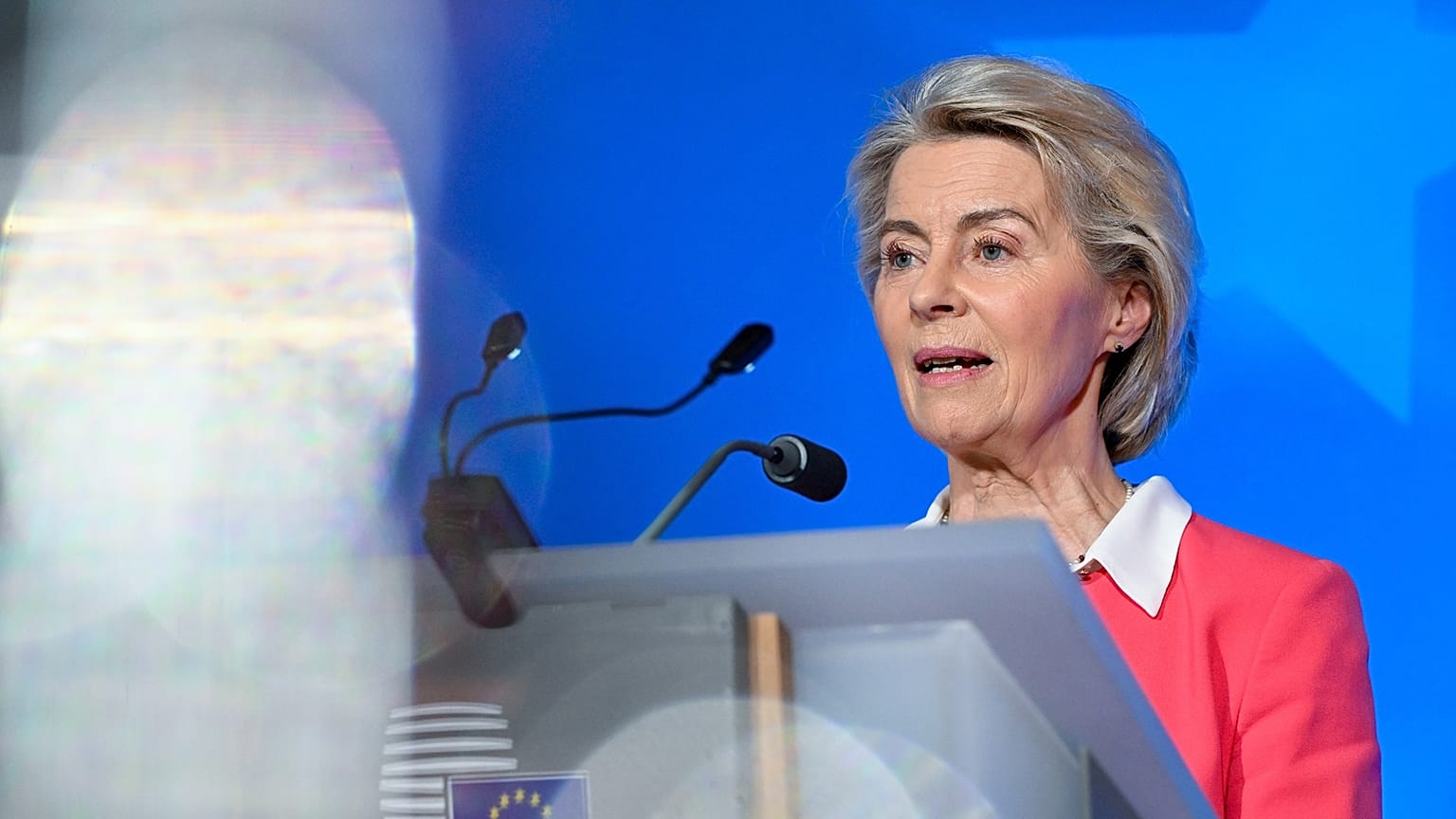
Amid Donald Trump's threats to seize Greenland, Ursula von der Leyen says the EU will continue working with the US to reinforce Arctic security. At the same time, the European Commission has confirmed that Greenland is "in principle" covered by the bloc's mutual assistance clause.
European Commission President Ursula von der Leyen has said the European Union will continue to work closely with the United States to strengthen security in the Arctic even as US President Donald Trump persists with his threats to seize Greenland from Denmark.
"The European Union has a very good reputation in Greenland, and we are counting very much on the excellent cooperation that we have," von der Leyen said on Thursday on an official visit to Limassol, Cyprus.
"We will thus continue our work on Arctic security with our allies (and) our partners, including the United States," she added.
Trump has framed his expansionist agenda as a national security goal.
On Wednesday, the American president said that NATO would become "more formidable and effective with Greenland in the hands of the United States". Otherwise, he said, Russia and China would stand to benefit in the strategic region.
"Anything less than that is unacceptable," he wrote on his social media platform, Truth Social.
His remarks coincided with a meeting in Washington between the foreign ministers of Denmark and Greenland, US Secretary Marco Rubio, and US Vice President JD Vance.
The Danish minister, Lars Løkke Rasmussen,said the tone had been frank and constructive, but conceded there remained a "fundamental disagreement" between the two sides.
"We didn't manage to change the American position," he said at the end of the meeting. "It's clear that the president has this wish of conquering over Greenland."
Rasmussen added that Denmark and the US had agreed to set up a high-level "working group" to find a "common way forward" on the matter of Greenland. He also countered Trump's claims that Chinese warships had gained ground around the island.
At the same time, several European countries began to publicly announce their intention to send military officers as part of a reconnaissance mission to the mineral-rich territory, a stark reflection of the sky-high tensions fuelled by Trump's vision.
France, Germany, Sweden, Norway and the Netherlands are among those that have committed to joining the mission at Copenhagen's request.
Speaking as she marked the start of the Cypriot presidency of the EU Council, von der Leyen promised to "double down" on investments and cooperation in Greenland.
"What is clear is that Greenland can count on us politically, economically, and financially," she said at a press conference, standing next to the Cypriot President Nikos Christodoulides.
"When it comes to its security, the discussions on Arctic security are, first and foremost, a core issue of NATO. But I also want to emphasise that the Arctic and Arctic security, both topics, are core topics for the European Union and matter enormously for us."
Mutual assistance
Separately, the European Commission confirmed that Denmark would be able to invoke the EU's mutual assistance clause in the event of an armed attack against Greenland, even though the semi-autonomous island is not part of the bloc.
The Commission had recently avoided clarifying the legal application.
"Greenland is part of the territory of the Kingdom of Denmark and therefore in principle covered by the mutual solidarity clause in Article 42.7 TEU," a Commission spokesperson told Euronews in a statement.
"However, currently the question doesn't ask itself," the spokesperson added, referring to the fact that Trump's threats have not yet been translated into action.
The mutual assistance clause is enshrined in Article 42.7 of the EU treaties, which says that if a country is "the victim of armed aggression on its territory", the other member states will have an "obligation of aid and assistance by all the means in their power" in accordance with the right of collective self-defence recognised by the UN Charter.
The article does not spell out what measures qualify as "aid and assistance" in practice.
According to an explanatory memo from the Commission, member states should have ample margin to decide their support, which could be of a diplomatic, technical, medical or civilian nature. Military assistance is also envisioned.
Activating the article requires an attack "from abroad" carried out by state or non-state actors, the memo says. The decision to activate rests solely on the member state under assault. Once triggered, the duty to assist becomes "legally binding".
Since its introduction in 2007, Article 42.7 has been invoked only once, when France fell victim to the terrorist attacks of November 2015 and asked other member states to contribute manpower to its Opération Sentinelle.
Notably, Article 42.7 establishes a direct connection with NATO's Article 5, which is the bedrock of the transatlantic alliance's collective defence. Most EU countries are members of NATO, creating an overlap of commitments and obligations.
Unlike the EU provision, which is broadly worded, NATO's Article 5 is more explicit, compelling allies to take necessary action "including the use of armed force" to "restore and maintain the security of the North Atlantic area".
However, given that both the US and Denmark are members of NATO, there is no precedent to determine how Article 5 would apply in a scenario where the American military violated Danish sovereignty and seized Greenland by force.
Such a dilemma emerged in 2020 when Turkey and Greece were involved in a standoff over Ankara's contested gas exploration in waters claimed by Athens. In response, Greece put its army on alert, bringing two NATO members to the brink of war.
'EU-US trade deal is separate from Greenland dispute,' top MEP McAllister tells Euronews
David McAllister, the influential chair of the European Parliament's Committee on Foreign Affairs, argues the parliament should not derail the ratification the EU-US trade deal to punish Trump over US threats to acquire Greenland in an interview with Euronews.
A top member of the European Parliament has warned against blocking the ratification of the trade deal signed by the EU and the United States last summer in retaliation for the bellicose language around Greenland from the Trump administration.
"We need to separate the two issues: the EU-US trade deal and support for Greenland", top European People's Party MEP David McAllister told flagship Euronews morning show Europe Today on Thursday.
"We need to finalise the US trade talks because companies need predictability," added McAllister, who is chair of the European Parliament's committee on foreign affairs.
The European Parliament must ratify the agreement reached by Donald Trump and the Commission's President Ursula von der Leyen last August in Scotland, which tripled tariffs on EU products while reducing to zero industrial good coming from the US.
The US is pushing to have the full ratification of the agreement in place, but several MEPs are considering blocking the approval process to protest Trump's ownership demands on the Danish territory which he claims will happen "one way or another."
McAllister said "there are different views within the political groups" of the European Parliament but insisted the two should be treated as the two issues.
"The EPP and the European Conservatives are for moving forward [approving the deal], he said. "The Socialists, liberals and greens perhaps want to postpone the vote."
On Wednesday, the Parliament issued a joint statement from the leaders of the political groups expressing their "unequivocal support to Greenland and Denmark" and condemned the bellicose language employed by the US, which has not ruled out military means to gain ownership of the semi-autonomous rich in rare earth minerals.
"We have been very clear in our commitment towards Greenland. The European Union will step up its engagement in Greenland: financial support for it will be doubled in the next annual multi-financial framework," the statement said.
European troops arrive in Greenland as US and Denmark talks fail to resolve dispute
By Aleksandar Brezar Published on
The deployment was announced the same day the foreign ministers of Denmark and Greenland met with US Vice President JD Vance and Secretary of State Marco Rubio in Washington.
European military personnel began arriving in Greenland on Thursday, hours after a meeting between US, Danish and Greenlandic officials in Washington failed to resolve what Denmark's foreign minister called "fundamental disagreement" over the mineral-rich Arctic island.
France, Sweden, Germany and Norway announced Wednesday they would deploy military personnel as part of a reconnaissance mission to Greenland's capital Nuuk.
Germany's defence ministry said Thursday that the reconnaissance mission to Greenland by several European NATO members aims "to explore options for ensuring security in light of Russian and Chinese threats in the Arctic".
A 13-strong Bundeswehr reconnaissance team would deploy to Nuuk from Thursday to Sunday at Denmark's invitation, the ministry said.
French President Emmanuel Macron said on Thursday France would soon send more "land, air, and sea" forces to join the military exercise in Greenland.
"A first team of French service members is already on site and will be reinforced in the coming days with land, air, and maritime assets," Macron told troops during a speech to start the new year.
"Soldiers of NATO are expected to be more present in Greenland from today and in the coming days. It is expected that there will be more military flights and ships," Greenland's Deputy Prime Minister Mute Egede told a news conference Wednesday, adding they would be conducting "training".
Meanwhile, the Netherlands and Estonia announced they would join the exercise, which Dutch Foreign Minister Ruben Brekelmans described as a signal that security matters in Greenland and the region are "of strategic importance to all NATO allies."
Estonia was also "ready to put boots on the ground if requested," Foreign Minister Margus Tsahkna said in a post on X.
The deployment was announced the same day the foreign ministers of Denmark and Greenland met with US Vice President JD Vance and Secretary of State Marco Rubio in Washington.
Danish Foreign Minister Lars Løkke Rasmussen, speaking after leaving the White House, said a US takeover of Greenland was "absolutely not necessary."
"We didn't manage to change the American position. It's clear the president has this wish of conquering Greenland," Løkke told reporters. "We therefore still have a fundamental disagreement, but we also agree to disagree."
US President Donald Trump has repeatedly vowed to take control of the autonomous Danish territory, arguing it is vital for US security.
European military personnel began arriving in Greenland on Thursday, hours after a meeting between US, Danish and Greenlandic officials in Washington failed to resolve what Denmark's foreign minister called "fundamental disagreement" over the mineral-rich Arctic island.
France, Sweden, Germany and Norway announced Wednesday they would deploy military personnel as part of a reconnaissance mission to Greenland's capital Nuuk.
Germany's defence ministry said Thursday that the reconnaissance mission to Greenland by several European NATO members aims "to explore options for ensuring security in light of Russian and Chinese threats in the Arctic".
A 13-strong Bundeswehr reconnaissance team would deploy to Nuuk from Thursday to Sunday at Denmark's invitation, the ministry said.
French President Emmanuel Macron said on Thursday France would soon send more "land, air, and sea" forces to join the military exercise in Greenland.
"A first team of French service members is already on site and will be reinforced in the coming days with land, air, and maritime assets," Macron told troops during a speech to start the new year.
"Soldiers of NATO are expected to be more present in Greenland from today and in the coming days. It is expected that there will be more military flights and ships," Greenland's Deputy Prime Minister Mute Egede told a news conference Wednesday, adding they would be conducting "training".
Meanwhile, the Netherlands and Estonia announced they would join the exercise, which Dutch Foreign Minister Ruben Brekelmans described as a signal that security matters in Greenland and the region are "of strategic importance to all NATO allies."
Estonia was also "ready to put boots on the ground if requested," Foreign Minister Margus Tsahkna said in a post on X.
The deployment was announced the same day the foreign ministers of Denmark and Greenland met with US Vice President JD Vance and Secretary of State Marco Rubio in Washington.
Danish Foreign Minister Lars Løkke Rasmussen, speaking after leaving the White House, said a US takeover of Greenland was "absolutely not necessary."
"We didn't manage to change the American position. It's clear the president has this wish of conquering Greenland," Løkke told reporters. "We therefore still have a fundamental disagreement, but we also agree to disagree."
US President Donald Trump has repeatedly vowed to take control of the autonomous Danish territory, arguing it is vital for US security.
Trump: 'I think something will work out'
Trump, speaking after the meeting which he did not attend, for the first time sounded conciliatory on Greenland, acknowledging Denmark's interests even as he again said he was not ruling out any options.
"I have a very good relationship with Denmark, and we'll see how it all works out. I think something will work out," Trump said without explaining further.
He reiterated that Denmark was powerless if Russia or China sought to occupy Greenland, but added, "There's everything we can do."
Trump has appeared emboldened on Greenland after ordering a surprise 3 January attack in Venezuela that removed Nicolás Maduro.
On the streets of Nuuk, red-and-white Greenlandic flags flew in shop windows, on apartment balconies and on cars and buses in a show of national unity this week.
Some residents described anxiety from finding themselves at the centre of the geopolitical spotlight.
"It's very frightening because it's such a big thing," said Vera Stidsen, 51, a teacher in Nuuk. "I hope that in the future we can continue to live as we have until now: in peace and without being disturbed."
Jorge Liboreiro contributed reporting.
Trump, speaking after the meeting which he did not attend, for the first time sounded conciliatory on Greenland, acknowledging Denmark's interests even as he again said he was not ruling out any options.
"I have a very good relationship with Denmark, and we'll see how it all works out. I think something will work out," Trump said without explaining further.
He reiterated that Denmark was powerless if Russia or China sought to occupy Greenland, but added, "There's everything we can do."
Trump has appeared emboldened on Greenland after ordering a surprise 3 January attack in Venezuela that removed Nicolás Maduro.
On the streets of Nuuk, red-and-white Greenlandic flags flew in shop windows, on apartment balconies and on cars and buses in a show of national unity this week.
Some residents described anxiety from finding themselves at the centre of the geopolitical spotlight.
"It's very frightening because it's such a big thing," said Vera Stidsen, 51, a teacher in Nuuk. "I hope that in the future we can continue to live as we have until now: in peace and without being disturbed."
Jorge Liboreiro contributed reporting.

No comments:
Post a Comment