IRANIAN KURDISTAN
Hospital attack highlights 'brutality' of Iran clampdownOmid Barin
Iranian forces "behaved with savage brutality" when they stormed a hospital in Ilam, a nurse told DW. Mass protests continue to grow.

The hospital is the largest in the impoverished Kurdish-majority province of Ilam
Image: Vahidonline
Shirin (name changed), a nurse at the Imam Khomeini Hospital in the western Iranian province of Ilam, recently found herself at the center of a tragedy far beyond anything she had seen in her work.
At the end of last week, she took note of reports on social media of a brutal clampdown on anti-government protesters in Malekshahi county, but she never imagined that she would find herself in the middle of it.
A few hours later, the first group of wounded people from Malekshahi — those who could not be treated at home — were rushed to the hospital where Shirin works.
"More than 40 injured people, covered in blood, were brought to us," the 38-year-old said. "Most had been shot in the upper body: neck, chest, shoulders. Two of them died on the way here. Two young men."
Video footage of security forces opening fire on the protesters quickly went viral.
Hospital becomes scene of violent raid
Imam Khomeini Hospital in Ilam is the largest health facility in this Kurdish-majority province in western Iran.
Shirin said the hospital was completely unprepared for such a surge in patients. "We had to treat them in the women's ward and even the pediatric ward. It was overwhelming, and everyone was on edge."
As Shirin and her colleagues fought to save lives, families of the wounded and other residents began gathering outside the building. "Security forces, meanwhile, were closing in," she said.
On January 4, the area outside Imam Khomeini Hospital in Ilam turned into a scene of unrestrained violence by Iranian security forces, according to Shirin.
"We knew the security agents were coming to arrest the wounded or record their identities," Shirin said. "People gathered at the entrance to stop them." She added: "At the same time, we were desperately short of blood, so calls for donors went out on social media. But the IRGC [Islamic Revolutionary Guard Corps] and special units prevented donors from reaching us. Several citizens were even detained."
The IRGC, one of the most powerful organizations in Iran, is a branch of the armed forces that answers directly to Supreme Leader Ayatollah Ali Khamenei. It was created after the 1979 revolution with the mission of defending the regime.
Shirin (name changed), a nurse at the Imam Khomeini Hospital in the western Iranian province of Ilam, recently found herself at the center of a tragedy far beyond anything she had seen in her work.
At the end of last week, she took note of reports on social media of a brutal clampdown on anti-government protesters in Malekshahi county, but she never imagined that she would find herself in the middle of it.
A few hours later, the first group of wounded people from Malekshahi — those who could not be treated at home — were rushed to the hospital where Shirin works.
"More than 40 injured people, covered in blood, were brought to us," the 38-year-old said. "Most had been shot in the upper body: neck, chest, shoulders. Two of them died on the way here. Two young men."
Video footage of security forces opening fire on the protesters quickly went viral.
Hospital becomes scene of violent raid
Imam Khomeini Hospital in Ilam is the largest health facility in this Kurdish-majority province in western Iran.
Shirin said the hospital was completely unprepared for such a surge in patients. "We had to treat them in the women's ward and even the pediatric ward. It was overwhelming, and everyone was on edge."
As Shirin and her colleagues fought to save lives, families of the wounded and other residents began gathering outside the building. "Security forces, meanwhile, were closing in," she said.
On January 4, the area outside Imam Khomeini Hospital in Ilam turned into a scene of unrestrained violence by Iranian security forces, according to Shirin.
"We knew the security agents were coming to arrest the wounded or record their identities," Shirin said. "People gathered at the entrance to stop them." She added: "At the same time, we were desperately short of blood, so calls for donors went out on social media. But the IRGC [Islamic Revolutionary Guard Corps] and special units prevented donors from reaching us. Several citizens were even detained."
The IRGC, one of the most powerful organizations in Iran, is a branch of the armed forces that answers directly to Supreme Leader Ayatollah Ali Khamenei. It was created after the 1979 revolution with the mission of defending the regime.
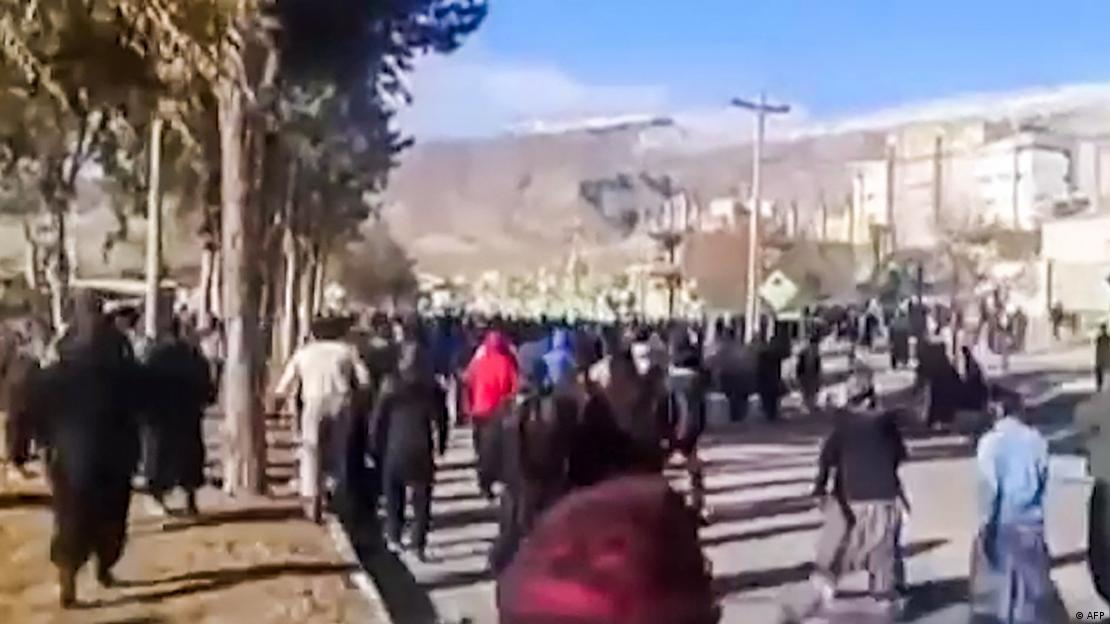
The latest mass protests in Iran were triggered by anger over the rising cost of livingImage: AFP
'IRGC forces beat patients, the wounded, staff and families with batons'
The siege of the Imam Khomeini Hospital lasted over 24 hours and ended on Monday with a fierce clampdown by security forces.
"The agents used shotguns, tear gas and fire inside the building," Shirin said. "They smashed the glass doors at the entrance and stormed the wards."
"IRGC forces beat patients, the wounded, staff and families with batons," Shirin said. "They fired tear gas canisters at the building. Many patients and civilians got seriously injured. Even some children in the pediatric ward suffered severe breathing problems."
"They behaved with savage brutality," Shirin said. "They hurled sexual and ethnic slurs, degrading everyone. People were screaming. The scene was more like a war movie than a hospital."
A witness, who asked not to be named for safety reasons, told DW that "within minutes, 11 of the wounded were taken away by the IRGC and moved to an unknown location. Five others remain in intensive care, shackled to their beds. Some were interrogated on site, while those with less serious injuries managed to escape through a back exit."
An official from Ilam governor's office, who requested anonymity, told DW's Farsi service that some of the injured had been transferred to an IRGC facility in the Sheshdar area near Ilam.
Cost of living
The mass protests were triggered by anger over the rising cost of living in Iran, which is home to more than 90 million people.
The protests began on December 28 with a shutdown by merchants in the capital, Tehran. The protests have since spread to other areas, especially the western part of the country, which is home to Kurdish and Lor minority groups.
It is the largest protest movement in Iran since the 2022-2023 nationwide rallies sparked by the in-custody killing of 22-year-old Jina Mahsa Amini, who had been arrested by "morality police" for allegedly not wearing her hijab properly.
A Malekshahi resident who took part in the protests told DW that the demonstrations began peacefully.
"Everything stayed calm until we reached the Basij building," she said. "Some protesters moved closer to the building, and then — incredibly — the agents inside opened blind, automatic fire on us."
Basij is a volunteer paramilitary faction controlled by the IRGC.
"There were so many wounded. No one was prepared for that. We didn't know how to help them. We only knew we had to get them to the hospital as quickly as possible," said the resident, who asked not to be identified.
Violence draws sharp condemnation
Rights groups have slammed Iranian authorities for targeting hospitals.
"Hospitals are civilian facilities. Attacking them violates the Fourth Geneva Convention and other international covenants. These acts can be classified as crimes against humanity or war crimes, and international courts have jurisdiction to prosecute them," said Adnan Hassanpour, a member of the Kurdistan Human Rights Network who closely follows events in Iran's Kurdish regions.
Amnesty International condemned the attack as a "flagrant violation of international law."
The US State Department also sharply criticized the Iranian authorities' actions in Ilam, describing them on its Farsi-language X account as an "obvious crime against humanity," "barbaric," and "savage."
Iranian officials initially claimed that their entry into the hospital was necessary "to restore security," alleging that the presence of families and protesters had disrupted treatment — a claim that one medical staff member categorically denied when speaking with DW.
Iranian President Masoud Pezeshkian has ordered an investigation into the incidents in Ilam.
The parliament announced that its Health Committee would review reports of security forces entering hospitals in Ilam province and the capital, Tehran.
Shirin, the nurse, said she had always thought of a hospital as a sanctuary. "But what we went through that Sunday opened my eyes," she said. "Now I understand better why people have taken to the streets."
Edited by: Srinivas Mazumdaru
No comments:
Post a Comment