
Russia is building more than 200 missiles and about 10,000 strike drones a month, Ukraine's Main Directorate of Intelligence (HUR) told NV on October 20.
The agency puts the stockpile as of October at up to 700 ballistic missiles, several thousand cruise missiles of various types and more than 6,000 strike drones. Of the missiles coming off the lines each month, 110 are ballistic.
That is a war industry already running past the plan Ukrainian intelligence set out for it a year ago, when it reported a Russian aim to double missile output to 2,500 a year and lift drone production to 2,700 a month. The headline missile rate annualises to more than 2,400 a year, while the named classes add up to about 225 a month; the drone figure is almost four times the stated 2,700-a-month plan. Ukraine, which started the war with no missile industry of its own, still counts its missile output in the hundreds a year.
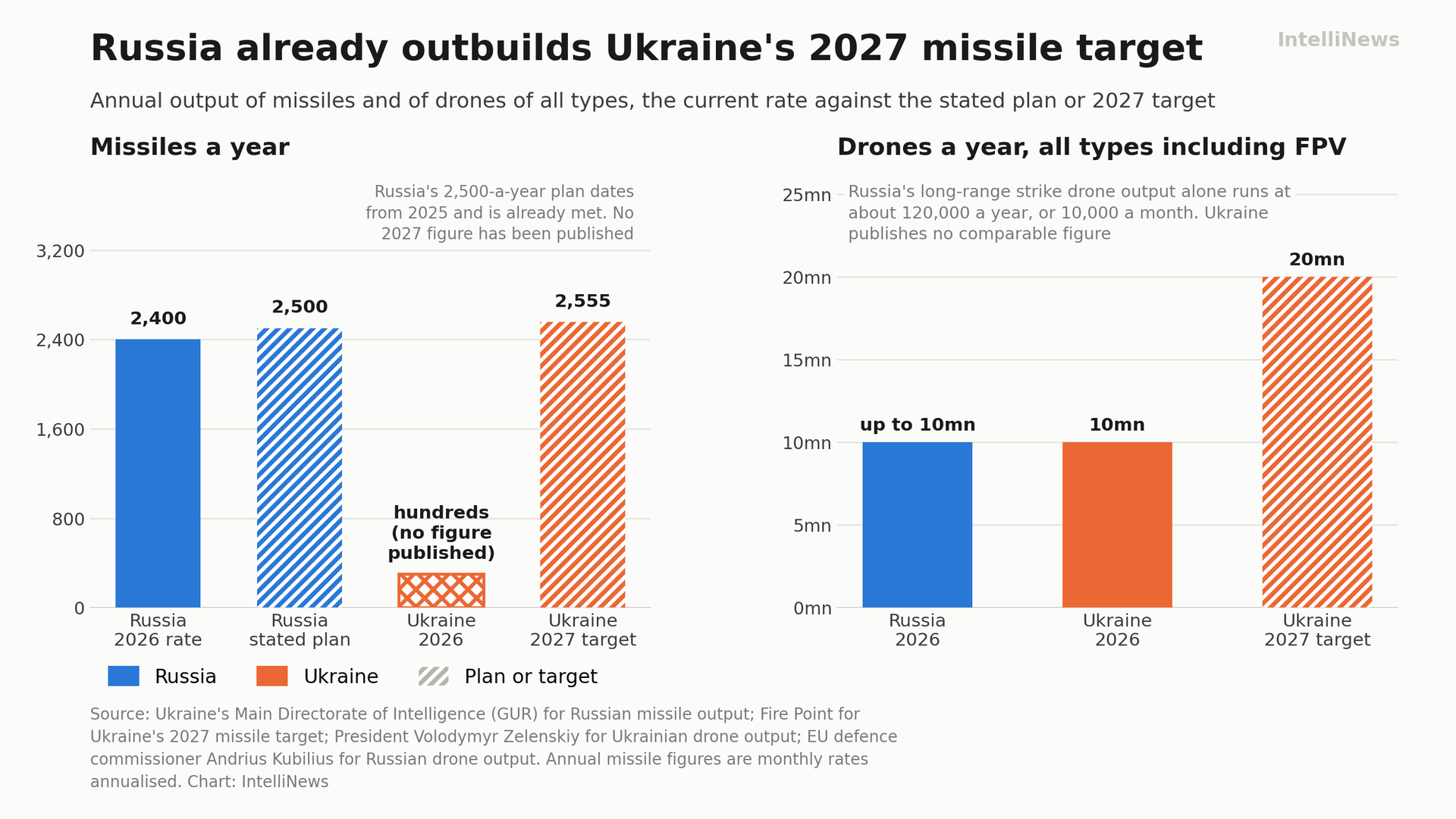
Russia already outbuilds Ukraine's 2027 missile target. Annual output of missiles and of drones of all types, the current rate against the stated plan or 2027 target. Russian missile output is GUR's monthly figure annualised; Russia's 2,500-a-year plan dates from 2025 and no 2027 figure has been published. Drone totals include FPV models and are not like for like with long-range strike output.
Ukraine now makes 10mn drones a year and wants 20mn with help from its partners, President Volodymyr Zelenskiy said in July, against about 4mn in 2025. Its missile and drone arsenal is the mirror image of Russia's: the missile side rests on the Neptune and the Flamingo, whose maker Fire Point plans serial production from 2027 at up to seven a day, or 2,555 missiles a year, with a ballistic programme that saw its first combat use, of the FP-7, in October.
Russian missiles
The Kh-101 remains the mainstay of Russia's mass strikes, with a monthly plan of more than 80 and factories said to be beating it. Iskander-M output runs at up to 65 a month against a stock of about 115.
The RM-48U, an S-300PM and S-400 air defence missile adapted to hit ground targets, is made at about 40 a month from a stock of up to 400, and the sea-launched Kalibr at about 29 against more than 450 held. Most new Kalibrs go to the strategic reserve and to the fleets because Ukrainian air defences shoot down so many, the agency said.
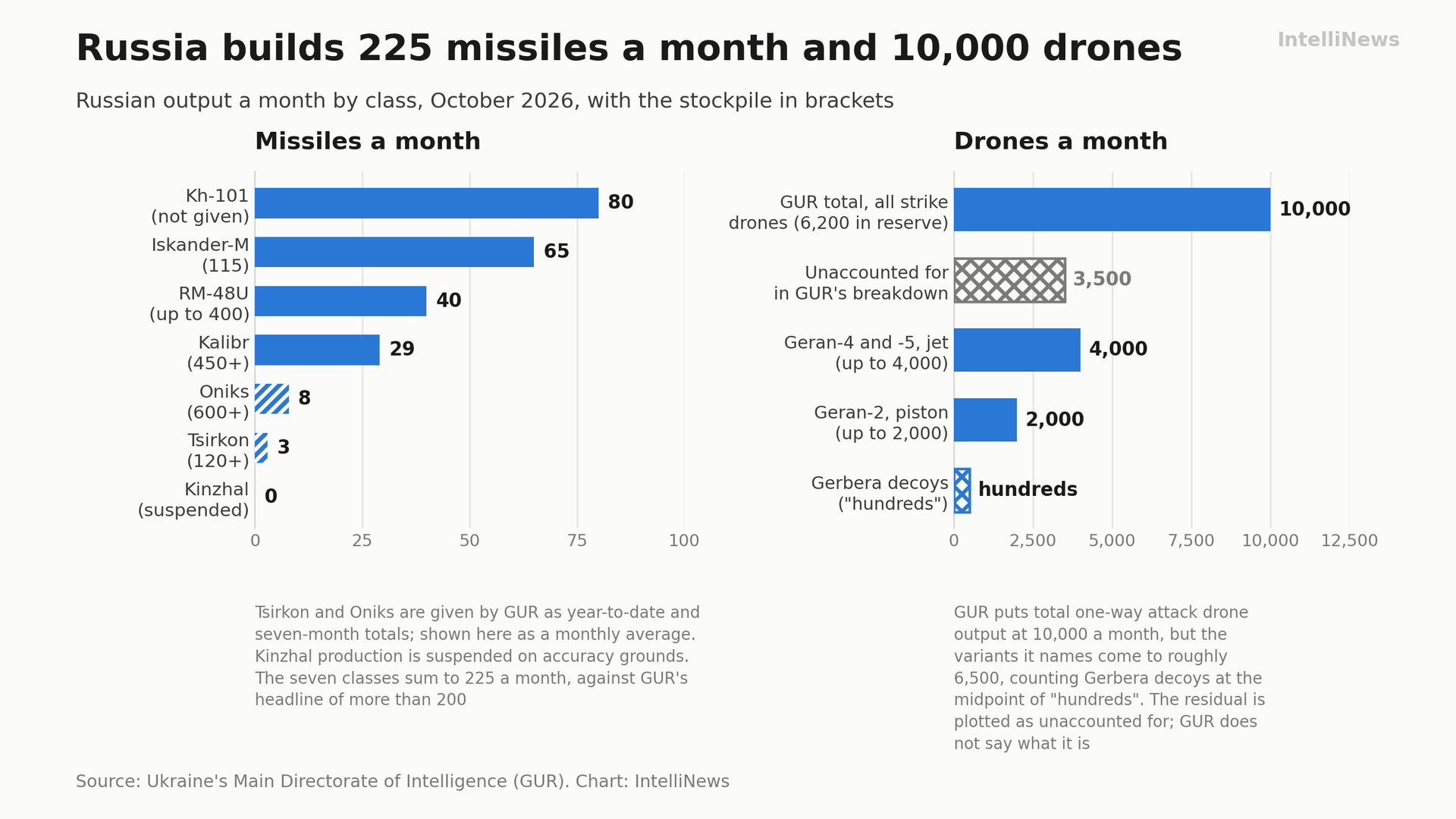
Russian output a month by class, October 2026, with the stockpile in brackets. Tsirkon and Oniks are given by GUR as year-to-date and seven-month totals and are shown here as a monthly average; Kinzhal production is suspended. GUR's drone total of 10,000 a month is larger than the variants it names, and the residual is plotted as unaccounted for. Source: Ukraine's Main Directorate of Intelligence (HUR).
Stocks of the modernised Oniks anti-ship missile, now given a longer range and a heavier warhead, exceed 600, of which more than 55 were built in the first seven months of 2026.
The hypersonic Tsirkon passes 120, with just over 30 made this year. Production of the Kinzhal aeroballistic missile has been suspended because it was not accurate enough, and that capacity switched to conventional ballistics.
The list leaves out the Banderol, the cheap light cruise missile Russia put into mass production in August.
Russian drones
On drones the agency gives a total of 10,000 one-way attack aircraft a month and an operational reserve of about 6,200 Geran airframes of all modifications, jet-powered ones included. Since the summer the effort has gone into the jet Geran-4 and Geran-5, at up to 4,000 a month, alongside up to 2,000 piston Geran-2s and hundreds of plywood and foam Gerbera decoys flown to drain air defences and expose Ukrainian launcher positions.
This year's state order for Geran-type and decoy drones at the Alabuga special economic zone in Tatarstan has passed 100,000 units, a figure intelligence said showed "a systemic bet by the enemy on exhausting the Ukrainian air defence system", Ukrainska Pravda reported on October 21.
Russia is also developing a modernised Iskander-M with a projected range of 550-700 km, against up to 500 km now. GUR deputy head Vadym Skibitskyi said in September that Russia planned to finish testing a new ballistic missile reaching 800 km by the end of 2026, and in August he put the defence industry's performance against its own missile plans at 110-120%.
Ukraine goes into winter with its interceptor missiles run dry and Russia again working to freeze it into submission by taking down the grid.
Russia strikes Kyiv with three cluster-warhead ballistic missiles, Zelenskyy says
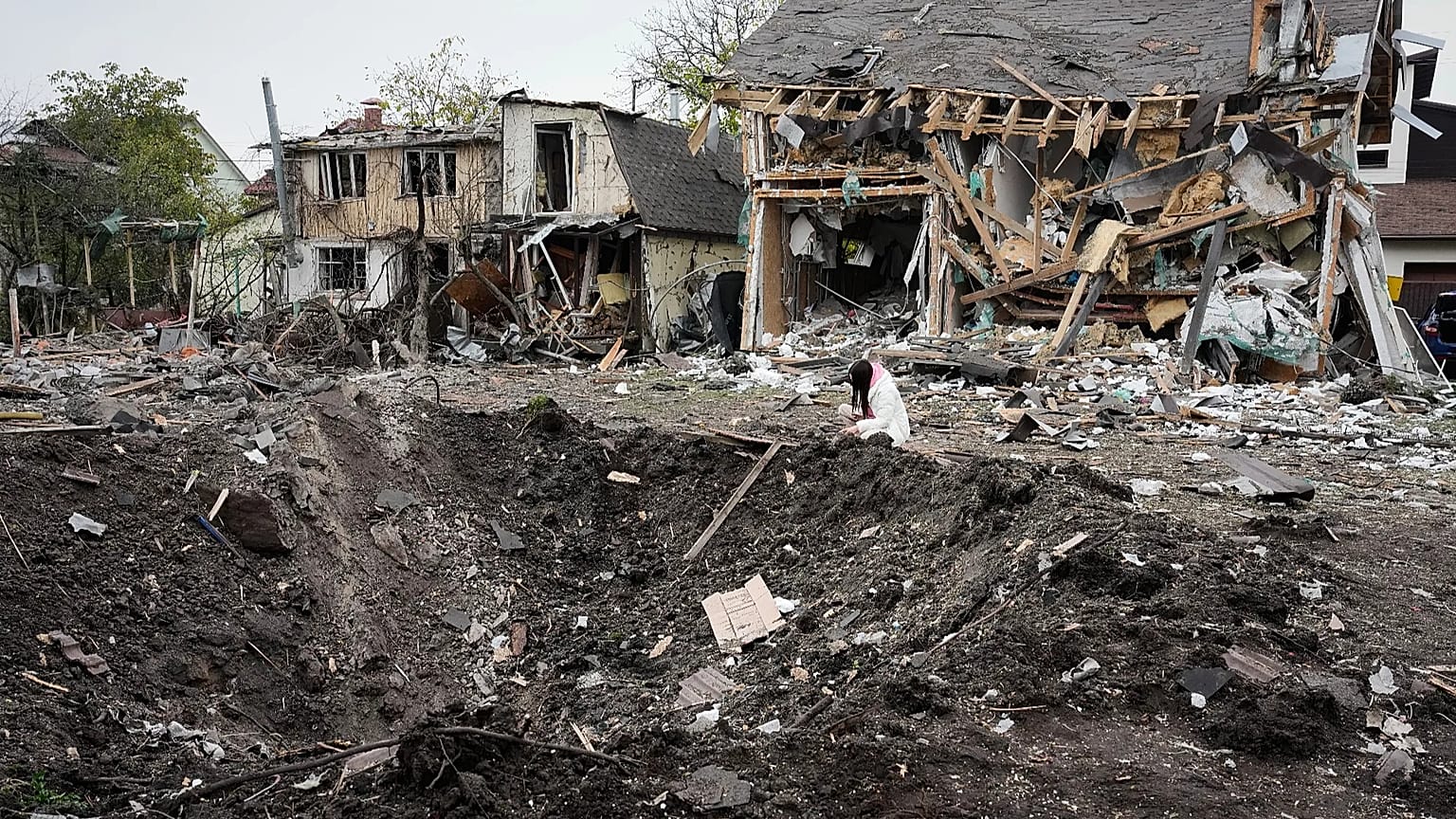
The latest Russian bombardment of Ukraine's capital came just hours after US envoy Steve Witkoff met Vladimir Putin in St Petersburg, underscoring the stark contrast between Washington's renewed diplomatic efforts and Moscow's continuing attacks on Ukrainian cities.
Russian forces struck Kyiv overnight with three ballistic missiles carrying cluster warheads designed to inflict maximum casualties across densely populated areas, Ukrainian President Volodymyr Zelenskyy confirmed on Thursday.
One of the missiles struck Pechersk, the Ukrainian capital's historic centre, hitting an area between the Kyiv-Pechersk Lavra and the Holy Presentation Monastery, damaging religious buildings, homes, shops, cafés and other civilian infrastructure.
The missiles were designed to detonate in the air as they approached their targets, dispersing explosive submunitions across an area 400 metres in diameter, Zelenskyy said.
Serhii Beskrestnov, Ukraine's presidential adviser known by his callsign "Flash", earlier identified one of the missiles as an Iskander equipped with a K5 cluster warhead.
At least two dead and dozens injured
"This warhead detonates above the ground and is used specifically for inflicting maximum harm to people and equipment over an area of 400 by 400 metres," Beskrestnov said, adding that its 58 bomblets explode in the air.
Zelenskyy accused Moscow of deliberately targeting civilians in Kyiv's historic centre, insisting that the choice of both weapon and location was intentional.
"This is another extraordinarily revealing strike – revealing because it was no accident. The choice of weapon was deliberate, the choice of target area was deliberate, and so was the intent to inflict as much loss and damage on civilians as possible," he said.
"There was no military target nearby, not even in theory, and the weapon was designed to cause widespread destruction."
The strike was part of a large-scale Russian aerial assault on the Ukrainian capital and surrounding region overnight on 21–22 October.
At least two people were killed and 34 others injured, including five children, across the affected areas, according to Zelenskyy.
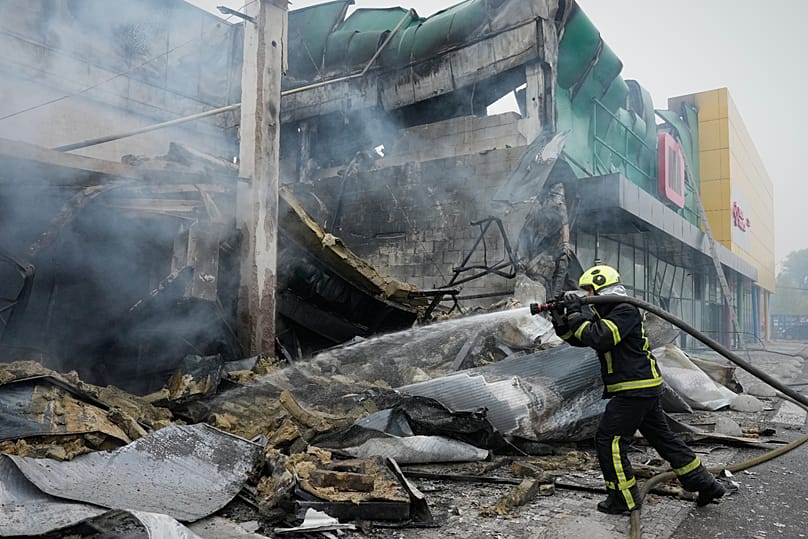
The bombardment came in several waves, with ballistic missiles and drones striking residential neighbourhoods, transport facilities and medical infrastructure across the capital.
Kyiv authorities reported damage in the Holosiivskyi, Obolonskyi, Pecherskyi, Sviatoshynskyi and Dniprovskyi districts.
Ukraine's Air Force said Russia had launched 210 drones, including 110 jet-powered variants, alongside Iskander-M, S-400, Zircon and Onyx missiles.
Ukrainian air defences intercepted or suppressed 181 drones, including 87 jet-powered variants, while strikes were recorded at 32 locations and falling debris at another eight.
Zelenskyy said Russia had fired 21 missiles in total during three waves of ballistic strikes on Kyiv.
The attacks continued throughout Thursday, with further strikes reported in Kharkiv, Dnipro, Marhanets, Mykolaiv and Kherson, as well as several other regions. In Kharkiv, a commuter train was hit, according to the Ukrainian president.
Zelenskyy said Russia had carried out more than 170 strikes against critical energy facilities since 11 October, despite Ukrainian air defences intercepting significant numbers of drones and some missiles.
He warned that Ukrainian intelligence identified Russian priorities for further attacks in the coming weeks, accusing Moscow of exploiting delays in Western air defence supplies.
"Russia is clearly taking advantage of the slowdown in air defence supplies from our partners," he said, calling for the accelerated delivery of military assistance already approved by Ukraine's allies.
The overnight bombardment came just hours after US special envoy Steve Witkoff met Russian President Vladimir Putin in St Petersburg as Washington sought to revive negotiations to end the war.
During the visit, Witkoff described Putin as a "humanitarian", despite the Russian president being wanted by the International Criminal Court over the alleged unlawful deportation and transfer of Ukrainian children.
Zelenskyy said on Wednesday that Ukraine was ready to accept literally any form of truce, on any aspect of the war, that Russia would be willing to agree to.
But following the latest attacks, the Ukrainian president questioned Moscow's willingness to pursue peace.
"Russia has not changed the way it wages this war, and it is taking no steps that would signal a genuine desire to end it," he said.
No comments:
Post a Comment