
The 2026-2027 El Niño is expected to be among the strongest since 1950, putting power supplies at risk across Latin America, where hydropower provides more than half of average annual electricity generation in seven countries, the International Energy Agency (IEA) said in a commentary.
Brazil, Colombia, Costa Rica, Ecuador, Panama, Paraguay and Peru all depend on dams for most of their power, and hydropower output is "highly sensitive to variations in precipitation and temperature", IEA analysts Alejandra Bernal-Guzman and Lissete Davila wrote. El Niño conditions began in June and are likely to last until spring 2027, and northern Brazil is again expected to see below-average rainfall.
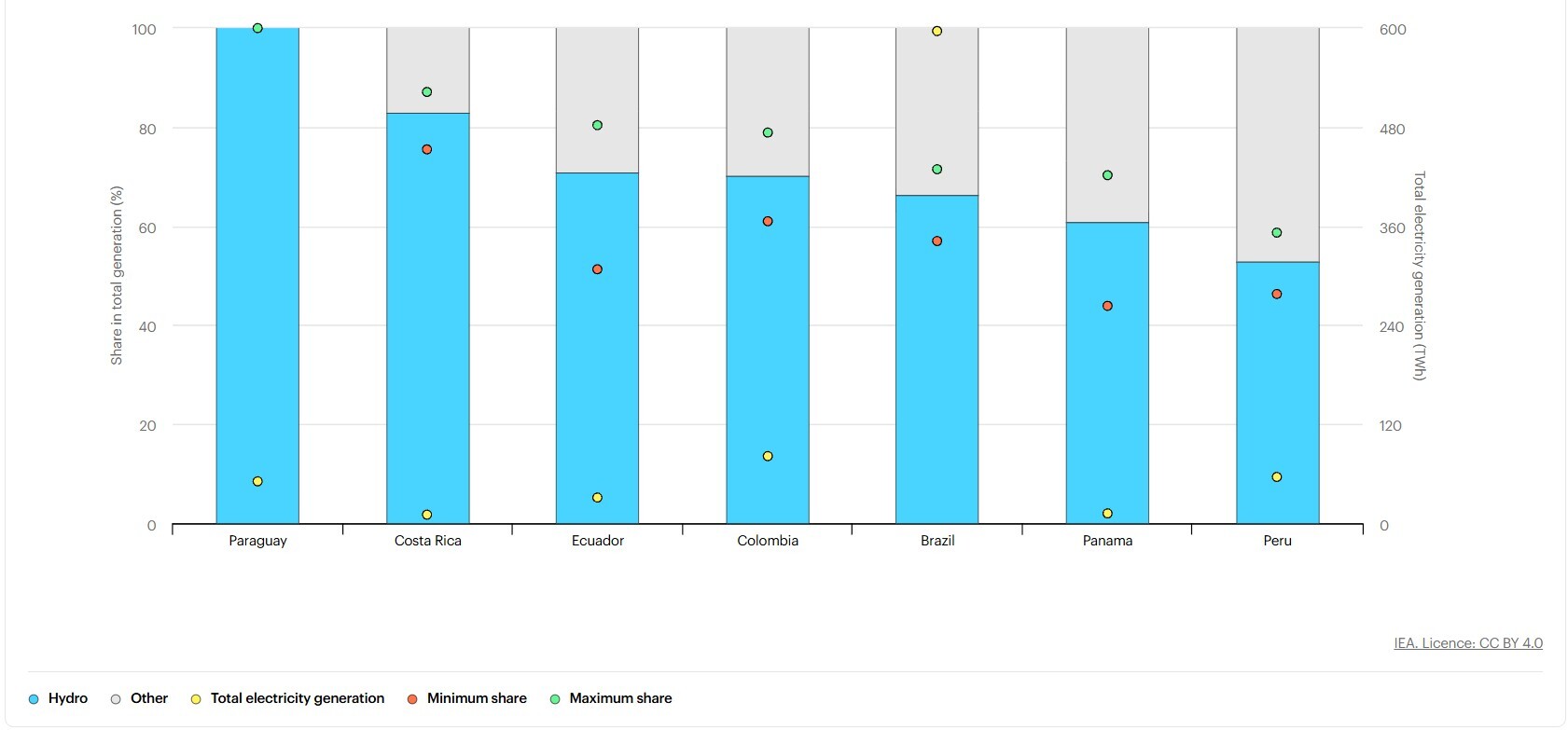
Hydropower's share of electricity generation in seven Latin American countries in 2025, with the range of shares since 2015 and total generation. Source: IEA. Licence: CC BY 4.0.
The last strong event showed what is at stake. When the 2023-2024 El Niño struck, Colombia's reservoirs fell to less than 30% of their average levels by April 2024 and gas demand in its power sector almost doubled, while Brazil's 3.6 GW Santo Antonio hydropower plant shut for two weeks for lack of water. Over 2015-2025 the share of hydropower in generation swung by up to 20 percentage points in Ecuador, 17 points in Panama and 10 points in Colombia.
The IEA set out four priorities: clear risk governance, as in Costa Rica's national El Niño strategy; ready-to-use emergency measures, such as Brazil bringing forward the start of five contracted power plants; long-term resilience through regional interconnections like those in Central America, through which Costa Rica and Nicaragua bought electricity in 2023-2024; and regular drills, such as those run through the Central American Integration System (SICA).
The warning comes in another disaster season of droughts and floods that is testing power systems well beyond Latin America.
Kenya's geothermal cushion
Kenya shows how diversification can absorb a shock, the IEA said in its National Climate Resilience Assessment for the country, published on September 25. In February 2023 a prolonged drought cut hydropower generation by 64% from the month before, a record low, but geothermal plants raised their output by 46% to compensate and imports from Ethiopia helped Kenya avoid rationing, although power prices rose.
Geothermal supplied 43% of Kenya's electricity in 2024 and hydropower 28%, from 16 plants with 826 MW of capacity, within a 91% renewable share. Kenya is the world's sixth-largest geothermal producer, with an estimated potential of 10 GW. All the climate scenarios the IEA assessed show the potential of Kenya's existing hydropower plants falling by about 10% to mid-century, compared with 1971-2010, before recovering towards the end of the century.
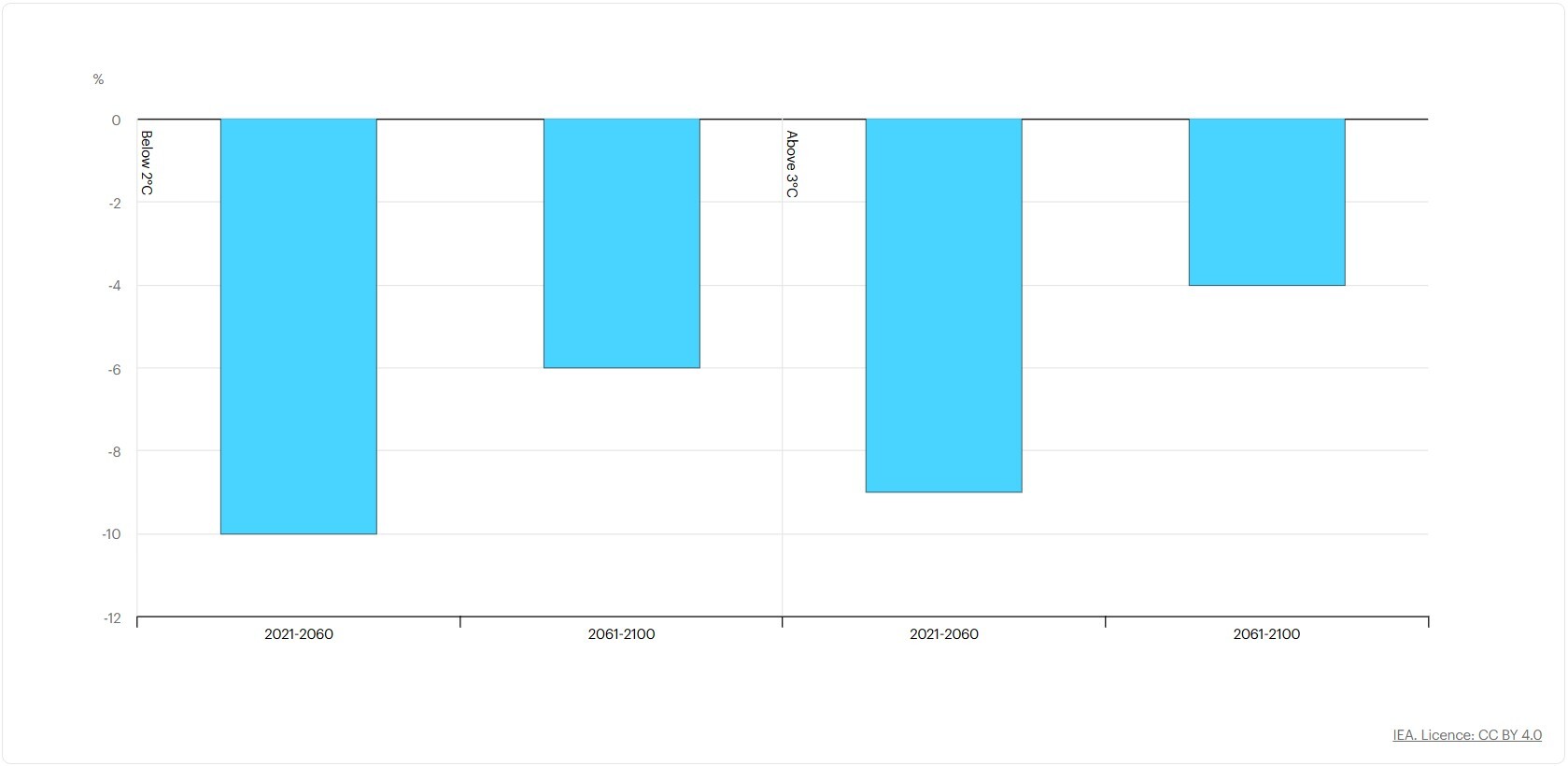
Projected change in the hydrological potential of Kenya's operating hydropower plants against the 1971-2010 baseline, under below 2C and above 3C warming scenarios. Source: IEA. Licence: CC BY 4.0.
Southeast Asia's import exposure
Southeast Asia is projected to account for nearly 20% of the increase in global energy demand to 2035 under current policies, and the war in the Middle East has exposed its dependence on imported oil and LNG and its vulnerability to price swings, the IEA said in its ASEAN Energy Security Review, prepared with the ASEAN Centre for Energy and published on October 6.
Past efficiency gains already keep the region's fuel imports about 10% lower than they would otherwise be, but energy intensity has improved by less than 0.5% a year so far this decade, below the global average and far short of the more than 4% a year needed to meet ASEAN's 2030 target of a 40% cut from 2005 levels. The review calls for faster grid investment, smart meters and time-of-use pricing to unlock demand-side flexibility, regional critical minerals strategies, emergency stockpiles and wider use of the ASEAN Power Grid so countries can share supply in a crisis.
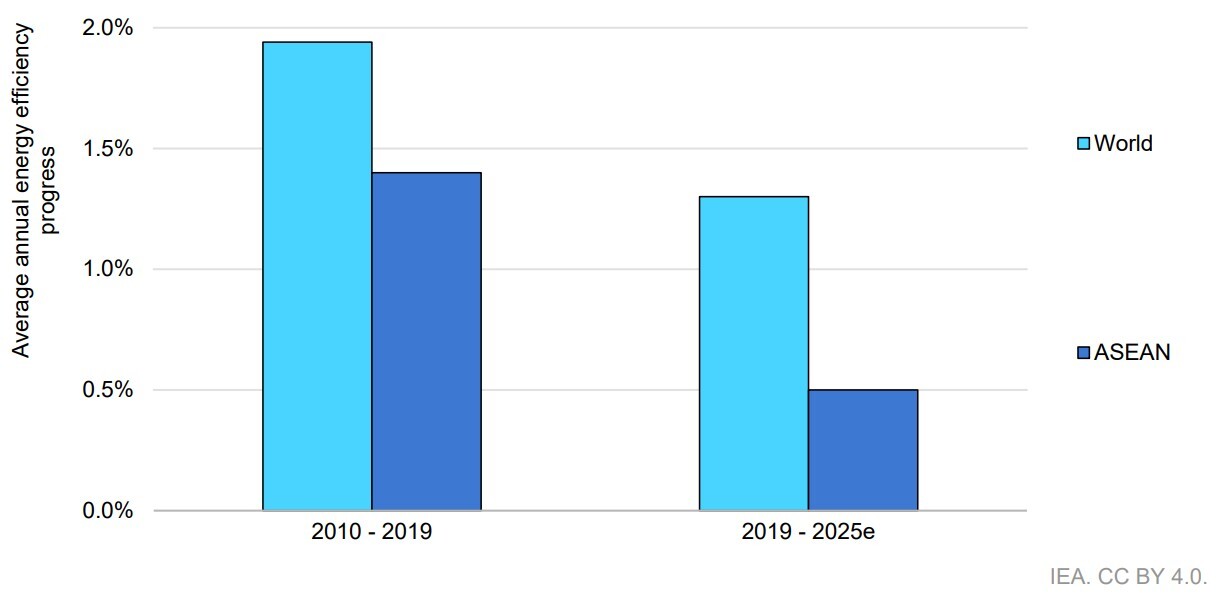
Average annual energy efficiency progress in ASEAN and the world, 2010-2019 and 2019-2025 (estimate). Source: IEA Energy Efficiency Progress Tracker. Licence: CC BY 4.0.
No comments:
Post a Comment