Sunday, October 18, 2026


No breakthrough in talks at Antofagasta’s striking Centinela copper mine, unions say


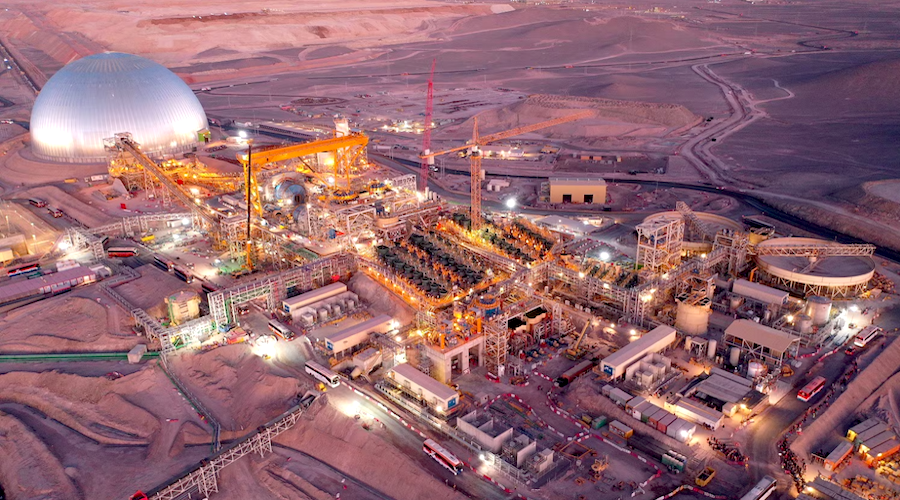
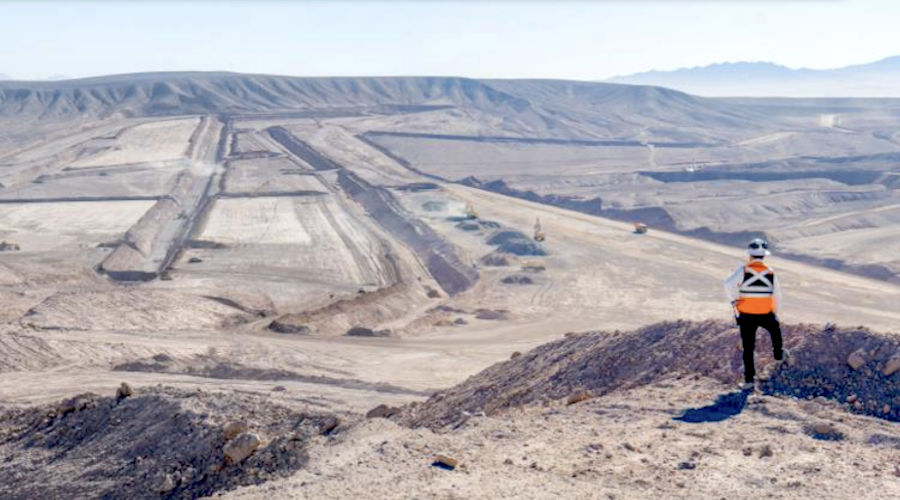
Tailings facility construction at Centinela. (Image: Antofagasta’s presentation.)

Negotiations between Antofagasta Minerals and two striking unions at Chile’s Centinela copper mine showed no progress on Thursday, while three workers marked their seventh day on a hunger strike.

The Distrito Centinela and Minera Esperanza unions, which together represent more than 700 workers, began the walkout on October 7 after contract talks collapsed. The sides returned to the negotiating table on Tuesday in an effort to resolve the dispute.

“So far, after three days of voluntary mediation, the company has refused to address a mechanism to end discrimination during the term of the collective agreement,” the unions said in a statement.

The unions added that the company was continuing to present a financial offer already rejected by workers, while ignoring what they called the core issue: alleged violations of workers’ fundamental rights to equal treatment and non-discrimination.

The unions say the dispute centers on alleged disparities in pay and benefits for workers performing similar roles at the mine.

Antofagasta said on Wednesday that it had so far managed to keep production running as planned. On Thursday, the company reported a 7% rise in third-quarter output and maintained its full-year production forecast of 625,000 to 655,000 metric tons of copper.

In a statement on Thursday, the firm reaffirmed its willingness to seek an agreement, and said dialogue this week has opened up the possibility to reach a deal.

The company said it opposed the use of a hunger strike that could put workers’ health and lives at risk.

The strike at Centinela — along with the ultimately averted risk of a supervisors’ stoppage at Escondida — has helped support global copper prices, amid concerns of difficulties to expand supply enough to meet expected future demand.

(Reporting by Fabian Cambero; Editing by Aida Pelaez-Fernandez and Daina Beth Solomon)


BHP sues union at Spence copper mine over ‘illegal’ stoppages


Spence’s newest copper concentrator plant. (Image courtesy of BHP.)

Global miner BHP (ASX: BHP) has sued the workers’ union at its Spence copper mine in Chile over two work stoppages it deemed “illegal” because they occurred outside a scheduled negotiating period, a court filing seen by Reuters on Thursday showed.

In the lawsuit, BHP alleged that the mine operations were “significantly” affected due to “two illegal work stoppages” in June and July, and sought compensation of roughly $8.6 million.

The union aimed to pressure the mine to pay a special bonus of 5 million pesos ($5,102) per member, which was not included in the existing agreements, the lawsuit shows.

The union declined to comment. BHP in a statement confirmed that it had filed the lawsuit.

Spence is BHP’s second-largest operation in Chile, a country where the firm runs the world’s biggest copper mine Escondida.

Copper mine unions in Chile, the world’s biggest copper producer, often stage strikes to push for better pay and benefits, usually during contract negotiations.

($1 = 979.9300 Chilean pesos)

(Reporting by Fabian Cambero; Writing by Paolo Laudani; Editing by Daina Beth Solomon and Mark Porter)


Congo arrests hundreds of Chinese miners in copper heartland

Congolese soldiers. Stock image.

About 300 Chinese nationals working in the Democratic Republic of Congo’s copper belt were detained earlier this week as part of a crackdown on illegal mining, according to people familiar with the matter.

The arrests took place mostly in the mining hub of Kolwezi, the people said, asking not to be named describing a sensitive issue. Chinese companies dominate copper output in Congo, and workers were arrested for their alleged involvement in illicit mining on concessions belonging to other firms, according to some of the people. 

The officials carrying out the arrests included agents from Congo’s National Security Council and immigration authority, some of the people said. The Chinese embassy in Kinshasa intervened and some of the workers have since been released, they said.

The Chinese embassy, and Congo’s mining ministry, immigration authority and presidency didn’t respond to requests for comment.   

A wave of mainly Chinese investment has fueled Congo’s copper expansion in recent years, helping the nation triple output since 2015 and surpass Peru as the world’s second-largest producer. But the mining boom has also brought disorder. 

Artisanal miners, sometimes supported by soldiers, have repeatedly operated without authorization on permits held by international investors.

(By William Clowes and Julian Luk)


Copper squeeze breathes new life into old mines


Mt Lyell copper-gold project. (Image courtesy of Sibanye-Stillwater.)

 In 1899, the Mt Lyell mine in Tasmania produced some 9,500 metric tons of copper. That made it the largest copper mine in the British Empire, though small by today’s standards.

In September, after 12 years idle, owner Sibanye-Stillwater (JSE: SSW) approved a restart of Mt Lyell, putting it among a string of copper mines around the world being revived due to expectations for a structural shortage of the industrial metal.

Consultancy Benchmark Mineral Intelligence is tracking almost a million tons of potential annual copper production from mine restarts by 2030, equivalent to over 4% of current output.

About half of that is from the huge Cobre Panama project and the long-closed Panguna mine in Papua New Guinea, but for both, a potential restart is as much a political as a market consideration.

While most idled mines are small, they have infrastructure, known ore bodies and permitting histories, meaning they can produce copper many years sooner than discoveries in new locations, which take an average of 17 years to reach production, according to S&P Global Energy.

Johannesburg-based Sibanye, which paid $10 million for Mt Lyell in 2023, expects to spend around $340 million to restart it, with plans to ramp up to 26,000 tons of annual production after it comes back online in 2029.

As part of its modernisation of the facility, the company has digitised filing cabinets of hand-drawn geological and mine plans dating back more than a century.

“It’s all millimetre-perfect, but drawn by hand,” Barry Harris, an executive vice president at Sibanye-Stillwater, told Reuters.

Cheaper and faster, but smaller

Record prices, with the benchmark London Metal Exchange copper contract hitting $14,875 a ton on September 10, have made some idled mines viable again, but it is the prospect of medium- to long-term shortages that is prompting operators to restart them.

“Many of these operations are relatively small, but collectively they can make an important contribution to bridging the copper mine supply gap over the medium term,” said Craig Lang, principal analyst at CRU.

Global copper demand is projected to rise 50% to 42 million tons a year by 2040, driven by the energy transition and data centers, S&P Global Energy predicts. It expects nearly half of new mine supply to come from restarts and expansions of existing resources, but even then the market could face a structural shortfall of 10 million tons.

“Brownfield additions can buy the market valuable time, but they cannot replace the need for brand-new, world-class tier-1 discoveries to satisfy that scale of demand,” said Eillen Grace Dela Cruz, principal analyst at S&P Global Energy.

In Zambia, partial production has restarted in the upper section of the Luanshya mine, which was offline for over two decades, and underground infrastructure is now being built, a Zambian mines ministry spokesperson said.

The mine is majority owned by China Nonferrous Mining Corp (CNMC) 1258.HK and has a target production of 100,000 tons per year by 2030.

In Argentina, global commodities trader and miner Glencore (LON: GLEN) has said it plans to revive production at its Alumbrera mine, shuttered since 2018, in the second half of 2027, to produce a total of 75,000 tons of copper over four years. The restart is intended to support the ramp-up of the undeveloped Agua Rica pit nearby, which has the potential to produce more than 200,000 tons of copper per year.

More than flipping a switch

Potential hurdles abound for some of these plans, such as flooding, run-down plants and outdated tailings dams, along with protesters and stricter environmental rules.

“A dormant mine is not simply waiting for someone to turn the power back on,” said Charles Cooper, head of copper research at Wood Mackenzie. “The key question is why the mine closed in the first place.”

The pool of viable restart candidates is “relatively small” and output from revived mines averages around 33,000 tons a year, according to Wood Mackenzie’s historical analysis, against more than 100,000 tons for many extensions at existing mines, which therefore matter more for lifting supply.

In Bougainville, an autonomous region of Papua New Guinea that is seeking independence, the government wants to reopen Panguna, which was once among the world’s biggest open-pit copper mines but has been shut since 1989, when a brutal civil war broke out.

Last month, a mining camp at Panguna was attacked, with personnel assaulted and equipment destroyed.

“Environmental, social and political issues can ultimately prove more challenging than the mining itself,” Cooper said.

Mine modernisation

Mt Lyell was shuttered in 2014 after three workers were killed in two accidents within six weeks of each other.

The closure cost about 200 jobs in Queenstown, a town of nearly 2,000 people. A planned restart was shelved in 2015 when copper prices fell, and workers drifted away. LME copper closed that year at $4,705 a ton. Sibanye says Mt Lyell will cost around $5,644 a ton to keep running.

The company expects to employ about 300 people and is refurbishing accommodation and building housing in Queenstown rather than a workers’ camp.

One of the accidents before the mine’s closure involved a mud rush that struck a worker operating a loader. Some loaders will be operated remotely when the mine reopens, Harris said, adding that some of Mt Lyell’s previous workers have expressed interest in returning.

“They’re going to be coming from very manual activities, all the way from start through to finish, into an operation that will be at modern industry standard, with digitisation and automation all the way through.”

(Reporting by Solomon Cefai; additional reporting by Maxwell Akalaare Adombila, Melanie Burton, Tom Daly, Clara Denina, Chris Mfula, Divya Rajagopal and Ernest Scheyder; Editing by Tony Munroe and Sonali Paul)


Bolivia loosens gold export controls while ending purchases


Bolivian government building. Stock image.

Bolivia is dismantling a state-controlled gold trading system in a bid to pull more dollars into its financial system, ending central bank purchases and easing restrictions on private exports of the precious metal.

Under new rules backed by President Rodrigo Paz, exporters will no longer need central bank certificates to ship gold overseas, although at least 80% of their export proceeds must flow into Bolivia’s banking system. The overhaul ends a three-year-old regime overseen by the bank.

Central Bank President David Espinoza told Bloomberg he expects the changes will help the institution grow its reserves as it pulls back as a buyer.

“The central bank will no longer buy gold,” Espinoza said in an interview on Thursday. “We’re suspending gold purchases.”

The 11-month-old Paz administration is touting the reforms as a way to improve the flow of dollars in the local financial system and reduce state control over the economy, following two decades of socialist governments in the South American nation.

“The aim is to increase foreign currency inflows into the domestic financial system, strengthen dollar availability and improve oversight of gold exports,” government spokesperson José Luis Gálvez said in a webcast on Wednesday.

The revamped system will allow the finance ministry to receive data on gold exports from the metal trading regulator SENARECOM, and the corresponding bank deposits. The ministry can also adjust the minimum share of proceeds that must be deposited going forward.

Falling exports 

Economist Fernando Romero thinks the success of the new gold trading regime will depend on the willingness of exporters to comply, as well as any currency exchange obstacles banks might erect that would undermine access to the full value of the deposits.

“If compliance becomes costly, slow or uncertain, some operators may scale back their activities or seek informal channels rather than bring more foreign currency into the system,” said Romero.

He cautioned that the changes aren’t intended to curb informal mining, which has become a major source of locally-sourced gold, and could even lead to more smuggling. But he added that oversight of the exports and their traceability should improve.

The overhaul kicked off on Tuesday with a decree signed by Paz and his cabinet that scrapped the requirement for central bank certificates. The move phased out the previous system established in 2023 under socialist former President Luis Arce.

Since then, the central bank had effectively controlled the gold trade. It did so by purchasing locally produced supplies to build up its reserves before authorizing the remainder to be shipped to foreign buyers. The bank paid exporters in bolivianos at an exchange rate often criticized as unfavorable, and would later sell the gold to obtain dollars at a time of hard currency shortages. The sales were in part used to finance subsidized fuel.

Critics of the system argued that it created an incentive for gold to be smuggled out of Bolivia, as some miners and exporters sought dollars instead of local currency. 

Gold exports fell sharply under the previous system, sliding to $1.1 billion last year from more than $3 billion in 2022, according to official data.

The central bank’s move to end gold purchases comes after it met a requirement set last year to deliver 6.6 tons of the metal sold forward under Arce’s government, according to Espinoza. The obligation was fully met on Oct. 9, with the delivery of the final 1.2 tons.

The bank has said that the 6.6 tons were valued at $872.5 million, while it received $737.6 million from the forward sales. 

Espinoza expects the new system to increase dollar inflows from the exchange market. He also pointed to the bank’s purchase of $400 million from private lenders in July and August, adding that future dollar purchases will be facilitated by the government’s changes to gold trading and lead to a “genuine increase in reserves.”

(By Sergio Mendoza)


AFC eyes iron ore and uranium investments in Africa


Saldanha Bay, West Coast, South Africa. Stock image.

The Africa Finance Corporation is looking for investments in iron ore and uranium as it seeks to expand its reach in critical minerals projects on the continent, the agency’s head of mining and metals said.

Critical minerals have become a focal point of global competition, with the US and other major economies seeking to secure supply chains for electric vehicles and renewable energy while reducing dependence on China.

Franklin Edochie, deputy director and head of mining at the Lagos-based continental financial institution, said the agency’s interest in Africa’s mining sector is broad, spanning precious and base metals as well as critical minerals.

AFC already has interests in minerals such as gold, bauxite, copper and manganese across Africa, and now wants to add iron ore and uranium.

Speaking on the sidelines of a mining conference in Cape Town, Edochie said combined output from Guinea, Liberia, Mauritania, and Sierra Leone could over the next 10 years “easily” equate to a top three iron ore producer in volume terms.

“We are working towards financing those projects,” he added. “Hopefully, within the next 6 to 12 months, we should be able to announce something (on uranium and iron ore investments).”

AFC is also lead developer of the US-backed Lobito ‌minerals transport corridor linking African copper and cobalt mines to the Atlantic coast.

The corridor will combine new and existing railway lines linking mines in Zambia and the Democratic Republic of Congo to Angola’s Atlantic port of Lobito.


(Reporting by Olivia Kumwenda-Mtambo; Editing by Jan Harvey)

PLS Group greenlights $1.3 billion expansion to lift Pilgangoora lithium output


Pilgan plant at the Pilgangoora lithium operation. (Image courtesy of Pilbara Minerals.)  

Australia’s PLS Group (ASX: PLS) has approved a final investment decision for its A$1.9 billion ($1.31 billion) project at its hard rock lithium mine Pilgangoora operation, betting on long-term growth in demand for the key battery-making ingredient.

The country’s largest independent lithium producer said the P2000 project will boost spodumene concentrate production at its flagship project in Western Australia to nearly 2 million tonnes per annum (mtpa) from 2029, through the construction of a new Jimmagunya processing plant.

Its shares rose more than 6% in early trading, set for their best day since August 24.

Energy transition and growth in battery storage continue to support the long-term demand for lithium, with companies worldwide racing to secure the metal.

PLS, formerly known as Pilbara, said the project was made possible by advances in processing technology that allowed around 67 million tonnes of material previously classified as waste to be brought into the mine plan, helping increase Pilgangoora’s ore reserve by 23% and contained lithium by 31%.

The project, it said, would lift average annual production to about 1.97 million tonnes of spodumene concentrate over the first 10 years of steady-state operations, while lowering average unit operating costs to around A$620 per tonne.

CEO Dale Henderson said the project would strengthen Pilgangoora’s position on the global lithium cost curve and provide greater exposure to any recovery in lithium prices.

The company also plans to invest a further A$600 million to A$650 million in supporting infrastructure, including a new accommodation village, road upgrades and maintenance facilities, while funding the development from its A$2.3 billion cash balance and operating cash flows.

PLS revised its FY27 capital expenditure forecast to be between A$1.11 billion and A$1.18 billion to incorporate the P2000 expansion and associated infrastructure spending.

It said the P2000 expansion would also produce tantalum, a critical mineral used in electronics and defence, as by-product.

($1 = 1.4449 Australian dollars)

(Reporting by Aamir Shaik Khalid & Rajasik Mukherjee in Bengaluru; Editing by Anil D’Silva and Shilpi Majumdar)

GOOD NEWS

Greenland to introduce ban on seabed mining  


Near Kulusuk, eastern Greenland. Stock image.

Greenland Parliament has unanimously passed a resolution to introduce a ban on seabed mineral extraction, RMF24 reported Friday.  

The news comes a day after US President Donald Trump announced “massive oil, gas and mineral exploration” was set to begin on Greenland.  

Trump described the Danish Arctic island, which is run by a semi-autonomous government, as “our new and beautiful Greenland” in a social media post that hailed what he said were US gains from a security deal signed in September. 

The resolution stipulates the memorandum on deep-sea mining is to remain in force until the end of 2029, RMF24 reported, with the possibility of extension for further two-year periods. The legislation is expected to be passed in the first half of 2027.  

Greenland has been caught up in a confrontation with Trump who has been saying since 2019 the US should buy or take the strategically located and mineral-rich island for security reasons. On several occasions, he refused to rule out force. 

Greenland has one of the world’s most significant underexplored critical mineral endowments, positioning the territory at the center of critical minerals and defense supply chain strategies. 

The Tanbreez property in Greenland, with a 28.2 million tonne TREO resource, has been ranked as one of the world’s top rare earth projects. Rare earth explorers are drawn to Greenland to dig into what the US Geological Survey calls the world’s biggest undeveloped deposits of rare earth metals. 

While the US signalled in September it is nearing approval for permits to mine the deep sea, the specter of seabed mining being allowed to commence has alarmed many environmentalists due to concern it could cause irreversible biodiversity loss. 

Parts of the Pacific Ocean and elsewhere are estimated to contain large amounts of potato-shaped rocks known as polymetallic nodules that contain the building blocks for electric vehicles, weapons and electronics. 

Scientists at the United States Geological Survey (USGS) have discovered that some metal-rich rocks recovered from the deep ocean can spontaneously combust when exposed to air and processed, raising unexpected safety concerns for a potential new mining industry. 

Saskatchewan potash developer clears final key permit ahead of 2027 startup

Story by Dylan Sikes - AllPennyStocks.com News
• 1d •


Saskatchewan Potash Developer Clears Final Key Permit Ahead of 2027 Startup

Potash has drawn steady attention from policymakers as North American governments look to secure supplies of the minerals behind food production. Canada is the world’s largest potash producer, and Saskatchewan accounts for the bulk of that output, which makes the province the main focus of new development in the fertilizer sector.

Shares of Buffalo Potash Corporation (TSX-V: BUFF) (OTCQB: BLPTF) are higher Friday after the company received approval from the Saskatchewan Ministry of Environment to construct and operate the Initial Production Module (IPM) at its Disley Project. The company described the approval as the final key regulatory approval it needs to complete construction and begin operating the IPM.

The approval, Permit No. PC26-153, follows the ministry’s Sept. 17 determination that the IPM is not a “development” requiring an Environmental Impact Assessment. It covers the surface works for the remaining phases of the IPM plan, including pipelines, brine and water storage tanks, processing equipment, electrical infrastructure, modular buildings and roads. Conditions include ministry approval of a groundwater monitoring plan, compliance with air quality requirements before processing equipment operates, and financial assurance acceptable to the ministry. The approval runs to April 30, 2027, with provision for extension, and applies only to the IPM.

The IPM is designed to produce 125,000 tonnes per year of soluble-grade potash and is the first of three planned solution mining facilities at Disley, which sits about 50 kilometers northwest of Regina next to the K+S Bethune and Mosaic Belle Plaine solution mines. Buffalo’s May 2026 preliminary economic assessment outlined a full build-out of up to 1,125,000 tonnes per year, with an after-tax net present value of US$1.1 billion at an 8% discount rate and an internal rate of return of 30%. The company noted that its IPM production decision is not based on a feasibility study with mineral reserves, which historically carries a higher risk of economic and technical failure.

Buffalo is developing Disley with its patented Horizontal Line-Drive method. Source and disposal wells and horizontal drilling for the IPM are complete, and site development is in progress. The next phase, brine circulation, is designed to establish communication along a clay seam between injector and producer wells, then develop the mining plane that will feed the IPM processing facility.

President and Chief Operating Officer Quinton Hardage said the approval allows the company to advance surface construction in parallel with brine circulation preparations.

“Our team, together with our contractors and consultants, has shown disciplined execution in keeping this project on schedule, and we continue to target first production in Q1 2027,” Hardage said.

Shares of BUFF are up 3.9% to C$0.81, while shares of BLPTF are flat at $0.5536.

Copyright © 2026 AllPennyStocks.com.


Canadian steelmakers offset some US tariff pain with domestic demand


(Image: Tenaris. )

Canada’s steel industry, among the sectors hit first and hardest by US President Donald Trump’s tariffs, is starting to turn a corner thanks to an uptick in mining, energy and AI data center projects as well as government support, although the impact has not been even across the country.

While Canada is a small producer globally and steel contributes less than 1% to national GDP, it is one sector in which Prime Minister Mark Carney’s efforts to make Canada’s economy less reliant on the United States appear to be having some success, albeit with a heavy dose of government intervention.

Steel companies have been diversifying away from the US and focusing on domestic demand since Trump increased tariffs on imported steel from 25% to 50% in June 2025, steelmakers, analysts and union representatives said.

Canada used to send around 90% of its steel exports to the US, but shipments plummeted by 60% in 2025, according to the Canadian Steel Producers Association. Hundreds of steelworkers have been laid off.

But the share of steel used in Canada that was produced domestically rose to 51% in 2025, up from 41% in 2024, according to United Steelworkers, the sector’s main labour union. The import share declined from 59% to 49%. USW calculated the data based on World Steel Data and Canada’s imported steel data, said Guio Jacinto, an economic researcher for the union.

The green shoots are mostly appearing in western Canada, where some large industrial projects including a 1.2 gigawatt data center in Saskatchewan are under construction. Carney said a new oil pipeline to the Pacific Coast would also boost demand for steel.

Canadian steel demand is estimated to have grown around 2.7% in 2025 and is projected to increase by about 0.9% in 2026, according to an OECD report published in July.

“What we are seeing right now is that more Canadian companies are competing for domestic market, which means there is less space for steelmakers from outside,” said David Fritz of Alberta-based Supreme Steel, which manufactures fabricated steel.

“I feel optimistic for the outlook of fabricated steel market in Canada, there are enough projects in pipeline to support this industry,” Fritz added.

Government intervention

At a time of excess global capacity, Canadian steel would struggle to compete with lower-cost producers in China and South Korea without import quotas. Canada produces around 13 million tonnes of primary steel annually.

In May, the federal government announced C$1 billion ($700 million) in loans to the steel, aluminum and copper industries as working capital funding to get through the impact of US tariffs. The government extended a cap on foreign steel coming into the country, known as tariff rate quota, to address the issue of foreign steel dumping

Canada’s adaptation to Trump’s tariffs has been closely watched internationally, as Carney is one of the few global leaders to retaliate against US tariffs despite his country’s overwhelming economic dependence on the US.

The prime minister also threatened legal action against US steel producer Cleveland-Cliffs (NYSE: CLF) over plans to cut hundreds of jobs at its Hamilton, Ontario, facility.

Cleveland-Cliffs, which acquired Canada’s Stelco in 2024, said in its second-quarter earnings there was steep international competition for the galvanized steel produced at the Hamilton plant, but the market for its specific hot-rolled steel produced elsewhere in Canada contributed to improved guidance for the second half of 2026.

Cleveland-Cliffs will report quarterly results on October 19, potentially giving a clearer picture of the future of its Canadian operations.

Domestic market pivot

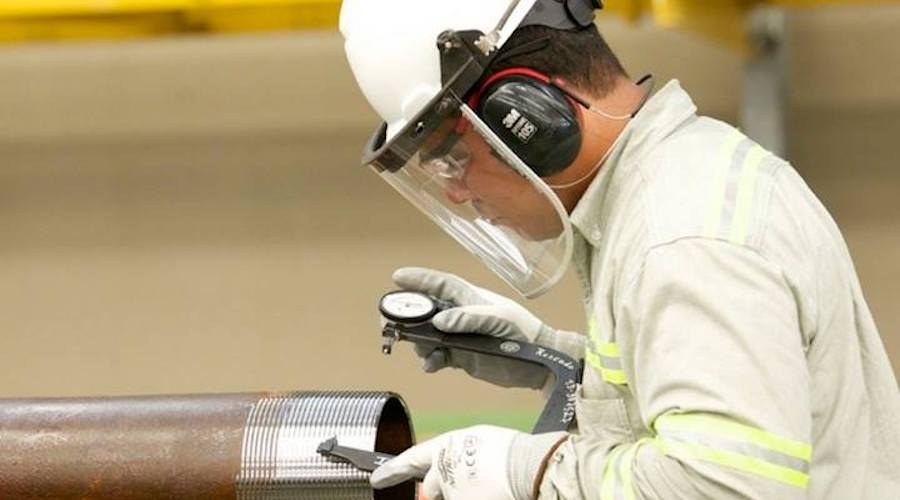
Luxembourg-headquartered Tenaris, which manufactures steel pipes for energy companies at its Sault Ste Marie, Ontario, facility, said it recently invested C$306 million to expand production of its Canadian-made products for Canadian customers.

“This strengthens Tenaris’s commitment to produce in Canada what Canada’s oil and gas industry needs. As a result, the company’s exposure to the United States tariffs is limited,” said Martín Castro, president of Tenaris in Canada, in an email.

The largest Canadian steel producer, Algoma (TSX: ASTL), said in December it would lay off 1,000 workers in Ontario – accounting for nearly all of the sector layoffs nationally since tariffs were imposed. But the company’s CEO recently touted the strengthening domestic market, citing growing infrastructure, construction and defence demand for its discrete steel plate.

“While the 50% US Section 232 tariffs continue to effectively foreclose our traditional access to the US market, our pivot to a Canada-centric, plate-first strategy is working,” CEO Rajat Marwah said on an earnings call in July.

Marty Warren, head of the Canadian branch of the USW, said there has been a turnaround in the industry but a bigger revival would require replacing even more imported steel with domestic production. The union also wants Canada to tighten the quota on imported steel and put tariffs on steel used in the US auto and aviation industries, which are currently exempt from broader retaliatory tariffs by Canada.

Canada’s finance ministry said the steel sector remained exposed to tariffs and the government was encouraging investment through a number of policies, such as buying Canadian steel for infrastructure projects.

“This is evidenced by the domestic demand cycle we are enabling through the Buy Canadian policy and more generally the government’s growth agenda which will require Canadian steel and workers,” the ministry said in an emailed statement.

(Divya Rajagopal in Toronto, additional reporting by Promit Mukherjee; Editing by Caroline Stauffer and Nia Williams)


Canada’s new foreign investment rules: What critical minerals miners need to know 


Stock image.

Canadian critical minerals companies will need to consider how they raise foreign capital as Ottawa prepares to implement new Investment Canada Act rules that will require certain types of minority investments into a mandatory pre-closing filing regime. 

The changes could have particular consequences for miners and developers that rely on strategic investors to finance exploration, feasibility work, and project development, Toronto- based partner in Cassels’ Competition & Foreign Investment Group Chris Hersh told MINING.COM in an interview. 

The legislation underpinning the new regime was enacted in 2024, but key provisions requiring regulations are set to take effect in early 2027. 

Under the coming rules, certain investments by non-Canadians in businesses operating in prescribed sensitive sectors will require notification before the transaction can be completed — and will target investments that do not involve an acquisition of control of a Canadian business. 

Currently, acquisitions of control of Canadian businesses that fall below the applicable net-benefit review threshold generally require a notification that can be submitted up to 30 days after implementation, while minority investments that do not trigger a mandatory filing can be voluntarily notified to obtain greater certainty under national security review provisions of the law.  

This is because the Investment Canada Act allows the government to review foreign investments on national security grounds regardless of their value or whether control is acquired.  

The 2024 amendments will expand mandatory filings to certain non-control investments where the Canadian entity conducts a prescribed business activity and the foreign investor obtains rights including, those relating to access to material non-public technical information or material assets, together with certain governance or other special rights. 

For mining companies, this means that a range of minority investments by foreign investors may be caught by the new regime and they will need to proactively consider how to factor this into their business planning. 

“The new mandatory notification regime is not going to apply to every single transaction,” Hersh said. “But companies now need to consider how the Investment Canada Act applies not only to control transactions, but also minority interest transactions,” where the investment meets the conditions established by the new regime. 

Exactly which businesses will be covered remains one of the biggest outstanding questions. Ottawa has yet to finalize the “prescribed business activities” that will trigger the requirement. 

The federal government has said those activities will target sensitive sectors and will be informed partly by existing government policy statements and guidelines, including Canada’s Sensitive Technology List, as well as those relating to the application of the national security regime Critical minerals are already treated as a national security priority under Canada’s foreign investment policy. 

Hersh expects critical minerals to be among the sectors affected, while emphasizing that the regime is considerably broader than mining. 

“It’s not directed specifically at critical minerals, it’s directed at a range of sensitive sectors that includes critical minerals,” he said.  “In short, investments across a broad range of sectors will be potentially affected by the new law.” 

Financing timelines could stretch 

For critical minerals companies, the immediate issue may be less whether foreign capital remains available than how quickly companies can access it. 

Transactions caught by the new regime will have to file their notification before completion, meaning companies accustomed to bringing in strategic investors relatively quickly may need to build regulatory review timing into their financing schedules. 

Hersh anticipates many transactions will make it through an initial 45-day national security screening period without further action, but investments that raise concerns could face a much longer review that can take up to 200 days, or longer. 

“I do think that a majority of the deals caught by the new regime are likely to be subject to a 45-day screening period, following which the government will conclude that there are no problems,” he said. 

The complication is that companies may not know at the outset whether their deal will fall into that relatively straightforward category. 

For a junior miner that needs capital quickly, even the prospect of a mandatory waiting period could affect how investments are structured. 

“It means that you can’t necessarily do quick transactions in the same way you can today,” Hersh said, adding that Canadian companies engaged in prescribed activities will have to consider both the timing and structure of foreign investments. 

That could be particularly important for strategic investments in which a foreign company takes a minority equity position in exchange for board representation, access to technical information or other rights. 

Companies doing deals that are caught by the new mandatory pre-close notification process will have to give themselves enough time to complete the Investment Canada Act process or design transactions, so they do not trigger the new filing requirement. 

One possibility could be staged financing. 

Hersh offered the example of a company needing an immediate cash injection completing an initial tranche that does not grant the investor the rights or information access necessary to trigger the regime, followed by a subsequent investment that goes through the required process. 

“Maybe you do tranche one that is structured in a manner that is not subject to mandatory notification, he said, followed by “a secondary transaction where you would have to go through the regime.” 

Such structures would need to comply with the final regulations and would not eliminate the possibility that the second tranche investment encounters national security concerns. 

Still, the example illustrates how the rules could influence financing strategy well before a foreign investor actually writes a cheque. 

Preventing forced divestitures 

Ottawa’s rationale is that sensitive investments should be examined before foreign investors gain access to assets, intellectual property or confidential information that could create national security risks. 

The government has explicitly said the new pre-implementation notification requirement is intended to prevent potentially irreversible national security harm while avoiding the disruption caused by ordering divestiture or other remedies that have a material economic impact on the investment after it has already occurred. 

Canada’s critical minerals sector has already seen how disruptive that can be. 

In 2022, Ottawa  ordered three Chinese companies to divest their stakes in Canadian critical minerals companies following national security reviews.  

Sinomine Rare Metals Resources had to sell its shares in Power Metals, Chengze Lithium International had to divest its stake in Lithium Chile and Zangge Mining Investment (Chengdu) had to exit its investment in Ultra Lithium Inc.  

These orders demonstrated that minority acquisitions were not beyond the government’s reach, even after they had been completed. 

The new regime could provide more certainty by forcing potentially sensitive transactions into the screening process before they close. 

“The intention is to prevent situations like that, where somebody buys something, and then is told to divest after the fact,” Hersh said. “It does provide a degree of certainty that may not have existed unless somebody was prepared to make a voluntary filing.” 

That certainty comes with a trade-off: transactions subject to the requirement cannot necessarily close as quickly. 

Balancing attracting foreign investment with national security 

The changes arrive as Ottawa is simultaneously trying to attract billions of dollars into Canadian critical minerals projects and accelerate development of mines, infrastructure and other projects deemed strategically important. 

That creates an apparent tension between attracting foreign capital and increasing scrutiny of the investors providing it. 

Hersh does not see the two objectives as contradictory. 

“I think it’s an attempt to balance the desire to encourage foreign investment in critical minerals projects and other significant projects…with the need to protect national security,” he said. 

How restrictive the regime becomes ultimately depends on how Ottawa handles transactions that fall between obviously benign investments and deals presenting clear national security risks. 

“The real question is what happens in the middle to those transactions in the gray area that raise some, but not deal breaking concerns,” Hersh said. 

These situations will test whether the government can manage legitimate security risks through the implementation of mitigation measures rather than simply blocking investments. 

“The proof in the pudding is does the government manage to walk that line, or do they lean too far on one side or the other side?”, Hersh said.  

For critical minerals companies, however, the practical message is already becoming clearer: foreign financing may require more advance planning. 

Companies contemplating minority strategic investments may need to assess earlier whether proposed board rights, access to technical information or other investor protections could trigger a mandatory filing — and build the potential review period into their financing plans. 

Despite the added scrutiny, Hersh remains cautiously optimistic that the rules will not materially undermine investment in the Canadian critical minerals sector. 

“The reality is that there are only so many stable jurisdictions with significant critical mineral reserves and companies operating in the critical minerals sector,” he said. “We do have what the world wants.” 
ALL CAPITALI$M IS STATE CAPITALI$M

US Project Vault readies $1B loan blitz for industry


Trump addressing coal industry representatives. (Image courtesy of The White House.)

The US government-backed Project Vault is preparing to issue up to $1 billion in loans to American manufacturers seeking critical minerals, advancing Washington’s efforts to shield domestic industry from supply disruptions.

VaultCo, the entity managing the stockpiling initiative, is in discussions with more than 70 companies across the critical minerals supply chain, Bloomberg reported. The first round of financing is expected to cover more than a dozen original equipment manufacturers (OEMs), with another group to follow.

“What’s likely to happen is we’ll announce several hundred million dollars, maybe a billion dollars, of loans to OEMs who have requested use of the Vault facility,” VaultCo Executive Chairman Brett Lambert told the news outlet. “In the first tranche, we’ll have more than a dozen firms, followed by more than a dozen shortly after.”

The financing would mark a significant step towards making Project Vault operational as the US seeks to reduce its exposure to volatile critical minerals markets and strengthen manufacturers’ access to materials essential for industrial production.

Lambert said the recipients would not be publicly identified at this stage, although the announcement is expected to disclose the types of minerals they have requested.

Stockpile takes shape

Launched in February, Project Vault is structured as an independently governed public-private partnership backed by a $10 billion loan from the US Export-Import Bank (EXIM) and nearly $2 billion in private investment.

Commodity trading giants Glencore (LON: GLEN) and Mercuria recently committed $500 million each, becoming the first commodity traders to join the initiative.

Mercuria has already delivered 12,000 tonnes of copper from the Democratic Republic of Congo, establishing a new destination for the African country’s metal within Washington’s supply security strategy.

The shipment comes amid growing US demand for Congolese copper. Imports reached a record 53,290 tonnes in July, driven by competitive prices, improved product quality and concerns over potential tariffs that prompted buyers to accelerate shipments.

Commercial imports and Project Vault serve different purposes. While conventional purchases meet immediate industrial demand, the reserve is intended to provide manufacturers with access to materials when normal supply channels become disrupted.

Tailored mineral demand

Unlike conventional government stockpiles, Project Vault is designed around manufacturers’ specific requirements rather than predetermined inventories of strategic commodities.

Participating companies have requested not only raw metals and minerals but also specialized magnets, powders, alloys and other processed materials tailored to their production needs.

“There isn’t any one mineral that stands out, but the specificity of the requests have surprised me,” Lambert told Bloomberg.

The demand-driven approach allows manufacturers to determine which materials are purchased and stored, potentially giving smaller buyers greater purchasing power in fragmented and often opaque markets.


It also distinguishes Project Vault from the US National Defense Stockpile, which the Defense Logistics Agency administers to secure materials required for national defence.

The next test will be whether the initial loans can translate manufacturers’ highly specific requests into reliable inventories, particularly for processed materials that may be harder to source than raw commodities.


Shanghai Moved a Staggering 5.1M TEU in September Recovering from Typhoons

Port of Shanghai
Shanghai set a monthly record as it recovered from three typhoons (SIPG)

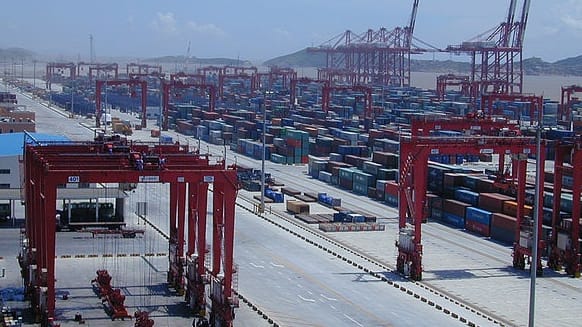
While already recognized for many years as the world’s busiest container port, Shanghai exceeded its own records, handling a staggering 5.135 million TEU during September. Port officials are highlighting the achievement to emphasize that the port is clearing its backlogs and working very efficiently.

Shanghai’s operations were disrupted starting in July by three powerful typhoons. The weather-related suspensions contributed to a growing backlog and vessel congestion. It was further exacerbated by a surge in exports and strong international demand. The Port of Los Angeles, for example, reported the best single month in terms of volume in its history during September at just over 1 million TEU and capping the strongest four-month stretch in the port’s history.

The Shanghai International Port Group highlights a concerted effort and close coordination to alleviate the temporary production issues following the typhoons. It reports it was dealing with concentrated arrivals of ships and backlogs of exports coming from manufacturers.

To deal with the challenges, it optimized berthing and loading/unloading operations. It also coordinated with the shipping companies to merge shipments where possible.

The result was a throughput of 5.135 million TEU in September, an increase of 6.2 percent over September 2025. It was a new monthly record, with the port highlighting that it had a daily average of 171,000 TEU.

One terminal, the Mingdong Terminal, exceeded 30,056 TEUs in one 24-hour period. It beat its own operational record. Shanghai emphasizes the high level of automation and production organization to manage these large volumes.

The momentum appears to have carried into October. The Shanghai International Port Group reports that all the docks and various departments maintained their operations during the National Day holiday, which is celebrated between October 1 and 3. The National Day makes up part of the Golden Week, where traditionally businesses take a break. Shipping lines traditionally blank sailings from their schedule for the holiday.

SIPG, however, reports that operations continued throughout the holiday week. The port handled 1.15 million TEU. That was an increase of 1.3 percent over the prior year.

The port says it continues to closely monitor vessel arrivals and cargo volume fluctuations. However, it asserts that Shanghai Port has fully returned to normal operating conditions after the successive typhoons.

Similar reports from across Asia indicate that the ports are clearing much of the backlog that built up due to the typhoons and other recent disruptions. The analysts at Linerlytica, however, continue to list Shanghai with the highest number of vessels at anchor (114 as of October 10), with an additional 82 vessels on dock. It reports that over 629,000 TEU are at anchor, giving Shanghai the highest queue-to-berth ratio.


Port of Savannah Gets Army Corps Permit for New 3.5M TEU Container Terminal

GPA
File image courtesy GPA

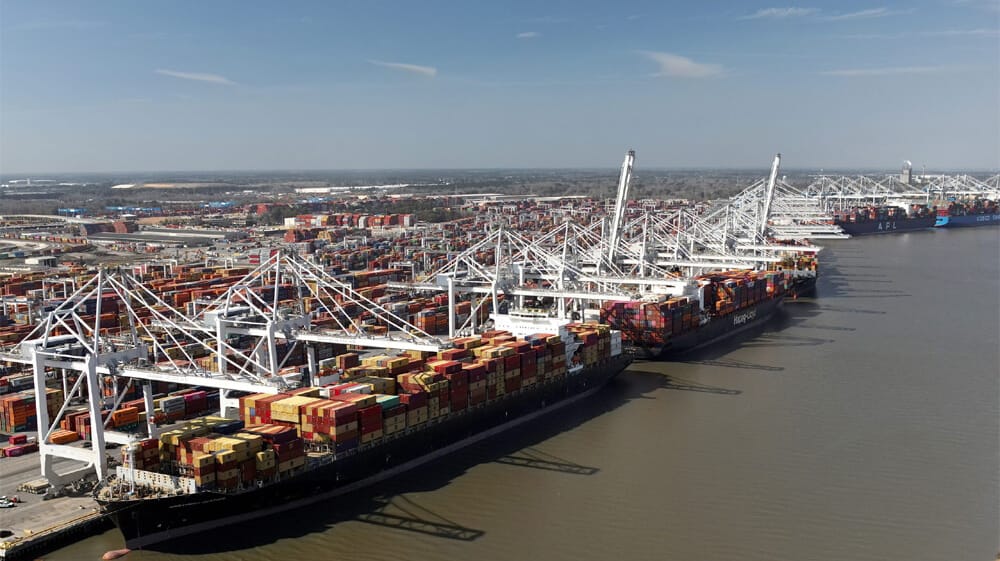
Georgia Port Authority has secured the U.S. Army Corps of Engineers' approval for a massive new container terminal at the Port of Savannah, completing a three-year-long review process. 

The new terminal will be built on Hutchison Island on 350 acres, and will have a capacity of 3.5 million TEU. The extra room will allow Savannah to continue a decade-long growth boom, which started with the inauguration of the New Panama Canal and "all-water" routes from Asia to the U.S. East Coast back in 2016. 

At present, the port has a nameplate capacity of about 7.75 million TEU. It is also augmenting the Ocean Terminal, spending about $1.6 billion to increase its capacity from 200,000 TEU today to about 1.75 million TEU in 2028. 

The port authority, the state and the Corps of Engineers are working on additional projects to improve the harbor for larger vessel traffic and build out the shoreside infrastructure for intermodal transport. The work includes a large-scale dredging project for Savannah Harbor. 

The progress on permitting for the new terminal will be a capstone for the tenure of longtime CEO Griff Lynch, who has been at the helm of the Georgia Port Authority since 2011. Over the period, Savannah's container volume has nearly doubled, and GPA's overall revenues have more than tripled. 

"We have been blessed with talented, dedicated people at GPA and with business partners who defined our service levels, enabling our customers to succeed and grow. I’m proud of our people, thankful for our customers and confident in the port and inland infrastructure we’ve built. We’re never done growing," said Lynch in a statement.