Sunday, October 18, 2026


No breakthrough in talks at Antofagasta’s striking Centinela copper mine, unions say


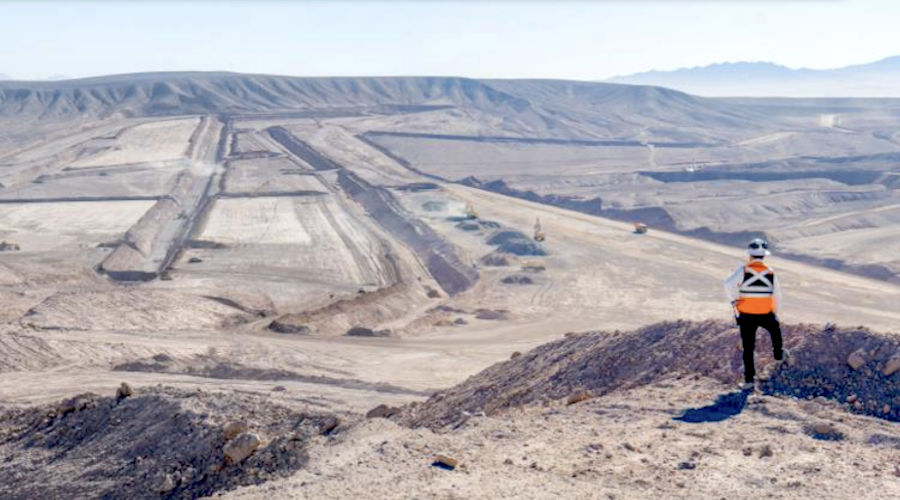
Tailings facility construction at Centinela. (Image: Antofagasta’s presentation.)

Negotiations between Antofagasta Minerals and two striking unions at Chile’s Centinela copper mine showed no progress on Thursday, while three workers marked their seventh day on a hunger strike.

The Distrito Centinela and Minera Esperanza unions, which together represent more than 700 workers, began the walkout on October 7 after contract talks collapsed. The sides returned to the negotiating table on Tuesday in an effort to resolve the dispute.

“So far, after three days of voluntary mediation, the company has refused to address a mechanism to end discrimination during the term of the collective agreement,” the unions said in a statement.

The unions added that the company was continuing to present a financial offer already rejected by workers, while ignoring what they called the core issue: alleged violations of workers’ fundamental rights to equal treatment and non-discrimination.

The unions say the dispute centers on alleged disparities in pay and benefits for workers performing similar roles at the mine.

Antofagasta said on Wednesday that it had so far managed to keep production running as planned. On Thursday, the company reported a 7% rise in third-quarter output and maintained its full-year production forecast of 625,000 to 655,000 metric tons of copper.

In a statement on Thursday, the firm reaffirmed its willingness to seek an agreement, and said dialogue this week has opened up the possibility to reach a deal.

The company said it opposed the use of a hunger strike that could put workers’ health and lives at risk.

The strike at Centinela — along with the ultimately averted risk of a supervisors’ stoppage at Escondida — has helped support global copper prices, amid concerns of difficulties to expand supply enough to meet expected future demand.

(Reporting by Fabian Cambero; Editing by Aida Pelaez-Fernandez and Daina Beth Solomon)


Congo arrests hundreds of Chinese miners in copper heartland

Congolese soldiers. Stock image.

About 300 Chinese nationals working in the Democratic Republic of Congo’s copper belt were detained earlier this week as part of a crackdown on illegal mining, according to people familiar with the matter.

The arrests took place mostly in the mining hub of Kolwezi, the people said, asking not to be named describing a sensitive issue. Chinese companies dominate copper output in Congo, and workers were arrested for their alleged involvement in illicit mining on concessions belonging to other firms, according to some of the people. 

The officials carrying out the arrests included agents from Congo’s National Security Council and immigration authority, some of the people said. The Chinese embassy in Kinshasa intervened and some of the workers have since been released, they said.

The Chinese embassy, and Congo’s mining ministry, immigration authority and presidency didn’t respond to requests for comment.   

A wave of mainly Chinese investment has fueled Congo’s copper expansion in recent years, helping the nation triple output since 2015 and surpass Peru as the world’s second-largest producer. But the mining boom has also brought disorder. 

Artisanal miners, sometimes supported by soldiers, have repeatedly operated without authorization on permits held by international investors.

(By William Clowes and Julian Luk)

GOOD NEWS

Greenland to introduce ban on seabed mining  


Near Kulusuk, eastern Greenland. Stock image.

Greenland Parliament has unanimously passed a resolution to introduce a ban on seabed mineral extraction, RMF24 reported Friday.  

The news comes a day after US President Donald Trump announced “massive oil, gas and mineral exploration” was set to begin on Greenland.  

Trump described the Danish Arctic island, which is run by a semi-autonomous government, as “our new and beautiful Greenland” in a social media post that hailed what he said were US gains from a security deal signed in September. 

The resolution stipulates the memorandum on deep-sea mining is to remain in force until the end of 2029, RMF24 reported, with the possibility of extension for further two-year periods. The legislation is expected to be passed in the first half of 2027.  

Greenland has been caught up in a confrontation with Trump who has been saying since 2019 the US should buy or take the strategically located and mineral-rich island for security reasons. On several occasions, he refused to rule out force. 

Greenland has one of the world’s most significant underexplored critical mineral endowments, positioning the territory at the center of critical minerals and defense supply chain strategies. 

The Tanbreez property in Greenland, with a 28.2 million tonne TREO resource, has been ranked as one of the world’s top rare earth projects. Rare earth explorers are drawn to Greenland to dig into what the US Geological Survey calls the world’s biggest undeveloped deposits of rare earth metals. 

While the US signalled in September it is nearing approval for permits to mine the deep sea, the specter of seabed mining being allowed to commence has alarmed many environmentalists due to concern it could cause irreversible biodiversity loss. 

Parts of the Pacific Ocean and elsewhere are estimated to contain large amounts of potato-shaped rocks known as polymetallic nodules that contain the building blocks for electric vehicles, weapons and electronics. 

Scientists at the United States Geological Survey (USGS) have discovered that some metal-rich rocks recovered from the deep ocean can spontaneously combust when exposed to air and processed, raising unexpected safety concerns for a potential new mining industry. 

Saskatchewan potash developer clears final key permit ahead of 2027 startup

Story by Dylan Sikes - AllPennyStocks.com News
• 1d •


Saskatchewan Potash Developer Clears Final Key Permit Ahead of 2027 Startup

Potash has drawn steady attention from policymakers as North American governments look to secure supplies of the minerals behind food production. Canada is the world’s largest potash producer, and Saskatchewan accounts for the bulk of that output, which makes the province the main focus of new development in the fertilizer sector.

Shares of Buffalo Potash Corporation (TSX-V: BUFF) (OTCQB: BLPTF) are higher Friday after the company received approval from the Saskatchewan Ministry of Environment to construct and operate the Initial Production Module (IPM) at its Disley Project. The company described the approval as the final key regulatory approval it needs to complete construction and begin operating the IPM.

The approval, Permit No. PC26-153, follows the ministry’s Sept. 17 determination that the IPM is not a “development” requiring an Environmental Impact Assessment. It covers the surface works for the remaining phases of the IPM plan, including pipelines, brine and water storage tanks, processing equipment, electrical infrastructure, modular buildings and roads. Conditions include ministry approval of a groundwater monitoring plan, compliance with air quality requirements before processing equipment operates, and financial assurance acceptable to the ministry. The approval runs to April 30, 2027, with provision for extension, and applies only to the IPM.

The IPM is designed to produce 125,000 tonnes per year of soluble-grade potash and is the first of three planned solution mining facilities at Disley, which sits about 50 kilometers northwest of Regina next to the K+S Bethune and Mosaic Belle Plaine solution mines. Buffalo’s May 2026 preliminary economic assessment outlined a full build-out of up to 1,125,000 tonnes per year, with an after-tax net present value of US$1.1 billion at an 8% discount rate and an internal rate of return of 30%. The company noted that its IPM production decision is not based on a feasibility study with mineral reserves, which historically carries a higher risk of economic and technical failure.

Buffalo is developing Disley with its patented Horizontal Line-Drive method. Source and disposal wells and horizontal drilling for the IPM are complete, and site development is in progress. The next phase, brine circulation, is designed to establish communication along a clay seam between injector and producer wells, then develop the mining plane that will feed the IPM processing facility.

President and Chief Operating Officer Quinton Hardage said the approval allows the company to advance surface construction in parallel with brine circulation preparations.

“Our team, together with our contractors and consultants, has shown disciplined execution in keeping this project on schedule, and we continue to target first production in Q1 2027,” Hardage said.

Shares of BUFF are up 3.9% to C$0.81, while shares of BLPTF are flat at $0.5536.

Copyright © 2026 AllPennyStocks.com.


Canada’s new foreign investment rules: What critical minerals miners need to know 


Stock image.

Canadian critical minerals companies will need to consider how they raise foreign capital as Ottawa prepares to implement new Investment Canada Act rules that will require certain types of minority investments into a mandatory pre-closing filing regime. 

The changes could have particular consequences for miners and developers that rely on strategic investors to finance exploration, feasibility work, and project development, Toronto- based partner in Cassels’ Competition & Foreign Investment Group Chris Hersh told MINING.COM in an interview. 

The legislation underpinning the new regime was enacted in 2024, but key provisions requiring regulations are set to take effect in early 2027. 

Under the coming rules, certain investments by non-Canadians in businesses operating in prescribed sensitive sectors will require notification before the transaction can be completed — and will target investments that do not involve an acquisition of control of a Canadian business. 

Currently, acquisitions of control of Canadian businesses that fall below the applicable net-benefit review threshold generally require a notification that can be submitted up to 30 days after implementation, while minority investments that do not trigger a mandatory filing can be voluntarily notified to obtain greater certainty under national security review provisions of the law.  

This is because the Investment Canada Act allows the government to review foreign investments on national security grounds regardless of their value or whether control is acquired.  

The 2024 amendments will expand mandatory filings to certain non-control investments where the Canadian entity conducts a prescribed business activity and the foreign investor obtains rights including, those relating to access to material non-public technical information or material assets, together with certain governance or other special rights. 

For mining companies, this means that a range of minority investments by foreign investors may be caught by the new regime and they will need to proactively consider how to factor this into their business planning. 

“The new mandatory notification regime is not going to apply to every single transaction,” Hersh said. “But companies now need to consider how the Investment Canada Act applies not only to control transactions, but also minority interest transactions,” where the investment meets the conditions established by the new regime. 

Exactly which businesses will be covered remains one of the biggest outstanding questions. Ottawa has yet to finalize the “prescribed business activities” that will trigger the requirement. 

The federal government has said those activities will target sensitive sectors and will be informed partly by existing government policy statements and guidelines, including Canada’s Sensitive Technology List, as well as those relating to the application of the national security regime Critical minerals are already treated as a national security priority under Canada’s foreign investment policy. 

Hersh expects critical minerals to be among the sectors affected, while emphasizing that the regime is considerably broader than mining. 

“It’s not directed specifically at critical minerals, it’s directed at a range of sensitive sectors that includes critical minerals,” he said.  “In short, investments across a broad range of sectors will be potentially affected by the new law.” 

Financing timelines could stretch 

For critical minerals companies, the immediate issue may be less whether foreign capital remains available than how quickly companies can access it. 

Transactions caught by the new regime will have to file their notification before completion, meaning companies accustomed to bringing in strategic investors relatively quickly may need to build regulatory review timing into their financing schedules. 

Hersh anticipates many transactions will make it through an initial 45-day national security screening period without further action, but investments that raise concerns could face a much longer review that can take up to 200 days, or longer. 

“I do think that a majority of the deals caught by the new regime are likely to be subject to a 45-day screening period, following which the government will conclude that there are no problems,” he said. 

The complication is that companies may not know at the outset whether their deal will fall into that relatively straightforward category. 

For a junior miner that needs capital quickly, even the prospect of a mandatory waiting period could affect how investments are structured. 

“It means that you can’t necessarily do quick transactions in the same way you can today,” Hersh said, adding that Canadian companies engaged in prescribed activities will have to consider both the timing and structure of foreign investments. 

That could be particularly important for strategic investments in which a foreign company takes a minority equity position in exchange for board representation, access to technical information or other rights. 

Companies doing deals that are caught by the new mandatory pre-close notification process will have to give themselves enough time to complete the Investment Canada Act process or design transactions, so they do not trigger the new filing requirement. 

One possibility could be staged financing. 

Hersh offered the example of a company needing an immediate cash injection completing an initial tranche that does not grant the investor the rights or information access necessary to trigger the regime, followed by a subsequent investment that goes through the required process. 

“Maybe you do tranche one that is structured in a manner that is not subject to mandatory notification, he said, followed by “a secondary transaction where you would have to go through the regime.” 

Such structures would need to comply with the final regulations and would not eliminate the possibility that the second tranche investment encounters national security concerns. 

Still, the example illustrates how the rules could influence financing strategy well before a foreign investor actually writes a cheque. 

Preventing forced divestitures 

Ottawa’s rationale is that sensitive investments should be examined before foreign investors gain access to assets, intellectual property or confidential information that could create national security risks. 

The government has explicitly said the new pre-implementation notification requirement is intended to prevent potentially irreversible national security harm while avoiding the disruption caused by ordering divestiture or other remedies that have a material economic impact on the investment after it has already occurred. 

Canada’s critical minerals sector has already seen how disruptive that can be. 

In 2022, Ottawa  ordered three Chinese companies to divest their stakes in Canadian critical minerals companies following national security reviews.  

Sinomine Rare Metals Resources had to sell its shares in Power Metals, Chengze Lithium International had to divest its stake in Lithium Chile and Zangge Mining Investment (Chengdu) had to exit its investment in Ultra Lithium Inc.  

These orders demonstrated that minority acquisitions were not beyond the government’s reach, even after they had been completed. 

The new regime could provide more certainty by forcing potentially sensitive transactions into the screening process before they close. 

“The intention is to prevent situations like that, where somebody buys something, and then is told to divest after the fact,” Hersh said. “It does provide a degree of certainty that may not have existed unless somebody was prepared to make a voluntary filing.” 

That certainty comes with a trade-off: transactions subject to the requirement cannot necessarily close as quickly. 

Balancing attracting foreign investment with national security 

The changes arrive as Ottawa is simultaneously trying to attract billions of dollars into Canadian critical minerals projects and accelerate development of mines, infrastructure and other projects deemed strategically important. 

That creates an apparent tension between attracting foreign capital and increasing scrutiny of the investors providing it. 

Hersh does not see the two objectives as contradictory. 

“I think it’s an attempt to balance the desire to encourage foreign investment in critical minerals projects and other significant projects…with the need to protect national security,” he said. 

How restrictive the regime becomes ultimately depends on how Ottawa handles transactions that fall between obviously benign investments and deals presenting clear national security risks. 

“The real question is what happens in the middle to those transactions in the gray area that raise some, but not deal breaking concerns,” Hersh said. 

These situations will test whether the government can manage legitimate security risks through the implementation of mitigation measures rather than simply blocking investments. 

“The proof in the pudding is does the government manage to walk that line, or do they lean too far on one side or the other side?”, Hersh said.  

For critical minerals companies, however, the practical message is already becoming clearer: foreign financing may require more advance planning. 

Companies contemplating minority strategic investments may need to assess earlier whether proposed board rights, access to technical information or other investor protections could trigger a mandatory filing — and build the potential review period into their financing plans. 

Despite the added scrutiny, Hersh remains cautiously optimistic that the rules will not materially undermine investment in the Canadian critical minerals sector. 

“The reality is that there are only so many stable jurisdictions with significant critical mineral reserves and companies operating in the critical minerals sector,” he said. “We do have what the world wants.” 
ALL CAPITALI$M IS STATE CAPITALI$M

US Project Vault readies $1B loan blitz for industry


Trump addressing coal industry representatives. (Image courtesy of The White House.)

The US government-backed Project Vault is preparing to issue up to $1 billion in loans to American manufacturers seeking critical minerals, advancing Washington’s efforts to shield domestic industry from supply disruptions.

VaultCo, the entity managing the stockpiling initiative, is in discussions with more than 70 companies across the critical minerals supply chain, Bloomberg reported. The first round of financing is expected to cover more than a dozen original equipment manufacturers (OEMs), with another group to follow.

“What’s likely to happen is we’ll announce several hundred million dollars, maybe a billion dollars, of loans to OEMs who have requested use of the Vault facility,” VaultCo Executive Chairman Brett Lambert told the news outlet. “In the first tranche, we’ll have more than a dozen firms, followed by more than a dozen shortly after.”

The financing would mark a significant step towards making Project Vault operational as the US seeks to reduce its exposure to volatile critical minerals markets and strengthen manufacturers’ access to materials essential for industrial production.

Lambert said the recipients would not be publicly identified at this stage, although the announcement is expected to disclose the types of minerals they have requested.

Stockpile takes shape

Launched in February, Project Vault is structured as an independently governed public-private partnership backed by a $10 billion loan from the US Export-Import Bank (EXIM) and nearly $2 billion in private investment.

Commodity trading giants Glencore (LON: GLEN) and Mercuria recently committed $500 million each, becoming the first commodity traders to join the initiative.

Mercuria has already delivered 12,000 tonnes of copper from the Democratic Republic of Congo, establishing a new destination for the African country’s metal within Washington’s supply security strategy.

The shipment comes amid growing US demand for Congolese copper. Imports reached a record 53,290 tonnes in July, driven by competitive prices, improved product quality and concerns over potential tariffs that prompted buyers to accelerate shipments.

Commercial imports and Project Vault serve different purposes. While conventional purchases meet immediate industrial demand, the reserve is intended to provide manufacturers with access to materials when normal supply channels become disrupted.

Tailored mineral demand

Unlike conventional government stockpiles, Project Vault is designed around manufacturers’ specific requirements rather than predetermined inventories of strategic commodities.

Participating companies have requested not only raw metals and minerals but also specialized magnets, powders, alloys and other processed materials tailored to their production needs.

“There isn’t any one mineral that stands out, but the specificity of the requests have surprised me,” Lambert told Bloomberg.

The demand-driven approach allows manufacturers to determine which materials are purchased and stored, potentially giving smaller buyers greater purchasing power in fragmented and often opaque markets.


It also distinguishes Project Vault from the US National Defense Stockpile, which the Defense Logistics Agency administers to secure materials required for national defence.

The next test will be whether the initial loans can translate manufacturers’ highly specific requests into reliable inventories, particularly for processed materials that may be harder to source than raw commodities.


Shanghai Moved a Staggering 5.1M TEU in September Recovering from Typhoons

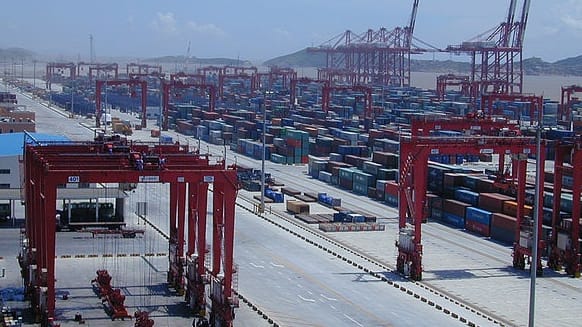
Port of Shanghai
Shanghai set a monthly record as it recovered from three typhoons (SIPG)

While already recognized for many years as the world’s busiest container port, Shanghai exceeded its own records, handling a staggering 5.135 million TEU during September. Port officials are highlighting the achievement to emphasize that the port is clearing its backlogs and working very efficiently.

Shanghai’s operations were disrupted starting in July by three powerful typhoons. The weather-related suspensions contributed to a growing backlog and vessel congestion. It was further exacerbated by a surge in exports and strong international demand. The Port of Los Angeles, for example, reported the best single month in terms of volume in its history during September at just over 1 million TEU and capping the strongest four-month stretch in the port’s history.

The Shanghai International Port Group highlights a concerted effort and close coordination to alleviate the temporary production issues following the typhoons. It reports it was dealing with concentrated arrivals of ships and backlogs of exports coming from manufacturers.

To deal with the challenges, it optimized berthing and loading/unloading operations. It also coordinated with the shipping companies to merge shipments where possible.

The result was a throughput of 5.135 million TEU in September, an increase of 6.2 percent over September 2025. It was a new monthly record, with the port highlighting that it had a daily average of 171,000 TEU.

One terminal, the Mingdong Terminal, exceeded 30,056 TEUs in one 24-hour period. It beat its own operational record. Shanghai emphasizes the high level of automation and production organization to manage these large volumes.

The momentum appears to have carried into October. The Shanghai International Port Group reports that all the docks and various departments maintained their operations during the National Day holiday, which is celebrated between October 1 and 3. The National Day makes up part of the Golden Week, where traditionally businesses take a break. Shipping lines traditionally blank sailings from their schedule for the holiday.

SIPG, however, reports that operations continued throughout the holiday week. The port handled 1.15 million TEU. That was an increase of 1.3 percent over the prior year.

The port says it continues to closely monitor vessel arrivals and cargo volume fluctuations. However, it asserts that Shanghai Port has fully returned to normal operating conditions after the successive typhoons.

Similar reports from across Asia indicate that the ports are clearing much of the backlog that built up due to the typhoons and other recent disruptions. The analysts at Linerlytica, however, continue to list Shanghai with the highest number of vessels at anchor (114 as of October 10), with an additional 82 vessels on dock. It reports that over 629,000 TEU are at anchor, giving Shanghai the highest queue-to-berth ratio.


Port of Savannah Gets Army Corps Permit for New 3.5M TEU Container Terminal

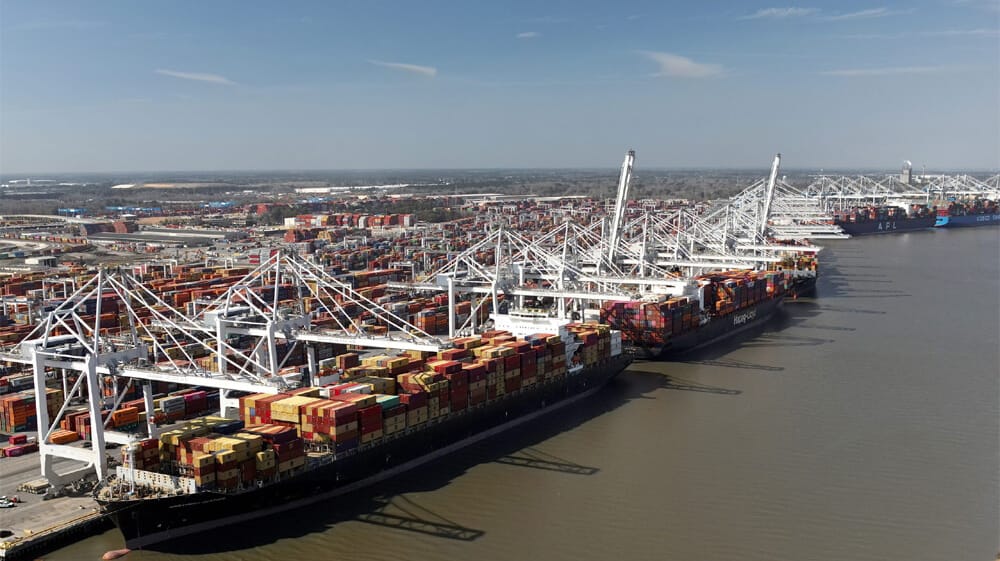
GPA
File image courtesy GPA

Georgia Port Authority has secured the U.S. Army Corps of Engineers' approval for a massive new container terminal at the Port of Savannah, completing a three-year-long review process. 

The new terminal will be built on Hutchison Island on 350 acres, and will have a capacity of 3.5 million TEU. The extra room will allow Savannah to continue a decade-long growth boom, which started with the inauguration of the New Panama Canal and "all-water" routes from Asia to the U.S. East Coast back in 2016. 

At present, the port has a nameplate capacity of about 7.75 million TEU. It is also augmenting the Ocean Terminal, spending about $1.6 billion to increase its capacity from 200,000 TEU today to about 1.75 million TEU in 2028. 

The port authority, the state and the Corps of Engineers are working on additional projects to improve the harbor for larger vessel traffic and build out the shoreside infrastructure for intermodal transport. The work includes a large-scale dredging project for Savannah Harbor. 

The progress on permitting for the new terminal will be a capstone for the tenure of longtime CEO Griff Lynch, who has been at the helm of the Georgia Port Authority since 2011. Over the period, Savannah's container volume has nearly doubled, and GPA's overall revenues have more than tripled. 

"We have been blessed with talented, dedicated people at GPA and with business partners who defined our service levels, enabling our customers to succeed and grow. I’m proud of our people, thankful for our customers and confident in the port and inland infrastructure we’ve built. We’re never done growing," said Lynch in a statement. 

MONOPOLY CAPITALI$M

International Seaways Expands VLCC Fleet Through Combination with Bruton

International Seaways

[By International Seaways]

International Seaways, Inc. (NYSE: INSW), one of the largest tanker companies worldwide providing energy transportation services for crude oil and petroleum products, today announced the execution of agreements to acquire Bruton Limited (OSL: BRUT), in a series of transactions that values Bruton at approximately $370 million.

The transaction combines Bruton’s 4 VLCC vessels, including newbuildings, with Seaways diversified fleet of approximately 70 vessels across both the crude and product segments.

Seaways has entered into exchange agreements with Bruton shareholders holding approximately 50.5% of Bruton’s outstanding common shares, to immediately acquire those shares in exchange for 0.0519 INSW shares for each Bruton share held (the “First-Step Exchange”). The First-Step Exchange transactions are expected to settle on or about October 20, 2026.

Seaways has also entered into a definitive transaction agreement with Bruton, pursuant to which the Company will acquire all of the Bruton shares that remain outstanding following the completion of the First-Step Exchange in a cash and stock merger (the “Merger” and, together with the First-Step Exchange, the “Transactions”). Seaways expects to issue approximately 3.12 million INSW shares in the Transactions, representing approximately 96% of the aggregate consideration payable in the Transactions, with the remainder settled in cash.

Bruton will hold a special meeting of shareholders on or about October 30, 2026, to vote on the proposed Merger. The Bruton shareholders party to the First-Step Exchange have agreed to vote their shares in favor of the Merger. The Merger is expected to close promptly following the Bruton special meeting of shareholders, subject to the satisfaction of other customary closing conditions. Additional details with respect to the structure of the Transactions will be included in the Company’s current report on Form 8-K, expected to be filed today with the SEC.

Lois K. Zabrocky, International Seaways President and CEO commented, “We're excited about the opportunity to expand and modernize our fleet through this accretive transaction with Bruton. The transaction underscores our disciplined approach to growth. Following completion of the transaction, Seaways will remain well-positioned to continue executing on our growth strategy, generating attractive returns and creating long-term value for our shareholders.”

Preliminary Third Quarter 2026 Results

The Company also today announced selected preliminary financial results for the third quarter of 2026.

Based on information currently available, the Company expects:

•    Shipping Revenues and Other Operating Revenues of approximately $480-$490 million
•    Net income of approximately $340-$350 million, which includes a gain on the sale of a 2012-built Suezmax of approximately $50 million
•    Total Liquidity was approximately $965 million as of September 30, 2026, including cash (and short-term investments) of $455 million and $510 million of undrawn revolving credit capacity.

Results for the third quarter were driven primarily by strong market conditions that resulted in blended spot earnings of approximately $68,000 per day compared to $79,000 per day in the second quarter of 2026 and $29,000 per day in the third quarter of 2025. During the first three weeks of the fourth quarter, the Company has fixed blended spot earnings of approximately $180,000 per day on about 37% of expected fourth quarter revenue days. Blended spot earnings exclude revenues associated with profit-share components of the Company’s time charters.

These preliminary results are based on management's initial review of operations for the quarter and are subject to completion of the Company's financial closing procedures. Actual results may differ from these preliminary estimates and will be reported in the Company's full earnings release on November 5, 2026.

Advisors

The products and services herein described in this press release are not endorsed by The Maritime Executive.


First Electric Ferry in Estonia to Feature Steerprop Propulsors

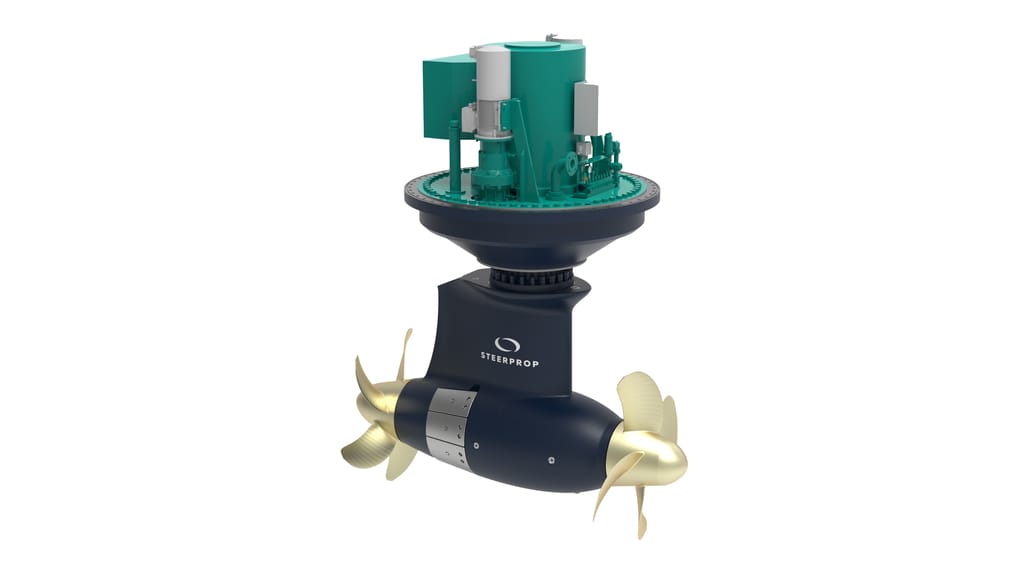
Steerprop's advanced propulsion technology will power Estonia's first fully electric passenger ferry.

First Electric Ferry in Estonia to Feature Steerprop Next Generation of Contra-Rotating Propeller Units

[By Steerprop]

Finnish marine propulsion specialist Steerprop will supply the latest version of its well-established contra-rotating propeller (CRP) technology to a fully electric ferry being built by Polish shipyard CRIST SA for the Estonian State Fleet.

The vessel, described as Estonia’s first fully electric passenger ferry, will be propelled by two Steerprop SP 25 CRP units featuring permanent magnet motor drives. The ferry will also be the first to feature next generation of CRP technology, which further improves mechanical efficiency while delivering the excellent thrust in ice and open water for which the long-established CRP range is known.

Steerprop’s propulsion was selected for the project due to its ability to provide high thrust in ice, wind and open water conditions even with tight constraints on propeller diameter. The unique configuration of the push and pull propellers on Steerprop CRP’s single shaftline mean that it can achieve higher thrust and efficiency than similarly sized single-propeller units – or similar thrust using less power, helping to reduce installed power, energy use and emissions.

Steerprop Cruise & Ferry Segment Director Markku Miinala said: “The latest Steerprop CRP development has resulted in a propulsor with unique efficiency and thrust performance, and one that offers an even greater performance boost for vessels operating in ice conditions. Steerprop is pleased to widen its installed base in Estonia, where we already operate four double-ended ferries with Steerprop CRP propulsors on the Saaremaa and Hiiumaa routes.”

The next generation of CRP introduces pressure lubrication as standard for smaller CRP applications. By removing immersion lubrication, mechanical losses are reduced, enabling an increase of around 3.5 percentage points in mechanical efficiency alongside superior fuel economy and performance. As with all CRP units, the next-generation propulsors are hydrodynamically optimized and can be deployed as part of diesel, hybrid or pure-electric drivechains.

The 95 metre-long ferry designed by LMG Marin will use renewable shore power, with electricity stored in a 3MWh battery system, alongside auxiliary biodiesel generators for severe weather and emergency operations. She will be classed to 1B Ice Class, enabling operation in ice of up to 60cm thick.

Steerprop's propulsion equipment is scheduled for delivery in late 2027, with the vessel expected to enter operation in late 2028. The total value of the design and construction contract is EUR 49.93 million. The project is co-funded by the European Union Modernisation Fund (EUR 28 million) and Estonia’s CO? quota trading mechanisms.

The products and services herein described in this press release are not endorsed by The Maritime Executive.


RoRo to Transport Airbus Components is Fitted with Six Rotor Sails

RoRo with wind rotors
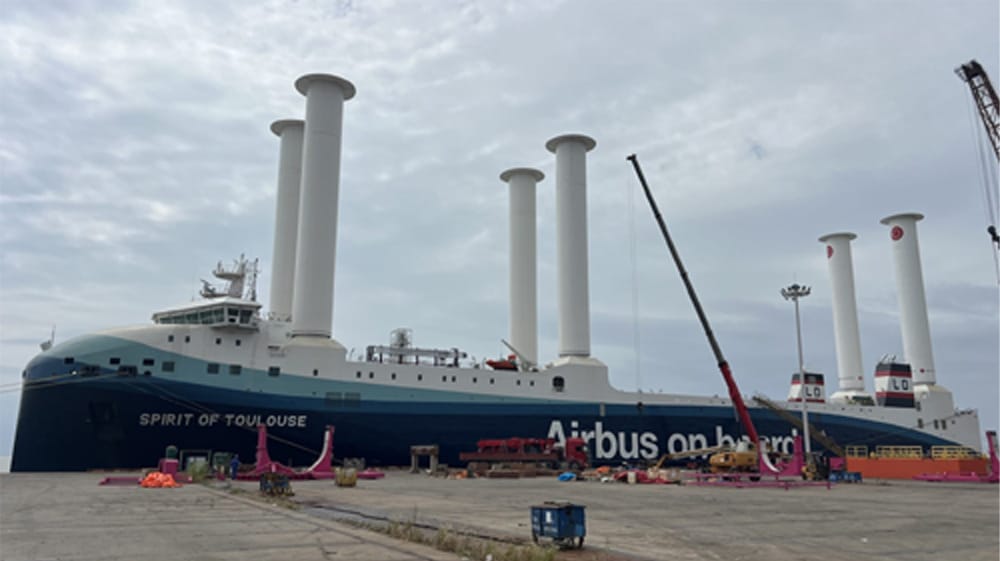
The RoRo being built to transport Airbus components completed the installation of its six wind rotors (LD Armateurs)

The Spirit of Toulouse, the first of three pioneering RoRos with wind-assisted propulsion, marked a milestone in its construction with the installation of its six wind rotors. The vessel, which is being built in China, becomes not only the largest RoRo vessel to be equipped with wind-assisted propulsion, but also has the largest number of mechanical sails fitted on a single vessel.

"Spirit of Toulouse is much more than a new vessel. It is a tangible demonstration of how the maritime industry can accelerate its transition by combining innovation, operational expertise, and strong industrial partnerships,” said Samira Draoua, CEO of LD Armateurs, the owners of the vessels.

The vessel, which is 19,000 gross tons, is being fitted with six Norsepower Rotor Sails. The six rotor sails each measure 35 meters by 5 meters (approximately 115 feet by 16.4 feet), and they are being paired with two dual-fuel main engines and two dual-fuel generator sets, capable of running on e-methanol, bio-methanol, or marine diesel oil. LD Armateurs, which is building the vessel for charter to Airbus, expects each vessel to deliver a 70 percent decrease in CO2 emissions, on an annual basis, compared with the two vessels it currently operates on the Atlantic for Airbus.

Each of the ships has an overall length of approximately 168 meters (551 feet) and will be 5,300 dwt. They will have a service speed of 14 knots. The ships will be registered in France.


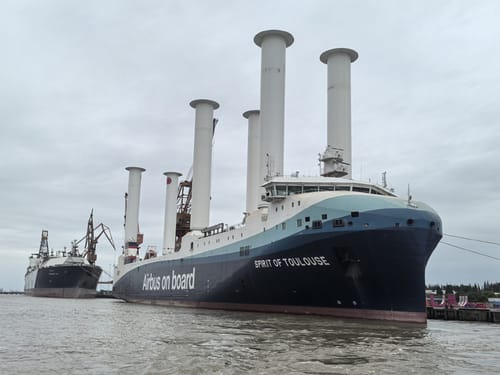
Spirit of Toulouse is the largest RoRo with wind-assisted propulsion and has the largest number of mechanical sails on a vessel (LD Armateurs)


“Completing installation of six Norsepower Rotor Sails on Spirit of Toulouse is a significant milestone for wind propulsion in the RoRo segment,” said Heikki Pöntynen, CEO of Norsepower. Wind-assisted propulsion continues to gain momentum with adoption ranging from tankers to bulkers and more RoRos and cruise ships.

The companies note that fitting six rotors to a single hull is a demanding undertaking. Commissioning activities commenced immediately following the installation of the first rotor sail. With all sails installed, the rotor sails will undergo comprehensive testing during the vessel's upcoming sea trials to confirm their performance and integration with onboard systems. Further optimization and fine-tuning will continue during the maiden voyage from China to France.

The project for these pioneering ships began in 2024 with construction at the Wuchang Shipyard, a division of CSSC Group in China. The hull for the Spirit of Toulouse was launched in early 2026, and in September it began the journey along the Yangtze to Shanghai. Outfitting and installation of the rotors are being completed at the yard in Shanghai.

The Spirit of Toulouse will be joined by sister ships Spirit of Mobile and Spirit of Mirabel, which are also under construction in China. Operating under charter to Airbus, they will transport large aircraft sub-assemblies between Airbus’s sites in Europe and North America.


Canaveral Port Authority Donates Firefighting Equipment

Canaveral Port Authority
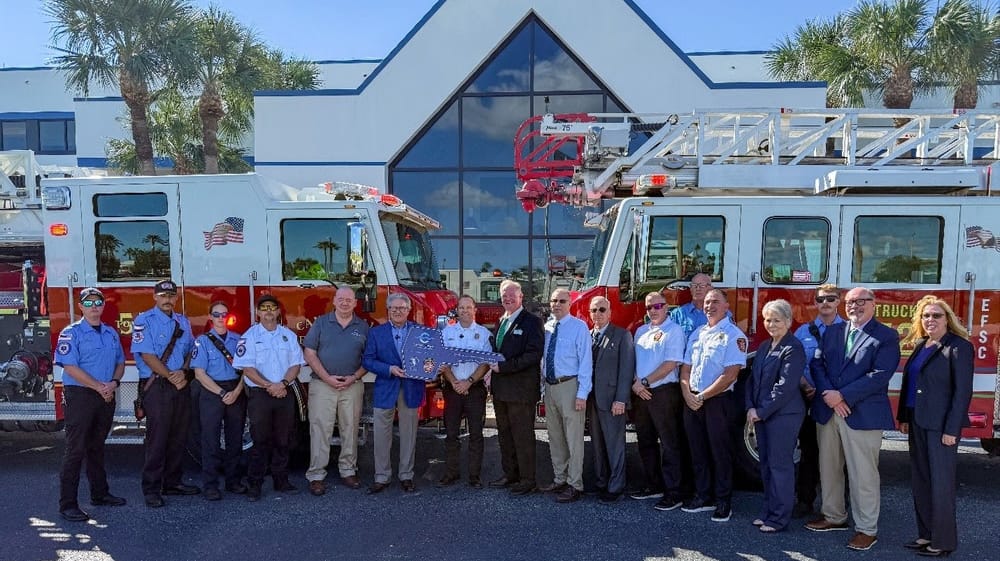
Officials from Canaveral Port Authority and Canaveral Fire Rescue Present a ceremonial key to Eastern Florida State College for the donation of Truck 52 to the college’s fire academy. (Credit: Canaveral Port Authority)

[By Canaveral Port Authority]

The Canaveral Port Authority today officially turned over the ceremonial keys to “Truck 52,” an aerial fire apparatus formerly operated by Canaveral Fire Rescue, to Eastern Florida State College (EFSC) for use in the school’s Fire Training Center. The donation was formally recognized during a ceremony today at Port Canaveral, where Port Canaveral CEO Capt. John Murray and Canaveral Fire Rescue Deputy Chief Jeff Crawley presented a ceremonial key to Eastern Florida State College Vice President External Affairs Jack Parker. 

“We are proud to donate this valuable equipment to support Eastern Florida’s education and training program,” said Capt. John Murray, Port Canaveral CEO. “Truck 52 served our Port community well, and it will continue to be of service in preparing the next generation of firefighters and first responders for their vitally important careers.”

The apparatus formerly known as, “Canaveral Fire Rescue Truck 52” is a 2012 model year 75-foot Pierce Velocity ladder truck, which was purchased by the Canaveral Port Authority and operated by Canaveral Fire Rescue. During its time in service, the truck and its complement of Canaveral Fire Rescue firefighters has responded to nearly 7,000 calls throughout Brevard County because of Port Canaveral’s mutual aid and automatic aid agreements with 26 communities and federal government installations including Kennedy Space Center, NASA, Cape Canaveral Space Force Station, Patrick Space Force Base, and U.S. Navy’s Naval Ordnance Test Unit (NOTU).

"Although this truck's assignment is changing, its mission remains the same: serving others. We are proud to be part of the handover of this apparatus so it can continue making a difference and helping firefighters answer the call when their community needs them most,” said Chris Quinn, Fire Chief, Canaveral Fire Rescue.

The donated firetruck will be incorporated into EFSC’s firefighter and emergency response training programs, providing students and trainees with valuable hands-on training experience required to become a state certified firefighter in Florida. In addition to offering a Fire Science associate’s degree, the college operates a fire training center and Fire Fighter I/II Certificate Program and Continuing Education Fire Science courses to advance firefighter professional skills.  

“Eastern Florida State College is grateful to the Canaveral Port Authority and Canaveral Fire Rescue for the donation of Truck 52 which will help our students gain valuable hands-on experience for their future careers,” said Dr. James Richey, President of EFSC.  “Support from partners like the Canaveral Port Authority and Canaveral Fire Rescue are critical to our ongoing efforts to train and educate the next generation of firefighters and first responders.”

The Pierce Velocity ladder truck is equipped with a 2,000 GPM (gallon-per-minute) pumping capacity with a 400-gallon tank and can carry up to 1,000 feet of five-inch supply hose. Built in Appleton, Wisc., the truck’s 75-foot aerial ladder provides nearly 68 feet of horizontal reach, giving instructors and students the ability to conduct a wide range of practical training evolutions involving elevated rescue, fire suppression and aerial operations.

Port Canaveral has donated firefighting assets in previous years, including a Pierce Lance fire truck and a fire pumper to the Monticello Volunteer Fire Department in Jefferson County, Fla.

The products and services herein described in this press release are not endorsed by The Maritime Executive.