Showing posts sorted by relevance for query ALL CAPITALI$M IS STATE CAPITALI$M. Sort by date Show all posts

Thursday, December 26, 2024

Canada’s Seymour lithium project secures $69.5m in financing from EDC

ALL CAPITALI$M IS STATE CAPITALI$M

The non-binding letter of interest (LOI) could lead to a direct lending debt funding package of up to C$100m ($69.5m) 
Credit: BJP7images / Shutterstock. · Mining Technology · BJP7images / Shutterstock.

GlobalData

Mon, December 23, 2024 


Green Technology Metals (GTM) has received a non-binding letter of interest (LOI) from Export Development Canada (EDC) to finance the company’s Seymour lithium project in northwestern Ontario, Canada.

The LOI could lead to a direct lending debt funding package of up to C$100m ($69.5m), bolstering the project's development within Canada's critical minerals supply chain.


GTM has been in discussions with EDC since September 2024, providing key project details and preliminary financial models.

The project’s permitting approvals and final investment decision are expected to be completed in 2025.

The project is expected to start production in 2026 as Ontario’s first mine for battery metal.

Green Technology Metals managing director Cameron Henry said: “This marks the first step in our financing strategy for the Seymour project development and we’re pleased to have achieved this milestone in 2024. EDC’s support potentially increases sourcing flexibility, allows greater access to low-cost direct lending and is non-dilutive to GT1 shareholders.

“We continue to engage with global commercial lenders as part of our broader financing efforts, but the strong indication of interest from EDC validates the robustness of the Seymour Project and further reinforces our strategy to become Ontario’s first lithium producer.”

EDC's support is expected to offer flexible sourcing options and access to low-cost lending, and will not dilute the value for current shareholders.


The financing from EDC is subject to a thorough due diligence process, internal approvals, and standard project finance conditions, including an environmental and social review in line with EDC’s framework.

Following the appointment of financial adviser Endeavour Financial, the Seymour Project has attracted global commercial lenders, enhancing the project's financial structure.

As a financial Crown corporation, EDC focuses on financing solutions for Canadian exporters and has completed over 540 transactions across various sectors, including mining.

"Canada’s Seymour lithium project secures $69.5m in financing from EDC" was originally created and published by Mining Technology, a GlobalData owned brand.

Friday, February 03, 2023

SOCIALISM BY ANY OTHER NAME
Kansas commits $304M to chip plant to lure federal funds
ALL CAPITALI$M IS STATE CAPITALI$M
By JOHN HANNA

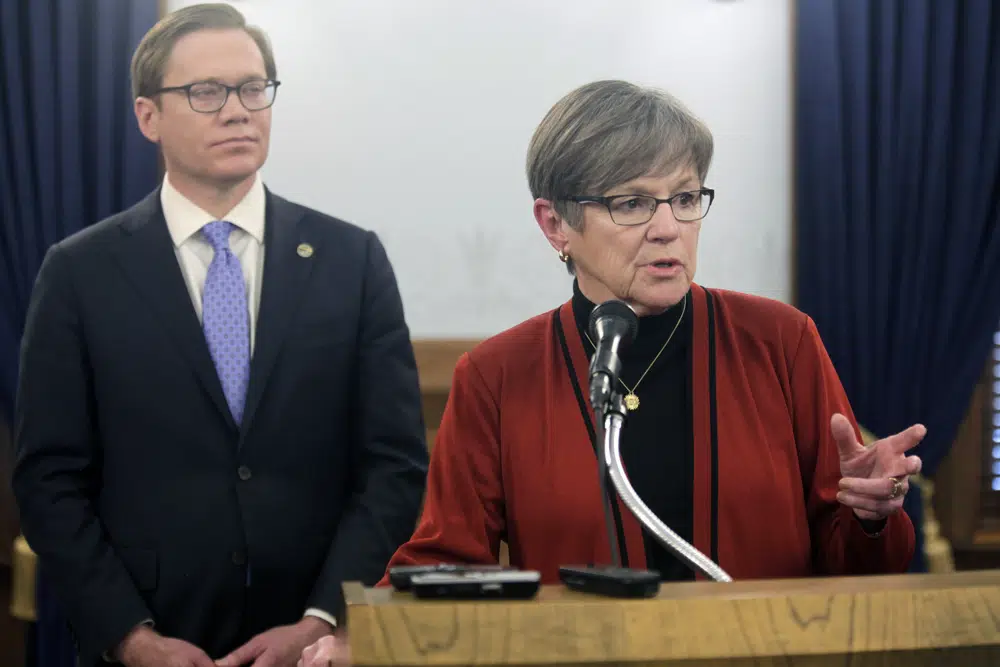
Kansas Gov. Laura Kelly discusses plans by Integra Technologies, of Wichita, Kansas, to build a new, $1.8 billion semiconductor factory, during a news conference, Thursday, Feb. 2, 2023, at the Statehouse in Topeka, Kan. The state has pledged $304 million in taxpayer-funded incentives over 10 years, but the project also needs federal funding. (AP Photo/John Hanna)

TOPEKA, Kan. (AP) — Kansas plans to give $304 million in taxpayer-funded incentives to a semiconductor company in its largest city to build a huge new factory, but the project won’t go forward without funds the U.S. government has promised for rebuilding the nation’s chip-making capacity.

Gov. Laura Kelly announced Thursday that Kansas has an agreement with Integra Technologies, based in Wichita, for a 10-year package of tax breaks and reimbursement of expenses. State officials said the new, $1.8 billion plant would cover 1 million square feet, have 2,000 employees and create 3,000 additional jobs among suppliers and other local businesses.

The announcement comes with the U.S. trying to reverse a loss of capacity for making the chips that are vital to smartphones, laptops and other modern-day conveniences, as well as automobiles and life-saving medical devices. Congress last year approved a measure that provides more than $52 billion in grants and other incentives for the semiconductor industry.

Kelly told reporters during a Statehouse news conference that the state’s incentives are crucial to attracting the federal funds and “making Kansas an essential part of our country’s national security efforts.”

“This advanced manufacturing facility is part of a national push to restore our semiconductor industry so that U.S. workers and businesses can compete and win in the race for the 21st Century,” Kelly said.

Integra CEO Brett Robinson would not say how much federal funding the company needs, only that there is “no commercially viable way” to do the project without it. He and state officials said other states were trying to attract the project, though they did not disclose the competitors.

“It’s not just critical to the United States and to security, but it’s critical to the supply chain,” said Kansas Senate President Ty Masterson, a Wichita-area Republican.

President Joe Biden pushed Congress last year to boost the U.S. semiconductor industry, because of a shortage of chips made worse by the global coronavirus pandemic and concerns about competing with international rivals, particularly China. There’s been a decades-long shift to cheaper-to-operate Asian chip plants, and the industry is now dependent on Taiwan, which China has long claimed as its own.

“If we were ever to lose, for a sustainable amount of time, access to the southeast Asian supply chain, what we just went through would pale in comparison,” Robinson said.

Integra, founded in 1983, has about 500 employees in Wichita and Silicon Valley and describes itself as the largest U.S. provider of the last two major assembly and testing steps in the chip manufacturing process. The new factory is expected to pay an average annual wage of $51,000, about 46% higher than the state’s average of roughly $35,000.

For Integra to receive its incentives, it must invest at least $1.5 billion in the new factory in the next five years and consistently provide the equivalent of 1,600 full-time jobs for 10 consecutive years.

The incentives are part of a program Kansas created last year to ramp up its efforts to compete with other states for new, large factories. Under that program, the state was allowed to offer up to $1 billion in incentives to a single company each in 2022 and 2023.

In July 2022, Kelly and other state officials announced that Panasonic Corp. plans to build a mega-factory to produce electric vehicle batteries for Tesla and other carmakers. The state lured the Japanese electronics giant’s project to the edge of the Kansas City area with incentives worth $829 million over 10 years, the most the state has ever offered.

The law allowing the incentives required top leaders of the Republican-controlled Legislature to sign off any deal between a company and the state Department of Commerce, which is led by Lt. Gov. David Toland, a Democrat like Kelly. The legislative leaders gave their approval just minutes ahead of the announcement, after meeting in private with Kelly for half an hour to review the agreement, with no opportunity for public review or input.

The law also requires Kansas to drop its corporate income tax rates by half a percentage point for each mega-deal. If the Integra project goes forward, the top rate would decline to 6% from 7%, saving all corporations roughly $100 million a year.

While both mega-projects have had bipartisan support, some lawmakers are critical of promising such big taxpayer-funded incentives to a single firm.

“We have not written the checks for this first project and they’re starting the second one without even knowing that it works,” state Senate tax committee Chair Caryn Tyson, a conservative Republican from eastern Kansas, said before Thursday’s announcement.

___

Follow John Hanna on Twitter: https://twitter.com/apjdhanna


Saturday, May 18, 2024


Oregon’s Port of Portland Gets State Funds to Maintain Container Ops

Portland Oregon
SM Line began operations to Portland in 2020 (Port of Portland)

PUBLISHED MAY 17, 2024 5:41 PM BY THE MARITIME EXECUTIVE


ALL CAPITALI$M IS STATE CAPITALI$M


The Port of Portland, Oregon’s only ocean-going seaport, announced it will reverse course and not suspend container operations. The move came after the state’s governor, Tina Kotek, released a letter on Thursday reporting she would provide stop-gap funding and would include long-term funding for channel maintenance in the state’s budget. In total, she is proposing $40 million in future support to the port and its container operations.

“Farmers, union members, shippers, and business leaders have all asked me what the state can do to keep this important service in place,” Governor Kotek wrote in announcing her decision. She said the port and specifically the container service provides a competitive advantage for Oregon growers and other businesses which would have been forced to truck their shipments hundreds of miles to neighboring ports.

In April, it leaked out into the media that the port authority had sent a letter to shippers informing them that it would be ending container operations at the port as of October 2024. The port reported losing $30 million from the container operations over the past three years, including a projected $14 million shortfall this year. They said talks with an independent operator had collapsed and that they had no other choice but to end container service at the T6 Terminal but would maintain the bulk, RoRo, and other operations at the port.

“The port has been working to rebuild container service since taking over the operation in 2018, following a temporary shutdown under former operator ICTSI,” the port authority writes in its response to the governor. “Without direct state support or a financially acceptable third-party lease, container operations have not been sustainable.”

The governor said it was important to send a strong signal to the state’s business partners and as such she would ask the legislature for $5 million in September to stabilize near-term operations at the port. It is part of an overall $40 million investment she said the state would be making to support the continuation of container service.

In offering the funding and support, the governor said she understands that the port’s location makes container operations economically challenging. She cites the limitations of an upriver port within a relatively small metropolitan area, saying she understands they can not fix those limitations. She however calls on the port authority to use the state’s commitment and to pursue an aggressive strategy to make the container operations sustainable for the long term.

“I expect the port to pursue all viable strategies for making T6 operations sustainable over the long-term,” writes the governor.

In addition to the stop-gap funding, she said she will include an initial investment of $15 million for dredging of the Lower Columbia River. She says the state previously committed nearly $28 million but notes the federal project is due to expire in 2025. She expects up to $70 million will be required in a new round of investment for the river. 

She also recognizes the high cost of repairing and replacing needed infrastructure at the port to support container operations. As part of the 2025-2027 recommended budget, she will also support a $20 million investment in a capital program to support container operations.

The Port of Portland has had a difficult history with container operations. They attracted ICTSI to operate the terminal but the company became embroiled in a dispute with the union that ultimately led to the company walking away and a long legal battle. The legal battle was recently settled, but the port had attempted to run the container terminal. It attracted several lines including SM Line during the pandemic offering an uncongested alternative.

Port officials came in for strong criticism from the union, elected officials, and others when they confirmed in April the decision to suspend the operation. In a press release, they said they were grateful to the governor for the declaration of support and for helping to maintain the operation.
 

Wednesday, January 29, 2025

UK National Wealth Fund drives growth with a £28.6m investment into Cornish Metals Inc, facilitating the domestic supply of tin

ALL CAPITALI$M IS STATE CAPITALI$M


28 January 2025

The National Wealth Fund has today announced a £28.6m direct equity investment into Cornish Metals Inc, to help finance the re-opening of Cornwall’s South Crofty tin mine, creating more than 300 direct local jobs.

The NWF’s commitment is designed to mobilise private capital into the project. Its investment is part of a £56m funding round to further de-risk the South Crofty tin mine by commencing early project works, placing orders on long-lead items and completing key work programmes including the shaft refurbishment and mine dewatering. South Crofty is a fully permitted underground tin mine with more than 400 years of recorded production prior to its closure in 1998, and hosts one of the highest grade tin resources in the world.


The financing supports the continued growth and sustainability of Cornwall’s mining sector, building on the NWF’s investment into nearby Cornish Lithium in August 2023, with both lithium and tin considered by the UK government as critical minerals, and essential for the net zero transition. Solar panels, wind turbines, electric vehicles (EVs), semi-conductors and energy storage all require a supply of tin, with demand for these components set to outstrip supply in the coming years, driven in part by increased use across the renewables sector.

Aligning with its objective to drive growth, the NWF’s investment also supports the local enterprise plan to leverage access to critical minerals as a priority. By creating a critical minerals cluster in Cornwall, there will be an increase in skilled, year-round job opportunities in what is one of the more-deprived areas of the UK.

Chancellor of the Exchequer Rachel Reeves said:


Growth is this Government’s number one mission, and we’re going further and faster to kick start our economy so that we can put more money in people’s pockets.

“This is just the kind of investment that will help us do that, not only supporting the growth of the Cornish mining sector, but creating high-quality jobs and opportunity for the region and beyond.

John Flint, CEO, National Wealth Fund, said:


Critical minerals are not only an important driver of the UK’s transition to net zero, but also of the UK’s growth mission, providing opportunities to anchor important supply chains in the UK.

“This is our second investment in critical minerals in Cornwall, and shows how we can mobilise private investment into local economies, creating skilled and long-term employment.

Don Turvey, CEO of Cornish Metals, commented:


We are very pleased to have NWF become a major shareholder in Cornish Metals and to lead this fundraise alongside Vision Blue, demonstrating support for the Company and our plans to bring tin mining back to Cornwall.

“The Cornish Metals team has achieved many important milestones over the last couple of years as we continue to advance South Crofty towards a restart of production. This financing will enable the Company to maintain this strong momentum and further unlock the project’s potential by delivering crucial milestones expected in the coming year including the completion of mine dewatering and shaft refurbishment, the start of early project works and placing orders of long lead items, and concluding the project finance process.

The investment is subject to the requisite shareholder approvals in March 2025.

Monday, September 11, 2023

U$A 

IRA Subsidies Spark Green Energy Gold Rush In Conservative Regions

ALL CAPITALI$M IS STATE CAPITALI$M

  • Massive federal funding available for wind, solar, and EV initiatives are prompting conservative states to re-evaluate low-carbon energy projects.

  • West Virginia, traditionally coal-dependent, approved three renewable projects worth $400 million, driven by the prospect of job creation.

  • Most of the Inflation Reduction Act funding for renewable energy is being directed to conservative states, with 27 out of 30 projects located in these areas, valued at over $35 billion.

Massive federal subsidies for wind and solar energy are prompting conservative state governments to reconsider their opinions on low-carbon generation capacity or, indeed, consider having some.

With several hundred billion available in the form of subsidies for solar and wind farms, EV manufacturing, and batteries, among others, the Inflation Reduction Act passed by Congress last year has prompted a race among states for a piece of the subsidy pie.

It’s not just the money, either. West Virginia recently approved a titanium manufacturing project led by Berkshire Hathaway that will be powered by a solar+battery installation. It is one of three low-carbon energy projects the state has approved over the past year, the Wall Street Journal reported this week, worth $400 million in total.

This is a major breakthrough for a state so heavily dependent on coal it generates 90% of its electricity from it. The heart of coal country also, unsurprisingly, has a strong pro-coal lobby influencing energy decisions on the state government level. What did the trick, it appears, was the promise of new job creation.

The Berkshire factory, for instance, will employ some 200 people in its titanium production plant and another hundred in a facility for the production of utility-scale battery storage. That facility is being developed by a Berkshire partner in the West Virginia project, Michigan-based Our Next Energy.

Jobs are changing minds in conservative states, which also just so happen to have plenty of low-carbon resources, meaning a lot of sun and a lot of wind. Indeed, early this year, the Wall Street Journal reported that most of the IRA money for low-carbon energy was going into red states. Driven by the promise of generous subsidies, companies have also made pledges worth tens of billions for these states.

As of January, the report said, out of 30 low-carbon and other transition-related projects that had a location included in the description, 27 were in red states. Together, these 27 projects were worth over $35 billion.

Of course, investment pledges are not actual investments, and yet the abundant federal government support will likely motivate a lot of companies to really spend the promised sums. As for job creation, there seems to be a widespread misconception that everyone involved in every wind or solar project gets a job for life. This is not the case.

The number of people directly involved on a permanent basis in transition activities, that is, wind and solar power, battery and EV production, and green hydrogen, tends to be smaller than politicians like to boast. Scotland is a case in point: its government promised a few years ago offshore wind would create as many as 28,000 new jobs. The number of full-time jobs that industry actually created, as of 2021, was 3,100.

This has sparked an effort to define what a green job actually means. Perhaps this effort will spread to the United States as well as job creation as approving low-carbon generation and other transition-related projects gains popularity in the states with the most abundant wind, solar, and land resources.

While it becomes clear which of the prospective transition investors was indeed serious about it, the race between states will continue—there is still a lot of money to be distributed—and it will cost them money.

The FT wrote about that in May, saying states were competing to offer the best incentives to prospective transition investors looking for a place to set up shop and benefit from the IRA subsidy package. Some have questioned the outcome of such an approach to attracting investment, noting there is no certainty such incentives are necessary at all and what they would realistically achieve in terms of returns.

One executive at an accountability research company described the situation graphically: “The states are free to overspend and rip each other’s guts out and compete, race to the bottom, and waste gazillions of dollars,” Greg LeRoy from Good Jobs First told the FT.

By Irina Slav for Oilprice.com 

Sunday, May 26, 2024

New York will set aside money to help local news outlets hire and retain employees

ALL CAPITALI$M IS STATE CAPITALI$M

Maysoon Khan
Thu, May 23, 2024

The Associated Press


ALBANY, N.Y. (AP) — New York is offering up to $90 million in tax credits for news outlets to hire and retain journalists in an effort to help keep the shrinking local news industry afloat.

The U.S. newspaper industry has been in a long decline, driven by factors including a loss in advertising revenue as outlets have moved from primarily print to mostly digital. That prompted state lawmakers to help in a measure passed in the state budget.

New York’s three-year program allows some news organizations to tap into refundable tax credits each year, with a single outlet able to receive tax credits of up to $320,000 annually.

State Sen. Brad Hoylman-Sigal, a Democrat who sponsored the legislation, said preserving journalism jobs is vital for the health of democracy. As evidence, he cited the weakened New York news media's failure to research the background of George Santos, a Republican who fabricated many details of his life story, until after he had been elected to Congress.


“Some of my colleagues have dubbed this credit the ‘George Santos Prevention Act’ because many believe it was the lack of local press coverage that enabled Santos to spin his web of lies undetected,” Hoylman-Sigal said.

While it is intended to benefit small community news sites, larger media organizations could also potentially benefit. The tax credits would mostly only be available to news outlets that are not publicly traded, though there would be an exception for certain media businesses that can show a reduction in circulation.

Hoylman-Sigal said he is open to making revisions to expand the legislation to include nonprofit news organizations and digital-only media outlets, which are currently left out of the program.

“This is the first time in American history that we have created a tax credit structure to support journalism jobs,” Jon Schleuss, president of the NewsGuild-CWA, a labor union for journalists, said.

Lawmakers in several states have weighed various approaches to help struggling news organizations.

The state governments in California and New Mexico help fund local news fellowship programs.

The California Legislature is considering a bill that would require tech giants like Google, Facebook and Microsoft to pay a percentage of advertising revenue to media companies for linking to their content. Google pushed back recently by temporarily removing California news websites from some people’s search results.

In Illinois, lawmakers have proposed a journalism scholarship program, a tax credit and a requirement that news outlets notify the state of plans to sell their operations four months in advance. Bills in Connecticut and Illinois would direct that some money the state spends on advertising go to local outlets.

Most of the measures advancing this year have been in Democrat-controlled states. But Anna Brugmann, director of policy at Rebuild Local News, which advocates for government help for journalism, said there is interest in the idea in red states, too. The hang-up, she said: The initiatives can be expensive.

She noted that in Wisconsin, there were both Republican and Democratic news aid bills this year.

“We’re certainly looking at red and purple states, for the next legislative session,” Brugmann said.

About 203 counties across the U.S. do not have any local news outlets, according to a report last year from Northwestern University’s Medill School of Journalism. More than 1,500 – nearly half the counties – have only one.

New York's program, which would start in 2025, will divide tax breaks into two pots, with about $4 million worth of credits available to help newsrooms hire staff and about $26 million in credits to help with staff retention.

Newsrooms could receive $5,000 worth of tax credits for each new hire, with a cap at $20,000, or four new positions. Newsrooms could get up to $300,000 worth of tax credits to help retain staff.

“In a day and age where there’s so much information, having trained journalists who can ask the tough questions and hold elected officials and other public figures accountable is critical to our democracy as a country,” said state Sen. Jeremy Cooney, a Democrat who represents parts of the Rochester area in western New York.

News businesses applying for the tax credit wouldn’t be evaluated based on whether government officials like their coverage, state officials said.

Zachary Richner, the founder of Empire State Local News Coalition, said he hopes regulations for the program will be drafted in a way that prioritizes tax credits for “the news outlets that need it the most.”

Tom Wiley, publisher at The Buffalo News, said the tax credit will help them invest in frontline journalism.

“We think the tax credit will help us continue to be the key source for local news in western New York," Wiley said. “Our work is what sustains an informed electorate in our environment of misinformation and falsehoods.”

___

Associated Press writer Geoff Mulvihill in Cherry Hill, New Jersey, contributed to this report.

Maysoon Khan is a corps member for the Associated Press/Report for America Statehouse News Initiative. Report for America is a nonprofit national service program that places journalists in local newsrooms to report on undercovered issues.

Maysoon Khan, The Associated Press

Wednesday, September 01, 2021

ALL CAPITALI$M IS STATE CAPITALI$M
North African sun offers green hope but state role key

Issued on: 01/09/2021 - 
This handout satellite imagery released by Maxar Technologies on May 20, 2021 shows a view of the Noor Ouarzazate solar complex in Morocco - 
Satellite image ©2021 Maxar Technologies/AFP


Cairo (AFP)

Blessed with year-round sunshine, North Africa has enormous potential for solar energy, but the huge investment and state subsidies required for large-scale projects are a challenge for cash-strapped regional governments.

The region boasts a few marquee projects that are among the largest in the world but renewable energy entrepreneurs say the focus should be at community level, helping whole villages to operate off the national grid and without using diesel fuel.

Egypt, the most populous Arab country, with more than 100 million people, has made solar power a priority in its quest to source 42 percent of its electricity from renewables by 2035.


In the western desert, about 40 kilometres (25 miles) north of the southern city of Aswan stands the Benban Solar Park. Visible from space, the $4 billion World Bank-funded project is the fourth largest solar park in the world, stretching over 37 square kilometres (14 square miles).

With six million solar panels, Benban was connected to Egypt's national grid in 2019 and currently produces 930 gigawatt hours a year, which is enough to light up 420,000 households, according to the UN.

Egypt's 42 percent target is an ambitious one. In 2016, just nine percent of its power needs came from renewable sources, according to official figures.

- Incentives -

But experts say the state will need to provide incentives if it expects much help from consumers, few of whom have the means or space to switch to solar energy for their household needs.

"In Cairo, it's a bit difficult to install solar panels because you need a lot of space on top of buildings plus it doesn't cover all your electricity needs like powering an air conditioner during summer," said Mohamed Abdel Raouf, an expert on green economies in the region.

]This handout satellite imagery released by Maxar Technologies on May 20, 2021 shows a view of the power substation at the Benban Solar Park in Egypt. The $4 billion World Bank-funded project is the fourth largest solar park in the world - 
Satellite image ©2021 Maxar Technologies/AFP

He said tourist resorts on the Red Sea and Mediterranean coasts as well as rural centres offered more fertile ground.

"The state needs to incentivise it for the average consumer because it would cost me around 60,000 pounds ($3,800) to switch over to solar energy for my home in urban Cairo," he said.

"Why would I invest in environmentally friendly technology that's expensive? The state really needs to take the lead in making it attractive."

The International Energy Agency said over the past decade North Africa has managed to increase its renewable energy production by 40 percent. But that does not mean that addiction to fossil fuels has waned.

In oil-rich Algeria, which receives around 3,600 hours of sun per year, renewable energy only represents a paltry 1.8 percent of the country's consumption.

- 'Monstrous projects' -

In Morocco, the gaps in its green strategy are embodied by the gigantic Noor Ouarzazate solar complex -- the world's largest multi-technology solar installation.

At the gateway to the Sahara, the enormous complex has four power plants with an installed capacity of 530 megawatts.

Blessed with year-round sunshine, North Africa has enormous potential for solar energy Ludovic MARIN AFP

"From the start, it was clear that the strategy was unbalanced. The strategic error was to want to invest in monstrous projects that are difficult to finance," Said Guemra, a specialist in energy management, told AFP.

Rabat sells its green energy at a loss with the generating costs double the price it is sold at to the national grid.

Concentrated solar power (CSP) stations produce energy costing between 1.6 and 1.4 dirhams (18 cents to 16 cents) per kilowatt hour, which is sold to the National Electricity Office (ONEE) at 0.8 dirhams.

The strategy has not paid off and the privately-owned, publicly-funded Moroccan Agency for Sustainable Energy (Masen), which runs the Noor complex, is more than $100 million in debt.

The CEO of Cairo-based start-up Karm Solar, Ahmed Zahran, says it is time to move away from the model of selling electricity to the state in a private public partnership like Benban.

"The business model... is pretty abusive and... not comprehensive. Companies are focusing on selling electricity to one offtaker (the state) and they're not interested in participating in the infrastructure of the countries they're operating in," Zahran told AFP.

"So they're always viewed as opportunistic investors, who are trying to get specific contracts in place, preferably with the government and that's it."

Zahran's company designs solar-powered buildings and water pumping systems to help whole villages operate off the national grid and without using diesel fuel.

It was the first private solar company to obtain a power distribution licence in Egypt.

"We realised that our future is not in being a solar developer but in being a utility-scale solar firm... We're working on the entire infrastructure from building the power plant, building the distribution network, we're doing the tower management, the power mix, everything," Zahran said.

His firm says it has saved 2.3 million litres (608,000 gallons) of diesel and offset 10,000 tonnes of carbon dioxide annually in the process of installing solar plant projects with over 71 MW capacity.

© 2021 AFP

Thursday, April 29, 2021

LONG LIVE THE BOURGEOIS DEMOCRATIC REVOLUTION
China Warns US Against Imposing Democratic Ideals After Biden Speech

By AFP News on April 29 2021 

China warned the United States on Thursday against imposing its democratic ideals, while criticising trade sanctions and military moves in Beijing's backyard just hours after President Biden's speech on American geopolitical priorities.

The remarks came after Biden's first address to Congress, in which the US leader placed a renewed focus on diplomacy and said the country was in competition with China and others to win the 21st century.

Biden added that "autocrats think democracies can't compete", while noting the US welcomes competition and is not looking for conflict.

Asked about the speech, Chinese foreign ministry spokesman Wang Wenbin said it was normal for the US and China to compete in some areas.

"But this kind of competition should be a track and field race, not a duel to the death," he told a regular press briefing on Thursday.

Wang also warned that "forcing other countries to accept one's democratic system... will only create divisions, intensify tension, and undermine stability."

China on Thursday warned the US against imposing its democratic ideals just hours after President Biden's speech on the US' geopolitical priorities POOL / JIM WATSON

In his speech, President Biden also said the US would stand up to unfair trade practices such as subsidies for state-owned enterprises and intellectual property theft.

COMMUNIST CAPITALI$M

But China lashed out a day later at the US for "violating the market principle of fair competition" and "politicising" issues such as the economy, trade and technology, in reference to the trade war between both countries in recent years.

YES VIRGINIA ALL CAPITALI$M IS STATE CAPITALI$M 

TO A VARYING DEGREE


"China is committed to developing a relationship with the US based on non-conflict and non-confrontation," Wang said.


While Biden said he told Chinese President Xi Jinping the US would maintain a strong military presence in the Indo-Pacific to prevent conflict -- just as it did with NATO in Europe -- China highlighted issues with US deployments in the region.

China's defence ministry spokesman Wu Qian added in a separate statement Thursday that, since the inauguration of the current US government, the frequency of US warships sent to China's maritime territory increased by 20 percent from last year.

The frequency of reconnaissance aircraft activity in the region also increased by 40 percent, Wu added, saying that China "resolutely opposes this".

"The US frequently sends warships and planes to carry out activities in maritime waters and airspace near China, advancing regional militarisation and threatening regional peace and stability," he said.

Friday, May 17, 2024

CNX plans $1.5B hydrogen fuels plant at Pittsburgh airport, but wants federal tax credit to build it

ALL CAPITALI$M IS STATE CAPITALI$M

Wed, May 15, 2024 

HARRISBURG, Pa. (AP) — Natural gas producer CNX Resources said it plans to build a $1.5 billion facility at Pittsburgh's airport to make hydrogen-based fuels, but only if President Joe Biden’s administration allows coal mine methane to qualify for tax credits that are central to the Democrat's plan to fight climate change.

The proposed facility has the backing of Pittsburgh-area labor unions, which hope to fill thousands of construction jobs, and top Pennsylvania officials, including U.S. Sen. Bob Casey. But it is likely to face scrutiny from clean energy and climate change activists.


The announcement comes as Biden's administration decides how to tailor billions of dollars in tax credits in a massive effort to build out a hydrogen industry to be a cleaner alternative to fossil fueled energy and slash planet-warming greenhouse gas emissions.

CNX said the facility would remove a potent greenhouse gas from the atmosphere — methane vented from coal mines — and blend it with natural gas to produce enough hydrogen-based airline fuel to supplant almost all of the jet fuel consumption at Pittsburgh International Airport.

“We want to produce our gas here, use it here to solve complex problems and this is one of those that addresses a really hard problem to solve: decarbonizing aviation is a challenge," said Ravi Srivastava, CNX's president of new technologies.

CNX's partners include the airport and KeyState Energy, which is building a facility in northern Pennsylvania to produce hydrogen from natural gas.

Darrin Kelly, president of the Allegheny/Fayette Central Labor Council, called it the “most significant energy project" in years in a region where many boosters have hoped a natural gas boom would reindustrialize an economy battered by the collapse of coal and steel.

Climate change activists don't want coal mine methane and other fossil fuels to qualify for the tax credits.

They don't like coal mine methane escaping into the atmosphere, but producing hydrogen from fossil fuels, instead of from carbon-free electricity, would undermine the purpose of the entire hydrogen program to displace fossil fuels, they say.

“I fear that if we take this path, we’ll look up a decade down the line and see we’ll have just poured hundreds of billions of taxpayer dollars into something that is not clean and does not move us in the right direction," said Julie McNamara, a senior energy analyst at the Union of Concerned Scientists.

Lobbying is heavy over the final rule, giving Biden a political hot potato in a premier battleground state with fewer than six months until November's election.

The Treasury Department hasn’t said when it will publish a final rule, and nothing may happen before the election.

A final rule could determine how qualifying hydrogen projects must calculate their emissions and direct billions of public tax dollars on a sliding scale. Qualifying projects with the lowest emissions scores would get bigger tax credits.

As part of that, the department could determine whether a project can use coal mine methane as a feedstock. The federal government considers methane capture to have a negative emissions score, which helps lower the emissions score of a project that also uses natural gas a feedstock.

CNX could draw natural gas from below the airport and it has the rights to capture methane from coal mines in northern Appalachia.

Methane from operating and shuttered coal mines is normally vented straight into the atmosphere. Capturing it requires expensive equipment and there are no regulatory requirements or incentives to capture it.

The tax credit, however, makes methane capture economically viable as part of a project "that is checking all the boxes when it comes to economy, jobs and climate that the law was intending to check,” CNX’s CEO Nicholas DeIuliis said.

The project isn't financially viable without a tax credit to price the aviation fuel competitively, CNX officials said.

The draft regulation for the tax credits — part of Democrats’ Inflation Reduction Act passed in 2022 — was published in December. At the time, the Treasury Department said it anticipated a final rule would allow “hydrogen production pathways” using coal mine methane.

Administration officials estimate the hydrogen production credits will help the U.S. produce 50 million metric tons of hydrogen by 2050.

Hydrogen is being developed around the world as an energy source and can be made by splitting water with solar, wind, nuclear or geothermal electricity, yielding little if any greenhouse gases.

Most hydrogen today is made from natural gas. About 10 million metric tons of hydrogen is currently produced in the United States each year, primarily for petroleum refining and ammonia production.

___

Follow Marc Levy at twitter.com/timelywriter.

Marc Levy, The Associated Press


Carbon intensity of blue hydrogen productionAccounting for technology and upstream emissions ... There is significant interest in blue hydrogen right now, as ...

The Shell Blue Hydrogen Process is an end-to-end lineup that enables affordable responsible hydrogen production. By applying proven carbon capture technologies, ...


Green hydrogen is hydrogen produced by splitting water by electrolysis. This produces only hydrogen and oxygen. We can use the hydrogen and vent the oxygen to ...

Jan 6, 2022 ... Blue hydrogen is hydrogen produced from natural gas with a process of steam methane reforming, where natural gas is mixed with very hot steam ...

The main difference between green and blue hydrogen lies in the process of obtaining the hydrogen, and in its environmental impact. Blue hydrogen does not ...


Sunday, August 24, 2025

'Not what I voted for!' MAGA fans slam Trump's latest 'socialist' move

ALL CAPITALI$M IS STATE CAPITALI$M

Carl Gibson, 
AlterNet
August 22, 2025 


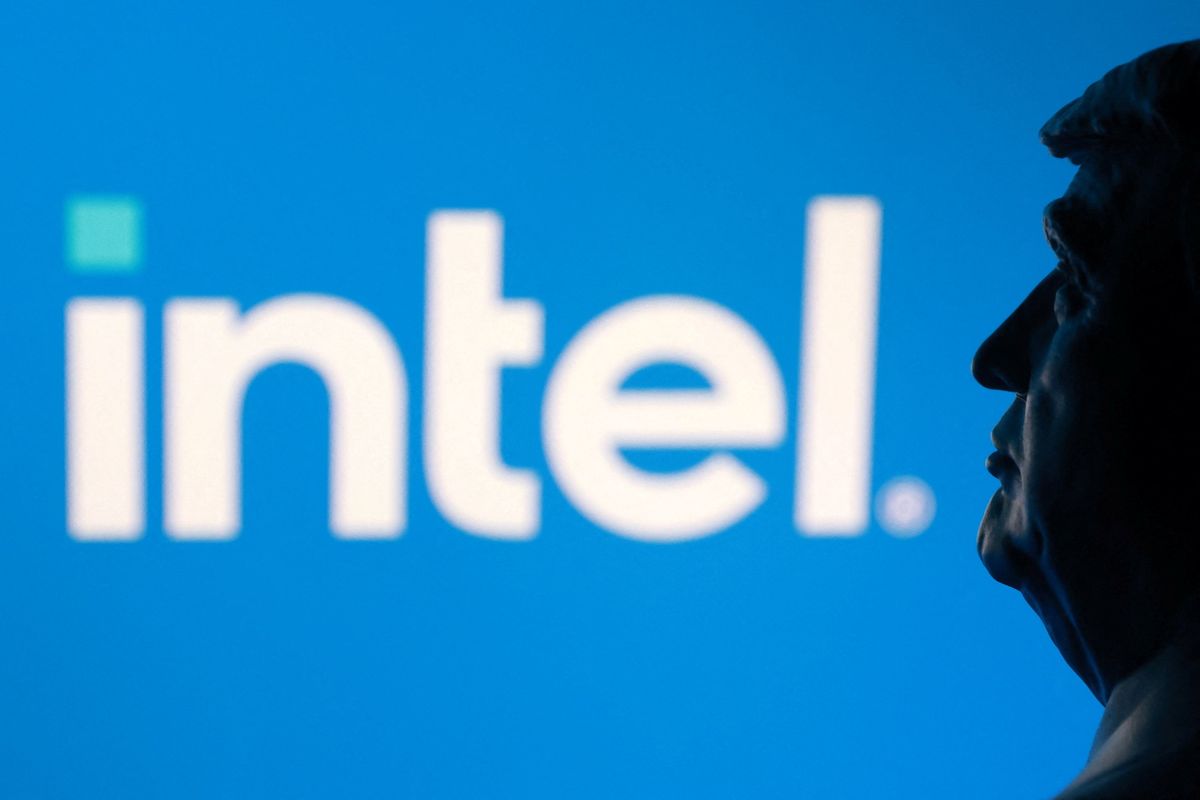
A 3D-printed miniature model depicting U.S. President Donald Trump and Intel logo are seen in this illustration taken August 22, 2025. REUTERS/Dado Ruvic/Illustration

On Friday, President Donald Trump announced that the U.S. government was now a part-owner of a major publicly traded tech company. The reaction among his base was less than enthusiastic.

Trump announced via his Truth Social platform that as of Friday the U.S. is a multibillion-dollar shareholder in Intel as part of an agreement with CEO Lip-Bu Tan — with the U.S. supposedly paying nothing for its new stake. The announcement notably came roughly two weeks after Trump's angry social media tirade against Tan, in which he demanded that Tan "resign immediately" from his role due to his investments in Chinese tech companies.

"It is my Great Honor to report that the United States of America now fully owns and controls 10% of INTEL, a Great American Company that has an even more incredible future," Trump wrote in his signature style of oddly placed capital letters. "I negotiated this Deal with Lip-Bu Tan, the Highly Respected Chief Executive Officer of the Company. The United States paid nothing for these Shares, and the Shares are now valued at approximately $11 Billion Dollars. This is a great Deal for America and, also, a great Deal for INTEL. Building leading edge Semiconductors and Chips, which is what INTEL does, is fundamental to the future of our Nation. MAKE AMERICA GREAT AGAIN! Thank you for your attention to this matter.

While some of the responses to the Trump administration's post on X announcing the news were complimentary, many replies were deeply critical of the government taking ownership of a private company. One user who described themselves in their bio as a "Constitutional Conservative" wrote: "Not what I voted for. I voted against this specifically." Conservative podcast host @amandatalks_ tweeted: "ngl [not gonna lie] don't love this guys."

"I'm a Republican but I do not agree with this," another user posted. "Government and privately owned businesses should not mix."

"Governments shouldn't own private business," tweeted retired Naval officer Mike Rodman.

Aerospace engineer Michael Heil also weighed in, responding to the White House's post by writing: "Not good. Even partial government ownership of private industry is socialism."


'Washington is becoming Chinatown': Wall Street Journal bashes Trump's 'statism' move

Robert Davis
August 24, 2025
RAW STORY


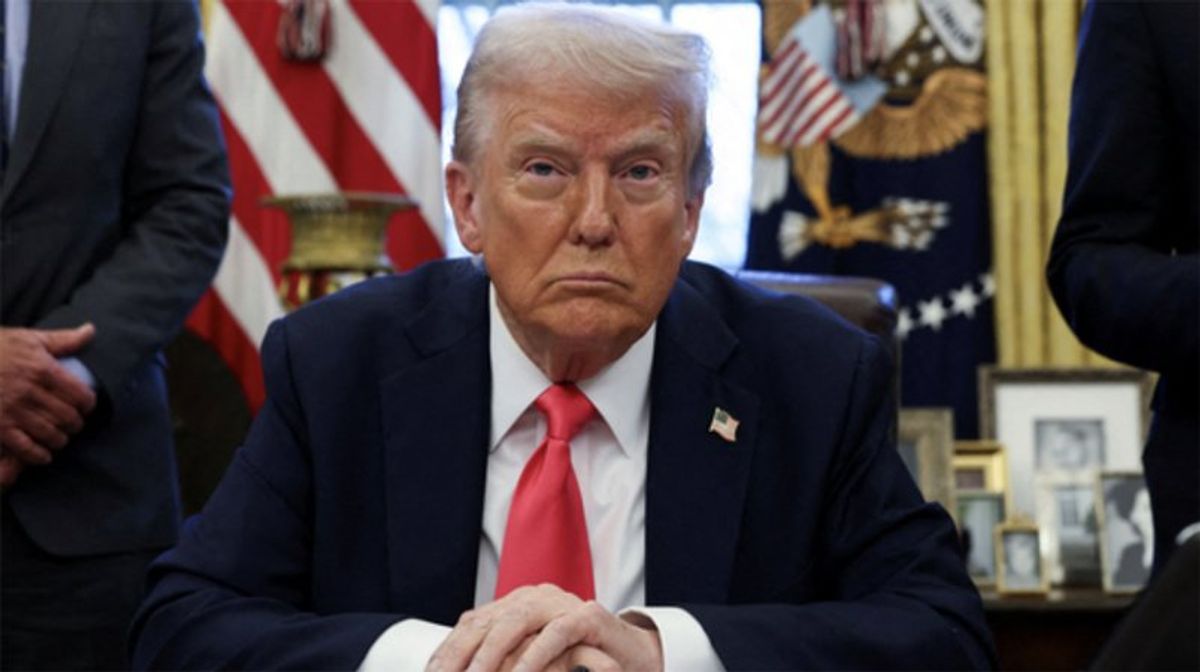
Donald Trump (Photo via Reuters)

The Wall Street Journal's conservative editorial board bashed President Donald Trump's latest business move, arguing that it models China's "statism."

On Friday, Trump announced that the U.S. government is taking a 10% stake in computer chip-maker Intel. The government is paying the company $8.7 billion in all, with the funds coming from an approved but not yet paid grant under the U.S. CHIPS and Science Act and the Secure Enclave program, according to a statement from the company.

The Wall Street Journal's editorial board slammed the deal in a new op-ed, arguing that the deal will stifle innovation at the struggling company

"In the name of competing with China, the U.S. is imitating its model of state-run business," the editorial reads in part. "Washington is becoming Chinatown."

"Mr. Trump accused Kamala Harris of being a socialist, but the Biden Administration never nationalized companies," the editorial continues.

The Journal's editors also found it curious that Trump's policies have not yet received significant pushback from Republicans in Congress.

Why aren’t Republicans pushing back on Mr. Trump’s Intel deal?" the editors asked. "They might consider how the next Democratic President could use the government’s stake to press the left’s political imperatives—Intel profits to build low-income housing? Statism is gaining currency on the political left and right, resulting in a bizarre fusion of ideas."

Read the entire editorial by clicking here.


Trump thinks owning a piece of Intel would be a good deal for the US. Here's what to know

An Intel sign is shown at the chipmaker's global headquarters in Santa Clara, Calif. on Friday, Aug. 8, 2025. (AP Photo/Terry Chea · Associated Press

MICHAEL LIEDTKE
Wed, August 20, 2025 


SAN FRANCISCO (AP) — President Donald Trump wants the U.S. government to own a piece of Intel, less than two weeks after demanding the Silicon Valley pioneer dump the CEO that was hired to turn around the slumping chipmaker. If the goal is realized, the investment would deepen the Trump administration's involvement in the computer industry as the president ramps up the pressure for more U.S. companies to manufacture products domestically instead of relying on overseas suppliers.


What’s happening?

The Trump administration is in talks to secure a 10% stake in Intel in exchange for converting government grants that were pledged to Intel under President Joe Biden. If the deal is completed, the U.S. government would become one of Intel's largest shareholders and blur the traditional lines separating the public sector and private sector in a country that remains the world's largest economy.

Why would Trump do this?

In his second term, Trump has been leveraging his power to reprogram the operations of major computer chip companies. The administration is requiring Nvidia and Advanced Micro Devices, two companies whose chips are helping to power the craze around artificial intelligence, to pay a 15% commission on their sales of chips in China in exchange for export licenses.

Trump’s interest in Intel is also being driven by his desire to boost chip production in the U.S., which has been a focal point of the trade war that he has been waging throughout the world. By lessening the country's dependence on chips manufactured overseas, the president believes the U.S. will be better positioned to maintain its technological lead on China in the race to create artificial intelligence.

Didn’t Trump want Intel’s CEO to quit?

That's what the president said August 7 in an unequivocal post calling for Intel CEO Lip-Bu Tan to resign less than five months after the Santa Clara, California, company hired him. The demand was triggered by reports raising national security concerns about Tan's past investments in Chinese tech companies while he was a venture capitalist. But Trump backed off after Tan professed his allegiance to the U.S. in a public letter to Intel employees and went to the White House to meet with the president, who applauded the Intel CEO for having an “amazing story.”

Why would Intel do a deal?

The company isn't commenting about the possibility of the U.S. government becoming a major shareholder, but Intel may have little choice because it is currently dealing from a position of weakness. After enjoying decades of growth while its processors powered the personal computer boom, the company fell into a slump after missing the shift to the mobile computing era unleashed by the iPhone’s 2007 debut.

Intel has fallen even farther behind in recent years during an artificial intelligence craze that has been a boon for Nvidia and AMD. The company lost nearly $19 billion last year and another $3.7 billion in the first six months of this year, prompting Tan to undertake a cost-cutting spree. By the end of this year, Tan expects Intel to have about 75,000 workers, a 25% reduction from the end of last year.

Would this deal be unusual?

Although rare, it’s not unprecedented for the U.S. government to become a significant shareholder in a prominent company. One of the most notable instances occurred during the Great Recession in 2008 when the government injected nearly $50 billion into General Motors in return for a roughly 60% stake in the automaker at a time it was on the verge of bankruptcy. The government ended up with a roughly $10 billion loss after it sold its stock in GM.

Would the government run Intel?

U.S. Commerce Secretary Howard Lutnick told CNBC during a Tuesday interview that the government has no intention of meddling in Intel's business, and will have its hands tied by holding non-voting shares in the company. But some analysts wonder if the Trump administration's financial ties to Intel might prod more companies looking to curry favor with the president to increase their orders for the company's chips.


What government grants does Intel receive?

Intel was among the biggest beneficiaries of the Biden administration’s CHIPS and Science Act, but it hasn’t been able to revive its fortunes while falling behind on construction projects spawned by the program.

The company has received about $2.2 billion of the $7.8 billion pledged under the incentives program — money that Lutnick derided as a “giveaway” that would better serve U.S. taxpayers if it’s turned into Intel stock. “We think America should get the benefit of the bargain,” Lutnick told CNBC. “It’s obvious that it’s the right move to make.”


Monday, June 26, 2023

MONOPOLY CAPITALI$M

Japan to buy semiconductor materials giant for $6.3 billion


ALL CAPITALI$M IS STATE CAPITALI$M
A semiconductor chip

Illustration: Rebecca Zisser/Axios

Japan Investment Corp., a government-backed group, has agreed to buy Tokyo-listed chipmaking materials provider JSR for $6.3 billion.

Why it matters: This is part of a global trend of governments seeking to safeguard their semiconductor supply chains.

By the numbers: Japan Investment Corp. will offer around $30.40 per JSR share via a tender, representing a 35% premium to Friday's closing price.

  • JSR has around a 30% global market share share for photoresists, light-sensitive polymers that are used as coatings on semiconductor substrates.

More, per Bloomberg: "Those compounds are needed to make semiconductors used in supercomputers, AI-harnessing data centers and missile control systems, not to mention gadgets including iPhones. Government control over the materials critical to powerful chips would grant Japan greater leverage in a world increasingly divided by an escalating US-China technological rift."