
What I Saw in Cuba? Resilience
What I witnessed over those days was not the Cuba of Western propaganda. It was a country enduring a 66-year siege, and a people who, against all odds, continue to build, create, and care for one another.
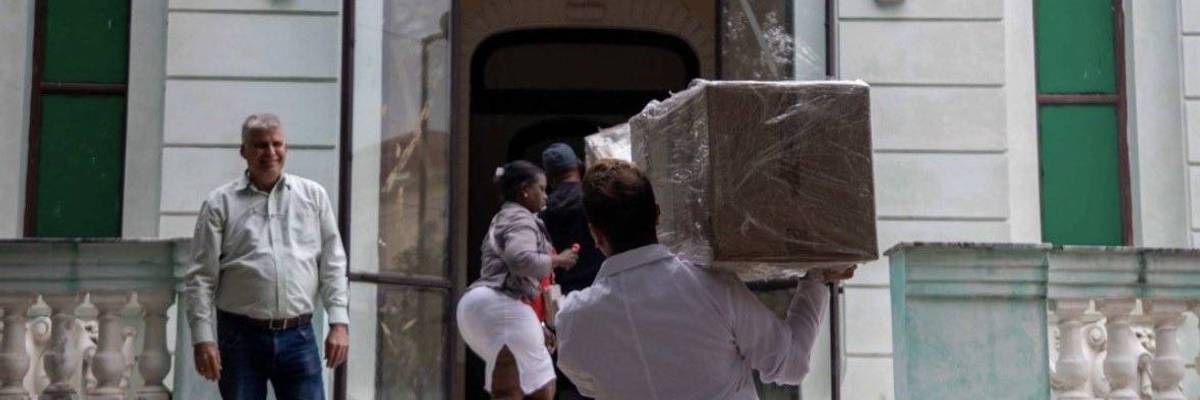
A medical worker carries a box of aid supplies delivered by the Nuestra America Convoy on March 18, 2026 in Havana, Cuba.
(Photo by the Progressive International)
Gerargo Delgado
Mar 28, 2026
A Public Health System Under Siege
One of the most profound visits was to a neighborhood polyclinic in Havana. These clinics are the backbone of Cuba’s public health system. Doctors live on the second floor, above where they work. They know every patient in their community by name. They treat physical and psychological health alike, and they embody a model of care that prioritizes people over profit.
I saw a people who are already free—free to define their own destiny, even under the weight of a siege designed to break them.
But the doctors I met face heartbreaking constraints. They are highly trained professionals who know exactly what their patients need, and they know those treatments exist. Due to the US embargo, they cannot access them. Imagine living every day with the skill to heal and being blocked by a political and economic siege.
We brought what we could: 6,300 pounds of medical supplies delivered by our delegation, including neonatal equipment, analgesics, catheters, and other critical materials, valued at $433,000 and more still in unquantifiable amounts stuffed into carry-on and personal bags, sacrificing space for our own clothing and toiletries. Cuban doctors told us about nights when the power goes out, and medical students rush to respirators, manually pumping air for hours until electricity is restored. They save lives with their bare hands.
Community and Creativity in the Face of Scarcity
Everywhere we went, I saw people organizing to survive. In a central Havana neighborhood, we helped refurbish a crumbling playground. We brought paint and new swings. A local man who maintains the park offered to take the swings down each night so they wouldn’t be taken, then put them back up each morning for the children. That kind of mutual care was everywhere.
We met an artist named Lázaro, who collects garbage and old newspapers to create recycled art. He teaches neighborhood kids to do the same. His studio walls are covered in vibrant works that double as expressions of resistance and creativity.
On another day, we set up a table outside Lázaro’s studio with construction paper, markers, and glue. Children from the neighborhood gathered to write letters to pen pals in Singapore. I translated letters from English to Spanish, helping each child respond in Spanish and illustrate their replies. Parents played drums and danced while the kids painted and wrote. It was a profound moment of cross-border connection—kids building relationships through art and translation, across continents, across the blockade.
For Cuban Americans, there is something like a spiritual cost that is paid for quietly going along with the status quo in the face of the many injustices we have grown up with for decades, which seem to us to have intensified in these recent years. But the children I saw in Havana had their spirit intact.
The Human Cost of the Embargo
The blockade is not an abstraction. Poverty is real. I gave what I could, but as individuals, we cannot meet that scale of need brought upon by a systemic crisis created by US policy.
I came back with a deeper sense of what solidarity looks like: showing up, listening, sharing what we can, and staying connected to the work.
Rolling blackouts on the island are the result of a strategy of siege warfare intensified in January. Cuba has gone months without fuel imports due to sanctions and naval pressure aimed at stopping oil shipments to the island. Power plants cannot run consistently. Hospitals cannot perform necessary surgeries. Water pumping infrastructure fails. This is not a natural disaster. It is man-made violence; it is a silent war.
And yet, the Cuban people do not wait for rescue. They organize. They adapt. They invent.
What I witnessed over those days was not the Cuba of Western propaganda. It was a country enduring a 66-year siege, and a people who, against all odds, continue to build, create, and care for one another.
A medical worker carries a box of aid supplies delivered by the Nuestra America Convoy on March 18, 2026 in Havana, Cuba.
(Photo by the Progressive International)
Gerargo Delgado
Mar 28, 2026
Common Dreams
I traveled to Cuba this month. As a Cuban American, that sentence carries the weight of longing born of an estrangement from my roots. For much of my life, Cuba existed as a distant story, a place I knew only through descriptions from my father.
I was there as part of an international solidarity convoy; over 500 representatives from more than 30 countries, united by a simple conviction: No country has the right to strangle another simply because it chose a different path. I cannot stand by while the island of my family’s heritage is suffocated.
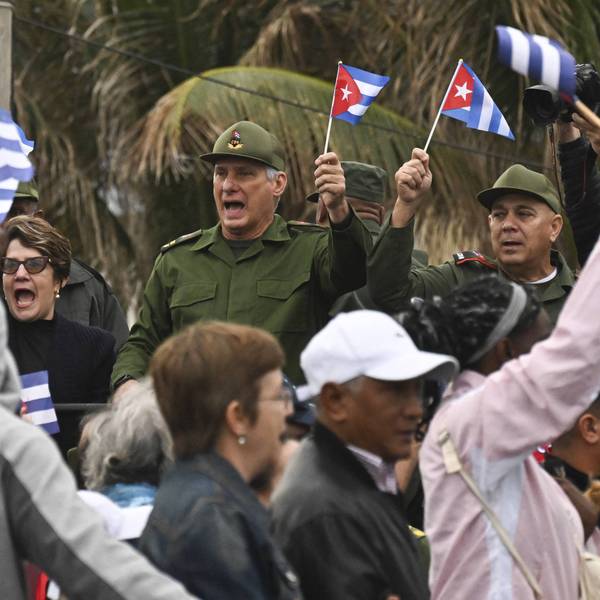
Cuban President Vows ‘Impregnable Resistance’ to Any Trump Attempt to Seize the Island
What I witnessed over those days was not the Cuba of Western propaganda. It was a country enduring a 66-year siege, and a people who, against all odds, continue to build, create, and care for one another.
I traveled to Cuba this month. As a Cuban American, that sentence carries the weight of longing born of an estrangement from my roots. For much of my life, Cuba existed as a distant story, a place I knew only through descriptions from my father.
I was there as part of an international solidarity convoy; over 500 representatives from more than 30 countries, united by a simple conviction: No country has the right to strangle another simply because it chose a different path. I cannot stand by while the island of my family’s heritage is suffocated.
Cuban President Vows ‘Impregnable Resistance’ to Any Trump Attempt to Seize the Island
What I witnessed over those days was not the Cuba of Western propaganda. It was a country enduring a 66-year siege, and a people who, against all odds, continue to build, create, and care for one another.
A Public Health System Under Siege
One of the most profound visits was to a neighborhood polyclinic in Havana. These clinics are the backbone of Cuba’s public health system. Doctors live on the second floor, above where they work. They know every patient in their community by name. They treat physical and psychological health alike, and they embody a model of care that prioritizes people over profit.
I saw a people who are already free—free to define their own destiny, even under the weight of a siege designed to break them.
But the doctors I met face heartbreaking constraints. They are highly trained professionals who know exactly what their patients need, and they know those treatments exist. Due to the US embargo, they cannot access them. Imagine living every day with the skill to heal and being blocked by a political and economic siege.
We brought what we could: 6,300 pounds of medical supplies delivered by our delegation, including neonatal equipment, analgesics, catheters, and other critical materials, valued at $433,000 and more still in unquantifiable amounts stuffed into carry-on and personal bags, sacrificing space for our own clothing and toiletries. Cuban doctors told us about nights when the power goes out, and medical students rush to respirators, manually pumping air for hours until electricity is restored. They save lives with their bare hands.
Community and Creativity in the Face of Scarcity
Everywhere we went, I saw people organizing to survive. In a central Havana neighborhood, we helped refurbish a crumbling playground. We brought paint and new swings. A local man who maintains the park offered to take the swings down each night so they wouldn’t be taken, then put them back up each morning for the children. That kind of mutual care was everywhere.
We met an artist named Lázaro, who collects garbage and old newspapers to create recycled art. He teaches neighborhood kids to do the same. His studio walls are covered in vibrant works that double as expressions of resistance and creativity.
On another day, we set up a table outside Lázaro’s studio with construction paper, markers, and glue. Children from the neighborhood gathered to write letters to pen pals in Singapore. I translated letters from English to Spanish, helping each child respond in Spanish and illustrate their replies. Parents played drums and danced while the kids painted and wrote. It was a profound moment of cross-border connection—kids building relationships through art and translation, across continents, across the blockade.
For Cuban Americans, there is something like a spiritual cost that is paid for quietly going along with the status quo in the face of the many injustices we have grown up with for decades, which seem to us to have intensified in these recent years. But the children I saw in Havana had their spirit intact.
The Human Cost of the Embargo
The blockade is not an abstraction. Poverty is real. I gave what I could, but as individuals, we cannot meet that scale of need brought upon by a systemic crisis created by US policy.
I came back with a deeper sense of what solidarity looks like: showing up, listening, sharing what we can, and staying connected to the work.
Rolling blackouts on the island are the result of a strategy of siege warfare intensified in January. Cuba has gone months without fuel imports due to sanctions and naval pressure aimed at stopping oil shipments to the island. Power plants cannot run consistently. Hospitals cannot perform necessary surgeries. Water pumping infrastructure fails. This is not a natural disaster. It is man-made violence; it is a silent war.
And yet, the Cuban people do not wait for rescue. They organize. They adapt. They invent.
Solidarity and a Call to Action
As a Cuban American, I have heard all my life that Cuba is a country ruled by capricious autocrats. That the Cuban people are waiting to be liberated. That their strangulation is meant to help them. But standing on that island, talking to doctors and artists and children and families, I saw something else entirely. I saw a people who are already free—free to define their own destiny, even under the weight of a siege designed to break them.
Cuba is open to dialogue and investment with respect for its sovereignty. But the US continues to enforce a policy that even much of the world condemns. Year after year, the United Nations General Assembly votes overwhelmingly to end the embargo. Year after year, the US ignores it.
I came back with a deeper sense of what solidarity looks like: showing up, listening, sharing what we can, and staying connected to the work. But solidarity cannot end after a single delegation. We need to break the siege. We need to end this decades-long economic warfare.
Cubans have a right to self-governance. They have a right to medicine, to electricity, to water, to dignity. My father chose to leave Cuba in the face of poverty brought on by a cruel sanctions regime. I chose to return for the same reason.
Let Cuba live.
Our work is licensed under Creative Commons (CC BY-NC-ND 3.0). Feel free to republish and share widely.
Gerargo Delgado
Gerardo Delgado is a Cuban-American educator in Miami, Florida. Working with the Miami Coalition to End the US Blockade of Cuba. He recently was a delegate on CODEPINK’s delegation to Cuba as part of the Nuestra América Convoy.
Full Bio >
As a Cuban American, I have heard all my life that Cuba is a country ruled by capricious autocrats. That the Cuban people are waiting to be liberated. That their strangulation is meant to help them. But standing on that island, talking to doctors and artists and children and families, I saw something else entirely. I saw a people who are already free—free to define their own destiny, even under the weight of a siege designed to break them.
Cuba is open to dialogue and investment with respect for its sovereignty. But the US continues to enforce a policy that even much of the world condemns. Year after year, the United Nations General Assembly votes overwhelmingly to end the embargo. Year after year, the US ignores it.
I came back with a deeper sense of what solidarity looks like: showing up, listening, sharing what we can, and staying connected to the work. But solidarity cannot end after a single delegation. We need to break the siege. We need to end this decades-long economic warfare.
Cubans have a right to self-governance. They have a right to medicine, to electricity, to water, to dignity. My father chose to leave Cuba in the face of poverty brought on by a cruel sanctions regime. I chose to return for the same reason.
Let Cuba live.
Our work is licensed under Creative Commons (CC BY-NC-ND 3.0). Feel free to republish and share widely.
Gerargo Delgado
Gerardo Delgado is a Cuban-American educator in Miami, Florida. Working with the Miami Coalition to End the US Blockade of Cuba. He recently was a delegate on CODEPINK’s delegation to Cuba as part of the Nuestra América Convoy.
Full Bio >
Cuba holds civilian military drills amid deepening fuel crisis
Issued on: 28/03/2026 -
Cuba held a nationwide civilian military exercise Friday involving weapons training and combat drills, part of a broader push to expand militarisation to youth under its “war of the entire people” doctrine, which authorities describe as a collective patriotic duty. The drills came amid a deepening humanitarian crisis for the island as it faces chronic fuel shortages due to a US oil blockade.
Video by: FRANCE 24
Issued on: 28/03/2026 -
Cuba held a nationwide civilian military exercise Friday involving weapons training and combat drills, part of a broader push to expand militarisation to youth under its “war of the entire people” doctrine, which authorities describe as a collective patriotic duty. The drills came amid a deepening humanitarian crisis for the island as it faces chronic fuel shortages due to a US oil blockade.
Video by: FRANCE 24
“Trump has started illegal regime change conflicts in Venezuela and Iran and is now threatening Cuba,” said Rep. Pramila Jayapal. “We must pass this legislation to block him from acting on a whim.”
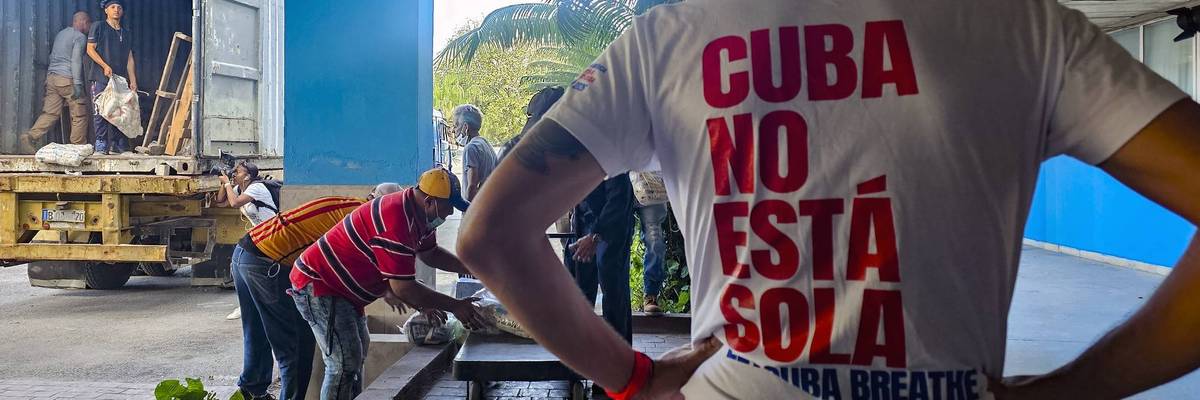
Aid brought by the Nuestra América Convoy from Mexico is unloaded at the William Soler Pediatric Cardiocenter in Havana, Cuba on March 25, 2026.
(Photo by Lisandra Cots/AFP via Getty Images)
Jessica Corbett
Mar 26, 2026
COMMON DREAMS
Amid calls for Congress to “do something—before it is too late,” a pair of US House Democrats on Thursday introduced the Prevent an Unconstitutional War in Cuba Act to block President Donald Trump from using any federal funds to take military action against the island nation without congressional authorization.
The proposal from Reps. Pramila Jayapal (D-Wash.) and Gregory Meeks (D-NY), ranking member of the House Foreign Affairs Committee, comes after Trump ramped up the United States’ decades-long economic blockade, cutting off Cuba from Venezuelan oil. The fuel shortage has led to island-wide blackouts, and disrupted everything from healthcare to transportation. As Jayapal put it earlier this month, the “cruel and failing policy... has caused incredible harm to the Cuban people.”
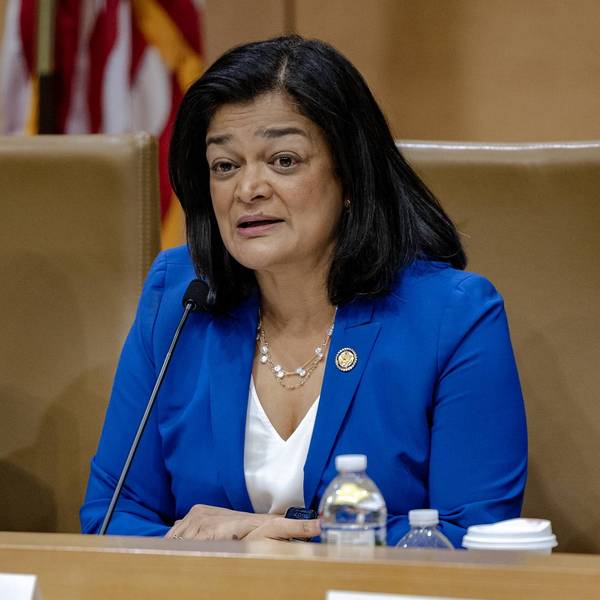
Jayapal Rips ‘Cruel and Failing’ US Policy After Trump Says ‘Cuba Is Gonna Fall’
Warning of Another ‘Disaster’ Like Iran, Senators Introduce War Powers Resolution on Cuba
Trump has also repeatedly threatened a US takeover of Cuba. His other misadventures abroad—such as joining Israel in waging war on Iran without authorization from Congress, bombing boats allegedly being used to smuggle drugs in the Caribbean Sea and Pacific Ocean, and abducting President Nicolás Maduro from Venezuela in an operation that killed dozens of Venezuelans and Cubans—have fueled fears that he may act on those threats, as Jayapal signaled in a Thursday statement.
“Trump has started illegal regime change conflicts in Venezuela and Iran and is now threatening Cuba. These military attacks put our troops in danger, endanger innocent civilians, waste billions of taxpayer dollars, and are not what the American people want,” she said. “Trump promised to end forever wars—he lied. Congress alone has the power to declare war, something Trump clearly does not respect. He has no plan to improve conditions for the Cuban people or promote democracy, and we must pass this legislation to block him from acting on a whim.”
The bill’s prohibition on funding military action against Cuba does not apply to any use of force that is consistent with the section of the War Powers Act that empowers the president to respond to a “national emergency” created by an attack on the United States or its armed forces. In January, Trump notably signed an executive order declaring a national emergency with respect to Cuba and authorized new tariffs on imports from countries that supply oil to the island.
As with Iran pre-war, the Trump administration is currently engaged in negotiations with the Cuban government. Those talks are being led by US Secretary of State Marco Rubio, a son of Cuban immigrants and longtime supporter of regime change in the country, who said earlier this month that “the embargo is tied to political change on the island... They’re in a lot of trouble, and the people in charge, they don’t know how to fix it, so they have to get new people in charge.”
Predictions over whether Trump will actually bomb or invade Cuba, which is located just 90 miles south of Florida, remain mixed.
“I think once Donald Trump gets an economic agreement that opens the island to US business, he will have fulfilled his transactional aims in Cuba. I don’t think he cares about political transition. He doesn’t seem to care about it in Venezuela,” American University professor and Back Channel to Cuba coauthor William LeoGrande told USA Today this week. “And so, I think once there’s an economic agreement that’s to the advantage of the United States and US businesses, the president will move on to the next thing.”
Current Affairs editor-in-chief Nathan Robinson, who’s reported on the Nuestra América Convoy from Havana this week, declared on Wednesday that “they WILL run the Venezuela playbook on Cuba.”
“They want a Republican donor imperial viceroy who will privatize the Cuban healthcare and school systems, and hand all the waterfront property to developers, with the Cuban people serving as cheap labor building a playground for Miami’s rich,” said Robinson.
Meeks—who is facing pressure to force a vote on his Iran war powers resolution—said Thursday that “Cuba is not for Donald Trump to take, and today we stand firm against the illegal use of the US military to pursue turning Cuba into another playground for Trump’s chaotic adventurism.”
“Such a reckless course would risk American lives, cost taxpayers billions, and, in all likelihood, leave the underlying political and economic conditions unchanged,” he said. “The United States cannot bomb Cuba out of economic collapse or political repression—lasting change must come through empowering the Cuban people, not doubling down on a failed approach that disproportionately harms them.”
The new bill is backed by Democratic Reps. Gabe Amo (RI), Joaquin Castro (Texas), Sara Jacobs (Calif.), Jesús “Chuy” García (Ill.), Hank Johnson (Ga.), Sydney Kamlager-Dove (Calif.), Jim McGovern (Mass.), Eleanor Holmes Norton (DC), Mark Pocan (Wis.), Jan Schakowsky (Ill.), Melanie Stansbury (NM), Dina Titus (Nev.), Rashida Tlaib (Mich.), and Nydia Velázquez (NY). However, like legislation aimed at stopping Trump’s boat strikes, aggression toward Venezuela, and war on Iran, it is unlikely to be passed by the GOP-controlled Congress.
Still, earlier this week, Velázquez also introduced a war powers resolution to prevent US involvement in military hostilities against the island. She said in a statement that “Donald Trump’s belligerent foreign policy is creating new wars and conflicts across the world.”
“This administration’s foreign policy is totally out of control and is putting countless American and foreign lives at risk,” Velázquez warned. “Trump’s military blockade, his threats, and his track record this term show that Congress must reassert its constitutional authority and stop another disastrous war before it’s too late.”

No comments:
Post a Comment