Kanaky: Mobilization on 21 March against colonialism
Thursday 26 March 2026, by An Gwesped
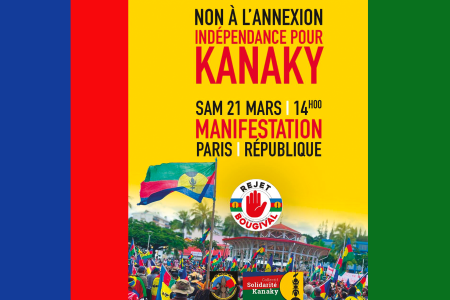
For several months, the French government has been trying to impose on Kanaky an exit from the framework of the Nouméa Accords, by calling into question the decolonization process, even though it is recognized by the UN. The so-called “Bougival Agreement”, imposed in July 2025 against the advice of the Kanak and Socialist National Liberation Front (FLNKS), provides for the creation of a “state” of Kanaky-New Caledonia integrated into the French republic. A formula that in no way corresponds to independence.
On 24 February 2026, the French Senate adopted the corresponding constitutional revision, despite strong criticism, including from the non-independence camp. However, all the signals are red: the absence of local consensus, a historical condition of political equilibrium in Kanaky, poses the risk of a new explosion. The executive nevertheless persists in moving forward, in continuity with the methods already at work during the third referendum imposed in 2021 or the attempt to unblock the electoral body in 2024.
Upholding the right to self-determination
It is in this context that the mobilization of 21 March is being organized, on the occasion of the International Day against Racial Discrimination and the opening of the Anti-Colonial and Anti-Racist Week. The organisers call for “the immediate abandonment of the Bougival draft agreement” and for “respect for the Kanak people’s right to self-determination”.
While the text is due to be examined by the National Assembly at the end of March, the challenge is clear: to prevent a new passage by force and to impose the reopening of discussions within the framework of the Noumea agreements. More broadly, it is a question of recalling that no lasting solution can be imposed against the will of the Kanak people.
Repression and colonial justice
This policy is accompanied by massive repression. The opinion issued in January 2026 by the National Consultative Commission on Human Rights (CNCDH) draws a damning conclusion: “violent, sometimes lethal repression”, different judicial treatment between Kanak and non-Kanak, "collective retaliation measures” targeting the Kanak populations. More than 2,500 police custody cases were recorded, almost exclusively targeting Kanaks, while loyalist militias were not prosecuted.
In this context, the death on 6 February of Frédéric Grochain, a 31-year-old Kanak transferred to mainland France after the 2024 revolts, was deeply shocking. Found dead in his cell after months of isolation, he embodied the consequences of a prison policy that prolonged colonial domination: forced release, isolation, failures in health care. For the FLNKS, he is “a direct victim of the colonial judicial and prison system”.

No comments:
Post a Comment