
Cuba Operating on Fumes While Marco Rubio Smirks
It’s doubly ironic that Rubio who thinks he knows so much about Cuba has been to Cuba only once, for only one day visiting the American prison at the US naval base at Guantanamo, Cuba.
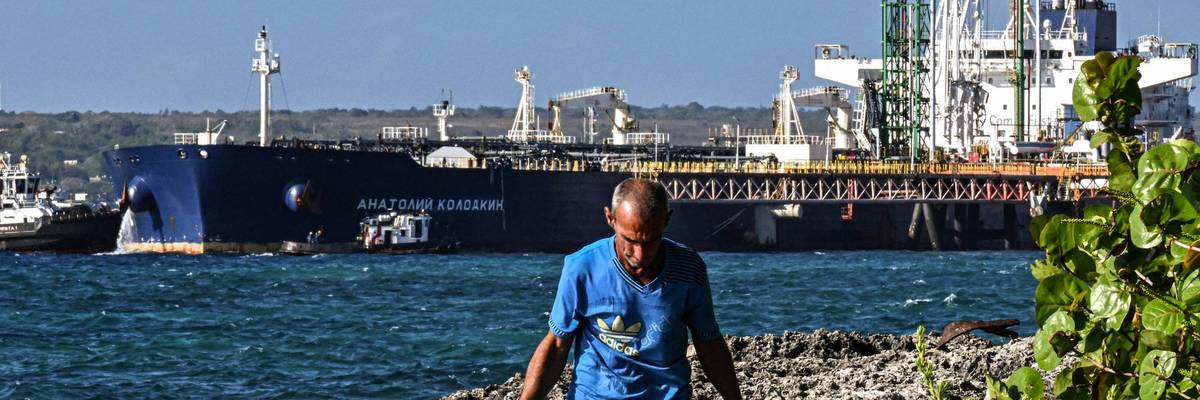
A man walks as the Russian oil tanker Anatoly Kolodkin is seen at the oil terminal in the port of Matanzas, northwestern Cuba, on March 31, 2026. The Anatoly Kolodkin, a tanker under US sanctions carrying 730,000 barrels of crude, is set to deliver the first crude shipment to Cuba since January after Washington gave the crisis-hit island a reprieve from an effective fuel blockade.
(Photo by Yamil Lage / AFP via Getty Images)
Ann Wright
Apr 01, 2026
Apr 01, 2026
Common Dreams
As 700 international solidarity citizens visited Cuba last weekend, Cuban-American Secretary of State Marco Rubio smirked at the humanitarian disaster his and Trump’s policies were wrecking on Cuba, as small island nation of 9 million people only 90 miles off the tip of Florida. Rubio had predicted the Cuban government would fall from the disastrous policies, particularly the blockade of fuel to the island.
But Rubio’s plan was partially upended on Sunday night, when President Trump decided to allow a Russian oil tanker carrying 100 tons of oil to deliver it to Cuba.
International Citizens Solidarity with Cuba, While Nations Turn Their Backs on Cuba
Last weekend, I was in Cuba for the second time in two months, joining 700 international solidarity citizens from 30 countries. Organized in less than six weeks by Progressive International, CODEPINK: Women For Peace, and many other groups, hundreds of persons outraged about the latest US punishment of the Cuban people saw very quickly and deeply the inhumane effects of the recent oil embargo as well as the cumulative effects of a 65-year-old US economic blockade of Cuba.
On my first trip this year, in late January 2026, the capital city of Havana, where we spent most of our time, was showing definite signs of the negative effects of the blockade, particularly of the fuel shortage.
Six weeks later in mid-March, the lack of fuel was starkly evident. Very few cars were on the streets. Lines for the few buses with fuel were very long.
Cubans were cooking with wood in the parks as electricity was sporadic.
Electrical blackouts of the entire country were frequent.
Hospital generators were almost out of fuel.
Cuba Operating on Fumes
Aiming directly at Mexico, Trump’s January 29, 2026 executive order threatened heavy tariffs on “any other country that directly or indirectly sells or otherwise provides any oil to Cuba.” PEMEX, the Mexico state oil company, has been the primary supplier of oil to Cuba after the kidnapping of Venezuelan President Nicolas Maduro in January. Sadly, bending to Washington’s threat, with only two to three weeks left of oil in Cuba at the time of the executive order, the Mexican government suspended shipments of oil to keep the country running.
While rumors abounded of Russia sending an oil tanker to Cuba, no ship was in sight until Sunday.
In the meantime, Cuba is operating on fumes.
Secretary of State Marco Rubio Willing to Torpedo the Entire Country of Cuba
It is ironic that Cuban-American Rubio has US citizenship through the “birthright law” that he and the Trump administration are trying to eliminate. The US Supreme Court is hearing arguments on Rubio’s case for torpedoing the birthright law on April 1.
Rubio was born in the US of non-U.S. citizen parents who fled the Baptista regime before the Cuban revolution against Baptista. Finally, journalists delved into his background years after Rubio entered politics and he was forced to acknowledge his “birthright” citizenship something he had kept hidden.
It’s doubly ironic that Rubio who thinks he knows so much about Cuba has been to Cuba only once, for only one day visiting the American prison at the US naval base at Guantanamo, Cuba.
Rubio grew up in Miami in midst of the fervent anti-revolution rhetoric and actions. He quickly saw that his political future rested with being as anti-revolution as possible, despite the strides in health and education that were being made in Cuba.
U.S. Government, not the Cuban Government, Holding up Compensation of US Citizens and Corporations from 1959 Nationalization
In his many years in Florida state politics and then as a US senator, Rubio refused to acknowledge that it was the US government that stopped compensation of US individuals and corporations when the revolutionary government nationalized services for the people to take them from the hands of the private sector that was getting richer and richer off the backs of the poverty stricken and enslaved Cubans.
After the 1959 revolution, Cuba negotiated “lump sum” compensation packages with Canada, Switzerland, the United Kingdom, Spain, and France for individuals and corporations whose property had been nationalized.
The United States, however, refused to participate in the compensation plan for US individuals and businesses. Instead, the US decided efforts to overthrow the revolutionary Cuban government would be its strategy.
Today, 65-years later, in order to attract US private investment to Cuba, Cuban Deputy Foreign Minister Carlos Fernández de Cossio told Drop Site News that the Cuban government will attempt to convince the US government to agree to a “lump sum” to handle the claims of approximately 6,000 US individuals and businesses who have filed claims for nationalized property, as a part of a larger agreement that would eliminate US sanctions and the economic blockade. The claims that have been certified by US Foreign Claims settlement Commission initially totaled $1.9 billion but now with interest accumulated over the decades amount to around $9 billion.
Trump’s “Change of Heart” to Let Oil Come Into Cuba
On an evening flight of Air Force One on Sunday, President Trump said to reporters: “I told them if a country wants to send some oil into Cuba right now, I have no problem with that, whether it’s Russia or not. Whether or not they get a boat of oil, it’s not going to matter. I’d prefer letting it in, whether it’s Russia or anybody else, because the people need heat and cooling and everything else.”
The Russian-owned oil tanker Anatoly Kolodkin left Primorsk, Russia on March 8 carrying 730,000 barrels of crude oil (100,000 tons) and is expected to dock at the Matanzas, Cuba oil storage facility on the morning of April 1. The tanker was accompanied by a Russian naval escort through the English Channel. The oil will be processed at one of Cuba’s three refineries, located in Havana, Cienfuegos, and Santiago.
When questioned about the oil delivery, Russian government spokesman Dmitry Peskov said, “The brutal blockade is jeopardizing life-support systems and electricity generation” and inhibiting the ability of Cubans to provide medical services. “Russia considers it its duty not to stand idly by and to provide the necessary assistance to our Cuban friends.”
International Group Visits Cuba in Solidarity with the Cuban People
The international delegations last week with over 700 persons were a part of a globalized effort called the Nuestra América Convoy organized by Progressive International. Hundreds of people came to Cuba from Latin America, the United States, Canada, and Europe to denounce the US blockade on Cuba and deliver life-saving aid to the Cuban people.
CODEPINK’s Nuestra América Convoy delegation of 170 people brought together a politically diverse but deeply aligned group of people—healthcare workers, lawyers, professors, students, veterans, labor organizers, journalists, independent media workers, photographers, filmmakers, writers, artists, researchers, faith-based activists, immigrant justice organizers, reproductive justice advocates, Palestine solidarity activists, Black liberation organizers, cultural workers, and more.
CODEPINK’s delegation delivered 6,300 pounds of urgently needed medicines and medical supplies, including neonatal equipment, analgesics, catheters, and other critical hospital materials. The supplies, valued at $433,000, were collected by Global Health Partners.
In addition to the several tons of medical aid, delegates brought suitcases containing supplies tailored to the needs of specific groups affected by the blockade, such as LGBTQ+ people, artists, students, animals, and others.
In total, the Nuestra America convoy delivered:More than $400,000 of humanitarian supplies on a charter flight, including medical equipment, medicines, staple foods, infant nutrition products, and hygiene supplies, coordinated by CODEPINK.
Over $500,000 worth of solar panels and generators to support hospitals and essential infrastructure facing electricity shortages.
Over 2000 pounds of medical supplies from Europe, carried by a medical delegation travelling from Milan, Italy.
Cancer medicines valued at $23,000 organized by Global Exchange.
Around 1100 pounds of medical supplies from Brazil, coordinated by the Brazilian Front of Solidarity with Cuba.
Solar-powered equipment from Colombia, including solar chargers and lighting systems.
Menstrual health kits for approximately 1,300 women, organized by a solidarity coalition in Mexico.
$100,000 in aid for maternity centers.
Our work is licensed under Creative Commons (CC BY-NC-ND 3.0). Feel free to republish and share widely.
Ann Wright
Ann Wright is a 29 year US Army/Army Reserves veteran who retired as a Colonel and a former US diplomat who resigned in March 2003 in opposition to the war on Iraq. She served in Nicaragua, Grenada, Somalia, Uzbekistan, Kyrgyzstan, Sierra Leone, Micronesia and Mongolia. In December 2001 she was on the small team that reopened the US Embassy in Kabul, Afghanistan. She is the co-author of the book "Dissent: Voices of Conscience."
Full Bio >
As 700 international solidarity citizens visited Cuba last weekend, Cuban-American Secretary of State Marco Rubio smirked at the humanitarian disaster his and Trump’s policies were wrecking on Cuba, as small island nation of 9 million people only 90 miles off the tip of Florida. Rubio had predicted the Cuban government would fall from the disastrous policies, particularly the blockade of fuel to the island.
But Rubio’s plan was partially upended on Sunday night, when President Trump decided to allow a Russian oil tanker carrying 100 tons of oil to deliver it to Cuba.
International Citizens Solidarity with Cuba, While Nations Turn Their Backs on Cuba
Last weekend, I was in Cuba for the second time in two months, joining 700 international solidarity citizens from 30 countries. Organized in less than six weeks by Progressive International, CODEPINK: Women For Peace, and many other groups, hundreds of persons outraged about the latest US punishment of the Cuban people saw very quickly and deeply the inhumane effects of the recent oil embargo as well as the cumulative effects of a 65-year-old US economic blockade of Cuba.
On my first trip this year, in late January 2026, the capital city of Havana, where we spent most of our time, was showing definite signs of the negative effects of the blockade, particularly of the fuel shortage.
Six weeks later in mid-March, the lack of fuel was starkly evident. Very few cars were on the streets. Lines for the few buses with fuel were very long.
Cubans were cooking with wood in the parks as electricity was sporadic.
Electrical blackouts of the entire country were frequent.
Hospital generators were almost out of fuel.
Cuba Operating on Fumes
Aiming directly at Mexico, Trump’s January 29, 2026 executive order threatened heavy tariffs on “any other country that directly or indirectly sells or otherwise provides any oil to Cuba.” PEMEX, the Mexico state oil company, has been the primary supplier of oil to Cuba after the kidnapping of Venezuelan President Nicolas Maduro in January. Sadly, bending to Washington’s threat, with only two to three weeks left of oil in Cuba at the time of the executive order, the Mexican government suspended shipments of oil to keep the country running.
While rumors abounded of Russia sending an oil tanker to Cuba, no ship was in sight until Sunday.
In the meantime, Cuba is operating on fumes.
Secretary of State Marco Rubio Willing to Torpedo the Entire Country of Cuba
It is ironic that Cuban-American Rubio has US citizenship through the “birthright law” that he and the Trump administration are trying to eliminate. The US Supreme Court is hearing arguments on Rubio’s case for torpedoing the birthright law on April 1.
Rubio was born in the US of non-U.S. citizen parents who fled the Baptista regime before the Cuban revolution against Baptista. Finally, journalists delved into his background years after Rubio entered politics and he was forced to acknowledge his “birthright” citizenship something he had kept hidden.
It’s doubly ironic that Rubio who thinks he knows so much about Cuba has been to Cuba only once, for only one day visiting the American prison at the US naval base at Guantanamo, Cuba.
Rubio grew up in Miami in midst of the fervent anti-revolution rhetoric and actions. He quickly saw that his political future rested with being as anti-revolution as possible, despite the strides in health and education that were being made in Cuba.
U.S. Government, not the Cuban Government, Holding up Compensation of US Citizens and Corporations from 1959 Nationalization
In his many years in Florida state politics and then as a US senator, Rubio refused to acknowledge that it was the US government that stopped compensation of US individuals and corporations when the revolutionary government nationalized services for the people to take them from the hands of the private sector that was getting richer and richer off the backs of the poverty stricken and enslaved Cubans.
After the 1959 revolution, Cuba negotiated “lump sum” compensation packages with Canada, Switzerland, the United Kingdom, Spain, and France for individuals and corporations whose property had been nationalized.
The United States, however, refused to participate in the compensation plan for US individuals and businesses. Instead, the US decided efforts to overthrow the revolutionary Cuban government would be its strategy.
Today, 65-years later, in order to attract US private investment to Cuba, Cuban Deputy Foreign Minister Carlos Fernández de Cossio told Drop Site News that the Cuban government will attempt to convince the US government to agree to a “lump sum” to handle the claims of approximately 6,000 US individuals and businesses who have filed claims for nationalized property, as a part of a larger agreement that would eliminate US sanctions and the economic blockade. The claims that have been certified by US Foreign Claims settlement Commission initially totaled $1.9 billion but now with interest accumulated over the decades amount to around $9 billion.
Trump’s “Change of Heart” to Let Oil Come Into Cuba
On an evening flight of Air Force One on Sunday, President Trump said to reporters: “I told them if a country wants to send some oil into Cuba right now, I have no problem with that, whether it’s Russia or not. Whether or not they get a boat of oil, it’s not going to matter. I’d prefer letting it in, whether it’s Russia or anybody else, because the people need heat and cooling and everything else.”
The Russian-owned oil tanker Anatoly Kolodkin left Primorsk, Russia on March 8 carrying 730,000 barrels of crude oil (100,000 tons) and is expected to dock at the Matanzas, Cuba oil storage facility on the morning of April 1. The tanker was accompanied by a Russian naval escort through the English Channel. The oil will be processed at one of Cuba’s three refineries, located in Havana, Cienfuegos, and Santiago.
When questioned about the oil delivery, Russian government spokesman Dmitry Peskov said, “The brutal blockade is jeopardizing life-support systems and electricity generation” and inhibiting the ability of Cubans to provide medical services. “Russia considers it its duty not to stand idly by and to provide the necessary assistance to our Cuban friends.”
International Group Visits Cuba in Solidarity with the Cuban People
The international delegations last week with over 700 persons were a part of a globalized effort called the Nuestra América Convoy organized by Progressive International. Hundreds of people came to Cuba from Latin America, the United States, Canada, and Europe to denounce the US blockade on Cuba and deliver life-saving aid to the Cuban people.
CODEPINK’s Nuestra América Convoy delegation of 170 people brought together a politically diverse but deeply aligned group of people—healthcare workers, lawyers, professors, students, veterans, labor organizers, journalists, independent media workers, photographers, filmmakers, writers, artists, researchers, faith-based activists, immigrant justice organizers, reproductive justice advocates, Palestine solidarity activists, Black liberation organizers, cultural workers, and more.
CODEPINK’s delegation delivered 6,300 pounds of urgently needed medicines and medical supplies, including neonatal equipment, analgesics, catheters, and other critical hospital materials. The supplies, valued at $433,000, were collected by Global Health Partners.
In addition to the several tons of medical aid, delegates brought suitcases containing supplies tailored to the needs of specific groups affected by the blockade, such as LGBTQ+ people, artists, students, animals, and others.
In total, the Nuestra America convoy delivered:More than $400,000 of humanitarian supplies on a charter flight, including medical equipment, medicines, staple foods, infant nutrition products, and hygiene supplies, coordinated by CODEPINK.
Over $500,000 worth of solar panels and generators to support hospitals and essential infrastructure facing electricity shortages.
Over 2000 pounds of medical supplies from Europe, carried by a medical delegation travelling from Milan, Italy.
Cancer medicines valued at $23,000 organized by Global Exchange.
Around 1100 pounds of medical supplies from Brazil, coordinated by the Brazilian Front of Solidarity with Cuba.
Solar-powered equipment from Colombia, including solar chargers and lighting systems.
Menstrual health kits for approximately 1,300 women, organized by a solidarity coalition in Mexico.
$100,000 in aid for maternity centers.
Our work is licensed under Creative Commons (CC BY-NC-ND 3.0). Feel free to republish and share widely.
Ann Wright
Ann Wright is a 29 year US Army/Army Reserves veteran who retired as a Colonel and a former US diplomat who resigned in March 2003 in opposition to the war on Iraq. She served in Nicaragua, Grenada, Somalia, Uzbekistan, Kyrgyzstan, Sierra Leone, Micronesia and Mongolia. In December 2001 she was on the small team that reopened the US Embassy in Kabul, Afghanistan. She is the co-author of the book "Dissent: Voices of Conscience."
Full Bio >
Russian tanker set to deliver oil to crisis-hit Cuba
By AFP
March 31, 2026

The Anatoly Kolodkin, a tanker under US sanctions, is on its way to the port of Matanzas, east of Havana, with 730,000 barrels of crude - Copyright AFP Yamil LAGE
Lisandra COTS
A Russian oil tanker was set to deliver the first crude shipment to Cuba since January on Tuesday after Washington gave the crisis-hit island a reprieve from an effective fuel blockade.
The Anatoly Kolodkin, a tanker under US sanctions, was on its way to the port of Matanzas, east of Havana, with 730,000 barrels of crude.
US President Donald Trump’s decision to let Russia deliver the oil avoids a confrontation with Moscow and provides temporary relief to a country that has endured blackouts, fuel rationing and dwindling public transportation.
“We’ll welcome it with open arms. You have no idea how badly we need that oil,” said Rosa Perez, a 74-year-old retiree whose home in Matanzas had lost power again.
“Let’s see if things improve for us, even just a little… I can’t take it anymore,” she told AFP, voicing hope that more shipments will follow.
Trump said Sunday that he did not object to Russia or others sending oil to the island because Cubans “have to survive.”
The White House denied however that there was any change to US sanctions policy.
“We allowed this ship to reach Cuba in order to provide humanitarian needs to the Cuban people. These decisions are being made on a case-by-case basis,” White House Press Secretary Karoline Leavitt said.
– Driving Cuba ‘to the brink’ –
Cuba was cut off from oil supplies in January after US forces ousted its main regional ally, Venezuela’s socialist leader Nicolas Maduro, and Trump threatened tariffs on countries that send crude to the country.
The US president has mused about “taking” the communist-ruled island, though Cuban President Miguel Diaz-Canel confirmed in March that Cuban and US officials had held talks.
Ricardo Herrero, executive director of the Cuba Study Group, a nonpartisan policy group in Washington, said the aim of restricting oil was to force Havana “to make real concessions at the negotiating table.”
“The strategy here is to drive the system to the brink,” Herrero told AFP. “But it’s not to precipitate a full-blown societal or humanitarian collapse.”
“It’s all consistent with idea that the US holds all the cards and they’ll decide when to hold, when to fold and when they go all in,” he said.
– Two weeks of diesel –
Cubans have endured seven nationwide blackouts since 2024, including two in March, and fuel prices have soared.
The blackouts as well as persistent shortages of food and medicine have fueled public frustration and some rare protests.
Analysts said the Russian oil would buy the Cuban economy only a few weeks.
Jorge Pinon, an expert on Cuba’s energy sector at the University of Texas at Austin, said the more urgent need is diesel, which could be used for backup power generators or for transportation systems to keep the economy running.
It would take a month to refine the oil and deliver the diesel, which would be enough to cover demand for about two weeks, he said.
Herrero said the shipment was just “another donation” by Cuba’s Russian ally, but he doubted that Moscow wanted to subsidize the Cuban economy in the long term.
“This is not going to help the economy recover,” he said. “This is just humanitarian aid.”
By AFP
March 31, 2026
The Anatoly Kolodkin, a tanker under US sanctions, is on its way to the port of Matanzas, east of Havana, with 730,000 barrels of crude - Copyright AFP Yamil LAGE
Lisandra COTS
A Russian oil tanker was set to deliver the first crude shipment to Cuba since January on Tuesday after Washington gave the crisis-hit island a reprieve from an effective fuel blockade.
The Anatoly Kolodkin, a tanker under US sanctions, was on its way to the port of Matanzas, east of Havana, with 730,000 barrels of crude.
US President Donald Trump’s decision to let Russia deliver the oil avoids a confrontation with Moscow and provides temporary relief to a country that has endured blackouts, fuel rationing and dwindling public transportation.
“We’ll welcome it with open arms. You have no idea how badly we need that oil,” said Rosa Perez, a 74-year-old retiree whose home in Matanzas had lost power again.
“Let’s see if things improve for us, even just a little… I can’t take it anymore,” she told AFP, voicing hope that more shipments will follow.
Trump said Sunday that he did not object to Russia or others sending oil to the island because Cubans “have to survive.”
The White House denied however that there was any change to US sanctions policy.
“We allowed this ship to reach Cuba in order to provide humanitarian needs to the Cuban people. These decisions are being made on a case-by-case basis,” White House Press Secretary Karoline Leavitt said.
– Driving Cuba ‘to the brink’ –
Cuba was cut off from oil supplies in January after US forces ousted its main regional ally, Venezuela’s socialist leader Nicolas Maduro, and Trump threatened tariffs on countries that send crude to the country.
The US president has mused about “taking” the communist-ruled island, though Cuban President Miguel Diaz-Canel confirmed in March that Cuban and US officials had held talks.
Ricardo Herrero, executive director of the Cuba Study Group, a nonpartisan policy group in Washington, said the aim of restricting oil was to force Havana “to make real concessions at the negotiating table.”
“The strategy here is to drive the system to the brink,” Herrero told AFP. “But it’s not to precipitate a full-blown societal or humanitarian collapse.”
“It’s all consistent with idea that the US holds all the cards and they’ll decide when to hold, when to fold and when they go all in,” he said.
– Two weeks of diesel –
Cubans have endured seven nationwide blackouts since 2024, including two in March, and fuel prices have soared.
The blackouts as well as persistent shortages of food and medicine have fueled public frustration and some rare protests.
Analysts said the Russian oil would buy the Cuban economy only a few weeks.
Jorge Pinon, an expert on Cuba’s energy sector at the University of Texas at Austin, said the more urgent need is diesel, which could be used for backup power generators or for transportation systems to keep the economy running.
It would take a month to refine the oil and deliver the diesel, which would be enough to cover demand for about two weeks, he said.
Herrero said the shipment was just “another donation” by Cuba’s Russian ally, but he doubted that Moscow wanted to subsidize the Cuban economy in the long term.
“This is not going to help the economy recover,” he said. “This is just humanitarian aid.”
By AFP
March 30, 2026

A Russian oil tanker is due to arrive in the Cuban port of Matanzas by Tuesday - Copyright AFP STRINGER
Laurent Thomet and Lisandra Cots
Cubans on Monday cautiously welcomed the imminent arrival of a Russian oil shipment, with some warning it would do little to ease an energy crisis after US President Donald Trump granted a reprieve from an oil blockade.
The Anatoly Kolodkin, a tanker under US sanctions carrying 730,000 barrels of crude, was due to arrive by Tuesday with the first shipment of oil to the communist-ruled island since January.
Trump’s decision to let Russia deliver oil to Cuba avoids a confrontation with Moscow and provides a potential lifeline to a country that has endured blackouts, fuel rationing and dwindling public transportation.
“It’s wonderful. Of course it’s going to be a huge help given the situation we’re facing in our country,” Miriam Joseph, a 65-year-old government worker in Havana, told AFP.
Others said it was not enough to solve Cuba’s crisis.
“It’s a drop in the bucket compared to what this country needs. It means next to nothing,” said Raul Pomares, a 56-year-old gardener waiting for a taxi in the capital.
“It’s a symbolic gesture that won’t have any real impact on the economy for ordinary Cubans,” he added.
Moscow said Monday it was “pleased” that the tanker had reached Cuban waters.
“Russia considers it its duty to step up and provide necessary assistance to our Cuban friends,” Kremlin spokesman Dmitry Peskov told reporters.
Peskov said Moscow and Washington had been in touch over the shipment.
“We don’t mind having somebody get a boatload, because they need — they have to survive,” Trump said on Sunday.
“I told them, if a country wants to send some oil into Cuba right now, I have no problem with that. Whether it’s Russia or not,” he said.
But he predicted that the oil delivery would have no impact as he renewed his threats against the Cuban government.
“Cuba’s finished, they have a bad regime, they have very bad and corrupt leadership, and whether or not they get a boat of oil it’s not going to matter,” Trump said.
Cuba lost its main regional ally and oil supplier in January when US forces captured Venezuela’s socialist leader Nicolas Maduro.
Trump subsequently threatened to impose tariffs on any country sending oil to Cuba and has mused about “taking” the island of 9.6 million people.
Mexican President Claudia Sheinbaum, whose country last sent crude to Cuba in January, said Monday that there are talks with private companies about buying oil from Mexico’s state-owned energy company to sell it to private entities in Cuba.
Washington slightly eased the blockade last month to allow oil sales to Cuba’s small private sector.
– Diesel for buses or power? –
The Anatoly Kolodkin was just north of central Cuba on Monday and is estimated to arrive at the western port of Matanzas by Tuesday morning, according to shipping tracker MarineTraffic.
It would take about 15-20 days to process the oil and another 5-10 days to deliver its refined products, according to Jorge Pinon, an expert on Cuba’s energy sector at the University of Texas at Austin.
The Russian shipment could be converted into 250,000 barrels of diesel, enough to cover the country’s demand for around 12.5 days, Pinon told AFP.
The government would have to decide whether to use the fuel for backup power generators or for buses, tractors and trains needed to keep the economy going for two weeks, he added.
“This little diesel that they have, which is not a lot, where do they prioritize it?” Pinon said.
The oil would likely not be used for Cuba’s aging thermoelectric power plants, which rely on the country’s own crude production.
Cubans have endured regular outages as the power plants struggle to meet demand, with seven nationwide blackouts since 2024, including two this month.
The blackouts as well as persistent shortages of food, medicine and other basics, have fueled public frustration and some rare protests.
Orlando Ocana, a 76-year-old retiree, said the Russian shipment was a “Band-Aid.”
“It’s a relief, but it’s not the solution,” he said. “The real solution to our problems is building new thermoelectric power plants.”


No comments:
Post a Comment