Saturday, April 04, 2026

 More Than 23,000 People Evacuated From War Zone In Ukraine Four Years Ago Remain In Temporary Housing In Russia – OpEd


By 

After Putin launched his expanded invasion of Ukraine in February 2022, Russian forces evacuated many residents from the war zone and placed them in what are known as “temporary accommodation centers.” Now, four years later, officials concede, there are more than 23,000 people in these places (tass.ru/obschestvo/26461721). 

Initially, these people were put in municipal hotels and sanatoria in small cities far from Moscow; but over time, most of those in such places have been moved to “old peoples’ homes” and that has become the name that both those living there and those they live among now use to refer to their locations (cherta.media/story/bezhency-v-rossii-pvr-i-pomoshh/).

Never lavishly provided with food and services and often living crowded together in single rooms, the “temporarily” evacuated are at least alive for which they are grateful but increasingly have been provided with a narrower range of food products and some of them would like to return to their homes, moves the authorities have generally blocked.

Because their numbers are small and because they have been put in places few tourists, Western journalists or diplomats are likely to visit, these people have received far less attention than other groups. That makes the compilation of some of the personal tragedies by the Cherta news portal especially valuable.

What will happen to these people in the future remains unclear, and the uncertainty they feel about that defines their lives even more than the shortages and the lack of contact with their families and friends in former homes. Presumably if there is a settlement, some of these people will be able to return home, but even that is uncertain, as the “temporarily” housed admit. 

Ukrainian children taken at gunpoint by Russian forces in Kherson, documents show

Children play in a backyard in the liberated village of Kyselivka, 15 November, 2022
Copyright AP Photo

By Sasha Vakulina
Published on Euronews 


Euronews obtained a copy of one of the documented episodes of Russia's systemic abduction and forceful deportation of Ukrainian children from temporarily occupied territories.

Ukraine's Prosecutor General filed charges against a serviceman of the Russian Armed Forces who organised and personally participated in the unlawful transfer to Russia of 15 Ukrainian children.

According to official documents seen by Euronews, the case concerns events in the village of Novopetrivka in the Kherson region during Russia's occupation between March and November 2022.

The children were in the care of the local school's director, who, together with her husband, tried to "ensure their safety and proper living conditions."

Ten of the children lived with no parental care, three were orphans and two others were living in what was only described as difficult circumstances.

The accused Russian soldier together with other servicemen, arrived at the school threatening people with weapons, according to the documents seen by Euronews.

The director was interrogated, and in order to prevent any departure, three armed soldiers were left at the school.

Empty cribs at a playhouse in the courtyard of Kherson regional children's home in Kherson, 25 November, 2022
Empty cribs at a playhouse in the courtyard of Kherson regional children's home in Kherson, 25 November, 2022 AP Photo

Ukraine's Prosecutor General says that the next day, the accused Russian serviceman personally organised the forcible removal of the children.

Escorted by around 20 armed servicemen, the children, as well as the school director and her husband, were transported to the settlement of Stepanivka, deeper inside Kherson.

They were held there for about three months.

Forceful transfer to Russia

On 19 October 2022, shortly before Ukrainian forces liberated part of the Kherson region, the Ukrainian children were moved even further away.

First, they were taken by boat across the Dnipro River to Oleshky, a town which still remains occupied, on the left bank of Kherson region.

From there they were taken by bus to Armyansk in northern Crimea and then by train from Dzhankoi, Crimea to Anapa in Russia's Krasnodar Krai.

This is where the children were placed in a child care institution.

According to court papers, the children were forced to sing the Russian national anthem, participate in propaganda events and were forbidden from speaking Ukrainian.

"All of this was accompanied by constant psychological pressure," the documents said.

Ukrainian children from an orphanage in the Donetsk region at a camp in Zolotaya Kosa, 8 July, 2022
Ukrainian children from an orphanage in the Donetsk region at a camp in Zolotaya Kosa, 8 July, 2022 AP Photo

The investigation established that there were no grounds for the so-called evacuation. The school had food supplies, medicines and shelter and there were no active hostilities nearby.

Maksym Maksymov, head of projects at Bring Kids Back Ukraine told Euronews the case highlights how Russia is systematically carrying out the forced deportation of Ukrainian children.

"There was no justification for their transfer from Novopetrivka to Russia. The children were not in danger, they had shelter, food, and care. What happened instead was a deliberate operation, with a clear chain of actions from surveillance and control to forced transfer and deportation, alongside efforts to erase their identity," he said.

Euronews has previously reported cases of Ukrainian children who endured abuse, beatings, confinement in basements and threats of being sent to psychiatric hospitals for disobedience.

Who is charged?

According to the court case, the organiser of the crime has been identified and is charged with violating the laws and customs of war, committed by a group of persons in prior conspiracy as per the Criminal Code of Ukraine.

Commenting on the case, Deputy Prosecutor General Viktor Lohachov said that this is one of the documented episodes of the systematic practice of unlawfully transferring and deporting Ukrainian children from temporarily occupied territories.

"We are talking not only about 15 children from one specific locality. According to the information currently available, data on more than 19,000 children are being verified and this figure is not final," Lohachov said.

According to him, this criminal proceeding has established the full chain of actions: from controlling the children under occupation to their forced removal, further transfer through occupied territories, and deportation to the Russian Federation.

The regional administration building damaged by Russia's constant shelling on the main square in the frontline city of Kherson, 3 November, 2025
The regional administration building damaged by Russia's constant shelling on the main square in the frontline city of Kherson, 3 November, 2025 AP Photo

According to Ukraine's Prosecutor General, these were "organised actions by servicemen of the aggressor state, carried out with the use of weapons, coercion, and full control over the children."

"Prosecutors are documenting every such case and building the evidence base both for national courts and for international institutions."

The accused face between eight and 12 years in prison.

The pre-trial investigation was conducted by investigators of the Security Service of Ukraine (SBU).

Maksymov told Euronews what is important about this case is that it allows Ukraine "to identify not just the crime, but the individual responsible for organising and carrying it out."

"That is how accountability is built and every person involved must face justice."

Ukrainian teenager Bohdan Yermokhin holds the Ukraine flag upon his return after forceful deportation to Russia, 19 November, 2023
Ukrainian teenager Bohdan Yermokhin holds the Ukraine flag upon his return after forceful deportation to Russia, 19 November, 2023 AP/Ukrainian Presidential Press Office

Efforts to bring abduected children back to Ukraine

All 15 children in this case were successfully returned to Ukraine but tens of thousands remain in Russia.

To date, Ukraine has managed to bring back around 2,000 children of the at least 20,000 forcefully deported by Russia.

For Ukraine and the President of Ukraine's Bring Kids Back UA initiative it can take years to return one child from Russia after abduction, from the beginning of the identification until the return happens.

Almost every return is mediated by a third state, notably Qatar, South Africa and the Vatican.

On Thursday the White House announced that US First Lady Melania Trump has for the fourth time helped secure the return of abducted Ukrainian children to their families.

US First lady Melania Trump attends an event at the White House, 25 March, 2026
US First lady Melania Trump attends an event at the White House, 25 March, 2026 AP Photo

Maksymov told Euronews as with the returns, Kyiv is also seeking international support in its investigations.

"Ukraine is working with international partners to bring every deported child home and to document these crimes for both national and international justice. The scale of these violations goes far beyond a single case, which is why sustained cooperation is essential," he said.

In March, the United Nations said that the deportation and forcible transfer of Ukrainian children to Russia constitutes a crime against humanity and a war crime.

A new report by the Independent International Commission of Inquiry on Ukraine said Russian authorities "at the highest level" have deported "thousands" of children from occupied areas of Ukraine.

Vladimir Putin's "direct involvement" has been "visible form the outset," it adds.

Ukraine says almost 20,000 children have been illegally sent to Russia.

Yale's Humanitarian Research Lab placed the number of deported Ukrainian children closer to 35,000 while Moscow claimed the number could reach as high as 700,000

The US-based Institute for the Study of War (ISW) think tank insists that the true number of deported children is almost impossible to verify.


Semenya hits out at impact of Olympic ban on DSD athletes
DW
April 2, 2026

Caster Semenya has had her gender scrutinized in public for years after winning two Olympic golds. She has hit out at what she sees as a policy that disproportionately affects athletes with sexual differences.

Caster Semenya won Olympic gold in 2012 and 2016 but a rule change stopped her from competing in 2020
Image: Martin Rickett/empics/picture alliance

While the impact of last week's new "Policy on the Protection of the Female (women's) Category in Olympic Sport" has focused largely on trans athletes, medical experts and Olympians say the impact of the ban will be felt more keenly by those with Differences in Sexual Development (DSD).

New Zealander Laurel Hubbard is the only recorded trans athlete in Olympic history. The weightlifter failed to record a successful lift in the women's +87 kilograms weightlifting in the delayed 2020 Olympics and crashed out early.

South Africa's Caster Semenya was not at those Games in Tokyo to defend her 800 meters title from Rio in 2016 and London 2012 after falling foul of a tweaked World Athletics (then the IAAF) policy that female athletes must lower their testosterone levels below the prescribed 5 nmol/L threshold for at least six months before competition. Semenya refused.

Testosterone levels have long been the battleground for athletes who do not necessarily fit neatly in to either the male or female categories.
Trans and DSD athletes treated much the same in new policy

While the new IOC policy makes a "rare exception of athletes with a diagnosis of Complete Androgen Insensitivity Syndrome (CAIS) or other rare differences/disorders in sex development (DSDs) who do not benefit from the anabolic and/or performance-enhancing effects of testosterone" it has otherwise reverted to SRY testing, comprising a cheek swab, which it used in the 1990s. SRY tests for the presence of the SRY gene, which is found on the Y or "male" chromosome.

Semenya has labeled the decision a "disgrace" in an article published on Wednesday for Time magazine.

"Genetic screening is not, and never has been, a way to protect girls and women in sports. To call it that is to mask a monster. Let's call this what it is: exclusion, just with a different name. "

Under its previous boss, Thomas Bach, the IOC's position was that there was "no one-size-fits-all solution" to the issue of gender testing.

A 2023 report from a number of scientists around the world stated that "in athletic events and sports relying on endurance, muscle strength, speed, and power, men typically outperform women because of fundamental sex differences dictated by their sex chromosomes and sex hormones at puberty, in particular, testosterone."

Athletic advantage for trans women but DSD cases more complex

While trans athletes can broadly be accepted to have distinct advantages as a result, individual cases are far from black and white, particularly for athletes with DSD. The condition makes genes, hormones and reproductive organs, including genitals, naturally develop differently, whereas trans people have an identity which does not match their sex and may have surgery or treatment to reflect that.


Semenya and boxer Imane Khelif, who won gold at Paris 2024, both have DSD. Professor Alun Williams, a sports scientist at Manchester Metropolitan University, told the BBC that they, and others like them, are in danger of being marginalized by the change.

"There are real ethical problems about genetic testing of a large number of people – many of whom are younger than 18 – and revealing potentially life-changing information to them about their personal biology," he told the BBC.

"So, what we're doing now is going back to the 1990s, a system that was tried and abandoned, and it does try to reduce biological sex down to the presence of a single gene on the Y chromosome which is an over-simplification.

"While the direct evidence of physical advantage in transgender people is pretty strong, the evidence of advantage for those with DSD, even though they have a Y chromosome, is highly disputed."

Semenya feels failed by IOC chief Coventry

The IOC now mirrors World Athletics (WA) in its policies regarding the female category. After WA changed their rules last year, Semenya told DW she felt targeted.

"When you're born with your differences, those are your differences and they don't make you a great athlete," she said.

"You are a great athlete through training, hard work, showing up every day, dedication. Not because of your given body."

Khelif (right) won gold at Paris 2024 but was the subject of much debate
Image: Sebastian Kahnert/dpa/picture alliance

That decision was taken by WA chief Sebastian Coe, a double Olympic gold- medal-winning distance runner like Semenya. Like the new IOC chief, former Olympic swimmer Kirsty Coventry, Coe made the changes soon after taking charge. Coventry said her organization's policy was based on science and fairness.

"At the Olympic Games, even the smallest margins can be the difference between victory and defeat. So, it is absolutely clear that it would not be fair for biological males to compete in the female category. In addition, in some sports it would simply not be safe,” she said in a statement.

"Every athlete must be treated with dignity and respect, and athletes will need to be screened only once in their lifetime. There must be clear education around the process and counselling available, alongside expert medical advice."

Semenya, who was invited to give her perspective when the IOC were weighing up the ban, finds this difficult to take.

"Like me, IOC President Kirsty Coventry is a woman from Africa. I hoped she would be different," she wrote in Time. "Instead, she failed us."

Edited by: Chuck Penfold

Matt Pearson Reporter and editor

Trump seeks $1.5T for defense, 10% cut to domestic programs
DW with Reuters, AP and AFP
04.04.2026


The US budget proposals come as Washington faces rising costs from the Iran war and seeks to rebuild weapons stockpiles. The president said he also wants to cut back or eliminate "woke, weaponized and wasteful programs."


US President Donald Trump on Friday aimed to boost defense spending to $1.5 trillion (€1.3 trillion) in his 2027 budget proposal.

The request, which comes five weeks into the US-Israel war with Iran, would lift military spending by more than 40% in a single year — the steepest increase since World War II.

To partially offset the increase, Trump also proposed a 10% cut in non-defense spending, "reducing or eliminating woke, weaponized and wasteful programs, and by returning state and local responsibilities to their respective governments," the 92-page document said.

Though the president's annual budget proposals are nonbinding, they serve as an indication of the administration's priorities as lawmakers begin drafting legislation. It will ultimately be up to Congress to write and pass a federal budget.

What are some of Trump's other priorities?

The increased defense budget would cover Trump's controversial Golden Dome missile defense shield, a build-up of critical mineral supplies for the defense industry and $65.8 billion to build 34 new combat and support ships.

The president also requested a 13% increase in Justice Department spending to "maximize" its "capacity to bring violent criminals to justice."

His budget proposals seeks to maintain high spending ⁠for homeland security and immigration enforcement at $2.2 billion. The administration said that money will pay ​for US Immigration and Customs Enforcement operations, 41,500 detention beds, and 30,000 "family unit beds."

Also among the proposals is a $481 million increase in funding to enhance aviation safety and support hiring more air traffic controllers, and $152 million for Trump's idea to reopen Alcatraz as an active prison.

What are some of the proposed cuts?

Trump has targeted several major federal departments in his list of requested cuts, including a 19% ⁠decrease for the Agriculture Department, a 12.5% cut for the Health Department, and a 52% cut for the Environmental Protection Agency.


One of his proposals slashes more than $15 billion from the Biden-era bipartisan infrastructure law, including funds for renewable energy projects, and cuts funds to what the Trump administration calls "woke” environmental justice programs.

The president also seeks to cut $106 million in funding from the Agency for Healthcare Research and Quality, which it says has "pushed radical gender ideology onto children."


He also requested scrapping nearly 30 Justice Department programs deemed to be "weaponized" against the American people, along with cutting the $315 million National Endowment for Democracy.

The White House also asked for a 23% decrease in funding for NASA, including a $3.6 billion cut to the agency's science unit.

What has the reaction been?

Democrats swiftly attacked the proposal, with Senator Jeff Merkley, the top Democrat on the Budget Committee, calling it "an out-of-touch plea for more money for ⁠guns and bombs, and ​less for the things people need, like housing, health care, education, roads, scientific research, and environmental protection."

Some Republicans backed the proposed military increase, saying it would help move US military spending toward 5% of GDP and ensure the country's military remains the most advanced in the world.

Roger Wicker and Mike Rogers, the respective chairmen of the Senate and House armed services committees, praised Trump in a joint statement for "sending a clear signal for our allies and partners to build on recent progress and meet this benchmark alongside us."

Edited by: Sean Sinico


'Drill baby drill': Trump opens wilderness to big energy
DW
04.04.2026


America's beloved national parks and public lands face conservation rollbacks and sell-offs as the Trump administration pushes for fossil fuel and timber extraction.


Yosemite National Park is a protected UNESCO World Heritage Site, but other public lands are facing increased exploitation
Image: robertharding/picture alliance


From the majestic valleys of the Grand Canyon to the granite peaks of the Yosemite National Park and ancient trees of Alaska's Tongass National Forest, US President Donald Trump has pledged to make America's federal nature reserves "beautiful again."

National parks make up one part of over 600 million acres (243 million hectares) of US public lands that span forests, deserts, waterways and wildlife refuges.

"These include some of the most ecologically intact and biodiverse lands in the country," said Jenny Rowland-Shea, who directs public lands policy at the Washington-based think tank, Center for American Progress.

But critics say these landscapes are threatened by steep budget cuts and environmental rollbacks that open them to resource extraction.

In May 2025, for example, the Trump administration proposed cutting nearly $1 billion (€860 million) from the National Park Service budget — a reduction that park advocates warn could force hundreds of sites to close or sharply scale back services.

For Rowland-Shea, the weakening of the National Park Service and its conservation mission "under the guise of 'government efficiency' has only made parks and public lands less safe, less clean, less accessible, and more crowded than ever before."


In April 2025, Trump signed an order that removed environmental and climate regulations restricting coal and energy production on federal lands
Image: Andrew Thomas/NurPhoto/picture alliance


Two months after announcing the cuts, Trump signed an executive order devoted to "improving" national parks. While lyrically invoking natural areas that have "inspired generations," it also called out "land-use restrictions" that have "stripped hunters, fishers, hikers, and outdoorsmen of access to public lands that belong to them."

But by casting nature conservation measures as impediments, there is a fear that Trump was flagging a bigger policy shift that opens more federally managed lands to mining, drilling and logging.


National parks remain hugely popular


Celebrated for preserving an iconic landscape, the national park network is often called "America's best idea." In 2024, the parks alone set a record with about 332 million visitors who spent roughly $29 billion in nearby communities.

A November 2025 YouGov poll showed that a strong majority (69%) of Americans oppose the Trump administration's proposed cuts to the National Park Service.

This was played out in the Senate in January when a bipartisan budget bill rejected those cuts. Still, park advocates cautioned that since language was removed from the bill ensuring that national parks remain public lands, they are now vulnerable to a potential sell-off.

"Protecting our national parks is a bipartisan issue," said Theresa Pierno, then-president of the National Parks Conservation Association (NPCA), which commissioned the poll, in a statement. "Nobody asked for reckless cuts to park staffing or the gutting of our shared heritage. Nobody wants this."

Millions of hectares opened to mining and logging

More than 40% of the total US public lands have long been subject to oil, gas, coal and mineral extraction, including the so-called federal mineral estate that produces 15% and 9% respectively of domestic oil and gas.

But Trump is now focused on "unleashing" more American energy on public lands by rolling back "ideologically motivated" regulations, including environmental and climate laws, as he said in an executive order in January 2025. This includes a proposal to end the 2024 Public Lands Rule, which the Biden administration instituted to equally balance resource extraction on these lands with conservation.


"Trump's actions are largely aimed at weakening protections," Rowland-Shea told DW. "The value of public lands is determined by their potential resource extraction and market value."

Citing the need for reducing "foreign dependence" on critical minerals, in March 2025 the Trump administration ordered a significant increase in domestic "mineral production" on federal lands. Large swaths have been identified for fast-tracked mining leases for "critical minerals" like copper, uranium and gold.

The administration has also opened up millions of acres of public land and water to oil drilling and coal mining to "secure reliable energy," while overturning a rule that prohibited logging and road construction to allow "responsible" timber production and "fire prevention."

Preserved public lands vital for 'disappearing wildlife'

And it's not entirely new. Back in 2017 when Trump took office for his first term, Stephen Nash, an environmental researcher at the University of Richmond in Virginia, described how the administration quickly removed millions of acres from protected public lands, and made them available for logging and mining.

These included Bears Ears and Grand Staircase-Escalante national monuments, and vast canyon complexes in southern Utah — though this was reversed by the Biden administration. Oil and gas leasing on public lands also tripled in less than a year.

In Trump's second term, Nash is concerned that, while landmark national parks are likely safe from major extraction projects, the "much larger portfolio of public lands" that includes national forests and wildlife preserves will be severely degraded.

"Those other public lands are even more crucial as habitat for our rapidly disappearing wildlife," Nash told DW, explaining that thousands of plant and animal species will need these lands as they migrate from extreme temperatures linked to planetary heating.


Reintroduced bison are helping to restore ecosystems at Yellowstone National Park
Image: IMAGO

Scientists have noted, for example, how the return of once-endangered American bison to national parks like Yellowstone are helping to restore ecosystems. And until recently, such parks also contributed to educating patrons about the impacts of climate disruption on the natural environment.

But echoing the deletion of the word climate from government websites, in February this year the Trump administration forced park service staff to remove or censor exhibits that share scientific knowledge about climate change.

Instead, the administration remains focused on "eliminating impediments" to "responsible forest management," or what conservationists like Nash call "immediate exploitation."

"The only natural resources they esteem are the ones they can extract and sell," he said.

Edited by: Jennifer Collins and Tamsin Walker


Stuart Braun Berlin-based journalist with a focus on climate and culture.
Greek ministers resign over EU farming subsidy scandal

DW with AFP, AP, dpa, Reuters
04.04.2026


A scandal over the misuse of EU subsidies has triggered ministerial resignations in Greece. Beneficiaries allegedly made claims for land and livestock they did not own, waved through by lawmakers seeking votes.

Greek Prime Minister Kyriakos Mitsotakis replaced several officials on Friday after multiple resignations tied to a widening farm payment scandal.

Investigators allege that lawmakers tried to illegally channel subsidies from the European Union to benefit their voter base.

What is the political significance?

Agriculture Minister Kostas Tsiaras and Civil Protection Minister Yiannis Kefalogiannis both stood down, as well as Deputy Health Minister Dimitris Vartzopoulos. All three denied wrongdoing and said their resignations were intended to smooth the path of the investigation.

Their replacements included the appointment of Margaritis Schinas, a former European Commission vice president, as Greece's new agriculture minister.

Opposition parties have rejected the reshuffle and renewed calls for early elections, warning the crisis could undermine political stability ahead of a scheduled election next year.

Mitsotakis, who was not in power when the fraud began, has vowed to imprison the "thieves" responsible and to reclaim money from those who benefited.

The case has been complicated by Greece's legal framework, under which ministers can only be prosecuted if parliament lifts their immunity — a process often blocked by governing majorities.

It is the second wave of resignations connected with the scandal after five senior officials stepped down last year.

What is the Greek farming subsidy scandal?

Investigators have cited alleged offenses including breach of trust, computer fraud, and false declarations to obtain unlawful benefits.

A probe by the European Public Prosecutor's Office (EPPO) has now expanded to at least 20 members of the ruling New Democracy party, including current and former lawmakers.

The EPPO first released details of the scam last May. It accused subsidy beneficiaries of making claims for land that did not belong to them and of exaggerating livestock numbers.

Authorities say the scheme may have involved €23 million (about $26.5 million) in fraudulent payments since about 2018. Among the schemes that have drawn suspicion are banana plantations on Mount Olympus, olive trees in a military airport and pastures on an archeological site.

Most of the fraudulent subsidies were siphoned off to the island of Crete, where the family of Prime Minister Kyriakos Mitsotakis has held political sway for more than a century. Official figures show that roughly 80% of subsidies for pastures granted from 2017 to 2020 went to Crete. While the number of livestock farmers in Greece is waning, Crete saw some 13,000 new farmers registered between 2019 and 2025. The tally of declared sheep and goats doubled in the same time frame.

Past investigations and police actions have already led to arrests and fines tied to subsidy mismanagement.

Edited by: Sean Sinico

Richard Connor Reporting on stories from around the world, with a particular focus on Europe — especially Germany.
Cuba: 2,000 prisoners pardoned in Holy Week gesture

DW with dpa, AP, AFP
04.04.2026

The move, which Cuba has described as a "humanitarian" gesture, comes after the United States allowed a Russian oil tanker to deliver crude to the island. But tensions between Havana and Washington persist.

The Cuban government has announced that 2,010 prisoners have been pardoned in a "humanitarian and sovereign gesture" during Holy Week and amid diplomatic tensions with the United States.

The Easter pardons, which applied to some young people, people over 60, women and foreigners, were the second such move this year after Havana unexpectedly announced the release of 51 prisoners in mid-March.

The March pardons were reportedly a result of diplomatic efforts by the Vatican, which has been showing signs of playing a mediating role between Havana and Washington.

The US has been ramping up the pressure on the island to agree to economic and political changes.

Cuba, the communist-ruled Caribbean nation off the south coast of Florida, has been mired in an economic crisis for years, which has been exacerbated over the past three months by a US oil embargo.

US pressure on Cuba

US President Donald Trump has called for changes to Cuba's system of government and even has mused about "taking" the island — but he did allow a Russian tanker to deliver must-needed crude oil to the fuel-starved country this week.

Whether the temporary lifting of the oil embargo and the pardons were linked was not explicitly clear, but Michael Bustamante, chair of Cuban studies at the University of Miami, told the AFP news agency: "It seems not far-fetched to think that this is a sign that some of the conversation between both governments is advancing. Perhaps slowly, but advancing. To where? Unclear."

He added: "I think we will also have to see who is included in these releases to have a sense of their potential political significance."

Cuba: Who has been released?

The Cuban government said that sex offenders and murderers would not be released, but it remained unclear as to whether any political prisoners were among those pardoned.

President Miguel Diaz-Canel said in a statement that the move was based on the nature of the crimes committed, good behavior in prison, health reasons and time served.

It said the decision was "taking place within the context of the religious observances of Holy Week — a customary practice within our criminal justice system and a reflection of the humanitarian legacy of the Revolution."

According to Cuban government figures, more than 11,000 people have now been freed in five prisoner releases since 2011.

The latest comes months after the US deposed ex-Venezuelan President Nicolas Maduro and pressured Caracas to make radical changes, including releasing prisoners detained for political reasons and passing an amnesty law.

US Secretary of State Marco Rubio, a Cuban-American and vociferous critic of Havana's government, has applied similar pressure to Cuba, telling Fox News on Tuesday that the country needs economic and political reforms.

"You cannot fix their economy if you don't change their system of government," he said. "But they're in a lot of trouble, there's no doubt about it, and we'll have more news on that fairly soon."


Artemis II passes halfway point to Moon, sends Earth photos

Jenipher Camino Gonzalez 
DW with AFP, AP, Reuters
04.04.2026, 

Artemis II is now closer to the Moon than the Earth. The astronauts on board have sent back eye-catching photos of our planet, and fixed a malfunctioning toilet along the way.


Astronauts captured a stunning shot of the globe, with the oceans topped by swirling clouds
Image: Reid Wiseman/NASA/ZUMA/picture alliance


The Artemis II mission successfully continued its lunar flyby path, passing the halfway point between the Earth and the Moon, NASA has said.

Artemis II astronauts are the first to fly towards the moon since Apollo 17 in 1972. They will not land, as their mission is a test of the capsule itself and the first steps of NASA's planned landing in 2028. The agency hopes to eventually establish a base on the moon.

MIssion control in Houston held a call with the four astronauts on board the Orion capsule at around 11:00 pm (4:00 am UTC) on Friday night, and informed them of the significance of their location.

"You are now closer to the moon than you are to us on Earth," said. NASA said they were 219,000 kilometers (136,080 miles) from Earth.

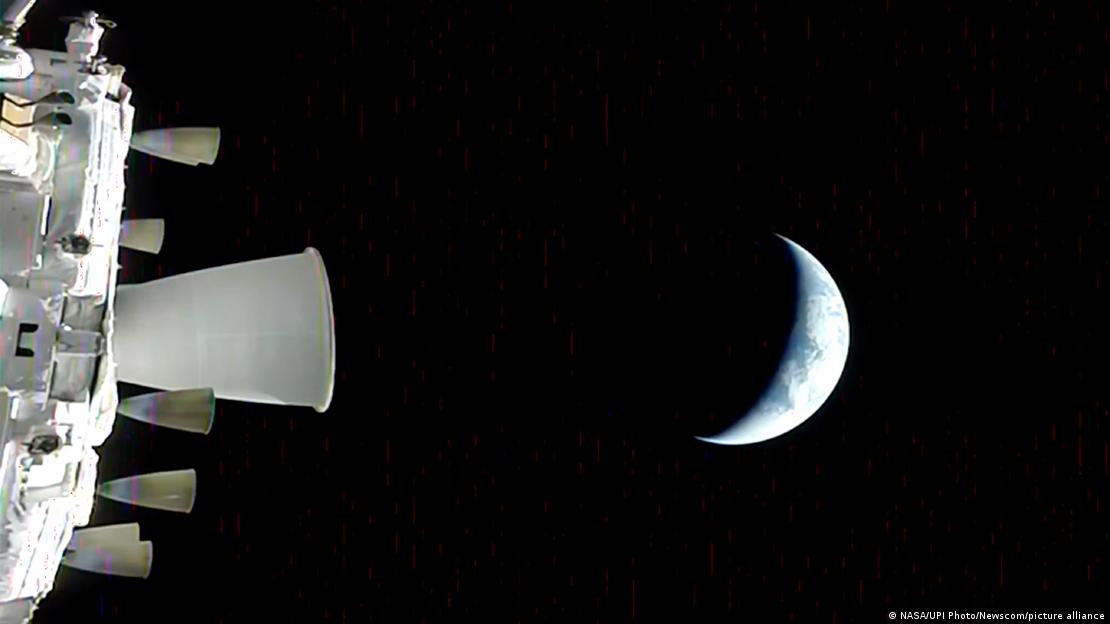
The Orion spacecraft will use the Moon's gravity to slingshot itself back to Earth without propulsionImage: NASA/UPI Photo/Newscom/picture alliance

The milestone comes just two days, five hours and 24 minutes after they took off from Cape Canaveral, Florida.

American astronauts Christina Koch, Victor Glover, Reid Wiseman and Canadian Jeremy Hansen are now on a so-called "free-return" trajectory, which allows Orion to use the Moon's gravity to slingshot around it before heading back towards Earth without propulsion.

"We all ... had a collective, I guess, expression of joy at that... We can see the Moon out of the docking hatch right now; it is a beautiful sight," Koch told mission control during the call.

Stunning photos and a broken toilet

As they swung around Earth, the astronauts took photos of our planet, which NASA has released.

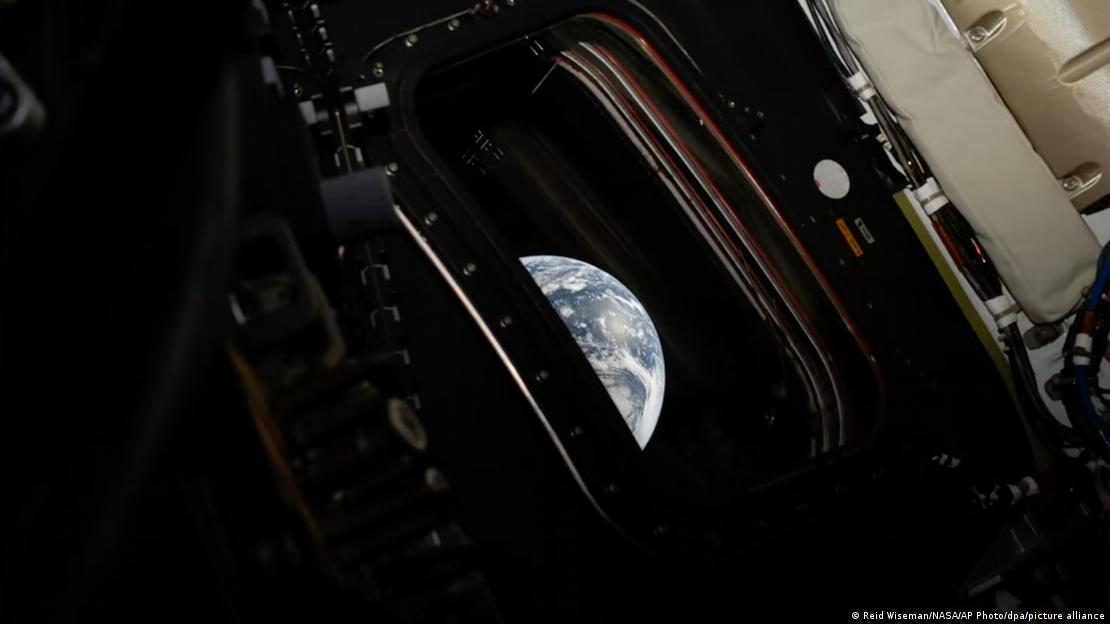
Among the photos taken by Commander Wiseman were a curved slice of Earth in one of the capsule's windows and a shot of the entire globe with the oceans topped by swirling clouds, where even a green aurora could be seen at the North Pole.

"It was the most spectacular moment, and it paused all four of us in our tracks," Wiseman said during a TV interview that the astronauts held.


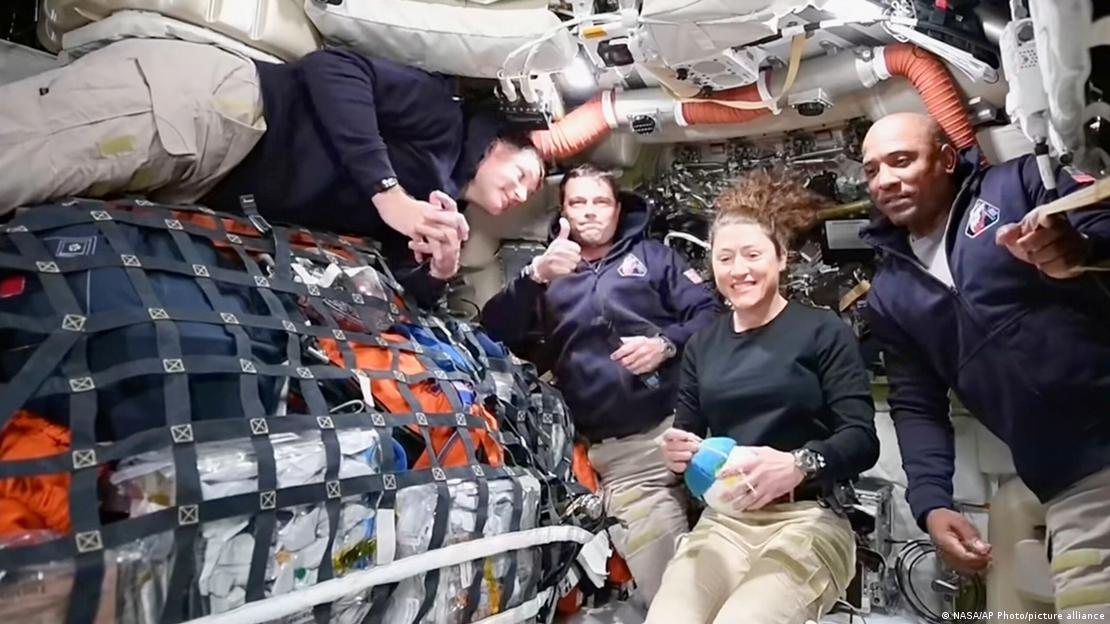
The Artemis II crew are working to make the spaceship a home during their 10-day missionImage: NASA/AP Photo/picture alliance

As their journey progresses, the astronauts have been settling into their confined space. They reported that it was a little bit cold inside the spacecraft, but that they were still making it a home.

During their first hours aboard Orion, they performed checks and fixed minor problems on the spacecraft, which included a communications issue and, crucially, a malfunctioning toilet.

Artemis II astronauts are the first to fly in the Orion capsule

Koch told the media that she was proud to call herself a space plumber.

"I like to say that it is probably the most important piece of equipment on board," Koch said. "So we were all breathing a sigh of relief when it turned out to be just fine," she added.

The astronauts have also already put in their first workouts, as each must spend 30 minutes a day exercising to offset the muscle and bone loss that occurs in zero gravity.


Artemis II astronauts ignite engines and head for lunar flyby

NASA’s Artemis II astronauts fired their engines and set course for a lunar flyby on Thursday, marking the first human departure from Earth orbit since 1972. The crew of three Americans and one Canadian will break distance records, witness a solar eclipse and pave the way for future lunar missions despite early challenges in orbit.


Issued on: 03/04/2026 
By: FRANCE 24

The Artemis 2 mission rocket was launched from the Kennedy Space Center at Cape Canaveral, Florida, on April 1, 2026. © Jim Watson, AFP

NASA’s Artemis II astronauts fired their engines and blazed toward the moon Thursday night, breaking free of the chains that have trapped humanity in shallow laps around Earth since Apollo.

The so-called translunar ignition came 25 hours after liftoff, putting the three Americans and a Canadian on course for a lunar fly-around early next week. Their Orion capsule bolted out of orbit around Earth right on cue and chased the moon to nearly 250,000 miles (400,000 kilometres) away.

It was the first such engine firing for a space crew since Apollo 17 set out on that era’s final moonshot on 7 December 1972. NASA reported preliminary indications that it went well.

NASA had the Artemis II crew stick close to home for a day to test their capsule’s life-support systems before clearing them for lunar departure.

Now committed to the Moon, the Artemis II test flight is the opening act for NASA’s grand plans for a Moon base and sustained lunar living.

© France 24
14:52


Commander Reid Wiseman, pilot Victor Glover, Christina Koch and Jeremy Hansen will dash past the moon, then hang a U-turn and zip straight home without stopping on land. In the process, they will become the humans travelling the farthest ever from Earth, breaking the Apollo 13 distance record set in 1970. They also may become the fastest during reentry at flight’s end on 10 April.

Glover, Koch and Hansen have already made history as the first Black, the first woman and the first non-US citizen to launch to the moon. Apollo’s 24 lunar travellers were all white men.

READ MORE Artemis II launches historic flyby lunar mission with diverse crew

To set the mood for the day’s main event, Mission Control woke the crew with John Legend’s “Green Light” featuring André 3000 and a medley of NASA teams cheering them.

“We are ready to go,” pilot Victor Glover said.

Artemis II launches historic flyby lunar mission © France 24
00:39


Mission Control gave the final go-ahead minutes before the critical engine firing, telling the astronauts they were embarking on “humanity’s lunar homecoming arc” to bring them back to Earth. Koch replied: “With this burn to the moon, we do not leave Earth. We choose it.”

The next major milestone will be Monday’s lunar flyby.

Orion will zoom 4,000 miles (6,400 kilometres) beyond the moon before turning back, providing unprecedented and illuminated views of the lunar far side, at least for human eyes. The crew will even witness a total solar eclipse as the moon temporarily blocks the sun from their perspective.

While awaiting their orbital departure earlier Thursday, the astronauts savoured views of Earth from tens of thousands of miles high. Koch told Mission Control they could make out entire coastlines and even the South Pole, her old stomping ground.

“It is just absolutely phenomenal,” radioed Koch, who spent a year at an Antarctic research station before joining NASA.

© France 24
01:19


NASA is counting on the test flight to kickstart the Artemis programme and lead to a moon landing by two astronauts in 2028. Orion’s toilet may need some design tweaks before that happens.

The so-called lunar loo malfunctioned as soon as the Artemis crew reached orbit Wednesday evening. Mission Control guided Koch through some plumbing tricks, and she finally got it going, but not before using contingency urine storage bags.

Controllers also managed to bump up the cabin temperature. It was so cold earlier that the astronauts had to dig into their suitcases for long-sleeved clothes.

The contingency urine bags came in handy later. Mission Control ordered the crew to fill a number of empty bags with water from the capsule’s dispenser. A valve issue arose following liftoff, and NASA wanted plenty of drinking water on hand in case the problem worsened. The astronauts used straws and syringes to fill more than 2 gallons (7 litres) before pivoting to the moon.

(FRANCE 24 with AP)

Artemis heads to the Moon as old rivals race to stake their claim

As NASA counts down to sending astronauts back to the Moon under the Artemis programme, countries are racing to secure their place in the lunar future – laying plans to build infrastructure on the surface and exploit its resources. More than 60 years after John F Kennedy called for cooperation in space, competition is once again driving the race to the Moon.


Issued on: 01/04/2026 - RFI

NASA's Artemis II Space Launch System rocket and Orion spacecraft rest on Launch Pad 39B at Kennedy Space Center in Cape Canaveral, Florida, on 31 March 2026, ahead of the crewed lunar mission. AFP - JIM WATSON

Artemis II will carry four astronauts – three Americans and one Canadian – around the Moon, in what will be the first crewed mission of the programme.

The launch is expected at Cape Canaveral, Florida in the United States, drawing attention around the world to a mission seen as a key step in returning humans to the Moon.

According to local Florida newspapers, some 400,000 people are expected to turn up to watch the liftoff, which is currently slated for Wednesday at 6:24 pm local time (22h24 UT)

More than six decades ago, the US was making a very different case for the future of space.

NASA astronauts Reid Wiseman, Artemis II commander, from left, Victor Glover, Artemis II pilot, Christina Koch, Artemis II mission specialist, and CSA (Canadian Space Agency) astronaut Jeremy Hansen, Artemis II mission specialist, right, in a group photograph as they visit NASA's Artemis II SLS (Space Launch System) rocket and Orion spacecraft, Monday, 30 March 2026, at Launch Complex 39B of NASA's Kennedy Space Center, in Cape Canaveral, Florida. AP - Bill Ingalls


A call for cooperation

On 20 September, 1963, President Kennedy stood before the United Nations General Assembly in New York and delivered a message – aimed firmly at Soviet leader Nikita Khrushchev, even if his name wasn't heard.

Kennedy warned against the increase of military power on both sides of the Cold War divide – by both the US and the Soviet Union.

“Too long, we have increased our military budgets, our nuclear arsenals and our capacity to destroy all life on this hemisphere,” Kennedy said.

Calling for disarmament, he welcomed a Soviet proposal to keep weapons of mass destruction out of space.

“Why should man’s first flight to the Moon be a matter of national competition?” he asked.

Kennedy proposed a joint mission and said scientists and astronauts from different countries could work together, sending “not the representatives of a single nation, but the representatives of all of our countries”.


Buzz Aldrin’s bootprint on the Moon in 1969 – one of the first marks left by humans on its surface during the Apollo missions. © NASA

No joint landing


Khrushchev left power in 1964. His son later said the Soviet leader had rejected an earlier offer so as not to reveal the Soviet Union’s technological lag, but might have accepted the second one. Instead, the two powers went their separate ways.

Less than six years after Kennedy’s assassination, the US landed on the Moon alone in 1969. Twelve Americans walked on its surface between 1969 and 1972.

At the same time, countries around the globe began setting rules for space. The 1967 Outer Space Treaty laid out principles for exploring and using space, including the Moon and other celestial bodies.

Further agreements followed – in 1968, rules were set for rescue operations and in 1972, responsibility in case of problems involving artificial satellites was clarified.

This cooperation continued after the fall of the Berlin Wall, first with regard to the Mir space station and later on the International Space Station.

But geopolitical tensions did not disappear with the lifting of the Iron Curtain.

"Fast-forward to today, and the current sharp escalation of security threats in and from outer space requires a legally binding agreement to preserve its peaceful nature," writes the UN on its website.

"However, the most recent attempts in the General Assembly and the Security Council to adopt a document on a weapons-free outer space have failed."

Power play: why NASA is betting on nuclear to outpace rivals on the Moon


Back to the Moon

In 2017, US President Donald Trump announced plans to revive a programme similar to George W Bush’s cancelled Constellation programme, which would have carried astronauts to the ISS, as the successor to the US space shuttle programme, which was shuttered in 2011.

Trump's stated aim was to return to the Moon and stay there – if possible before China. To this end, the Artemis Moon exploration programme was established in 2017, with Artemis II set to be the first mission to carry astronauts.

The Canadian Space Agency is taking part, along with the European Space Agency (ESA) and Japan’s Jaxa, as is the United Arab Emirates through the Mohammed bin Rashid Space Centre. Italy has a separate bilateral agreement linked to the supply of a module for the lunar surface. French companies involved include Airbus, Latelec and ArianeGroup.

NASA’s Space Launch System is the most powerful rocket in history among those certified for crewed flights, but the mission carries risks.

Shortly before the launch of Artemis I in 2021, a liquid hydrogen leak during fuelling forced three members of a “red team” to go on to the launch pad and tighten bolts, in front of hundreds of tonnes of highly explosive liquids.

Russia's first lunar mission in 47 years smashes into the moon in failure


Building a lunar future

Artemis aims to build an overall system on the Moon and test what can be done there – making bricks, producing fuel, installing solar panels, and even a civilian nuclear power plant.

Europe has built the European Service Module, a crucial part of the Orion spacecraft that will carry the first crews around the Moon from Artemis II onwards. Four have been delivered, potentially enough for missions up to Artemis IV.

The astronauts are already training for their mission. In 2024 in Cologne, the ESA opened Luna, a lunar simulation site run jointly with the German Aerospace Centre (DLR), where crews can learn to move across artificial Moon dust.

Private companies too are now central to the programme – especially when it comes to landing systems, in which Blue Origin, the space company founded by Jeff Bezos, and SpaceX, led by Elon Musk, are both involved. While NASA will send the next humans on their journey to the Moon, private firms are expected to be the ones putting them on its surface.
The Moon rises over Dubai in June 2025. The United Arab Emirates is among the partners taking part in NASA’s Artemis programme. AFP - FADEL SENNA


Blue Origin has paused its space tourism flights to focus on its larger New Glenn rocket and its work on the Moon. Its first cargo lander, Blue Moon MK-1, arrived at NASA’s Johnson Space Centre in Houston in early February.

SpaceX, meanwhile, hopes to step up tests of its Starship system. In February, Musk said his company was now refocusing on the Moon, with the goal of building a first “autonomous city”.

“We can potentially achieve this in less than 10 years, whereas Mars would take more than 20 years,” Musk said – adding that launches to the red planet come every 26 months, while “we can do a launch to the Moon every 10 days”.


Risks and rivalries


The Artemis programme should not be confused with the Artemis Accords, which date from 2020. Backed by Washington before the end of Trump’s first term, they created a legal framework around the exploitation of space resources and have now been signed by around 60 countries.

However, Russia was excluded from early talks, while China was not part of the process either. Russia is now working with China on its own lunar plans under the ILRS project and sees the Artemis Accords as centred on US interests.

France did not sign the accords until 2022, after checking they would not conflict with existing treaties, given the 1967 charter states that no state or private company can appropriate anything in space. By creating “safety zones” to protect activities on the ground, the accords raise the question of whether this amounts to taking control of territory on the Moon.

And by allowing private companies to exploit space resources, the Artemis Accords also raise the question of who gets to take possession of those resources.

“These questions will be discussed among those who can be part of the adventure and who will be able to go there. Artemis creates this framework,” said Lionel Suchet, deputy director general of the French National Centre for Space Studies.

Europe's quick-fit spacesuit to be tested aboard ISS by France's Adenot

The accords are also unusual in the way they were drafted and adopted.

“It is the first time we have had this kind of international act,” legal expert Lucien Rapp, scientific director of the Sirius Chair research programme, told RFI.

A text proposed “unilaterally by a space power” is being signed by other states, “but not all together, one by one”, Rapp said.

Trump plans to send humans to the Moon in 2028 if possible, setting out plans to “assert American leadership in space”, lay the foundations for a lunar economy, prepare for missions to Mars and inspire a new generation of explorers in a 2025 executive order.

Different countries may soon be operating side by side near the Moon’s south pole – Americans, Russians, Chinese, Indians and others, each with their own bases and projects – raising the practical question of how those missions will coexist, and whether cooperation will be possible on the ground.

The 1967 Outer Space Treaty says space should be used “for the benefit and in the interests of all countries”. But as new missions take shape, that principle will be tested.

This story was adapted from the original version in French by Igor Gauquelin