Kyiv (Ukraine) (AFP) – When the US-Israeli war with Iran began at the end of February, it was widely assumed that Moscow would be one of the conflict's key winners.
Issued on: 10/04/2026 - RFI

Higher oil prices, a distracted Washington and a sudden need for Western air defence systems in the Gulf were seen as a boost to Moscow's four-year invasion of Ukraine.
But in Kyiv, officials and analysts say a flurry of high-level visits by President Volodymyr Zelensky and the inking of security accords across the Middle East amount to a diplomatic coup that have given the embattled country outsized clout in a region recently seen as aligned with Russia.
"Ukraine is for the first time -- and to some countries' surprise -- acting as a state that can provide security services, that can, as experts say, export defence and security expertise," Volodymyr Fesenko, a respected political observer in Kyiv, told AFP.
That is a marked turnaround from 2022 when an under-equipped Kyiv went on bended knee to the United States and Europe to appeal for sophisticated air defence systems, advanced battle tanks, and as many artillery shells as they could get their hands on.
The rapid proliferation of drones has made many of those weapons less relevant, and spurred Ukrainian rag-tag arms producers to become global leaders in drone warfare and anti-drone systems.
'Moscow extremely upset'
Kyiv's forces neutralise hundreds of the Iranian-designed drones launched by Russia every day, and as Iran started firing off drones across the Middle East in retaliation for the US-Israeli attacks, Zelensky quickly deployed more than 200 of his anti-drone experts to at least four states.
Zelensky himself paid high-profile visits to Saudi Arabia, the United Arab Emirates, Qatar, Jordan and Syria -- becoming one of the first foreign leaders to visit the region during the war.
"Moscow is extremely upset with Ukraine's rapid strengthening of ties with the Gulf countries in the wake of Iranian air terror," Ukrainian Foreign Minister Andriy Sybiga said on social media.
"They understand that Ukraine's unique experience has dramatically changed its role in the region," he added.
Sybiga said Russia and its close ally Iran had taken to spreading disinformation about Ukrainian anti-drone units to undermine Kyiv's diplomatic reach -- like that Iran had struck a depot housing Ukrainian anti-drone systems in the United Arab Emirates.
Despite Ukraine managing to give itself a surprise role in the conflict, the question remains what material benefit it can extract besides some good publicity.
"Frankly, in the Gulf countries you can simply ask for money," political analyst Taras Zagorodniy suggested to AFP in a telephone interview.
"This is a way to scale our own technologies and attract additional resources, because we need money to support our technologies and investments," Zagorodniy, Managing Partner of the National Anti-Crisis Group think tank, added.
Details of the defence agreements struck with several states in the region have not been made public.
Zelensky had previously proposed swapping Ukrainian drone warfare technology for the advanced air defence missile ammunition -- though that idea appeared to gain little traction.
No 'breakthrough'
The Ukrainian leader has also suggested that improved ties with the Gulf could help place broader pressure on Russia to halt its invasion.
But analysts have warned that these overtures do not amount to a breakthrough -- yet.
For one, the impact of the two-week truce agreed between the United States and Iran is unclear.
Zelensky has said Ukrainian anti-drone units will remain in the Middle East but the long-term demand for Ukrainian war tech remains in question.
The region has largely refrained from criticising Russia's invasion and has not hit Moscow with sanctions. Many states seek good relations with both sides to play a mediating role -- hosting talks or brokering the return of children.
"It is premature to speak of a breakthrough. This is not even a step -- rather a first cautious move in the right direction," former Ukrainian diplomat Vadym Triukhan wrote in a recent analysis.
To be a "game changer" for Kyiv, the pace of engagement needed to be kept up.
"If this tempo is not lost, then within a few months it will be quite realistic to reach multi-year, multibillion contracts," Triukhan wrote.
© 2026 AFP
Ukrainians shot down Iran's drones in the Gulf — what does Kyiv get in return?
Ukraine’s president announced that Ukrainian experts in the Middle East have already shot down Iranian drones in “several countries” with domestically produced interceptors.
Ukrainian military personnel have already successfully shot down Iranian Shahed-type drones targeting countries in the Middle East, President Volodymyr Zelenskyy revealed in his first public acknowledgement of Kyiv's specialists' first results in the Gulf region.
Zelenskyy said Ukrainian experts on the ground are part of a broader Kyiv’s effort "to help partners counter the same weapons used by Russia in Ukraine."
Ukraine’s president made these remarks to reporters on Wednesday, but the briefing content was embargoed until Friday.
Zelenskyy said Ukrainian forces took part in active operations using domestically produced interceptor drones.
"We sent our military experts to the Middle East, including specialists in interceptor drones and electronic warfare. We demonstrated to some countries how to work with interceptors," he said, revealing for the first time Kyiv’s strategy following the cooperation agreements with the Gulf countries.
"Did we destroy Iranian Shaheds? Yes, we did. Did we do it in just one country? No, in several. And in my view, this is a success."
Zelenskyy said Ukraine’s military presence on the ground is "not about a training mission or exercises, but about support in building a modern air defence system that can actually work."
"In those countries that opened up their air defence systems to us, our experts were able to very quickly advise how to make those systems stronger."
"In some cases, we directly shared our experience in actual defence. In any case, all of this has had a very positive outcome, and it commands respect for Ukraine," Zelenskyy stated.
Ukraine’s agreements with the Gulf states
Kyiv signed 10-year agreements with three Gulf countries: Saudi Arabia, the UAE and Qatar, where Ukrainian companies will work with the armed forces of these countries to protect specific facilities, Zelenskyy said at the Wednesday briefing.
"My task is to negotiate volumes, services, and types of weaponry," he stated.
Zelenskyy also confirmed that the talks are currently under way with Oman, Kuwait and Bahrain.
In return for Kyiv’s support and expertise, Ukraine will receive "various things," according to Zelenskyy.
"In some cases, it involves interceptors to protect our energy infrastructure; in others, there are financial arrangements."
He said that ultimately these agreements will strengthen Ukraine’s energy stability.
"There are also supplies of oil and diesel for Ukraine. In some cases, we receive crude oil that will be delivered to refineries in Europe for processing. In others, we are talking about finished products – diesel," Zelenskyy explained.
“So in essence, we are helping strengthen their security in exchange for contributions to our country’s resilience – and this is far more than simply receiving money.
Zelenskyy said earlier that Ukrainian military personnel are also participating in consultations on the functioning of the Strait of Hormuz.
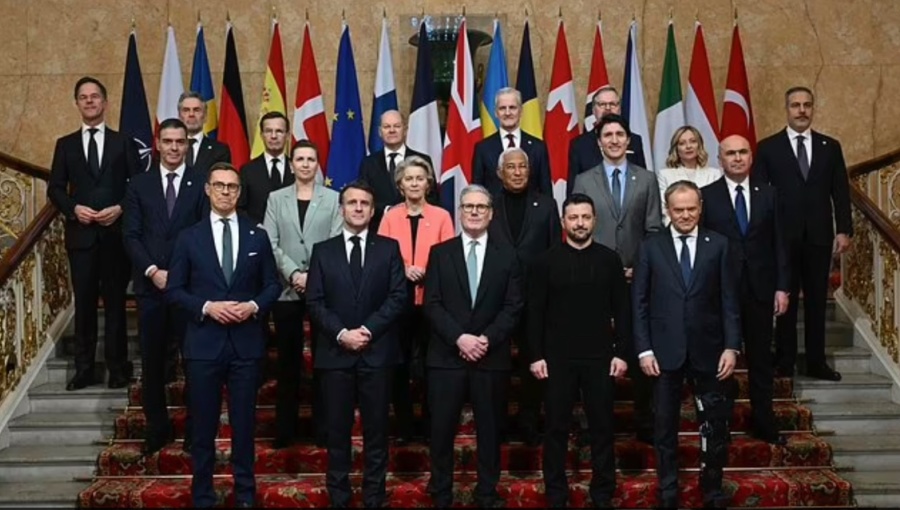
Ukrainian President Volodymyr Zelenskiy has proposed the creation of a new European-centred security bloc that would include Ukraine, the EU, the UK, Turkey and Norway, as concerns mount over the future of US support for Nato.
US President Donald Trump has threatened to take the US out of Nato twice in the last month, after he called on Nato allies to join his armada in the Gulf to open the Strait of Hormuz by force and was rebuffed. As IntelliNews reported, that has brought Nato to the brink of breaking up. Trump claims that he has the authority to nix US’ membership in the alliance, but under US law only Congress can vote to exit the treaty.
Speaking amid reports of a potential US withdrawal from the alliance, Zelenskiy said Europe needed to take greater responsibility for its own defence. He suggested that a broader coalition, anchored by Ukraine’s military capabilities, could provide a credible deterrent against Russia.
“Without Ukraine and Turkey, Europe will not have an army comparable to the Russian one. With Ukraine, Turkey, Norway, and Britain, you will control security at sea – and not just one,” Zelenskiy said. He added that he remained confident Ukraine would ultimately join the EU.
Since taking office, Trump has aggressively pushed for European Nato allies to increase their spending from 2% of GDP mandated by the Welsh Nato summit in 2015 to 5% by 2035 agreed at the Nato summit in the Hague last year. This year all Nato members reached the 2% of GDP spending level for the first time with Poland spending the most, 4.3% of GDP, as it attempts to build the largest conventional army in Europe.
Despite the pledges, the US has withdrawn from supplying Ukraine with weapons directly under the Trump administration and Europe has been unable to offset the end of US weapons deliveries to Ukraine which fell in the last year. The US now provides Ukraine with weapons under the Prioritised Ukraine Requirements List (PURL) programme, where Europe pays for them.
The proposal for a new Nato comes as Kyiv seeks strong security guarantees as part of the ongoing ceasefire talks with Russia. The White House has offered a US security deal, but Trump made it explicit this month, the deal won’t go through until Bankova gives up the remaining parts of the Donetsk region in the Donbas that the Armed Forces of Ukraine (AFU) still control. That is a red line for Zelenskiy, who continues to refuse until not only the US deal is signed, but also ratified by Congress, giving it the status of an international treaty the president can’t undo.
Ukrainians have become more ambivalent towards membership in the alliance, torn between the need for security assurances and lingering scepticism about the bloc’s effectiveness. According to a recent poll, 68.9% of Ukrainians support joining Nato, but only 54.7% say they trust the alliance, while 41.5% express distrust. Support for the idea of reacquiring nuclear weapons has also begun to rise, as another way to prevent Russia’s re-invasion in the future.
Survey findings suggest that perceptions of Nato are closely tied to its tangible actions during the war. Some 18.5% of respondents said their level of trust depended primarily on the practical assistance provided by the alliance. Other significant factors included protection for Ukraine, cited by 13.3%, and the provision of security guarantees, identified by 11.8%.
At the same time, dissatisfaction with Nato’s conduct during the conflict remains a key driver of scepticism. As IntelliNews reported, the strategy from the start has been “some, but not enough” supplies to ensure Ukraine doesn’t lose the war, but not enough so it can actually win. That formula has perpetuated the war and ensures the maximum casualties. It also means that the Western allies have withheld supplies of their most powerful weapons, long-range missiles like Germany’s Taurus in particular. Many Ukrainians view the alliance as having acted too slowly and indecisively, and as failing to do enough to counter Russian aggression.
Zelenskiy has long lobbied for Nato membership, but has been repeatedly rebuffed, most notably at the Nato summit in Vilnius in July 2023. He also put Nato membership at the top of his “victory plan” list in December 2024 to the outgoing Biden administration, but was ignored again.
As part of the 27-point peace plan (27PPP) thrashed out at the Moscow meeting on December 3 last year between Russian President Vladimir Putin and the US envoys, it was proposed that Ukraine join the EU in 2027 as a compromise. The EU founding treaty also contains a collective security clause, Article 42/7, that requires all members to come to the military assistance of any member that is attacked. However, most EU members have rejected the idea of an accelerated membership of Ukraine in the EU.
Zelenskiy’s remarks highlight a growing debate in Europe over the continent’s long-term security architecture and the extent to which it can rely on transatlantic support

No comments:
Post a Comment