What Clean Energy Transition?
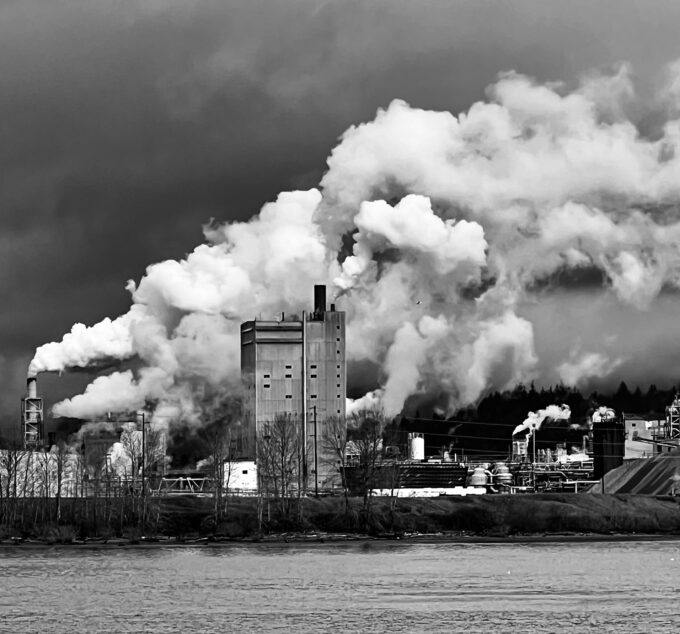
Longview, Washington. Photo: Jeffrey St. Clair.
A pox of optimism has infected climate reporting in late years, and one of the Iran War’s unremarked casualties is that it has only furthered the scourge. Perhaps you know the sort of reports I’m referring to, the sanguine dispatches telling us that our long-overdue divorce from fossil fuels may be behind schedule, but the “dire predictions about renewable energy were all wrong,” for we have embarked at last upon a “clean energy boom” that, rather unexpectedly, is “arriving faster than you think,” indeed is now “unstoppable.” Decarbonization, we are assured, lies no longer around the next bend. “The renewables future has arrived.”
The most influential traffickers in this line are The New Yorker’s Bill McKibben and the New York Times’ David Wallace-Wells. “The clean energy transition,” McKibben wrote last fall, “is not destined to be the slow, dragged-out affair that most analysts would have predicted even five years ago.” Instead, we’ve entered “a kind of mind-blowing virtuous cycle” in which solar and wind power are getting so much cheaper and more efficient that governments and corporations can’t resist tapping into them. Wallace-Wells, taking the war-fueled surge in oil prices as his cue, declaresthat “green energy has been a dizzying, ecstatic success” and that we are now smack “in the middle” of the switch to renewables. Such optimistic chords reverberate all down the chain of liberal and left media. “Everywhere, the world is turning to renewables,” a lead story in CounterPunch averred last month. With the disruptions of the Iran War, “Perhaps we are finally seeing the end of oil.”
There’s just one problem with all these gladsome reports: The evidence to support them is witheringly thin. We are nowhere near the middle of a green transition, global emissions have yet to decline by a single gram of carbon, and the end of oil, far from nigh, remains well out of sight.
One chart tells the story. Below, courtesy of Our World in Data, is the bleak totting-up of all the energy that humankind has used over the last two and a quarter centuries.
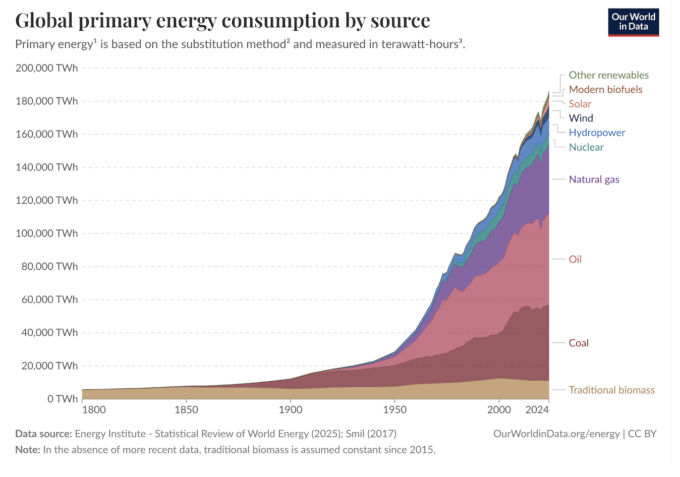
What is striking about this chart is not merely that carbon-free renewables make up so small a share of today’s energy mix—about one-seventh—but that the growth in renewables has done nothing to halt the overall rise of fossil fuels. At best, renewables have only slightly slowed that rise. The only carbon-based fuel we’re burning less of these days, and very marginally less at that, is traditional biomass, mostly wood. Our burning of coal may—emphasize, may—be approaching a leveling off, but our extraordinary use of that fuel almost certainly won’t dip substantially for years, and even then forecasters expect not a plunge but a very long, slow decline across many decades. Meanwhile oil and gas are going great guns and by any dispassionate forecast will keep blazing, year on year, for decades.
In short, while renewables are indeed growing, their growth has not yet spurred an energy transition. They’ve simply added to our ever-burgeoning energy expansion.
Lest you think I’ve cherry picked my chart, you can find much the same narrative from other credible sources freely available online. Below, for example, is a comparable chart from the International Energy Agency, which shows (in different units, across a shorter span of time, and treating supply rather than consumption) that we are producing roughly one and half times the carbon-based fuel that we were producing just thirty years ago, with no sign of a letup. Squint and you just might see the minutely increasing slice of renewables sandwiched among all that carbon.
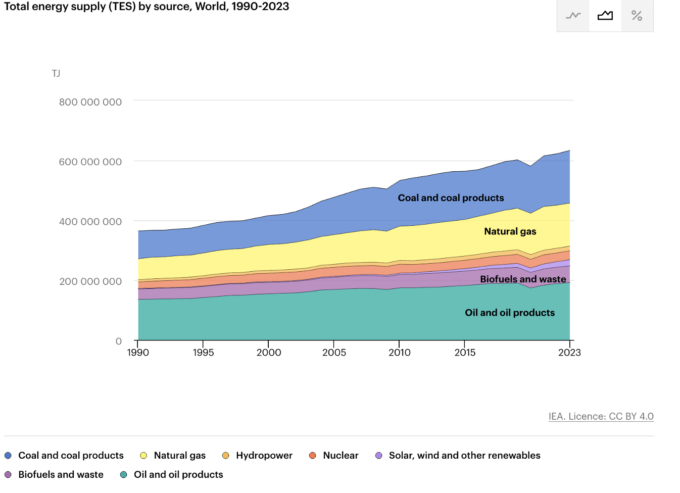
The terrifyingly inconvenient truth that leaps off graphs like these is that we are still unmistakably barreling, if you’ll forgive the pun, toward a grim new climate, possibly even our worst-case scenario: a rise in global temperatures of 4°C to 5°C (7.2°F to 9.0°F) by early next century.
But how can this be? Isn’t it true, to take just one thread of the energy tapestry, that the burning of coal has fallen in the last two decades by roughly half in the US and to virtually nothing in the UK?
Yes, that’s true. But it’s also not true. What is true is that the coal burned within the territorial confines of the US and UK has fallen by those amounts. But no country’s economy is confined to its own borders, certainly no country as rich as the US or UK. So it is also true that the US and UK are burning just as much coal as ever, only they’re burning it in the vast extraterritorial labor camp known as the Global South. Keats’s “dark Satanic Mills” are still burning coal, still churning out the goods that keep western lifestyles afloat, only at different latitudes.
China burns the most staggering heaps of coal, and although the growth curve is flattening, we can’t be sure when it will decrease. India and Indonesia also burn coal willy-nilly and are forecast to burn ever and ever more for decades. A recent report concluded that India could more than double—double—the coal it burns by mid-century. This is a high-end estimate, but even the lesser projections make forbidding reading. If you can believe the forecasters, whenever coal finally does peak in China, India, and Indonesia, it will make up a sizeable share of their fuel supplies until late in the century.
The story for other fuels is just as bleak. Oil and natural gas look likely to peak in China and India in the 2030s but are still expected to be used in dreadful quantities for decades, just as they will be in the US and many other rich countries. Nearly everywhere, oil and gas are likely to be in the mix for most of the century.
And that may not be the worst of it. Bad as the forecasts are, few of them fully account for—because few forecasters have any idea how to account for—the obscene surge in AI data centers with their ravenous appetite for power. AI might not merely rearrange the climate chessboard; it could overturn it altogether.
+++
You may ask why, despite the growth in renewables, we keep burning more carbon than ever. The answer is simple: We—and here We means both the great mass of people and the tiny sliver of elites who run the world—have used every advance in renewables to consume more rather than less. Rooftop solar panels are all well and good, but the SUV (or two) in the garage of the 3,000-square-foot house, the vacations in Bali and Dalmatia, and the thrice daily meat and milk make a mockery of the panels. The equivalent profligacy by corporations is of course exponentially worse than any individual decadence.
So why, then, do so many of my fellow commentators and reporters, many of them good of heart and noble of intent, tell us we’re deep into the salvation of an energy transition?
Before I answer, let me note that some reporters do nod in this direction. “New power changes the existing system only on the margins,” Wallace-Wells allowed recently. “[N]ew green energy has mostly supplemented rather than displaced fossil fuels.”
But the trouble is that such sentences are so very few and far between, and so lightly played, they don’t begin to balance the heady tumble of paragraphs about the gathering tsunami of renewables. The inescapable implication is that whatever nits one may pick just now, they will momentarily be swept away by the indomitable green wave.
So why do journalists paint so optimistic a picture? I see four reasons. The first is that with stakes so horrific—we are talking, after all, about whether organized human existence can even survive, let alone thrive, in a +4°C world—few people care to face the facts. A whole academic literature has blossomed around the idea that rather than depress people into inertia with doomsaying, activists and journalists should attend to the upside of the green transition. It’s a strategy McKibben has evidently taken to heart, and Wallace-Wells has freely acknowledged that after writing grimly about the intransigence of politicians, a handful of climate ministers took him to task and suggested he write instead about “something that looks much more like progress.” And so he has. Whether this is a good strategy for activism, I can’t say. But it is not good journalism.
The second reason for the undue optimism is that everyone who gains by capitalism and its endless consumption has a potent incentive to swallow good news about it. In the West, that’s nearly everyone. Few Americans, reporters included, are eager to give up their SUVs or cheeseburgers, and few news outlets care to forgo the ad revenue from hawkers of those so-called goods. Not that reporters outright lie to us. Instead they merely tout the boom in renewable electricity, which is indeed cause for (restrained) celebration. What they don’t say, or say only fleetingly, is that electricity remains a modest piece of the current energy puzzle and that the great majority of our factories, cars, trucks, planes, ships, and furnaces run on coal, oil, or gas—and will for some time.
The third reason for the cheerleading is that many observers who have paid long and painful attention to the climate catastrophe have grown demoralized by the failure of politics. Our decades of marches and speeches and reports have moved not a single powerful government to take the bold action needed to avert disaster. Now, of a sudden, plummeting solar and wind prices have made the most astonishing end run around government. What activism so long failed to achieve, the law of supply and demand—the magic of the marketplace, in the old libertarian phrase—has done overnight. The rout of politics by economics has proven as inspiriting as it is unexpected. How often, after all, have impersonal economic forces helped people and planet? But there’s peril in this celebratory thinking, for its implies—sometimes this is flatly stated—that the problem is solving itself and climate activism is less necessary than ever before. Yet as the charts above attest, nothing could be further from the truth.
The fourth and more occult reason for the journalistic immoderation is that almost nobody understands the history of energy transitions. Better said, nobody understands that we’ve never had one. Not once when humans have found a new fuel has the happy discovery prompted us to abandon the previous fuel. Instead, we’ve just kept burning it. You’d hardly know this from conventional histories of energy, which almost always tell a story that goes like this: Once upon a time humans burned biomass, mostly wood, for their heating and cooking. But then we discovered coal and gradually abandoned wood. Later we found oil, and we began the long but certain transition away from coal. Shortly afterward we discovered natural gas, which helped accelerate the transition from coal. Thus energy historians write of a Wood Age, a Coal Age, an Oil Age, and an Oil and Gas Age. This thinking has seeped into the minds of environmental reporters and, to a degree, the public. It makes an energy transition seem a straightforward process, like swapping a wood stove for a coal furnace.
But take a look again at that first chart, and what do you see? Coal didn’t replace wood. Not at all. We just kept burning wood alongside coal. And when oil came along, oil didn’t replace coal. We kept burning that too. Nor did natural gas ease out coal. And renewables aren’t replacing any of it, not globally anyway. We’re just using more of almost everything we can get our hands on.
The story of why we have done so is soberingly told by Jean-Baptiste Fressoz in his superb More and More and More: An All-Consuming History of Energy (2025). It’s a bit of a twisting tale, but a big part of it is that once a fuel becomes widely used in a complex economy, it gets so embedded in everything that it’s hard to eliminate when a new fuel comes along. Another part of the tale is that new fuels create new industries that are necessarily fueled in part (often a large part) by the old fuels.
Take the appearance of coal toward the end of the so-called Wood Age. When coal first boomed in the mid-1800s, many households nonetheless continued to burn wood because it was either cheaper than coal or readier to hand. Wood was also essential for mining coal and for building the industries that coal begat. Whole forests were logged for the millions of framing timbers that kept mine shafts and tunnels from caving in and, a little later, for the billions of sleepers underlying railroad tracks. (Railroads were both created by coal and essential for its widespread diffusion.) When the wooden members of the mines and rails reached the end of their lives, they were pulled, burned for fuel, and replaced by a new batch of timber—the whole cycle starting again.
Today’s story is different only in its particulars, not its outcome. Whole forests are now razed to make the shipping pallets and cardboard boxes that are vital to global capitalism, and when they reach the end of their lives, they’re often burned for fuel. We’ve also never abandoned wood for home heating and cooking. The wood stoves of today are more efficient than those of yore and make up a much smaller share of heating and cooking, but because our one billion people in 1800 have become eight billion today, far more of us—on the order of two billion or so—use wood for heating or cooking.
A like story can be told for oil and gas. Oil and gas may have supplanted coal for transport and heating a century ago, but coal is still baked into those industries. To make our innumerable cars, trucks, trains, ships, furnaces, and boilers requires massive amounts of steel, both for the machines themselves and for the infrastructure they demand: mining equipment to extract raw materials, factories to put the pieces together, railways and bridges to move everything, and on and on. Making high-quality steel requires massive amounts of coal—no electric-powered process is half so good—so as our oil- and gas-burning machines have run riot, coal has too.
In short, an energy transition—any energy transition, not just the renewables transition—is not at all as straightforward as swapping a wood stove for a coal furnace. In fact it’s so untidy and convoluted, we’ve yet to pull one off.
But for all that, it’s true that much of what now runs on wood, coal, oil, or gas could, with sufficient political will, run on sun, wind, or water. But by no means all of it, no time soon anyway. You can power a house with solar panels and batteries, but the steel in those devices will have to be forged for the foreseeable future in a coal-fired steelworks. And while a half-ton battery can power your one-ton car, the physics don’t scale up to getting a fifty-ton passenger jet off the ground or moving a ship with a hundred thousand tons of cargo across an ocean. Someday, hydrogen generated by renewable electricity or another innovation may power planes, ships, and steelworks, but such technologies are in their tender youth. We are decades from the grail of net zero.
I take no joy in reciting these unkind facts, but front them we must. To perpetuate the delusion that we’re deep into a transition to clean energy, that a politics-free rush to bargain-priced renewables will save the day—is saving the day even now—is to tranquilize ourselves when we desperately need to wake up, raise hell, and put an almighty fear in the moguls orchestrating our destruction. Only then will we stand a chance of upending fossil fuels, reining in our own ecocidal excess, and mitigating the climate holocaust already enveloping us.

No comments:
Post a Comment