Saturday, April 11, 2026

US Supreme Court Is Poised to Gut Remaining Protections of the Voting Rights Act


The prohibition of racial discrimination in voting and the right to have absentee ballots counted are in grave peril.
PublishedApril 8, 2026

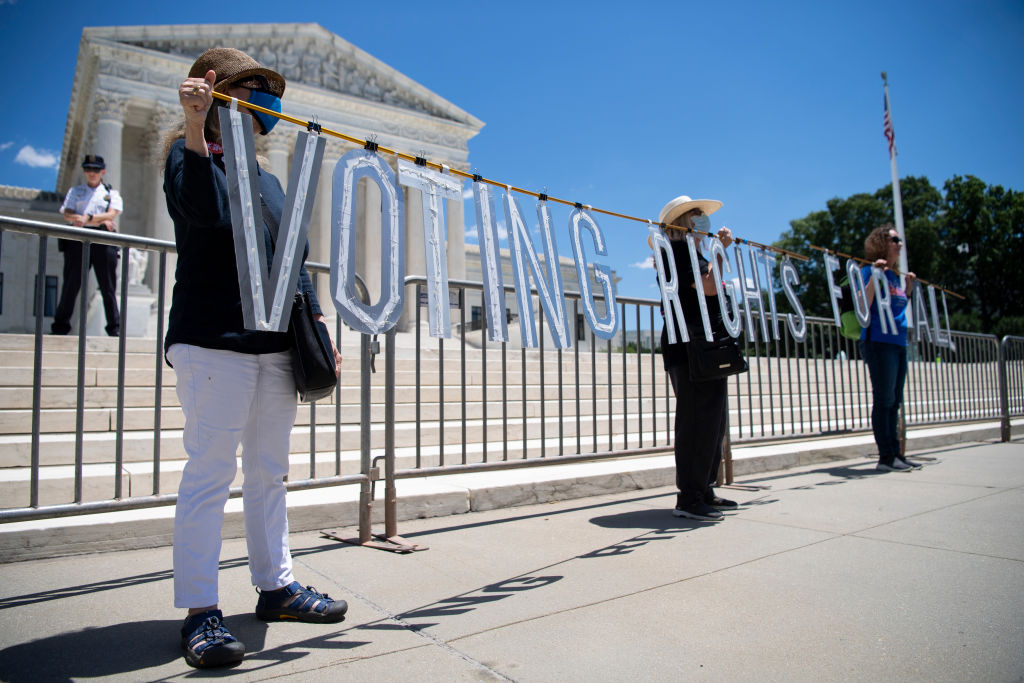
Demonstrators participate in the Moral March on Manchin and McConnell, a rally held by the Poor Peoples Campaign calling on them to eliminate the legislative filibuster and pass the "For The People" voting rights bill, outside the Supreme Court in Washington, D.C., on June 23, 2021.Caroline Brehman / CQ-Roll Call, Inc via Getty Images

The Supreme Court appears poised to deal a severe blow to the fundamental right to vote in two cases this term. Louisiana v. Callais threatens the right to vote free from racial discrimination and Watson v. Republican National Committee will test the right to have your absentee ballots counted.

On August 1, 2025, when the Supreme Court asked the parties in Callais to brief the issue of whether Section 2 of the Voting Rights Act (VRA) violates the 14th or 15th Amendment to the Constitution, alarm bells rang throughout the country.

By posing that question, the high court signaled its openness to striking down the remaining core of the VRA, which Congress enacted in 1965 to prevent racial discrimination in voting. Section 2 forbids the use of congressional maps that dilute the voting power of marginalized communities.

Section 2 was included in the VRA in order to enforce the 15th Amendment, which prohibits the government from denying or abridging the right to vote “on account of race, color, or previous condition of servitude.”

In Callais, a group of self-described “non-African American” voters claimed that the “intentional creation of a majority Black district” violated the Equal Protection Clause of the 14th Amendment.

The Supreme Court Asks Why It Shouldn’t Gut the Voting Rights Act
We may well see the elimination of the 11 Black-majority districts — all Democratic — in GOP-controlled Southern states. By Marjorie Cohn , Truthout August 29, 2025


During the oral argument on October 15, 2025, a majority of the Supreme Court appeared ready to side with the “non-African American” voters.

Moreover, at its March 23 argument in Watson, the court seemed inclined to overturn a Mississippi law that allows mail-in ballots to be counted if they are postmarked by, and received within five business days of, Election Day. Mail voting in Mississippi is limited to a few types of voters, including those with disabilities, the elderly, and people living away from home.

The Trump administration would like to prohibit mail-in ballots that aren’t received by Election Day. If the court holds that ballots must be received by Election Day, untold numbers of voters could be disenfranchised.

The “Crown Jewel of the Civil Rights Era” Is Gravely Imperiled

The Voting Rights Act — known as the “crown jewel of the civil rights era” — is in danger of being rendered null in Louisiana v. Callais.

Section 2 of the VRA prohibits any voting qualification or prerequisite to voting, or procedure or practice that “results in a denial or abridgment of the right of any citizen of the United States to vote on account of race.” That occurs when voters of color “have less opportunity than other members of the electorate to participate in the political process and to elect representatives of their choice.”

Since the Supreme Court struck down Section 5 of the VRA in 2013, Section 2 remains the only effective VRA remedy left to challenge racial discrimination in voting. Chief Justice John Roberts wrote the opinion in Shelby County v. Holder gutting Section 5, which had required federal preclearance before changes to election rules could go into effect in jurisdictions with a history of discriminatory voting practices.

But Roberts provided assurances in Shelby that Section 2 would still be available to protect voting rights. Now, the court is poised to obliterate Section 2 as well.

Congress amended Section 2 of the VRA in 1982 to provide that evidence of discriminatory intent is not necessary to prove racial discrimination; even policies that appear neutral can have a discriminatory effect (legally referred to as disparate impact) on a particular group.

The 14th Amendment’s Equal Protection Clause forbids the government from treating people differently on account of race. In the 1990s, the Supreme Court held that the government cannot use race as a predominant factor when it draws election districts unless it satisfies strict scrutiny by proving it is necessary to achieve a compelling governmental interest.

In Callais, a coalition of civil rights groups and Black voters wanted to reinstate a map that the state legislature had adopted in 2024. The map established a second majority-Black congressional district and was drawn in response to a 2022 U.S. district court ruling that a map drawn in 2020 likely violated Section 2 of the VRA.

The 2020 map included only one majority-Black district out of the state’s six congressional districts. The coalition argued that the 2020 map diluted the votes of Black residents, who comprise about one-third of Louisiana’s population.

The Fifth Circuit Court of Appeals affirmed the district court ruling that the 2020 map likely violated Section 2, and the appellate court ordered Louisiana to adopt a new map by January 15, 2024. The Louisiana Legislature then drew a map with a second majority-Black district.

In response, the “non-African American” voters challenged the 2024 map, claiming it was unconstitutional because it separated voters based primarily on race.

The Supreme Court didn’t decide the case after hearing oral arguments last term. Instead, it ordered a second round of arguments, which took place on October 15, 2025. At that proceeding, a majority of the court exhibited a willingness to eviscerate Section 2.

They may well determine that Section 2 of the VRA and the Equal Protection Clause are “in tension,” as Clarence Thomas suggested in his dissent to the ruling that held the case over to this term.

If the court adopts Thomas’s position, it would amount to a finding that disparate-impact liability under the VRA’s Section 2 is unconstitutional. That could make it harder to prove liability for violations of federal housing and employment discrimination laws, Berkeley Law School Dean Erwin Chemerinsky warned on SCOTUSblog: “Ending disparate-impact liability would be an enormous change in the law and a devastating blow to civil rights in the United States. That is why Louisiana v. Callais is potentially so important.”


Absentee Ballots Cast by Election Day Should Be Counted

The other major voting rights case on the Supreme Court’s docket presents a challenge to a Mississippi law governing the timing of mail-in ballots. In addition to Mississippi, at least 18 states and territories have laws that allow the counting of mail-in ballots postmarked by Election Day but received later. Twenty-nine states allow overseas and military ballots to be tallied if received after Election Day.

In Watson, the Republican Party of Mississippi and the Republican National Committee are challenging the Mississippi law. They argue that the state law conflicts with an 1845 federal law that established the Tuesday after the first Monday in November as “Election Day.”

A three-judge panel of the Fifth Circuit Court of Appeals agreed with the challengers that all ballots must be received by Election Day. The full appellate court affirmed that decision and the state of Mississippi appealed to the Supreme Court.

In its brief asking the high court to review the case, Mississippi officials argued that the appeals court ruling, “if left to stand — will have destabilizing nationwide ramifications” and it “would require scrapping election laws in most states.”

The Supreme Court agreed to hear the case. At oral argument, the right-wing supermajority of the court appeared to agree with the challenge to the Mississippi law. If the law is struck down, it could impact the upcoming midterm elections.

Donald Trump has long opposed mail-in voting, falsely claiming that it results in fraud and contributed to the outcome of the 2020 presidential election.

“Mail-in voting means mail-in cheating,” Trump declared during a recent appearance in Memphis, Tennessee. “I call it mail-in cheating, and we got to do something about it all.” When asked about his vote by mail in a special election in Florida, he said: “I’m president” and “I had a lot of different things” to do. Meanwhile, Trump is trying to prevent Americans from casting absentee ballots.

The high court will issue rulings in Louisiana v. Callais and Watson v. RNC by the end of June or early July. As we await their decisions, the right to vote is on the line.


This article is licensed under Creative Commons (CC BY-NC-ND 4.0), and you are free to share and republish under the terms of the license.


Marjorie Cohn
Marjorie Cohn is professor emerita at Thomas Jefferson School of Law, dean of the People’s Academy of International Law and past president of the National Lawyers Guild. She sits on the national advisory boards of Veterans For Peace and Assange Defense, and is a member of the bureau of the International Association of Democratic Lawyers and the U.S. representative to the continental advisory council of the Association of American Jurists. Her books include Drones and Targeted Killing: Legal, Moral, and Geopolitical Issues.

US-Israeli War on Iran Is Intensifying All of Global Capitalism’s Problems

This war is widening the deep systemic problems that were already present before February 28, says scholar Adam Hanieh.

By Ashley Smith , TruthoutPublishedApril 9, 2026

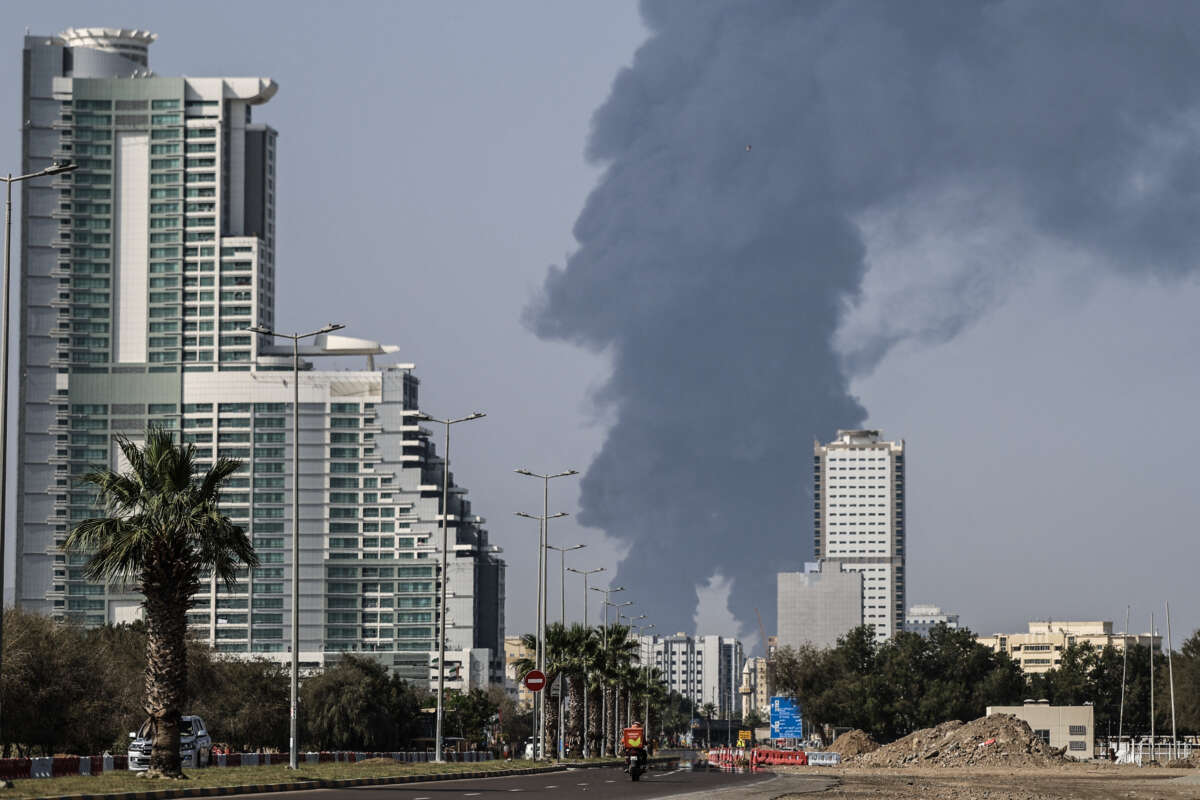
Smoke rises from the direction of an energy installation in Fujairah, United Arab Emirates, on March 14, 2026.AFP via Getty Images

On February 28, the U.S. and Israel expanded their joint genocidal war on Gaza onto Iran as well as Lebanon. After weeks of assassinations and bombing, President Donald Trump agreed to a ceasefire on April 7. This war of aggression by the U.S. and Israel is part of a continued attempt to wipe out any and all opposition to their dominance over the Middle East and its strategic energy reserves.

But they underestimated the capacity of the Iranian state. In addition to launching missile and drone attacks throughout the region, Iran blockaded the Strait of Hormuz, disrupting the production and shipment not only of fossil fuels but also an array of other commodities vital to global capitalism. With fossil fuel prices spiking and stocks crashing, Trump called off his threat to wipe out Iranian civilization and agreed to a ceasefire with Iran.

But Israel has already violated it, Iran has re-closed the Strait of Hormuz, and the ceasefire seems in jeopardy on the eve of negotiations for a settlement of the conflict in Pakistan. As a result, the world stands at the precipice of a multidimensional economic crisis.

In this interview for Truthout, Adam Hanieh discusses the U.S. and Israel’s imperialist goals, the war’s impact on the economies of the Global North and Global South, and its consequences for the geopolitical order as well as class and social struggles in the region and around the world. Hanieh is a professor in development studies and director of the SOAS Middle East Institute, University of London. He is author of Crude Capitalism: Oil, Corporate Power, and the Making of the World Market. This interview was conducted before the ceasefire and has been edited for clarity and length.

Ashley Smith: Clearly this war has been a disaster for the people of Iran. But the Iranian state has launched an asymmetric counteroffensive, targeted countries throughout the region, and shut down the Strait of Hormuz, and thereby disrupted the world economy. Why did the U.S. and Israel launch this war to begin with? What are the two states’ different war aims? How do they diverge? As the war has clearly backfired, what will they do to salvage it?

Adam Hanieh: The war needs to be placed in the wider context of a weakening of American power and a global environment marked by a range of deep political, economic, and ecological crises. Under Trump, Washington has been trying to reassert its global strength through a mix of military coercion, sanctions, tariff threats, and pressure on weaker states. In that sense, this war is not an aberration but part of a broader attempt to demonstrate that the U.S. can still dictate terms in strategically vital regions.


“Any divergence between Israel and the U.S. is more a matter of emphasis than overall strategic goals.”

The Middle East remains absolutely central here because of its importance to energy and other commodity flows, as well as its substantial financial surpluses that are reinvested globally. In 2025, nearly 15 million barrels per day of crude passed through Hormuz, about one-third of global crude trade. Most of these go eastward to China, India, and East Asia. This helps explain why Washington sees the region as a potential lever over rivals.

I don’t think there are major differences in U.S. and Israeli war aims. Both wanted to break Iran’s regional capacity, degrade its military infrastructure, and weaken the network of the various organizations aligned with Tehran across the Middle East. Lebanon is crucial in this respect, because Hezbollah has long fought against Israeli aggression — in this regard, Israel’s horrific onslaught in Lebanon has not received the attention it deserves in most media coverage.

I think any divergence between Israel and the U.S. is more a matter of emphasis than overall strategic goals. Israel tends to want a more thorough remaking of the regional balance in its favor, while the U.S. needs to consider the wider system of alliances it has built up over the decades. But the overlap is far greater than the difference.

The U.S. clearly underestimated Iran’s ability to respond asymmetrically, especially around the Strait of Hormuz. As such, Iran has not needed to “win” conventionally — by disrupting shipping, targeting energy infrastructure, and widening the field of conflict, it has shown that it can impose enormous costs on the world economy. It’s obviously very difficult to predict what the endgame will be.


“Israel’s use of mass displacement and collective punishment are now completely normalized in the eyes of the world.”

I do not think either the U.S. or Israel can easily get the clean victory they wanted, but neither can they afford to admit defeat. So perhaps the most likely outcome is a coerced and highly unstable arrangement that involves some partial reopening of Hormuz, some claim that Iran’s military capacities have been significantly degraded, and continued pressure on Iran’s regional allies, especially in Lebanon.

Israel, with the implicit greenlight from the U.S., has also launched a war on Lebanon, continued its genocide in Gaza, and escalated settlement in the West Bank. What are its aims here? What will this dimension of the war mean for the Lebanese, Palestinians, and the rest of the peoples of the region?

Away from media scrutiny, the Israeli military continues its blockade, destruction, and killing in Gaza. In the West Bank, we have seen a massive acceleration in settlement and settler violence against the Palestinian population. In Lebanon, Israel is trying to break Hezbollah and at the same time create a depopulated buffer zone in the south through bombardment, displacement, and reoccupation.

The human cost in Lebanon has been enormous, with more than a million people displaced. To put this in perspective for a U.S. audience, this is proportionally equivalent to more than the entire populations of California and Texas combined. What this really demonstrates is the ways in which Israel’s use of mass displacement and collective punishment are now completely normalized in the eyes of the world.

This war has cut off oil and natural gas supplies to the world and is dramatically impacting countries throughout the world. But too many people accept a stereotyped view of the region as just a source of fossil fuels. How have the economies of the region transformed themselves over the last few decades? How has that changed their role not only in the region, but in global capitalism?

Too many people still imagine the region, especially the Gulf countries, as simply giant oil spigots. What this misses is that the Gulf economies have fundamentally transformed over the past decade or so. They are now much more than simply producers of crude oil — they are major players in commodities (e.g. chemicals, fertilizers, and aluminium), maritime and air transport, and global finance. This is important because many of the basic inputs into global manufacturing and trade now originate in the Gulf, and what happens in the Gulf can quickly cascade through global supply chains.

One clear example is fertilizer. The Gulf produces roughly a third of global ammonia and urea, and this is crucial to food systems far beyond the region. The Middle East also accounted for more than 40 percent of global polyethylene exports last year, which is a massively important basic plastic and is why the conflict has sent shockwaves through manufacturing as well as energy markets. So, while the region is still indispensable to global energy flows, it is also deeply embedded in industrial production and the movement of goods across Asia, Africa, and Europe.

A further part of this transformation lies in the Gulf’s role within global finance. Over the last few decades, the region’s large and persistent current account surpluses have generated enormous pools of capital, much of it channeled through sovereign wealth funds, central banks, and other state-linked investment vehicles. These funds are deeply embedded in international equity markets, real estate, infrastructure, private equity, technology, and debt markets, and they have become increasingly important sources of liquidity and investment at a global scale.

These financial flows have a longer history in relation to American power. Since the 1970s, Gulf oil surpluses have played a significant role in U.S.-centered finance through what is described as petrodollar recycling: the channeling of oil revenues into dollar assets, Western banks, and U.S. financial markets. This recirculation of the Gulf’s financial surpluses helped sustain both the dollar’s international role and the wider architecture of U.S. financial power. This relationship is another reason why the Middle East is such a vital region to global capitalism.

Given all that, how will the war impact the world economy? What key industries will be impacted? How will it affect global finance and the world’s main stock markets? Where is global capitalism headed as a result?

The war is already having a major economic impact through the closure of Hormuz and damage to related energy and logistical infrastructure. This can be seen in higher oil and gas prices that are likely to persist throughout the year. Countries such as India are already increasing coal-fired power generation in anticipation of gas shortages. And of course, energy shocks feed through into the cost of transport, food, and everyday consumer prices, pushing inflation higher across the globe.


“The war has deepened an already existing turn toward more militarized states and zero-sum economic and political competition.”

There is also a substantial risk of shortages and price increases to fertilizers, chemicals, and other Gulf-produced commodities. Poorer countries are especially vulnerable here, because they have less fiscal capacity and many states in the Global South are already suffering from high levels of debt. One way this vulnerability might appear is in agriculture and food supplies. India’s domestic fertilizer industry, for instance, depends on the Gulf for nearly 80 percent of its ammonia imports; prolonged disruption of these supplies combined with higher energy costs could really impact food security in the country.

We also need to consider what a deep downturn in the Gulf might mean for the region’s migrant workforce. Migrant workers make up around half of the labor force across each of the Gulf monarchies, and millions of households in South Asia, the Middle East, and beyond depend on the remittances they send home. In an extended crisis, these workers may lose jobs, face deportation, or simply find themselves unable to keep sending money home at previous levels. A sharp fall in remittance flows would have serious effects on surrounding countries. This is exactly what happened during the 2008 global financial crisis and again during the COVID-19 pandemic. In that sense, migrant labor is one of the key channels through which crisis in the Gulf is transmitted outward to the wider global economy.

The overarching point is that this war is widening the deep systemic problems that were already present before February 28. Long before this war, global capitalism was marked by weak growth, mounting public and private debt, and overcapacity in many sectors. The war is intensifying all of these problems and pushing an already unstable system toward a much more serious breakdown. I think the possibility of a crash on the scale of 2008 or worse is very real if the war continues.

The war has undoubtedly impacted geopolitics. Already, Trump has lowered sanctions on Russian fossil fuels, enabling Russia to sustain its economy amid its imperialist war on Ukraine. What will the war mean for other great powers like China? What will this war mean for other states and their strategies and policies?

Russia has benefited directly from higher oil prices and the temporary waiving of some constraints on oil exports. That helps Moscow sustain export revenues and, by extension, its war in Ukraine. China faces a more contradictory position. On the other hand, the country has been systematically building up its oil reserves for a number of years, and its more diverse energy mix helps to insulate it from any immediate supply shock.


“Prior to the war, many countries in the Global South were already facing what is widely acknowledged as the worst debt crisis in history.”

It is noteworthy that foreign capital has been flowing into Chinese stocks and bonds over the last couple of weeks, which indicates that investors appear to view China as a relative “safe haven” at this moment. But if the war continues for a lengthy period of time, China will face difficulties because of its heavy reliance on Middle Eastern oil and gas. Chinese independent refiners are already cutting output as the prices of sanctioned Russian and Iranian crude rise and margins are squeezed.

More generally, the war has deepened an already existing turn toward more militarized states and zero-sum economic and political competition. This is because the war intersects with the wider systemic crises that I mentioned earlier, and which are forcing all states to find ways to manage and navigate global instability. This means expanding military spending, stockpiling energy and food, border securitization, and framing the control of raw materials and industrial capacity as matters of national security.

The other likely consequence is a renewed doubling down on fossil fuel production. Faced with supply disruption and price volatility, governments will move to lock themselves more deeply into existing hydrocarbon dependence. This means more oil and gas deals, the expansion of liquefied natural gas infrastructure, subsidies to domestic hydrocarbon production, and the rolling back of environmental regulations. Obviously, this just deepens the likelihood of future wars in the Middle East and elsewhere and worsens the accelerating climate emergency.

Finally, how will this war impact the people of the region, the Global South, and the Global North? How might it shape class and social struggles that have swept the world in the last couple of decades? How will ruling classes and especially the new authoritarian right in various countries likely respond?

As with all major crises, the impacts will be experienced very unequally. The most immediate and catastrophic costs are being felt in Iran and Lebanon through loss of life, displacement, destroyed infrastructure, and the massive ecological consequences of the war. For the wider Global South, the war is likely to mean higher food prices, higher transport costs, depressed trade, and worsening debt pressures.


“The key question is whether popular anger can be turned against the system that produced this crisis, rather than channeled into a politics of national chauvinism and fear.”

We need to remember that prior to the war, many countries in the Global South were already facing what is widely acknowledged as the worst debt crisis in history. In the Global North, the effects will be different but still severe. We are already seeing a renewed cost-of-living squeeze and expectations of much higher inflation over the coming year.

All of this will sharpen social antagonisms and may well open the way to renewed potential of mass protest. We should remember that the last two years have already produced a profound political radicalization among millions of people across the world, above all around the horrors of the genocide in Gaza. For many, Gaza has stripped away any lingering illusions about the existing order. It has brought into sharp relief the realities of a system that offers only war, obscene levels of inequality, climate collapse, and permanent insecurity.

Of course, this does not automatically translate into progressive politics. Crises of this kind can generate solidarity and new forms of internationalism, but they can also be seized upon by ruling classes and the authoritarian right. The danger is that a crisis produced by imperial war is re-coded as a justification for greater repression and renewed militarism. We can see this in the rush to frame the war in the language of national security. So, the key question is whether popular anger can be turned against the system that produced this crisis, rather than channeled into a politics of national chauvinism and fear.

This article is licensed under Creative Commons (CC BY-NC-ND 4.0), and you are free to share and republish under the terms of the license.

Ashley Smith


Ashley Smith is a socialist writer and activist in Burlington, Vermont. He has written in numerous publications including Truthout, The International Socialist Review, Socialist Worker, ZNet, Jacobin, New Politics, and many other online and print publications. He is currently working on a book for Haymarket Books entitled Socialism and Anti-Imperialism.
CDC Head Blocks Release of Findings Showing Strong COVID Vax Effectiveness


The report detailed how adults receiving COVID-19 vaccines saw hospitalization rates drop by 55 percent.
April 10, 2026

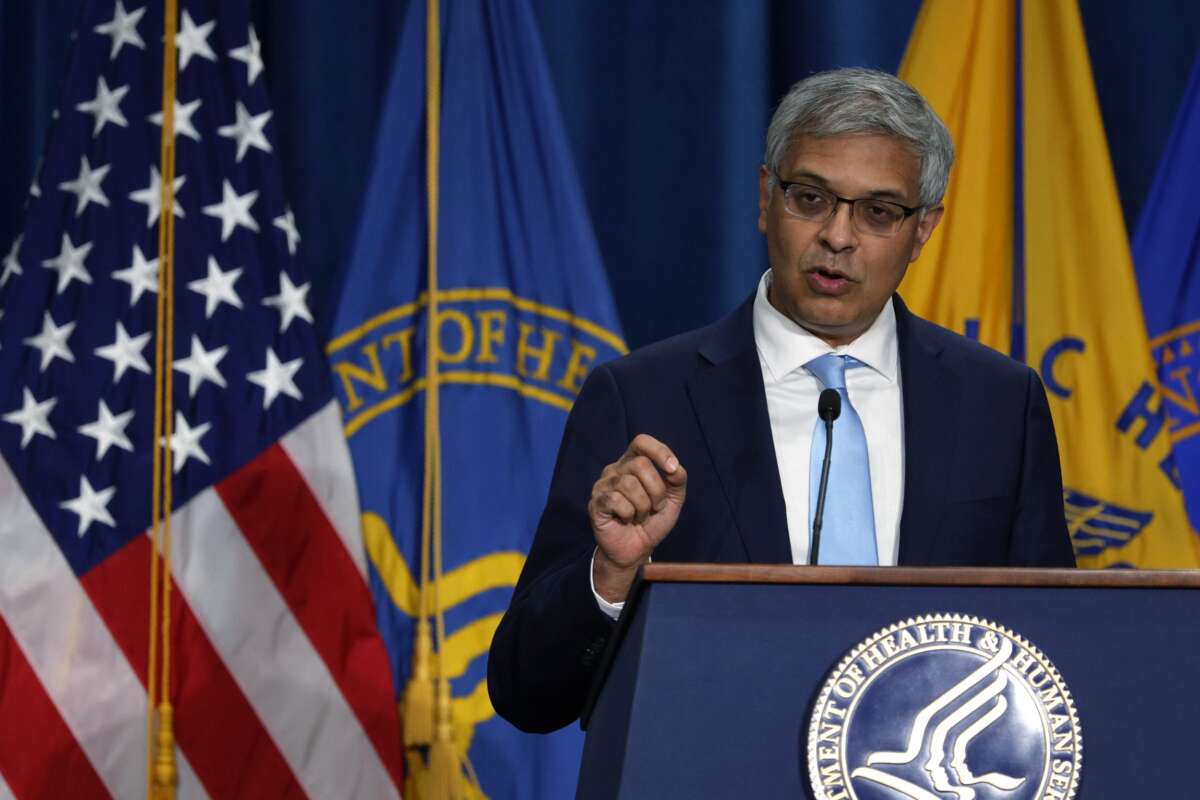
National Institutes of Health Director Jay Bhattacharya speaking on December 18, 2025 in Washington, DC.Alex Wong / Getty Images

Acting Centers for Disease Control and Prevention (CDC) Director Jay Bhattacharya, who also leads the National Institutes of Health (NIH), is reportedly delaying the publication of new findings within the health agency showcasing the strong effectiveness of COVID-19 vaccines to prevent emergency room visits and hospitalizations.

According to a report from The Washington Post, which cites two scientists with knowledge of Bhattacharya’s actions, the unpublished report examined adults who had been vaccinated between the months of September and December last year, and compared their health results to adults who didn’t get vaccinated. Among those who received vaccinations, ER and urgent care visits dropped by 50 percent, while hospitalizations overall saw a 55 percent decline.

The report has cleared the CDC’s scientific-review process, but Bhattacharya is blocking its publication over supposed concerns over its methodology, the scientists said, demanding further scrutiny. However, the report used methods that are regularly utilized by the national health agency, and a report on flu vaccines, using the same methodology as this blocked report, was published just last week.

The revelation of the delay of the report and the questionable rationale for delaying its release is raising concerns among members of the scientific community that the agency is shaping its policy due to the anti-vaccine attitudes of Bhattacharya and Department of Health and Human Services Secretary Robert F. Kennedy Jr.

Bhattacharya was picked by President Donald Trump to lead NIH last fall, a move that many public health advocates described as deeply alarming. Walker Bragman, a public health journalist, went so far as to describe Bhattacharya as Trump’s “most extreme pick” for his administration overall. He was named as acting CDC director in February due to a vacancy in that position.


FDA Announces COVID Vaccine Deaths Inquiry, Despite Evidence Showing Safety
The inquiry was spearheaded by FDA official Vinay Prasad, an anti-vaxxer who has cited little evidence for his claims. By Chris Walker , Truthout December 10, 2025


During the pandemic, Bhattacharya expressed skepticism of stay-at-home orders, worrying about the psychological effects that they would bring. Instead, before vaccines became available, he promoted so-called “natural” herd immunity, which calls for people to go about their lives as usual, with the hopes that their purposely getting infected leads to them developing their own immunity to the virus.

Such a method, if it had been carried out, would have inevitably led to more cases, hospitalizations, and ultimately deaths during the COVID crisis.

Reacting to The Washington Post report, several critics expressed concern that Bhattacharya and Kennedy were allowing their noted anti-vaccine beliefs to dictate policy rather than evidence-based studies.

“MORE evidence COVID vaccines hugely beneficial. MORE lies & spin by RFK Jr et al.,” said Timothy Caulfield, health law professor at the University of Alberta, writing on Bluesky.

“This is a clear example of putting politics over science at the cost of lives,” said science communicator and public health advocate Lucky Tran.

“This is definitely an escalation of this administration’s undermining of CDC science,” said Fiona Havers, a former adviser on vaccines at the CDC. “The fact that they are now blocking this is extremely concerning.”
Trump 'craters' a major alliance as leader now urged not to trust the US


'All doors have shut' for Trump as Europe’s rejection leaves him 'isolated and enraged'


April 10, 2026
ALTERNET

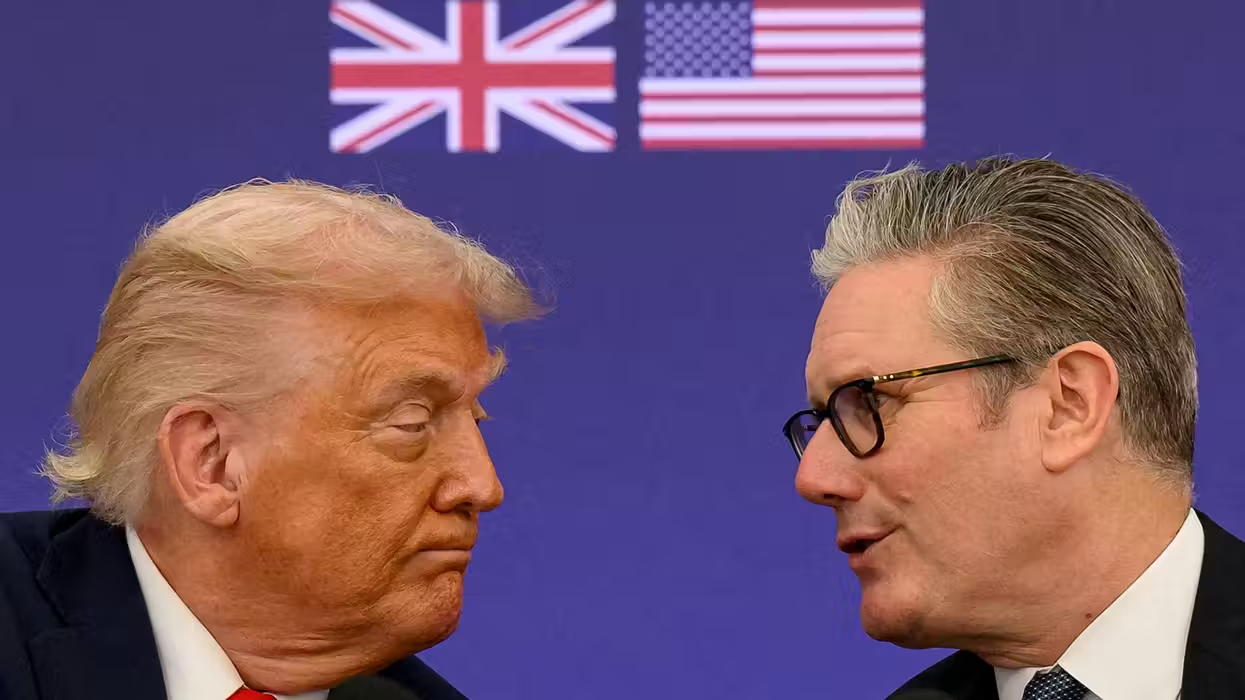
President Donald Trump's conduct has reportedly "cratered" one the most important U.S. alliances, according to the New York Times, with advisors urging "fed up" U.K. Prime Minister Keir Starmer to ditch the "special relationship" between the two countries.

In a report released on Friday, the Times said that Starmer is "looking to diversify his friend group" as Trump makes the U.S. "into an increasingly grumpy and unreliable partner for Britain." This was evident in a Thursday trip to Saudi Arabia, where he pledged "to show that we stand with our allies" in the Gulf states, only interacting with Trump near the end of the trip.

"That was no accident," Michael D. Shear, the lead U.K. correspondent for the Times, wrote. "Mr. Starmer’s new approach, which follows almost a year in which he repeatedly tried to cozy up to Mr. Trump, is part of a broader strategy to move Britain closer to partners in Europe, the Middle East and elsewhere as the relationship with the United States sours."


Despite his efforts to be "chummy" with Trump, the U.S. president has engaged in "repeated taunts and mockery" towards the U.K. This has led Starmer to alter his approach, taking a firmer stance against Trump and refusing to get involved in the Iran conflict

"I'm fed up," Starmer said in a Thursday interview, making a rare reference to Trump by name when he blamed spikes in energy costs for U.K. residents on "the actions of Putin or Trump across the world.”


In the same interview, Starmer reserved particular outrage for Trump's widely condemned Easter weekend Truth Social post threatening to wipe Iran's "whole civilization" if peace terms were not accepted soon.

“Let me be really clear about this,” the prime minister said, “They are not words I would use — ever use — because I come at this with our British values and principles.”

Peter Ricketts, "a veteran British diplomat who served as the country’s first national security adviser," also weighed in on the fraying "special relationship" this week, encouraging Starmer to outright abandon reliance on the U.S. and expand relations with Europe.


“We do have to rethink the idea that the U.S. is a reliable, trustworthy ally on which we can depend in the longer term,” Ricketts told BBC Radio. “We’ve got to get closer to the Europeans. We’ve got to work out how we live in a world where American interest has moved away from Europe.”
'What corruption looks like': How Trump 'went to war' to protect family’s businesses


Donald Trump Jr. and Eric Trump react outside the Nasdaq building after ringing the opening bell at the Nasdaq Market, in New York City, August 13, 2025. REUTERS/Eduardo Munoz
April 09, 2026
ALTERNET

Critics attacked President Donald Trump's newest move against states as a "war" against betting market regulations meant to help enrich his family's business interests, with one activist stating bluntly, "This is what corruption looks like."

According to a Thursday report from the Popular Information substack, Arizona, Connecticut and Illinois have launched lawsuits against "prediction market" platforms Kalshi, Polymarket, Crypto.com and Robinhood, alleging that they have worked to "circumvent state laws" in order to run "illegal gambling sites." As these services have exploded in popularity, critics have accused them of turning a wide range of random circumstances into opportunities for betting, as well as offering betting opportunities on things like sporting events that critics say are indistinguishable from real gambling altogether.

In response to these state-level efforts to rein in these platforms, Trump's Commodity Futures Trading Commission filed counter lawsuits, arguing that the services those sites offer "are distinct from traditional gambling." That is the same line of argument the platforms themselves have put forward as they have attempted to avoid being regulated or outright banned under traditional gambling laws.


As Popular Information laid out in detail, Trump has extensive connections to these platforms, owning the largest share of the Trump Media & Technology Group, which in turn does significant business with Crypto.com. Trump's son, Donald Trump Jr., is also "deeply enmeshed" in the industry, serving as an advisor for both Kalshi and Polymarket. And it does not stop there.

"Many of Trump’s political allies also have connections to the prediction market industry," the report elaborated. "Trump-supporting billionaire Peter Thiel, for example, has helped raise millions in funding for Polymarket. Paradigm, an investment firm, and venture capital firm Andreessen Horowitz also participated in a funding round for Kalshi. Paradigm donated $1 million to Trump’s inaugural fund. Andreessen Horowitz co-founders Marc Andreessen and Ben Horowitz both donated millions to a super PAC supporting Trump’s 2024 campaign, and Trump recently appointed Andreessen to his 'President’s Council of Advisors on Science and Technology.'"


Melanie D'Arrigo is an executive director for the New York Health Campaign, which advocates for universal single-payer healthcare, and has co-founded non-profits involved with the LGBTQ community. Sharing a link to the report on X Thursday, she was unsparing in her appraisal of the corruption at play with the CFTC's lawsuits.

"Donald Trump Jr. is a paid strategic advisor for Kalshi," D'Arrigo wrote. "Trump Jr. is a major investor and advisor for Polymarket. Trump Media has a $6.5 billion+ investment and partnership with Crypto.com. Robinhood runs the Trump Accounts. The Trump administration is blocking states from suing them. This is what corruption looks like."

MAGA Christians unleash unintentionally hilarious Ben Franklin film


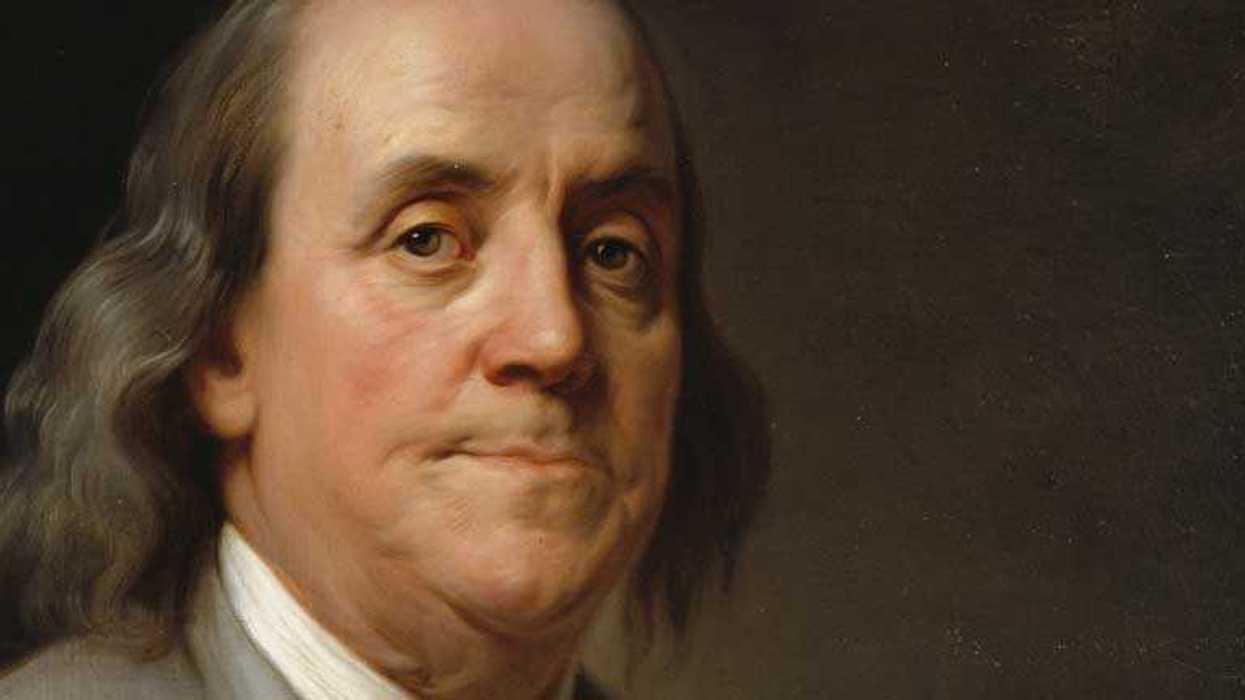
By Joseph-Siffred Duplessis - ZgEyj5EEKdux-g at Google Cultural Institute maximum zoom level, Public Domain, https://commons.wikimedia.org/w/index.php?curid=21880454

April 05, 2026
ALTERHET


Editor's Note: This article has been updated to reflect that the Val Kilmer play "Citizen Twain" was renamed "Cinema Twain" upon being released as a film.


In theory, “A Great Awakening” could have been a fascinating film. It depicts the real-life friendship between American founding father Benjamin Franklin and George Whitefield, one of the founders of the evangelical movement. Franklin was a deist intellectually and a lapsed Puritan emotionally, while Whitefield was Calvinistic.

Yet “A Great Awakening” has no interest in exploring their relationship in any thoughtful or dramatically interesting way.

It’s easy to see why that happened. Despite focusing on religion, “A Great Awakening” is not a good faith movie, at least in the sense that it exists primarily to entertain, enlighten or in some other way enrich the lives of its audience. Director Joshua Enck and his co-writers Jeff Bender and Jonathan Blair, have created a bad faith film, a Trojan horse of Christian nationalist propaganda packed inside as a supposedly poignant tribute to two 18th century luminaries. Blair also stars as Whitefield, and the film’s lone virtue is that his performance is so horrible, it becomes unintentionally hilarious (more on that later). Blair’s costar John Paul Sneed, a longtime veteran of Christian Right schlock, plays Benjamin Franklin with such blandness that I laughed when my autocorrect tried to change his surname to “Snooze.” Sneed could learn a lot from cinema’s greatest Franklin, Howard Da Silva in “1776.”

The propaganda behind “A Great Awakening.”

The movie’s central plot is the claim that George Whitefield inspired Benjamin Franklin to support human equality; for this reason, I cannot talk about it with any semblance of intellectual honesty and not dive into the story. While Franklin did ask the 1787 Constitutional Convention to open its daily sessions with prayer, he was not particularly religious and seems to have done so because — like millions of Americans today — he could simultaneously want to be on God’s good side without also being a theocrat. Yet the movie draws from a controversial account by a man named William Steele, written almost 40 years after the event occurred and relying entirely on Steele’s unverified second hand recollections supposedly relayed by New Jersey delegate Jonathan Dayton. Steele was later contradicted by Virginia delegate, future president and the Constitutional equivalent of influencer James Madison, who recalled that Franklin, who represented Pennsylvania (where much of the movie is set), had not asked for that prayer in quite the dramatic fashion that Steele relayed. Madison was confident that Franklin’s “proposition was received and treated with the respect due to it; but the lapse of time which had preceded, with consternations growing out of it, had the effect of limiting what was done, to a reference of the proposition to a highly respectable Committee.”

Madison added, “That the communication [Steele’s account of Dayton’s testimony] was erroneous is certain; whether from misapprehension or mis-recollection, uncertain.”

"We know little of relevance about either William Steele or Jonathan Steele,” scholar Louis J. Sirico, Jr., wrote in 2018 (Benjamin Franklin, Prayer, and the Constitutional Convention: History as Narrative, 10 Legal Comm. & Rhetoric 89 (2013)). “We know that William Steele was a Revolutionary War veteran who was born in New York, lived in New Jersey, married Mary Dayton, possibly a relative of Jonathan Dayton, and moved to upstate New York. He was an active Presbyterian and often wrote poetry for his family. Jonathan D. Steele became a wealthy businessman and served as president of the Niagara Fire Insurance Company."


Sirico added, “Nothing in the available historical record offers any insight into the genesis of the false narrative.”

Sirico is not the lone voice casting doubt on the credibility of the Steele account. John Fea, Professor of American History and Chair of the History Department at a private Pennsylvania Christian college called Messiah, wrote for Commonwealth Magazine in 2024 that “the Awakening had nothing to do with the American Revolution (and, in fact, may never have happened in the first place),” and that indeed there is a “twenty-five-year gap between the First Great Awakening and the Revolutionary Era.” He concluded that a 1981 thesis by historian Jon Butler disproving any link between the two events (to the extent that the former occurred at all beyond a few local incidents) was “groundbreaking and convincing.”

Yet with powerful Christian nationalists like informal President Trump adviser Steve Bannon and longtime theocrat David Barton spreading the lie that the Great Awakening inspired the American Revolution, “A Great Awakening” is guaranteed a built-in audience, especially with it being distributed by a mainstream studio like Roadside Attractions.


Which brings us back to the movie on screen.

Christian Right movies are notoriously second-rate.

The only people who enjoy these movies are either those who deliberately dull their tastes to insensitive nubs in order to “own the libs” or those who enjoy laughing (often with gallows humor) at the fact that these movies exist at all. The most notable entries in the genre include “Kirk Cameron’s Saving Christmas,” “War Room” and the five “God’s Not Dead” movies. None of them amount to much as serious or even unironically funny films, but like “A Great Awakening,” each is rip-roaringly hysterical if you have a taste for the specific type of cheese produced by these particularly talentless people.

“A Great Awakening” has plenty such moments, at least when Blair is gnashing his teeth, contorting his face and otherwise mugging as the most unlikeable and histrionic Whitefield ever performed by an actor. There is a maudlin scene of foot washing in which Blair and an extra seem to compete to overact, a narcissistic so-called “self doubt” set piece that had me agreeing with a John Wesley put-down and several blatant uses of African Americans as props, even though Whitefield in real life had a very complicated relationship with race. My favorite moment was when Blair’s Whitefield insults the clerical establishment in a scene intended to come across as free-thinking but instead seems needlessly rude. He is given a command that he may no longer “preach inside.” With a look of triumph he declares, “Then I will preach outside!”


I try to be polite during movies, but at that moment I couldn’t stop myself from guffawing so loudly my voice literally reverberated against the auditorium walls. Where else is he going to go? Fortunately, the theater was empty except for me, so I wasn’t technically rude.

Yet I don’t think those theaters will remain empty (I was at an early morning screening and paid because it is the film critic’s tax, so to speak), as much as I hope my cynicism is misplaced. I’ve seen advertisements for “A Great Awakening” everywhere, and if you go to my earlier list of Christian Right films that normal people laugh at, you’ll see that several of them were box office successes. The audience for these films are not the early 21st century equivalents of Franklin or Whitefield or either man’s many contemporary followers in the 18th century, but rather of the people from that era too mediocre to be remembered. The individuals who earnestly support “A Great Awakening” or any similar slop films own themselves as the world laughs that such insipid material can economically support itself at all. Unfortunately, because they believe they're owning their ideological opponents, millions of such mediocrities are out there, happy to part with their money to prove a point.

The sad thing is, as I mentioned earlier, it didn't have to be this way. I think back to "Cinema Twain," an obscure play-turned-movie directed, written by and starring Val Kilmer as an American secularist as iconic as Benjamin Franklin, author Mark Twain. The 19th/early 20th century novelist had a respectful-yet-critical epistolary relationship with Christian Science founder Mary Baker Eddy. Kilmer (who busted my balls when he saw there was a journalist in the audience) did a poignant job of vividly bringing to life both the brilliant personalities and the sharply different ideas of his two central figures. Kilmer's passion project, which sadly was never adapted into a film, moved me because it came from a place of authentic curiosity and was executed with talent. By contrast, "A Great Awakening" strives only to manipulate, and it does so ineptly.

Like all movies made by the Christian Right that intend to proselytize, “A Great Awakening” is full of lazy exposition, flat dialogue and cringey pandering to reactionary self-glorification. This movie is so dumb that it has the gall to insert in one character’s mouth the line “How long will you hide behind your wit?”, as if any substantial amount of that precious commodity exists in this motion picture.
Trump nominates extremist to lead world's largest humanitarian agency


(REUTERS)

April 10, 2026 
ALTERNET

President Donald Trump’s choice to fight global hunger subscribes to a philosophy that will only make it worse.

Trump appointed Luke Lindberg, the Department of Agriculture’s undersecretary for Trade and Foreign Agricultural Affairs, to lead the Rome-based World Food Program, which is the world’s largest humanitarian agency, according to a report by PassBlue. Yet Lindberg’s most recent job was rebranding the Food for Peace international food aid program as "America First" international food assistance. Under Trump the federal government has pushed for cuts to the McGovern-Dole program, which provides food assistance to low-income nations, as well as for Lindberg’s own Food for Peace program.

“Under the second Trump administration, funding for the World Food Program was slashed in half after the dismantling of USAID,” PassBlue reported. “The loss of $2.6 billion in US funding in the last year triggered the layoff of a third of WFP’s staff and a surge in malnutrition in some of the most fragile countries. Despite the cuts, Washington remains at the top of the donors’ list for WFP. This reality makes it more likely that Trump’s nominee will pull through the Senate confirmation hearings without major opposition.”

In addition to supporting Trump's funding cuts, Lindberg is also linked with unpopular food distribution methods. Both the World Food Program and other UN humanitarian agencies prefer to either provide cash or help local and regional governments obtain food, arguing that these approaches are cheaper, more efficient and less disruptive. But Lindberg advocates exporting US-grown commodities to provide the same international food aid.

“Sam Vigersky, an international affairs fellow at the Council on Foreign Relations, said that recourse to the old practice of WFP procurement restricted only to US commodities is a strong possibility if an American leads the agency again,” PassBlue reported.

“The practice is inefficient in that it involves shipping grain at significant cost from America, which is rarely the most readily available or the cheapest source; nor is it always the locally preferred kind of grain,” Nick Coghlan, a former Canadian diplomat with experience in Sudan and South Sudan, told PassBlue.

He added, “Moreover, the practice seriously undermines regional food markets which would otherwise receive a useful boost; and it discourages more innovative WFP programmes that require cash injections.”

When Trump dismantled USAID, more than a million people were left without three months worth of food because $98 million in ready-made meals and other rations were abandoned in four warehouses by the administration.

“Contracts with suppliers, shipping companies, and contractors have been canceled since USAID was taken over by the Trump administration's so-called Department of Government Efficiency, with the White House saying the agency—with a relatively small budget of just $40 billion—was responsible for ‘significant waste,’” Common Dreams reported in May. “Since DOGE, run by tech billionaire Elon Musk, targeted USAID in one of its first full-scale attacks on a federal entity, the agency is being run by Secretary of State Marco Rubio.”

In response to Trump’s attacks on food programs, a current federal official told NOTUS in July that Trump’s actions are a sign of America slipping into authoritarianism.

“Take it from those of us who worked in authoritarian countries: We’ve become one,” the official told NOTUS. “They were so quick to disband AID, the group that supposedly instigates color revolutions. But they’ve done a very foolish thing. You just released a bunch of well‑trained individuals into your population. If you kept our offices going and had us play solitaire in the office, it might have been safer to keep your regime.”
Small Wisconsin City Overwhelmingly Passes First-of-Its-Kind Measure Restricting AI Data Centers

“This is really setting a precedent,” said one activist. “This is something that other communities can look to."


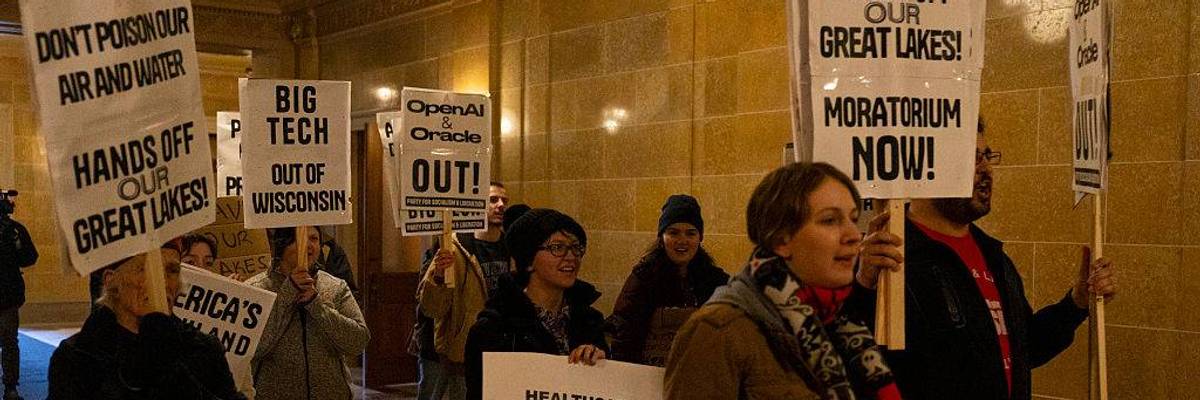
Protesters gather for a statewide data center day of action at the Wisconsin State Capitol on February 12, 2026 in Madison, Wisconsin.
(Photos by Joe Timmerman/Catchlight/Wisconsin Watch via Getty Images)

Brad Reed
Apr 08, 2026
COMMON DREAMS

The nationwide backlash against the artificial intelligence industry entered a new stage on Tuesday after a small Wisconsin city overwhelmingly passed a first-of-its-kind referendum limiting AI data center construction.

According to a Wednesday report in Politico, voters in the Milwaukee suburb of Port Washington, home to roughly 12,000 residents, supported the data center restrictions by a margin of around 2-to-1.


With First-of-Its-Kind Bill, Sanders and AOC Propose Moratorium on New AI Data Centers

The referendus requires town officials to seek voter permission before approving or providing tax incentives for any future data centers in the community, giving residents veto power over new projects.

Port Washington is already home to a $15 billion, 1.3-gigawatt data center funded by tech giants Oracle and OpenAI, and local residents wanted to ensure that no additional facilities are green lit without their express approval.

The referendum was pushed by a grassroots community organization called Great Lakes Neighbors United, which advocates “advancing transparency, environmental stewardship, and responsible development in Wisconsin.”

Christine Le Jeune, founder of Great Lakes Neighbors United, told Politico that she hopes the work done limiting AI facilities’ construction can be replicated nationwide.

“This is really setting a precedent,” Le Jeune, said. “This is something that other communities can look to.”

Politico noted that similar anti-data center measures are coming up for votes later this year in communities across the US, including in Monterey Park, California; Augusta Township, Michigan; and Janesville, Wisconsin.

Opposition to AI data centers has become a major political issue in recent months, as local residents have objected to the large facilities consuming massive amounts of electricity and water, while also generating significant noise pollution.

Data centers also put a major strain on the US electrical grid, causing a spike in utility bills across the country. PJM Interconnection, the largest US grid operator that serves over 65 million people across 13 states, projected earlier this year that it will be a full six gigawatts short of its reliability requirements in 2027 thanks to the demands of data centers.

Sen. Bernie Sanders (I-Vt.) and Rep. Alexandria Ocasio-Cortez (D-NY) introduced a bill in March that would impose a nationwide moratorium on AI data center construction “until strong national safeguards are in place to protect workers, consumers, and communities, defend privacy and civil rights, and ensure these technologies do not harm our environment.”

At the same time, the AI industry is planning on spending big money in 2026 to influence elections, with the goal of passing legislation setting a single set of AI regulations that will take effect throughout the US, overriding any restrictions placed on the technology by state governments.

CNN reported in February that Leading the Future—a super political action committee (PAC) backed by venture capital firm Andreessen Horowitz and Palantir co-founder Joe Lonsdale, is pledging to spend at least $100 million to ensure AI-friendly candidates get elected to Congress this year.
Iowa farmers sound alarm as Trump economy leaves them 'on the brink of something bad'


President Donald Trump speaks at a farmers' roundtable event during the 2024 presidential election, Image via C-Span.

April 09, 2026 
ALTERNET

U.S. farmers are continuing to get slammed by President Donald Trump's administration, as the closure of the Strait of Hormuz has drastically increased costs for the industry.

CNN spoke with farmers for an update as they kick off the spring planting season. "They're at a breaking point," the report began.

"A lot of farmer discouragement out there. Prices of our soybeans, prices of all our commodities started going down, prices of fertilizer and other things we import to plant a crop started going up. So for a year, we've seen some real chaos on all sorts of trade tensions," Aaron Lehman, a fifth-generation farmer, told CNN's Jeff Zelany.

"I see so many farms are reporting that they're on the brink of something bad, that their communities are on the brink of something bad," he added.

The farmer said that there are more uncertainties than in most other years.

Not only does oil come from Iran, but the war is also making fertilizer costs soar. Planting season for large crops such as corn, soybeans, and other major agricultural crops is typically in the spring, between March and June, depending on the area of the country.

At the same time, the weather this year hasn't been kind to both farmers and ranchers. A heavy drought in Texas has resulted in half of the winter wheat being rated poor to very poor, said the USDA’s first Crop Progress report of the season.

That drought is also driving up beef prices. In 2025, the U.S. faced the lowest cattle numbers since 1951.

"Severe drought over the past few years has discouraged cattle being retained for breeding," said CNBC. That drought hasn't changed much over the past 6 months.

"Tariffs and cattle disease have further exacerbated consumer price increases, though imports mainly affect the ground beef supply," the report said.

Farmers and ranchers were already suffering because of Trump's tariffs.

Bill Watts wrote for the Farm Journal that "in its monthly Agricultural Trade Monitor, NDSU found that tariffs imposed by the Trump administration under the International Emergency Economic Powers Act (IEEPA) collected an estimated $958 million in revenue from selected imports of agricultural inputs between February and October of last year. Of that, about: $273 million came from agricultural chemicals, $530 million from farm machinery, $110 million from fertilizers and $44 million from seeds."

Lehman noted that the Iran war is causing high fuel prices for all of the equipment. So, they're filling up 100 gallons of gas "multiple times a week."

Wes Rieth, farm manager of Longview Farms, explained that each farmer gets one chance each year to plant and one chance to harvest.


Serial failure Jared Kushner has no business negotiating peace

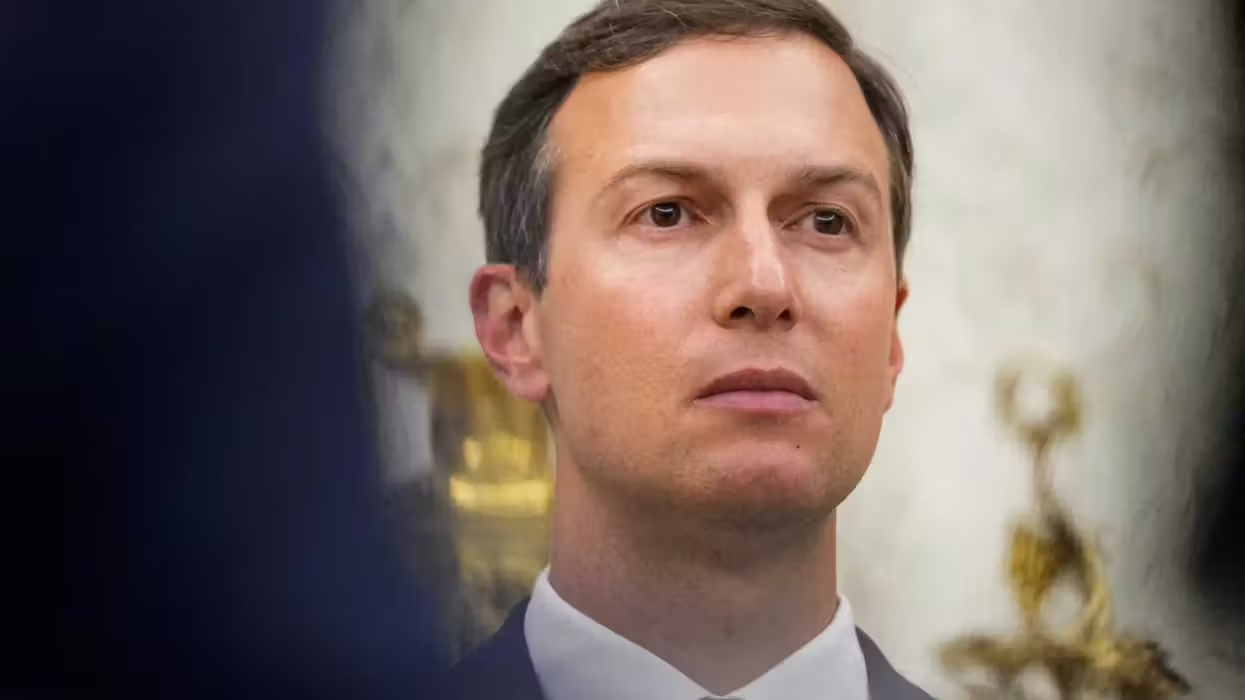
Jared Kushner looks on during a swearing-in ceremony of Special Envoy Steve Witkoff in the Oval Office at the White House in Washington, D.C., U.S., May 6, 2025.
 REUTERS/Kent Nishimura/File Photo

April 10, 2026 
ALTERNET

President Donald Trump's son-in-law Jared Kushner, was working with Middle East envoy Steve Witkoff to negotiate a new nuclear agreement with Iran when the U.S. began its bombing campaign. They were close to an agreement, but Trump went to war anyway, said a report from The Guardian.

It's prompting one national security analyst to question why the two are trying again to negotiate if they weren't able to succeed the first time around.

In a BlueSky thread, Marcy Wheeler questioned why folks are focused on things like the 25th Amendment and impeachment, instead of asking about Kushner, who doesn't even work for the White House and has his own economic interest in continuing the war. The New York Times reported last month that while he was negotiating a peace deal, he was also trying to raise money from Gulf states.


"NO ONE is really holding the GOP accountable for letting Trump send his son-in-law on a diplomat's errand, EVEN AFTER his incompetence led to war, or the fact that he has rid his White House of either experts or grown-up advisors," wrote Wheeler.

She added that there's also "the fact that they let him go to war without fully briefing before and during. It's that accountability that matters, one way or another. And impeachment/25A can be a tool to force that accountability."


Wheeler said that House and Senate Minority Leaders Hakeem Jeffries (D-N.Y.) and Chuck Schumer (D-N.Y.) are "intent" on demanding a vote over the War Powers Act.

"That would have the effect of peeling off a few members in both [houses]. But you need a larger narrative that GOP refusal to do its job enabled a catastrophic war," Wheeler added.

The comment comes as Trump posted on Truth Social that, despite closing the Strait of Hormuz and causing a possible global economic collapse, he believes Iran has "no cards." He called the closure of the strait "extortion."

The Guardian reported a few weeks after the bombing began that one Gulf diplomat, with direct knowledge of the negotiations, is furious with Witkoff and Kushner’s behavior. That person described them as “Israeli assets that had conspired to force the US president into entering a war from which he is now desperate to get himself out of."

Now, Vice President JD Vance is en route. Vance never wanted the war to begin with, so he might have more success than Kushner and Witkoff.

Meanwhile, inflation has risen above the level it was at when Trump took office in Jan. 2025.