
By AFP
March 24, 2026

Activists chanted 'Cuba yes! Blockade no!' as the aid boat arrived in Havana - Copyright AFP YAMIL LAGE
Elisa Colella aboard the Maguro with Lisandra Cots in Havana and Gerard Martinez in Miami
The first boat of a flotilla carrying medical supplies, food and solar panels reached Cuba on Tuesday to aid the island as a US fuel blockade deepens its energy crisis.
The Maguro shrimp fishing boat docked in Havana three days later than hoped after battling strong winds, currents and a pesky battery during its journey from Mexico.
As they approached Havana’s colonial-era fortification, the international activists stood on the cabin roof of the boat — symbolically renamed “Granma 2.0” as a tribute to the yacht used by Fidel Castro’s guerrilla fighters to launch their revolution in 1956.
They held a sign reading “Let Cuba live” while others waiting for them on the dock chanted “Cuba yes! Blockade no!”
“I wish everyone would unite, even Cubans abroad, and come and do the same because it is the people who are suffering,” said Amado Rodriguez, a 59-year-old driver walking near Havana Bay.
The first shipments arrived by plane from Europe, Latin America and the United States last week as part of an air and sea mission, dubbed Our America Convoy, to bring some 50 tonnes of aid to Cuba.
Two more ships are due to arrive Tuesday or Wednesday.
Activists say the mission, which had the support of the government, aims to bring relief to Cubans amid a de facto US oil blockade that President Donald Trump launched in January.
Critics have slammed the effort as benefiting the communist government more than ordinary people.
Convoy organizer David Adler, a US citizen, told AFP the mission brought urgently needed aid directly to Cubans and showed the world “the human costs of Trump’s siege on Cuba.”
“It demonstrated that international solidarity can triumph over forced isolation,” said Adler, coordinator of global left-wing group Progressive International.
The country has suffered seven nationwide blackouts since 2024 — two of them this past week — due to aging thermoelectric plants and oil shortages.
The situation has deteriorated since Trump ordered a military operation to capture Cuba’s chief regional ally, Venezuelan socialist leader Nicolas Maduro, in January — depriving the island of its main oil supplier.
Trump subsequently threatened to slap tariffs on any country shipping oil to Cuba.
– Trump’s ‘greed’ –
The Maguro left from Mexico’s Yucatan peninsula Friday carrying 32 people, including activists from Australia, Brazil, Ecuador, Italy, Mexico and the United States, and AFP journalists.
As the boat motored across the sea, Brazilian activist Thiago Avila said other nations should come to Cuba’s aid.
“We cannot allow the world and international law to be buried under the greed of Donald Trump,” Avila told AFP.
“That’s why we are here, that’s why people decided to mobilize for this and decided to donate.”
Avila was among the organizers of a flotilla that had tried to bring aid to Gaza last year despite a naval blockade. That effort was intercepted by Israeli forces.
Fellow Brazilian activist Lisi Proenca said the group was applying the experience it gained from the Gaza flotilla to bring aid to Cuba.
“The interesting thing is that we’re able to carry much larger items, like solar panels,” she told AFP.
– ‘Political sideshow’ –
In addition to daily outages, fuel prices have soared, public transport has become rare and trash is piling up as garbage trucks are no longer running.
Cuba has blamed Washington for the country’s hardship, pointing to the fuel blockade and a decades-old trade embargo.
Cuban exiles and other critics, who say the communist government is to blame for the economic crisis, said the convoy is giving political support to Havana.
“All of this is nothing more than a political sideshow,” Luis Zuniga, a former Cuban political prisoner now based in Miami, told AFP.
“The electricity crisis in Cuba does not stem from the oil embargo imposed by (Trump). It dates back to long before that,” Zuniga said.
11,000 Children Among Tens of Thousands ‘Waiting for Surgery’ in Cuba Due to US Blockade
Cuba’s Deputy Foreign Minister Carlos Fernandez de Cossio said he hoped the people of the United States would ask, “Why does our government treat the whole population of Cuba this way?”
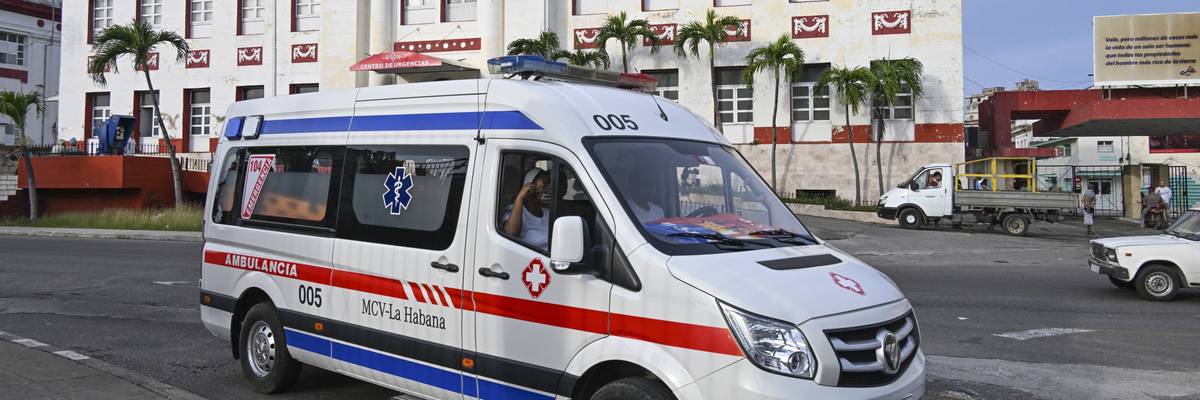
An ambulance passes in front of Calixto García Hospital in Havana on December 18, 2025.
(Photo by Yamil Lage/AFP via Getty Images)
Stephen Prager
Mar 23, 2026
COMMON DREAMS
More than 96,000 Cubans, including 11,000 children, are “waiting for surgery” due to a fuel shortage caused by the American blockade, the country’s deputy foreign minister, Carlos Fernandez de Cossio, said on Sunday.
The numbers cited by the minister on NBC’s “Meet the Press” on Sunday were first reported earlier this month by Cuban Minister of Public Health José Ángel Portal Miranda, who explained that President Donald Trump’s policy of “energy asphyxiation,” using tariffs to threaten countries out of importing fuel to Cuba, has devastated its National Health Service.
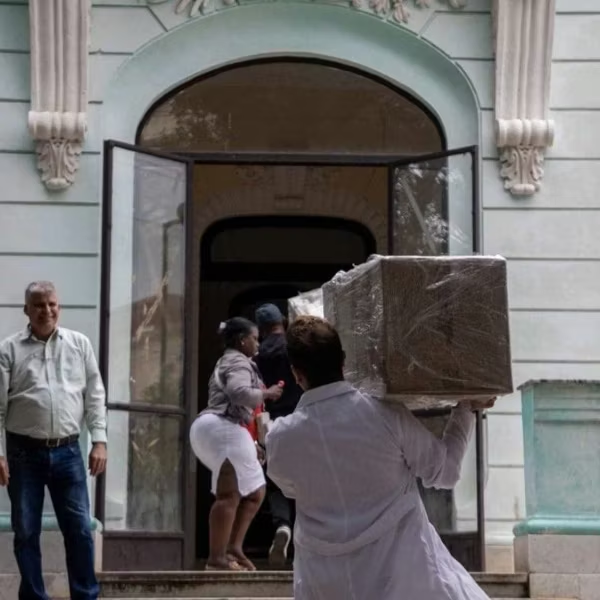
International Convoys Deliver Aid to Cuba as Russian Tanker Moves to Defy US Oil Blockade
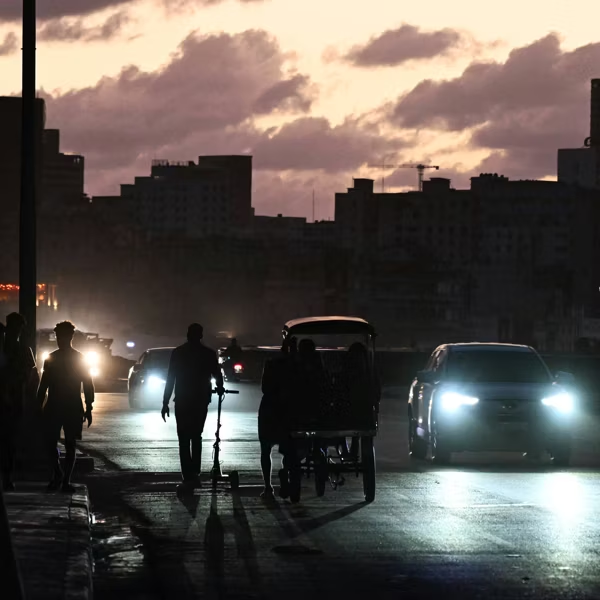
‘US Siege Is Warfare’: Cuba Faces Second Nationwide Blackout in Under a Week
The policy has left Cuba unable to import oil from abroad for more than three months, reducing its fuel supply by about 90% and leading to periodic blackouts and strict energy rationing.
Using the severely limited electricity at its disposal, Cuba’s health system has been forced to prioritize continuing cancer treatments and other lifesaving procedures, putting those awaiting non-urgent surgeries on the sidelines.
Last month, a specialist at a hospital in Holguín told Diario de Cuba that the surgeries canceled included “uncomplicated hernias, cataract surgeries, some non-urgent gynecological procedures, and scheduled orthopedic surgeries.”
Other healthcare professionals said that nobody was being admitted to the hospital for tests and that it was running low on basic supplies like syringes, IV tubing, and antibiotics, which could not be delivered due to fuel shortages. Most of those that have been used had to be donated by family members or purchased for exorbitant prices on the black market.
Jorge Barrera, a reporter for CBC News, spoke with patients and employees at Havana’s National Institute of Cardiology and Cardiovascular Surgery this weekend and found it to be at about half capacity, and that nonessential care has been virtually all suspended.
“Even though the health system is a point of pride for Cuba... something that they export to the rest of the world,” Barrera explained, “because of this crisis, because of the impact it’s had on the skyrocketing prices, it’s just not enough for them to make ends meet. So people are quitting... to find other ways to make money to feed their families.”
De Cossio said he hoped the people of the United States would ask “Why does our government treat the whole population of Cuba this way?” and that they’d “understand that it’s not correct to treat another nation the way the US is doing simply to try to achieve political goals.”
The US blockade of Cuba is largely unpopular with the American public. A poll published last week by YouGov found that just 28% of adult US citizens said they approved of the US blocking oil shipments to the country, while 46% said they opposed it.
Asked by anchor Kristen Welker about suggestions from Trump that Cuba would collapse “on its own” without the need for the US to intervene militarily, De Cossio retorted, “What does ‘on its own’ mean when it’s being forced by the United States?”
Prior to Trump’s further measures to isolate Cuba in January, the US had placed Cuba under an economic embargo for more than 60 years, which severely hampered the country’s economic development and has cost Cuba trillions of dollars since it began, according to the UN.
“It’s a very bizarre statement, and it’s claimed by most US politicians repeatedly that Cuba will collapse on its own,” De Cossio said. “Then why does the US government need to employ so many resources, so much political capital, so many human resources to try to destroy the economy of another country? Evidently, it implies that the country does not have the characteristics to collapse on its own.”
Cuba is Trump’s Next Imperial Project

Another Nonexistent Threat
Regime change in Cuba may be the next stop for the Trump war machine. Here’s what he told CNN in an interview March 6:
“Cuba is gonna fall pretty soon . . . They want to make a deal, and so I’m going to put Marco ]Rubio] over there and we’ll see how that works out. We’re really focused on this one [Iran] right now. We’ve got plenty of time, but Cuba’s ready — after 50 years . . . I’ve been watching it for 50 years, and it’s fallen right into my lap because of me, it’s fallen, but it’s nevertheless fallen right into the lap. And we’re doing very well.”
The justice department followed up by indicting several Cuban officials and entities for their alleged involvement in drug trafficking—a tactic now also being used to pursue another Trump critic, Colombia’s President Gustavo Petro.
The authority for Trump’s threats to Cuba are contained in an executive order on January 29, 2026. It states that “the policies, practices, and actions of the Government of Cuba constitute an unusual and extraordinary threat” to U.S. national security and foreign policy. The executive order E.O. declared a national emergency under the National Emergencies Act and invoked the International Emergency Economic Powers Act of 1977, which empowers Trump to impose tariffs on foreign countries that “directly or indirectly” supply oil to the Cuban government.
To be clear, Cuba presents no national emergency, nor is there evidence that Cuba constitutes a threat of any kind to US national security—no more so than Iran or Venezuela. The real emergency in Cuba is humanitarian: the needless suffering inflicted on the Cuban people by the US energy blockade, which is preventing necessities such as food, medicine, and medical equipment from reaching them.
Naked Imperialism
In a January 11, 2026, social media post, shortly after US forces seized Venezuela’s leader, Nicolas Maduro, Trump asserted that there would be “NO MORE OIL OR MONEY GOING TO CUBA.” Trump is in the driver’s seat on Cuba: The threat to its oil suppliers of high tariffs, accompanied by a cut-off of Venezuelan oil shipments to Cuba, has left Cuba’s economy without imported oil for three months. Cuba relies on those shipments for around 60 percent of its energy.
Cuba’s president, Miguel Diaz-Canel, has little choice but to deal with Trump; he’s now in talks with the US. Diaz-Canel says he is insisting that the talks must take place with mutual respect for each other’s political systems, which is about the last thing Trump would agree to. He and Rubio want nothing less than a dismantling of Cuba’s political-economic system. Diaz-Canel seems willing to make economic changes, such as allowing exiles to invest in the island. His government has also released some political prisoners.
Rubio quickly made clear that Diaz-Canel’s proposals were insufficient. “Cuba has an economy that doesn’t work and a political and governmental system that can’t fix it,” Rubio said. “So they have to change dramatically. What they announced … is not dramatic enough. It’s not going to fix it. So they’ve got some big decisions to make over there.”
What Rubio is really saying is that nothing short of regime change will satisfy the US. Trump has said just that; a week ago he demanded the resignation of Diaz-Canel.
Bloomberg reports that “People familiar with the matter say Trump . . . wants to use American economic pressure to make the island nation financially dependent on Washington. The US would essentially take the place of its onetime rival, the Soviet Union.” Presumably, Trump will decide who should be president of Cuba. Marco Rubio would then become Cuba’s viceroy, dictating policies designed to keep Cuba firmly under US control.
On March 18 Trump told reporters: “we’ll be doing something with Cuba very soon.” A day earlier, the president floated the idea of “taking Cuba in some form,” after saying last month a “friendly takeover of Cuba” was possible. “Whether I free it, take it, I think I could do anything I want with it,” he told reporters. Spoken like a true imperialist.
Resistance is Promised
US threats have led Diaz-Canel to say Cuba will resist any US attempt to take over the island. “In the face of the worst scenario, Cuba is accompanied by a certainty: any external aggressor will clash with an impregnable resistance,” Diaz-Canel said.
But when it comes to the capacity to resist, Cuba is far more like Venezuela than like Iran. Gone are the days when Cubans rose up against an invasion. That was in 1961, when the new Kennedy administration suffered its first major foreign policy defeat. He expected Cubans to reject Fidel Castro’s revolution and welcome the overthrow of the government by Cuban exiles who had trained in Guatemala with the full knowledge of the preceding Eisenhower administration.
Didn’t happen; the exiles’ invasion was easily defeated. Fidel welcomed the Russians instead, and a year later the US-USSR missile crisis resulted. Diaz-Canel isn’t Castro, and it is hard to see how a US show of force could be effectively resisted when the country is on the verge of economic collapse.
And this time around, Trump has plenty of support in Congress for overthrowing Cuba’s legitimate rulers. Only the war with Iran, he says, affects the timeline for dealing with Cuba. Should Trump fail to achieve any of his objectives in Iran, as now seems likely, he may be more determined than ever to seek a “win” in Cuba.
Mel Gurtov, syndicated by PeaceVoice, is Professor Emeritus of Political Science at Portland State University.

Donald Trump is plotting a “takeover” of Cuba.
Washington’s lethal siege has already brought life on the island to a standstill. Millions have been plunged into darkness amidst rolling blackouts. Public transportation cannot operate without fuel. Shelves are empty of food.
In 1962, the US State Department designed the Cuban embargo to “bring about hunger, desperation and overthrow of government.” Today, the Trump administration’s collective punishment channels the sinister logic of its predecessors.
That is why we are preparing the Nuestra América Convoy to Cuba, mobilising by air, land, and sea in solidarity with the Cuban people.
On Saturday, the 21 March, as our Convoy arrives in Havana, we will celebrate an International Day of Solidarity with Cuba — and call on you to join us.
Wherever you may be in the world, we invite you to get involved with this global day of action, mobilising with your friends, colleagues, and comrades at your local US embassy to make your voice heard.
(Make your own call to action with our design templates here.)
Together, we will demand an end to Washington’s illegal siege and stand up for the cause of Cuban self-determination.
Join your local Cuba solidarity group. Organize an embassy demonstration. Protest Trump’s deadly blockade.
Over more than 60 years, Cuba’s revolutionary internationalism has helped to liberate millions from colonial rule, saved countless lives from the scourge of disease and taught entire generations to read and write.
This unwavering commitment to the cause of humanity has earned the island the eternal hostility of its northern neighbour. According to the UN, the 60-year US embargo has now cost Cuba at least $130 billion in damages.
The Trump administration’s latest escalation has already compromised entire intensive care units and emergency rooms.
On 21 March, join us to resist Washington’s efforts to recolonise the Western hemisphere by taking action outside your local US embassy.
Our message is clear: ¡Cuba sí, bloqueo no!
In solidarity,


No comments:
Post a Comment