China Warns of “Uncontrollable” Escalation as Hormuz Crisis Deepens
- China warns the Hormuz crisis could spiral into an uncontrollable regional conflict threatening global energy supplies.
- Beijing is maintaining “strategic neutrality” while quietly ensuring continued oil flows, particularly from Iran.
- Prolonged disruption risks undermining China’s economy and its vast trade and infrastructure investments across the Middle East.
China has warned of an "uncontrollable situation" amid the escalating Strait of Hormuz crisis and urged all sides to halt military operations as the war involving Iran enters a critical phase and threatens global energy supplies.
On March 21, US President Donald Trump issued Tehran a 48-hour ultimatum to lift its partial closure of the Strait of Hormuz, a narrow Gulf passage that carries about 20 percent of global oil and gas supplies, or face potential strikes on its key energy infrastructure.
Chinese Foreign Ministry spokesman Lin Jian told reporters in Beijing on March 23 that the ongoing conflict and the situation around Hormuz has threatened global energy security as well as China's oil supplies and the "use of force will only lead to a vicious cycle."
"If the war expands further and the situation deteriorates again, the entire region could be plunged into an uncontrollable situation," Lin said, when commenting on President Trump's threats.
Beijing maintains ties with Iran, which has been targeted by US-Israeli strikes since late February, but has said it does not support Tehran's attacks on Gulf countries hosting US bases and has called for a cease-fire.
Trump, who had planned to visit Beijing this month but postponed the trip to focus on the war, has urged China and other nations to help restore access through the Strait of Hormuz.
China has not yet responded to that appeal, though it has tried to play a mediating role in the Middle East by dispatching its special envoy, Zhai Jun, on a regional tour to push for de-escalation.
Chinese officials have stepped up diplomatic engagement in recent weeks, holding talks with Iran and regional states to ensure at least partial oil and gas flows continue through Hormuz.
Even as broader shipping has all but ground to a halt in the Strait of Hormuz, some tankers, particularly those linked to China, have continued to transit the waterway under special arrangements, reflecting Beijing's leverage with Tehran.
Despite its political support for Iran, Beijing has been hesitating to offer military backing to Tehran and has also criticized Iranian attacks on neighboring Gulf states.
Chinese Foreign Minister Wang Yi warned earlier this month that the conflict risks destabilizing the entire international system.
"The war should not have happen, and the use of force will only deepen hatred and conflict," Wang said.
China's cautious response reflects what analysts describe as a policy of "strategic neutrality" -- maintaining relations with all sides while avoiding entanglement in the fighting.
Beijing's Strategic Dilemma
China is the world's largest importer of crude oil and remains the biggest buyer of Iranian oil, much of it sold at discounted prices due to Western sanctions.
Analysts say Beijing may be better positioned than many countries to absorb short-term shocks. China holds large strategic oil reserves that could help cushion the immediate impact of supply disruptions.
However, economists warn that prolonged instability in the Gulf could threaten China's broader economic outlook.
Chinese trade data for January and February, before the war began, showed that the country's economic growth has been driven largely by exports and international trade, leaving it vulnerable to disruptions in global shipping routes.
Beijing maintains extensive economic ties not only with Iran but also with Saudi Arabia, the United Arab Emirates, and other Gulf states. In recent years, Chinese companies have invested billions of dollars in ports, energy facilities, and logistics hubs across the region.
The Middle East is a key corridor in China's Belt and Road Initiative, which connects Asia with Europe and Africa through a network of infrastructure projects and trade routes.
By RFE/RL
IRGC Demonstrates Administrative Control Over the Strait of Hormuz
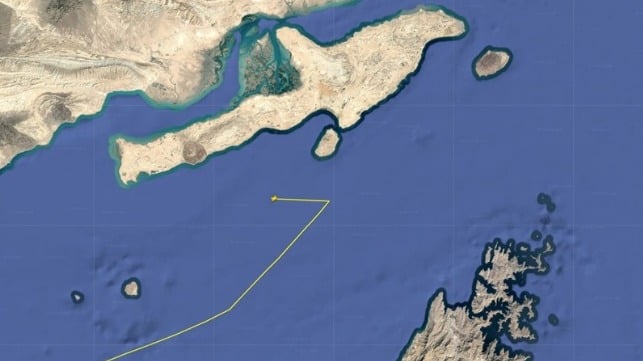
Iran has declared its intention to manage the "open" navigation of the Strait of Hormuz in perpetuity, and taken steps to put its plan into action. "Non-hostile" vessels may arrange passage with Iranian authorities, coordinated in advance (and in some cases, paid-for); vessels associated with Israel, the U.S. and other parties linked to the conflict are prohibited. The Islamic Revolutionary Guard Corps (IRGC) exercised this newfound authority in an administrative capacity for the first time on Wednesday, refusing passage to a container ship attempting to transit out from the Gulf to Pakistan.
On March 24, the 6,800 dwt container feeder Selen attempted to make the crossing from the Arabian Gulf to the Gulf of Oman, bound for Karachi and broadcasting "Food for Pakistan" in her AIS destination signal. AIS data provided by Pole Star Global shows that the vessel approached the Iranian-controlled traffic lane near Qeshm, but at 1000 GMT, she reversed course and went to anchor just off the southwestern coast of the island. Selen remained in place as of 2330 hours GMT.
In a statement, the commander of the Islamic Revolutionary Guard Corps' navy confirmed that the boxship had been refused permission to pass - the first time that the IRGC had claimed an administrative rejection under its formalized Strait of Hormuz control protocol. Previous IRGC enforcement actions employed lethal force to disable or destroy any unauthorized vessels, without warning.
"The container ship Selen was turned back by the IRGC Navy due to failure to comply with legal protocols and lack of permission to pass through Strait of Hormuz," the IRGC said. "The passage of any vessel through this waterway requires full coordination with Iran's maritime authority."
Iranian management of the strait is a de facto reality on the ground, and is the key priority in negotiations with Iran over a potential end to the conflict. Iranian control of the waterway is unacceptable to U.S. partners in the Gulf.
"The Strait of Hormuz is not a bargaining chip, nor a tool of pressure. It is an international passage that must remain open without condition or restriction, under any circumstance," said former Qatari Prime Minister Sheikh Hamad bin Jassim bin Jaber Al Thani. "Any attempt to impose unilateral control over it, or to turn it into a tool of extortion, represents a direct threat not only to the Gulf Cooperation Council states and the region, but to the global economy as a whole."
Report: Two Types of Iranian Mines Detected in Strait of Hormuz
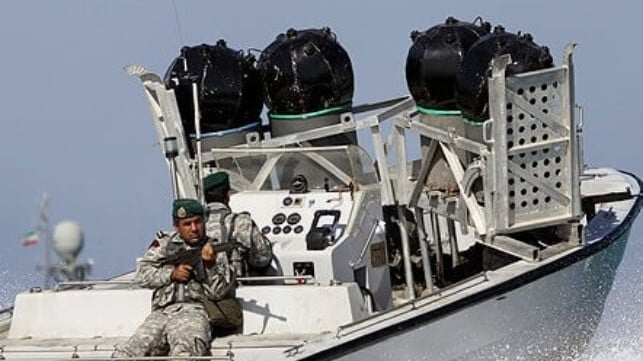
Reports of Iranian mines in the Strait of Hormuz have circulated for weeks, but the most detailed signal yet comes from CBS, which now reports that U.S. intelligence has detected at least a dozen advanced mines of two types in the waterway.
U.S. officials who are familiar with the latest intelligence told CBS that there are two types of Iranian mines emplaced in the strait. The first is an update on a familiar but deadly design: the buoyant, moored, high-explosive mine, which floats below the surface waiting for a passing ship. The Iranian variant, known as the Mahan 3, is a 300-kilo mine with acoustic sensors to detect passing ships. According to open-source munitions database Collective Awareness to UXO (CAT-UXO), it can pick up the signature of a nearby vessel from a distance of about 10 feet away. As it is acoustically activated, a nonmagnetic hull can still set it off.
The second device believed to be present in the strait is a 220-kilo bottom mine, the Maham 7, which can be deployed by small craft or helicopters. The device is intended for targeting smaller vessels, like landing craft or patrol ships, and can be installed in waters as shallow as 10 feet of depth (or as deep as 300 feet). Iran has previously offered the Maham 7 for export sale, and has published specifications and images (below).
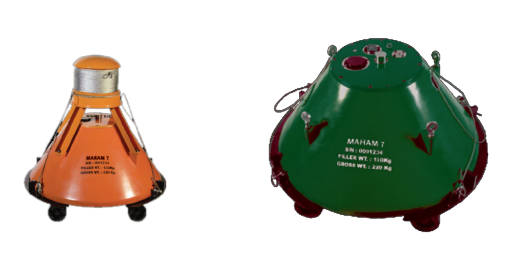
Previously, President Donald Trump has said that there are "no reports" of Iran mining the strait, while insisting that Iran must remove any mines if in fact it has laid them without the knowledge of U.S. forces.
In response to escalating threats from the White House, Iran has threatened to "fully close" the strait using unspecified means. For now, Iran's foreign ministry says, "non-hostile ships" may use the waterway so long as they participate in an Iranian-controlled tolling system. In practice, traffic through the strait has slowed to a trickle; a small number of vessels are using a lane between Iran's islands of Qeshm and Larak, passing well within Iranian waters.
Countering the mine threat
U.S. Central Command has been actively engaged in a campaign to destroy Iran's minelaying capability before it deploys by targeting Iranian naval forces, including smaller craft. The command has begun using Apache helicopters and A-10 close air support planes to support that objective, suggesting confidence that slow-moving, non-stealthy aircraft can now operate in the Strait of Hormuz.
Once deployed and activated, sea mines are a serious threat to shipping and are difficult to remove. There are few assets available: the U.S. Navy recently decommissioned and shipped home four Avenger-class minesweepers from the Gulf, and two of Central Command's three Independence-class LCS mine countermeasures hulls have been spotted in Southeast Asia, thousands of miles from the strait. Naval analysts suggest that Iranian antiship threats would have to be thoroughly reduced before beginning minehunting, as vessels engaged in the task are vulnerable to attack due to the slow nature of their work.
"I think the worst case now would be if we’ve found positive evidence of the Strait being mined," former Central Command chief General Joseph Votel told TWZ last week. "That would really extend out the time [for reopening]. We probably have to assume that there are mines in there right now. But a serious mining effort by Iran could really complicate and slow things down."
Little Change at Strait of Hormuz After Trump's 48-Hour Threat
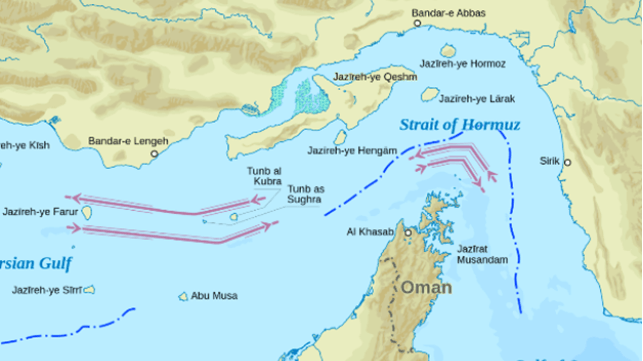
President Donald Trump has given the Iranian government until Monday evening to reopen the Strait of Hormuz, which he has previously said that the U.S. does not need. If Iran does not reopen the strait, Trump said, the U.S. will "obliterate" Iran's electrical power plants.
For its part, Iran claims that the strait is already open - for the right ships. A trickle of tonnage is getting past, according to tracking services, most of it using an Iranian-controlled lane past Qeshm and Larak. Iranian state media claims that negotiations are under way with multiple nations on terms for safe passage, including India and China. Iran's own tankers continue to load at Kharg Island and transit the strait, enabled by the U.S. decision to allow free passage for Iranian vessels and (as of Friday) to lift sanctions on Iranian oil sales.
Iran has refused to comply with Trump's new 48-hour threat, and has promised to retaliate with strikes on neighboring states' critical infrastructure if its power grid is hit. Traffic at the strait remained light as of Sunday; the Combined Maritime Forces Joint Maritime Information Center (JMIC) counted one vessel transit on March 22, down from historical average of 138 per day.
"If Iran's fuel and energy infrastructure is attacked by the enemy, all infrastructure of energy, information technology, and desalination facilities belonging to the US and [Israeli] regime in the region will be targeted," an IRGC spokesperson warned.
In the past week, Iran has destroyed approximately six percent of global LNG liquefaction capacity, damaged oil infrastructure infrastructure on the Saudi Red Sea coast, and attempted a strike on the U.S.-UK base at Diego Garcia - more than 2,000 miles away from the combat zone. Dozens of oil and gas sites, ports and ships around the Gulf have been hit in the conflict so far, from Kuwait to Oman.
Multiple analysts assess that the likely near-term outcomes include U.S./Israeli strikes on the Iranian power grid; Iranian retaliatory strikes on high-value infrastructure in neighboring states; continued Iranian control of the Strait of Hormuz, pending further developments; and continued pressure on the global supply of oil, gas and refined products, particularly affecting the Asian markets that depend on Mideast oil.
"Iran will not reopen the Strait of Hormuz. That’s not going to happen. In the coming days, we can expect Tehran to threaten to 'set the Gulf on fire,' especially if the U.S. strikes critical infrastructure," said former Israeli Defense Intelligence Iran chief Danny Citrinowicz. "Such rhetoric [U.S. threats] will not shift Iran’s position; instead, it forces [Trump] to choose: escalate and follow through, risking broader war, or back down and further erode U.S. deterrence."

No comments:
Post a Comment