CU
Prolonged Iran war would hammer top copper miners

A prolonged Iran conflict could push copper into surplus and sharply cut earnings for major producers, according to Bloomberg Intelligence.

Oil above $150 a barrel in a drawn-out war that disrupts Strait of Hormuz flows would likely slow global growth and cap copper demand at about 0.5%–1%, driving prices below $10,000 a tonne and leaving a refined surplus of 100,000–200,000 tonnes, BI analysts said.
Under that scenario, earnings could fall about 20% at Southern Copper (NYSE: SCCO), 32% at Antofagasta (LON: ANTO) and as much as 55% at First Quantum (TSX: FM), reflecting higher costs and weaker pricing than consensus forecasts assume.
Southern Copper appears best positioned in a downside scenario due to its low-cost base, while First Quantum faces the greatest risk given its higher cost profile and uncertainty around the restart of Cobre Panama, which consensus expects to contribute meaningfully by 2027.
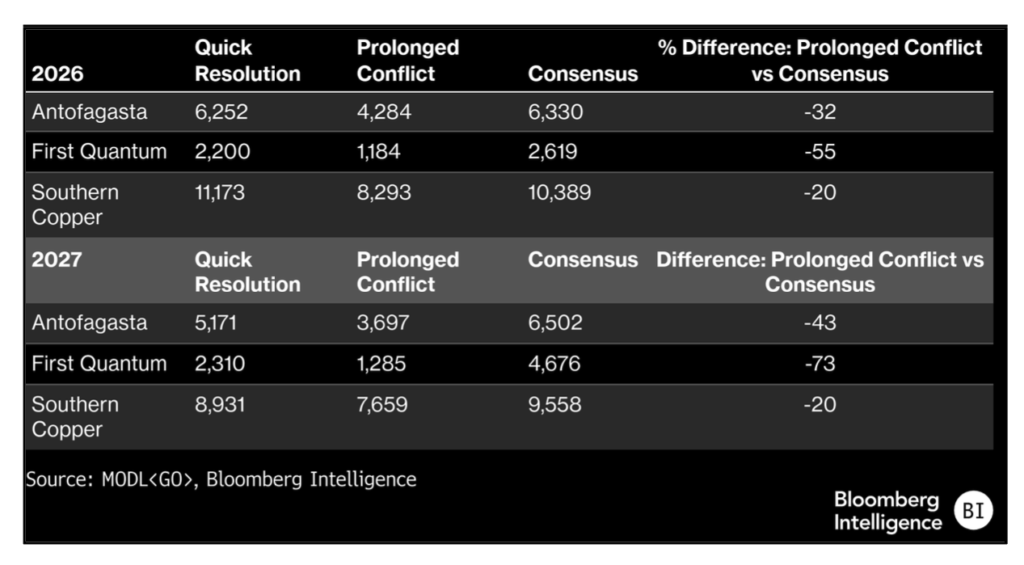
If the war extends beyond a year and Hormuz flows remain constrained, cooling demand would expose the cost curve and leave higher-cost producers most vulnerable.
“While copper’s long-term fundamentals remain intact, near-term pricing and margins are highly sensitive to energy-driven inflation and supply disruptions,” Grant Sporre, global head of metals and mining at Bloomberg Intelligence, said.
The outlook underscores how geopolitical risk in the Middle East could ripple through commodity markets, with copper caught between slowing demand and constrained supply inputs such as sulfur. Even as the global economy becomes less dependent on oil, higher energy prices would likely revive inflation, delay rate cuts and weigh on industrial activity, limiting copper’s upside while tightening margins across the mining sector, analysts warn.
Multi-month scenario
A multi-month conflict would be less damaging, with copper markets roughly balanced in 2026 and prices in the $10,500–$11,500 range, while a quick resolution could restore a modest deficit and support prices near $12,000. Rising inventories, now near 1.4 million tonnes, signal weaker demand and a buyer’s market, suggesting any rally may be capped until stockpiles normalize.
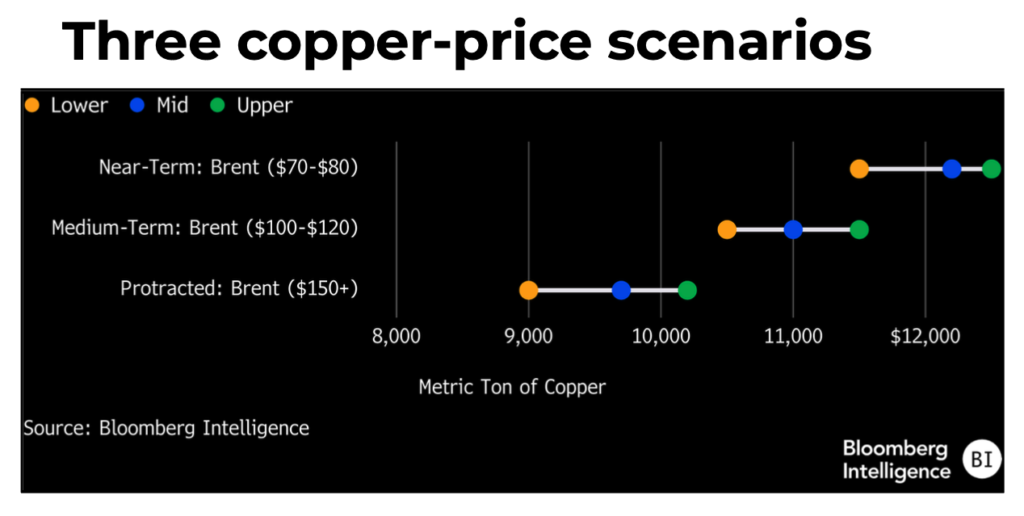
BI analysts had already expected slower global demand growth of 2%–2.3% in 2026 as high prices curb affordability, and warn it may be difficult to lift mined supply even with a 1.1 million-tonne disruption allowance as stoppages persist at major operations.
Supply risks could partially offset the downside. Disruptions to sulfur shipments from the Gulf may constrain output in the DRC, where 50%–60% of production depends on sulfuric acid, limiting the scale of any surplus.
Persistent mine disruptions and tight concentrate markets could also make it difficult to lift supply meaningfully in 2026.
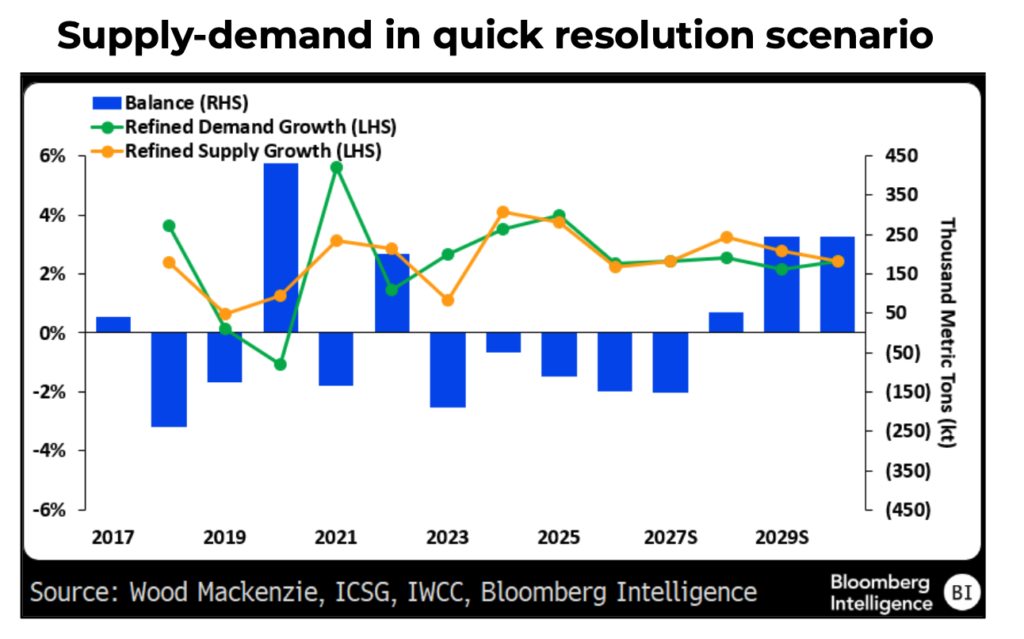
Higher costs remain a central concern. BI estimates a prolonged conflict could lift unit costs by 10%–20%, with sulfuric acid and other inputs driving broader inflation. High-cost producers may see margins compress to about 40% in 2026 from roughly 70% in 2025, with all-in margins nearing long-run averages, raising the risk of reduced capital spending and delayed project approvals.
The China factor
China’s demand outlook adds further uncertainty. BI’s proxy for Chinese copper demand fell to a multiyear low late last year, pointing to growth of just 0.5–1% in 2026, well below 2025 levels, as property weakness and softer industrial activity weigh on consumption.
The broader takeaway is that copper’s structural deficit story may be delayed rather than derailed, as short-term geopolitical shocks reshape demand, costs and investment timelines across the industry.
Rio Tinto expects Resolution Copper mine to open by mid-2030s
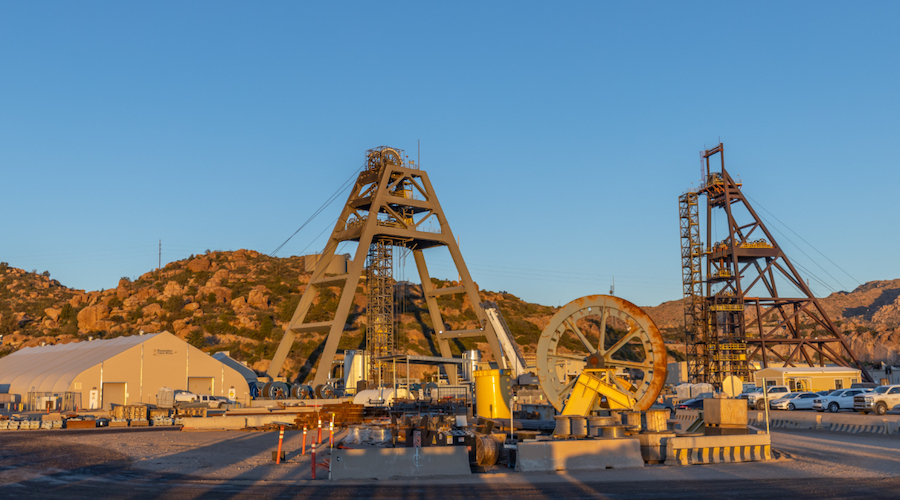
Rio Tinto aims to open Arizona’s Resolution Copper mine by the mid-2030s but may need to export some of its copper concentrate due to the challenging economics of smelting in the US, a senior executive told Reuters on Tuesday.
The Anglo-Australian mining giant this month gained control of acreage needed to build one of the world’s largest copper mines after a years-long court fight in which rising US demand for the red metal clashed with the religious rights of the San Carlos Apache people.
“We are quite committed to bringing copper on as quickly as we can,” Katie Jackson, head of Rio’s copper business, told Reuters on the sidelines of the CERAWeek by S&P Global conference in Houston. “This is something we want to do in the early- to mid-2030s.”
The Resolution project is slated to produce more than 40 billion pounds (18.1 million metric tons) of copper over its life and supply more than a quarter of US demand.
With control of the acreage, Rio has now begun a $500 million drilling campaign to study the 30% of the deposit it previously could not access.
Refining uncertainty
Resolution will produce copper concentrate that must be smelted into a form known as cathode that can be used to make wires and other products.
Rio executives have said for years the company aims to keep all of Resolution’s copper inside the United States. Jackson on Tuesday, though, said “it’s too early to say” whether all of the copper would remain.
Rio operates Utah’s Kennecott copper mine and smelter and Freeport-McMoRan operates the other US copper smelter.
Jackson said that Rio has not shifted its policy on keeping Resolution copper in the US but noted that smelting in the US has become unprofitable.
Smelters make money by turning copper concentrate into metal for fees known as treatment and refining charges (TC/RCs), but those charges have turned negative in recent years due to a shortage of copper concentrate, meaning smelters are paying to process copper supplied to their plants.
Rio has been telling US policymakers “that the current set of mechanisms and tariffs around copper don’t solve that problem,” Jackson said.
The Trump administration last year imposed a 50% tariff on semi-finished copper products, but left out copper input materials such as ores, concentrates, and cathodes.
Jackson said possible policy solutions could involve Washington setting a price floor for TC/RC charges, imposing a tariff on copper cathode, or blocking exports of copper concentrate.
“The current structures don’t support the Kennecott smelter,” said Jackson.
Kennecott to stay shut for weeks
Rio shut down part of Kennecott’s mine operations this month after a worker died, the second death at Rio’s operations this year.
Jackson, who plans to visit Utah later this week, said the company is investigating the death and that Kennecott’s underground mine will remain closed for a few weeks.
“We will never be able to make mining a zero-risk business, but we should be able to make it a zero-harm business,” Jackson said.
Mongolia negotiations
In Mongolia, Jackson oversees the Oyu Tolgoi copper and gold project. The country’s government, which owns 34% of the project to Rio’s 66%, is seeking to renegotiate what it has called the “unfair” commercial terms.
Mongolia took a multibillion-dollar loan from Rio Tinto to fund its share of the mine’s development. Rio also charges management fees.
Jackson, who was in Mongolia earlier this month, said Rio is open to reducing its management fees and the interest rate on the loan, but noted that the loan is unsecured and that Rio is guaranteeing the project’s finances.
“There is a very real and significant risk that we are carrying as a company,” said Jackson. “We have been negotiating in good faith for some while, and we are keen to get something done.”
(By Ernest Scheyder; Editing by David Gregorio and Sonali Paul)

No comments:
Post a Comment