Barge Catches Fire in Vancouver's Fraser River Port District
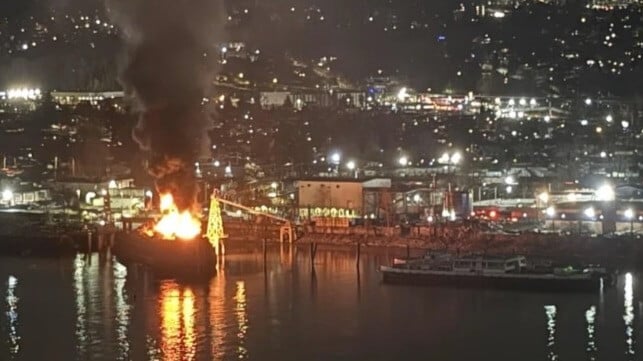
Overnight Thursday, a large fire broke out aboard a deck barge at the port of Surrey, BC, sending a dense plume of smoke into the air and startling residents who thought it was a commercial building fire.
The fire broke out aboard a barge at a scrap metal terminal at Musqueam Drive, on the Surrey side of the Fraser River. The local fire department received a call at about 2300 hours reporting a major fire, and found a burning barge laden with scrap metal. At its peak, the blaze extended the length of the barge and engulfed the pile.
The fire department treated it as a two-alarm fire and kept hoses on it into Friday. Metro Vancouver, the regional authority, said Friday that it was monitoring air quality given the large volume of smoke given off by the smoldering pile.
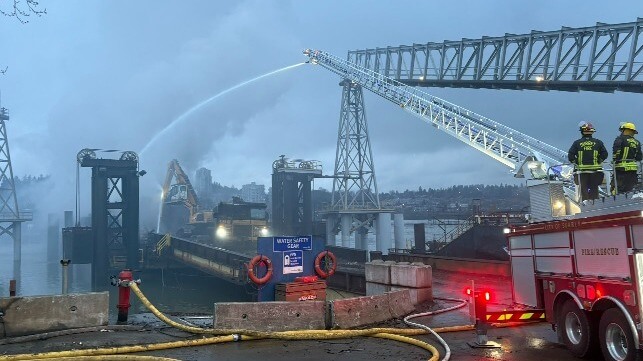
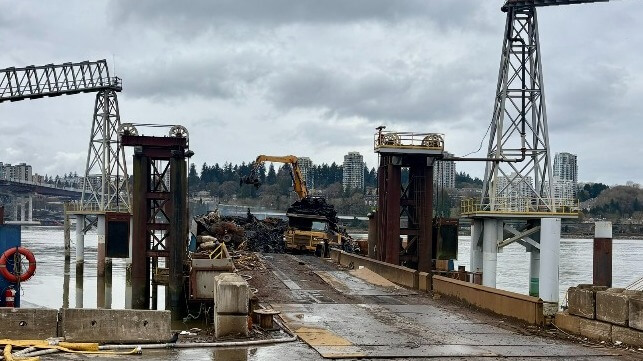
Courtesy Metro Vancouver
Scrap metal fires are all too common, and are typically ignited by unwanted contaminants - notably lithium-ion batteries, which can burst into flame when damaged. The problem has grown in recent years alongside the expanding use (and discarding) of consumer battery-powered devices. The fires grow and accelerate in the presence of flammable debris within the pile, such as oily wastes and plastics.
Tanker Truck Blast Closes Bridge Over Panama Canal
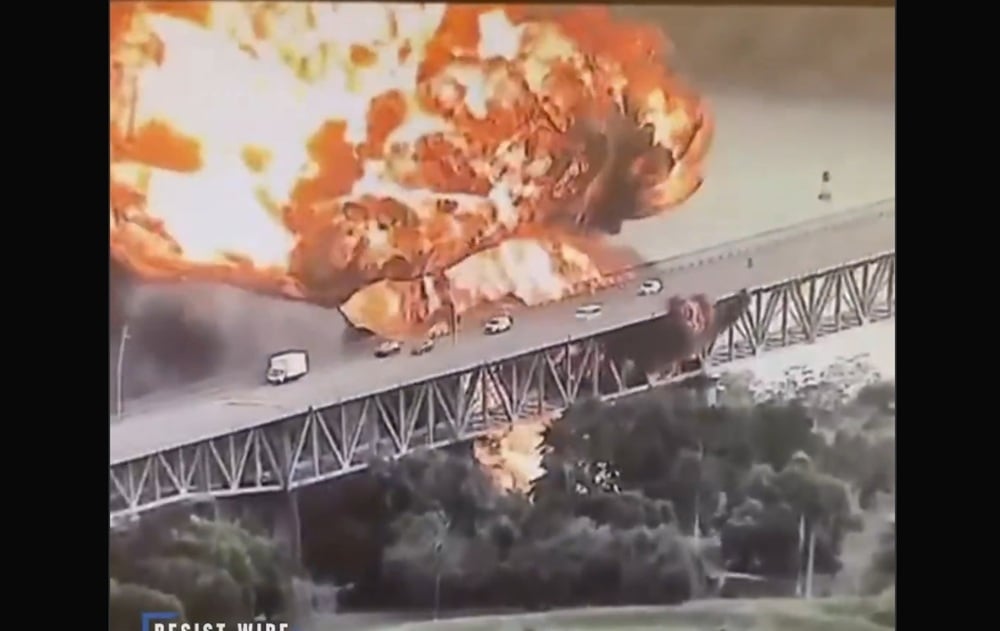
An explosion at a fuel facility next to the Bridge of the Americas has killed one and injured several others, according to the fire department for Panama City, Panama. The fireball from the fuel burn-off made contact with the bridge, which spans the Panama Canal and carries logistics traffic for the port of Balboa.
A large tank farm is located next to and beneath the bridge on the eastern bank, between the International Maritime University of Panama and a luxury hotel. A tanker truck loading fuel near the tank farm exploded Monday, igniting two other nearby trucks and sparking a massive blaze.
One person was killed in the blast, identified by the authorities as a truck driver. Three others were injured, including one survivor with second-degree burns. The accident had potential for far greater harm: traffic was moving on the bridge at the time of the blast, and several vehicles passed right through or next to the fireball - including a bus full of passengers.
Firefighters responded to the scene, and post-casualty video shows efforts under way to extinguish spot fires directly beneath the bridge. The span remained closed to motor traffic on Tuesday while an inspection got under way to evaluate the bridge's condition. The bridge pier and girders in the area of the blast were coated with black soot from the fire.
So far, the canal remains open to traffic, and merchant vessels continued to transit underneath the affected span on Tuesday morning.
The cause of the blast remains under investigation, and has received additional scrutiny because of the sensitive geopolitical moment. The canal is one of the most important maritime choke points, and the most important one for U.S. energy shipping interests; any shutdown of the canal would have strategic implications for the U.S. West Coast and Asia-Pacific petroleum markets, already under significant stress.
Trident Sues Tacoma Fire Dept. for the Loss of the Kodiak Enterprise
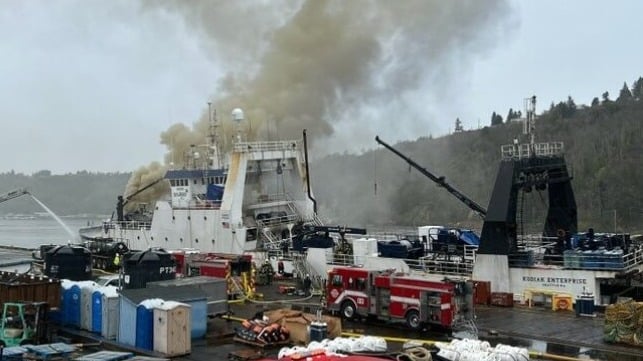
U.S. fishing company Trident Seafoods has filed a rare lawsuit against the city of Tacoma, Washington for alleged mishandling of the fire aboard the fishing vessel Kodiak Enterprise, which was destroyed in a massive blaze three years ago. A lawsuit against an emergency response agency is virtually unheard-of after a marine casualty, but Trident alleges gross negligence on the part of the Tacoma Fire Department.
In the early hours of April 8, 2023, a fire broke out in a compartment towards the bow of the Kodiak Enterprise while the vessel was alongside at the Port of Tacoma. The point of origin was likely in a dry stores space, according to Trident. The crew evacuated onto shore, and Tacoma Fire Department responded to the scene by about 0330 in the morning.
The fire department took command of the response and began its work. Meanwhile, Trident contracted with salvor Resolve Marine for expert marine firefighting services. Resolve has a base located in Tacoma and a strong presence in the Seattle area, and it mobilized a team to the scene beginning at about 0600 that morning. Tacoma Fire retained formal control, and Resolve's personnel acted in an advisory capacity.
A Tacoma Fire battalion chief took over the incident commander role at about 0720 hours, and the fire was substantially under control by 1330 hours, according to Trident. Resolve recommended boundary cooling and isolation (shutting down all ventilation) in order to let the fire burn out in the forward compartments, controlling risk.
Instead, the Tacoma Fire battalion chief insisted upon the opposite strategy, Trident alleges in its suit. Over the objections of Resolve's advisers, the incident commander allegedly ordered Tacoma Fire's responders to bring fans aboard and begin blowing large volumes of air into the space - a strategy called positive pressure ventilation (PPV) - at about 1845 hours.
In a shoreside fire, PPV is typically used after the blaze is knocked down or extinguished in order to clear out smoke and allow fire teams to move into the space, or to decrease the imminent hazards of smoke inhalation and heat for any trapped survivors (not a factor as the space was unoccupied). These use cases make PPV a popular firefighting tool for shoreside fire departments, but the technique is deployed with care: it has the risk of potentially re-igniting smoldering materials, as by the nature of its operation it blows additional oxygen into the fire space. PPV's success depends upon setting up a controlled airflow route between the blower fan at the entryway and a designated exit point for smoke and hot air.
PPV is controversial when applied in marine firefighting, according to the textbook IFSTA Marine Firefighting for Land-Based Firefighters, as ventilation inside a ship is harder to control. "Positive pressure ventilation is ineffective [in shipboard fires], and smoke movement is unpredictable," advised DoD civilian firefighter and consulting fire investigator Nicholas Palumbo in a recent editorial.
When Tacoma Fire's battalion commander ordered his fire teams to use PPV aboard Kodiak Enterprise, Trident asserts, Resolve Marine recommended against it and offered to take over incident command in the morning. The Tacoma Fire battalion commander proceeded anyways, without first arranging for a controlled ventilation pathway for the smoke and hot air to safely exit the space, Trident alleged in its complaint.
Per Trident's timeline, thick black smoke and flame emerged from the ship within a short time after Tacoma Fire commenced PPV in the fire-affected space. At about 2100, roughly 2.25 hours after ventilation began, Tacoma Fire's event chronology noted that the response was "transitioning to defensive." The agency evacuated its fire teams shortly after, and the fire burned through the rest of the ship over the course of the next several days. The Kodiak Enterprise was declared a total loss.
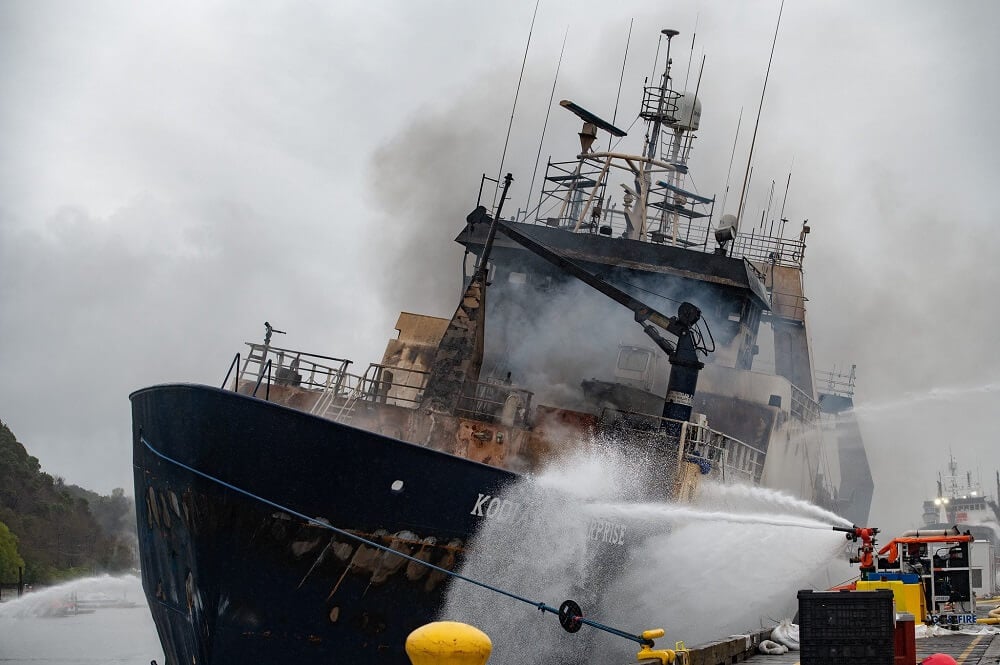
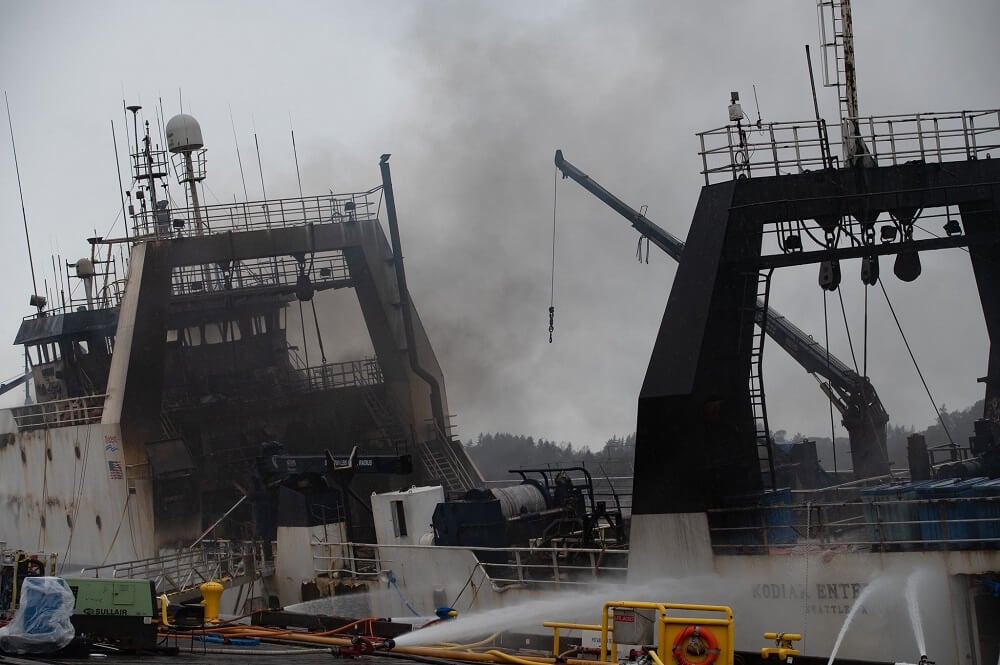
Images courtesy USCG
Trident alleges that the fire would have been contained to the forward compartment if Resolve's advice to isolate it had been followed; the company claims that the rest of the ship would have been unharmed if Tacoma Fire had not initiated positive pressure ventilation.
Trident claims that the value of the vessel was $185 million, and that the damages attributable to Tacoma Fire's decision came to at least $100 million.
Tacoma Fire and Resolve Marine have been contacted for comment.
When Bridge Teams Lose Control Without Realizing It
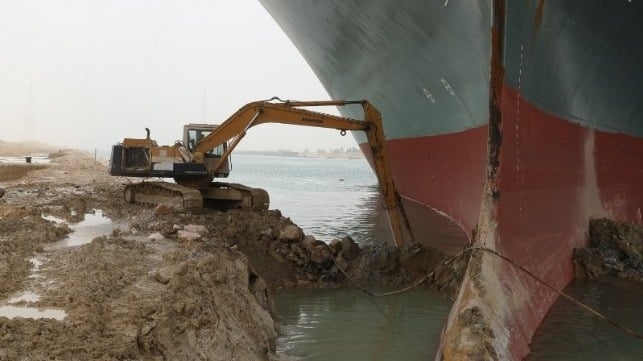
Following recent discussions on hydrodynamic instability in confined waters, an important operational question remains: Why do experienced bridge teams sometimes lose control of a vessel — without recognizing it in real time?
In many marine casualties, loss of control is not a sudden event. It develops gradually, often while the vessel still appears manageable.
The Illusion of control
On the bridge, control is typically assessed through heading response; rudder feedback; visual alignment with the channel; and engine response. As long as these indicators appear normal, the situation is perceived as stable.
However, in confined waters, this perception can be misleading. Hydrodynamic forces — especially when combined with environmental factors such as wind and shallow water — may begin to alter vessel behavior before it becomes visibly critical. The vessel is still responding, but it is no longer behaving predictably.
Delayed recognition
One of the most dangerous aspects of confined-water navigation is delayed recognition. The transition from stable control to instability is not always obvious. There is often no single alarm, no immediate failure.
Instead, corrections become slightly less effective; rudder angles increase; and the vessel requires more input to maintain track. These changes can be interpreted as “normal variation” rather than early warning signs.
By the time the deviation becomes clearly visible, the system may already be operating beyond a recoverable threshold.
Nonlinear response
At the core of this issue is a nonlinear relationship between cause and effect. Small increases in speed, small changes in position, or moderate environmental forces can lead to disproportionately large responses in vessel behavior.
This is particularly relevant in shallow and confined waterways, where squat reduces under-keel clearance, rudder efficiency decreases, and bank interaction forces intensify.
As a result, corrective actions may begin to produce unexpected outcomes. More rudder does not always mean more control. In some cases, it produces the opposite.
Cognitive bias under pressure
Bridge teams do not operate in a vacuum. They operate under schedule pressure, pilot expectations, traffic constraints and environmental uncertainty.
Under these conditions, there is a natural tendency to assume that the situation remains controllable — especially if it was under control moments before.
This creates a cognitive bias: “If we are still on track, we are still in control.” In reality, control may already be degrading.
The critical gap
The most dangerous phase is the gap between actual loss of controllability and recognition of that loss.
This gap can be only minutes — but it defines the difference between recovery and casualty.
Once the system crosses a nonlinear threshold, recovery options narrow rapidly.
Closing the gap
Reducing risk in such scenarios does not depend on more technology alone. It depends on operational awareness.
Three practical measures can significantly reduce exposure:
- Recognizing early signs of reduced control effectiveness
- Establishing predefined thresholds for intervention
- Maintaining active bridge team engagement during pilotage
Most importantly, bridge teams must accept that loss of control is not always visible when it begins.
From control to awareness

No comments:
Post a Comment