Sunday, April 12, 2026


Mining executives accused of hijacking Brazil lithium claims


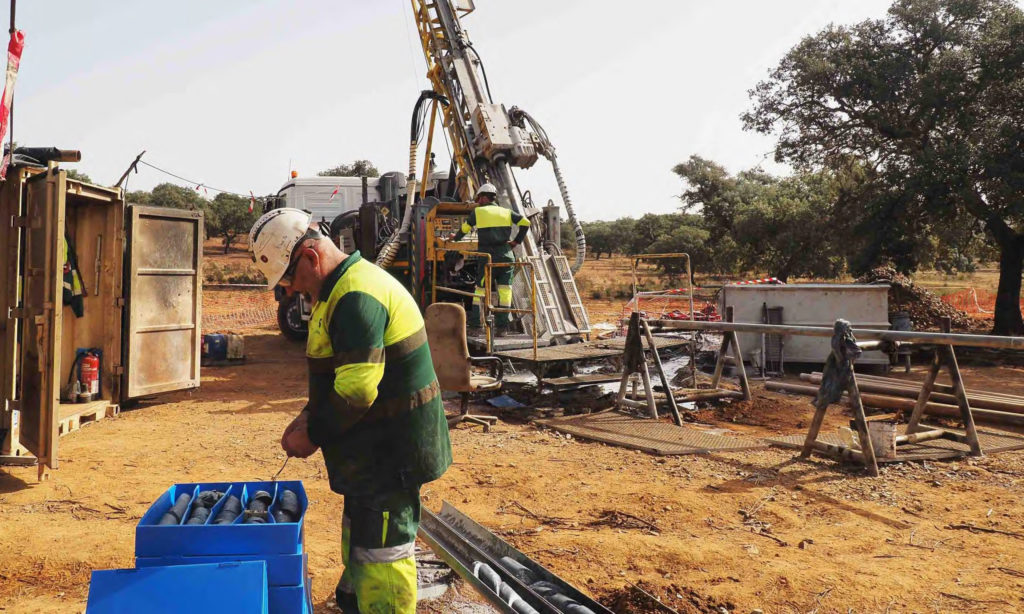
Drilling at Emerita Resources’ Iberian Belt West project in Spain. Credit: Emerita Resources.

Executives at Canadian minerals explorer Emerita Resources Corp. have been accused by Ontario’s securities regulator of diverting the firm’s lithium project rights to a new company they controlled.

The Ontario Securities Commission alleges the group established Lithium Ionic Corp. to pursue mining claims from Emerita’s Falcon project in Brazil, conduct that defrauded Emerita and its investors, according to a Friday statement from the regulator

Shares of Emerita fell as much as 38% in Toronto to their lowest level in nearly five years after the release, while Lithium Ionic plunged as much as 45%. Both Toronto-based companies are penny stocks, with market values below C$175 million ($126 million).

The regulator alleges Emerita chief executive officer David Gower, chairman Michael Lawrence Guy, chief financial officer Gregory Duras and corporate secretary Sergio Damian Lopez caused Emerita to say it had “relinquished” the Falcon project, which was misleading, while senior insiders were actually pursuing the project through Lithium Ionic.

Further, Gower and Hélio Diniz, a director with Lithium Ionic, misled the OSC during the investigation regarding the project, the regulator alleged.

The OSC’s allegations also encompass a high-grade zinc project in Spain called Plaza Norte.

The regulator claims that Gower, Lopez, Duras and Emerita president Joaquin Merino-Marquez approved untrue or misleading statements about Plaza Norte in public filings from 2017 to 2023. Those statements concerned Emerita’s permit status and ownership interest in the joint venture behind the development.

Emerita said in its own statement late Thursday that it has established a special committee to review and respond to the OSC allegations, which it describes as “unproven.”

“Plaza Norte and Falcon are legacy projects and are not related to the company’s current core business and operations,” Emerita said. “Both projects were previously assessed as having no relevance to the company’s go-forward strategy.”

Lithium Ion said it’s not a respondent in the “regulatory matter” outlined by the OSC, and that no orders have been sought against it, according to a statement on Friday. The company has established a special committee of independent directors to oversee “communications and disclosure” relating to the issue, it added.

The companies did not respond to separate emails requesting further comment on behalf of the individuals named.

A hearing is scheduled for May 8 in Toronto.

(By Sybilla Gross)


Peru pulls permit for $1.8B Tia Maria copper mine


The Tía María project has faced years of community opposition due to environmental concerns. (Image: Tía María | Facebook)

Peru has revoked Southern Copper’s (NYSE, LON: SCCO) permit for its $1.8 billion Tía María project, forcing a fresh review of one of the country’s most contentious copper developments.

The Ministry of Energy and Mines (Minem) said the original approval lacked legal justification and failed to meet requirements under mining and administrative regulations, while also flagging incomplete technical plans, including waste dump design and project scheduling.

“This process will reassess the project’s technical viability and determine whether outstanding observations have been resolved,” the ministry said.

The decision represents a fresh challenge for a project long stalled by conflict, after protests between 2011 and 2015 left six people dead and halted development.

The government approved the mine in 2019, but it tied progress to the restoration of social stability. Southern Copper resumed development in 2024 after local tensions eased. By October last year, the company calculated the project was 23% complete.

Tía María is expected to begin production by the end of this year or early 2027, delivering 120,000 tonnes of copper annually over a projected 20-year lifespan, though the permit revocation now clouds that timeline.

Billions in stalled projects

The setback reflects broader challenges for the sector, with an estimated $7 billion in copper projects stalled by illegal mining activity, while illicit gold exports could reach $12 billion in 2025, according to the Peruvian Institute of Economics.

The move also lands amid political uncertainty, with Peruvians set to elect a new president on Sunday, and Congress following years of instability marked by multiple leadership changes since 2018.

The outcome could shape foreign relations and investment flows as the US seeks to secure critical mineral supply chains and counter China’s growing influence in the region.

Souther Copper, controlled by Grupo Mexico, operates the Toquepala and Cuajone copper mines as well as the Ilo refinery in southern Peru.


2026 is shaping to be a key year for Latin America, with resources at the centre of a growing global power struggle, as governments and investors focus on who controls critical minerals and the supply chains behind them. If the region matters to you, don’t miss MINING.COM’s Latin America series tracking the geopolitical forces reshaping it and why markets are increasingly driven by global alliances as much as local politics.

Countries in the series so far:


Jamaica Calls Time on Paper-Based Maritime Practices in 2026

Maritime Authority of Jamaica
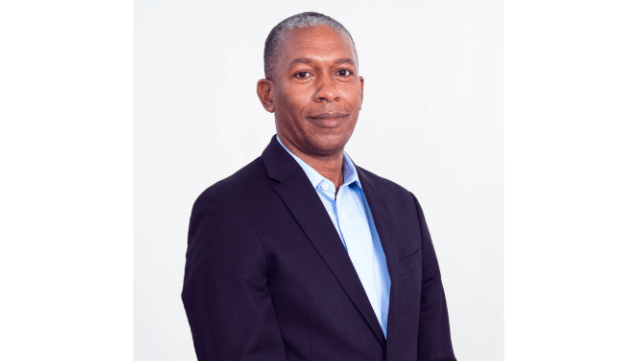
Bertrand Smith, Director General of the Maritime Authority of Jamaica.

Published Apr 11, 2026 5:58 PM by The Maritime Executive


[By: Maritime Authority of Jamaica]

The Maritime Authority of Jamaica has said paper-based processes are no longer fit for purpose in modern maritime operations, warning that outdated practices increasingly pose operational and safety risks in 2026.

The Authority said it expects operators to be able to demonstrate how digital systems, cyber resilience and crew training are being addressed as part of day-to-day operations, as reliance on manual processes continues to fall away across the sector.

Captain Steven Spence, Director of Safety, Environment and Certification, said: “Through Jamaica’s engagement at meetings of the International Maritime Organization, we are well aware of the issues shaping the global agenda. The challenge is not understanding what needs to change, but ensuring those discussions translate into practical action on the ground and at sea.”

He pointed to the continued reliance on manual and paper-heavy processes as one of the most visible barriers to progress. In 2026, there is a clear expectation that information should be accessible when it is needed, supported by reliable connectivity using a combination of cellular and satellite networks.

Captain Spence also cautioned that increased digitalisation brings new responsibilities. As systems become more connected, cyber security must be treated as a core element of maritime safety, with greater focus on protecting vessels, systems and crew from digital threats.

Sustainability remains a parallel pressure on the industry. The transition away from heavy fuel oils towards alternative fuels is already influencing ship design, engineering and operational planning, while efforts to reduce emissions, cut waste and move away from practices such as single-use plastics are now part of routine decision-making.

Looking across the sector, Bertrand Smith, Director General of the Maritime Authority of Jamaica, said: “The sector faces pressure from geopolitical uncertainty and environmental requirements. However, there is clear opportunity where the industry continues to invest in technology, people and cooperation.”

Captain Spence added that people will ultimately determine how successfully the sector adapts. He said: “As systems change, expectations change. Investment in training and development, both ashore and at sea, will decide how effectively the industry responds to the realities it is facing today.”

The products and services herein described in this press release are not endorsed by The Maritime Executive.


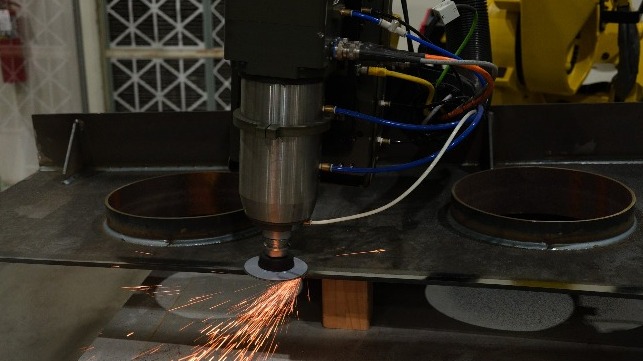
HII Brings In Robotics for Shipyard Grinding, Blasting and Painting

Robotics
Courtesy GrayMatter / HII

Published Apr 9, 2026 11:10 PM by The Maritime Executive


Most of the high-profile robotics initiatives in shipbuilding focus on welding or cutting, but there's much more that has to happen to get a ship into the water. Huntington Ingalls Industries (HII) wants to automate another few steps in the construction cycle - blasting, coating and inspection - and has enlisted the help of physical AI company GrayMatter Robotics (GMR) to move the work forward. 

HII builds nearly all of the U.S. Navy's full-size surface combatants - the destroyers, amphibs and carriers that make up the most visible parts of the fleet. Save for General Dynamics Bath Ironworks, which builds one destroyer per year, all of the largest gray hulls entering commission come from HII's yards in Newport News and Pascagoula. That makes HII's production rate a critical factor for the U.S. Navy, and the company is working hard to increase it despite longstanding challenges in workforce development.

GrayMatter is in the business of automating factory-environment surface treatment processes, including grinding, sanding, blasting and spraying. It says that its robots are up to 12 times faster than skilled people at the same tasks, and that it can cut down rework by 95 percent thanks to higher consistency and quality. Its solutions eschew the humanoid robotic trend in favor of more a traditional industrial format: steel articulated arms with servo controls. Its value-adding innovation is in AI-enabled control software that can be set up quickly on new tasks, without advanced programming skills or precise fixturing. 

"By working with new partners like GMR we can further augment our workforce and speed up U.S. Navy shipbuilding production," said Eric Chewning, HII’s executive vice president of maritime systems.

Earlier in the year, HII announced a deal with Path Robotics to bring advanced robotic welding technology into its shipyard environment, as is seen with increasing frequency in South Korea. Portable welding robots are making their way into Korean panel lines and even out into the yard, where smaller hand-carried "cobots" are gaining traction. 

"Welding is one of the hardest processes to automate in any industry, and shipbuilding is no exception. Path’s physical AI is purpose-built for that challenge – seeing, understanding, and adapting to real world conditions in real time," said Andy Lonsberry, Path Robotics CEO and co-founder, in a statement earlier this year.

With help from tech vendors like Path and GrayMatter, HII hopes to boost throughput by another 15 percent this year, matching last year's performance growth. 


Port Tampa Bay Receives Largest Containership as Growth Continues

Port Tampa Bay
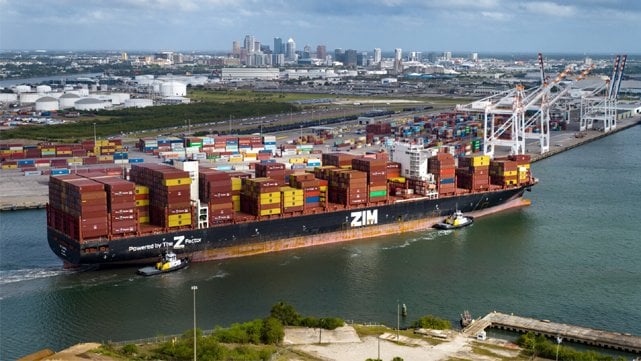
ZIM Canada arrives carrying 11,900 TEUs — the highest capacity ever handled at Port Tampa Bay (Port Tampa Bay)

Published Apr 10, 2026 4:11 PM by The Maritime Executive


Port Tampa Bay (Florida) welcomed a container vessel on Thursday, April 9, that set a new record for carrying capacity at the port. It comes as the port continues its long-term growth and is set to launch key new infrastructure projects.

The Zim Canada docked with 11,900 twenty-foot equivalent units (TEUs), nearly 2,000 more than any vessel previously handled at the port. The ship, stretching 1,083 feet in length, is 114,643 gross tons, also making it the largest vessel by gross tonnage ever to dock at Port Tampa Bay.

Built in 2022 in China, the 132,069 dwt vessel is owned by Seaspan and on long-term charter to Zim. It is registered in the Marshall Islands.

According to port officials, the arrival underscores the port’s growing role in handling larger, high-capacity containerships and highlights the importance of ongoing infrastructure investments.

The record-setting arrival came as the port advances its largest project in history, the deepening of the shipping channel from 43 feet to 47 feet, set to begin construction in 2027. The $1.3 billion project will extend the entrance channel by 1.9 miles, remove 22 million cubic feet of material, and improve access for deeper-draft vessels. 

This week, the port announced it will be receiving $10 million in federal funding for the Tampa Harbor Navigation Improvement Project. It will support initial planning, engineering, and design. The project will proceed in six phases and is expected to be completed by 2034. The port is also preparing for expanded crane capabilities, with six post-Panamax cranes expected to be operational by the end of 2026.

Port Tampa Bay continues to grow as Florida’s largest and most diversified seaport. In fiscal year 2025, the port handled 32 million tons of cargo, including petroleum products, dry bulk commodities, containers, breakbulk, and project cargo. Container volumes have increased by more than 300 percent since 2018, with nearly 263,000 TEUs moving through the port last year. 

Officials highlighted that 45 percent of Florida’s gas and jet fuel is handled through the Port of Tampa Bay while emphasizing the vital role the port plays in the West Coast of Florida’s economy.

Port of Tampa Bay also handled a record 1.66 million cruise passengers, the highest total in its history, during 2025. Officials recently said the port is currently tracking toward 1.8 million passengers in 2026.

Florida Governor Ron DeSantis, however, on March 19, signed legislation blocking a proposed new cruise terminal in Manatee County. It would have been located outside the Sunshine Skyway Bridge, which limits the size of cruise ships that can enter the port. City officials are continuing to explore options for the location of a new terminal that would support the growth of the cruise sector from the port.

Shipbuilding Orderbook Hits 17-Year High Driven by Tankers Reports BIMCO

tanker shipbuilding
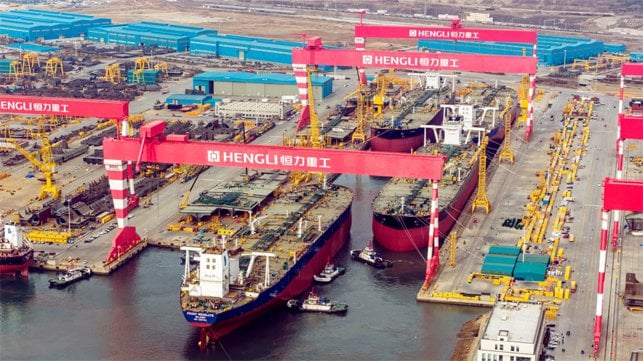
China's Hengli recently simultaneously floated four tankers as the surge in crude oil tanker oders continues to grow (Hengli)

Published Apr 9, 2026 7:56 PM by The Maritime Executive


The boom in shipbuilding orders is continuing, reaching a 17-year high, reports industry group BIMCO. While it sees a slowing in some sectors, it points to a recent surge in crude oil tanker orders coming after the container segment was already driven to new highs.

During the first quarter of 2026, newbuilding contracting has risen 40 percent year-over-year to 17.6 million Compensated Gross Tonnes (CGT). In total, it calculates the global shipping orderbook reached 191 million Compensated Gross Tonnes (CGT). BIMCO reports that this is equivalent to 17 percent of the global fleet, the highest ratio since 2011.

“So far during the 2020s, newbuilding contracting has been 47 percent higher than the average during the 2010s, driven by stronger market conditions in the larger sectors, an overall larger fleet, and an increased need for fleet renewal,” explains Filipe Gouveia, Shipping Analysis Manager at BIMCO. “This has contributed to an increase in newbuilding prices and longer lead times at shipyards, with 57 percent of contracting so far this year expected to be delivered after 2028.”

The most recent surge was driven, BIMCO reports, by a tripling of new tanker orders and a rebound in LNG tanker contracting. Overall, it calculates that tankers accounted for 32 percent of total contracting, the highest share since the second quarter of 2017. It breaks a long drought in the sector and coincides with the view that tankers have entered a strong new upcycle.

Some shipping sectors now have relatively large orderbooks BIMCO reports. The orderbook-to-fleet ratio, it points out, has risen to 22 percent for crude tankers, 19 percent for product tankers, 37 percent for containerships, and 40 percent for LNG carriers. For crude and product tankers, these newbuildings are expected to support fleet renewal, as 21 percent and 17 percent of the respective fleets are now over 20 years old, the age at which recycling is typically considered. By contrast, only 4 percent of the container fleet and 8 percent of the LNG fleet are over 25 years old, although these segments are expected to see higher demand growth.

Despite this significant yearly increase, BIMCO, however, also notes that newbuilding contracting has decreased 17 percent quarter over quarter, amid an easing in dry bulk orders. Bulker contracting spiked, it explains during the last quarter of 2025, largely due to increased orders for capesize vessels.

“In the medium term, the already swelling order books across several large shipping sectors could contribute to a slowdown in newbuilding contracting. Long lead times at shipyards and high newbuilding prices, combined with high market uncertainty concerning the Red Sea and the Strait of Hormuz sailings and alternative fuel availability, could also negatively affect contracting,” says Gouveia.

The data also highlights the ongoing concerns over geographic mix. Chinese shipyards remained the dominant choice for shipowners, says BIMCO, accounting for 70 percent of contracting in the first quarter of 2026. Korean yards captured just 20 percent, and that was mostly supported by stronger LNG tanker ordering. In contrast, contracting at Japanese yards fell 83 percent year-over-year to just 1 percent of new orders, the lowest share since at least 1996. BIMCO says this reflects limited capacity, long lead times, and reduced competitiveness.

The Japanese government has recently announced plans for a massive investment into its shipbuilding industry, while the major yards have been consolidating to improve their efficiency. South Korean yards are also moving aggressively on several fronts to stem their declines versus China, while the Trump administration and other geographies have heralded their own domestic plans to revitalize national shipbuilding.

Normal fleet renewal efforts and growing demand have also been supplemented by the growing need to address environmental issues. Despite the lack of clarity from the IMO and other regulators, companies have continued to invest in new technologies and ships able to adapt to the anticipated changes in fuels and efficiency in response to emerging regulations.
 

Global Cruise Outlook: New Challenges

After three blockbuster years, the industry may see slower growth in 2026

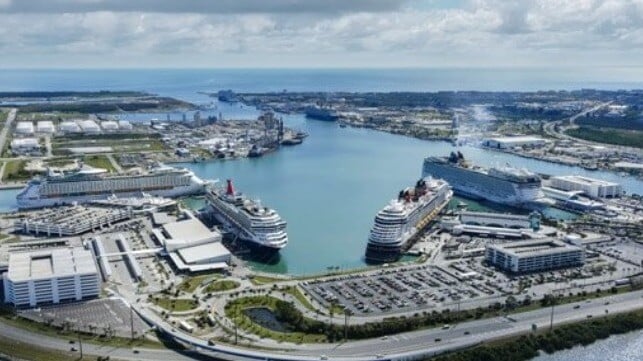
cruise ships in Port Canaveral
Port Canaveral emerged as the busiest homeport in 2025 handling more than 8.6 million passenger movements

Published Apr 10, 2026 9:34 AM by Allan E. Jordan

(Article originally published in Jan/Feb 2026 edition.)


After rebounding from the COVID-19 pandemic with "revenge travel" driving strong growth, the cruise industry is facing new headwinds from the broader macro-environment and geopolitical pressures. 

Financial analysts point to a return to more traditional growth rates while the luxury and expedition segments of the industry are taking on new importance to drive future growth. 

The basic elements of cruising, a largely all-inclusive vacation that's hassle-free and offers an excellent value, remain in place and continue to gain traction with travelers. Analyst Meredith Prichard Jensen at HSBC says, "The pillars of growth remain intact, led by durable experience-led demand, a boost from private destination roll-out, and a strong value equation for the budget conscious.”

She writes in a recent report that the industry “navigated through intermittent cross currents in 2025” and ended the year outperforming the S&P 500 and the broader travel segment.

STRONG START

Further, the industry has started 2026 with a bang. Analyst Robin Farley of UBS notes that one large U.S. seller told her "wave season” is off to a strong start, in line with expectations. Farley thinks the robust booking environment of late 2025 is carrying into 2026

It's a sentiment echoed by Steve Griswold, owner of travel agency Pixie Vacations, who says cruise bookings at his agency increased in 2025 and 2026 has already exceeded 2025. The major cruise companies have stated that they're well booked through 2026 and are now releasing itineraries for 2027.

“The outdated caricature of a cruise passenger as a retired shuffleboard player is rapidly fading thanks to savvy social media and influencer campaigns,” observes HSBC's Jensen. She notes that as much as a third of the bookings are from the “new to cruise” segment. The industry has adjusted its product to compete with land-based resorts and theme parks, adding more short cruises in the broad, mass-market segment known as contemporary cruising as well as in the premium segment. However, it will have to work harder to achieve growth.

Analyst Chris Woronka of Deutsche Bank says, “There might be a bit of fatigue setting in among cruisers who have been dealing with steadily rising prices on tickets, onboard extras, and shore excursions.” He sees growth continuing at moderate levels and looks for yield growth to be “much more 'normal' in 2026.”

Driving down costs and continuing to lower financial leverage remain key goals for cruise companies. They're using advanced revenue management capabilities and enhancing/refining loyalty programs, learning from the hotel sector. There's a greater emphasis on the pre-boarding spend and high-margin activities onboard.

OVERCAPACITY

One of the big concerns emerging among analysts is the potential for overcapacity, especially in the Caribbean in the near term.

Several major new ships came online in 2025, including the MSC World America (216,638 gross tons with 6,764 passenger capacity) at its Miami homeport and Royal Caribbean's Star of the Seas (248,663 gross tons with capacity around 7,600 passengers) in Port Canaveral, Florida. Star of the Seas and her sister ship, Icon of the Seas, share the title of the world's largest cruise ship. 

Norwegian Cruise Line added Norwegian Aqua (156,300 gross tons with capacity for 3,571 passengers), and Celebrity Cruises added CelebrityXcel (141,420 gross tons with accommodations for up to 3,950 passengers). Only Carnival Cruise Line was more disciplined, not introducing a newbuild last year. 

Homeports benefited with Port Canaveral becoming the world's largest cruise port, handling 8.6 million passenger movements in FY 2025 and eclipsing PortMiami, the longtime leader, which handled just under that number. Newer cruise ports, including Galveston, Texas (approximately four million passenger movements), also continued their rapid growth. 

Supply in the contemporary segment (mass market) continues to be slightly higher than demand, says C. Patrick Scholes of Truist Securities. In his latest report, Scholes calls it a “slight though not extreme imbalance” but believes it's leading to higher levels of promotional activity, which could erode some pricing power and impact financial results, especially net yields, in the first half of 2026.

To offset some of the softness and keep more revenue in-house, companies are stepping up their investments in private destinations. Carnival Cruise Line opened Celebration Key on Freeport in the Bahamas and is enhancing existing facilities in Honduras, while Norwegian added a pier, pool, and other amenities to its Bahamas out island, Great Stirrup Cay. Royal Caribbean International is launching private beach clubs, including its first in the Bahamas.

$70 BILLION ORDERBOOK

Reflecting the longer-term positive outlook and the mass market potential, companies continue to order ultra-large cruise ships.

Both Carnival and Norwegian confirmed orders for their first 200,000-plus gross ton ships to be built at Fincantieri in Italy. MSC expanded its order for World Class vessels to eight at Chantiers de l'Atlantique in France while Royal Caribbean has the third, fourth and fifth ships of its Icon Class under construction at Meyer Turku in Finland.

While the majority of the new ships on order will be delivered by 2030, the orderbook extends to 2036 to lock in building slots.

A total of 75 cruise ships are on order, representing more than $70 billion in investment. Almost half the orderbook, 34 cruise ships, are for the mass market and will have nearly 165,000 berths. Despite the large investments, HSBC's Jensen notes the 2026 orderbook is running less than half that of 2019.

Analysts like Jensen see a measured pace for new ship deliveries and strategic decisions to rationalize capacity. Woronka points out that across all segments of the industry the new ships are larger, improving the operating economics, while predicting, "There will eventually be a fresh round of non-core ship retirements within the next three to five years.”

BRIGHT SPOTS

One bright spot for the industry is the continued growth in the ultra-luxury segment as well as expedition cruises to exotic destinations. Norwegian Cruise Line Holdings is at the forefront, ordering the first new class of ships in 10 years for ultra-luxury Regent Seven Seas Cruises – four 77,000 gross ton ships due by 2036 – while luxury brand Oceania Cruises has ordered five 86,000 gross ton ships due between 2027 and 2037.

There's a total of 32 luxury cruise shíps on order, but Scholes points out that while the high-end luxury segment is growing, demand remains at or slightly above supply.

“Expedition and yacht-style cruising is one of the fastest-growing segments we're seeing,” adds Henry Gilroy, Executive Vice President at Internova Travel Group. “Travelers are willing to pay more for exclusivity, access, and once-in-a-lifetime experiences.” 

Internova, which calls itself one of the world's largest travel service companies, recently completed an analysis of millions of travel bookings and surveyed 4,000 North American travelers. The Internova Index revealed a significant broadening of traveler interest in high-end cruises.

“One-third of travelers surveyed expressed interest in luxury yacht cruises and expedition-style voyages, with demand particularly strong among affluent and adventure-seekers,” the group reports.

Michele D'Agostino, Co-Founder of Secret Atlas, expedition micro-cruise specialists, says consumers are trading up. He sees a “durable shift toward experiences that feel scarce, real, and story-worthy” and says in 2026 “authenticity” is a differentiator “because many travelers have become allergic to anything that feels staged.”

THE "LUXURY HALO"

"The growth in ultra-luxury and destinations extends to some river cruise itineraries as well. It's also not gone unnoticed by luxury hotel brands including Ritz-Carlton, Four Seasons, Orient Express, and Aman, all of which partnered to launch branded cruise ships.

HSBC's Jensen points to the “embracing of the luxury halo" as one of the core factors driving industry growth. She expects that the entrance of the luxury hotel brands could be an “outsized catalyst for sector expansion and evolution” and help to set new "aspirational pricing” for the luxury segment.

The hotel brands have strong loyalty programs to leverage with Jensen pointing out that approximately 70 percent of Ritz-Carlton Yacht Collection's first-year bookings were "new to cruise.” Four Seasons starts cruising in March, and Orient Express Corinthian enters service in June. 

Despite emerging challenges, the outlook remains very strong for the cruise industry. Analysts highlight that the “propensity to cruise” remains high as well as the recognition of the value aspects of a cruise vacation. For all its growth, however, cruising is just a small portion of the large, leisure-time travel sector, giving it extensive opportunities for continued expansion. – MarEx

Allan Jordan is the magazine's Associate Editor.
 

The opinions expressed herein are the author's and not necessarily those of The Maritime Executive.
ALT FUELS

Mining Giant Vale Orders World's First Ethanol-Powered Giant Bulkers

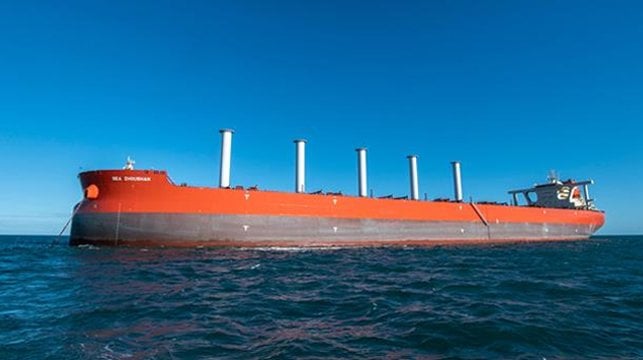
massive Guaibamax ore carrier
Vale plans to build at least two Guaibamax bulkers running on ethanol (Vale)

Published Apr 9, 2026 7:29 PM by The Maritime Executive


Vale reports it has entered into an agreement with China’s Shandong Shipping Corporation to build the first large ocean-going vessels that will use ethanol as their primary fuel. It is an adaptation of its current design for the massive Guaibamax vessels (325,000 dwt) and follows news from earlier this year that reported Vale and Everllence were working on ethanol as a marine fuel for its engines.

According to Vale, the agreement with Shandong includes 25-year contracts for the construction of two vessels, with an option for additional ships. The adoption of these second-generation Guaibamax vessels, which are 340 meters (1,115 feet) long and have a capacity of 325,000 tonnes, is part of the Brazilian mining company’s multi-fuel strategy. In addition to ethanol, these vessels will be capable of using methanol and heavy fuel oil, and their design also allows for conversion to use liquefied natural gas (LNG) or ammonia. 

Shipping companies and the engine manufacturers have reported they are exploring ethanol as an alternative fuel. While there are concerns over supply, it is easier to handle than ammonia, which is toxic and highly corrosive. Maersk reported last December that it was exploring ethanol aboard its pioneering methanol-fueled feeder ship Laura Maersk. Everllence reported in September 2025 that it had success testing ethanol on its large two-stroke engines in the factory. 

“The use of ethanol as fuel in the ships that transport our ore, combined with the adoption of rotor sails to harness wind energy, places Vale in a unique position for the energy transition in global shipping over the coming decades, whilst driving similar initiatives in the sector,” said Rodrigo Bermelho, Vale’s Director of Shipping.

Considering the full fuel cycle from well to wake, Vale highlights that ethanol can reduce carbon emissions by around 90 percent (in the case of second-generation ethanol) compared with heavy fuel oil. In addition to maritime transport, Vale’s adoption of ethanol in its logistics operations includes trials on trucks at its operations and on locomotives on the Vitória a Minas Railway (EFVM). 

The new ethanol-powered ships will be similar to 10 other dual-fuel vessels (methanol and heavy fuel oil) that Shandong will deliver to Vale starting in 2027. The second generation of the Guaibamax will be equipped with five rotor sails to provide wind-assisted propulsion, as well as more efficient engines, hydrodynamic devices, a shaft generator, frequency inverters, and silicone paint, among the energy efficiency improvements. Vale says this set of technologies applied will reduce GHG emissions by around 15 percent compared to the current generation of Guaibamax. These technologies and alternative fuels are being tested as part of Vale’s Ecoshipping program. 

The mining giant had reported in October 2024 that it was proceeding with the installation of rotors on one of its 400,000 dwt vessels. It was part of an agreement with the Japanese owners of the NSU Tubarao and Anemoi Marine. The company also added Norsepower rotors to one of its Capesize bulkers.

Vale’s chartered fleet includes first-generation Valemax vessels since 2011, second-generation Valemax vessels since 2018, and, since 2019, the first generation of Guaibamax. According to the company, these vessels are among the most efficient in the world and can reduce CO2 equivalent emissions by up to 41 percent compared to a standard capesize vessel.   


Exmar’s Pioneering Ammonia Dual-Fuel Gas Carriers Named at Hyundai Shipyard

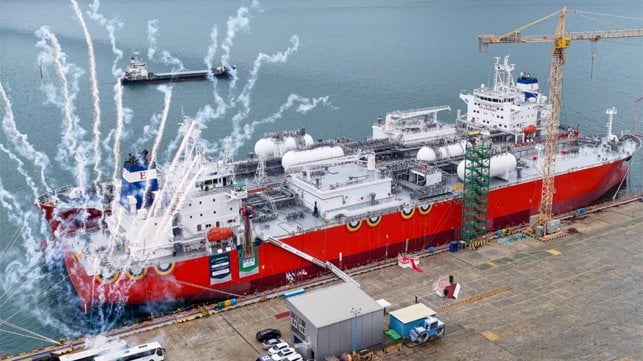
ammonia dual-fuel gas carriers
Pioneering ammonia dual-fuel gas carriers were named ahead of their delivery starting next month (Exmar)

Published Apr 9, 2026 6:47 PM by The Maritime Executive


Two innovative vessels, which are being billed as the world’s first mid-size gas carriers with ammonia dual-fuel engines, were named as they are nearing completion. The vessels, which were ordered in 2023 and 2024 by Exmar, a specialist in gas shipping, are being built at the Ulsan, South Korea, shipyard of HD Hyundai Heavy Industries and are viewed as the cutting edge for a new era in shipping.

The ships, which are each 46,000 cubic meter gas carriers, were named Antwerpen and Arlon in honor of two Belgian cities. Each measures 190 meters (623 feet) in length and is specifically designed for the transport of liquefied gas cargoes, including ammonia and LPG. Exmar highlights that the vessels were deliberately lengthened 10 meters (approximately 33 feet) in the design stage, along with a slight increase in beam to achieve a meaningfully higher cargo intake compared to the standard design. Hyundai developed the proprietary technology and the three tanks, which provide 45,000 cbm storage below deck, and two 500 cbm deck tanks.

HD Hyundai highlights that ammonia (NH3) can be stored in pressurized tanks at around 8 bar or in refrigerated tanks at -33°C without the need for cryogenic technology. In liquid form, it has about 1.7 times higher storage density than liquefied hydrogen (-253°C) at the same volume, making it suitable for large-scale, long-distance transport and storage of hydrogen.

One of the key features of the design is the ability to use cargo as fuel. Exmar says this creates significant operational flexibility and environmental advantages. It reports that the ammonia dual-fuel technology enables CO2 emission reductions of up to 90 percent during navigation.


The mid-sized gas carriers are the first to be outfitted with the ammonia dual-fuel engines (Exmar)


The ships also feature shaft generators and a selective catalytic reduction (SCR) system to reduce nitrogen oxide emissions.

The safety concerns about ammonia were addressed by equipping the vessels with advanced detection and mitigation systems. They have an ammonia gas detector for real-time leak monitoring and an ammonia purge recovery unit. These ships are the first of four being built for Exmar. They are currently completing outfitting and are scheduled for delivery in May and late June.

For HD Hyundai, the vessels represent a significant achievement in its strategy to pursue high-value vessels and new technologies. It highlights the ammonia gas carriers as the next step following its 2016 delivery of the world’s first methanol-powered petrochemical product carrier and the 2023 delivery of the first methanol-powered containership. Designs for the ammonia gas carriers were developed through a partnership involving HD Hyundai, HHI-EMD, Wartsila Gas Solutions, WinGD, Lloyd's Register, and Exmar

While the expectations remain high for ammonia as an alternative maritime fuel, DNV highlights that there are only three ships in the world currently operating with ammonia, two tugs and one offshore supply vessel. However, it calculates that there are currently 46 vessels on order, with as many as 18 scheduled for delivery in 2026 and reaching 46 vessels by 2030.

HD Hyundai highlights the forecast by the International Energy Agency that projects ammonia will account for eight percent of marine fuel demand by 2030. It is projected to rise to 46 percent by 2050. Ammonia is also seen as a likely carrier, as it can be used to transport hydrogen when combined with a cracking process at the destination.


EcoNavis to Validate and Demonstrate Improved Design for Wind Rotors

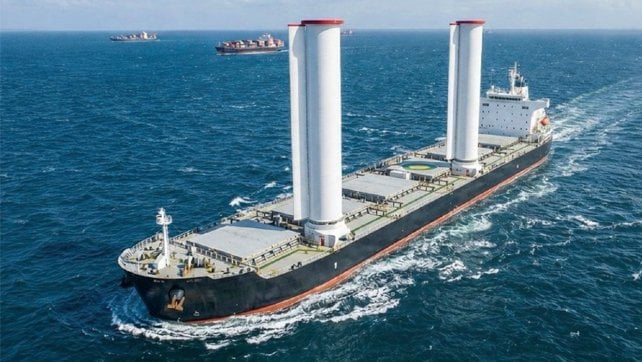
enhancement to wind rotor design
EcoNavis adds an appendage to the rotor to increase its performance and address changes in wind direction (EcoNavis Solutions)

Published Apr 7, 2026 5:57 PM by The Maritime Executive


Scotland-based EcoNavis Solutions believes it has a technological innovation that can enhance the performance of wind rotors. With wind-assisted propulsion gaining increased interest, the company is using a Scottish Enterprise research grant to move its concept from the drawing board to validation and demonstration.

The basic concept of the wind rotor promoted by Anton Flettner in the 1920s remains largely unchanged after more than a century. The spinning rotor captures the energy of the wind to provide additional thrust for ships and has become one of several competing technologies in the sector.

EcoNavis, however, points out that there are limitations to the original technology that impact its reliability. Issues such as a change in wind direction can reduce the effectiveness and also mean that ships require more route planning to maximize the effectiveness of the technology. 

The company has patented a tail-appendage device, which it says can increase thrust, reduce power demand, and widen the range of wind angles in which the rotor sail can operate efficiently. The tail enables the company to essentially broaden the rotor’s effective “wind window” and reshape the wind flow in the rotor’s wake.

It delivers higher thrust with lower torque demand. EcoNavis reports initial simulations indicate an increase in thrust of up to 10 percent with a 5 percent reduction in torque.

“Flettner rotors already offer one of the highest lift-to-drag ratios among wind-assisted devices, with a relatively modest footprint, but the main drawback has been the narrow band of wind angles – typically beam and stern-quarter winds,” said EcoNavis CEO and founder Dr. Batuhan Aktas. “By recovering energy that would otherwise be lost and optimizing the flow behind the rotor, we can provide a Flettner rotor design with a greater operational range.”

The fixed aerodynamic appendage downstream helps to stabilize the airflow behind the rotor. The company says it will permit the rotor to continue to generate thrust as wind conditions change.

By recovering energy that would otherwise be lost and optimizing the flow behind the rotor, EcoNavis believes its EcoRotor Sail can offer greater operational range. It says shipowners can have greater flexibility in route planning and more consistent performance over a typical trading year without fundamental changes to vessel operations.

The next phase will move into physical testing. Development of the EcoRotor Sail is being backed by a £100,000 ($133,000) research grant from Scottish Enterprise to take the £265,000 ($352,000) project through to validation and demonstration stages.


After Ceasefire, Iranian Attacks Cut Saudi Oil Production

Fires at Abqaiq
Fires and smoke near the vast Abqaiq refinery complex, April 8 (Sentinel-2)

Published Apr 9, 2026 8:35 PM by The Maritime Executive


Official Saudi sources have confirmed that recent Iranian attacks caused extensive damage to oil and gas facilities, killing at least one person and leading to a substantial cut in production capacity. Argus Media reports that all of the strikes occurred within the past 48 hours.  

The official Saudi Press Agency detailed out the effects of the drone strikes in an extensive list released Thursday. The most serious issue is yesterday's attack on a pumping station for the East-West Pipeline, which has become a lifeline for moving Saudi crude from the bottled-up Gulf to a secure loading terminal on the Red Sea. It is the largest pipeline carrying GCC crude oil to market, and the strike reduced its throughput by about 700,000 barrels per day, according to SPA. 

Saudi upstream operations have also suffered. An  oil production facility at the Manifa offshore field was hit, cutting output by 300,000 barrels per day, and the Khurais facility as well, cutting another 300,000 bpd (a total production cut of 600,000 bpd). 

In addition, other Iranian strikes hit the giant refinery and petchem complexes operated by Saudi Aramco and foreign partners. The list includes refining sites in Jubail, Ras Tanura, Yanbu and Riyadh - all affecting exports of refined products (though officials did not provide an exact amount). 

In nearby Qatar, one of the world's leading producers of LNG, contractors are beginning intensive work to prepare for the restart of the working liquefaction trains at Ras Laffan. These facilities process the output from Qatar's gigantic North Dome complex and ship it to the world, accounting for about 20 percent of the total global supply of gas traded over the water. Iran's ballistic missiles hit two out of the 14 trains at Ras Laffan, taking them out of commission for up to five years, according to operator QatarEnergy. 

WoodMac assesses that the north half of Ras Laffan could be brought back online within a month. The south side of the site was damaged in an Iranian strike and could take until August to return its surviving four trains to operation, the consultancy said in a research note. It is unclear if QatarEnergy will want to begin restarting production before a permanent truce is agreed between the U.S., Iran and Israel, Wood Mac noted. 

For the region's shut-in oilfields, now totaling some 11 million barrels per day of lost production, the restart timeline could be even longer. Wood Mac predicts a 6-9 month timeline for bringing wells and upstream infrastructure back online, accounting for unforeseen repairs and setbacks during the reactivation process. 

"All this comes with a health warning," said Fraser McKay, Head of Upstream Analysis at Wood Mackenzie. "Operators hastened by regulators and governments to restore production too rapidly, will risk doing more long-term damage to foundational assets."


Opening Hormuz to Be Key Issue of Negotiations as Transits Remain Low

tanker at sea
A Rusian-flagged tanker linked to Iran made the transit, but traffic in the Strait of Hormuz remains very limted

Published Apr 10, 2026 12:48 PM by The Maritime Executive


Three days into the announced ceasefire, the military portion appears to largely be holding, but Donald Trump’s demand that the Strait of Hormuz be open for “complete, immediate, and safe” operations remains elusive. The expectation is that it will be front and center as the U.S. and Iranians start talks in Pakistan this weekend.

Donald Trump again lashed out on social media Thursday evening, calling Iran’s efforts “dishonorable” and saying it was doing “a very poor job” of allowing oil to go through the Strait of Hormuz. He said it was not the agreement, and responding to reports of fees being charged to tankers, Trump wrote, “If they are, they better stop now.” This was after he earlier said maybe the U.S. and Iran might jointly control the Strait and split the fees.

Despite the demands on social media, the reality remains that only a handful of ships have transited for a third day. First reports said it was six ships on Thursday, but Kpler later revised it, saying the total was nine, up from five on April 8. Early expectations and indications of a slight uptick after the announcement of the ceasefire largely did not pan out. 

All the sources agreed it was fewer than 10 ships in the last 24 hours based on AIS transmissions, with NBC reporting it was 19 ships in total since the start of the ceasefire. However, some vessels are still believed to be going dark for the transit, meaning the actual number might be higher, but nowhere near the 100 to 120 vessels a day before the hostilities began.


(Animation from MarineTraffic showing th continued lack of traffic through the Strait of Hormuz)


One notable transit late on Thursday tracked by Bloomberg was the Russian-flagged VLCC Arhimeda. Built in 2000, the 309,497-dwt tanker took on this latest identity and the Russian flag at the start of 2026. It was previously sanctioned by the United States in July 2025 for its involvement with the Iranian oil trade and linked to a sanctioned manager. Bloomberg reports the tanker appears to be heading to Iran’s Kharg to load a cargo.

While U.S. negotiators are expected to demand Iran immediately open the Strait, a top economic advisor to the White House said in interviews on Thursday, there were backup plans. Kevin Hassett, director of the White House’s National Economic Council, admitted that traffic on the route remained “tightly throttled.”

Hassett said they hoped for clarity from the negotiations, but said it could take two months for the oil flow to return to normal levels through the Strait. He also said the Trump administration had a backup plan, while Reuters reported that UK Prime Minister Keir Starmer discussed plans to reopen the Strait with Donald Trump and in meetings with Bahrain and the United Arab Emirates.