Qatar LNG Tankers Make First Move Through Hormuz Since War Began
Two tankers that loaded LNG from Qatar before the war began appear to be attempting to exit the Strait of Hormuz in what could be the first export of Qatari LNG in over a month.
The Al Daayen and the Rasheeda, which took Qatari LNG at the end of February just before the war started, have idled in the Persian Gulf for a month as Iran effectively closed the Strait of Hormuz to vessel traffic after the U.S. and Israel began bombing it on February 28.
Now the two LNG carriers loaded with Qatari gas are moving east toward the opening of the Strait of Hormuz near Oman, Bloomberg reported on Monday, citing vessel-tracking data.
The Al Daayen signals its destination is China, according to data in MarineTraffic. The Rasheeda signals ‘for orders’, but both destinations could change and it’s unclear whether and when the tankers would be able to transit the Strait of Hormuz.
If they succeed, though, these would be the first loaded LNG tankers that have exited the Strait of Hormuz since February 28.
The de facto closure of the Strait of Hormuz has trapped about 20% of daily global LNG flows. In addition, Iranian drone and missile strikes on energy infrastructure in the region has damaged Qatar’s key LNG liquefaction complex Ras Laffan.
Qatar’s state firm QatarEnergy expects the damage to the Ras Laffan LNG complex, the world’s single largest LNG-producing facility, to cost it about $20 billion per year in lost revenue and to take up to five years to repair.
QatarEnergy has been forced to declare force majeure for up to five years on some long-term LNG contracts.
The LNG crunch has sent Asian and European gas prices to the highest levels in three years and stoked fears about rebuilding gas inventories in Europe ahead of the next winter.
By Tsvetana Paraskova for Oilprice.com
Nearly 50 Qatar LNG Tankers Sit Idle Across Asia
Almost 50 liquefied natural gas carriers used by Qatar to export the superchilled fuel are idled in Asia, Bloomberg has reported, citing data from Kpler. All the vessels are empty, the data shows.
The LNG carriers are accumulated in a handful of locations, including West India, Sri Lanka, close to the Strait of Malacca between Indonesia and Malaysia, and offshore Singapore.
LNG carriers typically have a capacity of 170,000 cu m of natural gas, which translates into 72,000 tons of liquefied gas. The Bloomberg report references “more than four dozen” vessels being idled across Asia, meaning a loss of at least 3.456 million tons of LNG in carrier capacity.
Bloomberg notes that globally, there are about 800 LNG carriers in operation. This number is considered insufficient for projected LNG demand, analysts warned before the latest Middle Eastern war. With Qatar’s LNG production suspended as a result of the war, tanker supply should be a less major issue.
Amid the disruption in global LNG trade, China has been reselling record amounts of liquefied gas to other Asian countries, taking advantage of its solid stockpiles and lukewarm demand. In March alone, China resold up to 10 cargoes of LNG—a record-high for any month ever, according to data from energy analytics firms Vortexa, Kpler, and ICIS, as cited by Reuters last week.
Yet the events in the Middle East have started to sap demand for liquefied gas across Asia, as supply tightness pushes prices higher, helped by competition from Europe. Imports of liquefied natural gas into Asian countries fell last month by the sharpest rate since 2020, when pandemic lockdowns decimated energy demand. The total for the month stood at 20.6 million tons, according to Bloomberg, which represented an annual drop of 8.6%. It was the sharpest demand drop since December 2020.
By Irina Slav for Oilprice.com
QatarEnergy’s U.S. LNG Plant Achieves First Production at Critical Time
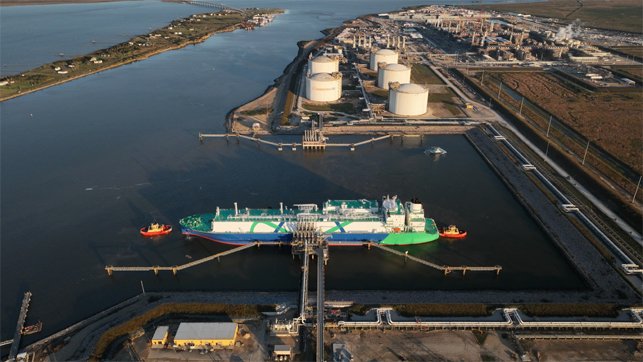
Just as the world is looking for alternative sources of LNG, Golden Pass LNG in Texas reported it has achieved first production. The project, which has been in planning and development for 15 years, is set to start export shipments in the second quarter, coming online to help fill some of the shortfall from Qatar and the Middle East.
The United States is already setting records for LNG shipments and has been rivaling Qatar for the title of the largest producer/exporter. The U.S. Energy Information Administration reported the U.S. was the largest export country in 2025 with over 100 million tons of LNG, further establishing its position after strong exports in 2024. LSGE reports that the U.S. set another new all-time high in March, exporting 11.7 million metric tons, versus the previous record of 11.5 million tons just four months ago.
Global supply fell by as much as 20 percent in March as hostilities with Iran grew. QatarEnergy reported that it had suspended its operations at Ras Laffan after it was struck by the Iranians, and it warned that its operations could be reduced by as much as 12 million metric tons per year for up to five years while it completes repairs. Qatar had expected to pull ahead in the global race as it commissioned its new North Field.
Golden Pass had been in the application and permitting phase from 2012 to 2017. It is a joint venture with Qatar owning 70 percent and ExxonMobil holding the other 30 percent. The two companies made their final investment decision in February 2019, reporting they would invest approximately $10 billion for the development of Golden Pass LNG.
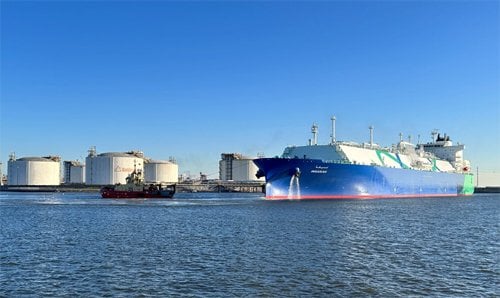
Cool down cargo arrived in December 2025 (Golden Pass)
“Golden Pass LNG is part of a wider QatarEnergy strategy for international investments that we have been planning over the past decade,” said Saad Sherida Al-Kaabi, the Minister of State for Energy Affairs, and the President and CEO of QatarEnergy. “It also represents a significant part of the plans announced by QatarEnergy in 2018 to invest 20 billion dollars in the U.S. energy sector.”
The project had received its cool down cargo in early December aboard one of QatarEnergy’s new LNG carriers. The company is taking delivery on a massive new fleet with its shipping partners after what was billed as the largest shipping building project. The ships are being built in both South Korea and China.
“First LNG is of particular importance for one of the largest single investment decisions in U.S. LNG history,” commented the minister. “The operational phase and market entry of Golden Pass LNG will come at an important time when global energy security ranks very high on energy agendas worldwide.”
The project is located 10 miles south of Port Arthur, Texas, and close to the Louisiana border. The project highlights that it has a unique advantage in its location with a large, deep-water port. EIA notes it has been just 10 years since the U.S. launched Sabine Pass as an LNG export hub.
The first of three trains at the new site is now in production at the Sabine Pass Terminal. The company said it is now focusing on the delivery of its first cargo, achieving sustained liquefaction operations, and moving to meet its commercial and strategic objectives.
When the project is completed, the three trains will have a total capacity of 18.1 million tons per year. It also includes five 155,000 m³ LNG storage tanks and two marine berths. It will be able to accommodate the largest LNG carriers in the world and become one of North America’s largest LNG export terminals.

No comments:
Post a Comment